
Jeremiah 39:5

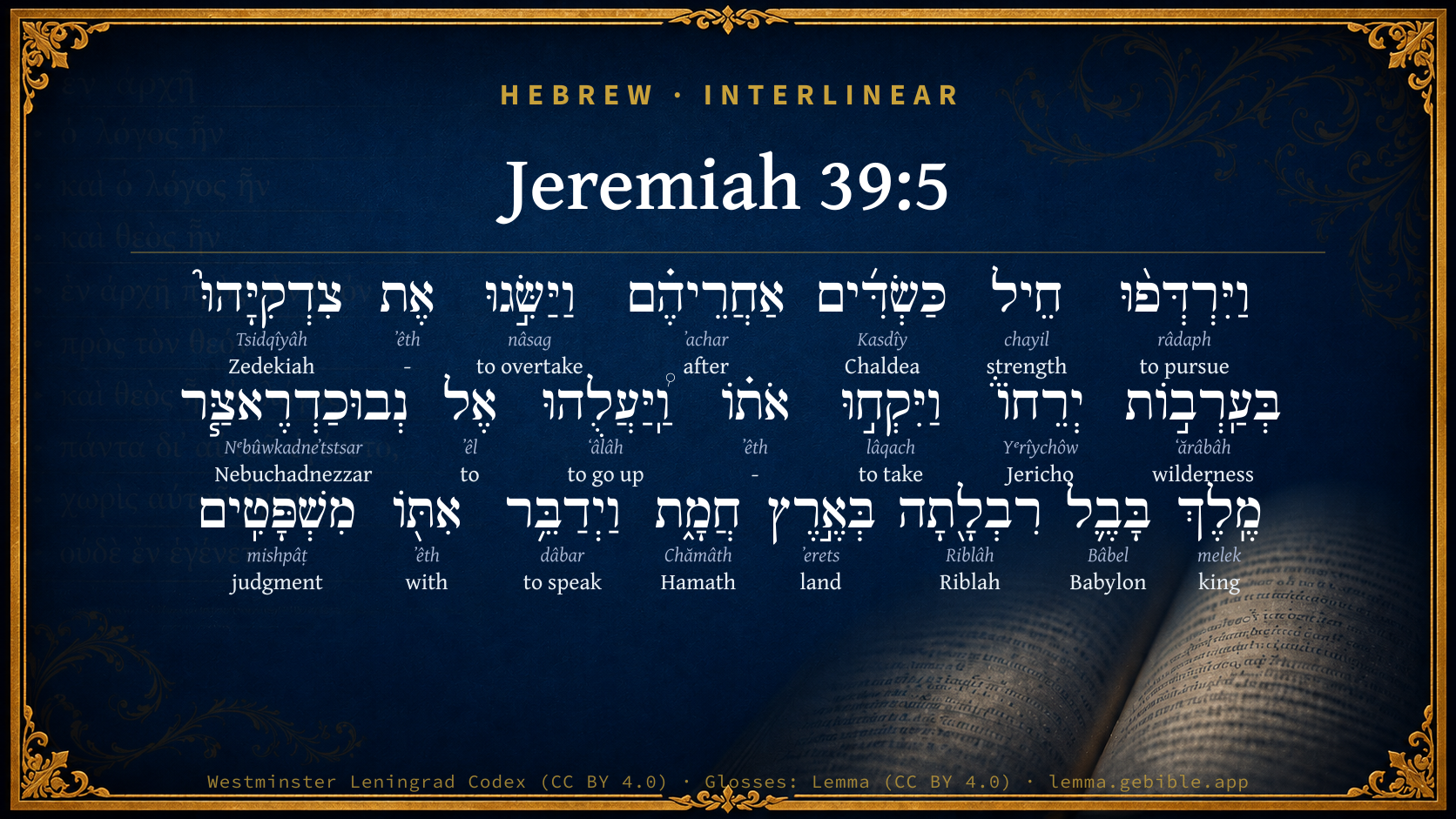
Hebrew (Westminster Leningrad Codex) Jeremiah 39:5 appears in the Hebrew Old Testament. The text above is from the Westminster Leningrad Codex. Each word links to its Strong’s number, a concise gloss, and parsing drawn from the Open Scriptures Hebrew Bible morphology. Click any word for its full Brown-Driver-Briggs (BDB) entry.
Download image
Cite this verse

Jeremiah 39:5 (World English Bible). Public Domain. Lemma interlinear Bible study tool, https://lemma.gebible.app/v/jeremiah/39/5.

Show BibTeX & RIS
BibTeX
RIS
English Translation
But the army of the Chaldeans pursued after them, and overtook Zedekiah in the plains of Jericho: and when they had taken him, they brought him up to Nebuchadrezzar king of Babylon to Riblah in the land of Hamath; and he gave judgment on him.
World English Bible · Public Domain
Download a study sheet

One document with this verse’s original text, its word-by-word gloss line, the meaning frame, cross-references with their text, attributed commentary, and full source and license credits — printable, and it pastes into notes with its structure intact.

This verse Autodidact and up

Study sheet (.html) Plain text (.txt)

A passage Seminary Student

Up to 50 verses in one chapter. A passage sheet keeps up to 6 commentary sources and 12 cross-references per verse, in the order this page ranks them, and says so on the sheet whenever that leaves anything out. Ask for a single verse and you get the Autodidact verse sheet above.

Everything on this page stays free to read, with no account — the sheet is a download of what is already on screen, not access to it.

Want to remove ads? Support Godless Engineer
Compare translations 3

The same verse in 3 English versions, stacked beneath the original-language interlinear above. Click any original word for its lexicon entry.

Each is an independent rendering of the whole verse — the interlinear is not word-aligned to these translations.

Highlighted words mark where these versions differ — a whole-verse word diff, not a word-by-word alignment.

  • World English Bible Public Domain
    But the army of the Chaldeans pursued after them, and overtook Zedekiah in the plains of Jericho: and when they had taken him, they brought him up to Nebuchadrezzar king of Babylon to Riblah in the land of Hamath; and he gave judgment on him.
  • King James Version Public Domain
    But the Chaldeans' army pursued after them, and overtook Zedekiah in the plains of Jericho: and when they had taken him, they brought him up to Nebuchadnezzar king of Babylon to Riblah in the land of Hamath, where he gave judgment upon him.
  • unfoldingWord Literal Text CC BY-SA 4.0
    But the army of Chaldeans pursued them and overtook Zedekiah in the plains of the Jordan River valley near Jericho. Then they captured him and brought him up to Nebuchadnezzar, king of Babylon, at Riblah in the land of Hamath, where Nebuchadnezzar passed sentence on him.

unfoldingWord Literal Text — © unfoldingWord, licensed CC BY-SA 4.0. Word-aligned USFM3 via Door43 (git.door43.org/unfoldingWord/en_ult).

Versions to compare (up to 4)

3 of 4 selected

Show all 18 translations

Every available English version of this verse, each an independent rendering of the whole verse.

  • World English Bible Public Domain
    But the army of the Chaldeans pursued after them, and overtook Zedekiah in the plains of Jericho: and when they had taken him, they brought him up to Nebuchadrezzar king of Babylon to Riblah in the land of Hamath; and he gave judgment on him.
  • Berean Standard Bible Public Domain
    But the army of the Chaldeans pursued them and overtook Zedekiah in the plains of Jericho. They seized him and brought him up to Nebuchadnezzar king of Babylon at Riblah in the land of Hamath, where he pronounced judgment on him.
  • Majority Standard Bible Public Domain
    But the army of the Chaldeans pursued them and overtook Zedekiah in the plains of Jericho. They seized him and brought him up to Nebuchadnezzar king of Babylon at Riblah in the land of Hamath, where he pronounced judgment on him.
  • King James Version Public Domain
    But the Chaldeans' army pursued after them, and overtook Zedekiah in the plains of Jericho: and when they had taken him, they brought him up to Nebuchadnezzar king of Babylon to Riblah in the land of Hamath, where he gave judgment upon him.
  • American Standard Version (1901) Public Domain
    But the army of the Chaldeans pursued after them, and overtook Zedekiah in the plains of Jericho: and when they had taken him, they brought him up to Nebuchadrezzar king of Babylon to Riblah in the land of Hamath; and he gave judgment upon him.
  • Revised Version (1885) Public Domain
    But the army of the Chaldeans pursued after them, and overtook Zedekiah in the plains of Jericho: and when they had taken him, they brought him up to Nebuchadrezzar king of Babylon to Riblah in the land of Hamath, and he gave judgment upon him.
  • Geneva Bible (1599) Public Domain
    But the Caldeans hoste pursued after them, and ouertooke Zedekiah in the desart of Iericho: and when they had taken him, they brought him to Nebuchad-nezzar King of Babel vnto Riblah in the land of Hamath, where he gaue iudgement vpon him.
  • Douay-Rheims (1899) Public Domain
    But the army of the Chaldeans pursued after them: and they took Sedecias in the plain of the desert of Jericho, and when they had taken him, they brought him to Nabuchodonosor king of Babylon to Reblatha, which is in the land of Emath: and he gave judgment upon him.
  • Young's Literal Translation Public Domain
    And the forces of the Chaldeans pursue after them, and overtake Zedekiah in the plains of Jericho, and they take him, and bring him up unto Nebuchadnezzar king of Babylon, to Riblah, in the land of Hamath, and he speaketh with him -- judgments.
  • Literal Standard Version CC BY-SA 4.0
    And the forces of the Chaldeans pursue after them, and overtake Zedekiah in the plains of Jericho, and they take him, and bring him up to Nebuchadnezzar king of Babylon, to Riblah, in the land of Hamath, and he speaks with him—judgments.
  • Unlocked Literal Bible CC BY-SA 4.0
    But the army of Chaldeans pursued them and overtook Zedekiah in the plains of the Jordan River valley near Jericho. Then they captured him and brought him up to Nebuchadnezzar, king of Babylon, at Riblah in the land of Hamath, where Nebuchadnezzar passed sentence on him.
  • unfoldingWord Literal Text CC BY-SA 4.0
    But the army of Chaldeans pursued them and overtook Zedekiah in the plains of the Jordan River valley near Jericho. Then they captured him and brought him up to Nebuchadnezzar, king of Babylon, at Riblah in the land of Hamath, where Nebuchadnezzar passed sentence on him.
  • Darby Bible Public Domain
    And the army of the Chaldeans pursued after them, and overtook Zedekiah in the plains of Jericho; and they took him, and brought him up to Nebuchadnezzar king of Babylon, unto Riblah in the land of Hamath; and he pronounced judgment upon him.
  • World Messianic Bible Public Domain
    But the army of the Kasdim pursued them, and overtook Zedekiah in the plains of Jericho. When they had taken him, they brought him up to Nebuchadnezzar king of Babylon to Riblah in the land of Hamath; and he pronounced judgment on him.
  • Webster's Bible Public Domain
    But the Chaldeans' army pursued them, and overtook Zedekiah in the plains of Jericho: and when they had taken him, they brought him to Nebuchadnezzar king of Babylon to Riblah in the land of Hamath, where he gave judgment upon him.
  • Free Bible Version CC BY-SA 4.0
    But the Babylonian army chased after them and caught up with Zedekiah in the plains of Jericho. They captured him and brought him before Nebuchadnezzar king of Babylon at Riblah in the land of Hamath, where he put him on trial and punished him.
  • Bible in Basic English Public Domain
    But the Chaldaean army went after them and overtook Zedekiah in the lowlands of Jericho: and they made him a prisoner and took him up to Nebuchadrezzar, king of Babylon, to Riblah in the land of Hamath, to be judged by him.
  • JPS Tanakh (1917) Public Domain
    But the army of the Chaldeans pursued after them, and overtook Zedekiah in the plains of Jericho; and when they had taken him, they brought him up to Nebuchadrezzar king of Babylon to Riblah in the land of Hamath, and he gave judgment upon him.

Literal Standard Version (2020), Covenant Press — licensed CC BY-SA 4.0. Text via the HelloAO Bible API (eBible.org). Unlocked Literal Bible (unfoldingWord) — licensed CC BY-SA 4.0. Text via the HelloAO Bible API (eBible.org). unfoldingWord Literal Text — © unfoldingWord, licensed CC BY-SA 4.0. Word-aligned USFM3 via Door43 (git.door43.org/unfoldingWord/en_ult). Free Bible Version, Dr. Jonathan Gallagher — licensed CC BY-SA 4.0. Text via the HelloAO Bible API (eBible.org).

Word by word

More ways to search: Search by grammar → Find every occurrence → Compare this word →

Practice this passage: Drill this verse → Learn its vocabulary →

רִבְלָ֖תָה
Riblâh
H7247
“Riblah · toward”
Noun, Proper + Suffix, Demonstrative
Part of Speech
Noun
Type
Proper
Full BDB Definition

Origin: from an unused root meaning to be fruitful

TWOT: None

Riblah = "fertility" - a place on the eastern boundary of Israel - a town in the land of Hamath on the great road between Babylon and Palestine
  1. וַיִּרְדְּפ֨וּ râdaph H7291 “and · to pursue” Conjunction + Verb, Qal, Sequential Imperfect, 3rd Person, Masculine, Plural
  2. חֵיל chayil H2428 “strength of” Noun, Common, Masculine, Singular, Construct
  3. כַּשְׂדִּ֜ים Kasdîy H3778 “Chaldea” Noun, Proper
  4. אַחֲרֵיהֶ֗ם ʼachar H310 “after · them” Preposition + Suffix, Personal, 3rd Person, Masculine, Plural
  5. וַיַּשִּׂ֣גוּ nâsag H5381 “and · to overtake” Conjunction + Verb, Hiphil, Sequential Imperfect, 3rd Person, Masculine, Plural
  6. אֶת ʼêth H853 “-” Particle, Direct Object
  7. צִדְקִיָּהוּ֮ Tsidqîyâh H6667 “Zedekiah” Noun, Proper
  8. בְּעַֽרְב֣וֹת ʻărâbâh H6160 “in/at · wildernesses of” Preposition + Noun, Common, Feminine, Plural, Construct
  9. יְרֵחוֹ֒ Yᵉrîychôw H3405 “Jericho” Noun, Proper
  10. וַיִּקְח֣וּ lâqach H3947 “and · to take” Conjunction + Verb, Qal, Sequential Imperfect, 3rd Person, Masculine, Plural
  11. אֹת֗וֹ ʼêth H853 “- · him” Particle, Direct Object + Suffix, Personal, 3rd Person, Masculine, Singular
  12. וַֽ֠יַּעֲלֻהוּ ʻâlâh H5927 “and · to go up · him” Conjunction + Verb, Hiphil, Sequential Imperfect, 3rd Person, Masculine, Plural + Suffix, Personal, 3rd Person, Masculine, Singular
  13. אֶל ʼêl H413 “to” Preposition
  14. נְבוּכַדְרֶאצַּ֧ר Nᵉbûwkadneʼtstsar H5019 “Nebuchadnezzar” Noun, Proper
  15. מֶֽלֶךְ melek H4428 “king of” Noun, Common, Masculine, Singular, Construct
  16. בָּבֶ֛ל Bâbel H894 “Babylon” Noun, Proper
  17. בְּאֶ֣רֶץ ʼerets H776 “in/at · land of” Preposition + Noun, Common, Both, Singular, Construct
  18. חֲמָ֑ת Chămâth H2574 “Hamath” Noun, Proper
  19. וַיְדַבֵּ֥ר dâbar H1696 “and · to speak” Conjunction + Verb, Piel, Sequential Imperfect, 3rd Person, Masculine, Singular
  20. אִתּ֖וֹ ʼêth H854 “with · him” Preposition + Suffix, Personal, 3rd Person, Masculine, Singular
  21. מִשְׁפָּטִֽים mishpâṭ H4941 “judgments” Noun, Common, Masculine, Plural, Absolute

About this verse

These counts appear in no published source. They are computed here, from the morphology-tagged text and Lemma’s own curated glosses. What Lemma adds →

22
words
21
distinct lemmas
Prophets
section

Notable vocabulary

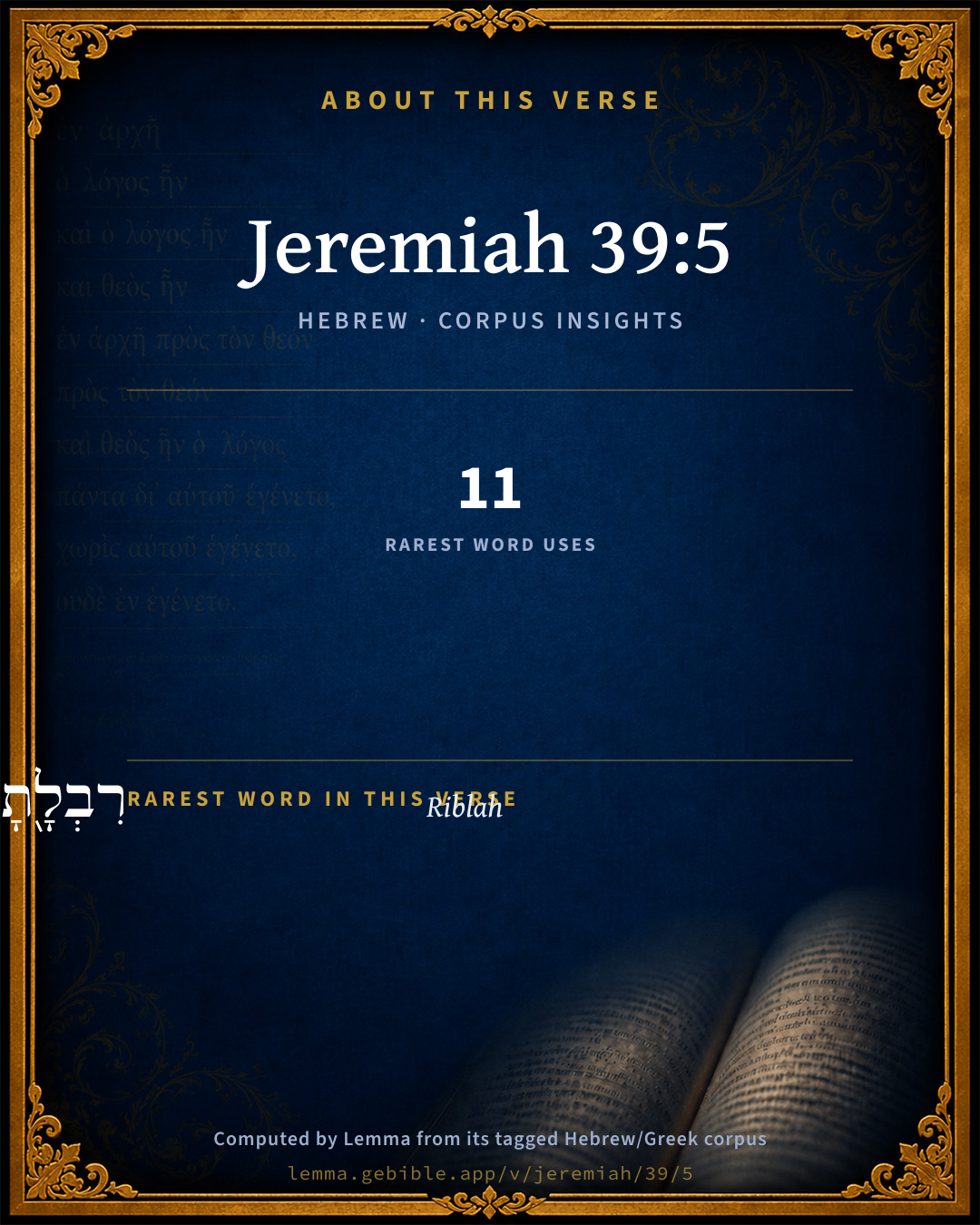
The rarest word here is רִבְלָ֖תָה Riblah H7247 — appearing just 11 times in the whole Hebrew Bible.

Shared distinctive vocabulary

רִבְלָ֖תָה Riblah H7247 occurs in 11 verses of the Hebrew Bible. Also found in:

Grammatical profile

  • 5 verbs
  • 12 nouns
  • 3 prepositions
  • 2 particles

Verb forms

  • וַיִּרְדְּפ֨וּ Qal · Sequential Imperfect
  • וַיַּשִּׂ֣גוּ Hiphil · Sequential Imperfect
  • וַיִּקְח֣וּ Qal · Sequential Imperfect
  • וַֽ֠יַּעֲלֻהוּ Hiphil · Sequential Imperfect
  • וַיְדַבֵּ֥ר Piel · Sequential Imperfect

Cross-references

19

Topical passages linked to Jeremiah 39:5 in the Treasury of Scripture Knowledge — connected by theme and wording, ordered by reader-vote popularity; previews shown in the World English Bible.

  • 2 Kings 23:33 Pharaoh Necoh put him in bonds at Riblah in the land of Hamath, that he might not reign in Jerusalem; and put the land to a tribute of one hundred talents of silver, and a talent of gold.
  • Joshua 5:10 The children of Israel encamped in Gilgal; and they kept the Passover on the fourteenth day of the month at even in the plains of Jericho.
  • Joshua 4:13 about forty thousand ready armed for war passed over before Yahweh to battle, to the plains of Jericho.
  • Jeremiah 32:4–5 and Zedekiah king of Judah shall not escape out of the hand of the Chaldeans, but shall surely be delivered into the hand of the king of Babylon, and shall speak with him mouth to mouth, and his eyes shall see his eyes;
  • Jeremiah 38:18 But if you will not go forth to the king of Babylon's princes, then shall this city be given into the hand of the Chaldeans, and they shall burn it with fire, and you shall not escape out of their hand.
  • Jeremiah 38:23 They shall bring out all your wives and your children to the Chaldeans; and you shall not escape out of their hand, but shall be taken by the hand of the king of Babylon: and you shall cause this city to be burned with fire.
  • Jeremiah 52:8–9 But the army of the Chaldeans pursued after the king, and overtook Zedekiah in the plains of Jericho; and all his army was scattered from him.
  • Jeremiah 52:26–27 Nebuzaradan the captain of the guard took them, and brought them to the king of Babylon to Riblah.
  • Numbers 13:21 So they went up, and spied out the land from the wilderness of Zin to Rehob, to the entrance of Hamath.
  • Joshua 13:5 and the land of the Gebalites, and all Lebanon, toward the sunrise, from Baal Gad under Mount Hermon to the entrance of Hamath;
  • Judges 3:3 [namely], the five lords of the Philistines, and all the Canaanites, and the Sidonians, and the Hivites who lived on Mount Lebanon, from Mount Baal Hermon to the entrance of Hamath.
  • 2 Samuel 8:9 When Toi king of Hamath heard that David had struck all the host of Hadadezer,
  • 2 Kings 17:24 The king of Assyria brought men from Babylon, and from Cuthah, and from Avva, and from Hamath and Sepharvaim, and placed them in the cities of Samaria instead of the children of Israel; and they possessed Samaria, and lived in the cities of it.
  • 2 Kings 25:6 Then they took the king, and carried him up to the king of Babylon to Riblah; and they gave judgment on him.
  • 2 Chronicles 33:11 Therefore Yahweh brought on them the captains of the host of the king of Assyria, who took Manasseh in chains, and bound him with fetters, and carried him to Babylon.
  • Jeremiah 4:12 a full wind from these shall come for me: now will I also utter judgments against them.
  • Lamentations 1:3 Judah is gone into captivity because of affliction, and because of great servitude; She dwells among the nations, she finds no rest: All her persecutors overtook her within the straits.
  • Lamentations 4:20 The breath of our nostrils, the anointed of Yahweh, was taken in their pits; Of whom we said, Under his shadow we shall live among the nations.
  • Ezekiel 17:15–21 But he rebelled against him in sending his ambassadors into Egypt, that they might give him horses and much people. Shall he prosper? shall he escape who does such things? shall he break the covenant, and yet escape?

Cross-references courtesy of OpenBible.info (CC BY 4.0).

Hebrew and Greek witnesses Masoretic Hebrew ↔ Greek Septuagint

The same verse in the two great witnesses to the Old Testament, shown verse-for-verse.

These are two independent witnesses, not word-aligned to each other, and the Septuagint is shown in lemma (dictionary) form.

Hebrew Jeremiah 39:5 Masoretic · Westminster Leningrad Codex

וַיִּרְדְּפ֨וּ חֵיל כַּשְׂדִּ֜ים אַחֲרֵיהֶ֗ם וַיַּשִּׂ֣גוּ אֶת צִדְקִיָּהוּ֮ בְּעַֽרְב֣וֹת יְרֵחוֹ֒ וַיִּקְח֣וּ אֹת֗וֹ וַֽ֠יַּעֲלֻהוּ אֶל נְבוּכַדְרֶאצַּ֧ר מֶֽלֶךְ בָּבֶ֛ל רִבְלָ֖תָה בְּאֶ֣רֶץ חֲמָ֑ת וַיְדַבֵּ֥ר אִתּ֖וֹ מִשְׁפָּטִֽים

But the army of the Chaldeans pursued after them, and overtook Zedekiah in the plains of Jericho: and when they had taken him, they brought him up to Nebuchadrezzar king of Babylon to Riblah in the land of Hamath; and he gave judgment on him.

World English Bible · Public Domain

Greek LXX Structure differs

In the Septuagint, Jeremiah is about an eighth shorter than the Hebrew and arranges its material differently — the Oracles Against the Nations (Hebrew chapters 46–51) appear in the middle of the Greek book, after 25:13. Because the chapter and verse boundaries do not line up, a verse-for-verse comparison with the Hebrew is not shown.

A verse-for-verse comparison isn’t shown here because the chapters and verses don’t line up. Switch to the LXX edition with the MT / LXX toggle above to read the Greek directly.

Hebrew: Westminster Leningrad Codex (CC BY 4.0). Greek: Septuagint (public domain); English from a public-domain English Septuagint. How the Septuagint differs from the Hebrew →

Targum (Aramaic paraphrase)

1

The Targum is the ancient Jewish Aramaic paraphrase of the Hebrew Scriptures — an interpretive translation, not the Hebrew text itself. Onkelos (literal) and Pseudo-Jonathan (expansive) render the Torah, and Jonathan the Prophets. Coverage is partial: where no permissively-licensed English translation exists for a verse, only the Aramaic is shown. This is verse-level text, not a word-by-word alignment to the Hebrew.

  1. Targum Jonathan Prophets (Joshua–Malachi)
    וּרְדָפָא מַשִׁירְיַת כַּסְדָאֵי בַּתְרֵיהוֹן וְאַדְבִּיקוּ יַת צִדְקִיָה בְּמֵישְׁרֵי יְרִיחוֹ וּדְבָרוּ יָתֵיהּ וְאַסְקוּהִי לְוַת נְבוּכַדְרֶאצַר מַלְכָּא דְבָבֶל לְרִבְלַת בְּאַרְעָא דַחֲמָת וּמַלֵיל עִמֵיהּ פִּתְגָמֵי דִינִין:

    (no public-domain English translation for this verse)

    Targum Jonathan — Aramaic: “Mikraot Gedolot” (public domain). English: “Sefaria Community Translation” (CC0 1.0 (public-domain dedication)); “London "Chaldee Paraphrase," 1871” (public domain). Text via Sefaria.

Commentary

Notes on Jeremiah 39:5 from classic Christian and Jewish commentators (each source and its license shown beneath its notes). The classic Christian expositions comment on the surrounding passage and are grouped to its opening verse, so a note may address several verses; the Jewish commentaries on the Tanakh (Rashi and others) are per-verse, so they appear only where the commentator wrote on this verse.

Lemma curates 59 commentaries, every one of them public domain or Creative Commons licensed, each selected and text-cleaned for this edition rather than reprinted as found. About our sources →

Trapp's Complete Commentary

John Trapp

Jer 39:5 But the Chaldeans’ army pursued after them, and overtook Zedekiah in the plains of Jericho: and when they had taken him, they brought him up to Nebuchadnezzar king of Babylon to Riblah in the land of Hamath, where he gave judgment upon him.

Ver. 5. But the Chaldeans pursued.] See on 2Ki 25:5.

John Trapp, A Commentary or Exposition upon All the Books of the Old and New Testament (1647–1656) — public domain. Text from a community e-Sword module.

Tyndale Open Study Notes

Tyndale Open Resources

39:5 Zedekiah and his royal party fled on foot, so it was not difficult for strong and healthy soldiers to capture the group near Jericho. The enemy troops then forced their captives to walk more than 200 miles north to Riblah, where King Nebuchadnezzar had his field headquarters.

Tyndale Open Study Notes — © Tyndale Open Resources, licensed CC BY-SA 4.0. Text via the HelloAO Bible API.

Geneva Bible (1599)

Geneva Bible translators

Which is called Antioch in Syria.

Geneva Bible (1599) marginal notes — public domain. Text via Bolls.life.

Jamieson, Fausset & Brown

Robert Jamieson, A. R. Fausset & David Brown

Riblah--north of Palestine (see Jer 1:14; Num 34:11). Hamath is identified by commentators with Antioch, in Syria, on the Orontes, called Epiphania, from Antiochus Epiphanes.

gave judgment upon him--literally, "spake judgments with him," that is, brought him to trial as a common criminal, not as a king. He had violated his oath (Eze 17:13-19; Ch2 36:13).

Jamieson, Fausset & Brown — Commentary Critical and Explanatory on the Whole Bible (1871) — public domain (CC PDM 1.0). Text via the HelloAO Bible API.

Adam Clarke's Commentary

Verse 5. To Riblah] This city was situated on the northern frontier of Palestine, and Hamath was a large city belonging also to Syria. See Ge 10:18.

Adam Clarke's Commentary on the Bible (1810–1826) — public domain. Text from a community e-Sword/MySword module.

John Calvin's Commentaries

The Chaldeans pursued the fugitive king, no doubt, through a hidden impulse from above. It is, indeed, probable that he was betrayed by his own people; and this often happens in a disturbed state of things; but however, he might have escaped, had he not been given up by the hand of God. These things are therefore narrated, that we may know that the ungodly, by their evasions, gain no other thing than really to acknowledge that God is true ill his threatenings as well as in his promises. They believe not his word, it is therefore necessary that they should be convinced by actual experience. Zedekiah then is here set before us as an example, so that we may know that as soon as God announces any calamity, we ought to tremble and to humble ourselves under his mighty hand, for he holds us on every side completely shut up, so that if hiding places and refuges be open before us, they can yet avail us nothing.

The Prophet then tells us, that he was taken in the deserts of Jericho This circumstance also is important, for he had gone forth beyond the sight of men, even into solitude; for that plain was not so fruitful as to support many inhabitants, but it was as it were a desert. It is then a wonder how the Chaldeans found him in that solitude, but they had God, as it were, as their guide. Hence then it was, that Zedekiah fell into the hands of the Chaldean army. The Prophet adds, that they brought him into Riblah, which is thought to have been Antioch. It is also called Hemath; but this name designated the country and not the city. And yet in Amos 6:2, it means the city, when it is said,

“Go to Calneh, go to Hemath the great.”

But it may be, that the dignity of the city was the reason why the country was so called; and no doubt Pliny, in his fifth book, calls that part of Syria Antiochean; and as to what he says shortly before, that Antioch was that part of Syria toward Cilicia, that place seems to me to have been corrupted. I rather read thus, that it was a part of Syria, for, as I have said, he calls it Antiochean. And it was not unsuitable that the city should be called Hemath and Riblah, and that the name of the city should be given to the country. Interpreters indeed agree, that Riblah was Antioch. Jerome says, that in his day, the first station towards Chaldea still retained its ancient name, though, by changing some letters, they called it Emmaus. But he doubts not but it was Antioch, which was formerly called Epidaphne, and had also the name of Hemath. There then Zedekiah was brought to Nebuchadnezzar, who spoke judgments with him, that is, who brought him as a criminal before his tribunal, that he might pronounce sentence upon him; for to speak judgments means the same as to minister justice or to pass judgment.

Now this was very inconsistent with royal dignity, for though, as a conqueror, he was angry with his enemy, he might yet have been content with his death alone. Kings are not wont to deal in this way with kings, for they respect themselves, and are not disposed to degrade royal dignity. But Jeremiah says, that Zedekiah was by no means dealt with royally; for he was constrained to plead guilty, and was condemned by a solemn sentence. Then to speak judgments is the same as what we call in French former proces criminel. And this indignity increased the weight of his calamity and his punishment; for Zedekiah not only had to bear many reproaches, while the king of Babylon expostu-lated with him, but he was also brought to judgment, so that punishment, according to the common practice, was allotted to him. For Nebuchadnezzar had made him king, and imposed tribute on him. He therefore condemned him as guilty of perfidy and perjury. This is the degradation which the Prophet points out, when he says, that he spoke judgments with him, or acted towards him judicially; and he repeats the same expression in the last chapter. It follows —

John Calvin's Commentaries (1540-1563) — public domain. Text from the Calvin Translation Society English edition (1840s-50s) via the Christian Classics Ethereal Library (ccel.org). Calvin's coverage is partial (roughly two-thirds of the Bible); uncommented books and verses are honest gaps, never fabricated. The 19th-century editor's footnotes and remarks are omitted so the notes are faithfully Calvin's own voice.

Ellicott's Commentary for English Readers

(5) In the plains of Jericho.—Here again we have the distinctive word, the Araboth of the Jordan, the enlargement of the Jordan valley, three miles wide, near Jericho. The intention of the king was apparently to make his way to the ford near Jericho, cross the river, and escape to the open country of Gilead.

Riblah in the land of Hamath.—The city of Hamath stood on the Orontes, about half-way from its source, near Baalbek, to the bend which it makes at Jisr-hadid, and commanded the whole valley of the river to the defile of Daphne, below Antioch. It was a well-known city at the time of the Exodus (Num_13:21; Num_34:8), and in that of David was the capital of a kingdom, which became tributary to him and Solomon (2Sa_8:10; 1Ki_4:21-24). Riblah (still retaining its name, Ribleh), also on the Orontes, and near its source, was a centre from which the great lines of traffic led by the Euphrates to Nineveh, by Palmyra to Babylon, by Lebanon and the coast to Palestine and Egypt, and through the Jordan valley to the Holy Land. It was, therefore, a natural post of observation for the Chaldæan king while his generals were carrying on the sieges of Tyre and Jerusalem. So when Pharaoh-necho was for a time, before the battle of Carchemish, master of the Assyrian territory, it was to Riblah that he summoned Jehoahaz, and there imprisoned him (2Ki_23:33). In this instance Zedekiah was brought before Nebuchadnezzar as a vassal prince who, having received his authority from the Chaldæan king (2Ki_24:17), had rebelled, and met with scant mercy.

A Bible Commentary for English Readers, edited by Charles John Ellicott (1878–1897) — public domain. Text from a community e-Sword module.

The Cambridge Bible for Schools and Colleges

gen. ed. J. J. S. Perowne

5. the plains of Jericho] the W. side of the Arabah.

Riblah] (Ribleh) between the mountain ranges of Lebanon and Hermon. It was a suitable halting-place for Nebuchadnezzar, as being on the high road between Babylon and Palestine and lying “on the banks of a mountain stream in the midst of a vast and fertile plain yielding the most abundant supplies of forage.” Robinson’s Bible Researches, III. 545.

gave judgement upon him] lit. spake judgements with him. See on ch. Jer_1:16.

The Cambridge Bible for Schools and Colleges (gen. ed. J. J. S. Perowne; Cambridge University Press, 1878–1918) — public domain. Text from a community e-Sword module.

John Gill's Exposition

But the Chaldean army pursued after them,.... Being informed of the flight of them, by those who surrendered to them, as Josephus says; or not finding the king, his family, nobles, and guards, at the palace, where they expected them; and, knowing which way they must take, pursued after them; not the whole army, only a part of it; for some must remain at Jerusalem to demolish the city, and take the spoil of it:

and overtook Zedekiah in the plains of Jericho; not far from it, as Josephus says; and who also observes, that when his friends and generals saw the enemy near, they left him, and shifted for themselves, and only a few were with him when overtook:

and when they had taken him they brought him to Nebuchadnezzar king of Babylon to Riblah in the land of Hamath: which is generally thought to be Antioch in Syria; whither he had retired from the siege of Jerusalem, having left it to his generals to refresh himself in this pleasant place, as it seems it was; or that he might be nearer his own kingdom, if any troubles should arise in it during his absence; however, here he was, and here the army brought Zedekiah to him, and those they took with him; which must be very agreeable to the king of Babylon to have this perfidious and ungrateful prince in his power:

where he gave judgment upon him: or passed sentence on him, which was to have his eyes put out: or, "spake judgments with him" (i); he severely chide him, and upbraided him for the injury he had done him; the perfidy he had been guilty of in breaking his oath and covenant. So Josephus says,

"after he came to him, Nebuchadnezzar began to call him a wicked man and a covenant breaker, unmindful of promises he had made to preserve the country for him; he reproached him with ingratitude, in receiving the kingdom from him he had taken from Jehoiakim, and given to him, who had used his power against the giver; but, says he, the great God that hates thy manners has put thee into our hands.''

(i) "et locutus est cum eo, vel ipso judicia", Pagninus, Montanus, Cocceius, Schmidt.

John Gill's Exposition of the Whole Bible (1746–1763) — public domain (CC PDM 1.0). Text via the HelloAO Bible API.

Haydock's Catholic Bible Commentary

In the land, or environs of Emesa, in Syria. (Theodoret) --- Judgment. Reproaching him with perfidy and ingratitude. (Worthington) --- He slew the nobles, as his accomplices.

George Leo Haydock (1774–1849), Haydock's Catholic Family Bible and Commentary, 1859 edition — public domain. Excludes Psalms (Douay-Rheims chapter numbering differs from Protestant) and Deuterocanonical books (Catholic canon only).

Matthew Poole's English Annotations

Thus God by his providence fulfilled his threatening by his prophet Ezekiel, Eze 17:12. Riblah was upon the borders of Canaan, as appeareth from Num 34:11; it was in the land of Hamath, of which we read 2Ki 17:24, being one of those provinces in the dominion of the king of Assyria, from whence he brought men to place them in the land of Israel after that he had conquered the ten tribes. It is not usual for princes upon conquests to sit in judgment upon princes conquered, but the reason of it in this case was because Zedekiah was a tributary to the king of Babylon, and so subject to his power, having made a covenant with him, and secured his allegiance by his oath to him, and then rebelled against him, as we read, Eze 17:13-18.

Matthew Poole's English Annotations on the Holy Bible (1683–1685) — public domain. Text from a community e-Sword/MySword module.

Whedon's Commentary on the Bible

Daniel D. Whedon

5. Riblah is situated on the right bank of the Orontes, on the great road between Baalbec and Hums, about thirty-five miles from the former place.

It is fully identified and bears its original name. Dr. Robinson points out the advantages of this locality as a place of encampment for a great army.

“From this point the roads were open by Aleppo and the Euphrates to Nineveh, or by Palmyra to Babylon… by the end of Lebanon and the coast to Palestine and Egypt, or through the Bukaa and the Jordan valley to the centre of the Holy Land.”

Gave judgment — Compare Jer_1:16.

Daniel D. Whedon (gen. ed.), Commentary on the Old and New Testaments (1874–1909) — public domain. Text from a community e-Sword module.

John Wesley's Explanatory Notes

Riblah - Riblah was upon the borders of Canaan. Zedekiah was a tributary to the king of Babylon, and so subject to his power, having made a covenant with him, and secured his allegiance by his oath to him.

John Wesley, Explanatory Notes Upon the Whole Bible (1754–1765) — public domain. Text via the GEBible commentary corpus.

Rashi

Rabbi Shlomo Yitzchaki (Rashi)

he called him to account Why did you transgress the oath?

Rashi on the Tanakh — English translations: “The Judaica Press complete Tanach with Rashi, translated by A. J. Rosenberg” (CC BY 4.0); “Pentateuch with Rashi's commentary by M. Rosenbaum and A.M. Silbermann, 1929-1934” (public domain); “The Metsudah Tanach series, Lakewood, N.J” (CC BY 4.0); and “The Book of Joshua, Metsudah Publications, 1997” (CC BY 4.0). Text via Sefaria.

Lesson kit

Teaching starters — assembled from the data on this page, not authored interpretation. Every prompt links to the verse data it draws on. Edit before teaching.

Jeremiah, in the Prophets, opens this verse with 22 words (21 distinct Hebrew lemmas). Its most distinctive word is Riblâh (“Riblah”). A historical commentator’s framing appears above. Read the whole chapter for the surrounding context.

Discussion questions

  1. The word Riblâh carries the sense “Riblah.” How does it shape the verse?
  2. Numbers 34:11 shares the word «Riblah» with this verse. How do the two illuminate each other?
  3. These translations render this verse differently. What is at stake in choosing one wording over another?
  4. The verb «וַיִּרְדְּפ֨וּ» is Qal Sequential Imperfect. How does its form color the action?
  5. Reading how Trapp's Complete Commentary and Tyndale Open Study Notes read this verse, where do the two commentators agree and where do they part?

Things to notice

Reading settings

Reading text

Shown beneath each verse's original-language words.

Old Testament
Old Testament edition

Read the OT as the Masoretic Hebrew (MT) or the Greek Septuagint (LXX).

English shown for the Greek Septuagint (in the Hebrew ↔ Greek comparison).

Comparing translations? Open the Compare panel on any verse page to stack up to four side by side.