
2 Chronicles 13:3

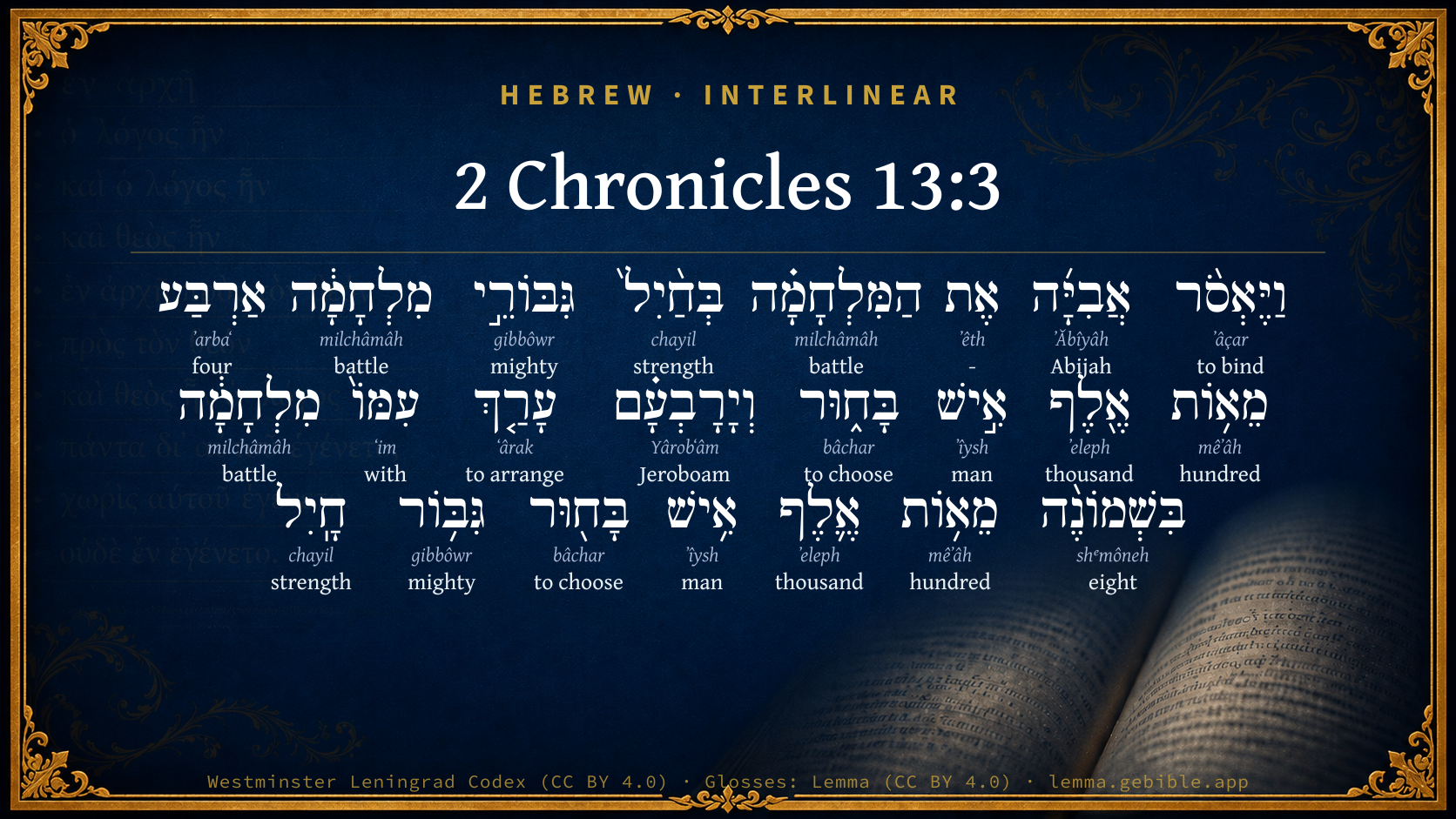
Hebrew (Westminster Leningrad Codex) 2 Chronicles 13:3 appears in the Hebrew Old Testament. The text above is from the Westminster Leningrad Codex. Each word links to its Strong’s number, a concise gloss, and parsing drawn from the Open Scriptures Hebrew Bible morphology. Click any word for its full Brown-Driver-Briggs (BDB) entry.
Download image
Cite this verse

2 Chronicles 13:3 (World English Bible). Public Domain. Lemma interlinear Bible study tool, https://lemma.gebible.app/v/2-chronicles/13/3.

Show BibTeX & RIS
BibTeX
RIS
English Translation
Abijah joined battle with an army of valiant men of war, even four hundred thousand chosen men: and Jeroboam set the battle in array against him with eight hundred thousand chosen men, who were mighty men of valor.
World English Bible · Public Domain
Download a study sheet

One document with this verse’s original text, its word-by-word gloss line, the meaning frame, cross-references with their text, attributed commentary, and full source and license credits — printable, and it pastes into notes with its structure intact.

This verse Autodidact and up

Study sheet (.html) Plain text (.txt)

A passage Seminary Student

Up to 50 verses in one chapter. A passage sheet keeps up to 6 commentary sources and 12 cross-references per verse, in the order this page ranks them, and says so on the sheet whenever that leaves anything out. Ask for a single verse and you get the Autodidact verse sheet above.

Everything on this page stays free to read, with no account — the sheet is a download of what is already on screen, not access to it.

Want to remove ads? Support Godless Engineer
Compare translations 3

The same verse in 3 English versions, stacked beneath the original-language interlinear above. Click any original word for its lexicon entry.

Each is an independent rendering of the whole verse — the interlinear is not word-aligned to these translations.

Highlighted words mark where these versions differ — a whole-verse word diff, not a word-by-word alignment.

  • World English Bible Public Domain
    Abijah joined battle with an army of valiant men of war, even four hundred thousand chosen men: and Jeroboam set the battle in array against him with eight hundred thousand chosen men, who were mighty men of valor.
  • King James Version Public Domain
    And Abijah set the battle in array with an army of valiant men of war, even four hundred thousand chosen men: Jeroboam also set the battle in array against him with eight hundred thousand chosen men, being mighty men of valor.
  • unfoldingWord Literal Text CC BY-SA 4.0
    And Abijah began the battle with an army of mighty ones of battle, 400,000 chosen men. And Jeroboam deployed against him in battle 800,000 chosen men, mighty ones of strength.

unfoldingWord Literal Text — © unfoldingWord, licensed CC BY-SA 4.0. Word-aligned USFM3 via Door43 (git.door43.org/unfoldingWord/en_ult).

Versions to compare (up to 4)

3 of 4 selected

Show all 18 translations

Every available English version of this verse, each an independent rendering of the whole verse.

  • World English Bible Public Domain
    Abijah joined battle with an army of valiant men of war, even four hundred thousand chosen men: and Jeroboam set the battle in array against him with eight hundred thousand chosen men, who were mighty men of valor.
  • Berean Standard Bible Public Domain
    Abijah went into battle with an army of 400,000 chosen men, while Jeroboam drew up in formation against him with 800,000 chosen and mighty men of valor.
  • Majority Standard Bible Public Domain
    Abijah went into battle with an army of 400,000 chosen men, while Jeroboam drew up in formation against him with 800,000 chosen and mighty men of valor.
  • King James Version Public Domain
    And Abijah set the battle in array with an army of valiant men of war, even four hundred thousand chosen men: Jeroboam also set the battle in array against him with eight hundred thousand chosen men, being mighty men of valor.
  • American Standard Version (1901) Public Domain
    And Abijah joined battle with an army of valiant men of war, even four hundred thousand chosen men: and Jeroboam set the battle in array against him with eight hundred thousand chosen men, who were mighty men of valor.
  • Revised Version (1885) Public Domain
    And Abijah joined battle with an army of valiant men of war, even four hundred thousand chosen men: and Jeroboam set the battle in array against him with eight hundred thousand chosen men, who were mighty men of valour.
  • Geneva Bible (1599) Public Domain
    And Abiiah set the battel in aray with the armie of valiant men of warre, euen foure hundreth thousand chosen men. Ieroboam also set the battell in aray against him with eight hundreth thousande chosen men which were strong and valiant.
  • Douay-Rheims (1899) Public Domain
    And when Abia had begun battle, and had with him four hundred thou- sand most valiant and chosen men, Jeroboam put his army in array against him, eight hundred thousand men, who were also chosen and most valiant for war.
  • Young's Literal Translation Public Domain
    And Abijah directeth the war with a force of mighty men of war, four hundred thousand chosen men, and Jeroboam hath set in array with him battle, with eight hundred thousand chosen men, mighty of valour.
  • Literal Standard Version CC BY-SA 4.0
    And Abijah directs the war with a force of mighty men of war, four hundred thousand chosen men, and Jeroboam has set in array [for] battle with him, with eight hundred thousand chosen men, mighty men of valor.
  • Unlocked Literal Bible CC BY-SA 4.0
    Abijah went into battle with an army of strong, courageous soldiers, 400,000 chosen men. Jeroboam placed battle lines against him with 800,000 chosen men, strong, courageous soldiers.
  • unfoldingWord Literal Text CC BY-SA 4.0
    And Abijah began the battle with an army of mighty ones of battle, 400,000 chosen men. And Jeroboam deployed against him in battle 800,000 chosen men, mighty ones of strength.
  • Darby Bible Public Domain
    And Abijah began the war with an army of men of war, four hundred thousand chosen men; and Jeroboam set the battle in array against him with eight hundred thousand chosen men, mighty men of valour.
  • World Messianic Bible Public Domain
    Abijah joined battle with an army of valiant men of war, even four hundred thousand chosen men; and Jeroboam set the battle in array against him with eight hundred thousand chosen men, who were mighty men of valor.
  • Webster's Bible Public Domain
    And Abijah set the battle in array with an army of valiant men of war, even four hundred thousand chosen men: Jeroboam also set the battle in array against him with eight hundred thousand chosen men, being mighty men of valor.
  • Free Bible Version CC BY-SA 4.0
    Abijah went out to fight with an army of 400,000 brave warriors, while Jeroboam opposed him with his army of 800,000 chosen warriors of great strength.
  • Bible in Basic English Public Domain
    And Abijah went out to the fight with an army of men of war, four hundred thousand of his best men; and Jeroboam put his forces in line against him, eight hundred thousand of his best men of war.
  • JPS Tanakh (1917) Public Domain
    And Abijah joined battle with an army of valiant men of war, even four hundred thousand chosen men; and Jeroboam set the battle in array against him with eight hundred thousand chosen men, who were mighty men of valour.

Literal Standard Version (2020), Covenant Press — licensed CC BY-SA 4.0. Text via the HelloAO Bible API (eBible.org). Unlocked Literal Bible (unfoldingWord) — licensed CC BY-SA 4.0. Text via the HelloAO Bible API (eBible.org). unfoldingWord Literal Text — © unfoldingWord, licensed CC BY-SA 4.0. Word-aligned USFM3 via Door43 (git.door43.org/unfoldingWord/en_ult). Free Bible Version, Dr. Jonathan Gallagher — licensed CC BY-SA 4.0. Text via the HelloAO Bible API (eBible.org).

Word by word

More ways to search: Search by grammar → Find every occurrence → Compare this word →

Practice this passage: Drill this verse → Learn its vocabulary →

אֲבִיָּ֜ה
ʼĂbîyâh
H29
“Abijah”
Noun, Proper
Part of Speech
Noun
Type
Proper
Full BDB Definition

Origin: from H1 and H3050

TWOT: None

Abia or Abiah or Abijah = "Jehovah is (my) father" - king of Judah, son and successor of Rehoboam - second son of Samuel - son of Jeroboam the first, king of Israel - son of Becher, a Benjamite - head of a priestly house (one of the 24 Levite groups) - head of a priestly house (after the exile) - wife of Hezron - mother of Hezekiah (compare H21 )
  1. וַיֶּאְסֹ֨ר ʼâçar H631 “and · to bind” Conjunction + Verb, Qal, Sequential Imperfect, 3rd Person, Masculine, Singular
  2. אֶת ʼêth H853 “-” Particle, Direct Object
  3. הַמִּלְחָמָ֗ה milchâmâh H4421 “the · battle” Particle, Definite Article + Noun, Common, Feminine, Singular, Absolute
  4. בְּחַ֨יִל֙ chayil H2428 “in/at · strength” Preposition + Noun, Common, Masculine, Singular, Absolute
  5. גִּבּוֹרֵ֣י gibbôwr H1368 “mighty of” Adjective, Adjective, Masculine, Plural, Construct
  6. מִלְחָמָ֔ה milchâmâh H4421 “battle” Noun, Common, Feminine, Singular, Absolute
  7. אַרְבַּע ʼarbaʻ H702 “four” Adjective, Cardinal number, Feminine, Singular, Absolute
  8. מֵא֥וֹת mêʼâh H3967 “hundred” Adjective, Cardinal number, Both, Plural, Absolute
  9. אֶ֖לֶף ʼeleph H505 “thousand” Adjective, Cardinal number, Both, Singular, Absolute
  10. אִ֣ישׁ ʼîysh H376 “man” Noun, Common, Masculine, Singular, Absolute
  11. בָּח֑וּר bâchar H977 “chosen” Verb, Qal, Participle Passive, Masculine, Singular, Absolute
  12. וְיָרָבְעָ֗ם Yârobʻâm H3379 “and · Jeroboam” Conjunction + Noun, Proper
  13. עָרַ֤ךְ ʻârak H6186 “to arrange” Verb, Qal, Perfect, 3rd Person, Masculine, Singular
  14. עִמּוֹ֙ ʻim H5973 “with · him” Preposition + Suffix, Personal, 3rd Person, Masculine, Singular
  15. מִלְחָמָ֔ה milchâmâh H4421 “battle” Noun, Common, Feminine, Singular, Absolute
  16. בִּשְׁמוֹנֶ֨ה shᵉmôneh H8083 “in/at · eight” Preposition + Adjective, Cardinal number, Feminine, Singular, Absolute
  17. מֵא֥וֹת mêʼâh H3967 “hundred” Adjective, Cardinal number, Both, Plural, Absolute
  18. אֶ֛לֶף ʼeleph H505 “thousand” Adjective, Cardinal number, Both, Singular, Absolute
  19. אִ֥ישׁ ʼîysh H376 “man” Noun, Common, Masculine, Singular, Absolute
  20. בָּח֖וּר bâchar H977 “chosen” Verb, Qal, Participle Passive, Masculine, Singular, Absolute
  21. גִּבּ֥וֹר gibbôwr H1368 “mighty of” Adjective, Adjective, Masculine, Singular, Construct
  22. חָֽיִל chayil H2428 “strength” Noun, Common, Masculine, Singular, Absolute

About this verse

These counts appear in no published source. They are computed here, from the morphology-tagged text and Lemma’s own curated glosses. What Lemma adds →

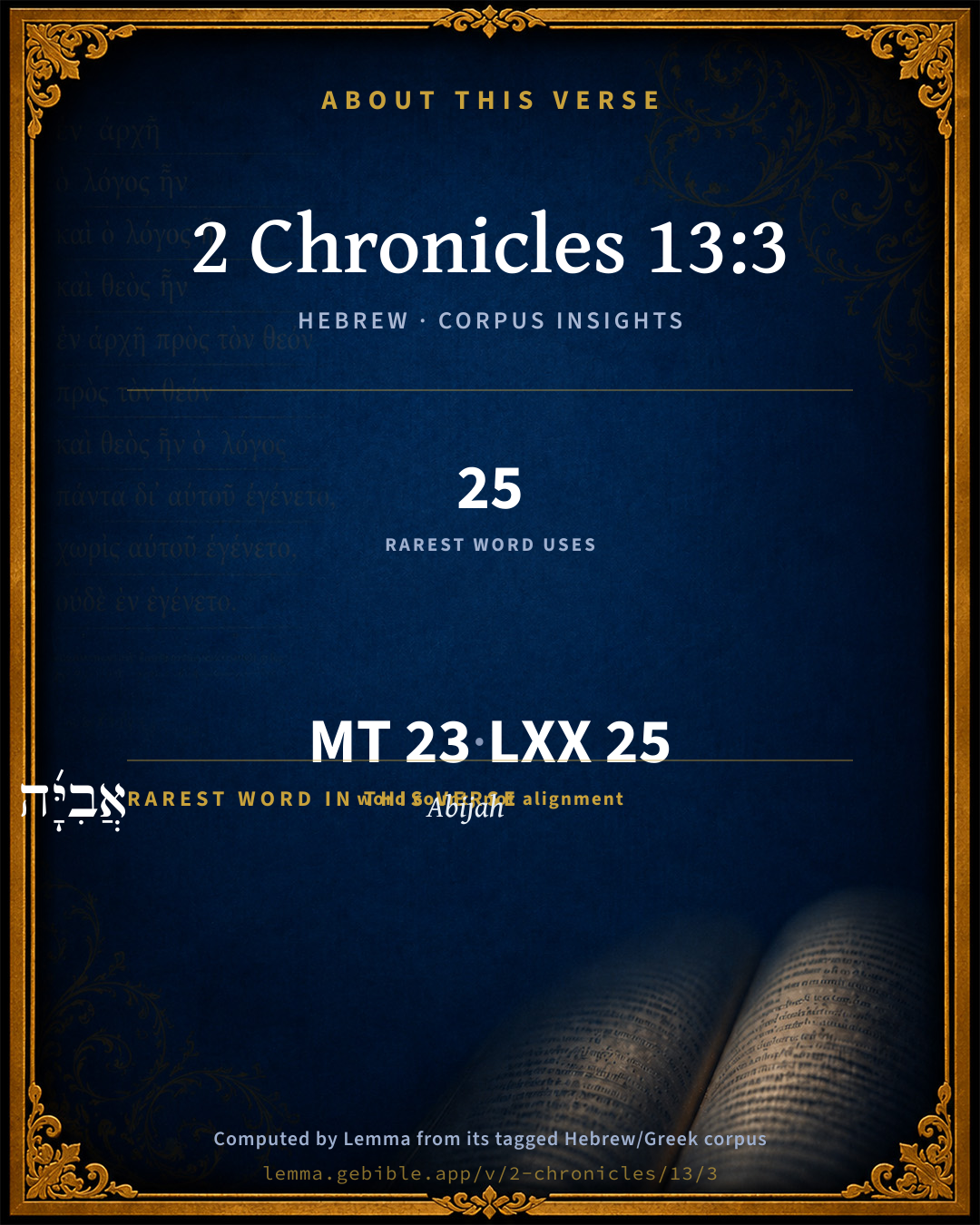
23
words
15
distinct lemmas
Historical
section

Notable vocabulary

The rarest word here is אֲבִיָּ֜ה Abijah H29 — appearing just 25 times in the whole Hebrew Bible.

Shared distinctive vocabulary

אֲבִיָּ֜ה Abijah H29 occurs in 25 verses of the Hebrew Bible. Also found in:

Grammatical profile

  • 4 verbs
  • 9 nouns
  • 8 adjectives
  • 1 preposition
  • 1 particle

Verb forms

  • וַיֶּאְסֹ֨ר Qal · Sequential Imperfect
  • בָּח֑וּר Qal · Participle Passive
  • עָרַ֤ךְ Qal · Perfect
  • בָּח֖וּר Qal · Participle Passive

Repetition

Words recur within this verse — often emphatic in Hebrew:

  • הַמִּלְחָמָ֗ה battle H4421 ×3
  • בְּחַ֨יִל֙ strength H2428 ×2
  • גִּבּוֹרֵ֣י mighty H1368 ×2
  • מֵא֥וֹת hundred H3967 ×2
  • אֶ֖לֶף thousand H505 ×2
  • אִ֣ישׁ man H376 ×2
  • בָּח֑וּר to choose H977 ×2

Hebrew & Septuagint length

In English translation the verse runs 38 words from the Hebrew and 41 from the Septuagint (LXX English) — closely comparable.

A rough comparison of the two English renderings, which tokenize alike — not a word-level alignment.

Word counts can differ between the Hebrew and the Greek without any difference in meaning — e.g. the Hebrew direct-object marker אֵת has no separate Greek word, and Greek often adds the article ὁ.

In the original languages it is 23 Hebrew tokens and 25 Greek tokens — but the two are counted differently (Hebrew bundles its prefixes and suffixes into one token; the Greek is in lemma form), so that isn’t a like-for-like length.

Cross-references

6

Topical passages linked to 2 Chronicles 13:3 in the Treasury of Scripture Knowledge — connected by theme and wording, ordered by reader-vote popularity; previews shown in the World English Bible.

  • 1 Samuel 17:1–3 Now the Philistines gathered together their armies to battle; and they were gathered together at Socoh, which belongs to Judah, and encamped between Socoh and Azekah, in Ephesdammim.
  • 1 Chronicles 21:5 Joab gave up the sum of the numbering of the people to David. All those of Israel were one million one hundred thousand men who drew sword: and in Judah were four hundred seventy thousand men who drew sword.
  • 2 Chronicles 11:1 When Rehoboam was come to Jerusalem, he assembled the house of Judah and Benjamin, one hundred eighty thousand chosen men, who were warriors, to fight against Israel, to bring the kingdom again to Rehoboam.
  • 2 Chronicles 14:8–9 Asa had an army that bore bucklers and spears, out of Judah three hundred thousand; and out of Benjamin, that bore shields and drew bows, two hundred eighty thousand: all these were mighty men of valor.
  • 2 Chronicles 17:14–18 This was the numbering of them according to their fathers' houses: Of Judah, the captains of thousands: Adnah the captain, and with him mighty men of valor three hundred thousand;
  • 2 Chronicles 26:12–13 The whole number of the heads of fathers' [houses], even the mighty men of valor, was two thousand and six hundred.

Cross-references courtesy of OpenBible.info (CC BY 4.0).

Hebrew and Greek witnesses Masoretic Hebrew ↔ Greek Septuagint

The same verse in the two great witnesses to the Old Testament, shown verse-for-verse.

These are two independent witnesses, not word-aligned to each other, and the Septuagint is shown in lemma (dictionary) form.

Hebrew 2 Chronicles 13:3 Masoretic · Westminster Leningrad Codex

וַיֶּאְסֹ֨ר אֲבִיָּ֜ה אֶת הַמִּלְחָמָ֗ה בְּחַ֨יִל֙ גִּבּוֹרֵ֣י מִלְחָמָ֔ה אַרְבַּע מֵא֥וֹת אֶ֖לֶף אִ֣ישׁ בָּח֑וּר וְיָרָבְעָ֗ם עָרַ֤ךְ עִמּוֹ֙ מִלְחָמָ֔ה בִּשְׁמוֹנֶ֨ה מֵא֥וֹת אֶ֛לֶף אִ֥ישׁ בָּח֖וּר גִּבּ֥וֹר חָֽיִל

Abijah joined battle with an army of valiant men of war, even four hundred thousand chosen men: and Jeroboam set the battle in array against him with eight hundred thousand chosen men, who were mighty men of valor.

World English Bible · Public Domain

Greek LXX 2 Chronicles 13:3 Septuagint · lemma form

καί παρατάσσω αβια ὁ πόλεμος ἐν δύναμις πολεμιστής δύναμις τετρακόσιοι χιλίας ἀνήρ δυνατός καί ιεροβοαμ παρατάσσω πρός αὐτός πόλεμος ἐν ὀκτακόσιοι χιλίας δυνατός πολεμιστής δύναμις

And Abia set the battle in array with an army, with mighty men of war, even four hundred thousand mighty men: and Jeroboam set the battle in array against him with eight hundred thousand, they were mighty warriors of the host.

LXX2012 (modern English Septuagint) · Public Domain

On this verse, Adam Clarke's Commentary discusses the Septuagint’s reading. Read the note in Commentary ↓

Hebrew: Westminster Leningrad Codex (CC BY 4.0). Greek: Septuagint (public domain); English from LXX2012 (modern English Septuagint) (Public Domain). How the Septuagint differs from the Hebrew →

Commentary

Notes on 2 Chronicles 13:3 from classic Christian and Jewish commentators (each source and its license shown beneath its notes). The classic Christian expositions comment on the surrounding passage and are grouped to its opening verse, so a note may address several verses; the Jewish commentaries on the Tanakh (Rashi and others) are per-verse, so they appear only where the commentator wrote on this verse.

Lemma curates 59 commentaries, every one of them public domain or Creative Commons licensed, each selected and text-cleaned for this edition rather than reprinted as found. About our sources →

Adam Clarke's Commentary

Verse 3. Abijah set the battle in array] The numbers in this verse and in the seventeenth seem almost incredible. Abijah's army consisted of four hundred thousand effective men; that of Jeroboam consisted of eight hundred thousand; and the slain of Jeroboam's army were five hundred thousand. Now it is very possible that there is a cipher too much in all these numbers, and that they should stand thus: Abijah's army, forty thousand; Jeroboam's eighty thousand; the slain, fifty thousand. Calmet, who defends the common reading, allows that the Venice edition of the Vulgate, in 1478; another, in 1489; that of Nuremberg, in 1521; that of Basil, by Froben, in 1538; that of Robert Stevens, in 1546; and many others, have the smaller numbers. Dr. Kennicott says: "On a particular collation of the Vulgate version, it appears that the number of chosen men here slain, which Pope Clement's edition in 1592 determines to be five hundred thousand, the edition of Pope Sixtus, printed two years before, determined to be only fifty thousand; and the two preceding numbers, in the edition of Sixtus, are forty thousand and eighty thousand. As to different printed editions, out of fifty-two, from the year 1462 to 1592, thirty-one contain the less number. And out of fifty-one MSS. twenty-three in the Bodleian library, four in that of Dean Aldrich, and two in that of Exeter College, contain the less number, or else are corrupted irregularly, varying only one or two numbers."

This examination was made by Dr. Kennicott before he had finished his collation of Hebrew MSS., and before De Rossi had published his Variae Lectiones Veteris Testamenti; but from these works we find little help, as far as the Hebrew MSS. are concerned. One Hebrew MS., instead of ארבע מאות אלף arba meoth eleph, four hundred thousand, reads ארבע עשר אלף arba eser eleph, fourteen thousand.

In all printed copies of the Hebrew, the numbers are as in the common text, four hundred thousand, eight hundred thousand, and five hundred thousand.

The versions are as follow: - The Targum, or Chaldee, the same in each place as the Hebrew.

The Syriac in 2Ch 13:3 has four hundred thousand young men for the army of Abijah, and eight hundred thousand stout youth for that of Jeroboam. For the slain Israelites, in 2Ch 13:17, it has [Syriac] five hundred thousand, falsely translated in the Latin text quinque milia, five thousand, both in the Paris and London Polyglots: another proof among many that little dependence is to be placed on the Latin translation of this version in either of the above Polyglots.

The Arabic is the same in all these cases with the Syriac, from which it has been translated.

The Septuagint, both as it is published in all the Polyglots, and as far as I have seen in MSS.. is the same with the Hebrew text. So also is Josephus.

The Vulgate or Latin version is that alone that exhibits any important variations; we have had considerable proof of this in the above-mentioned collations of Calmet and Kennicott. I shall beg liberty to add others from my own collection.

In the Editio Princeps of the Latin Bible, though without date or place, yet evidently printed long before that of Fust, in 1462, the places stand thus: 2Ch 13:3. Cumque inisset certamen, et haberet bellicosissimos viros, et electorum QUADRAGINTA milia: Iheroboam construxit e contra aciem OCTOGINTA milia virorum; "With him Abia entered into battle; and he had of the most warlike and choice men forty thousand; and Jeroboam raised an army against him of eighty thousand men."

And in 2Ch 13:17: Et corruerunt vulnerati ex Israel, QUINQUAGINTA milia virorum fortium; "And there fell down wounded fifty thousand stout men of Israel."

In the Glossa Ordinaria, by Strabo Fuldensis, we have forty thousand and eighty thousand in the two first instances, and five hundred thousand in the last.-Bib. Sacr. vol. ii., Antv. 1634.

In six ancient MSS. of my own, marked A, B, C, D, E, F. the text stands thus: -

A. - Cumque inisset Abia certamen, et haberet bellicosissimos viros, et electorum XL. MIL. Jeroboam instruxit contra aciem LXXX. MIL.

And in 2Ch 13:17: Et corruerunt vulnerati ex Israel L. MIL. virorum fortium. Here we have forty thousand for the army of Abijah, and eighty thousand for that of Jeroboam, and FIFTY thousand for the slain of the latter.

B.-QUADRAGINITA milia, OCTOGINTA milia,

FORTY thousand. EIGHTY thousand.

QUINQUIAGINTA milia,

FIFTY thousand.

The numbers being here expressed in words at full length, there can be no suspicion of mistake.

C.-CCCC milia, DCCC milibus, D milia

400 thousand. 800 thousand. 500 thousand.

This is the same as the Hebrew text, and very distinctly expressed.

D.-xl. m. lxxx. m. l. v. m.

40,000. 80,000. 50 and 5000.

This, in the two first numbers, is the same as the others above; but the last is confused, and appears to stand for fifty thousand and five thousand. A later hand has corrected the two first numbers in this MS., placing over the first four CCCC, thus (cccc/xl.), thus changing forty into four hundred; and over the second thus, (dccc/lxxx.), thus changing eighty into eight hundred. Over the latter number, which is evidently a mistake of the scribe, there is no correction.

E.-xl. m. OCTOGINTA m. l. m.

40,000 EIGHTY thousand. 50,000.

F.-CCCC. m. DCCC. m. D. m.

400,000. 800,000. 600,000.

This also is the same as the Hebrew.

The reader has now the whole evidence which I have been able to collect before him, and may choose; the smaller numbers appear to be the most correct. Corruptions in the numbers in these historical books we have often had cause to suspect, and to complain of.

Adam Clarke's Commentary on the Bible (1810–1826) — public domain. Text from a community e-Sword/MySword module.

Trapp's Complete Commentary

John Trapp

2Ch 13:3 And Abijah set the battle in array with an army of valiant men of war, [even] four hundred thousand chosen men: Jeroboam also set the battle in array against him with eight hundred thousand chosen men, [being] mighty men of valour.

Ver. 3. And Abijah set the battle in array.] Josephus saith, that Jeroboam began the war, in hope to vanquish young Abijah; but Sethus Calvisius saith, that Abijah, rashly offering war to Jeroboam, yet obtained the victory, when he called upon God.

Even four hundred thousand, &c.] Yet was this great army out numbered by Jeroboam’s; so was Asa’s six hundred thousand by Zera’s million. Huge were the armies of the Jews, that small people in comparison: five hundred thousand - not fifty thousand only, as Ruffinus ill translateth Josephus - were slain on one side; the greatest number that ever we read of slain in any battle.

John Trapp, A Commentary or Exposition upon All the Books of the Old and New Testament (1647–1656) — public domain. Text from a community e-Sword module.

Joseph Benson's Commentary

2Ch 13:3. Abijah set the battle in array — Namely, against Jeroboam, having, no doubt, God’s authority to engage with him in battle. It is probable, indeed, that Jeroboam was the aggressor, and that what Abijah did was in his own necessary defence.

Joseph Benson's Commentary on the Old and New Testaments (1811–1818) — public domain. Text from a community e-Sword module.

Keil & Delitzsch

C. F. Keil & F. Delitzsch

The War between Abijah and Jeroboam. - היתה מלחמה, war arose, broke out.

Ch2 13:3

Abijah began the war with an army of 400,000 valiant warriors. בּחוּר אישׁ, chosen men. את מ אסר, to bind on war, i.e., to open the war. Jeroboam prepared for the war with 800,000 warriors. The number of Jeroboam's warriors is exactly that which Joab returned as the result, as to Israel, of the numbering of the people commanded by David, while that of Abijah's army is less by 100,000 men than Joab numbered in Judah (Sa2 24:9).

Ch2 13:4

When the two armies lay over against each other, ready for the combat, Abijah addressed the enemy, King Jeroboam and all Israel, in a speech from Mount Zemaraim. The mountain צמרים is met with only here; but a city of this name is mentioned in Jos 18:22, whence we would incline to the conclusion that the mountain near or upon which this city lay was intended. But if this city was situated to the east, not only of Bethel, but also of Jerusalem, on the road to Jericho (see on Jos 18:22), as we may conclude from its enumeration between Beth-arabah and Bethel in Josh. loc. cit., it will not suit our passage, at least if Zemaraim be really represented by the ruin el Sumra to the east of Khan Hadur on the way from Jerusalem to Jericho. Robinson (Phys. Geog. S. 38) conjectures Mount Zemaraim to the east of Bethel, near the border of the two kingdoms, to which Mount Ephraim also extends. Abijah represented first of all (Ch2 13:5-7) to Jeroboam and the Israelites that their kingdom was the result of a revolt against Jahve, who had given the kingship over Israel to David and his sons for ever.

Ch2 13:5-7

"Is it not to you to know?" i.e., can it be unknown to you? מלח בּרית, accus. of nearer definition: after the fashion of a covenant of salt, i.e., of an irrevocable covenant; cf. on Lev 2:13 and Num 18:19. "And Jeroboam, the servant of Solomon the son of David (cf. Kg1 11:11), rebelled against his lord," with the help of frivolous, worthless men (רקים as in Jdg 9:4; Jdg 11:3; בליּעל בּני as in Kg1 21:10, Kg1 21:13 -not recurring elsewhere in the Chronicle), who gathered around him, and rose against Rehoboam with power. על התאמּץ, to show oneself powerful, to show power against any one. Against this rising Rehoboam showed himself not strong enough, because he was an inexperienced man and soft of heart. נער denotes not "a boy," for Rehoboam was forty-one years old when he entered upon his reign, but "an inexperienced young man," as in Ch1 29:1. לבב רך, soft of heart, i.e., faint-hearted, inclined to give way, without energy to make a stand against those rising insolently against him. lp' התחזק ולא, and showed himself not strong before them, proved to be too weak in opposition to them. This representation does not conform to the state of the case as narrated in 2 Chron 10. Rehoboam did not appear soft-hearted and compliant in the negotiation with the rebellious tribes at Sichem; on the contrary, he was hard and defiant, and showed himself youthfully inconsiderate only in throwing to the winds the wise advice of the older men, and in pursuance of the rash counsel of the young men who had grown up with him, brought about the rupture by his domineering manner. But Abijah wishes to justify his father as much as possible in his speech, and shifts all the guilt of the rebellion of the ten tribes from the house of David on to Jeroboam and his worthless following.

Ch2 13:8-9

Abijah then points out to his opponents the vanity of their trust in the great multitude of their warriors and their gods, while yet they had driven out the priests of Jahve. "And now ye say," scil. in your heart, i.e., you think to show yourself strong before the kingdom of Jahve in the hands of the sons of David, i.e., against the kingdom of Jahve ruled over by the sons of David, by raising a great army in order to make war upon and to destroy this kingdom. רב המון ואתּם, and truly ye are a great multitude, and with you are the golden calves, which Jeroboam hath made to you for gods; but trust not unto them, for Jahve, the true God, have ye not for you as a helper.

Ch2 13:9

"Yea, ye have cast out the priests of Jahve, the sons of Aaron, and made you priests after the manner of the nations of the lands. Every one who has come, to fill his hand with a young bullock and ... he has become a priest to the no-god." ידו מלּא, to fill his hand, denotes, in the language of the law, to invest one with the priesthood, and connected with ליהוה it signifies to provide oneself with that which is to be offered to Jahve. To fill his hand with a young bullock, etc., therefore denotes to come with sacrificial beasts, to cause oneself to be consecrated priest. The animals mentioned also, a young bullock and seven rams, point to the consecration to the priesthood. In Ex 29 a young bullock as a sin-offering, a ram as a burnt-offering, and a ram as a consecratory-offering, are prescribed for this purpose. These sacrifices were to be repeated during seven days, so that in all seven rams were required for consecratory-sacrifices. Abijah mentions only one young bullock along with these, because it was not of any importance for him to enumerate perfectly the sacrifices which were necessary. But by offering these sacrifices no one becomes a priest of Jahve, and consequently the priests of Jeroboam also are only priests for Not-Elohim, i.e., only for the golden calves made Elohim by Jeroboam, to whom the attributes of the Godhead did not belong.

Ch2 13:10-11

While, therefore, the Israelites have no-gods in their golden calves, Judah has Jahve for its God, whom it worships in His temple in the manner prescribed by Moses. "But in Jahve is our God, and we have not forsaken Him," in so far, viz., as they observed the legal Jahve-worship. So Abijah himself explains his words, "as priests serve Him the sons of Aaron (who were chosen by Jahve), and the Levites are בּמלאכת, in service," i.e., performing the service prescribed to them. As essential parts of that service of God, the offering of the daily burnt-offering and the daily incense-offering (Exo 29:38., Ch2 30:7), the laying out of the shew-bread (Exo 25:30; Lev 24:5.), the lighting of the lamps of the golden candlesticks (Exo 25:37; Exo 27:20.), are mentioned. In this respect they keep the יהוה משׁמרת (cf. Lev 8:35).

Ch2 13:12

Abijah draws from all this the conclusion: "Behold, with us at our head are (not the two calves of gold, but) God (האלהים with the article, the true God) and His priests, and the alarm-trumpets to sound against you." He mentions the trumpets as being the divinely appointed pledges that God would remember them in war, and would deliver them from their enemies, Num 10:9. Then he closes with a warning to the Israelites not to strive with Jahve, the God of their fathers.

Ch2 13:13-15

The war; Judah's victory, and the defeat of Jeroboam and the Israelites. - Ch2 13:13. Jeroboam caused the ambush (the troops appointed to be an ambush) to go round about, so as to come upon their rear (i.e., of the men of Judah); and so they (the main division of Jeroboam's troops) were before Judah, and the ambush in their rear (i.e., of the men of Judah); and the men of Judah, when they turned themselves (scil. to attack), saw war before and behind them, i.e., perceived that they were attacked in front and rear. In this dangerous position the men of Judah cried to the Lord, and the priests blew the trumpets (Ch2 13:15); and as they raised this war-cry, God smote their enemies so that they took to flight. In ויּריעוּ and בּהריע the loud shout of the warriors and the clangour of the trumpets in the hands of the priests are comprehended; and הריע is neither to be taken to refer only to the war-cry raised by the warriors in making the attack, nor, with Bertheau, to be referred only to the blowing of the trumpets.

Ch2 13:16-17

So Abijah and his people inflicted a great blow (defeat) on the Israelites, so that 500,000 of them, i.e., more than the half of Jeroboam's whole army, fell.

Ch2 13:18-19

The results of this victory. The Israelites were bowed down, their power weakened; the men of Judah became strong, mighty, because they relied upon Jahve their God. Following up his victory, Abijah took from Jeroboam several cities with their surrounding domains: Bethel, the present Beitin, see on Jos 7:2; Jeshanah, occurring only here, and the position of which has not yet been ascertained; and Ephron (עפרון, Keth.; the Keri, on the contrary, עפרין). This city cannot well be identified with Mount Ephron, Jos 15:9; for that mountain was situated on the southern frontier of Benjamin, not far from Jerusalem, while the city Ephron is to be sought much farther north, in the neighbourhood of Bethel. C. v. Raumer and others identify Ephron or Ephrain both with Ophrah of Benjamin, which, it is conjectured, was situated near or in Tayibeh, to the east of Bethel, and with the Ἐφραΐ́μ, Joh 11:54, whither Jesus withdrew into the wilderness, which, according to Josephus, Bell. Jud. iv. 9. 9, lay in the neighbourhood of Bethel. See on Jos 18:23.

(Note: The account of this war, which is peculiar to the Chronicle, and which de Wette declared, on utterly insufficient grounds, to be an invention of the chronicler (cf. against him my apol. Vers. ber die Chron. S. 444ff.), is thus regarded by Ewald (Gesch. Isr. iii. S. 466, der 2 Aufl.): "The chronicler must certainly have found among his ancient authorities an account of this conclusion of the war, and we cannot but believe that we have here, in so far, authentic tradition;" and only the details of the description are the results of free expansion by the chronicler, but in the speech Ch2 13:4-13 every word and every thought is marked by the peculiar colouring of the Chronicle. But this last assertion is contradicted by Ewald's own remark, i. S. 203, that "in Ch2 13:4-7, Ch2 13:19-21, an antiquated manner of speech and representation appears, while in the other verses, on the contrary, those usual with the chronicler are found," - in support of which he adduces the words בליּעל בּני, Ch2 13:7, and מלח בּרית, Ch2 13:5. According to this view, Abijah's speech cannot have been freely draughted by the chronicler, but must have been derived, at least so far as the fundamental thoughts are concerned, from an ancient authority, doubtless the Midrash of the prophet Iddo, cited in Ch2 13:22. But Ewald's further remark (iii. S. 466), that the author of the Chronicle, because he regarded the heathenized Samaria of his time as the true representative of the old kingdom of the ten tribes, seized this opportunity to put into King Abijah's mouth a long denunciatory and didactic speech, addressed at the commencement of the battle to the enemy as rebels not merely against the house of David, but also against the true religion, is founded upon the unscriptural idea that the calf-worship of the Israelites was merely a somewhat sensuous form of the true Jahve-worship, and was fundamentally distinct from the heathen idolatry, and also from the idolatry of the later Samaritans. In the judgment of all the prophets, not only of Hosea and Amos, but also of the prophetic author of the book of Kings, the calf-worship was a defection from Jahve, the God of the fathers, - a forsaking of the commands of Jahve, and a serving of the Baals; cf. e.g., 1 Kings 13; 2 Kings 17:7-23. What Abijah says of the calf-worship of the Israelites, and of Judah's attitude to Jahve and His worship in the temple, is founded on the truth, and is also reconcilable with the statement in Kg1 15:3, that Abijah's heart was not wholly devoted to the Lord, like David's heart. Abijah had promoted the legal temple-worship even by consecratory gifts (Kg1 15:15), and could consequently quite well bring forward the worship of God in Judah as the true worship, in contrast to the Israelitic calf-worship, for the discouragement of his enemies, and for the encouragement of his own army; and we may consequently regard the kernel, or the essential contents of the speech, as being historically well-founded. The account of the war, moreover, is also shown to be historical by the exact statement as to the conquered cities in Ch2 13:19, which evidently has been derived from ancient authorities. Only in the statements about the number of warriors, and of the slain Israelites, the numbers are not to be estimated according to the literal value of the figures; for they are, as has been already hinted in the commentary, only an expression in figures of the opinion of contemporaries of the war, that both kings had made a levy of all the men in their respective kingdoms capable of bearing arms, and that Jeroboam was defeated with such slaughter that he lost more than the half of his warriors.)

Ch2 13:20

Jeroboam could not afterwards gain power (כּוח עצר, as in Ch1 29:14): "And Jahve smote him, and he died." The meaning of this remark is not clear, since we know nothing further of the end of Jeroboam's life than that he died two years after Abijah. ויּגּפהוּ can hardly refer to the unfortunate result of the war (Ch2 13:15.), for Jeroboam outlived the war by several years. We would be more inclined to understand it of the blow mentioned in Kg1 14:1-8, when God announced to him by Ahijah the extermination of his house, and took away his son Abijah, who was mourned by all Israel.

Keil & Delitzsch — Biblical Commentary on the Old Testament (1861–1891) — public domain (CC PDM 1.0). Text via the HelloAO Bible API. (Old Testament only.)

Jamieson, Fausset & Brown

Robert Jamieson, A. R. Fausset & David Brown

Abijah set the battle in array--that is, took the field and opened the campaign.

with . . . four hundred thousand chosen men . . . Jeroboam with eight hundred thousand--These are, doubtless, large numbers, considering the smallness of the two kingdoms. It must be borne in mind, however, that Oriental armies are mere mobs--vast numbers accompanying the camp in hope of plunder, so that the gross numbers described as going upon an Asiatic expedition are often far from denoting the exact number of fighting men. But in accounting for the large number of soldiers enlisted in the respective armies of Abijah and Jeroboam, there is no need of resorting to this mode of explanation; for we know by the census of David the immense number of the population that was capable of bearing arms (Ch1 21:5; compare Ch2 14:8; Ch2 17:14).

Jamieson, Fausset & Brown — Commentary Critical and Explanatory on the Whole Bible (1871) — public domain (CC PDM 1.0). Text via the HelloAO Bible API.

Ellicott's Commentary for English Readers

(3) Set the battle in array.—Began the battle. Vulg., “cumque iniisset Abia certanien” (1Ki_20:14).

Four hundred thousand chosen men.—In David’s census, Judah mustered 470,000 fighting men, and Israel 1,100,000, without reckoning Levi and Benjamin (1Ch_21:5). The numbers of the verse present a yet closer agreement with the results of that census as reported in 2Sa_24:9; where, as here, the total strength of the Israelite warriors is given as 800,000, and that of Judah as 500,000. This correspondence makes it improbable that the figures have been falsified in transmission. (See Note on 2Ch_13:17.)

Jeroboam also set the battle in array.—While Jeroboam had drawn up against him. Vulg., instruxite contra aciem.

A Bible Commentary for English Readers, edited by Charles John Ellicott (1878–1897) — public domain. Text from a community e-Sword module.

The Cambridge Bible for Schools and Colleges

gen. ed. J. J. S. Perowne

3. Abijah set the battle in array] R.V. Abijah joined battle.

four hundred thousand … eight hundred thousand] It is to be noted that the Chronicler does not expressly say that these two huge armies met on one field of battle. In 2Sa_24:9 (David’s numbering) the fighting men of Israel are given at 800,000 and the fighting men of Judah at 500,000. Similarly the Chronicler may mean to state here the whole armed strength of Israel and Judah without committing himself to the number of those who actually took the field. The language is not precise, for the Chronicler is little interested in military details. It should be noted, moreover, that the numbers precede the mention of the battlefield, and therefore are not necessarily to be included in the account of the fight.

Similarly it is to be noted that the Chronicler does not say in 2Ch_13:17 that 500,000 of Israel fell in one day (contrast 2Ch_28:6). Rather, he implies that the war continued for some time (2Ch_13:19).

3–20 (no parallel in 1 Kin.). The Battle of Zemaraim

The historical probabilities of this account are discussed in the Introduction, § 8.

The Cambridge Bible for Schools and Colleges (gen. ed. J. J. S. Perowne; Cambridge University Press, 1878–1918) — public domain. Text from a community e-Sword module.

John Gill's Exposition

And Abijah stood upon Mount Zemaraim, which is in Mount Ephraim,.... Which might have its name from a city of Benjamin of this name, to which it was near, though within the borders of Ephraim, Jos 18:22 formerly inhabited by the Zemarites, from whence it might have its name, Gen 10:18 here Abijah stood, that he might be the better heard by the armies pitched in the valley; and very probably he desired a parley, and it was granted, otherwise he would not have been safe in the position in which he was:

and said, hear me, thou Jeroboam, and all Israel; as many as were now gathered together, and which were a great number.

John Gill's Exposition of the Whole Bible (1746–1763) — public domain (CC PDM 1.0). Text via the HelloAO Bible API.

Albert Barnes' Notes on the Bible

It has been proposed to change the numbers, here and in 2Ch 13:17, into 40,000, 80,000, and 50,000 respectively - partly because these smaller numbers are found in many early editions of the Vulgate, but mainly because the larger ones are thought to be incredible. The numbers accord well, however, with the census of the people taken in the reign of David 1Ch 21:5, joined to the fact which the writer has related 2Ch 11:13-17, of a considerable subsequent emigration from the northern kingdom into the southern one. The total adult male population at the time of the census was 1,570, 000. The total of the fighting men now is 1,200, 000. This would allow for the aged and infirm 370, 000, or nearly a fourth of the whole. And in 2Ch 13:17, our author may be understood to mean that this was the entire Israelite loss in the course of the war, which probably continued through the whole reign of Abijah.

Albert Barnes' Notes on the Bible (1834–1885) — public domain. Text from a community e-Sword/MySword module.

Haydock's Catholic Bible Commentary

War. The author of the new edition of St. Jerome mentions two manuscripts and there are several printed editions, which reduce these numbers to one half. Castalio adopts this correction, asserting that the Greek and Josephus are on his side, which is not true. (Calmet) --- We must however observe, that there is some doubt with respect to Josephus, (Haydock) as some of the oldest Latin editions acknowledge the smaller numbers; and Vignoles (i. 29.) conjectures, that the Greek copies did the same formerly, since Aborbanel "accuses Josephus of having made Jeroboam’s loss no more than 50,000, contrary to the Hebrew text," ver. 17. This learned author is of opinion, that the Jews sometimes expressed their numbers by figures, (Kennicott) analogous to those which the later Arabs borrowed from the Indians; though, in more ancient times, the letters of the alphabet had been used. Both customs seem to have prevailed; (Erpenius) and this may account for many variations, as the omission of a single cypher, resembling our period (.), might easily occasion much confusion. Kennicott (Diss. i., and ii.) seems to suspect, that the ancient versions have been made to agree with the corrupted Hebrew, no less than Josephus; and that many of the large numbers, recorded in Scripture, (which might countenance what we here read) are incorrect. See chap. xvii. 13, 19., and xiv. 8., comp.[compare] with xvi. 1., and xxv. 6., comp.[compare] with 4 Kings xiii. 7. It is certain (Haydock) many Latin manuscripts confirm the edition of Sixtus V, which has the smaller numbers; and this is the case with most of the older manuscripts and editions. How St. Jerome expressed it, we cannot easily determine. The editor of his works has been guided chiefly by the Memmian canon. See 2 Kings xv. 7. Lyranus quotes St. Jerome, as reading 50,000; (ver. 7) and it is so expressed in the Paris editions of 1534 and (Haydock) 1546, of the Hebrew questions on Paralipomenon. But Erasmus doubts whether this be the genuine work of St. Jerome, (Kennicott) or in the state in which he left it. If we consult the more ancient manuscripts and editions, prior to that of Clement VIII, we shall allow that they are more favourable to the smaller numbers, on this occasion; and are more likely to exhibit the pure version of the holy doctor, (Haydock) as the later editions have had "the Hebrew fountains" also in view. (Kennicott) --- If however we adhere to the received numbers, (Haydock) we must remember that kings, at that time, led forth to battle all their subjects who were able to bear arms. Under Moses there were 600,000. David found 1,100,000 in Israel, and 470,000 in Juda, exclusive of Levi and Benjamin; (chap. xxi. 5.) or, at least, as it is expressed [in] 2 Kings xxiv. 9., in all, 1,300,000. Asa was at the head of 580,000, chap. xiv. 8., &c.

George Leo Haydock (1774–1849), Haydock's Catholic Family Bible and Commentary, 1859 edition — public domain. Excludes Psalms (Douay-Rheims chapter numbering differs from Protestant) and Deuterocanonical books (Catholic canon only).

Matthew Poole's English Annotations

Abijah set the battle in array against Jeroboam. We need not scrupulously inquire into the lawfulness of this war, for this Abijah, though here he makes a fair flourish, and maintained the better cause, yet was indeed an ungodly man, 1Ki 15:3, and therefore minded not the satisfaction of his conscience, but only the recovery of his parent’s ancient dominions.

Matthew Poole's English Annotations on the Holy Bible (1683–1685) — public domain. Text from a community e-Sword/MySword module.

Whedon's Commentary on the Bible

Daniel D. Whedon

3. Set the battle in array — Literally, joined the battle; that is, opened the war; began the fight.

Jeroboam also set the battle in array — The verb here is different from that translated by the same words above. Abijah began the war in order to punish Jeroboam and Israel for rebellion, and Jeroboam ordered out his army for defense. The numbers 800,000 and 400,000 seem incredibly large; but perhaps the author only meant to designate the forces which each kingdom could command, not to say that all these 1,200,000 were engaged in any one battle. Compare the number of fighting men in David’s time. 2Sa_24:9.

Daniel D. Whedon (gen. ed.), Commentary on the Old and New Testaments (1874–1909) — public domain. Text from a community e-Sword module.

The Pulpit Commentary

It is not within the province of an expositor to assert dogmatically that numbers like these in this verse should be deprived of one cipher, and that the slaughter of ver. 17 must be, consequently, similarly discounted. It would be, however, a great relief to faith to be able to give proof that this treatment would be true to fact. At present the numbers can be shown to be consistent with other numbers, such as those of the entire man-population (1Ch_21:5; 2Ch_11:13-17) and this seems the best that can be said in support of them. It does not, however, suffice to bring comfortable conviction. It is remarkable, among the difficulties that the question entails, that we do not get any satisfactory explanation as to how such vast numbers of slain bodies were disposed of in a compass of ground comparatively so small.

Vers. 3-19.

A great war in a short reign.

I THE CONTENDING ARMIES. (Ver. 3.)

1. Their leaders. Of the army of Judah, Abijah; of the host of Israel, Jeroboam both capable generals, and each the inspiring spirit of his troops.

2. Their numbers. Of Judah, four hundred thousand men one hundred thousand fewer than Joab numbered to Judah; of Israel, eight hundred thousand exactly the number Joab counted to Israel. (2Sa_24:9)

3. Their quality.

(1) Abijah"s troops were

(a) heroes of war, veterans experienced in former campaigns under Rehoboam, and

(b) chosen or picked men, literally, "men of youth," whose powers were at their best. (Jer_18:3)

(2) Jeroboam"s soldiers were also

(a) chosen men and

(b) mighty men of valour. Thus both armies were well matched.

4. Their position. Over against each other, in the vicinity of Mount Zemaraim, near Bethel (Jos_18:22) the large ruin Samrah, north of Jericho" (Condor, "Handbook to the Bible," p. 427), and perhaps at that time the northern limit of Abijah"s territory (Ewald); obviously so close to one another that to them the words of Shakespeare ("King Henry V," Ac. chorus) may be fitly applied

From camp to camp, thro" the foul womb of night, The hum of either army stilly sounds, That the fix"d sentinels almost receive The secret whispers of each other"s watch: Fire answers fire: and through their paly flames Each battle sees the other"s umber"d face: Steed threatens steed, in high and boastful neighs

Piercing the night"s dull ear; and from the tents, The armourers, accomplishing the knights, With busy hammers closing rivets up, Give dreadful note of preparation.

II THE SPEECH OF ABIJAH. (Vers. 4-12.)

1. Whence spoken, From Mount Zemaraim, in Ephraim, as Jotham had formerly spoken to the Shechemites from Mount Gerizim. (Jud_1:9:7)

2. To whom addressed. To Jeroboam and all Israel. Generals commonly harangue their troops before going into action; (1Sa_4:9; 2Sa_10:11, 2Sa_10:12; 2Ch_18:30; cf. "King Henry V," Ac 4. sc. 3) Abijah directs his speech to his foes, as David did to Goliath, (1Sa_17:45) and Rabshakeh to the envoys of Hezekiah. (2Ki_18:28-35; cf. "Richard II," Ac 3. sc. 3)

3. Of what composed. Of a long, earnest argument, dissuasive, and appeal, for the purpose of inducing Jeroboam and his warriors to desist from their mad enterprise of attempting to conquer Judah. According to Abijah they could not succeed, for a variety of reasons.

(1) Their rebellion was a sin against their own better knowledge (ver. 5) a sin against the light. They knew, or might have known, that Jehovah the God of Israel had given the kingdom over Israel to David for ever, even to him and to his sons by a covenant of salt, i.e. by a perpetual covenant. (Num_18:19) This promise had been made to David, (2Sa_7:12-16) confirmed to Solomon, (1Ki_9:4, 1Ki_9:5) and reported to Jeroboam, (1Ki_11:31-38) who must have known that whatever sanction he had from Jehovah to ascend the throne of Israel, he had none to aspire after that of Judah. Abijah"s statement was true only of the throne of Judah; the sovereignty of undivided Israel was guaranteed to David and his sons on conditions which had not been fulfilled. Jehovah"s language concerning David"s throne has been realized in Christ, to whom the absolute and unbroken supremacy over God"s spiritual Israel has been committed for ever by a covenant of salt (Psa_2:6 Psa_72:17; Dan_7:13, Dan_7:14) Hence rebellion against the authority of Christ cannot prosper.

(2) Their rebellion was a revolt against their rightful lord (ver. 6). Though Jeroboam had beforehand been informed of Jehovah"s intention to wrest ten tribes from Rehobeam, it was none the less an act of insubordination on the part of Jeroboam and the Israelites to raise the standard of revolt against the son of Solomon. So the Divine foreknowledge that men will sin, reject Christ, and continue in unbelief, does not render it the less culpable on their part so to do. Christ, the Son of David, is their rightful Sovereign, (Act_10:36) and to disown his regal authority is to be guilty of spiritual high treason.

(3) Their rebellion was promoted and fostered by wicked men (ver. 7). Jeroboam had collected round him an army of vain men light persons like those Abimelech on a former occasion had hired to follow him; (Jud_1:9:4) children of Belial, or of worthlessness, of the stamp of, (1Sa_25:17) or of those who followed David when he rescued his wives from the spoilers of Zigiag; (2Sa 30:32) "lewd fellows of the baser sort" like those who assaulted the house of Jason; (Act_17:5) "men of the most abandoned principles and characters, or men without consideration, education, or brains" (Adam Clarke). Hence it was impossible their nefarious project could thrive (Pro_3:35; Psa_1:6)

(4) Their rebellion was aggravated by the time when it had been conceived and carried out, viz. at a time when Solomon"s son had not been able to withstand them, having but newly ascended the throne, and as a consequence been unprepared when the mine, as it were, was sprung beneath his feet (ver. 7). Abijah speaks of Rehoboam as having been at the time of Jeroboam"s rebellion "young and tender-hearted;" but, as Rehoboam was then forty-one years old, Abijah may have purposed by the expression to allude to his inexperience as a king, which laid him open to be misled by designing men, or to the instability of his throne, which would naturally invite the attacks of watchful adversaries.

(5) Their rebellion was supported only by human warriors and golden calves (ver. 8). But vain is the help of man, even when the battle is against a fellow, (Psa_60:11 Psa_108:12) and much more when against God. (Psa_2:1) "There is no king saved by the multitude of an host", (Psa_33:11) as Israel afterwards often came to know; (Hos_10:13) and they that trust in golden calves or idols of silver and gold are like unto them, (Psa_115:8 Psa_135:18) and shall eventually be put to (Isa_42:17; Hos_8:5)

(6) Their rebellion was being maintained in the interest of idolatry (ver. 9). Although Jeroboam had been expressly informed that Solomon"s apostasy had been the cause of the division of his kingdom, (1Ki_11:33) and that the permanence of his own throne depended on his steadfast adherence to the religion of Jehovah, (1Ki_11:38) yet had he wickedly ejected the priests of Jehovah from their offices, and instituted a new order of priesthood for the golden calves and other idols he had set up. (1Ki_12:28-31) Nay, as if to pour contempt upon the true religion, he followed the fashion of heathen nations both in the kind of persons he admitted to the sacerdotal Office, and in the rites of initiation with which these were installed. The former were selected from the lowest of the people, and the latter were of the simplest description. Any one who could bring the necessary offerings for consecration, "a young bullock and seven rams"," (cf. Exo_29:1) was admitted to the new hierarchy, and no questions were asked. This was all the recognition Jeroboam made of the true worship of Jehovah.

(7) Their rebellion was being prosecuted against those who adhered to the true worship of Jehovah (ver. 10). Abijah in this verse gives a better account of himself than the writer of the Kings does (1Ki_15:3) a natural and common, if not altogether justifiable, weakness. The probable explanation is that, while clinging to the idolatrous abominations introduced by Solomon and Rehoboam, Abijah had not abandoned the forms of the Mosaic cultus (vers. 10, 11). Like multitudes before and since, he and Ms people conceived it might be possible to do homage on equal terms to Jehovah and heathen divinities, which it was not; (Isa_42:8) just as many in the present day fancy they can serve God and mammon, which they cannot. (Mat_6:24)

(8) Their rebellion was directed against Jehovah himself (ver. 12), who was present in the camp of Judah as Captain, as he had been in the days of the conquest, (Jos_5:14) and as he still is, in the Person of Christ, in the army of the New Testament Church. (Mat_28:20) This constituted the hopelessness of Jeroboam"s attack ( Exo_15:3-7; (1 Samuel, (Job_41:10) as it does still of every assault upon the Church ofChrist. (Act_5:39 Act_23:9) No weapon that is formed against her shall prosper (Isa_54:17; Mat_16:18) That Jehovah remained in Judah in the midst of so much corruption was entirely owing to his gracious covenant with David; (1Ki_12:3-6) that Christ continues in the New Testament Church even when overrun with errors in doctrine and worship, as well as marred by defects in practice, is owing solely to his own faithfulness and truth. (Mat_28:20)

(9) Their rebellion was foredoomed to failure, because the alarm-trumpets of Jehovah"s priests were against them (ver. 12). Those alarm-trumpets were "the divinely appointed pledges that God would remember his people in war, and deliver them from their enemies". (Num_10:9) Against the Midianites Moses sent into the field, along with twelve thousand warriors, Phinehas the son of Eleazar the priest, with the holy instruments and the trumpets to blow in his hand". (Num_31:6) So the duty of Christian ministers is to sound an alarm in God"s Name against every thing and person that would injure Christ"s Church. Were this always done, timeously and earnestly, ultimate victory for the Church would be ensured (Act_20:31; 1Co_4:14; Col_1:28)

III THE AMBUSHMENT OF JEROBOAM. (Vers. 13, 14.)

1. Skilfully prepared.

(1) By Jeroboam. Wicked men often possess high talent, and, though not pious, make splendid generals, eminent statesmen, successful merchants, etc.

(2) While Abijah was orating. Neither praying nor preaching will suffice without watching. While performing every duty earnestly and thoroughly, (Ecc_9:10) it must not be imagined that prudence, foresight, and vigilance are not duties. The Christian, while praying always with all prayer and supplication, must take unto himself the whole armour of God. (Eph_6:13-18)

(3) Round about Judah. That Abijah had not perceived the stratagem of his opponent is explicable he had been preoccupied with his harangue; that his generals and soldiers were not on the alert was hardly to their credit, even if they were listening to their monarch"s eloquence. At any rate, as Jeroboam circumvented Abijah and his army, while engaged in what might be termed a religious duty, an attempt to avert the calamity of war and to promote the interests of peace, so does the prince of the power of the air commonly select the moment when Christ"s soldiers are engaged in some religious service to cast around them his snares.

2. Courageously met. Though surprised, the men of Judah were not thrown into panic. Realizing their danger, they confronted it:

(1) With faith: "they cried unto Jehovah," whom they believed to be their Captain (ver. 12) an excellent lesson for the Church (collectively and individually), which, though professing to regard Christ as her Captain, does not always turn to him for help in duty or relief in difficulty, but often repairs to worldly policy, human wisdom, or material props and defences.

(2) With hope: "The priests sounded with their trumpets," thus showing they anticipated victory. So should the Church of Christ never enter the field against her adversaries in a doubtful, but always in a confident, spirit, (Psa_60:12 Psa_108:13) expecting to be victorious. (Rom_8:37)

(3) With spirit: "The men of Judah gave a shout not merely sounded with their war-trumpets (Bertheau, Keil), but shouted like men contending for the mastery, (Exo_32:18) as soldiers do when rushing into battle (Jos_6:20; Jud_1:15:14; 1Sa_17:20) So should the Church give expression to her confident anticipations of victory in psalms and hymns and spiritual songs (Psa_132:9 Psa_149:3, Psa_149:5; Eph_5:19)

IV THE VICTORY OF JUDAH. (Vers. 15-18.)

1. The source of it. God. Not Abijah or Judah, but Eiohim smote Jeroboam and all Israel. "Safety "victory," Revised Version is of the Lord", (Pro_21:13) and "it is he that giveth salvation or, "deliverance " unto kings". (Psa_144:10) "Jehovah is a Man of war," sang Miriam; (Exo_15:3) while David owned, "He teacheth my hands to war, and my fingers to fight". (Psa_18:34 Psa_144:1)

2. The time of it. "As the men of Judah shouted." So "the Lord is nigh unto all that call upon him"; (Psa_145:18) and "whosoever shall. call upon the Name of the Lord shall be delivered" (Joe_2:32; (Acts, (Rom_10:13) even while they are calling. (Isa_65:24) Cf. the rescue of Jehoshaphat at Ramoth-Gilead. (2Ch_18:31)

3. The ground of it. "Because they relied upon the Lord God of their fathers" (ver. 18). That Jehovah should prove a Buckler to them that trusted in him accorded exactly with the representations of the Divine character furnished by Scripture (Gen_15:1; Deu_20:1; Jos_1:9; Psa_17:7 Psa_115:9) and had frequently Been verified in the experience of both sections of the kingdom-Joshua"s soldiers at Jericho (Jos_6:12, etc.) and Gideon"s at the well of Harod, (Jud_1:7:1, 21) because they trusted in the sword of Jehovah more than in their own weapons. So David prevailed over the Philistine, (1Sa_17:45) Hezekiah over the Assyrian king, and the Philistines (2Ki_18:5, 2Ki_18:8) and the Reubenites over the Hagarites. (1Ch_5:20) Confidence in God the strongest guarantee a Christian can have of emerging triumphantly from any moral or spiritual conflict (Psa_26:1 Psa_33:20, (Isa_12:2; 2Co_1:10; Rom_8:38)

4. The extent of it.

(1) Jeroboam"s army was routed (vers. 15, 16).

(2) Five hundred thousand chosen men were slain. A slaughter so terrific suggests that the numbers must have been exaggerated; and certainly nothing like it can be cited from either ancient or modern warfare. If, therefore, fifty thousand should not be read instead of five hundred thousand (Rawlinson), the figures may be regarded as a popular expression of the opinion of contemporaries of the war that Jeroboam lost more than half of his troops (Keil). Cf. Shakespeare"s description of a routed army: "The king himself, of his wings destitute, the army broken," etc. ("Cymbeline," act 5. sc. 3).

(3) The kingdom of Israel was completely prostrated (ver. 18). Their power to harass Israel was seriously impaired, which confirms the preceding statement that no ordinary blow had been inflicted on Jeroboam"s army.

(4) Several cities with their surrounding domains were captured Bethel, the present-day B eitin, an old patriarchal settlement, (Gen_12:8 Gen_28:19 Gen_35:1, Gen_35:6) and one of the seats of Jeroboam"s idolatrous worship, (1Ki_12:29, 1Ki_12:33) with the townships or villages in the district; Jeshanah, probably the Isanas of Josephus ("Ant.," 14:15.12) and the Jesuna of the LXX, occurring only here, and identified with the modern "Ain Sinia north of Bethel, with many rich springs and rock-tombs in the vicinity FConder, "Handbook," p. 416; Riehm, "HandwSrterbuch," 1:705); and Ephraim, or phron (LXX, Vulgate), the former Of which points to the Ephraim near Bethel (Josephus, "Wars," 4:9. 9), whither Jesus retired, (Joh_11:54) while the latter can hardly be connected with Mount Ephron on the south-west border of Benjamin (Bertheau), but must also be sought in the neighbourhood of Bethel.

(5) Jeroboam never again recovered strength (ver. 20). He outlived the war by several, and Abijah by two, years; but the decisive defeat he had sustained left him ever afterwards a crippled and comparatively feeble sovereign.

LESSONS.

1. The sinfulness of unjustifiable rebellion.

2. The horrors of war.

3. The political value of religion.

4. The power of faith.

5. The reward of sin. W.

The Pulpit Commentary (1880–1919), ed. H.D.M. Spence-Jones & Joseph S. Exell — public domain. Text from a community e-Sword module.

Lesson kit

Teaching starters — assembled from the data on this page, not authored interpretation. Every prompt links to the verse data it draws on. Edit before teaching.

2 Chronicles, in the Historical, opens this verse with 23 words (15 distinct Hebrew lemmas). Its most distinctive word is ʼĂbîyâh (“Abijah”). A historical commentator’s framing appears above. Read the whole chapter for the surrounding context.

Discussion questions

  1. What does “Abijah” (ʼĂbîyâh) contribute to the verse as a whole?
  2. How does 1 Samuel 8:2, which shares the word «Abijah», read alongside this verse?
  3. What does the repetition of “battle” (3× in this one verse) do in this verse?
  4. The translations on this page render this verse differently — a whole-verse word diff, not a word-by-word alignment. What might account for the different wordings?
  5. «וַיֶּאְסֹ֨ר» is a Qal Sequential Imperfect verb. How does that grammatical form shape the action described?
  6. Compare how Adam Clarke's Commentary and Trapp's Complete Commentary read this verse. Where do they agree or differ?

Things to notice

Reading settings

Reading text

Shown beneath each verse's original-language words.

Old Testament
Old Testament edition

Read the OT as the Masoretic Hebrew (MT) or the Greek Septuagint (LXX).

English shown for the Greek Septuagint (in the Hebrew ↔ Greek comparison).

Comparing translations? Open the Compare panel on any verse page to stack up to four side by side.