Job 20:18

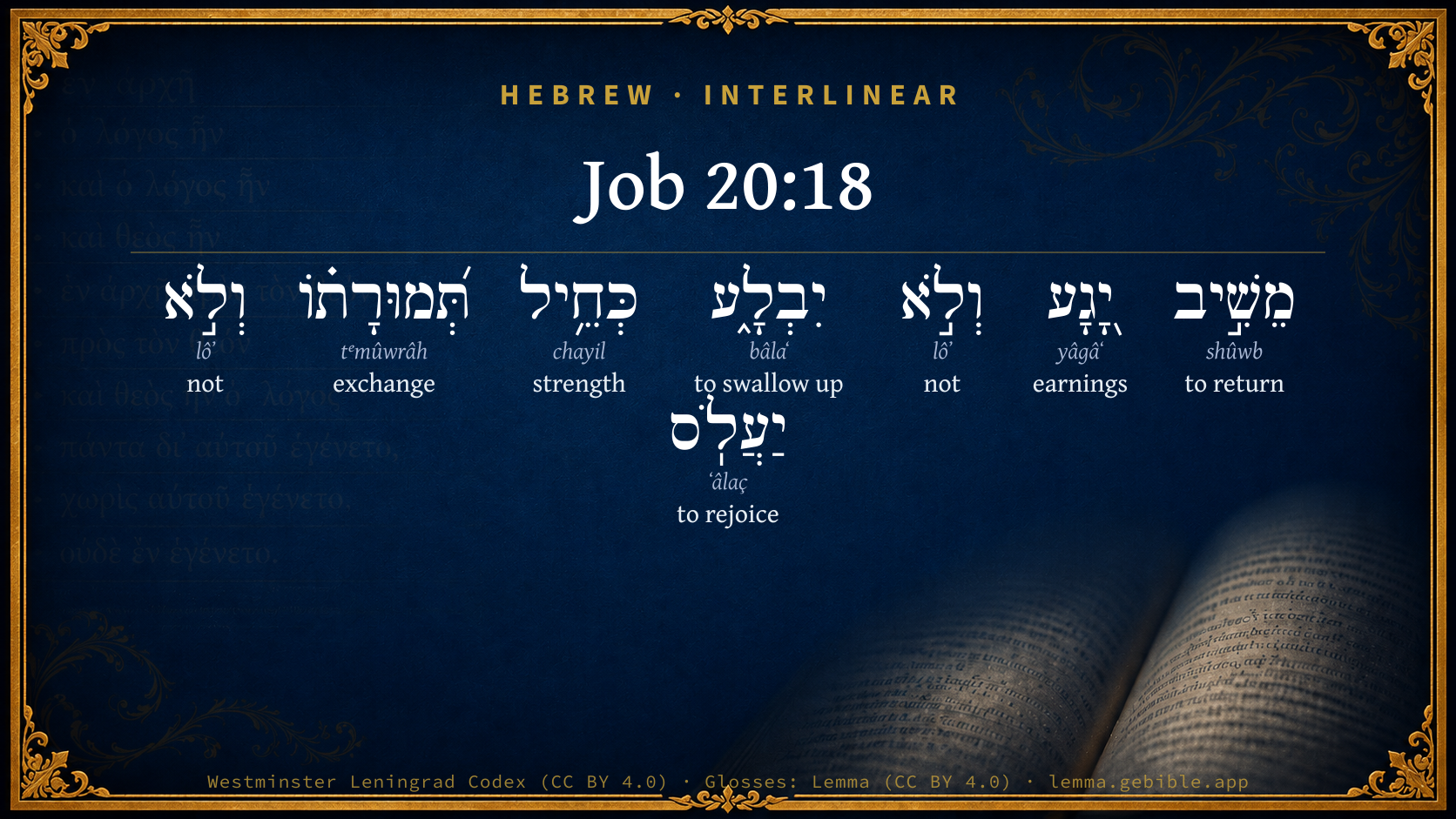
Hebrew (Westminster Leningrad Codex) Job 20:18 appears in the Hebrew Old Testament. The text above is from the Westminster Leningrad Codex. Each word links to its Strong’s number, a concise gloss, and parsing drawn from the Open Scriptures Hebrew Bible morphology. Click any word for its full Brown-Driver-Briggs (BDB) entry.
Download image
Cite this verse

Job 20:18 (World English Bible). Public Domain. Lemma interlinear Bible study tool, https://lemma.gebible.app/v/job/20/18.

Show BibTeX & RIS
BibTeX
RIS
English Translation
That for which he labored he shall restore, and shall not swallow it down; According to the substance that he has gotten, he shall not rejoice.
World English Bible · Public Domain
Highlights
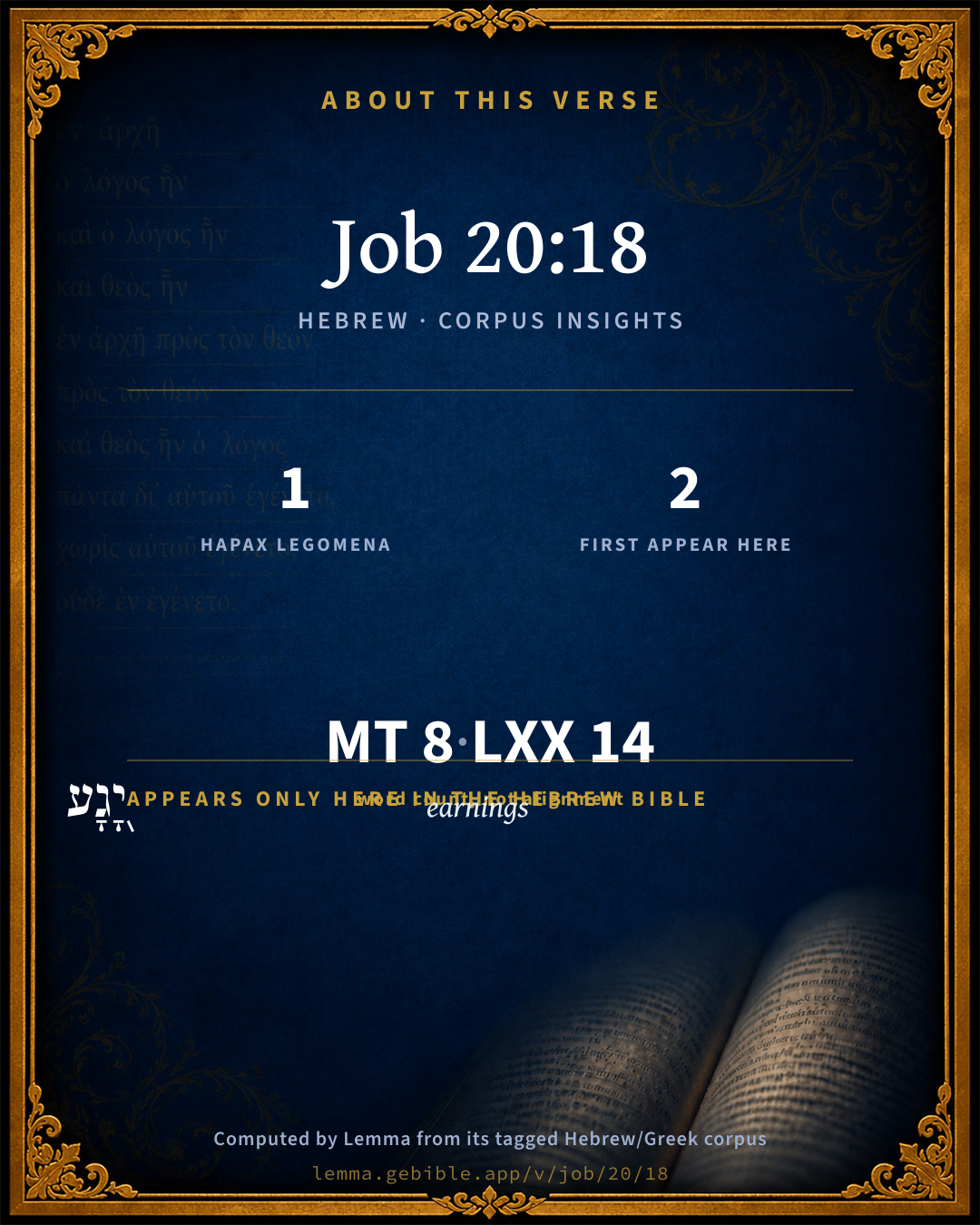
  • 1 hapax legomenon — only here in the Hebrew Bible
  • 2 first appearances in the Hebrew Bible
Full analysis ↓
Download a study sheet

One document with this verse’s original text, its word-by-word gloss line, the meaning frame, cross-references with their text, attributed commentary, and full source and license credits — printable, and it pastes into notes with its structure intact.

This verse Autodidact and up

Study sheet (.html) Plain text (.txt)

A passage Seminary Student

Up to 50 verses in one chapter. A passage sheet keeps up to 6 commentary sources and 12 cross-references per verse, in the order this page ranks them, and says so on the sheet whenever that leaves anything out. Ask for a single verse and you get the Autodidact verse sheet above.

Everything on this page stays free to read, with no account — the sheet is a download of what is already on screen, not access to it.

Want to remove ads? Support Godless Engineer
Compare translations 3

The same verse in 3 English versions, stacked beneath the original-language interlinear above. Click any original word for its lexicon entry.

Each is an independent rendering of the whole verse — the interlinear is not word-aligned to these translations.

Highlighted words mark where these versions differ — a whole-verse word diff, not a word-by-word alignment.

  • World English Bible Public Domain
    That for which he labored he shall restore, and shall not swallow it down; According to the substance that he has gotten, he shall not rejoice.
  • King James Version Public Domain
    That which he laboured for shall he restore, and shall not swallow it down: according to his substance shall the restitution be, and he shall not rejoice therein.
  • unfoldingWord Literal Text CC BY-SA 4.0
    He will return gain and will not consume, and he will not have enjoyment according to the wealth of his commerce.

unfoldingWord Literal Text — © unfoldingWord, licensed CC BY-SA 4.0. Word-aligned USFM3 via Door43 (git.door43.org/unfoldingWord/en_ult).

Versions to compare (up to 4)

3 of 4 selected

Show all 18 translations

Every available English version of this verse, each an independent rendering of the whole verse.

  • World English Bible Public Domain
    That for which he labored he shall restore, and shall not swallow it down; According to the substance that he has gotten, he shall not rejoice.
  • Berean Standard Bible Public Domain
    He must return the fruit of his labor without consuming it; he cannot enjoy the profits of his trading.
  • Majority Standard Bible Public Domain
    He must return the fruit of his labor without consuming it; he cannot enjoy the profits of his trading.
  • King James Version Public Domain
    That which he laboured for shall he restore, and shall not swallow it down: according to his substance shall the restitution be, and he shall not rejoice therein.
  • American Standard Version (1901) Public Domain
    That which he labored for shall he restore, and shall not swallow it down; According to the substance that he hath gotten, he shall not rejoice.
  • Revised Version (1885) Public Domain
    That which he laboured for shall he restore, and shall not swallow it down; according to the substance that he hath gotten, he shall not rejoice.
  • Geneva Bible (1599) Public Domain
    He shall restore the labour, and shall deuoure no more: euen according to the substance shalbe his exchange, and he shall enioy it no more.
  • Douay-Rheims (1899) Public Domain
    He shall be punished for all that he did, and yet shall not be consumed: according to the multitude of his devices so also shall he suffer.
  • Young's Literal Translation Public Domain
    He is giving back `what' he laboured for, And doth not consume `it'; As a bulwark `is' his exchange, and he exults not.
  • Literal Standard Version CC BY-SA 4.0
    He is giving back [what] he labored for, and does not consume [it]; As a bulwark [is] his exchange, and he does not exult.
  • Unlocked Literal Bible CC BY-SA 4.0
    He will give back the fruit of his labor and will not be able to eat it; he will not enjoy the wealth earned by his commerce.
  • unfoldingWord Literal Text CC BY-SA 4.0
    He will return gain and will not consume, and he will not have enjoyment according to the wealth of his commerce.
  • Darby Bible Public Domain
    That which he laboured for shall he restore, and not swallow down; its restitution shall be according to the value, and he shall not rejoice [therein].
  • World Messianic Bible Public Domain
    He will restore that for which he labored, and will not swallow it down. He will not rejoice according to the substance that he has gotten.
  • Webster's Bible Public Domain
    That which he labored for shall he restore, and shall not swallow it: according to his substance shall the restitution be, and he shall not rejoice in it.
  • Free Bible Version CC BY-SA 4.0
    They will have to give back what they have gained and will not have any benefit; they will not enjoy any of their profits.
  • Bible in Basic English Public Domain
    He is forced to give back the fruit of his work, and may not take it for food; he has no joy in the profit of his trading.
  • JPS Tanakh (1917) Public Domain
    That which he laboured for shall he give back, and shall not swallow it down; according to the substance that he hath gotten, he shall not rejoice.

Literal Standard Version (2020), Covenant Press — licensed CC BY-SA 4.0. Text via the HelloAO Bible API (eBible.org). Unlocked Literal Bible (unfoldingWord) — licensed CC BY-SA 4.0. Text via the HelloAO Bible API (eBible.org). unfoldingWord Literal Text — © unfoldingWord, licensed CC BY-SA 4.0. Word-aligned USFM3 via Door43 (git.door43.org/unfoldingWord/en_ult). Free Bible Version, Dr. Jonathan Gallagher — licensed CC BY-SA 4.0. Text via the HelloAO Bible API (eBible.org).

Word by word

More ways to search: Search by grammar → Find every occurrence → Compare this word →

Practice this passage: Drill this verse → Learn its vocabulary →

About this verse

These counts appear in no published source. They are computed here, from the morphology-tagged text and Lemma’s own curated glosses. What Lemma adds →

8
words
7
distinct lemmas
Wisdom
section

Notable vocabulary

1 hapax legomenon — a word that appears only here in the entire Hebrew Bible:

  • יָ֭גָע earnings H3022

First appearance in Scripture

These words make their first canonical appearance in the Hebrew Bible here:

  • יָ֭גָע earnings H3022
  • יַעֲלֹֽס to rejoice H5965

Shared distinctive vocabulary

יַעֲלֹֽס to rejoice H5965 occurs in 3 verses of the Hebrew Bible. Also found in:

Grammatical profile

  • 3 verbs
  • 3 nouns
  • 2 particles

Verb forms

  • מֵשִׁ֣יב Hiphil · Participle Active
  • יִבְלָ֑ע Qal · Imperfect
  • יַעֲלֹֽס Qal · Imperfect

Repetition

A word recurs within this verse — often emphatic in Hebrew:

  • וְלֹ֣א not H3808 ×2

Hebrew & Septuagint length

In English translation the verse runs 26 words from the Hebrew and 28 from the Septuagint (LXX English) — closely comparable.

A rough comparison of the two English renderings, which tokenize alike — not a word-level alignment.

Word counts can differ between the Hebrew and the Greek without any difference in meaning — e.g. the Hebrew direct-object marker אֵת has no separate Greek word, and Greek often adds the article ὁ.

In the original languages it is 8 Hebrew tokens and 14 Greek tokens — but the two are counted differently (Hebrew bundles its prefixes and suffixes into one token; the Greek is in lemma form), so that isn’t a like-for-like length.

Cross-references

20

Topical passages linked to Job 20:18 in the Treasury of Scripture Knowledge — connected by theme and wording, ordered by reader-vote popularity; previews shown in the World English Bible.

  • Job 20:10 His children shall seek the favor of the poor. His hands shall give back his wealth.
  • Job 20:15 He has swallowed down riches, and he shall vomit them up again. God will cast them out of his belly.
  • Proverbs 1:12 Let's swallow them up alive like Sheol, And whole, like those who go down into the pit.
  • Jeremiah 22:13 Woe to him who builds his house by unrighteousness, and his chambers by injustice; who uses his neighbor's service without wages, and doesn't give him his hire;
  • Jeremiah 51:44 I will execute judgment on Bel in Babylon, and I will bring forth out of his mouth that which he has swallowed up; and the nations shall not flow any more to him: yes, the wall of Babylon shall fall.
  • Job 20:5 That the triumphing of the wicked is short, The joy of the godless but for a moment?
  • Job 31:25 If I have rejoiced because my wealth was great, And because my hand had gotten much;
  • Job 31:29 "If I have rejoiced at the destruction of him who hated me, Or lifted up myself when evil found him;
  • Isaiah 24:7–11 The new wine mourns, the vine languishes, all the merry-hearted do sigh.
  • Jeremiah 11:15–16 What has my beloved to do in my house, seeing she has worked lewdness [with] many, and the holy flesh is passed from you? when you do evil, then you rejoice.
  • Jeremiah 22:17 But your eyes and your heart are not but for your covetousness, and for shedding innocent blood, and for oppression, and for violence, to do it.
  • Jeremiah 51:34 Nebuchadrezzar the king of Babylon has devoured me, he has crushed me, he has made me an empty vessel, he has, like a monster, swallowed me up, he has filled his maw with my delicacies; he has cast me out.
  • Hosea 8:7–8 For they sow the wind, And they will reap the whirlwind. He has no standing grain. The stalk will yield no head. If it does yield, strangers will swallow it up.
  • Matthew 23:13 "Woe to you, scribes and Pharisees, hypocrites! For you devour widows' houses, and as a pretense you make long prayers. Therefore you will receive greater condemnation.
  • Matthew 23:24 You blind guides, who strain out a gnat, and swallow a camel!
  • Lamentations 2:16 All your enemies have opened their mouth wide against you; They hiss and gnash the teeth; they say, We have swallowed her up; Certainly this is the day that we looked for; we have found, we have seen it.
  • Ezekiel 7:12 The time is come, the day draws near: don't let the buyer rejoice, nor the seller mourn; for wrath is on all the multitude of it.
  • Hosea 9:1 Don't rejoice, Israel, to jubilation like the nations; For you were unfaithful to your God. You love the wages of a prostitute at every grain threshing floor.
  • Amos 8:4 Hear this, you who desire to swallow up the needy, And cause the poor of the land to fail,
  • James 4:8–9 Draw near to God, and he will draw near to you. Cleanse your hands, you sinners; and purify your hearts, you double-minded.

Cross-references courtesy of OpenBible.info (CC BY 4.0).

Hebrew and Greek witnesses Masoretic Hebrew ↔ Greek Septuagint

The same verse in the two great witnesses to the Old Testament, shown verse-for-verse.

These are two independent witnesses, not word-aligned to each other, and the Septuagint is shown in lemma (dictionary) form.

Hebrew Job 20:18 Masoretic · Westminster Leningrad Codex

מֵשִׁ֣יב יָ֭גָע וְלֹ֣א יִבְלָ֑ע כְּחֵ֥יל תְּ֝מוּרָת֗וֹ וְלֹ֣א יַעֲלֹֽס

That for which he labored he shall restore, and shall not swallow it down; According to the substance that he has gotten, he shall not rejoice.

World English Bible · Public Domain

Greek LXX Job 20:18 Septuagint · lemma form

εἰς κενός καί μάταιος κοπιάω πλοῦτος ἐκ ὅς οὐ γεύω ὥσπερ στρίφνος ἀμάσητος ἀκατάποτος

He has laboured unprofitably and in vain, for wealth of which he shall not taste: it is as a lean thing, unfit for food, which he can’t swallow.

LXX2012 (modern English Septuagint) · Public Domain

Hebrew: Westminster Leningrad Codex (CC BY 4.0). Greek: Septuagint (public domain); English from LXX2012 (modern English Septuagint) (Public Domain). How the Septuagint differs from the Hebrew →

Commentary

Notes on Job 20:18 from classic Christian and Jewish commentators (each source and its license shown beneath its notes). The classic Christian expositions comment on the surrounding passage and are grouped to its opening verse, so a note may address several verses; the Jewish commentaries on the Tanakh (Rashi and others) are per-verse, so they appear only where the commentator wrote on this verse.

Lemma curates 59 commentaries, every one of them public domain or Creative Commons licensed, each selected and text-cleaned for this edition rather than reprinted as found. About our sources →

Trapp's Complete Commentary

John Trapp

Job 20:18 That which he laboured for shall he restore, and shall not swallow [it] down: according to [his] substance [shall] the restitution [be], and he shall not rejoice [therein].

Ver. 18. That which he laboured for shall he restore] (Great pains he hath taken to small purpose) in hope to make himself happy, the result whereof is, Reddet laborem, he shall restore his labour, either by regret and remorse of conscience, or by law, or by force, he shall be made to restore his ill gotten goods, which he had laboured for, even to lassitude; for wicked men are sore worksmen, and oppressors are great pains takers, κερδαινοντες ου κοπιωσι, in getting wealth unweariable (Nazian.).

And shall not swallow it down] Or if he do, as Job 20:15, it shall be but as the fish swalloweth the hook, or as the whale swallowed Jonah, ill at ease till he had laid up again.

According to his substance shall the restitution be] Heb. According to the substance of his exchange. Opes compensationis, the riches of his recompense, so the word is rendered, Job 15:31. The oppressor is so infatuated, that he looks upon his cursed hoards as the reward of his labour, and rejoiceth in that whereof he hath more reason to repent, as Leah said at the birth of her son Issachar (but not well), "God hath given me my hire, because I have given my maiden to my husband," Gen 30:18. Felix scelus virtus vocatur. Dionysius gloried that the gods disliked not his sacrilege, because they punished him not presently. But what saith Zophar here?

He shall not rejoice therein] Or if he do for a while, yet the triumphing of the wicked is short, Job 20:5, as a blaze of thorns under a pot, or as a flash of lightning, which is followed by rending and roaring; he shall be filled with unmedicinable sorrows, when his gold (his god) is taken from him; when he parteth with that whereon he had set his heart and built his felicity.

John Trapp, A Commentary or Exposition upon All the Books of the Old and New Testament (1647–1656) — public domain. Text from a community e-Sword module.

Joseph Benson's Commentary

Job 20:18. That which he laboured for shall he restore — Expressed in Hebrew by only two words, משׁיב יגע, meshib jagang, literally, restituens laborem, restoring labor: that is, the goods which were gotten with labour, that of others, or his own. It may refer either to the goods of others, of which he had obtained possession, not without pains and difficulty; or to his own goods, honestly gotten by the sweat of his brow. And this may be intended as an aggravation of his misery, that he is compelled, not only to restore other men’s goods, which were in his hands, but to part with his own also, to make reparation for damages. And shall not swallow it down — So as to hold it: he shall not possess it long, nor to any important purpose. According to his substance shall the restitution be — That is, he shall be forced to part with all his property to make compensation for his wrongs. And he shall not rejoice therein — He shall not enjoy what he had gotten, because it shall be taken from him. Houbigant’s translation of this verse is, He shall restore what he gained by his labour, and shall not consume it. His merchandise was abundant, but he shall not enjoy it.

Joseph Benson's Commentary on the Old and New Testaments (1811–1818) — public domain. Text from a community e-Sword module.

Geneva Bible (1599)

Geneva Bible translators

That is, these raveners and spoilers of the poor shall enjoy their theft but for a time: for after, God will take it from them, and cause them to make restitution, so that it is but an exchange.

Geneva Bible (1599) marginal notes — public domain. Text via Bolls.life.

Jamieson, Fausset & Brown

Robert Jamieson, A. R. Fausset & David Brown

Image from food which is taken away from one before he can swallow it.

restitution--(So Pro 6:31). The parallelism favors the English Version rather than the translation of GESENIUS, "As a possession to be restored in which he rejoices not."

he shall not rejoice--His enjoyment of his ill-gotten gains shall then be at an end (Job 20:5).

Jamieson, Fausset & Brown — Commentary Critical and Explanatory on the Whole Bible (1871) — public domain (CC PDM 1.0). Text via the HelloAO Bible API.

Adam Clarke's Commentary

Verse 18. That which he laboureth for shall he restore] I prefer here the reading of the Arabic, which is also supported by the Syriac, and is much nearer to the Hebrew text than the common version. He shall return to labour, but he shall not eat; he shall toil, and not be permitted to enjoy the fruit of his labour. The whole of this verse Mr. Good thus translates: -

"To labour shall he return, but he shall not eat.

A dearth his recompense: yea, nothing shall he taste."

It may be inquired how Mr. Good arrives at this meaning. It is by considering the word יעלס yaalos, which we translate he shall rejoice, as the Arabic [Arabic] alasa, "he ate, drank, tasted;" and the word כהיל kehil, which we make a compound word, keeheyl, "according to substance," to be the pure Arabic word [Arabic] kahala, "it was fruitless," applied to a year of dearth: hence kahlan, "a barren year." Conceiving these two to be pure Arabic words, for which he seems to have sufficient authority, he renders תמורתו temuratho, his recompense, as in Job 15:31, and not restitution, as here.

The general meaning is, He shall labour and toil, but shall not reap, for God shall send on his land blasting and mildew. Houbigant translates the verse thus: Reddet labore partum; neque id absumet; copiosae fuerunt mercaturae ejus, sed illis non fruetur. "He shall restore what he gained by labour, nor shall he consume it; his merchandises were abundant, but he shall not enjoy them." O, how doctors disagree! Old Coverdale gives a good sense, which is no unfrequent thing with this venerable translator: -

But laboure shal he, and yet have nothinge to eate; great travayle shal he make for riches, but he shal not enjoye them.

Adam Clarke's Commentary on the Bible (1810–1826) — public domain. Text from a community e-Sword/MySword module.

Ellicott's Commentary for English Readers

(18) That which he laboured for shall he restore . . .—The latter part of this verse is probably right; but it may be, “According to the substance that he hath gotten he shall not rejoice.”

A Bible Commentary for English Readers, edited by Charles John Ellicott (1878–1897) — public domain. Text from a community e-Sword module.

The Cambridge Bible for Schools and Colleges

gen. ed. J. J. S. Perowne

18. That which he laboured for] i. e. that which he has acquired—the fruit of his labour; this he shall restore and shall not swallow down, or enjoy.

according to his substance] This half verse reads: according to the wealth which he has gotten he shall not rejoice, lit. according to the wealth of his exchange (cf. ch. Job_15:31). The meaning is, however great the substance be which by his evil he has acquired he shall not have the joy of it he promised himself.

The following verses read most naturally,

19. Because he hath oppressed and forsaken the poor,

The house which he hath violently taken away he shall not build up;

20. Because he hath known no rest in his belly,

He shall not deliver himself with that wherein he delighteth;

21. There was nothing left that he devoured not,

Therefore his good shall not abide.

The Cambridge Bible for Schools and Colleges (gen. ed. J. J. S. Perowne; Cambridge University Press, 1878–1918) — public domain. Text from a community e-Sword module.

John Gill's Exposition

That which he laboured for shall he restore,.... This explains what was before figuratively expressed by vomiting, Job 20:15; and is to be interpreted either of that which another laboured for; so the Targum paraphrases it,

"another's labour;''

and Mr. Broughton renders it, "he shall restore what man's pain get": and then the sense is, that that which another got by his labour, coming by some means or another into the hand of this rapacious, covetous, wicked man, he shall be obliged to restore to him again; or the hire of the labourer being detained in his hands, he shall be forced to give it to him, as the Egyptians, by lending the Israelites their jewels of gold and silver, restored to them the wages due to them for all their labour among them for many years; or else this is to be understood of what the wicked man himself had laboured for, who with much toil and labour, as well as trick and artifice, had got the wealth of others into his hands; but should be obliged to make restoration of it again, and along with that also what he had laboured for, and had got even in an honest and lawful way, the marathon of unrighteousness corrupting and marring his whole substance:

and shall not swallow it down; or "not have time to devour it", as Mr. Broughton; he shall be obliged so soon to restore it, that it shall be as if he had never had it; he shall have no enjoyment of it, at least no comfort, pleasure, and satisfaction in it:

according to his substance shall the restitution be; the law of Moses required, in some cases, fourfold, in others fivefold, and sometimes sevenfold was exacted; and if a man had not sufficient to pay, all his substance was to go towards payment, and by this means what he lawfully got went along with that which was obtained in an illicit way, as before, see Exo 22:1;

and he shall not rejoice therein; not in the restitution he is forced to make, it being greatly against his will; nor in his ill-gotten substance, at least but for a little while, as in Job 20:5; he shall neither enjoy it nor have delight and pleasure in it, nor glory of it, as men are apt to do; Mr. Broughton reads this in connection with the preceding clause thus,

"and never rejoice in the wealth for which he must make recompense.''

John Gill's Exposition of the Whole Bible (1746–1763) — public domain (CC PDM 1.0). Text via the HelloAO Bible API.

Albert Barnes' Notes on the Bible

That which he laboured for shall he restore - This means that he shall give back the profit of his labor. He shall not be permitted to enjoy it or to consume it.

And shall not swallow it down - Shall not enjoy it; shall not eat it. He shall be obliged to give it to others.

According to his substance shall the restitution be - literally, according to Gesenius, “As a possession to be restored in which one rejoices not.” The sense is, that all that he has is like property which a man has, which he feels not to be his own, but which belongs to another and which is soon to be given “up.” In such property a man does not find that pleasure which he does in that which he feels to be his own. He cannot dispose of it, and he cannot look on it and feel that it is his. So Zophar says it is with the wicked man. He can look on his property only as that which he will soon be compelled to part with, and not having any security for retaining it, he cannot rejoice in it as if it were his own. Dr. Lee, however, renders this, “As his wealth is, so shall his restitution be; and he shall not rejoice.” But the interpretation proposed above, seems to me to accord best with the sense of the Hebrew.

Albert Barnes' Notes on the Bible (1834–1885) — public domain. Text from a community e-Sword/MySword module.

Haydock's Catholic Bible Commentary

Suffer eternal torments. (Calmet) --- Hebrew, "according to his substance, shall the restitution be, and he shall not rejoice." (Protestants)

George Leo Haydock (1774–1849), Haydock's Catholic Family Bible and Commentary, 1859 edition — public domain. Excludes Psalms (Douay-Rheims chapter numbering differs from Protestant) and Deuterocanonical books (Catholic canon only).

Matthew Poole's English Annotations

That which he laboured for, Heb. labour, i.e. the goods which were gotten with labour; either,

1. By the labour of others; or rather,

2. By his own labour; which may relate as well to the goods of others, which he got not without pains and difficulty; or to his own goods honestly gotten by the sweat of his brows. And this is an aggravation of his misery, that he was forced to restore not only other men’s goods which were in his hands, but his own also, to make reparation for their damages.

Shall not swallow it down, to wit, so as to hold it; for otherwise he did swallow it, but withal did speedily vomit it up again, Job 20:15, which was as if he had not swallowed it. He shall not possess it long, nor to any considerable purpose.

According to his substance shall the restitution be, i.e. he shall be forced to part with all his estate to make compensation for his wrongs done to others.

He shall not rejoice therein, i.e. he shall not enjoy what he hath gotten, because it shall be taken from him.

Matthew Poole's English Annotations on the Holy Bible (1683–1685) — public domain. Text from a community e-Sword/MySword module.

Whedon's Commentary on the Bible

Daniel D. Whedon

18. Laboured for — The fruit of labour; but not necessarily his labour.

According to his substance, etc. — Delitzsch and Zockler render this difficult passage: “According to the riches he hath gotten (literally, “of his exchange,”) shall he not rejoice?” Hirtzel, Welte, etc., agree with the Authorized Version. Thus Renan: “His restitutions shall equal his riches;” which is but a feeble enlargement of the first clause of the verse. The word תמורה will be better rendered recompense, as in Job_15:31, According to his riches shall his recompense be, and he shall not rejoice. “Zophar enters now more particularly into the cause of the fate of the ungodly; and placing guilt and punishment together, seeks to bring into view the divine jus talionis,” [law of retribution.] — Hengstenberg.

Daniel D. Whedon (gen. ed.), Commentary on the Old and New Testaments (1874–1909) — public domain. Text from a community e-Sword module.

The Pulpit Commentary

That which he laboured for he shall restore. Even that which he gets by his own honest labour he shall have to part with and give up. He shall not swallow it down; i.e. "shall not absorb it, and make it his own." According to his substance shall the restitution be. So Schultens, Professor Lee, and Dr. Stanley Leathes, who understand Zophar as asserting that, in order to compensate those whom he has robbed, the wicked man will have to make over to them all the wealth that is honestly his Others translate, "According to the substance that he hath gotten, he shall not rejoice" (see the Revised Version, and the commentaries of Ewald, Delitzsch, and Dillmann).

The Pulpit Commentary (1880–1919), ed. H.D.M. Spence-Jones & Joseph S. Exell — public domain. Text from a community e-Sword module.

John Wesley's Explanatory Notes

Swallow - So as to hold it. He shall not possess it long, nor to any considerable purpose. Yea, he shall be forced to part with his estate to make compensations for his wrongs. So that he shall not enjoy what he had gotten, because it shall be taken from him.

John Wesley, Explanatory Notes Upon the Whole Bible (1754–1765) — public domain. Text via the GEBible commentary corpus.

Rashi

Rabbi Shlomo Yitzchaki (Rashi)

He will return that which he labored for The loot that he stole.

when his gain becomes vast wealth When his gain becomes vast wealth, then he will lose it.

he will not rejoice Heb. יעלס, with it. Similarly, יַעֲלֹז, and so יַעַלֹץ; the three of them are interchangeable.

Rashi on the Tanakh — English translations: “The Judaica Press complete Tanach with Rashi, translated by A. J. Rosenberg” (CC BY 4.0); “Pentateuch with Rashi's commentary by M. Rosenbaum and A.M. Silbermann, 1929-1934” (public domain); “The Metsudah Tanach series, Lakewood, N.J” (CC BY 4.0); and “The Book of Joshua, Metsudah Publications, 1997” (CC BY 4.0). Text via Sefaria.

Lesson kit

Teaching starters — assembled from the data on this page, not authored interpretation. Every prompt links to the verse data it draws on. Edit before teaching.

Job, in the Wisdom, opens this verse with 8 words (7 distinct Hebrew lemmas). Its most distinctive word is yâgâʻ (“earnings”). A historical commentator’s framing appears above. Read the whole chapter for the surrounding context.

Discussion questions

  1. How does “earnings” (yâgâʻ) shape what this verse is saying?
  2. This verse holds 1 word here found nowhere else in the Hebrew Bible. What might the rare word draw attention to?
  3. 2 words here appear for the first time in Scripture. What is being introduced at this debut?
  4. Job 39:13 shares the word «to rejoice» with this verse. How do the two illuminate each other?
  5. “not” occurs 2× in this one verse. What is the effect of the repetition?
  6. These translations render this verse differently; the difference is in the English rendering, not the original. What questions does that raise?
  7. The verb «מֵשִׁ֣יב» is Hiphil Participle Active. How does its form color the action?
  8. Reading how Trapp's Complete Commentary and Joseph Benson's Commentary read this verse, where do the two commentators agree and where do they part?

Things to notice

  • 1 word in this verse appears nowhere else in the Hebrew Bible.
  • 2 words make their first canonical appearance in Scripture here.
  • This verse counts 8 Hebrew ↔ 14 Greek words.
  • These translations choose different wording for 21 words in this verse.
  • “not” occurs 2× in this single verse.

Reading settings

Reading text

Shown beneath each verse's original-language words.

Old Testament
Old Testament edition

Read the OT as the Masoretic Hebrew (MT) or the Greek Septuagint (LXX).

English shown for the Greek Septuagint (in the Hebrew ↔ Greek comparison).

Comparing translations? Open the Compare panel on any verse page to stack up to four side by side.