Jeremiah 52:8

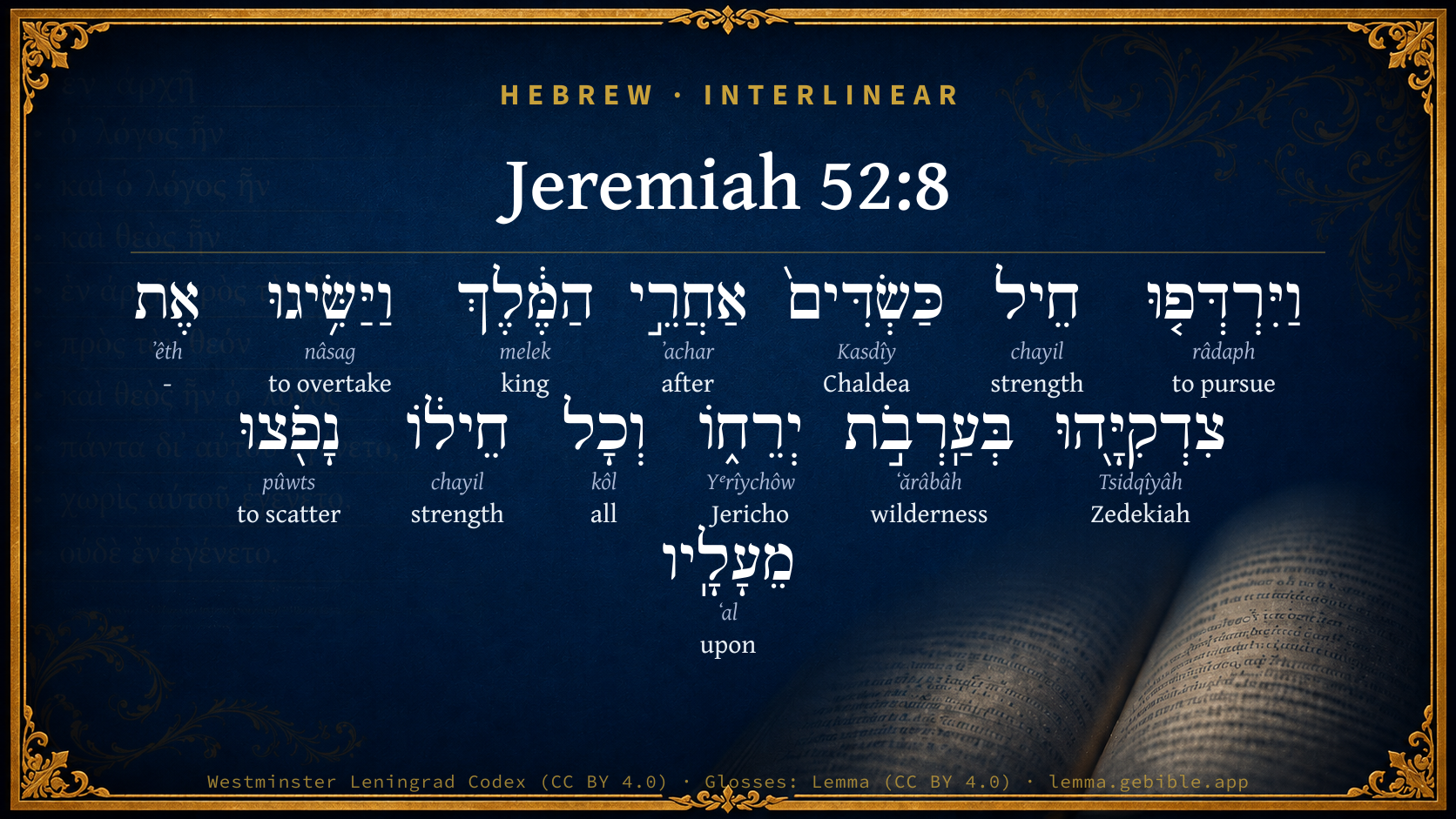
Hebrew (Westminster Leningrad Codex) Jeremiah 52:8 appears in the Hebrew Old Testament. The text above is from the Westminster Leningrad Codex. Each word links to its Strong’s number, a concise gloss, and parsing drawn from the Open Scriptures Hebrew Bible morphology. Click any word for its full Brown-Driver-Briggs (BDB) entry.
Download image
Cite this verse

Jeremiah 52:8 (World English Bible). Public Domain. Lemma interlinear Bible study tool, https://lemma.gebible.app/v/jeremiah/52/8.

Show BibTeX & RIS
BibTeX
RIS
English Translation
But the army of the Chaldeans pursued after the king, and overtook Zedekiah in the plains of Jericho; and all his army was scattered from him.
World English Bible · Public Domain
Download a study sheet

One document with this verse’s original text, its word-by-word gloss line, the meaning frame, cross-references with their text, attributed commentary, and full source and license credits — printable, and it pastes into notes with its structure intact.

This verse Autodidact and up

Study sheet (.html) Plain text (.txt)

A passage Seminary Student

Up to 50 verses in one chapter. A passage sheet keeps up to 6 commentary sources and 12 cross-references per verse, in the order this page ranks them, and says so on the sheet whenever that leaves anything out. Ask for a single verse and you get the Autodidact verse sheet above.

Everything on this page stays free to read, with no account — the sheet is a download of what is already on screen, not access to it.

Want to remove ads? Support Godless Engineer
Compare translations 3

The same verse in 3 English versions, stacked beneath the original-language interlinear above. Click any original word for its lexicon entry.

Each is an independent rendering of the whole verse — the interlinear is not word-aligned to these translations.

Highlighted words mark where these versions differ — a whole-verse word diff, not a word-by-word alignment.

  • World English Bible Public Domain
    But the army of the Chaldeans pursued after the king, and overtook Zedekiah in the plains of Jericho; and all his army was scattered from him.
  • King James Version Public Domain
    But the army of the Chaldeans pursued after the king, and overtook Zedekiah in the plains of Jericho; and all his army was scattered from him.
  • unfoldingWord Literal Text CC BY-SA 4.0
    But the army of Chaldeans pursued the king and overtook Zedekiah in the plains of the Jordan River valley near Jericho. All his army was scattered away from him.

unfoldingWord Literal Text — © unfoldingWord, licensed CC BY-SA 4.0. Word-aligned USFM3 via Door43 (git.door43.org/unfoldingWord/en_ult).

Versions to compare (up to 4)

3 of 4 selected

Show all 18 translations

Every available English version of this verse, each an independent rendering of the whole verse.

  • World English Bible Public Domain
    But the army of the Chaldeans pursued after the king, and overtook Zedekiah in the plains of Jericho; and all his army was scattered from him.
  • Berean Standard Bible Public Domain
    but the army of the Chaldeans pursued the king and overtook Zedekiah in the plains of Jericho, and all his army was separated from him.
  • Majority Standard Bible Public Domain
    but the army of the Chaldeans pursued the king and overtook Zedekiah in the plains of Jericho, and his whole army deserted him.
  • King James Version Public Domain
    But the army of the Chaldeans pursued after the king, and overtook Zedekiah in the plains of Jericho; and all his army was scattered from him.
  • American Standard Version (1901) Public Domain
    But the army of the Chaldeans pursued after the king, and overtook Zedekiah in the plains of Jericho; and all his army was scattered from him.
  • Revised Version (1885) Public Domain
    But the army of the Chaldeans pursued after the king, and overtook Zedekiah in the plains of Jericho; and all his army was scattered from him.
  • Geneva Bible (1599) Public Domain
    But the army of the Caldeans pursued after the king, and tooke Zedekiah in the desert of Iericho, and all his host was scattered from him.
  • Douay-Rheims (1899) Public Domain
    But the army of the Chaldeans pursued after the king: and they overtook Sedecias in the desert which is near Jericho: and all his companions were scattered from him.
  • Young's Literal Translation Public Domain
    And the forces of the Chaldeans pursue after the king, and overtake Zedekiah in the plains of Jericho, and all his forces have been scattered from him,
  • Literal Standard Version CC BY-SA 4.0
    And the forces of the Chaldeans pursue after the king, and overtake Zedekiah in the plains of Jericho, and all his forces have been scattered from him,
  • Unlocked Literal Bible CC BY-SA 4.0
    But the army of Chaldeans pursued the king and overtook Zedekiah in the plains of the Jordan River valley near Jericho. All his army was scattered away from him.
  • unfoldingWord Literal Text CC BY-SA 4.0
    But the army of Chaldeans pursued the king and overtook Zedekiah in the plains of the Jordan River valley near Jericho. All his army was scattered away from him.
  • Darby Bible Public Domain
    And the army of the Chaldeans pursued after the king, and overtook Zedekiah in the plains of Jericho; and all his army was scattered from him.
  • World Messianic Bible Public Domain
    but the army of the Kasdim pursued the king, and overtook Zedekiah in the plains of Jericho; and all his army was scattered from him.
  • Webster's Bible Public Domain
    But the army of the Chaldeans pursued the king, and overtook Zedekiah in the plains of Jericho; and all his army was scattered from him.
  • Free Bible Version CC BY-SA 4.0
    but the Babylonian army chased after the king and caught up with him on the plains of Jericho. His whole army had scattered and left him.
  • Bible in Basic English Public Domain
    And the Chaldaean army went after King Zedekiah and overtook him on the other side of Jericho, and all his army went in flight from him in every direction.
  • JPS Tanakh (1917) Public Domain
    But the army of the Chaldeans pursued after the king, and overtook Zedekiah in the plains of Jericho; and all his army was scattered from him.

Literal Standard Version (2020), Covenant Press — licensed CC BY-SA 4.0. Text via the HelloAO Bible API (eBible.org). Unlocked Literal Bible (unfoldingWord) — licensed CC BY-SA 4.0. Text via the HelloAO Bible API (eBible.org). unfoldingWord Literal Text — © unfoldingWord, licensed CC BY-SA 4.0. Word-aligned USFM3 via Door43 (git.door43.org/unfoldingWord/en_ult). Free Bible Version, Dr. Jonathan Gallagher — licensed CC BY-SA 4.0. Text via the HelloAO Bible API (eBible.org).

Word by word

More ways to search: Search by grammar → Find every occurrence → Compare this word →

Practice this passage: Drill this verse → Learn its vocabulary →

וַיַּשִּׂ֥יגוּ
nâsag
H5381
“and · to overtake”
Conjunction + Verb, Hiphil, Sequential Imperfect, 3rd Person, Masculine, Plural
Part of Speech
Conjunction + Verb
Stem
Hiphil
Form
Sequential Imperfect
Person
3rd Person
Gender
Masculine
Number
Plural
Full BDB Definition

Origin: a primitive root

TWOT: 1422

to reach, overtake, take hold upon - (Hiphil) - to overtake - to reach, attain to, cause to reach - to be able to secure, reach, have enough
  1. וַיִּרְדְּפ֤וּ râdaph H7291 “and · to pursue” Conjunction + Verb, Qal, Sequential Imperfect, 3rd Person, Masculine, Plural
  2. חֵיל chayil H2428 “strength of” Noun, Common, Masculine, Singular, Construct
  3. כַּשְׂדִּים֙ Kasdîy H3778 “Chaldea” Noun, Proper
  4. אַחֲרֵ֣י ʼachar H310 “after” Preposition
  5. הַמֶּ֔לֶךְ melek H4428 “the · king” Particle, Definite Article + Noun, Common, Masculine, Singular, Absolute
  6. אֶת ʼêth H853 “-” Particle, Direct Object
  7. צִדְקִיָּ֖הוּ Tsidqîyâh H6667 “Zedekiah” Noun, Proper
  8. בְּעַֽרְבֹ֣ת ʻărâbâh H6160 “in/at · wildernesses of” Preposition + Noun, Common, Feminine, Plural, Construct
  9. יְרֵח֑וֹ Yᵉrîychôw H3405 “Jericho” Noun, Proper
  10. וְכָל kôl H3605 “and · all of” Conjunction + Noun, Common, Masculine, Singular, Construct
  11. חֵיל֔וֹ chayil H2428 “strength · his” Noun, Common, Masculine, Singular, Construct + Suffix, Personal, 3rd Person, Masculine, Singular
  12. נָפֹ֖צוּ pûwts H6327 “to scatter” Verb, Niphal, Perfect, 3rd Person, Common, Plural
  13. מֵעָלָֽיו ʻal H5921 “from · upon · him” Preposition + Preposition + Suffix, Personal, 3rd Person, Masculine, Singular

About this verse

These counts appear in no published source. They are computed here, from the morphology-tagged text and Lemma’s own curated glosses. What Lemma adds →

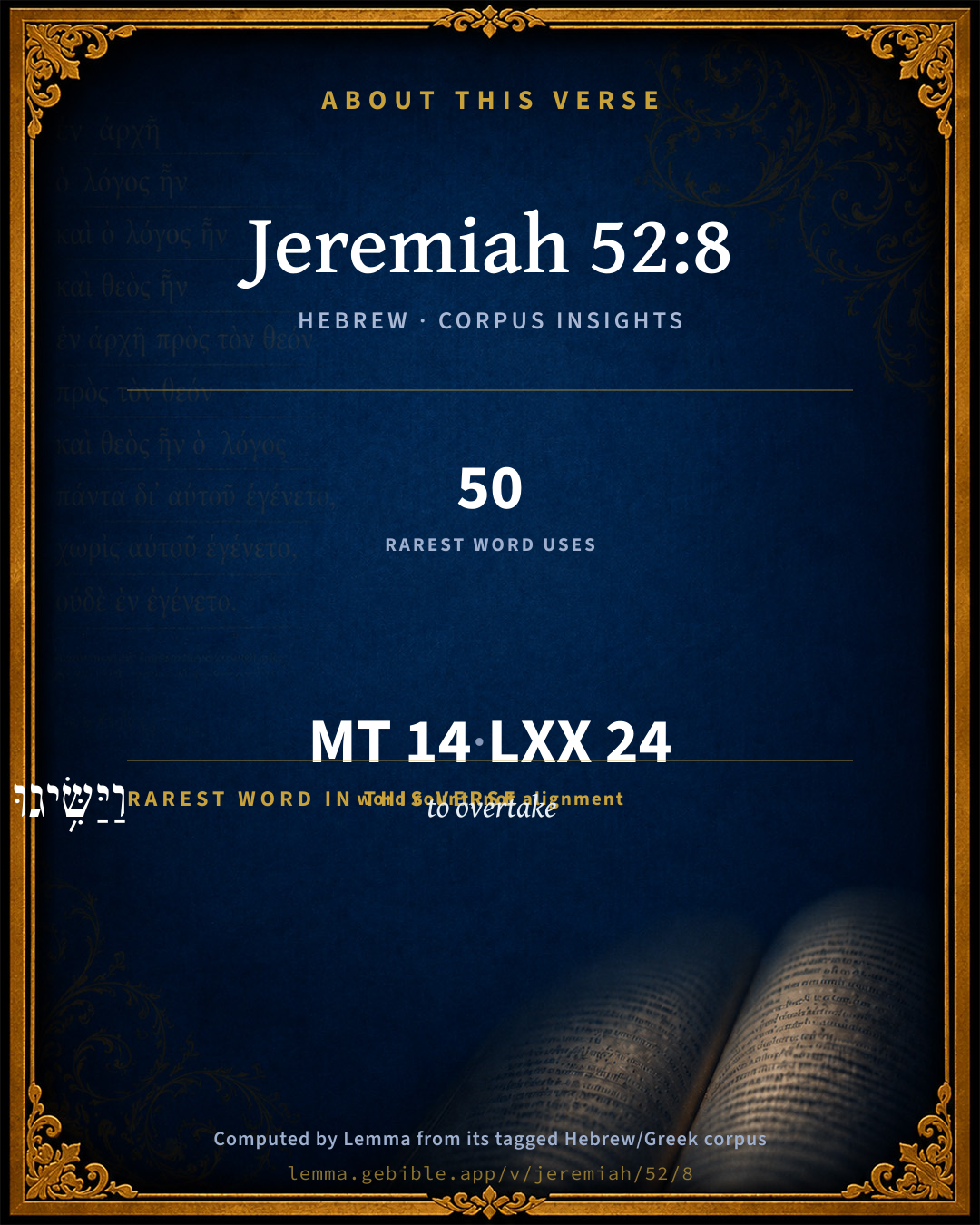
14
words
13
distinct lemmas
Prophets
section

Shared distinctive vocabulary

וַיַּשִּׂ֥יגוּ to overtake H5381 occurs in 47 verses of the Hebrew Bible. Also found in:

Grammatical profile

  • 3 verbs
  • 8 nouns
  • 2 prepositions
  • 1 particle

Verb forms

  • וַיִּרְדְּפ֤וּ Qal · Sequential Imperfect
  • וַיַּשִּׂ֥יגוּ Hiphil · Sequential Imperfect
  • נָפֹ֖צוּ Niphal · Perfect

Repetition

A word recurs within this verse — often emphatic in Hebrew:

  • חֵיל strength H2428 ×2

Hebrew & Septuagint length

In the original languages it is 14 Hebrew tokens and 24 Greek tokens — but the two are counted differently (Hebrew bundles its prefixes and suffixes into one token; the Greek is in lemma form), so that isn’t a like-for-like length.

Cross-references

12

Topical passages linked to Jeremiah 52:8 in the Treasury of Scripture Knowledge — connected by theme and wording, ordered by reader-vote popularity; previews shown in the World English Bible.

  • Jeremiah 34:21 Zedekiah king of Judah and his princes will I give into the hand of their enemies, and into the hand of those who seek their life, and into the hand of the king of Babylon's army, who have gone away from you.
  • Jeremiah 21:7 Afterward, says Yahweh, I will deliver Zedekiah king of Judah, and his servants, and the people, even such as are left in this city from the pestilence, from the sword, and from the famine, into the hand of Nebuchadrezzar king of Babylon, and into the hand of their enemies, and into the hand of those who seek their life: and he shall strike them with the edge of the sword; he shall not spare them, neither have pity, nor have mercy.
  • Jeremiah 32:4 and Zedekiah king of Judah shall not escape out of the hand of the Chaldeans, but shall surely be delivered into the hand of the king of Babylon, and shall speak with him mouth to mouth, and his eyes shall see his eyes;
  • Jeremiah 38:23 They shall bring out all your wives and your children to the Chaldeans; and you shall not escape out of their hand, but shall be taken by the hand of the king of Babylon: and you shall cause this city to be burned with fire.
  • Isaiah 30:16–17 but you said, No, for we will flee on horses; therefore shall you flee: and, We will ride on the swift; therefore shall those who pursue you be swift.
  • Jeremiah 37:18 Moreover Jeremiah said to king Zedekiah, Wherein have I sinned against you, or against your servants, or against this people, that you have put me in prison?
  • Jeremiah 39:5 But the army of the Chaldeans pursued after them, and overtook Zedekiah in the plains of Jericho: and when they had taken him, they brought him up to Nebuchadrezzar king of Babylon to Riblah in the land of Hamath; and he gave judgment on him.
  • Lamentations 4:19–20 Our pursuers were swifter than the eagles of the sky: They chased us on the mountains, they laid wait for us in the wilderness.
  • Ezekiel 12:12–14 The prince who is among them shall bear on his shoulder in the dark, and shall go forth: they shall dig through the wall to carry out thereby: he shall cover his face, because he shall not see the land with his eyes.
  • Ezekiel 17:20–21 I will spread my net on him, and he shall be taken in my snare, and I will bring him to Babylon, and will enter into judgment with him there for his trespass that he has trespassed against me.
  • Amos 2:14–15 Flight will perish from the swift; And the strong won't strengthen his force; Neither shall the mighty deliver himself;
  • Amos 9:1–4 I saw the Lord standing beside the altar, and he said, "Strike the tops of the pillars, that the thresholds may shake; and break them in pieces on the head of all of them; and I will kill the last of them with the sword: there shall not one of them flee away, and there shall not one of them escape.

Cross-references courtesy of OpenBible.info (CC BY 4.0).

Hebrew and Greek witnesses Masoretic Hebrew ↔ Greek Septuagint

The same verse in the two great witnesses to the Old Testament, shown verse-for-verse.

These are two independent witnesses, not word-aligned to each other, and the Septuagint is shown in lemma (dictionary) form.

Hebrew Jeremiah 52:8 Masoretic · Westminster Leningrad Codex

וַיִּרְדְּפ֤וּ חֵיל כַּשְׂדִּים֙ אַחֲרֵ֣י הַמֶּ֔לֶךְ וַיַּשִּׂ֥יגוּ אֶת צִדְקִיָּ֖הוּ בְּעַֽרְבֹ֣ת יְרֵח֑וֹ וְכָל חֵיל֔וֹ נָפֹ֖צוּ מֵעָלָֽיו

But the army of the Chaldeans pursued after the king, and overtook Zedekiah in the plains of Jericho; and all his army was scattered from him.

World English Bible · Public Domain

Greek LXX Structure differs

In the Septuagint, Jeremiah is about an eighth shorter than the Hebrew and arranges its material differently — the Oracles Against the Nations (Hebrew chapters 46–51) appear in the middle of the Greek book, after 25:13. Because the chapter and verse boundaries do not line up, a verse-for-verse comparison with the Hebrew is not shown.

A verse-for-verse comparison isn’t shown here because the chapters and verses don’t line up. Switch to the LXX edition with the MT / LXX toggle above to read the Greek directly.

Hebrew: Westminster Leningrad Codex (CC BY 4.0). Greek: Septuagint (public domain); English from a public-domain English Septuagint. How the Septuagint differs from the Hebrew →

Targum (Aramaic paraphrase)

1

The Targum is the ancient Jewish Aramaic paraphrase of the Hebrew Scriptures — an interpretive translation, not the Hebrew text itself. Onkelos (literal) and Pseudo-Jonathan (expansive) render the Torah, and Jonathan the Prophets. Coverage is partial: where no permissively-licensed English translation exists for a verse, only the Aramaic is shown. This is verse-level text, not a word-by-word alignment to the Hebrew.

  1. Targum Jonathan Prophets (Joshua–Malachi)
    וּרְדָפָא מַשִׁרְיַת כַּסְדָאֵי בָּתַר מַלְכָּא וְאַדְבִּיקוּ יַת צִדְקִיָה בְּמֵישְׁרֵי יְרֵיחוֹ וְכָל מַשִׁרְיָתֵיהּ אִתְבַּדָרָא מִנֵיהּ:

    (no public-domain English translation for this verse)

    Targum Jonathan — Aramaic: “Mikraot Gedolot” (public domain). English: “Sefaria Community Translation” (CC0 1.0 (public-domain dedication)); “London "Chaldee Paraphrase," 1871” (public domain). Text via Sefaria.

Commentary

Notes on Jeremiah 52:8 from classic Christian and Jewish commentators (each source and its license shown beneath its notes). The classic Christian expositions comment on the surrounding passage and are grouped to its opening verse, so a note may address several verses; the Jewish commentaries on the Tanakh (Rashi and others) are per-verse, so they appear only where the commentator wrote on this verse.

Lemma curates 59 commentaries, every one of them public domain or Creative Commons licensed, each selected and text-cleaned for this edition rather than reprinted as found. About our sources →

Adam Clarke's Commentary

Verse 8. The army of the Chaldeans pursued] 2Kg 25:5.

Adam Clarke's Commentary on the Bible (1810–1826) — public domain. Text from a community e-Sword/MySword module.

The Cambridge Bible for Schools and Colleges

gen. ed. J. J. S. Perowne

8. Lam_4:19 f. may perhaps refer to this, in which case the circumstances probably were these, that one body of Chaldaeans followed, and another laid wait in the plain. Cp. Eze_12:13.

The Cambridge Bible for Schools and Colleges (gen. ed. J. J. S. Perowne; Cambridge University Press, 1878–1918) — public domain. Text from a community e-Sword module.

John Gill's Exposition

Then they took the king,.... King Zedekiah, being left alone, excepting some few with him:

and carried him up unto the king of Babylon to Riblah in the land of Hamath; which is supposed to be Antioch in Syria:

where he gave judgment upon him; or "spake with him judgments" (r): chided and reproached him for his perfidy and ingratitude; expostulated and reasoned with him upon this subject, exposing his iniquity; and then passed sentence upon him, which was after executed; See Gill on Jer 39:5.

(r) "qui cum eo locutus est judicia", Schmidt. So Cocceius.

John Gill's Exposition of the Whole Bible (1746–1763) — public domain (CC PDM 1.0). Text via the HelloAO Bible API.

The Pulpit Commentary

Vers. 8-11. The fate of Zedekiah.

I THE CAUSES WHICH LED TO THE FATE OF ZEDEKIAH.

1. The general calamity of his nation. The king suffers with his people. Unfortunately it too often happens that an innocent people is punished for the fault of its sovereign. We must not be surprised if the converse is sometimes true. We are all members one of another. Not only kings, but in a less degree private individuals, must expect to share the troubles of the community, apart from the exact measure of private desert. In this life the execution of Divine justice is general; in the next life it will be particular then the judgment will be individualistic.

2. His own sin. Zedekiah did "evil in the eyes of the Lord" (ver. 2). Others may have done worse and escaped. But if we have no more severe a fate than we deserve, we can find no ground for complaint in the fact that more wicked men receive (at present) a milder treatment.

3. His weakness. Zedekiah was more weak than wicked. It is often observable in history that the weak king suffers calamities which the bad king escapes. But weakness is a culpable defect in a sovereign. If he is not strong enough for his duties he should resign the reins of power. No one has a right to retain a post which he cannot efficiently fulfil. Moral weakness is always wrong to be blamed as much as to be pitied for it can be overcome. (Isa_40:29-31)

4. His erroneous policy. Zedekiah was set on the throne by Nebuchadnezzar; he plotted with Pharaoh against his suzerain; and when his rebellion roused the vengeance of Babylon, he found Egypt to be only "a broken reed." In his case the vanity of trust in princes was illustrated.

5. The will of God. The fate of Zedekiah had been predicted by Jeremiah. (Jer_34:1-7) The prophecy implied a Divine decree. God has no hard, cruel decrees irrespective of our conduct and will. But following our wrong doing, God"s fixed counsels of judgment make flight hopeless.

II THE LEADING FEATURES OF THE FATE OF ZEDEKIAH.

1. He was captured in the agonies of flight. According to Josephus, this was not till he had reached the banks of the Jordan. How terrible to be so nearly saved, and yet to fall a prey to vengeance at last! To be only almost saved is worse than never to have had a hope of deliverance. They who have been near to the kingdom of heaven and have not entered it will feel the more bitterly the doom that they will share with the city of Destruction. "Remember Lot"s wife.

2. He was carried to Babylon and tried before King Nebuchadnezzar. The triumph of the great monarch was the shame of his vassal.

3. His children were slain before his eyes. Parents suffer in the sufferings of their children more than in the pain of their own bodies. The action of Nebuchadnezzar was cruel, brutal, devilish. There are no such spiteful elements in God"s punishment of the wicked. His is given in sorrow and with reluctance.

4. His eyes were put out. Here was the greatest refinement of cruelty. Zedekiah"s sight was preserved till he had witnessed the death agonies of his children. Then he was blinded, so that the last vision to dwell in his memory was the harrowing spectacle of his children"s massacre. But after so terrible a sight would the wretched man care to look on the light of day?

5. He was detained in prison till his death a punishment worse than death. Dethroned, humiliated, in chains, in a dungeon, bereaved of his children, the poor blind king is left to the agony of his own bitter thoughts. May God deliver us from a similar fate in the future world!

Vers. 8-11. The irony of a name.

These verses tell of King Zedekiah of the tragedy of Zedekiah, we might say, for never was there a tragedy more terrible than that in which he bore the chief part. But think of his name our Righteousness." "As the last note of Jeremiah"s dirge ever Jehoiachin died away, he had burst forth into one of those strains of hope, in which he had represented the future ruler of Israel as the righteousness or justice of Jehovah. (cf. Jer_23:5-7) It may be that, in allusion to this, the new king assumed that name Zedek-Jah on his accession to the throne. He was a mere youth, but not without noble feelings which, in a less critical moment, might have saved the state." And his very name attested the hope which was cherished concerning him. But read the history of his career and his awful fate, and see if ever there could be sadder irony than in the name he bore. It was a glorious name, but how miserably belied! Defeated, dethroned, disgraced, bereaved, tortured, blind, an exile, a slave, so he dragged out the last weary years of his life. We know not how many they were, we can only hope they were but few.

I SUCH IRONY OF NAMES IS FREQUENT. The degenerate bearers of noble and hallowed names are many. The children of Abraham were told by our Lord that they were children of the devil. A good name should be an inspiration; it often is; noblesse oblige. That it may be so is often the motive wherewith it is given by parents to their children. But, as with Zedekiah, their character and their names are in sad contrast.

II NOTE THE CAUSE OF THIS SAD IRONY IN THIS CASE. It was not lack of right knowledge. For a while he was under the teaching and influence of God"s prophet Jeremiah. And men rarely go wrong from lack of knowledge. Video meliora proboque, deteriora sequor. Nor for lack of right feeling. He had again and again good purposes and aspirations. So with men like him. Nor were there wanting sundry endeavours to act according as God prompted him. He made one and another attempt. But the secret of his sad failure was his lack of strength, infirmity of will, weakness of resolve. And thus it perpetually is with men who turn out failures in life. There is no more pitiful sight in this world than the spectacle of these ruined men. Jeremiah lamented bitterly over Zedekiah, as he well might.

III LET THIS ILL-APPLIED NAME LEAD US TO THINK OF HIM WHOSE NAME WAS NOTHING BUT BLESSED TRUTH JESUS. He was called Jesus because "he should save his people from their sins." For in him is the remedy for all such as Zedekiah was. Give up our will to him, come to be in him by a living faith, and his strength shall be reproduced in us, and out of weakness we shall be made strong. C.

Zedekiah"s army scattered.

Zedekiah"s aim was to keep his army together, for as long as he could do that there was a chance of averting the evil day, and perhaps in the end escaping it altogether. But without his army he was utterly helpless. He could not bring himself to heed Jeremiah"s counsels, doing the right and putting his trust in Jehovah. And so when the army was gone everything was gone. Nothing remained but random, desperate attempts at flight, and the certainty of ultimate capture. We have to ask ourselves what we shall do when our army is scattered from us, when the resources of our own making are vanished. The chief battles of our life are not to be fought with external resources at all. In every warfare where the weapons are carnal the weapons must fail at last. Only when we are engaged in truly spiritual warfare, and have the hosts of heaven on our side, can we be sure that our army will not be scattered from us. Y.

The Pulpit Commentary (1880–1919), ed. H.D.M. Spence-Jones & Joseph S. Exell — public domain. Text from a community e-Sword module.

Lesson kit

Teaching starters — assembled from the data on this page, not authored interpretation. Every prompt links to the verse data it draws on. Edit before teaching.

Jeremiah, in the Prophets, opens this verse with 14 words (13 distinct Hebrew lemmas). Its most distinctive word is nâsag (“to overtake”). A historical commentator’s framing appears above. Read the whole chapter for the surrounding context.

Discussion questions

  1. The word nâsag carries the sense “to overtake.” How does it shape the verse?
  2. Genesis 31:25 shares the word «to overtake» with this verse. How do the two illuminate each other?
  3. “strength” occurs 2× in this one verse. What is the effect of the repetition?
  4. These translations render this verse differently. What is at stake in choosing one wording over another?
  5. The verb «וַיִּרְדְּפ֤וּ» is Qal Sequential Imperfect. How does its form color the action?
  6. Reading how Adam Clarke's Commentary and The Cambridge Bible for Schools and Colleges read this verse, where do the two commentators agree and where do they part?

Things to notice

Reading settings

Reading text

Shown beneath each verse's original-language words.

Old Testament
Old Testament edition

Read the OT as the Masoretic Hebrew (MT) or the Greek Septuagint (LXX).

English shown for the Greek Septuagint (in the Hebrew ↔ Greek comparison).

Comparing translations? Open the Compare panel on any verse page to stack up to four side by side.