
Proverbs 13:22

Hebrew (Westminster Leningrad Codex) Proverbs 13:22 appears in the Hebrew Old Testament. The text above is from the Westminster Leningrad Codex. Each word links to its Strong’s number, a concise gloss, and parsing drawn from the Open Scriptures Hebrew Bible morphology. Click any word for its full Brown-Driver-Briggs (BDB) entry.
Download image
Cite this verse

Proverbs 13:22 (World English Bible). Public Domain. Lemma interlinear Bible study tool, https://lemma.gebible.app/v/proverbs/13/22.

Show BibTeX & RIS
BibTeX
RIS
English Translation
A good man leaves an inheritance to his children's children, But the wealth of the sinner is stored for the righteous.
World English Bible · Public Domain
Download a study sheet

One document with this verse’s original text, its word-by-word gloss line, the meaning frame, cross-references with their text, attributed commentary, and full source and license credits — printable, and it pastes into notes with its structure intact.

This verse Autodidact and up

Study sheet (.html) Plain text (.txt)

A passage Seminary Student

Up to 50 verses in one chapter. A passage sheet keeps up to 6 commentary sources and 12 cross-references per verse, in the order this page ranks them, and says so on the sheet whenever that leaves anything out. Ask for a single verse and you get the Autodidact verse sheet above.

Everything on this page stays free to read, with no account — the sheet is a download of what is already on screen, not access to it.

Want to remove ads? Support Godless Engineer
Compare translations 3

The same verse in 3 English versions, stacked beneath the original-language interlinear above. Click any original word for its lexicon entry.

Each is an independent rendering of the whole verse — the interlinear is not word-aligned to these translations.

Highlighted words mark where these versions differ — a whole-verse word diff, not a word-by-word alignment.

  • World English Bible Public Domain
    A good man leaves an inheritance to his children's children, But the wealth of the sinner is stored for the righteous.
  • King James Version Public Domain
    A good man leaveth an inheritance to his children's children: and the wealth of the sinner is laid up for the just.
  • unfoldingWord Literal Text CC BY-SA 4.0
    The good will cause sons of sons to inherit, but the wealth of a sinner is stored up for the righteous.

unfoldingWord Literal Text — © unfoldingWord, licensed CC BY-SA 4.0. Word-aligned USFM3 via Door43 (git.door43.org/unfoldingWord/en_ult).

Versions to compare (up to 4)

3 of 4 selected

Show all 18 translations

Every available English version of this verse, each an independent rendering of the whole verse.

  • World English Bible Public Domain
    A good man leaves an inheritance to his children's children, But the wealth of the sinner is stored for the righteous.
  • Berean Standard Bible Public Domain
    A good man leaves an inheritance to his children’s children, but the sinner’s wealth is passed to the righteous.
  • Majority Standard Bible Public Domain
    A good man leaves an inheritance to his children’s children, but the sinner’s wealth is passed to the righteous.
  • King James Version Public Domain
    A good man leaveth an inheritance to his children's children: and the wealth of the sinner is laid up for the just.
  • American Standard Version (1901) Public Domain
    A good man leaveth an inheritance to his children's children; And the wealth of the sinner is laid up for the righteous.
  • Revised Version (1885) Public Domain
    A good man leaveth an inheritance to his children’s children; and the wealth of the sinner is laid up for the righteous.
  • Geneva Bible (1599) Public Domain
    The good man shall giue inheritance vnto his childrens children: and the riches of the sinner is layde vp for the iust.
  • Douay-Rheims (1899) Public Domain
    The good man leaveth heirs, sons, and grandsons: and the substance of the sinner is kept for the just.
  • Young's Literal Translation Public Domain
    A good man causeth sons' sons to inherit, And laid up for the righteous `is' the sinner's wealth.
  • Literal Standard Version CC BY-SA 4.0
    A good man causes sons’ sons to inherit, || And the sinner’s wealth [is] laid up for the righteous.
  • Unlocked Literal Bible CC BY-SA 4.0
    A good person leaves an inheritance for his grandchildren, but a sinner's wealth is stored up for the righteous person.
  • unfoldingWord Literal Text CC BY-SA 4.0
    The good will cause sons of sons to inherit, but the wealth of a sinner is stored up for the righteous.
  • Darby Bible Public Domain
    A good man leaveth an inheritance to his children's children; but the wealth of the sinner is laid up for the righteous [man].
  • World Messianic Bible Public Domain
    A good man leaves an inheritance to his children’s children, but the wealth of the sinner is stored for the righteous.
  • Webster's Bible Public Domain
    A good man leaveth an inheritance to his children's children: and the wealth of the sinner is laid up for the just.
  • Free Bible Version CC BY-SA 4.0
    Good people leave an inheritance to their grandchildren, but the sinner's wealth is saved for those who live right.
  • Bible in Basic English Public Domain
    The heritage of the good man is handed down to his children's children; and the wealth of the sinner is stored up for the upright man.
  • JPS Tanakh (1917) Public Domain
    A good man leaveth an inheritance to his children's children; and the wealth of the sinner is laid up for the righteous.

Literal Standard Version (2020), Covenant Press — licensed CC BY-SA 4.0. Text via the HelloAO Bible API (eBible.org). Unlocked Literal Bible (unfoldingWord) — licensed CC BY-SA 4.0. Text via the HelloAO Bible API (eBible.org). unfoldingWord Literal Text — © unfoldingWord, licensed CC BY-SA 4.0. Word-aligned USFM3 via Door43 (git.door43.org/unfoldingWord/en_ult). Free Bible Version, Dr. Jonathan Gallagher — licensed CC BY-SA 4.0. Text via the HelloAO Bible API (eBible.org).

Word by word

More ways to search: Search by grammar → Find every occurrence → Compare this word →

Practice this passage: Drill this verse → Learn its vocabulary →

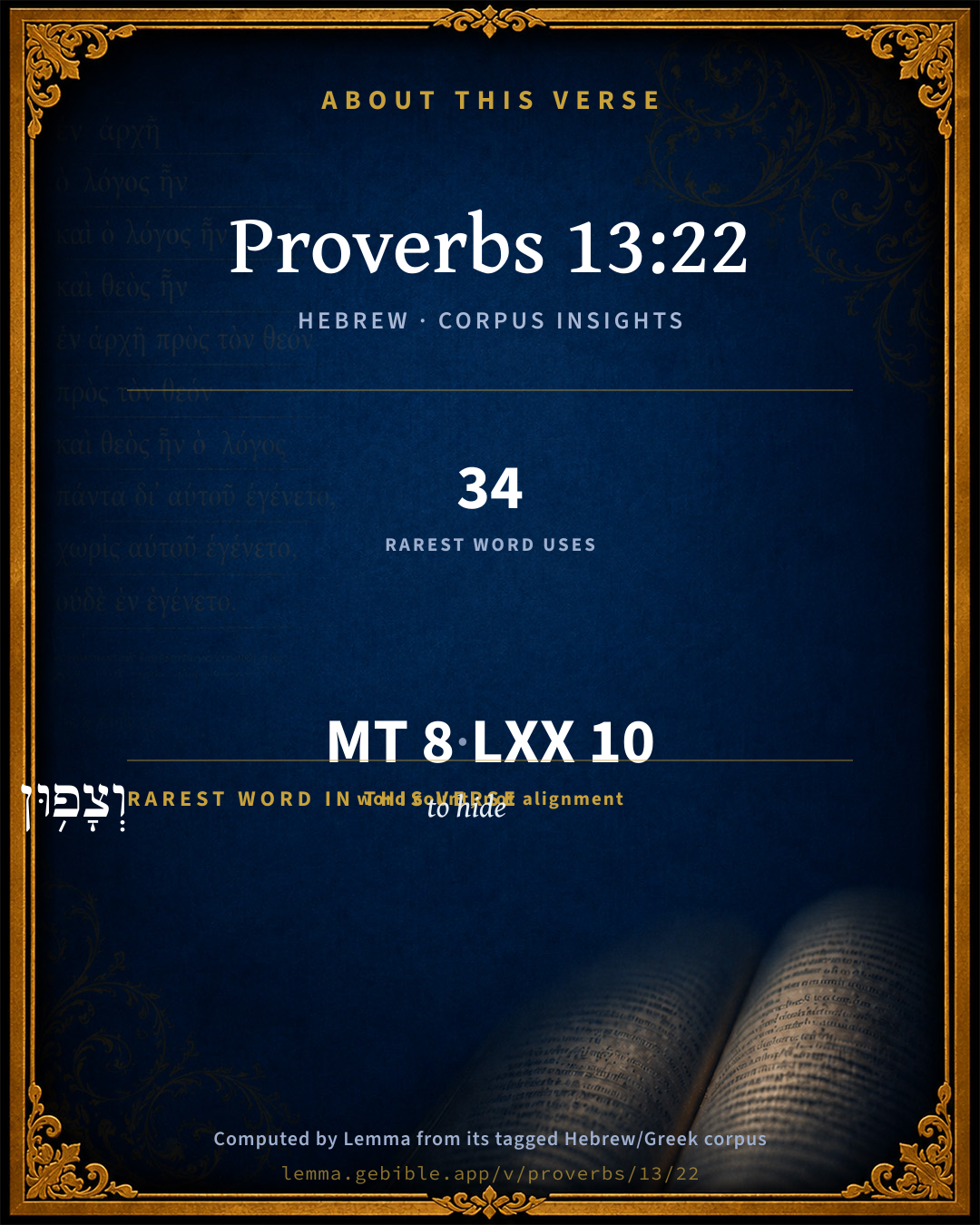
וְצָפ֥וּן
tsâphan
H6845
“and · hidden”
Conjunction + Verb, Qal, Participle Passive, Masculine, Singular, Absolute
Part of Speech
Conjunction + Verb
Stem
Qal
Form
Participle Passive
Gender
Masculine
Number
Singular
State
Absolute
Full BDB Definition

Origin: a primitive root

TWOT: 1953

to hide, treasure, treasure or store up - (Qal) - to hide, treasure, treasure up - to lie hidden, lurk - (Niphal) to be hidden, be stored up - (Hiphil) to hide, hide from discovery
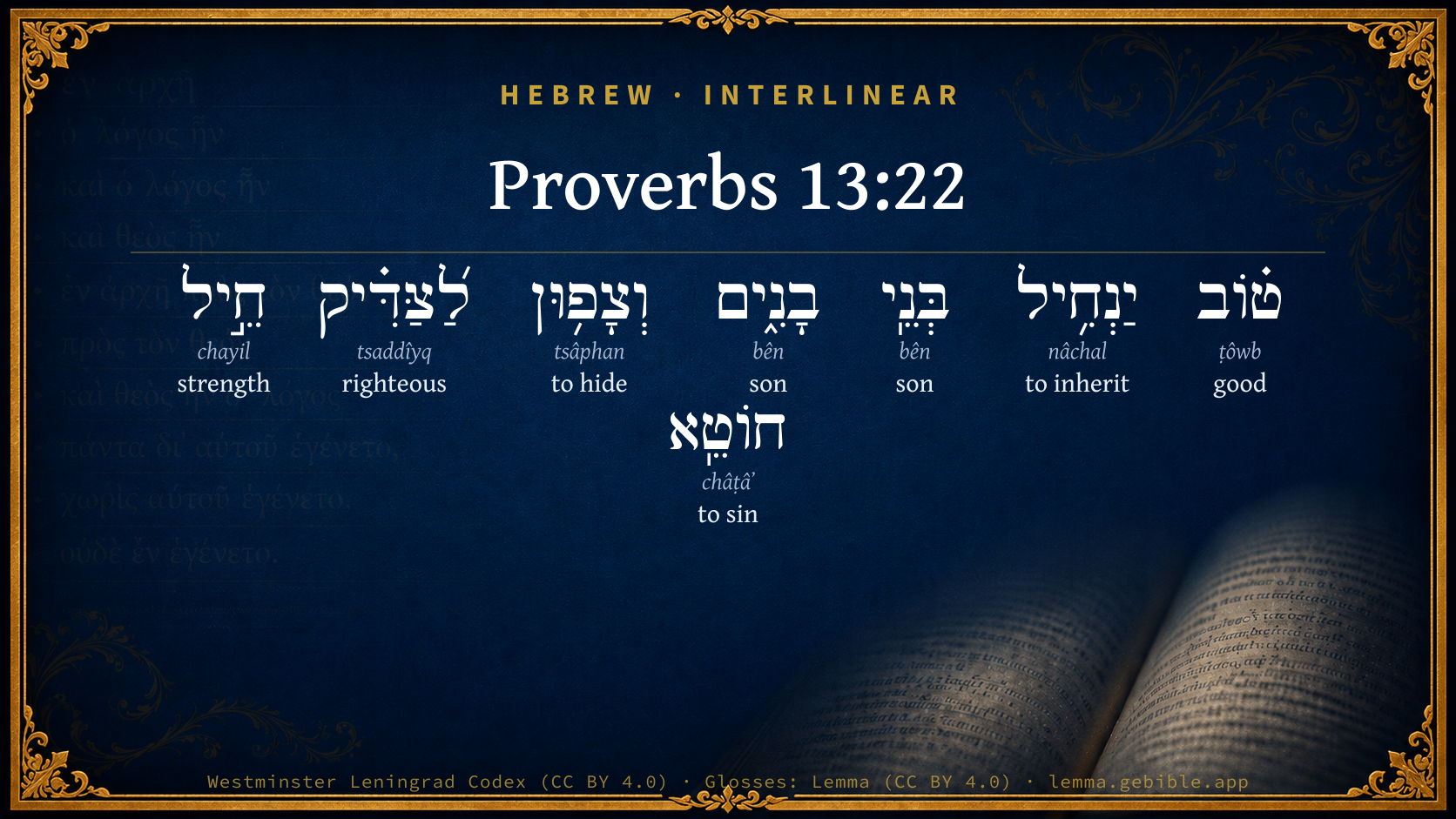
  1. ט֗וֹב ṭôwb H2896 “good” Adjective, Adjective, Masculine, Singular, Absolute
  2. יַנְחִ֥יל nâchal H5157 “to inherit” Verb, Hiphil, Imperfect, 3rd Person, Masculine, Singular
  3. בְּנֵֽי bên H1121 “sons of” Noun, Common, Masculine, Plural, Construct
  4. בָנִ֑ים bên H1121 “sons” Noun, Common, Masculine, Plural, Absolute
  5. לַ֝צַּדִּ֗יק tsaddîyq H6662 “to/for the · righteous” Preposition, Determined + Adjective, Adjective, Masculine, Singular, Absolute
  6. חֵ֣יל chayil H2428 “strength of” Noun, Common, Masculine, Singular, Construct
  7. חוֹטֵֽא châṭâʼ H2398 “sinning” Verb, Qal, Participle Active, Masculine, Singular, Absolute

About this verse

These counts appear in no published source. They are computed here, from the morphology-tagged text and Lemma’s own curated glosses. What Lemma adds →

8
words
7
distinct lemmas
Wisdom
section

Shared distinctive vocabulary

וְצָפ֥וּן to hide H6845 occurs in 31 verses of the Hebrew Bible. Also found in:

Grammatical profile

  • 3 verbs
  • 3 nouns
  • 2 adjectives

Verb forms

  • יַנְחִ֥יל Hiphil · Imperfect
  • וְצָפ֥וּן Qal · Participle Passive
  • חוֹטֵֽא Qal · Participle Active

Repetition

A word recurs within this verse — often emphatic in Hebrew:

  • בְּנֵֽי son H1121 ×2

Hebrew & Septuagint length

In English translation the verse runs 21 words from the Hebrew and 19 from the Septuagint (LXX English) — closely comparable.

A rough comparison of the two English renderings, which tokenize alike — not a word-level alignment.

Word counts can differ between the Hebrew and the Greek without any difference in meaning — e.g. the Hebrew direct-object marker אֵת has no separate Greek word, and Greek often adds the article ὁ.

In the original languages it is 8 Hebrew tokens and 10 Greek tokens — but the two are counted differently (Hebrew bundles its prefixes and suffixes into one token; the Greek is in lemma form), so that isn’t a like-for-like length.

Cross-references

10

Topical passages linked to Proverbs 13:22 in the Treasury of Scripture Knowledge — connected by theme and wording, ordered by reader-vote popularity; previews shown in the World English Bible.

  • Ecclesiastes 2:26 For to the man who pleases him, God gives wisdom, knowledge, and joy; but to the sinner he gives travail, to gather and to heap up, that he may give to him who pleases God. This also is vanity and a chasing after wind.
  • Job 27:16–17 Though he heap up silver as the dust, And prepare clothing as the clay;
  • Proverbs 28:8 He who increases his wealth by excessive interest Gathers it for one who has pity on the poor.
  • Psalms 37:25 I have been young, and now am old, Yet I have not seen the righteous forsaken, Nor his children begging for bread.
  • Psalms 112:2 His seed will be mighty in the land. The generation of the upright will be blessed.
  • Genesis 17:7–8 I will establish my covenant between me and you and your seed after you throughout their generations for an everlasting covenant, to be a God to you and to your seed after you.
  • Psalms 25:12–13 What man is he who fears Yahweh? He shall instruct him in the way that he shall choose.
  • Ezra 9:12 now therefore don't give your daughters to their sons, neither take their daughters to your sons, nor seek their peace or their prosperity forever; that you may be strong, and eat the good of the land, and leave it for an inheritance to your children forever.
  • Psalms 128:6 Yes, may you see your children's children. Peace be upon Israel.
  • Psalms 102:28 The children of your servants will continue. Their seed will be established before you."

Cross-references courtesy of OpenBible.info (CC BY 4.0).

Hebrew and Greek witnesses Masoretic Hebrew ↔ Greek Septuagint

The same verse in the two great witnesses to the Old Testament, shown verse-for-verse.

These are two independent witnesses, not word-aligned to each other, and the Septuagint is shown in lemma (dictionary) form.

Hebrew Proverbs 13:22 Masoretic · Westminster Leningrad Codex

ט֗וֹב יַנְחִ֥יל בְּנֵֽי בָנִ֑ים וְצָפ֥וּן לַ֝צַּדִּ֗יק חֵ֣יל חוֹטֵֽא

A good man leaves an inheritance to his children's children, But the wealth of the sinner is stored for the righteous.

World English Bible · Public Domain

Greek LXX Proverbs 13:22 Septuagint · lemma form

ἀγαθός ἀνήρ κληρονομέω υἱός υἱός θησαυρίζω δέ δίκαιος πλοῦτος ἀσεβής

A good man shall inherit children's children; and the wealth of ungodly men is laid up for the just.

LXX2012 (modern English Septuagint) · Public Domain

Hebrew: Westminster Leningrad Codex (CC BY 4.0). Greek: Septuagint (public domain); English from LXX2012 (modern English Septuagint) (Public Domain). How the Septuagint differs from the Hebrew →

Commentary

Notes on Proverbs 13:22 from classic Christian and Jewish commentators (each source and its license shown beneath its notes). The classic Christian expositions comment on the surrounding passage and are grouped to its opening verse, so a note may address several verses; the Jewish commentaries on the Tanakh (Rashi and others) are per-verse, so they appear only where the commentator wrote on this verse.

Lemma curates 59 commentaries, every one of them public domain or Creative Commons licensed, each selected and text-cleaned for this edition rather than reprinted as found. About our sources →

Trapp's Complete Commentary

John Trapp

Pro 13:22 A good [man] leaveth an inheritance to his children’s children: and the wealth of the sinner [is] laid up for the just.

Ver. 22. A good man leaveth inheritance to his child.] Personal goodness is profitable to posterity. God gives not to his servants some small annuity for life only, as great men used to do; but "keepeth mercy for thousands" of generations "of them that fear him" {Exo 34:7} - (where the Masorites observe Nun-Rabbath, a large N, in the word Notsot, "keepeth," to note the large extent of God’s love to the good man’s posterity.) God left David "a lamp in Jerusalem," {1Ki 15:4} although his house were not so with God. {2Sa 23:5}

And the wealth of the sinner is laid up for the just.] As Nabal’s was for David, Haman’s for Mordecai, the Canaanites’ for the Israelites. Howbeit this holds not perpetually and universally in every wicked person; for some of them are "full of children, and leave the rest of their substance for their babes." {Psa 17:14} Hereupon "their inward thought is, that their houses shall continue for ever; they call their lands after their own names" - as Cain called his new built city after the name of his son Enoch {Gen 4:17} - "this their way is their folly" - or, is their constant hope, for the word signifies both - "and their posterity approve their sayings," and vote the same way. {Psa 49:11; Psa 49:13} But together with their lands, they bequeath their children their sins and punishments, which is far worse than that legacy of leprosy that Joab left his issue. {2Sa 3:29} Compare Job 27:16-17 Isa 61:5.

John Trapp, A Commentary or Exposition upon All the Books of the Old and New Testament (1647–1656) — public domain. Text from a community e-Sword module.

The Biblical Illustrator

Joseph S. Exell

Pro_13:22

A good man leaveth an inheritance to his childrens children

The inheritance of a good mans children

The happiness of men depends less on their external conditions than on their personal virtues.

A good man is satisfied from himself. The effects of a mans habits are transmitted to his children, and even to their descendants. They derive from his character a sufficient and a permanent inheritance.

I. The instruction of a good man is an inheritance to his children. The habits which a young man acquires under his fathers eye are the foundations of his character. Even talents are subordinate to virtues, and good affections are of more importance in human life than the most splendid ornaments of an unprincipled mind. He who adds to good paternal character the principles of liberal knowledge and the views of a liberal mind sends his children into the world with those precious endowments without which the wealth of the rich serves only to render them more conspicuously contemptible or unhappy. Men of the same worth are not equally qualified for the duties of parental tuition, and their children have not the same advantages. But there is a minuteness and an affection in the paternal care of a good man which supplies the lack of many talents. His children venerate his intentions, even where his judgment has failed him.

II. The example of a good man is an inheritance to his children. The character of a father lies at the foundation of his influence, and the effect of his paternal solicitude depends on it. His habits are his most successful admonitions, and the examples of religion and probity which his children receive from the general tenor of his temper and conduct are his most permanent instructions. If he has convinced his children that he derives his motives and his consolations from the sincerity of his faith, and that he allows no competition to be in his mind betwixt the praise of men and the approbation of God, his example does more to determine their habits than his best instructions. There are certainly defects in all human characters which render our best examples to our children very imperfect. But even habitual errors in a good man are not vices, and defects and infirmities do not prevent the influence of substantial virtues.

III. The care and protection of providence are an inheritance to a good mans children. A good man will use his best endeavour to qualify his children for the business and duties of life; but his chief dependence is on Providence. He commits his children to God. His paternal labours are sanctified by prayer. It is an ever-working law that God shows mercy unto thousands of them that love Him, and to their children after them. The testimony of ages shows that this law has its full effect, and warrants the confidence with which devout men commit their children to God. The influence of God on the circumstances which regulate our lot is real and perpetual, amidst all the irreligion and incredulity of the world. The plan of Providence is not so uniform as to render it certain that the children of good men will be always prosperous, Their own misconduct often determines their conditions; so may errors in their early education; so may the moral discipline which they require.

IV. The kindness of faithful men is an inheritance to a good mans children. Their success in life must in part depend on the assistance and the friendship of other men, and the purposes of Providence in their favour are accomplished by means of those whom God raises up to assist, or to guide them. God selects the instruments of His purpose from all the variety of human characters. Kindness done to the child of a good man may become the means of transmitting virtue and prosperity through successive generations. Practical conclusions:

1. The indispensable obligation of every father to give to his children the inheritance of the faithful.

2. The children of good men ought anxiously to preserve the moral and religious advantages which they have received from their fathers.

3. Every conscientious man should feel a personal obligation to help in ensuring to the children of good men the inheritance bequeathed to them by their fathers. (Sir H. M. Wellwood.)

The advantage of having godly parents

What so interesting as children? Children are pledges of mutual and hallowed affection. Love to children is the source of numberless and unutterable hopes and fears, and pains and pleasures. It is the emblem of Divine compassion. As a father pitieth his children. If parents are affected by the condition of children, children are affected by the conduct of parents. We constantly see children, in ways innumerable, suffering for the vices of their ancestors. The fact is undeniable; and deism has to encounter the same difficulty with revelation. Religion is no more chargeable with it than the course of nature. On the other hand, goodness operates powerfully and beneficially in descent. In the text we have a godly father entailing blessings on his family.

I. The character in question is a good man. None are good perfectly; none are good naturally; some are saved, and God has begun a good work on them. This is the origin of the character; but what are the features of it?

1. In a good man we must have piety.

2. We must have sincerity.

3. We must have uniformity.

4. We must have benevolence and beneficence.

II. Such a good man may be found in connected life. His religion will improve all those views and feelings that tend to make him social and useful. The Scripture knows nothing of any pre-eminence attaching to celibacy. Though the subject is spoken of in reference to the man, the woman is by no means excluded. To a family, a good mother, no less than a good father, is an invaluable blessing.

III. Examine what the inheritance is which a good man leaves to his offspring.

1. It comprehends religious instructions.

2. Pious example.

3. It takes in believing prayers.

4. It consists of sanctified substance.

5. The death of a good man is another part of this inheritance.

6. God bears a regard to the descendants of His followers. (William Jay.)

The wealth of the sinner is laid up for the just.--

Material wealth

I. As entailed by the good and alienated by the evil. Here we have it--

1. Entailed by the good. A good man leaveth an inheritance to his childrens children. It is a characteristic in man that he feels an interest in posterity. This is an indication of the greatness of mans nature. It is here intimated by Solomon that the good have some special security by which their property shall descend to their childrens children. And truly they have; and what is it? The probable goodness of their childrens children.

2. Alienated by the evil. Wickedness, from its very nature, cannot hold property through many generations: the fortunes it inherits must crumble away.

II. As gained by industry and squandered by imprudence. Every acre of land is full of potential wealth. Skilled industry can make more of one rood of earth than some men can an acre. But it requires even more sense to retain and rightly use property than to get it. (Homilist.)

An inheritance that will wear

When the renowned Admiral Haddock was dying he begged to see his son, to whom he thus delivered himself--Notwithstanding my rank in life and public services for so many years, I shall leave you only a small fortune; but, my dear boy, it is honestly got, and will wear well; there are no seamens wages or provisions in it, nor is there one single penny of dirty money.

The Biblical Illustrator, edited by Joseph S. Exell (c. 1880s–1900s) — public domain. Text from a community e-Sword module.

Joseph Benson's Commentary

Pro 13:22. A good man leaveth an inheritance, &c. — “A man that doeth good with his estate, takes the surest course to settle it upon his posterity for many generations;” and the wealth, &c. — Rather, but the wealth of the sinner, “of him who regards nothing but his own sinful lusts and pleasures, shall be transferred from his family into one that is truly virtuous.”

Joseph Benson's Commentary on the Old and New Testaments (1811–1818) — public domain. Text from a community e-Sword module.

The Preacher's Complete Homiletical Commentary

Joseph S. Exell (gen. ed.)

MAIN HOMILETICS OF Pro_13:22

AS INHERITANCE INCORRUPTIBLE

I. A good man has always spiritual inheritance to leave his children. He has always his own holy character and example. And this is often of great service to them in a material point of view. Men who have obtained fame in the world leave their children the inheritance of a famous name, which is often a fortune in itself. The son or daughter of a famous man can command positions of worldly advantage which are closed against the children of obscure parents. But while a famous father can leave his fame as an inheritance to his children he cannot ensure to them the possession of the genius by which he gained it. Talent is not hereditary, and it often happens that a very gifted father has very common-place children. But moral worth—a godly character—is an inheritance that not only makes a son respected in the world for his father’s sake, but is very likely to make him also a partaker of the same godliness. A good man’s character is not hereditary, but it is very apt to propagate other characters of the same kind. This inheritance of a good man is an incorruptible inheritance. No inheritance of lands or money are entirely out of reach of the changes and chances of human life, but the example, and the memory, and the blessings which have come from a godly parentage, make an inheritance which, like the heavenly one, “fadeth not away.” It is the best possible safeguard that a father can leave his children against the temptations of the world, the flesh, and the devil. The remembrance of what belief in the Gospel did for a holy father has saved many a son from drifting on the quicksands of infidelity. There have been times in the history of many a child of godly parents, when such an anchor has been the only one which has held them from “making shipwreck of faith” (1Ti_1:19). The character of a good man is such an indisputable fact, and is so entirely unexplainable on any other ground than that of the existence of a supernatural and Divine power, that it constitutes an unanswerable argument for the truth of revelation. And so with every other form of evil that assails men. The inheritance which Christ has left to his disciples—to His spiritual children—is His character. This has produced and reproduced its own kind through all the ages since His sojourn upon earth. This has held them to the faith in the dark days of persecution. And when the infidel himself has come face to face with it, even he has been compelled to acknowledge the intrinsic worth of the children’s portion. This holy life, lived among sinful men, has been the “unsearchable riches” (Eph_3:8) of one Christian generation after another, for more than eighteen centuries, and it is by virtue of this inheritance that good men have been enabled to transmit to their posterity their own godly lives and examples.

II. A good man may have a material as well as a moral inheritance to bequeath. He may possess both character and substance. But the fact that a man is good is no guarantee that he will have any worldly wealth to leave behind him. If Lord Bacon’s assertion be correct, that “Prosperity is the blessing of the Old Testament, and adversity the blessing of the New,” he is quite as likely to die poor as rich. Still there is often a blessing of some amount of material riches given to honest labour, and probably there are far more godly men in proportion to their number, who acquire some inheritance to leave behind them, than there are godless men (See on Pro_13:11, etc.)

III. Good men sometimes inherit wealth which has been gathered by bad men. It is not a universal rule, but it may be oftener fulfilled than we are aware of. It may be inherited by generations of wicked men and at last come into the hands of a just one. That it should be so is seen to be a wise and good law of providence.

1. Because a good man will make a far better use of “the mammon of unrighteousness.” He will use it to minister to both the bodily and spiritual needs of his fellow-creatures as well as his own.

2. Because the laid-up wealth of the wicked has often been obtained by defrauding the good. God does not always cause it to be repaid to the identical persons who were thus defrauded, but He may often cause it to be restored to identical characters. This proverb must be taken to assert the straightforward motion of the wheels of providence, although by reason of their “great height” (Eze_1:18),—their vast circumference—they take a long time to go round.

OUTLINES AND SUGGESTIVE COMMENTS

The usurer lightly begets blind children that cannot see to keep what their father left them. But when the father is gone to hell for gathering, the son often follows for scattering, But God is just.—T. Adams.

That the wealth of the sinner is laid up for the just appears to have been a prominent feature of the Old Dispensation (chap. Pro_28:8; Job_27:16-17), and it will be openly renewed in the latter-day glory of the Church (Isa_61:6).—Bridges.

This is the direct promise of heaven (Psa_103:17; Pro_22:6). That it ever fails, must be by palpable neglect. A man may be saved himself, and lose his children; but the Bible speaks of this as the parent’s fault (1Sa_3:13; Pro_13:24), and brands it as the great curse upon the earth (Mal_4:6). While the sinner not only cannot send down his wealth, but cannot himself possess it. It is a curse to him. It will be used for the saints (Mat_25:28).—Miller.

It is quite clear that in this and other passages an inheritance is regarded as a good, and that no blame is attached to “the good man” who leaves it to his children. The principle expressed in the latter clause is the same as that laid down by the apostle, “All things are yours,” and, among other things, “the world.” That may most truly be called mine, from which I derive the greatest possible benefit it can be made to yield. It would be strange, indeed, were I to wish anything else, or anything more.… The wicked man calls his wealth his own. But it is God’s. God is the friend of His children, and holds that property, like everything else, for their good; so that it is theirs by being His.—Wardlaw.

Personal goodness profiteth for posterity. God gives not to His servants some small annuity for life only, as great men used to do, but “keepeth mercy for thousands” of generations “of them that fear Him.” The opposite is not perpetually and universally true of every wicked person, … but, together with their lands, they bequeath their children their sins and punishments, which is far worse than that legacy of leprosy that Joab left his issue (2Sa_3:29).—Trapp.

An expression of trust like that in Ecc_2:26, that in the long run the anomalies of the world are rendered even.—Plumptre.

The Preacher's Complete Homiletical Commentary (gen. ed. Joseph S. Exell; Funk & Wagnalls, c. 1892) — public domain (pre-1929). A full-Bible homiletical/sermon-outline anthology covering 65 of 66 books (2 John is absent from the source module). Text from a community e-Sword module.

Geneva Bible (1599)

Geneva Bible translators

Read Job 27:16, 17.

Geneva Bible (1599) marginal notes — public domain. Text via Bolls.life.

Matthew Henry's Commentary

See here, 1. How a good man's estate lasts: He leaves an inheritance to his children's children. It is part of his praise that he is thoughtful for posterity, that he does not lay all out upon himself, but is in care to do well for those that come after him, not by withholding more than is meet, but by a prudent and decent frugality. He trains up his children to this, that they may leave it to their children; and especially he is careful, both by justice and charity, to obtain the blessing of God upon what he has, and to entail that blessing upon his children, without which the greatest industry and frugality will be in vain: A good man, by being good and doing good, by honouring the Lord with his substance and spending it in his service, secures it to his posterity; or, if he should not leave them much of this world's goods, his prayers, his instructions, his good example, will be the best entail, and the promises of the covenant will be an inheritance to his children's children, Psa 103:17. 2. How it increases by the accession of the wealth of the sinner to it, for that is laid up for the just. If it be asked, How should good men grow so rich, who are not so eager upon the world as others are and who commonly suffer for their well-doing? It is here answered, God, in his providence, often brings into their hands that which wicked people had laid up for themselves. The innocent shall divide the silver, Job 27:16, Job 27:17. The Israelites shall spoil the Egyptians (Exo 12:36) and eat the riches of the Gentiles, Isa 61:6.

Matthew Henry's Commentary on the Whole Bible (1708–1710) — public domain (CC PDM 1.0). Text via the HelloAO Bible API.

Jamieson, Fausset & Brown

Robert Jamieson, A. R. Fausset & David Brown

wealth . . . just--While good men's estates remain in their families, God so orders that the gains of sinners enure to the just (compare Pro 28:8; Psa 37:18, Psa 37:22, Psa 37:26, &c.).

Jamieson, Fausset & Brown — Commentary Critical and Explanatory on the Whole Bible (1871) — public domain (CC PDM 1.0). Text via the HelloAO Bible API.

Adam Clarke's Commentary

Verse 22. A good man leaveth an inheritance] He files many a prayer in heaven in their behalf, and his good example and advices are remembered and quoted from generation to generation. Besides, whatever property he left was honestly acquired, and well-gotten goods are permanent. The general experience of men shows this to be a common case; and that property ill-gotten seldom reaches to the third generation. This even the heathens observed. Hence:

De male quaesitis non gaudet tertius haeres.

"The third generation shall not possess the

goods that have been unjustly acquired."

Adam Clarke's Commentary on the Bible (1810–1826) — public domain. Text from a community e-Sword/MySword module.

Ellicott's Commentary for English Readers

(22) A good man.—As this corresponds to the “just” man in the next line, who is one who “renders to all their due” (see above on Pro_10:2), it probably has the meaning here of “liberal,” “unselfish;” such a one gains the promise given in Pro_11:25.

A Bible Commentary for English Readers, edited by Charles John Ellicott (1878–1897) — public domain. Text from a community e-Sword module.

John Gill's Exposition

A good man leaveth an inheritance to his children's children,.... He not only has a sufficiency for the present support of himself and family; but is so prospered and succeeded, as to leave an inheritance after him; and which is continued to and enjoyed, not only by his immediate offspring, but theirs also; for being got honestly, it wears well; see Pro 13:11;

and the wealth of the sinner is laid up for the just; the riches which wicked men get are laid up in the purposes of God for good men; and in his providence they are translated from the one to the other: so the riches of the Egyptians were designed for the Israelites, and by the providence of God were put into their hands; see Job 27:16.

John Gill's Exposition of the Whole Bible (1746–1763) — public domain (CC PDM 1.0). Text via the HelloAO Bible API.

Albert Barnes' Notes on the Bible

An expression of trust, that in the long run the anomalies of the world are rendered even (compare the marginal references). The heaped up treasures of the wicked find their way at last into the hands of better men.

Albert Barnes' Notes on the Bible (1834–1885) — public domain. Text from a community e-Sword/MySword module.

Haydock's Catholic Bible Commentary

Heirs. This was more observable under the old law: yet we often seem the distress to which the unjust are exposed. De male quæsitis non gaudet tertius hæres. (Calmet)

George Leo Haydock (1774–1849), Haydock's Catholic Family Bible and Commentary, 1859 edition — public domain. Excludes Psalms (Douay-Rheims chapter numbering differs from Protestant) and Deuterocanonical books (Catholic canon only).

Matthew Poole's English Annotations

Is by God’s powerful providence ofttimes translated to good men of another family, who will be more faithful stewards of it.

Matthew Poole's English Annotations on the Holy Bible (1683–1685) — public domain. Text from a community e-Sword/MySword module.

Whedon's Commentary on the Bible

Daniel D. Whedon

22. A good man — One who is good and doeth good — a benevolent man.

An inheritance to his children’s children — Namely, in the remembrance of his piety, love, and compassion. A great truth, which should be well pondered by those on whom Providence has liberally bestowed the blessings of this life.

Daniel D. Whedon (gen. ed.), Commentary on the Old and New Testaments (1874–1909) — public domain. Text from a community e-Sword module.

The Pulpit Commentary

A good man leaveth an inheritance to his children"s children. This would be especially notable where a system of temporal rewards and punishments was expected and generally experienced. The wealth of the sinner is laid up for the just. Property unjustly acquired, or wickedly used, is taken from those who have it, and ultimately finds its way into better hands. They cannot keep it, and consequently cannot leave it to their children. "De male quaesitis non gaudet tertius haeres." "Ill-gotten wealth no third descendant holds.

This has often been the fate of property obtained by the sacrilegious seizure of what was dedicated to God"s service. For the general view of the clause, comp. Pro_28:8 Job_27:16, 17 Ecc_2:26; and the case of Jacob, (Gen_31:9) and the Israelites, (Exo_12:35, Exo_12:36) when "the righteous spoiled the ungodly". (RAPC Wis 10:20)

The Pulpit Commentary (1880–1919), ed. H.D.M. Spence-Jones & Joseph S. Exell — public domain. Text from a community e-Sword module.

Keil & Delitzsch

C. F. Keil & F. Delitzsch

22 The good man leaveth behind him for his children's children,

And the wealth of the sinner is laid up for the just.

As a commencing word, טוב signifies in the Mishle for the most part bonum (prae); but here, as at Pro 12:2, cf. Pro 22:9; Pro 14:4, it signifies bonus. As the expression that God is טוב (Psa 25:8, etc.) of the O.T. is equivalent to the N.T. that He is ἀγάπη, so that man who in his relation to others is determined by unselfish love is טוב for the good man [der Gtige], i.e., the man who is willing to communicate all good is truly good, because the essence of צדקה, righteousness of life, is love. Such an one suffers no loss by his liberality, but, according to the law, Pro 11:25, by which a dispenser of blessings is at the same time also a recipient of blessings, he has only gain, so that he makes his children's children to inherit, i.e., leaves behind him an inheritance extending even to his grandchildren (vid., regarding הנחיל, p. 182; here trans. as containing its object in itself, as at Deu 32:8 : to make to inherit, to place in possession of an inheritance). The sinner, on the contrary (חוטא sing. to חטּאים, ἁμαρτωλοί), loses his wealth, it is already destined to pass over to the righteous who is worthy of it, and makes use (cf. Job 27:17) of that which he possesses in accordance with the will and appointment of God - a revelation of justice appertaining to time, the exceptions to which the old limited doctrine of requital takes no notice of. חיל, strength, then like our "Vermgen" (cf. opes, facultates), that by means of which one is placed in circumstances to accomplish much (Fl.); cf. regarding the fundamental idea contorquere, compingere, p. 226, also regarding צפן, properly condensare, then condere, p. 61.

Keil & Delitzsch — Biblical Commentary on the Old Testament (1861–1891) — public domain (CC PDM 1.0). Text via the HelloAO Bible API. (Old Testament only.)

Bridges on Proverbs

Charles Bridges

Here we have particular instance of the good to be repaid to the righteous. It cannot however be meant as an universal statement. Many good men have no inheritance to leave; or they have no children; or none that survive them; or no children’s children; or this generation may be in poverty. The wealth of the sinner also, instead of being laid up for the just, descends to his posterity for successive generations. (Psa 17:14 .) Yet Scripture gives many examples of this dispensation of Providence; shewing the blessing of personal godliness to unborn posterity. Abraham left his covenanted inheritance to his children’s children.†1 Caleb’s children inherited their father’s possession.†2 "Although David’s house was not so with God" as he could have desired; yet his lamp continued to burn for upwards of seventeen generations.†3 Often also has the Divine blessing upon the discreet guidance of his affairs (Psa 112:5 ), and the special promise of Christian liberality (Pro 3:9-10 ), preserved the good man’s inheritance. And if there is no earthly substance to leave; yet a church in the house; a family altar; the record of holy example and instruction; and above all, a store of believing prayer laid up for accomplishment, when we shall be silent in the grave — will be an inheritance to our children of inestimable value. For though no trust can be placed in hereditary religion (Joh 1:13 ); yet the recollection of the path in which their fathers walked, and in which they themselves were trained, may, under God’s grace, continue a godly entail in our families, so that "instead of the fathers may be the children." (Psa 78:5-6 ; Psa 45:16 .)

But the good man’s inheritance is also increased from the wealth of the sinner. Laban’s wealth was laid up for Jacob;†4 the spoils of Egypt and Canaan†5 for Israel; Haman’s wealth for Esther and Mordecai.†6 Indeed this appears to have been a prominent feature of the Old Dispensation (Pro 28:8 . Job 27:16-17 ); and it will be openly renewed in the latter-day glory of the Church. (Isa 61:6 .) Probably therefore the fulfillment is far more frequent than meets the eye. Often also the wealth of the sinner, laid up for the aggrandizement of his own name in his posterity, becomes the portion of the just in their own holy seed; consecrated to the service of their Lord and his Church (Ecc 2:26 .)

Footnotes:

†1 Gen 17:7-8. Psa 112:2 .

†2 Jos 14:14.

†3 2Sa 23:5 . 2Ch 21:7 .

†4 Gen 31:1, Gen 31:9, Gen 31:16 .

†5 Exo 12:35-36. Jos 11:14 . Psa 105:44 .

†6 Est 8:1-2.

Charles Bridges, An Exposition of the Book of Proverbs (1846) — public domain. Text from a community e-Sword module.

Kretzmann's Popular Commentary

Paul E. Kretzmann

v. 22. A good man leaveth an inheritance to his children’s children, his estate being transmitted to them complete, as a result of God’s blessing upon him; and the wealth of the sinner is laid up for the just, the latter eventually becoming the possessor of that which the sinner squanders.

Paul E. Kretzmann, Popular Commentary of the Bible (1921–1924) — public domain. Text from a community e-Sword module.

Rashi

Rabbi Shlomo Yitzchaki (Rashi)

A good man will leave an inheritance of his merit and his property to his sons’ sons, but a sinner does not leave over an inheritance to his sons, for his wealth and his property are laid away for the righteous, as it is written (Esther 8:2): “And Esther set Mordecai over the house of Haman.”

Rashi on the Tanakh — English translations: “The Judaica Press complete Tanach with Rashi, translated by A. J. Rosenberg” (CC BY 4.0); “Pentateuch with Rashi's commentary by M. Rosenbaum and A.M. Silbermann, 1929-1934” (public domain); “The Metsudah Tanach series, Lakewood, N.J” (CC BY 4.0); and “The Book of Joshua, Metsudah Publications, 1997” (CC BY 4.0). Text via Sefaria.

Lesson kit

Teaching starters — assembled from the data on this page, not authored interpretation. Every prompt links to the verse data it draws on. Edit before teaching.

Proverbs, in the Wisdom, opens this verse with 8 words (7 distinct Hebrew lemmas). Its most distinctive word is tsâphan (“to hide”). A historical commentator’s framing appears above. Read the whole chapter for the surrounding context.

Discussion questions

  1. The word tsâphan carries the sense “to hide.” How does it shape the verse?
  2. How does Exodus 2:2, which shares the word «to hide», read alongside this verse?
  3. What does the repetition of “son” (2× in this one verse) do in this verse?
  4. These translations render this verse differently; the difference is in the English rendering, not the original. What questions does that raise?
  5. «יַנְחִ֥יל» is a Hiphil Imperfect verb. How does that grammatical form shape the action described?
  6. Compare how Trapp's Complete Commentary and The Biblical Illustrator read this verse. Where do they agree or differ?

Things to notice

Reading settings

Reading text

Shown beneath each verse's original-language words.

Old Testament
Old Testament edition

Read the OT as the Masoretic Hebrew (MT) or the Greek Septuagint (LXX).

English shown for the Greek Septuagint (in the Hebrew ↔ Greek comparison).

Comparing translations? Open the Compare panel on any verse page to stack up to four side by side.