Psalms 76:5

Hebrew (Westminster Leningrad Codex) Psalms 76:5 appears in the Hebrew Old Testament. The text above is from the Westminster Leningrad Codex. Each word links to its Strong’s number, a concise gloss, and parsing drawn from the Open Scriptures Hebrew Bible morphology. Click any word for its full Brown-Driver-Briggs (BDB) entry.
Download image
Cite this verse

Psalms 76:5 (World English Bible). Public Domain. Lemma interlinear Bible study tool, https://lemma.gebible.app/v/psalms/76/5.

Show BibTeX & RIS
BibTeX
RIS
English Translation
Valiant men lie plundered, They have slept their last sleep. None of the men of war can lift their hands.
World English Bible · Public Domain
Highlights
  • 1 first appearance in the Hebrew Bible
Full analysis ↓
Download a study sheet

One document with this verse’s original text, its word-by-word gloss line, the meaning frame, cross-references with their text, attributed commentary, and full source and license credits — printable, and it pastes into notes with its structure intact.

This verse Autodidact and up

Study sheet (.html) Plain text (.txt)

A passage Seminary Student

Up to 50 verses in one chapter. A passage sheet keeps up to 6 commentary sources and 12 cross-references per verse, in the order this page ranks them, and says so on the sheet whenever that leaves anything out. Ask for a single verse and you get the Autodidact verse sheet above.

Everything on this page stays free to read, with no account — the sheet is a download of what is already on screen, not access to it.

Want to remove ads? Support Godless Engineer
Compare translations 3

The same verse in 3 English versions, stacked beneath the original-language interlinear above. Click any original word for its lexicon entry.

Each is an independent rendering of the whole verse — the interlinear is not word-aligned to these translations.

Highlighted words mark where these versions differ — a whole-verse word diff, not a word-by-word alignment.

  • World English Bible Public Domain
    Valiant men lie plundered, They have slept their last sleep. None of the men of war can lift their hands.
  • King James Version Public Domain
    The stouthearted are spoiled, they have slept their sleep: and none of the men of might have found their hands.
  • unfoldingWord Literal Text CC BY-SA 4.0
    The stout of heart were plundered; they slept their sleep, and all of the men of strength found not their hands.

unfoldingWord Literal Text — © unfoldingWord, licensed CC BY-SA 4.0. Word-aligned USFM3 via Door43 (git.door43.org/unfoldingWord/en_ult).

Versions to compare (up to 4)

3 of 4 selected

Show all 18 translations

Every available English version of this verse, each an independent rendering of the whole verse.

  • World English Bible Public Domain
    Valiant men lie plundered, They have slept their last sleep. None of the men of war can lift their hands.
  • Berean Standard Bible Public Domain
    The valiant lie plundered; they sleep their last sleep. No men of might could lift a hand.
  • Majority Standard Bible Public Domain
    The valiant lie plundered; they sleep their last sleep. No men of might could lift a hand.
  • King James Version Public Domain
    The stouthearted are spoiled, they have slept their sleep: and none of the men of might have found their hands.
  • American Standard Version (1901) Public Domain
    The stouthearted are made a spoil, They have slept their sleep; And none of the men of might have found their hands.
  • Revised Version (1885) Public Domain
    The stouthearted are spoiled, they have slept their sleep; and none of the men of might have found their hands.
  • Geneva Bible (1599) Public Domain
    The stout hearted are spoyled: they haue slept their sleepe, and all the men of strength haue not found their hands.
  • Douay-Rheims (1899) Public Domain
    Thou enlightenest wonderfully from the everlasting hills.
  • Young's Literal Translation Public Domain
    Spoiled themselves have the mighty of heart, They have slept their sleep, And none of the men of might found their hands.
  • Literal Standard Version CC BY-SA 4.0
    The mighty of heart have spoiled themselves, || They have slept their sleep, || And none of the men of might found their hands.
  • Unlocked Literal Bible CC BY-SA 4.0
    The bravehearted were plundered; they fell asleep. All the warriors were helpless.
  • unfoldingWord Literal Text CC BY-SA 4.0
    The stout of heart were plundered; they slept their sleep, and all of the men of strength found not their hands.
  • Darby Bible Public Domain
    The stout-hearted are made a spoil, they have slept their sleep; and none of the men of might have found their hands.
  • World Messianic Bible Public Domain
    Valiant men lie plundered, they have slept their last sleep. None of the men of war can lift their hands.
  • Webster's Bible Public Domain
    \\76:4\\Thou art more glorious and excellent than the mountains of prey.
  • Free Bible Version CC BY-SA 4.0
    Our most courageous enemies have been plundered. They sleep the sleep of death. Even the strongest of them could not raise a hand against us.
  • Bible in Basic English Public Domain
    Gone is the wealth of the strong, their last sleep has overcome them; the men of war have become feeble.
  • JPS Tanakh (1917) Public Domain
    (76-6) The stout-hearted are bereft of sense, they sleep their sleep; and none of the men of might have found their hands.

Literal Standard Version (2020), Covenant Press — licensed CC BY-SA 4.0. Text via the HelloAO Bible API (eBible.org). Unlocked Literal Bible (unfoldingWord) — licensed CC BY-SA 4.0. Text via the HelloAO Bible API (eBible.org). unfoldingWord Literal Text — © unfoldingWord, licensed CC BY-SA 4.0. Word-aligned USFM3 via Door43 (git.door43.org/unfoldingWord/en_ult). Free Bible Version, Dr. Jonathan Gallagher — licensed CC BY-SA 4.0. Text via the HelloAO Bible API (eBible.org).

Word by word

More ways to search: Search by grammar → Find every occurrence → Compare this word →

Practice this passage: Drill this verse → Learn its vocabulary →

נָמ֣וּ
nûwm
H5123
“to slumber”
Verb, Qal, Perfect, 3rd Person, Common, Plural
Part of Speech
Verb
Stem
Qal
Form
Perfect
Person
3rd Person
Gender
Common
Number
Plural
Full BDB Definition

Origin: a primitive root

TWOT: 1325

to be drowsy, slumber, sleep - (Qal) to slumber, be drowsy
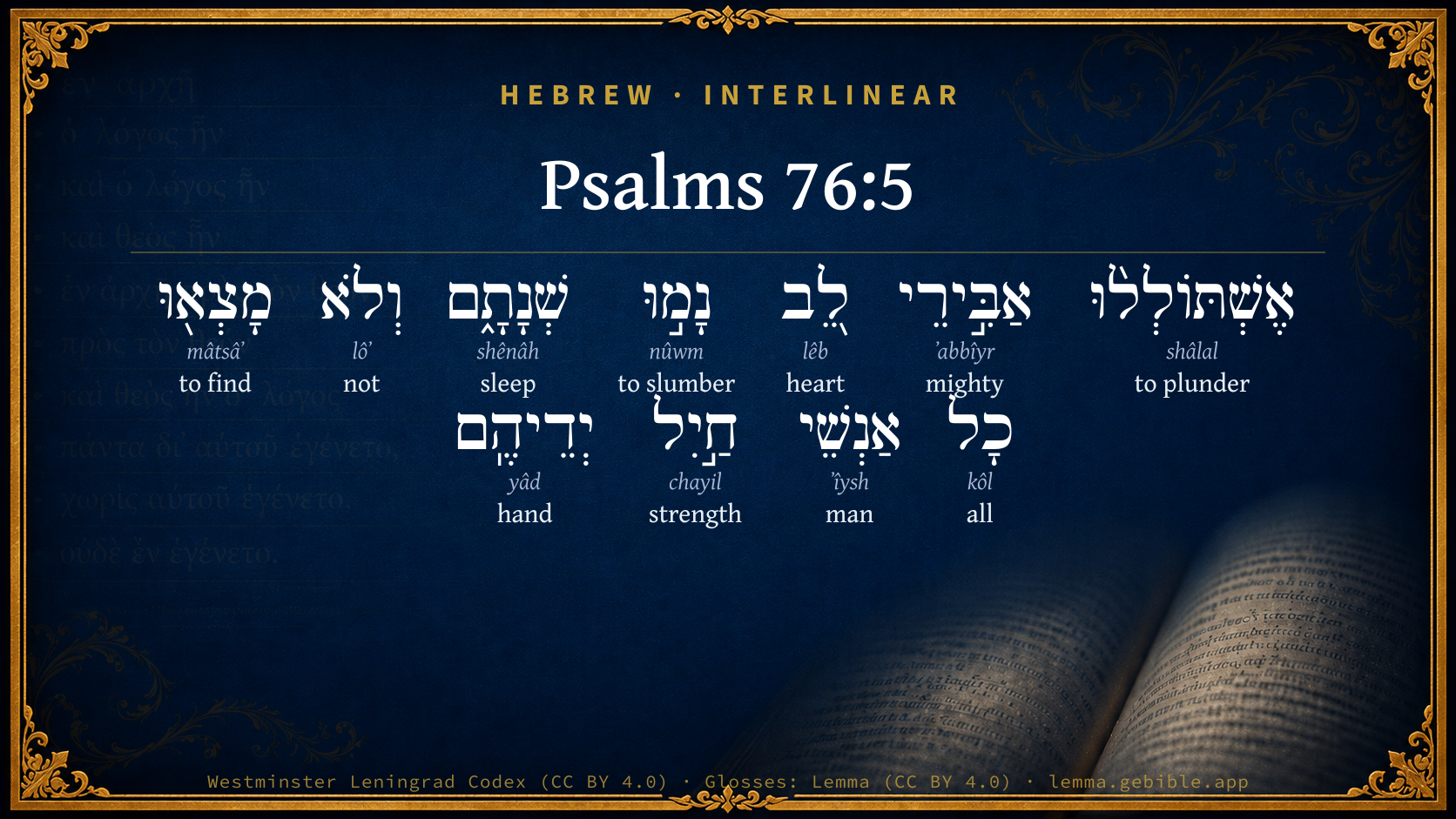
  1. אֶשְׁתּוֹלְל֨וּ shâlal H7997 “to plunder” Verb, Hithpolel, Perfect, 3rd Person, Common, Plural
  2. אַבִּ֣ירֵי ʼabbîyr H47 “mighty of” Adjective, Adjective, Masculine, Plural, Construct
  3. לֵ֭ב lêb H3820 “heart” Noun, Common, Masculine, Singular, Absolute
  4. שְׁנָתָ֑ם shênâh H8142 “sleep · their” Noun, Common, Feminine, Singular, Construct + Suffix, Personal, 3rd Person, Masculine, Plural
  5. וְלֹא lôʼ H3808 “and · not” Conjunction + Particle, Negative
  6. מָצְא֖וּ mâtsâʼ H4672 “to find” Verb, Qal, Perfect, 3rd Person, Common, Plural
  7. כָל kôl H3605 “all of” Noun, Common, Masculine, Singular, Construct
  8. אַנְשֵׁי ʼîysh H376 “men of” Noun, Common, Masculine, Plural, Construct
  9. חַ֣יִל chayil H2428 “strength” Noun, Common, Masculine, Singular, Absolute
  10. יְדֵיהֶֽם yâd H3027 “hands · their” Noun, Common, Both, Dual, Construct + Suffix, Personal, 3rd Person, Masculine, Plural

About this verse

These counts appear in no published source. They are computed here, from the morphology-tagged text and Lemma’s own curated glosses. What Lemma adds →

11
words
11
distinct lemmas
Wisdom
section

Notable vocabulary

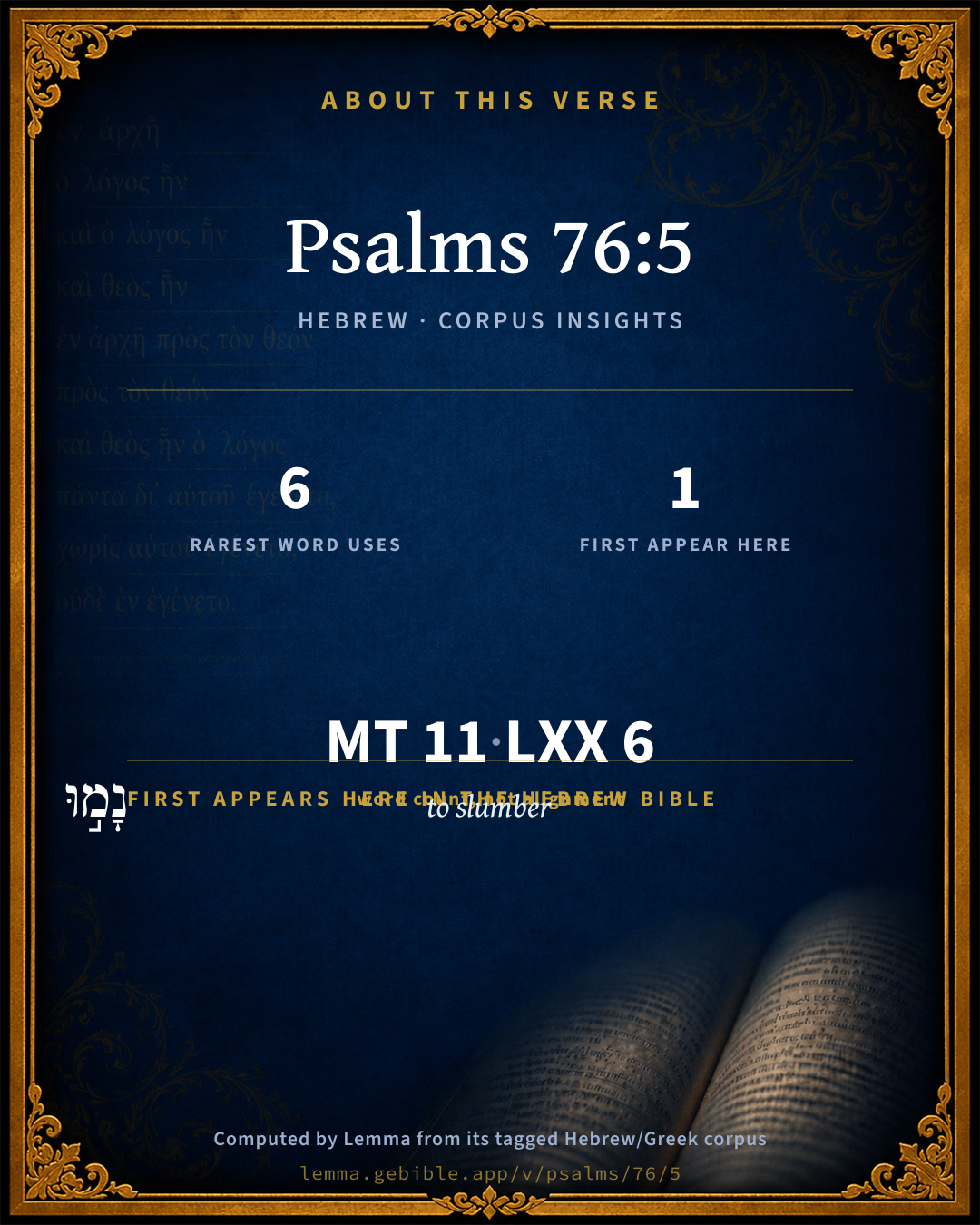
The rarest word here is נָמ֣וּ to slumber H5123 — appearing just 6 times in the whole Hebrew Bible.

First appearance in Scripture

This word makes its first canonical appearance in the Hebrew Bible here:

  • נָמ֣וּ to slumber H5123

Shared distinctive vocabulary

נָמ֣וּ to slumber H5123 occurs in 6 verses of the Hebrew Bible. Also found in:

Grammatical profile

  • 3 verbs
  • 6 nouns
  • 1 adjective
  • 1 particle

Verb forms

  • אֶשְׁתּוֹלְל֨וּ Hithpolel · Perfect
  • נָמ֣וּ Qal · Perfect
  • מָצְא֖וּ Qal · Perfect

Hebrew & Septuagint length

In English translation the verse runs 20 words from the Hebrew and 24 from the Septuagint (LXX English) — closely comparable.

A rough comparison of the two English renderings, which tokenize alike — not a word-level alignment.

Word counts can differ between the Hebrew and the Greek without any difference in meaning — e.g. the Hebrew direct-object marker אֵת has no separate Greek word, and Greek often adds the article ὁ.

In the original languages it is 11 Hebrew tokens and 6 Greek tokens — but the two are counted differently (Hebrew bundles its prefixes and suffixes into one token; the Greek is in lemma form), so that isn’t a like-for-like length.

Cross-references

10

Topical passages linked to Psalms 76:5 in the Treasury of Scripture Knowledge — connected by theme and wording, ordered by reader-vote popularity; previews shown in the World English Bible.

  • Nahum 3:18 Your shepherds slumber, king of Assyria. Your nobles lie down. Your people are scattered on the mountains, and there is no one to gather them.
  • Psalms 13:3 Behold, and answer me, Yahweh, my God. Give light to my eyes, lest I sleep in death;
  • Isaiah 46:12 Listen to me, you stout-hearted, who are far from righteousness:
  • Jeremiah 51:39 When they are heated, I will make their feast, and I will make them drunken, that they may rejoice, and sleep a perpetual sleep, and not wake, says Yahweh.
  • Isaiah 31:8 The Assyrian shall fall by the sword, not of man; and the sword, not of men, shall devour him; and he shall flee from the sword, and his young men shall become subject to forced labor.
  • Isaiah 37:36 The angel of Yahweh went forth, and struck in the camp of the Assyrians one hundred and eighty-five thousand; and when men arose early in the morning, behold, these were all dead bodies.
  • Ezekiel 30:21–25 Son of man, I have broken the arm of Pharaoh king of Egypt; and, behold, it has not been bound up, to apply [healing] medicines, to put a bandage to bind it, that it be strong to hold the sword.
  • Daniel 4:37 Now I, Nebuchadnezzar, praise and extol and honor the King of heaven; for all his works are truth, and his ways justice; and those who walk in pride he is able to abase.
  • Luke 1:51–52 He has shown strength with his arm. He has scattered the proud in the imagination of their heart.
  • Job 40:10–12 "Now deck yourself with excellency and dignity. Array yourself with honor and majesty.

Cross-references courtesy of OpenBible.info (CC BY 4.0).

Hebrew and Greek witnesses Masoretic Hebrew ↔ Greek Septuagint

The same verse in the two great witnesses to the Old Testament, shown verse-for-verse.

You’re reading Greek Psalm 75 (Hebrew Psalm 76). The Septuagint counts the superscription, so verse numbers can differ from the Hebrew — chapter-level alignment, not verse-by-verse. Numbering follows Rahlfs.

These are two independent witnesses, not word-aligned to each other, and the Septuagint is shown in lemma (dictionary) form.

Hebrew Psalms 76:5 Masoretic · Westminster Leningrad Codex

אֶשְׁתּוֹלְל֨וּ אַבִּ֣ירֵי לֵ֭ב נָמ֣וּ שְׁנָתָ֑ם וְלֹא מָצְא֖וּ כָל אַנְשֵׁי חַ֣יִל יְדֵיהֶֽם

Valiant men lie plundered, They have slept their last sleep. None of the men of war can lift their hands.

World English Bible · Public Domain

Greek LXX Greek Psalm 75:5 Septuagint · lemma form

φωτίζω σύ θαυμαστῶς ἀπό ὄρος αἰώνιος

All the simple ones in heart were troubled; all the men of wealth have slept their sleep, and have found nothing in their hands.

LXX2012 (modern English Septuagint) · Public Domain

On this verse, Albert Barnes' Notes on the Bible discusses the Septuagint’s reading. Read the note in Commentary ↓

Hebrew: Westminster Leningrad Codex (CC BY 4.0). Greek: Septuagint (public domain); English from LXX2012 (modern English Septuagint) (Public Domain). How the Septuagint differs from the Hebrew →

Commentary

Notes on Psalms 76:5 from classic Christian and Jewish commentators (each source and its license shown beneath its notes). The classic Christian expositions comment on the surrounding passage and are grouped to its opening verse, so a note may address several verses; the Jewish commentaries on the Tanakh (Rashi and others) are per-verse, so they appear only where the commentator wrote on this verse.

Lemma curates 59 commentaries, every one of them public domain or Creative Commons licensed, each selected and text-cleaned for this edition rather than reprinted as found. About our sources →

Trapp's Complete Commentary

John Trapp

Psa 76:5 The stouthearted are spoiled, they have slept their sleep: and none of the men of might have found their hands.

Ver. 5. The stout-hearted are spoiled] Heb. have yielded themselves up for prey: those that escaped the stroke of the angel, fled as fast as they could for their lives, leaving all behind them. The Rabbis expound it, they are spoiled of their understanding, infatuated.

They have slept their sleep] Their long ironsleep (as the poets call it) of death. The destroying angel hath laid them fast enough and safe enough.

And none of the men of might] Viri divitiarum, the Vulgate rendereth it, men of riches, such as are all worldlings, but men of might is better; these men of their hands could not find their hands, when God’s angel took them to do.

John Trapp, A Commentary or Exposition upon All the Books of the Old and New Testament (1647–1656) — public domain. Text from a community e-Sword module.

Joseph Benson's Commentary

Psa 76:5-6. The stout-hearted are spoiled — Of all that glory and advantage which they either had already obtained, or further expected from the success of their present expedition. They became a prey to those on whom they hoped to prey. They have slept their sleep — Even a perpetual sleep, or the sleep of death. They have slept so as never to awake again to life on earth. He terms their death sleep, because they were slain in the night, when they had composed themselves to sleep, and so passed, perhaps insensibly, from one sleep to another. None of the men of might have found their hands — They had no more strength in, or use of their hands, against the destroying angel, than those who have no hands. At thy rebuke, O God of Jacob — By a rebuking blast sent from thee; both the chariot and horse are cast into a dead sleep — Are rendered motionless and useless, like persons in a dead sleep. The horses were killed, as well as their riders, and the chariots were of no further service.

Joseph Benson's Commentary on the Old and New Testaments (1811–1818) — public domain. Text from a community e-Sword module.

J. A. Alexander on Psalms

Joseph Addison Alexander

6. (Psa 76:5). Spoiled are the stout of heart; they have slept their sleep; and all the men of might have not found their hands. The meaning of the first clause seems to be, that the spoilers are themselves spoiled, by a signal providential retribution. Some, however, explain the first word to mean snatched away, caused to disappear, or vanish. They have slept their own sleep, i.e. they, like others, in their turn, sleep the sleep of death. See above, on Psa 13:3, and compare Nah 3:18, 2Ki 19:35. Stout of heart suggests the two distinct ideas, courageous and hard-hearted. The same expression is used, in an unfavourable sense, by Isaiah (Isa 46:12). All have not found does not imply that some have found, but on the contrary, that none have found, or in other words that the negative proposition is true of all without exception. Found their hands is understood by some to mean regained their strength. But the direct sense of the word is, that they have not found the use of their hands, or been able to employ them with advantage.

Joseph Addison Alexander, The Psalms Translated and Explained (1850) — public domain. Text from a community e-Sword module.

Geneva Bible (1599)

Geneva Bible translators

God hath taken their spirits and strength from them as though their hands were cut off.

Geneva Bible (1599) marginal notes — public domain. Text via Bolls.life.

Adam Clarke's Commentary

Verse 5. The stout-hearted are spoiled] The boasting blasphemers, such as Rab-shakeh, and his master Sennacherib, the king of Assyria.

They have slept their sleep] They were asleep in their tent when the destroying angel, the suffocating wind, destroyed the whole; they over whom it passed never more awoke.

None of the men of might] Is not this a strong irony? Where are your mighty men? their boasted armour, &c.?

Adam Clarke's Commentary on the Bible (1810–1826) — public domain. Text from a community e-Sword/MySword module.

John Calvin's Commentaries

5. The stout-hearted were spoiled, The power of God in destroying his enemies is here exalted by another form of expression. The verb אשתוללו, eshtolelu, which we translate were spoiled, is derived from שלל, shalal, and the letter א, aleph, is put instead of the letter ה, he. Some translate, were made fools; but this is too forced. I, however, admit that it is of the same import, as if it had been said, that they were deprived of wisdom and courage; but we must adhere to the proper signification of the word. What is added in the second clause is to the same purpose, All the men of might have not found their hands that is to say, they were as incapable of fighting as if their hands had been maimed or cut off. In short, their strength, of which they boasted, was utterly overthrown. The words, they slept their sleep, refer to the same subject; implying that whereas before they were active and resolute, their hearts now failed them, and they were sunk asleep in sloth and listlessness. The meaning, therefore, is, that the enemies of the chosen people were deprived of that heroic courage of which they boasted, and which inspired them with such audacity; and that, in consequence, neither mind, nor heart, nor hands, none either of their mental or bodily faculties, could perform their office. We are thus taught that all the gifts and power which men seem to possess are in the hand of God, so that he can, at any instant of time, deprive them of the wisdom which he has given them, make their hearts effeminate, render their hands unfit for war, and annihilate their whole strength. It is not without reason that both the courage and power of these enemies are magnified; the design of this being, that the faithful might be led, from the contrast, to extol the power and working of God. The same subject is farther confirmed from the statement, that the chariot and the horse were cast into a deep sleep at the rebuke of God This implies, that whatever activity characterised these enemies, it was rendered powerless, simply by the nod of God. Although, therefore, we may be deprived of all created means of help, let us rest contented with the favor of God alone, accounting it all-sufficient, since he has no need of great armies to repel the assaults of the whole world, but is able, by the mere breath of his mouth, to subdue and dissipate all assailants.

John Calvin's Commentaries (1540-1563) — public domain. Text from the Calvin Translation Society English edition (1840s-50s) via the Christian Classics Ethereal Library (ccel.org). Calvin's coverage is partial (roughly two-thirds of the Bible); uncommented books and verses are honest gaps, never fabricated. The 19th-century editor's footnotes and remarks are omitted so the notes are faithfully Calvin's own voice.

Ellicott's Commentary for English Readers

(5) Are spoiled.—Literally, have let themselves be spoiled. The picture is of men rendered powerless, at a glance, a word, from God.

Slept their sleep.—Better, have sunk into a deep sleep.

None of the men of might have found their hands.—This expression for powerlessness naturally grew into an idiom in a language that used the word hand as a synonym for strength. (Comp. Jos_8:20, margin; Exo_14:31, margin; Deu_32:36, margin.) Delitzsch quotes a Talmudic phrase, “We did not find our hands and feet in the school house.” We may compare the Virgilian use of manus (Æn. 6:688), and Shakespeare’s “a proper fellow of my hands,” and for the use of “find” compare the common phrase “find one’s tongue.”

A Bible Commentary for English Readers, edited by Charles John Ellicott (1878–1897) — public domain. Text from a community e-Sword module.

The Cambridge Bible for Schools and Colleges

gen. ed. J. J. S. Perowne

5. The stouthearted] For illustration cp. Isa_10:12 ff.

are spoiled] Lit. have let themselves be spoiled. Cp. Isa_17:14; Isa_33:1. they have slept their sleep] They slumber their (last) sleep, the sleep of death (Jer_51:39; Jer_51:57; Nah_3:18).

have found their hands] Their hands refused to act; their strength was paralysed; in spite of all their haughty boastings, Isa_10:10; Isa_10:13-14; Isa_10:32.

The Cambridge Bible for Schools and Colleges (gen. ed. J. J. S. Perowne; Cambridge University Press, 1878–1918) — public domain. Text from a community e-Sword module.

John Gill's Exposition

The stout hearted are spoiled,.... The Assyrian army, its officers and generals, that came up against Jerusalem, with great resolution and courage, and with daring impiety and blasphemy against the God of heaven, as Rabshakeh and others; these were spoiled, and their armour and riches became a prey to those they thought to have made a prey of. So principalities and powers were spoiled by Christ upon the cross, and Satan, the strong man armed, has in the conversion of a sinner his armour taken from him, and his spoils divided by him that is stronger than he; and such as are stouthearted, and far from true righteousness, are stripped of their own, and made willing, in the day of Christ's power upon them, to submit to his; and as for antichrist, whose look is more stout than his fellows, that exalts himself above all that is called God, and opens his mouth in blasphemy against him and his followers, he shall be destroyed with the breath of Christ's mouth, and the brightness of his coming: or "the stout hearted have spoiled themselves" (a); as the Midianites did, or gave themselves for a prey; so the Targum,

"the stouthearted have cast off from them the weapons of war;''

threw away their armour, and ran away, such of them as were not destroyed by the angel. It is observable, that the Hebrew word, translated "spoiled", is in the Syriac form:

they have slept their sleep: the sleep of death, as did the Assyrians when smitten by the angel, which was done in the night, when probably they were fast asleep, and so never awoke more, as the Babylonians, Jer 51:57. So Jezebel, or the Romish antichrist, shall be cast into a bed, and her children killed with death, Rev 2:22. Death is often in Scripture signified by a sleep, both the death of the righteous and of the wicked; but there is a difference between the one and the other; wherefore the death of the wicked here is called "their sleep"; the one sleep in Jesus, in his arms, and under his guardianship, the other not; to the one death is a true and proper rest from toil and labour, to the other only a cessation from doing mischief, Job 3:17, the one rests in hopes of a glorious resurrection, the other not; the one will awake in Christ's likeness, and to everlasting life; the other in the image of Satan, and to everlasting shame and contempt:

and none of the men of might have found their hands; none of the valiant soldiers in the Assyrian army could find their hands to fight their enemies, or defend themselves; as men in a deep sleep cannot find their hands to do anything, and are as if they had none, and still less in a dead sleep. The Targum is,

"they were not able to lay hold on their armour with their hands.''

This was the case of them that were killed; and as for those that remained alive, they were struck with such a panic, that their hearts could not endure, nor their hands be strong when God thus dealt with them; and so it will be with the antichristian army at the battle of Armageddon; and so it is with the wicked at death, they cannot find their hands so as to prevent it; and when it has seized upon them, they cannot find their hands to do any more mischief.

(a) "praedae se exposnerunt", Tigurine version, Gejerus; "dediderunt se in praedam", Junius & Tremellius, Piscator.

John Gill's Exposition of the Whole Bible (1746–1763) — public domain (CC PDM 1.0). Text via the HelloAO Bible API.

Albert Barnes' Notes on the Bible

The stout-hearted are spoiled - The valiant men, the men who came so confidently to the invasion. The word “spoiled” here, as elsewhere in the Scriptures, means “plundered,” not (as the word is now used) “corrupted.” See the notes at Col 2:8.

They have slept their sleep - They are dead; they have slept their last sleep. Death, in the Scriptures, as in all other writings, is often compared with sleep.

And none of the men of might - The men who came forth for purposes of war and conquest.

Have found their hands - The Septuagint renders this, “Have found nothing in their hands;” that is, they have obtained no plunder. Luther renders it, “And all warriors must suffer their hands to fall.” De Wette, “Have lost their hands?” The idea seems to be, that they had lost the use of their hands; that is, that they had no use for them, or did not find them of any use. They could not employ them for the purpose for which they were intended, but were suddenly stricken down.

Albert Barnes' Notes on the Bible (1834–1885) — public domain. Text from a community e-Sword/MySword module.

Matthew Poole's English Annotations

Are spoiled of all that glory and advantage which they either had already gotten, or further expected, from the success of their present expedition, which they promised to themselves. They became a prey to those upon whom they hoped to prey.

Their sleep; even a perpetual sleep, as Jer 51:39,57, or the sleep of death, Psa 13:3; called their sleep emphatically, as being peculiar to them and such-like men, and not that sleep which is common to the good and bad. Their death he seems to call sleep, because they were slain in the night, when they had composed themselves to rest and sleep, and so passed insensibly from one sleep to another. For it is thought by many that this Psalm was composed upon the occasion of that prodigious slaughter of the Assyrians in Judah, 2Ki 19:35. None have found their hands; they had no more strength in or use of their hands against the destroying angel, than they who have no hands.

Matthew Poole's English Annotations on the Holy Bible (1683–1685) — public domain. Text from a community e-Sword/MySword module.

The Treasury of David

Charles H. Spurgeon

Ver. 5. The stouthearted are spoiled. They came to spoil, and lo! they are spoiled themselves. Their stout hearts are cold in death, the angel of the pestilence has dried up their life blood, their very heart is taken from them.

They have slept their sleep. Their last sleep--the sleep of death.

And none of the men of might have found their hands. Their arms are palsied, they cannot lift a finger, for the rigour of death has stiffened them. What a scene was that when Sennacherib's host was utterly destroyed in one night. The hands which were furious to pull down Jerusalem, could not even be raised from the sod, the most valiant warriors were as weak as the palsied cripples at the temple gate, yea, their eyes they could not open, a deep sleep sealed their vision in everlasting darkness. O God, how terrible art thou! Thus shalt thou fight for us, and in the hour of peril overthrow the enemies of thy gospel. Therefore in thee will we trust and not be afraid.

Whole Psalm. No Psalm has a greater right to follow Psalm 75 than this, which is inscribed To the Precentor, with accompaniment of stringed instruments (vid. iv. 1), a Psalm by Asaph, a song. Similar expressions (God of Jacob, Ps 75:10 77:7; saints, wicked of the earth, Ps 75:9 76:10), and the same impress throughout speak in favour of unity of authorship. In other respects too, they form a pair: Psalm 75 prepares the way for the divine deed of judgments as imminent, which Psalm 76 celebrates as having taken place. Franz Delitzsch.

Ver. 5. The stouthearted are spoiled. There is indicated in these words that consternation of mind which deprives of judgment and power. The valiant are spoiled of their heart: that is, they who at other times were wise and courageous have now lost their heart, and have been reduced to foolishness and stupidity. Hermann Venema.

Ver. 5. The stouthearted are spoiled. After the breaking of their weapons their spoliation is recorded, for that follows the slaughter of foes. Nor is mention made of that without reason. They had come to spoil, therefore are they deservedly spoiled. Musculus.

Ver. 5. The stouthearted are spoiled. Some translate it, They are spoiled of their stout heart. The stouthearted, the strong, are spoiled. The strong man may be spoiled by a stronger; that's a good sense, but it is more elegantly rendered, they are spoiled of their stout heart; that is, the Lord takes their heart out of their bosom. Daring men, who fear nothing, are turned into Magor-missabibs--fear round about; their stout hearts are taken from them, and they are so far from being a terror to other men, that they run from the shadow of a man; their courage is down; they cannot give a child a confident look, much less look dangers or enemies in the face. Joseph Caryl.

Ver. 5. (last clause). The strength and power of a man is in his hands; if they be gone, all his hope is gone. If a man's sword be taken from him, he will do what he can with his hands; but if his hands be gone, he may go to sleep for any disturbance he will work. For men not to find their hands, is not to have that power for the execution of their designs which formerly they had. John Owen.

Ver. 5. (last clause). As we say of a man that goes lamely or lazily, "he cannot find his feet; "so of a man that acts lamely or lazily, or of a soldier that fights faintly and cowardly, he cannot find his hands. Joseph Caryl.

Ver. 5-6.

For the Angel of Death spread his wings on the blast,

And breathed in the face of the foe as he passed;

And the eyes of the sleepers waxed deadly and chill,

And their hearts but once heaved, and for ever were still!

And there lay the steed with his nostril all wide,

But through it there rolled not the breath of his pride:

And the foam of his gasping lay white on the turf,

And cold as the spray of the rock breaking surf.

And there lay the rider distorted and pale,

With the dew on his brow and the rust on his mail;

And the tents were all silent, the banners alone,

The lances unlifted, the trumpet unblown.

George Gordon, Lord Byron.

Ver. 5. They have slept their sleep. Divers kinds of deaths or sleeps for the various classes of men.

Psalms 76:6*

Ver. 5-6. See Psalms on "Ps 76:6" for further information.

Charles H. Spurgeon's The Treasury of David (1869–1885) — public domain. Psalms only. Text from a community e-Sword/MySword module.

Whedon's Commentary on the Bible

Daniel D. Whedon

5. Stout-hearted are spoiled—Instead of making plunder of God’s people they themselves are become a spoil.

Slept their sleep—Their perpetual sleep, the sleep of death. Jer_51:39-57.

None… have found their hands—They found not “their hands” in the sense of discovering, bringing back to light, a lost object, though the least degree of self-consciousness would have sufficed for this; nor yet in the sense to have power over, as the word may signify. 1Sa_23:17; Psa_21:9. These mighty men, whose name had been the terror of the nations, now had neither consciousness to discover, nor ability to use, their hands. The words are in contrast with their boasted strength and skill.

Daniel D. Whedon (gen. ed.), Commentary on the Old and New Testaments (1874–1909) — public domain. Text from a community e-Sword module.

The Pulpit Commentary

The stout hearted are spoiled. A "vivid description of the catastrophe" now follows. The "stout hearted," the aggressors, the great dominant race, that has spoiled all the nations of the earth, and fears no one, (comp. Isa_10:12-14, "The stout heart of the King of Assyria is itself spoiled in turn. They have slept their sleep. They have slept, and, as they slept, (2Ki_19:35) they found it indeed a sleep, even the sleep of death. And none of the men of might have found their hands. The mighty men, suddenly assaulted by the grim destroyer, Death, can make no resistance; they are paralyzed; they cannot even move a hand.

The Pulpit Commentary (1880–1919), ed. H.D.M. Spence-Jones & Joseph S. Exell — public domain. Text from a community e-Sword module.

John Wesley's Explanatory Notes

Sleep - Even a perpetual sleep.

John Wesley, Explanatory Notes Upon the Whole Bible (1754–1765) — public domain. Text via the GEBible commentary corpus.

Rashi

Rabbi Shlomo Yitzchaki (Rashi)

You are destructive; mightier Heb. נאור, an expression of (Lam. 2:7): “He destroyed His Sanctuary”; (below 89:40), “You abolished the covenant of Your servant.” You destroy Your enemies and those who rise up against You and sweep them from the world. Because of His deeds, He is called נאור, destructive, like חנוּן, gracious; רחום, merciful; קנוא jealous, because He grants, because He pities, because He acts with zeal.

mightier than the mountains of prey Stronger than the predatory giants, who are as tall as mountains, but against You, their might is not known.

Rashi on the Tanakh — English translations: “The Judaica Press complete Tanach with Rashi, translated by A. J. Rosenberg” (CC BY 4.0); “Pentateuch with Rashi's commentary by M. Rosenbaum and A.M. Silbermann, 1929-1934” (public domain); “The Metsudah Tanach series, Lakewood, N.J” (CC BY 4.0); and “The Book of Joshua, Metsudah Publications, 1997” (CC BY 4.0). Text via Sefaria.

Lesson kit

Teaching starters — assembled from the data on this page, not authored interpretation. Every prompt links to the verse data it draws on. Edit before teaching.

Psalms, in the Wisdom, opens this verse with 11 words (11 distinct Hebrew lemmas). Its most distinctive word is nûwm (“to slumber”). A historical commentator’s framing appears above. Read the whole chapter for the surrounding context.

Discussion questions

  1. What does “to slumber” (nûwm) contribute to the verse as a whole?
  2. The word “to slumber” first appears here in Scripture. What is being introduced at this debut?
  3. Psalms 121:3 shares the word «to slumber» with this verse. How do the two illuminate each other?
  4. These translations render this verse differently. What is at stake in choosing one wording over another?
  5. The verb «אֶשְׁתּוֹלְל֨וּ» is Hithpolel Perfect. How does its form color the action?
  6. Reading how Trapp's Complete Commentary and Joseph Benson's Commentary read this verse, where do the two commentators agree and where do they part?

Things to notice

Reading settings

Reading text

Shown beneath each verse's original-language words.

Old Testament
Old Testament edition

Read the OT as the Masoretic Hebrew (MT) or the Greek Septuagint (LXX).

English shown for the Greek Septuagint (in the Hebrew ↔ Greek comparison).

Comparing translations? Open the Compare panel on any verse page to stack up to four side by side.