Numbers 31:14

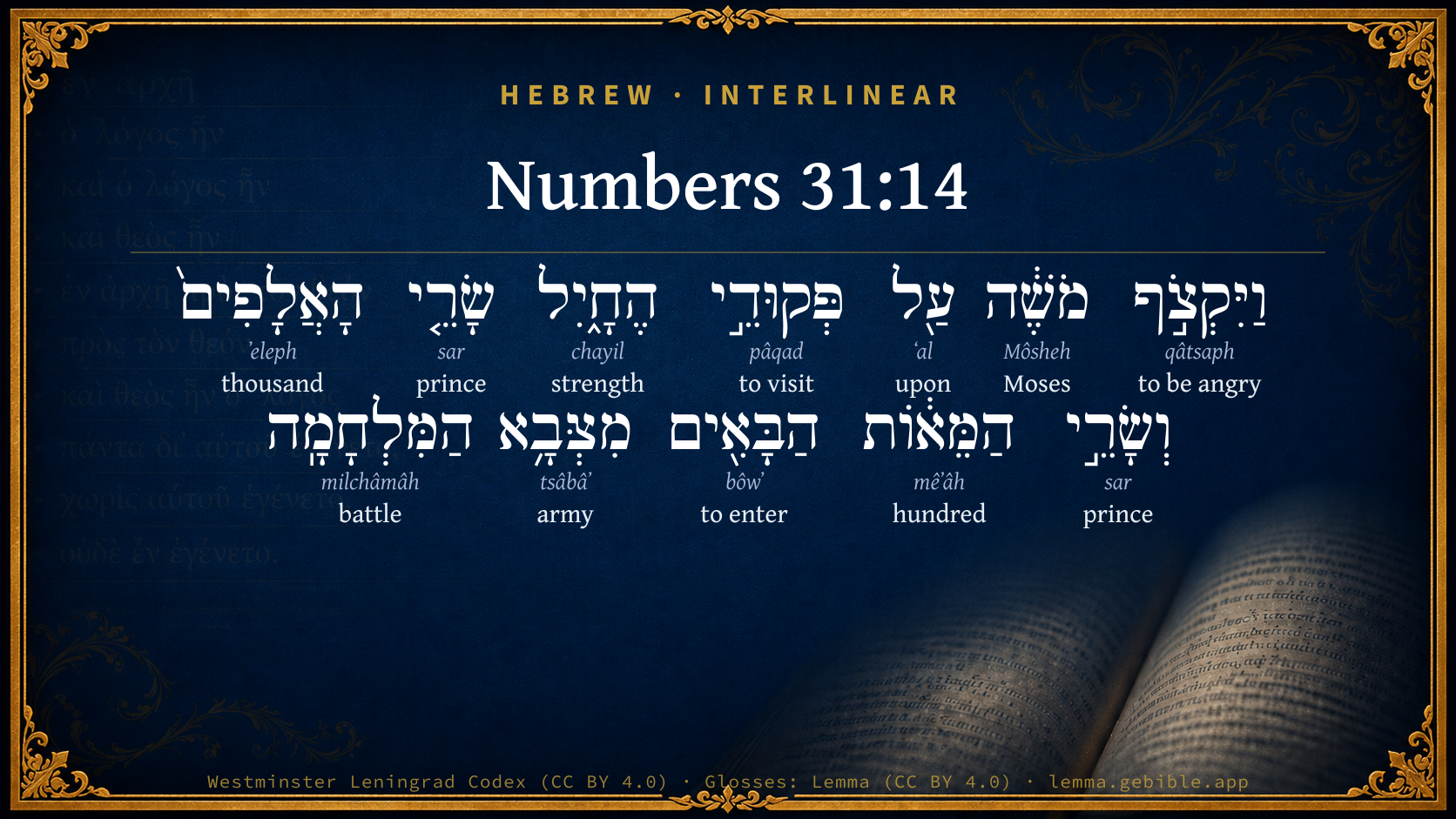
Hebrew (Westminster Leningrad Codex) Numbers 31:14 appears in the Hebrew Old Testament. The text above is from the Westminster Leningrad Codex. Each word links to its Strong’s number, a concise gloss, and parsing drawn from the Open Scriptures Hebrew Bible morphology. Click any word for its full Brown-Driver-Briggs (BDB) entry.
Download image
Cite this verse

Numbers 31:14 (World English Bible). Public Domain. Lemma interlinear Bible study tool, https://lemma.gebible.app/v/numbers/31/14.

Show BibTeX & RIS
BibTeX
RIS
English Translation
Moses was angry with the officers of the host, the captains of thousands and the captains of hundreds, who came from the service of the war.
World English Bible · Public Domain
Download a study sheet

One document with this verse’s original text, its word-by-word gloss line, the meaning frame, cross-references with their text, attributed commentary, and full source and license credits — printable, and it pastes into notes with its structure intact.

This verse Autodidact and up

Study sheet (.html) Plain text (.txt)

A passage Seminary Student

Up to 50 verses in one chapter. A passage sheet keeps up to 6 commentary sources and 12 cross-references per verse, in the order this page ranks them, and says so on the sheet whenever that leaves anything out. Ask for a single verse and you get the Autodidact verse sheet above.

Everything on this page stays free to read, with no account — the sheet is a download of what is already on screen, not access to it.

Want to remove ads? Support Godless Engineer
Compare translations 3

The same verse in 3 English versions, stacked beneath the original-language interlinear above. Click any original word for its lexicon entry.

Each is an independent rendering of the whole verse — the interlinear is not word-aligned to these translations.

Highlighted words mark where these versions differ — a whole-verse word diff, not a word-by-word alignment.

  • World English Bible Public Domain
    Moses was angry with the officers of the host, the captains of thousands and the captains of hundreds, who came from the service of the war.
  • King James Version Public Domain
    And Moses was wroth with the officers of the host, with the captains over thousands, and captains over hundreds, which came from the battle.
  • unfoldingWord Literal Text CC BY-SA 4.0
    And Moses was furious with the appointed ones of the army, the leaders of the thousands and the leaders of the hundreds, the ones coming from the battle of the war.

unfoldingWord Literal Text — © unfoldingWord, licensed CC BY-SA 4.0. Word-aligned USFM3 via Door43 (git.door43.org/unfoldingWord/en_ult).

Versions to compare (up to 4)

3 of 4 selected

Show all 18 translations

Every available English version of this verse, each an independent rendering of the whole verse.

  • World English Bible Public Domain
    Moses was angry with the officers of the host, the captains of thousands and the captains of hundreds, who came from the service of the war.
  • Berean Standard Bible Public Domain
    But Moses was angry with the officers of the army—the commanders of thousands and commanders of hundreds—who were returning from the battle.
  • Majority Standard Bible Public Domain
    But Moses was angry with the officers of the army—the commanders of thousands and commanders of hundreds—who were returning from the battle.
  • King James Version Public Domain
    And Moses was wroth with the officers of the host, with the captains over thousands, and captains over hundreds, which came from the battle.
  • American Standard Version (1901) Public Domain
    And Moses was wroth with the officers of the host, the captains of thousands and the captains of hundreds, who came from the service of the war.
  • Revised Version (1885) Public Domain
    And Moses was wroth with the officers of the host, the captains of thousands and the captains of hundreds, which came from the service of the war.
  • Geneva Bible (1599) Public Domain
    And Moses was angry with the captaines of the hoste, with the captaines ouer thousands, and captaines ouer hundreds, which came from the warre and battel.
  • Douay-Rheims (1899) Public Domain
    And Moses being angry with the chief officers of the army, the tribunes, and the centurions that were come from the battle,
  • Young's Literal Translation Public Domain
    and Moses is wroth against the inspectors of the force, chiefs of the thousands, and chiefs of the hundreds, who are coming in from the host of the battle.
  • Literal Standard Version CC BY-SA 4.0
    and Moses is angry against the inspectors of the force, chiefs of the thousands, and chiefs of the hundreds, who are coming in from the warfare of battle.
  • Unlocked Literal Bible CC BY-SA 4.0
    But Moses was angry with the officers of the army, the commanders of thousands and the captains of hundreds, who came from battle.
  • unfoldingWord Literal Text CC BY-SA 4.0
    And Moses was furious with the appointed ones of the army, the leaders of the thousands and the leaders of the hundreds, the ones coming from the battle of the war.
  • Darby Bible Public Domain
    And Moses was wroth with the officers of the army, with the captains of thousands, and captains of hundreds, who came from the service of the war;
  • World Messianic Bible Public Domain
    Moses was angry with the officers of the army, the captains of thousands and the captains of hundreds, who came from the service of the war.
  • Webster's Bible Public Domain
    And Moses was wroth with the officers of the host, with the captains over thousands, and captains over hundreds, who came from the battle.
  • Free Bible Version CC BY-SA 4.0
    Moses was angry with the army officers, the commanders of thousands and commanders of hundreds, who returned from the battle.
  • Bible in Basic English Public Domain
    And Moses was angry with the chiefs of the army, the captains of thousands and the captains of hundreds who had come back from the war.
  • JPS Tanakh (1917) Public Domain
    And Moses was wroth with the officers of the host, the captains of thousands and the captains of hundreds, who came from the service of the war.

Literal Standard Version (2020), Covenant Press — licensed CC BY-SA 4.0. Text via the HelloAO Bible API (eBible.org). Unlocked Literal Bible (unfoldingWord) — licensed CC BY-SA 4.0. Text via the HelloAO Bible API (eBible.org). unfoldingWord Literal Text — © unfoldingWord, licensed CC BY-SA 4.0. Word-aligned USFM3 via Door43 (git.door43.org/unfoldingWord/en_ult). Free Bible Version, Dr. Jonathan Gallagher — licensed CC BY-SA 4.0. Text via the HelloAO Bible API (eBible.org).

Word by word

More ways to search: Search by grammar → Find every occurrence → Compare this word →

Practice this passage: Drill this verse → Learn its vocabulary →

וַיִּקְצֹ֣ף
qâtsaph
H7107
“and · to be angry”
Conjunction + Verb, Qal, Sequential Imperfect, 3rd Person, Masculine, Singular
Part of Speech
Conjunction + Verb
Stem
Qal
Form
Sequential Imperfect
Person
3rd Person
Gender
Masculine
Number
Singular
Full BDB Definition

Origin: a primitive root

TWOT: 2058

to be displeased, be angry, fret oneself, be wroth - (Qal) to be wroth, to be full of wrath, to be furious - (Hiphil) to provoke to wrath or anger - (Hithpael) to put oneself in a rage, anger oneself
  1. מֹשֶׁ֔ה Môsheh H4872 “Moses” Noun, Proper
  2. עַ֖ל ʻal H5921 “upon” Preposition
  3. פְּקוּדֵ֣י pâqad H6485 “visited” Verb, Qal, Participle Passive, Masculine, Plural, Construct
  4. הֶחָ֑יִל chayil H2428 “the · strength” Particle, Definite Article + Noun, Common, Masculine, Singular, Absolute
  5. שָׂרֵ֤י sar H8269 “princes of” Noun, Common, Masculine, Plural, Construct
  6. הָאֲלָפִים֙ ʼeleph H505 “the · thousand” Particle, Definite Article + Adjective, Cardinal number, Both, Plural, Absolute
  7. וְשָׂרֵ֣י sar H8269 “and · princes of” Conjunction + Noun, Common, Masculine, Plural, Construct
  8. הַמֵּא֔וֹת mêʼâh H3967 “the · hundred” Particle, Definite Article + Adjective, Cardinal number, Both, Plural, Absolute
  9. הַבָּאִ֖ים bôwʼ H935 “the · entering” Particle, Definite Article + Verb, Qal, Participle Active, Masculine, Plural, Absolute
  10. מִצְּבָ֥א tsâbâʼ H6635 “from · army of” Preposition + Noun, Common, Both, Singular, Construct
  11. הַמִּלְחָמָֽה milchâmâh H4421 “the · battle” Particle, Definite Article + Noun, Common, Feminine, Singular, Absolute

About this verse

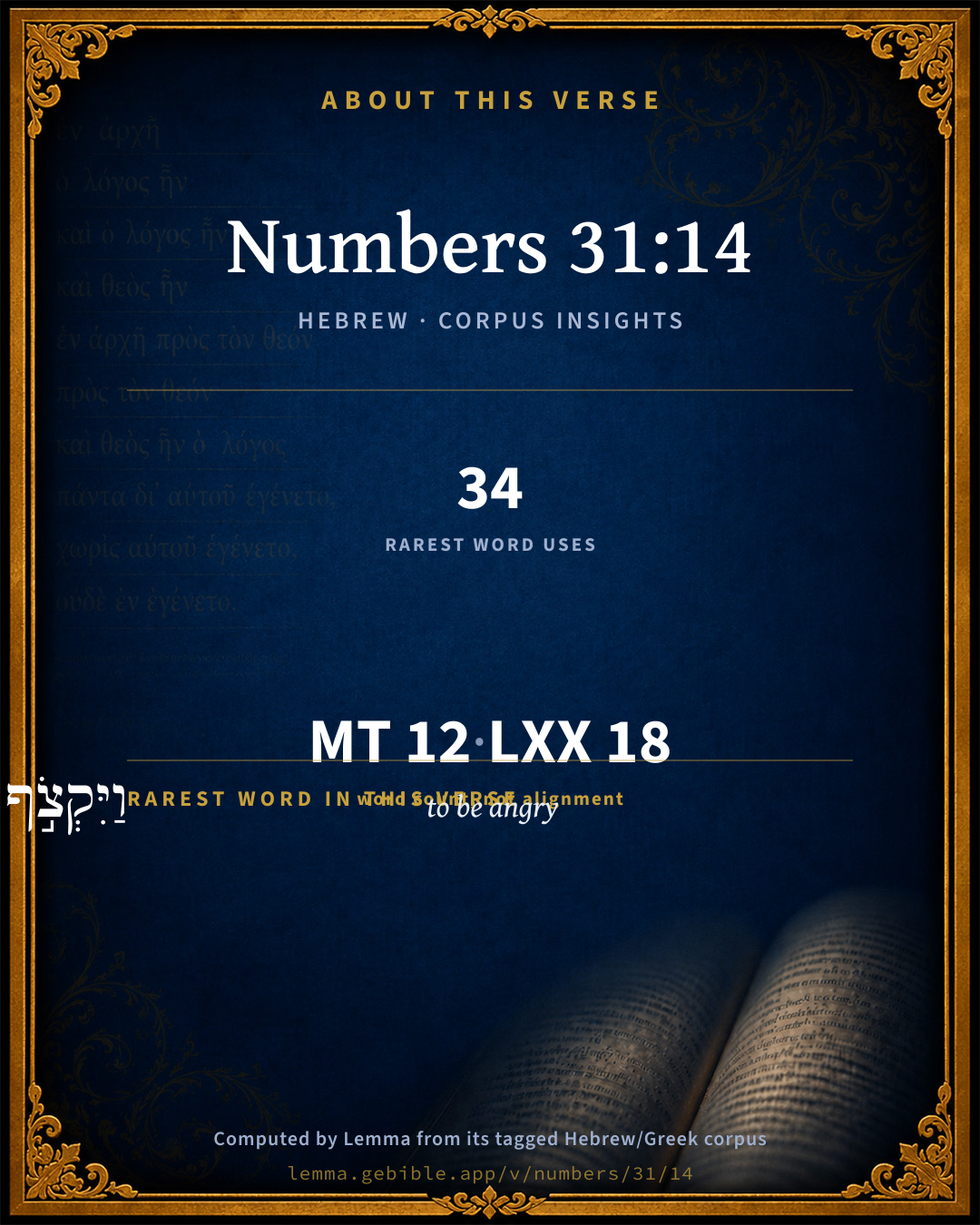
These counts appear in no published source. They are computed here, from the morphology-tagged text and Lemma’s own curated glosses. What Lemma adds →

12
words
11
distinct lemmas
Pentateuch
section

Shared distinctive vocabulary

וַיִּקְצֹ֣ף to be angry H7107 occurs in 32 verses of the Hebrew Bible. Also found in:

Grammatical profile

  • 3 verbs
  • 6 nouns
  • 2 adjectives
  • 1 preposition

Verb forms

  • וַיִּקְצֹ֣ף Qal · Sequential Imperfect
  • פְּקוּדֵ֣י Qal · Participle Passive
  • הַבָּאִ֖ים Qal · Participle Active

Repetition

A word recurs within this verse — often emphatic in Hebrew:

  • שָׂרֵ֤י prince H8269 ×2

Hebrew & Septuagint length

In English translation the verse runs 26 words from the Hebrew and 24 from the Septuagint (LXX English) — closely comparable.

A rough comparison of the two English renderings, which tokenize alike — not a word-level alignment.

Word counts can differ between the Hebrew and the Greek without any difference in meaning — e.g. the Hebrew direct-object marker אֵת has no separate Greek word, and Greek often adds the article ὁ.

In the original languages it is 12 Hebrew tokens and 18 Greek tokens — but the two are counted differently (Hebrew bundles its prefixes and suffixes into one token; the Greek is in lemma form), so that isn’t a like-for-like length.

Cross-references

9

Topical passages linked to Numbers 31:14 in the Treasury of Scripture Knowledge — connected by theme and wording, ordered by reader-vote popularity; previews shown in the World English Bible.

  • Exodus 32:19 It happened, as soon as he came near to the camp, that he saw the calf and the dancing: and Moses' anger grew hot, and he threw the tablets out of his hands, and broke them beneath the mountain.
  • Exodus 32:22 Aaron said, "Don't let the anger of my lord grow hot. You know the people, that they are set on evil.
  • Leviticus 10:16 Moses diligently inquired about the goat of the sin offering, and, behold, it was burned: and he was angry with Eleazar and with Ithamar, the sons of Aaron who were left, saying,
  • Numbers 12:3 Now the man Moses was very humble, above all the men who were on the surface of the earth.
  • Numbers 31:48 The officers who were over the thousands of the host, the captains of thousands, and the captains of hundreds, came near to Moses;
  • 1 Samuel 15:13–14 Samuel came to Saul; and Saul said to him, Blessed are you by Yahweh: I have performed the commandment of Yahweh.
  • 1 Kings 20:42 He said to him, Thus says Yahweh, Because you have let go out of your hand the man whom I had devoted to destruction, therefore your life shall go for his life, and your people for his people.
  • 2 Kings 13:19 The man of God was angry with him, and said, You should have struck five or six times: then had you struck Syria until you had consumed it, whereas now you shall strike Syria but thrice.
  • Ephesians 4:26 "Be angry, and don't sin." Don't let the sun go down on your wrath,

Cross-references courtesy of OpenBible.info (CC BY 4.0).

Hebrew and Greek witnesses Masoretic Hebrew ↔ Greek Septuagint

The same verse in the two great witnesses to the Old Testament, shown verse-for-verse.

These are two independent witnesses, not word-aligned to each other, and the Septuagint is shown in lemma (dictionary) form.

Hebrew Numbers 31:14 Masoretic · Westminster Leningrad Codex

וַיִּקְצֹ֣ף מֹשֶׁ֔ה עַ֖ל פְּקוּדֵ֣י הֶחָ֑יִל שָׂרֵ֤י הָאֲלָפִים֙ וְשָׂרֵ֣י הַמֵּא֔וֹת הַבָּאִ֖ים מִצְּבָ֥א הַמִּלְחָמָֽה

Moses was angry with the officers of the host, the captains of thousands and the captains of hundreds, who came from the service of the war.

World English Bible · Public Domain

Greek LXX Numbers 31:14 Septuagint · lemma form

καί ὀργίζω μωυσῆς ἐπί ὁ ἐπισκοπός ὁ δύναμις χιλίαρχος καί ἑκατόνταρχος ὁ ἔρχομαι ἐκ ὁ παράταξις ὁ πόλεμος

And Moses was angry with the captains of the host, the heads of thousands and the heads of hundreds who came from the battle-array.

LXX2012 (modern English Septuagint) · Public Domain

On this verse, The Pulpit Commentary discusses the Septuagint’s reading. Read the note in Commentary ↓

Hebrew: Westminster Leningrad Codex (CC BY 4.0). Greek: Septuagint (public domain); English from LXX2012 (modern English Septuagint) (Public Domain). How the Septuagint differs from the Hebrew →

Targum (Aramaic paraphrase)

2

The Targum is the ancient Jewish Aramaic paraphrase of the Hebrew Scriptures — an interpretive translation, not the Hebrew text itself. Onkelos (literal) and Pseudo-Jonathan (expansive) render the Torah, and Jonathan the Prophets. Coverage is partial: where no permissively-licensed English translation exists for a verse, only the Aramaic is shown. This is verse-level text, not a word-by-word alignment to the Hebrew.

  1. Targum Onkelos Torah (Genesis–Deuteronomy)
    וּרְגֵיז משֶׁה עַל דִמְמַנָן עַל חֵילָא רַבָּנֵי אַלְפִין וְרַבָּנֵי מַאֲוָותָא דְאָתוּ מֵחֵיל קְרָבָא

    (no public-domain English translation for this verse)

    Targum Onkelos — Aramaic: “Onkelos Genesis” (public domain); “Onkelos Exodus” (public domain); “Onkelos Leviticus” (public domain); “Onkelos Numbers” (public domain); “Onkelos Deuteronomy” (public domain). English: “Sefaria Community Translation” (CC0 1.0 (public-domain dedication)); “J.W. Etheridge. The Targums of Onkelos and Jonathan Ben Uzziel on the Pentateuch. London: Longmans, Green, 1862” (public domain). Text via Sefaria.

  2. Targum Pseudo-Jonathan Torah (Genesis–Deuteronomy)
    וּכְנַס משֶׁה עַל אִסְטְרְטִיגִין דִמְמַנָן עַל חֵילָא רַבָּנֵי אַלְפִין וְרַבָּנֵי מַאֲוָותָא דְאָתוּ מֵחֵיל סִדְרֵי קְרָבָא

    But Mosheh was angry with the leaders appointed over the host, the chiefs of thousands and of hundreds who came from the war with the host;

    Targum Pseudo-Jonathan — Aramaic: “Targum Jonathan on Genesis” (public domain); “Targum Jonathan on Exodus” (public domain); “Targum Jonathan on Leviticus” (public domain); “Targum Jonathan on Numbers” (public domain); “Targum Jonathan on Deuteronomy” (public domain). English: “The Targum of Jonathan ben Uzziel, trans. J. W. Etheridge, London, 1862” (public domain). Text via Sefaria.

Commentary

Notes on Numbers 31:14 from classic Christian and Jewish commentators (each source and its license shown beneath its notes). The classic Christian expositions comment on the surrounding passage and are grouped to its opening verse, so a note may address several verses; the Jewish commentaries on the Tanakh (Rashi and others) are per-verse, so they appear only where the commentator wrote on this verse.

Lemma curates 59 commentaries, every one of them public domain or Creative Commons licensed, each selected and text-cleaned for this edition rather than reprinted as found. About our sources →

Trapp's Complete Commentary

John Trapp

Num 31:14 And Moses was wroth with the officers of the host, [with] the captains over thousands, and captains over hundreds, which came from the battle.

Ver. 14. And Moses was wroth.] For all the joy he could not but be zealous for the Lord of hosts, when he saw the train. Zeal is the cream of all the affections.

John Trapp, A Commentary or Exposition upon All the Books of the Old and New Testament (1647–1656) — public domain. Text from a community e-Sword module.

Tyndale Open Study Notes

Tyndale Open Resources

31:14-16 Moses was furious: God had commanded total destruction, but the Midianite women who had followed Balaam’s advice and were largely responsible for the apostasy of Baal-peor had wrongly been given clemency.

Tyndale Open Study Notes — © Tyndale Open Resources, licensed CC BY-SA 4.0. Text via the HelloAO Bible API.

Jamieson, Fausset & Brown

Robert Jamieson, A. R. Fausset & David Brown

And Moses was wroth with the officers of the host--The displeasure of the great leader, though it appears the ebullition of a fierce and sanguinary temper, arose in reality from a pious and enlightened regard to the best interests of Israel. No order had been given for the slaughter of the women, and in ancient war they were commonly reserved for slaves. By their antecedent conduct, however, the Midianitish women had forfeited all claims to mild or merciful treatment; and the sacred character, the avowed object of the war (Num 31:2-3), made their slaughter necessary without any special order. But why "kill every male among the little ones"? It was designed to be a war of extermination, such as God Himself had ordered against the people of Canaan, whom the Midianites equalled in the enormity of their wickedness.

Jamieson, Fausset & Brown — Commentary Critical and Explanatory on the Whole Bible (1871) — public domain (CC PDM 1.0). Text via the HelloAO Bible API.

John Gill's Exposition

And Moses said unto them, have ye saved all the women alive? Which either had been reported to him, or he concluded, by seeing so many with them; and this question is put, not for information, but by way of reproof, and as chiding them for what they had done; for they might have received orders from him to put them to death, when he sent them out; and if so, there was the more reason to be angry with them; or he might conclude they would have done this of themselves, knowing what instruments of mischief these women had been to Israel.

And Moses said unto them, have ye saved all the women alive? Which either had been reported to him, or he concluded, by seeing so many with them; and this question is put, not for information, but by way of reproof, and as chiding them for what they had done; for they might have received orders from him to put them to death, when he sent them out; and if so, there was the more reason to be angry with them; or he might conclude they would have done this of themselves, knowing what instruments of mischief these women had been to Israel.

Numbers 31:16

num 31:16

num 31:16

num 31:16Behold, these caused the children of Israel, through the counsel of Balaam,.... Who advised the Midianites to send their women into the camp of Israel, and allure them to uncleanness, and so draw them into idolatry, which counsel they followed and it succeeded; for, by this means, they were brought

to commit trespass against the Lord in the matter of Peor; by worshipping Baalpeor, the god of the Moabites and Midianites; whereby they transgressed the commandment of God, which forbid them having and worshipping any other gods besides him, and is a sin highly offensive to him, being greatly derogatory to his honour and glory:

and there was a plague among the congregation of the Lord; for that sin; and in that plague died 24,000 persons, Num 25:9.

John Gill's Exposition of the Whole Bible (1746–1763) — public domain (CC PDM 1.0). Text via the HelloAO Bible API.

Matthew Poole's English Annotations

Because they had spared those who were most criminal, and who by the law of God and of nature were worthy of death.

Matthew Poole's English Annotations on the Holy Bible (1683–1685) — public domain. Text from a community e-Sword/MySword module.

Whedon's Commentary on the Bible

Daniel D. Whedon

14. Moses was wroth — The meekest man on earth was, (Num_12:3, note,) under personal abuse, often angry in the interest of justice. The more Godlike a man is, the more capable he is of indignation against sin. Plato compares the man who is not angry against injustice to one who has a withered muscle. Mar_3:5, note.

Daniel D. Whedon (gen. ed.), Commentary on the Old and New Testaments (1874–1909) — public domain. Text from a community e-Sword module.

The Pulpit Commentary

Officers of the host. Literally, "inspectors." Septuagint, toiv episkopoiv thv dunamewv .

The Pulpit Commentary (1880–1919), ed. H.D.M. Spence-Jones & Joseph S. Exell — public domain. Text from a community e-Sword module.

Rashi

Rabbi Shlomo Yitzchaki (Rashi)

ויקצף משה על פקודי החיל AND MOSES WAS ANGRY WITH THE פקודי החיל — WITH THOSE APPOINTED OVER THE ARMY — This serves to teach you that every misdeed of a generation is attributed to the leaders since these have the power to protest (Sifrei Bamidbar 157:5).

Rashi on the Tanakh — English translations: “The Judaica Press complete Tanach with Rashi, translated by A. J. Rosenberg” (CC BY 4.0); “Pentateuch with Rashi's commentary by M. Rosenbaum and A.M. Silbermann, 1929-1934” (public domain); “The Metsudah Tanach series, Lakewood, N.J” (CC BY 4.0); and “The Book of Joshua, Metsudah Publications, 1997” (CC BY 4.0). Text via Sefaria.

Lesson kit

Teaching starters — assembled from the data on this page, not authored interpretation. Every prompt links to the verse data it draws on. Edit before teaching.

Numbers, in the Pentateuch, opens this verse with 12 words (11 distinct Hebrew lemmas). Its most distinctive word is qâtsaph (“to be angry”). A historical commentator’s framing appears above. Read the whole chapter for the surrounding context.

Discussion questions

  1. What does “to be angry” (qâtsaph) contribute to the verse as a whole?
  2. How does Genesis 40:2, which shares the word «to be angry», read alongside this verse?
  3. What does the repetition of “prince” (2× in this one verse) do in this verse?
  4. The translations on this page render this verse differently — a whole-verse word diff, not a word-by-word alignment. What might account for the different wordings?
  5. «וַיִּקְצֹ֣ף» is a Qal Sequential Imperfect verb. How does that grammatical form shape the action described?
  6. Compare how Trapp's Complete Commentary and Tyndale Open Study Notes read this verse. Where do they agree or differ?

Things to notice

Reading settings

Reading text

Shown beneath each verse's original-language words.

Old Testament
Old Testament edition

Read the OT as the Masoretic Hebrew (MT) or the Greek Septuagint (LXX).

English shown for the Greek Septuagint (in the Hebrew ↔ Greek comparison).

Comparing translations? Open the Compare panel on any verse page to stack up to four side by side.