2 Samuel 11:16

Hebrew (Westminster Leningrad Codex) 2 Samuel 11:16 appears in the Hebrew Old Testament. The text above is from the Westminster Leningrad Codex. Each word links to its Strong’s number, a concise gloss, and parsing drawn from the Open Scriptures Hebrew Bible morphology. Click any word for its full Brown-Driver-Briggs (BDB) entry.
Download image
Cite this verse

2 Samuel 11:16 (World English Bible). Public Domain. Lemma interlinear Bible study tool, https://lemma.gebible.app/v/2-samuel/11/16.

Show BibTeX & RIS
BibTeX
RIS
English Translation
It happened, when Joab kept watch on the city, that he assigned Uriah to the place where he knew that valiant men were.
World English Bible · Public Domain
Download a study sheet

One document with this verse’s original text, its word-by-word gloss line, the meaning frame, cross-references with their text, attributed commentary, and full source and license credits — printable, and it pastes into notes with its structure intact.

This verse Autodidact and up

Study sheet (.html) Plain text (.txt)

A passage Seminary Student

Up to 50 verses in one chapter. A passage sheet keeps up to 6 commentary sources and 12 cross-references per verse, in the order this page ranks them, and says so on the sheet whenever that leaves anything out. Ask for a single verse and you get the Autodidact verse sheet above.

Everything on this page stays free to read, with no account — the sheet is a download of what is already on screen, not access to it.

Want to remove ads? Support Godless Engineer
Compare translations 3

The same verse in 3 English versions, stacked beneath the original-language interlinear above. Click any original word for its lexicon entry.

Each is an independent rendering of the whole verse — the interlinear is not word-aligned to these translations.

Highlighted words mark where these versions differ — a whole-verse word diff, not a word-by-word alignment.

  • World English Bible Public Domain
    It happened, when Joab kept watch on the city, that he assigned Uriah to the place where he knew that valiant men were.
  • King James Version Public Domain
    And it came to pass, when Joab observed the city, that he assigned Uriah unto a place where he knew that valiant men were.
  • unfoldingWord Literal Text CC BY-SA 4.0
    And it happened, when Joab looked at the city, that he put Uriah in the place where he knew that men of valor there.

unfoldingWord Literal Text — © unfoldingWord, licensed CC BY-SA 4.0. Word-aligned USFM3 via Door43 (git.door43.org/unfoldingWord/en_ult).

Versions to compare (up to 4)

3 of 4 selected

Show all 18 translations

Every available English version of this verse, each an independent rendering of the whole verse.

  • World English Bible Public Domain
    It happened, when Joab kept watch on the city, that he assigned Uriah to the place where he knew that valiant men were.
  • Berean Standard Bible Public Domain
    So as Joab besieged the city, he assigned Uriah to a place where he saw the strongest enemy soldiers.
  • Majority Standard Bible Public Domain
    So as Joab besieged the city, he assigned Uriah to a place where he knew the strongest enemy soldiers were.
  • King James Version Public Domain
    And it came to pass, when Joab observed the city, that he assigned Uriah unto a place where he knew that valiant men were.
  • American Standard Version (1901) Public Domain
    And it came to pass, when Joab kept watch upon the city, that he assigned Uriah unto the place where he knew that valiant men were.
  • Revised Version (1885) Public Domain
    And it came to pass, when Joab kept watch upon the city, that he assigned Uriah unto the place where he knew that valiant men were.
  • Geneva Bible (1599) Public Domain
    So when Ioab besieged the citie, he assigned Vriah vnto a place, where he knewe that strong men were.
  • Douay-Rheims (1899) Public Domain
    Wherefore as Joab was besieging the city, he put Urias in the place where he knew the bravest men were.
  • Young's Literal Translation Public Domain
    And it cometh to pass in Joab's watching of the city, that he appointeth Uriah unto the place where he knew that valiant men `are';
  • Literal Standard Version CC BY-SA 4.0
    And it comes to pass in Joab’s watching of the city, that he appoints Uriah to the place where he knew that valiant men [were];
  • Unlocked Literal Bible CC BY-SA 4.0
    So as Joab watched the siege upon the city, he assigned Uriah to the place where he knew the strongest enemy soldiers would be fighting.
  • unfoldingWord Literal Text CC BY-SA 4.0
    And it happened, when Joab looked at the city, that he put Uriah in the place where he knew that men of valor there.
  • Darby Bible Public Domain
    And it came to pass as Joab watched the city, that he assigned Urijah to a place where he knew that the valiant men were.
  • World Messianic Bible Public Domain
    When Joab kept watch on the city, he assigned Uriah to the place where he knew that valiant men were.
  • Webster's Bible Public Domain
    And it came to pass, when Joab observed the city, that he assigned Uriah to a place where he knew that valiant men were.
  • Free Bible Version CC BY-SA 4.0
    As Joab besieged the town, he made Uriah take a place where he knew the strongest enemy men would be fighting.
  • Bible in Basic English Public Domain
    So while Joab was watching the town, he put Uriah in the place where it was clear to him the best fighters were.
  • JPS Tanakh (1917) Public Domain
    And it came to pass, when Joab kept watch upon the city, that he assigned Uriah unto the place where he knew that valiant men were.

Literal Standard Version (2020), Covenant Press — licensed CC BY-SA 4.0. Text via the HelloAO Bible API (eBible.org). Unlocked Literal Bible (unfoldingWord) — licensed CC BY-SA 4.0. Text via the HelloAO Bible API (eBible.org). unfoldingWord Literal Text — © unfoldingWord, licensed CC BY-SA 4.0. Word-aligned USFM3 via Door43 (git.door43.org/unfoldingWord/en_ult). Free Bible Version, Dr. Jonathan Gallagher — licensed CC BY-SA 4.0. Text via the HelloAO Bible API (eBible.org).

Word by word

More ways to search: Search by grammar → Find every occurrence → Compare this word →

Practice this passage: Drill this verse → Learn its vocabulary →

א֣וּרִיָּ֔ה
ʼÛwrîyâh
H223
“Uriah”
Noun, Proper
Part of Speech
Noun
Type
Proper
Full BDB Definition

Origin: from H217 and H3050

TWOT: None

Uriah or Urijah = "Jehovah (Yahweh) is my light (flame)" - Hittite husband of Bathsheba - a priest who built king Ahaz' heathen altar - a priest who rebuilt Jerusalem's wall - a prophet slain by Jehoiakim
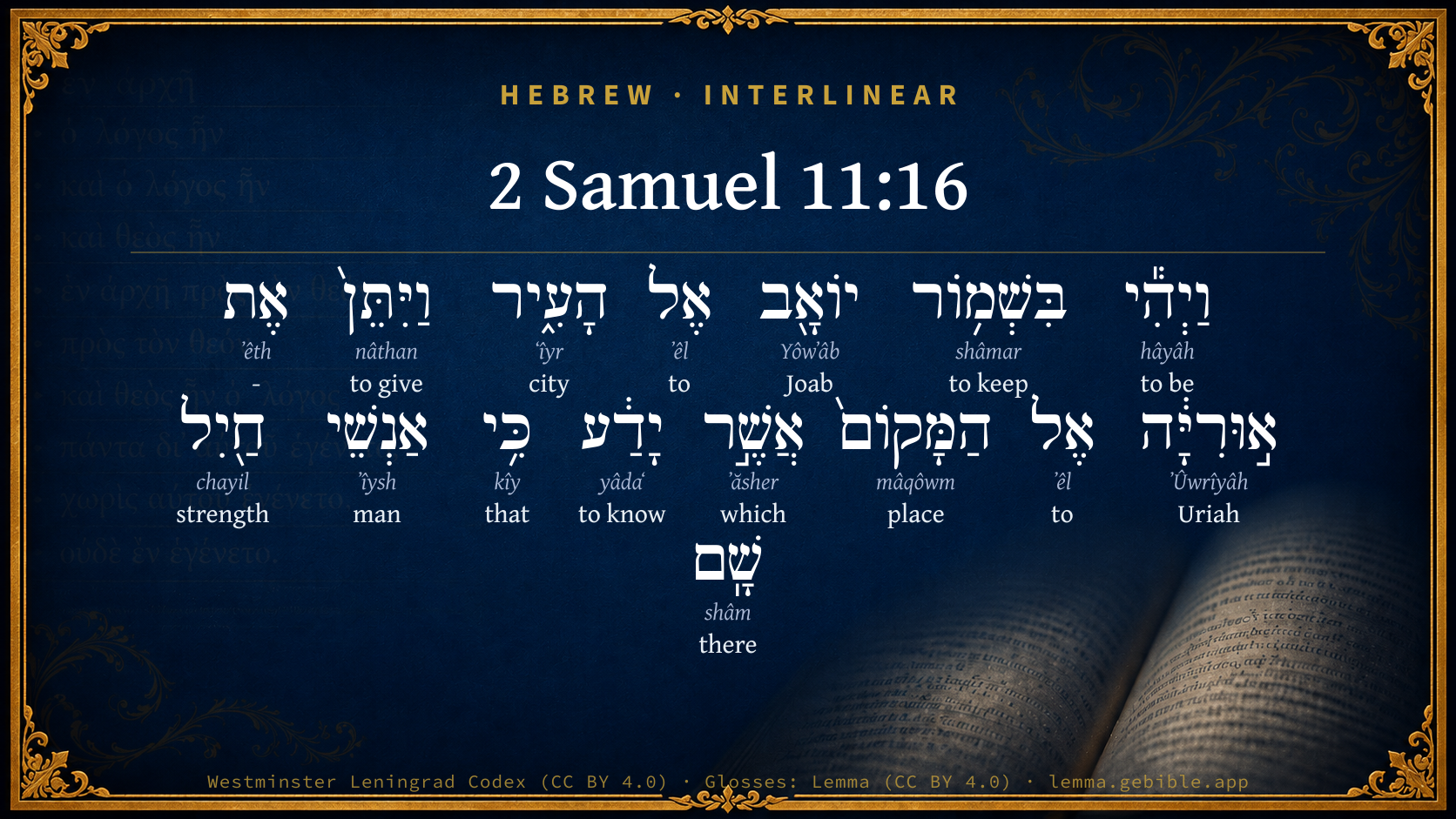
  1. וַיְהִ֕י hâyâh H1961 “and · to be” Conjunction + Verb, Qal, Sequential Imperfect, 3rd Person, Masculine, Singular
  2. בִּשְׁמ֥וֹר shâmar H8104 “in/at · to keep” Preposition + Verb, Qal, Infinitive Construct
  3. יוֹאָ֖ב Yôwʼâb H3097 “Joab” Noun, Proper
  4. אֶל ʼêl H413 “to” Preposition
  5. הָעִ֑יר ʻîyr H5892 “the · city” Particle, Definite Article + Noun, Common, Feminine, Singular, Absolute
  6. וַיִּתֵּן֙ nâthan H5414 “and · to give” Conjunction + Verb, Qal, Sequential Imperfect, 3rd Person, Masculine, Singular
  7. אֶת ʼêth H853 “-” Particle, Direct Object
  8. אֶל ʼêl H413 “to” Preposition
  9. הַמָּקוֹם֙ mâqôwm H4725 “the · place” Particle, Definite Article + Noun, Common, Masculine, Singular, Absolute
  10. אֲשֶׁ֣ר ʼăsher H834 “which” Particle, Relative
  11. יָדַ֔ע yâdaʻ H3045 “to know” Verb, Qal, Perfect, 3rd Person, Masculine, Singular
  12. כִּ֥י kîy H3588 “that” Conjunction
  13. אַנְשֵׁי ʼîysh H376 “men of” Noun, Common, Masculine, Plural, Construct
  14. חַ֖יִל chayil H2428 “strength” Noun, Common, Masculine, Singular, Absolute
  15. שָֽׁם shâm H8033 “there” Adverb

About this verse

These counts appear in no published source. They are computed here, from the morphology-tagged text and Lemma’s own curated glosses. What Lemma adds →

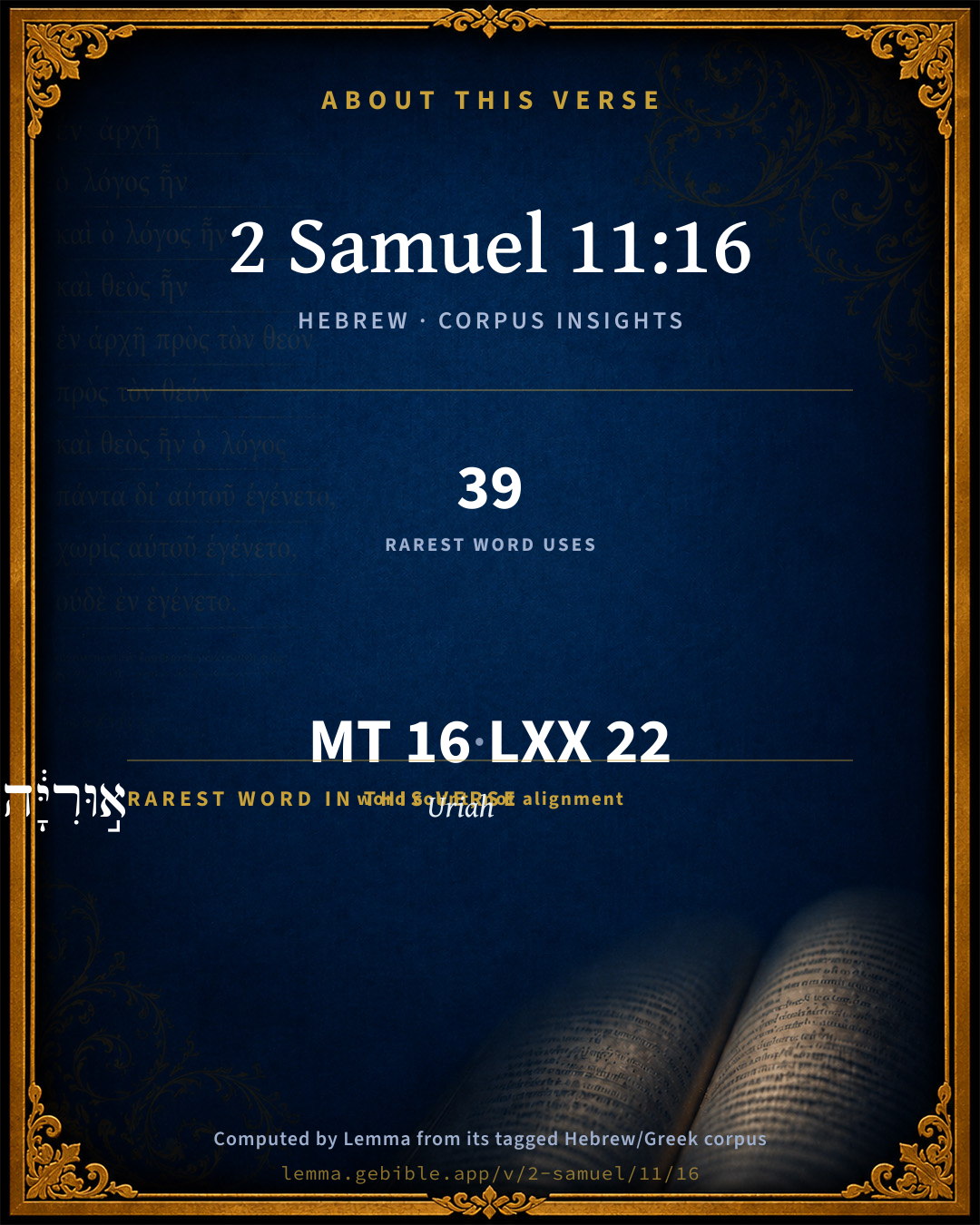
16
words
15
distinct lemmas
Historical
section

Shared distinctive vocabulary

א֣וּרִיָּ֔ה Uriah H223 occurs in 33 verses of the Hebrew Bible. Also found in:

Grammatical profile

  • 4 verbs
  • 6 nouns
  • 2 prepositions
  • 1 conjunction
  • 1 adverb
  • 2 particles

Verb forms

  • וַיְהִ֕י Qal · Sequential Imperfect
  • בִּשְׁמ֥וֹר Qal · Infinitive Construct
  • וַיִּתֵּן֙ Qal · Sequential Imperfect
  • יָדַ֔ע Qal · Perfect

Repetition

A word recurs within this verse — often emphatic in Hebrew:

  • אֶל to H413 ×2

Hebrew & Septuagint length

In English translation the verse runs 23 words from the Hebrew and 26 from the Septuagint (LXX English) — closely comparable.

A rough comparison of the two English renderings, which tokenize alike — not a word-level alignment.

Word counts can differ between the Hebrew and the Greek without any difference in meaning — e.g. the Hebrew direct-object marker אֵת has no separate Greek word, and Greek often adds the article ὁ.

In the original languages it is 16 Hebrew tokens and 22 Greek tokens — but the two are counted differently (Hebrew bundles its prefixes and suffixes into one token; the Greek is in lemma form), so that isn’t a like-for-like length.

Cross-references

11

Topical passages linked to 2 Samuel 11:16 in the Treasury of Scripture Knowledge — connected by theme and wording, ordered by reader-vote popularity; previews shown in the World English Bible.

  • 1 Samuel 22:17–19 The king said to the guard who stood about him, Turn, and kill the priests of Yahweh; because their hand also is with David, and because they knew that he fled, and didn't disclose it to me. But the servants of the king wouldn't put forth their hand to fall on the priests of Yahweh.
  • 2 Samuel 3:27 When Abner was returned to Hebron, Joab took him aside into the midst of the gate to speak with him quietly, and struck him there in the body, so that he died, for the blood of Asahel his brother.
  • 2 Samuel 11:21 who struck Abimelech the son of Jerubbesheth? Didn't a woman cast an upper millstone on him from the wall, so that he died at Thebez? Why did you go so near the wall?' then shall you say, 'Your servant Uriah the Hittite is dead also.'"
  • 2 Samuel 20:9–10 Joab said to Amasa, Is it well with you, my brother? Joab took Amasa by the beard with his right hand to kiss him.
  • 1 Kings 2:5 Moreover you know also what Joab the son of Zeruiah did to me, even what he did to the two captains of the hosts of Israel, to Abner the son of Ner, and to Amasa the son of Jether, whom he killed, and shed the blood of war in peace, and put the blood of war on his sash that was about his loins, and in his shoes that were on his feet.
  • 1 Kings 2:31–34 The king said to him, Do as he has said, and fall on him, and bury him; that you may take away the blood, which Joab shed without cause, from me and from my father's house.
  • 1 Kings 21:12–14 They proclaimed a fast, and set Naboth on high among the people.
  • 2 Kings 10:6 Then he wrote a letter the second time to them, saying, If you be on my side, and if you will listen to my voice, take the heads of the men your master's sons, and come to me to Jezreel by tomorrow this time. Now the king's sons, being seventy persons, were with the great men of the city, who brought them up.
  • Proverbs 29:12 If a ruler listens to lies, All of his officials are wicked.
  • Hosea 5:11 Ephraim is oppressed, He is crushed in judgment; Because he is intent in his pursuit of idols.
  • Acts 5:29 But Peter and the apostles answered, "We must obey God rather than men.

Cross-references courtesy of OpenBible.info (CC BY 4.0).

Hebrew and Greek witnesses Masoretic Hebrew ↔ Greek Septuagint

The same verse in the two great witnesses to the Old Testament, shown verse-for-verse.

These are two independent witnesses, not word-aligned to each other, and the Septuagint is shown in lemma (dictionary) form.

Hebrew 2 Samuel 11:16 Masoretic · Westminster Leningrad Codex

וַיְהִ֕י בִּשְׁמ֥וֹר יוֹאָ֖ב אֶל הָעִ֑יר וַיִּתֵּן֙ אֶת א֣וּרִיָּ֔ה אֶל הַמָּקוֹם֙ אֲשֶׁ֣ר יָדַ֔ע כִּ֥י אַנְשֵׁי חַ֖יִל שָֽׁם

It happened, when Joab kept watch on the city, that he assigned Uriah to the place where he knew that valiant men were.

World English Bible · Public Domain

Greek LXX 2 Samuel 11:16 Septuagint · lemma form

καί γίγνομαι ἐν ὁ φυλάσσω ιωαβ ἐπί ὁ πόλις καί τίθημι ὁ ουριας εἰς ὁ τόπος ὅς εἶδος ὅτι ἀνήρ δύναμις ἐκεῖ

And it came to pass while Joab was watching against the city, that he set Urias in a place where he knew that valiant men were.

LXX2012 (modern English Septuagint) · Public Domain

Hebrew: Westminster Leningrad Codex (CC BY 4.0). Greek: Septuagint (public domain); English from LXX2012 (modern English Septuagint) (Public Domain). How the Septuagint differs from the Hebrew →

Targum (Aramaic paraphrase)

1

The Targum is the ancient Jewish Aramaic paraphrase of the Hebrew Scriptures — an interpretive translation, not the Hebrew text itself. Onkelos (literal) and Pseudo-Jonathan (expansive) render the Torah, and Jonathan the Prophets. Coverage is partial: where no permissively-licensed English translation exists for a verse, only the Aramaic is shown. This is verse-level text, not a word-by-word alignment to the Hebrew.

  1. Targum Jonathan Prophets (Joshua–Malachi)
    וַהֲוָה כַּד צַר יוֹאָב עַל קַרְתָּא וִיהַב יַת אוּרִיָה לְאַתְרָא דִידַע אֲרֵי גַבְרִין גִבָּרִין תַּמָן:

    (no public-domain English translation for this verse)

    Targum Jonathan — Aramaic: “Mikraot Gedolot” (public domain). English: “Sefaria Community Translation” (CC0 1.0 (public-domain dedication)); “London "Chaldee Paraphrase," 1871” (public domain). Text via Sefaria.

Commentary

Notes on 2 Samuel 11:16 from classic Christian and Jewish commentators (each source and its license shown beneath its notes). The classic Christian expositions comment on the surrounding passage and are grouped to its opening verse, so a note may address several verses; the Jewish commentaries on the Tanakh (Rashi and others) are per-verse, so they appear only where the commentator wrote on this verse.

Lemma curates 59 commentaries, every one of them public domain or Creative Commons licensed, each selected and text-cleaned for this edition rather than reprinted as found. About our sources →

Trapp's Complete Commentary

John Trapp

2Sa 11:16 And it came to pass, when Joab observed the city, that he assigned Uriah unto a place where he knew that valiant men [were].

Ver. 16. He assigned Uriah, &c.] He thrust him into the jaws of death, and basely betrayed him: as holding that unsound principle, Whatsoever pleaseth the king shall please me, be it right or wrong. How much better he in the tragedian, {a} Obediemus Atridis honesta mandantibus; sin vero inhonesta mandabunt, non obediemus; We will obey the prince if he command things honest; and not, if otherwise. But Joab haply hoped hereby to ingratiate, and to come off the better, for the murder of Abner, which he had not yet answered, since David was now no less guilty than himself.

{a} Euripid., in Iphigen.

John Trapp, A Commentary or Exposition upon All the Books of the Old and New Testament (1647–1656) — public domain. Text from a community e-Sword module.

Joseph Benson's Commentary

2Sa 11:16-17. Where he knew that valiant men were — He ordered him, with others, to attack a part of the city which he knew would be valiantly defended; or out of which he knew the best men they had in the city would issue forth against them. Joab also was herein very guilty in complying with David’s wicked command; unless he supposed that Uriah had committed some great crime, for which David consulting his honour, chose to punish him in this manner, rather than openly. The men of the city went out —

They seem to have made a sally out of the city upon the Israelites, when they saw the latter were preparing for an assault. There fell some of the servants of David — This was a further aggravation of David’s sin, that he not only exposed an innocent and a valiant faithful servant to be killed, but other persons also with him, who might otherwise have lived to have done good service to their country. For it is not to be imagined that David meant Uriah to be set alone in the fore-front of the battle, where the service was hottest, but that there was to be a party with him, whom he was to lead on. This was accordingly ordered by Joab, and those men fell with Uriah.

Joseph Benson's Commentary on the Old and New Testaments (1811–1818) — public domain. Text from a community e-Sword module.

Tyndale Open Study Notes

Tyndale Open Resources

11:16-17 Uriah was not the only casualty: David sacrificed several other Israelite soldiers while attempting to hide his sin.

Tyndale Open Study Notes — © Tyndale Open Resources, licensed CC BY-SA 4.0. Text via the HelloAO Bible API.

Ellicott's Commentary for English Readers

(16) Observed the city.—The word means watched, or blockaded. In the operations of the siege Joab so arranged some of his forces as to invite a sally from the city under circumstances in which it would be successful. It appears from 2Sa_11:24 that Uriah’s party had been sent so near as to come within reach of the archers on the wall.

A Bible Commentary for English Readers, edited by Charles John Ellicott (1878–1897) — public domain. Text from a community e-Sword module.

The Cambridge Bible for Schools and Colleges

gen. ed. J. J. S. Perowne

16. when Joab observed the city] Better, as Joab watched the city, i.e. besieged it.

a place where he knew that valiant men were] Uriah was posted opposite the most strongly guarded part of the city, where the fighting was likely to be fiercest in case of a sally.

The Cambridge Bible for Schools and Colleges (gen. ed. J. J. S. Perowne; Cambridge University Press, 1878–1918) — public domain. Text from a community e-Sword module.

John Gill's Exposition

And it came to pass, when Joab observed the city,.... Where lay its greatest strength, and where it was best defended; or besieged it, as the Targum:

that he assigned Uriah unto a place where he knew that valiant men were; who would not easily give way, and when they saw an opportunity would sally out, Joab cannot be excused from sin, unless he thought that Uriah had been guilty of death, and that David took this way of dispatching him for some political reason; however David was king, and to be obeyed.

John Gill's Exposition of the Whole Bible (1746–1763) — public domain (CC PDM 1.0). Text via the HelloAO Bible API.

Albert Barnes' Notes on the Bible

Observed the city - In the sense of besieging it closely.

Albert Barnes' Notes on the Bible (1834–1885) — public domain. Text from a community e-Sword/MySword module.

Matthew Poole's English Annotations

Placed there to defend it, because that part of the city was supposed either the weakest, or the place designed for the assault. Joab having formerly committed a base murder upon Abner, was ready to execute this wicked command of the king; that so he being involved in the same guilt with him, might the more willingly receive him into favour.

Matthew Poole's English Annotations on the Holy Bible (1683–1685) — public domain. Text from a community e-Sword/MySword module.

Whedon's Commentary on the Bible

Daniel D. Whedon

16. Observed the city — Laid out his plans for besieging it.

Daniel D. Whedon (gen. ed.), Commentary on the Old and New Testaments (1874–1909) — public domain. Text from a community e-Sword module.

The Pulpit Commentary

When Joab observed the city; Revised Version, kept watch upon the city. This does net mean, as some suppose, that Joab sent a body of men to examine the fortifications with a view to an assault, and so provoked a sally. The verb simply refers to the ordinary operations of a siege, which usually resolved itself into a long blockade, continued until starvation compelled a surrender; and to hasten this the people of the villages were forced into the town, by the rule that all left outside were put to the sword. To maintain the blockade, men were posted at all fit points round the city, and these were constantly assailed by the besieged. Joab then placed Uriah at a post which was especially the object of attack; and when the usual sally took place and was repulsed, Joab seems to have ordered Uriah to pursue them up to the very gate, where they would be exposed to a shower of arrows from the walls. Others fell besides Uriah, and that the loss was considerable, and the result of bad generalship, though designedly such, seems probable from the deprecation of the king"s anger in ver. 20.

Vers. 16-21. (RABBAH.)

Complicity in sin.

Here are three men: David, a great but sinful king, bent on the destruction of a faithful servant; Uriah, a brave but injured soldier, sent unconsciously to his doom; and Joab, an able but unscrupulous general, (2Sa_3:22-30) become a willing agent and ready accomplice in his execution "with the sword of the children of Ammon". (2Sa_12:9)

1. There is seldom wanting a suitable accomplice in effecting a sinful purpose, however iniquitous it may be. The character of Joab was well known to David. "It was his very wickedness that commended him to the king as the most fitting instrument for carrying out his infamous design." He had formerly deprecated his wickedness; (2Sa_3:29, 2Sa_3:39) but now that he had himself fallen into sin, he associated himself with it, and made use of it for his own ends, although, as he afterwards found, to his own cost. "How Joab must have rejoiced when David sank down to his own level!

2. In serving another, such an accomplice is chiefly concerned aboutserving himself. He seeks supremely his own advantage. Joab acted not from loyalty, but self-love. "To make himself great, powerful, indispensable, was the object of his life" (Plumptre). "Possibly he had some information that Bathsheba had been with David" ("Speaker"s Commentary"). Anyhow, perceiving the design of the king against Uriah, he served him, in order that he might gain complete power over him; and in this he succeeded. "When David made him a partner and secret agent of his guilty purpose touching Uriah, he sold himself into his hands, and in that fatal letter he sealed away his liberty and surrendered himself up to this his unscrupulous accomplice" (Blunt). "All fellowship in sin begets despotism." Henceforth Joab did with the king very much as he pleased.

1. No authority of man can justify the violation of the Law of God. How often have men imagined that the command or sanction of one in authority

2. has been a sufficient warrant for doing what their own consciences condemned, and laid the blame of their conduct on the instigator thereof rather than on themselves! Joab probably needed little self excuse; but it ever he should want a defence, he might plead the king"s letter. He was reckless of human life; to effect his purpose made a greater sacrifice of it than the king intended (ver. 17), and became more hardened than ever in wickedness. "We ought to obey God rather than men.

3. There may be exemption from punishment when there is no exonerationfrom blame. "How must this example needs harden Joab against the conscience of Abner"s blood! while he cannot but think, "David cannot avenge that in me which he acteth himself (Hall). Nevertheless, his guilt, in the sight of God, remains; and judgment comes at last. D. (Ecc_12:14)

The Pulpit Commentary (1880–1919), ed. H.D.M. Spence-Jones & Joseph S. Exell — public domain. Text from a community e-Sword module.

unfoldingWord translationNotes

Door43 World Missions Community

the siege upon the city

The word "siege" can be expressed with the verbs "surround" and "attack." AT: "his army surround and attack the city" (See: Abstract Nouns)

some of the soldiers of David fell

The word "fell" is a polite way to refer to the soldiers being killed. AT: "David's soldiers were killed" or "they killed some of David's soldiers" (See: Euphemism)

and Uriah the Hittite was also killed there

This can be stated in active form. AT: "including Uriah the Hittite" or "and the men of the city also killed Uriah the Hittite" (See: Active or Passive)

translationWords

siege

assign

Uriah

Hittite

unfoldingWord translationNotes — © Distant Shores Media and the Door43 World Missions Community, licensed CC BY-SA 4.0. Source: git.door43.org/Door43/en_tn.

Lesson kit

Teaching starters — assembled from the data on this page, not authored interpretation. Every prompt links to the verse data it draws on. Edit before teaching.

2 Samuel, in the Historical, opens this verse with 16 words (15 distinct Hebrew lemmas). Its most distinctive word is ʼÛwrîyâh (“Uriah”). A historical commentator’s framing appears above. Read the whole chapter for the surrounding context.

Discussion questions

  1. How does “Uriah” (ʼÛwrîyâh) shape what this verse is saying?
  2. 2 Samuel 11:3 shares the word «Uriah» with this verse. How do the two illuminate each other?
  3. “to” occurs 2× in this one verse. What is the effect of the repetition?
  4. The translations on this page render this verse differently — a whole-verse word diff, not a word-by-word alignment. What might account for the different wordings?
  5. The verb «וַיְהִ֕י» is Qal Sequential Imperfect. How does its form color the action?
  6. Reading how Trapp's Complete Commentary and Joseph Benson's Commentary read this verse, where do the two commentators agree and where do they part?

Things to notice

Reading settings

Reading text

Shown beneath each verse's original-language words.

Old Testament
Old Testament edition

Read the OT as the Masoretic Hebrew (MT) or the Greek Septuagint (LXX).

English shown for the Greek Septuagint (in the Hebrew ↔ Greek comparison).

Comparing translations? Open the Compare panel on any verse page to stack up to four side by side.