Joshua 10:7

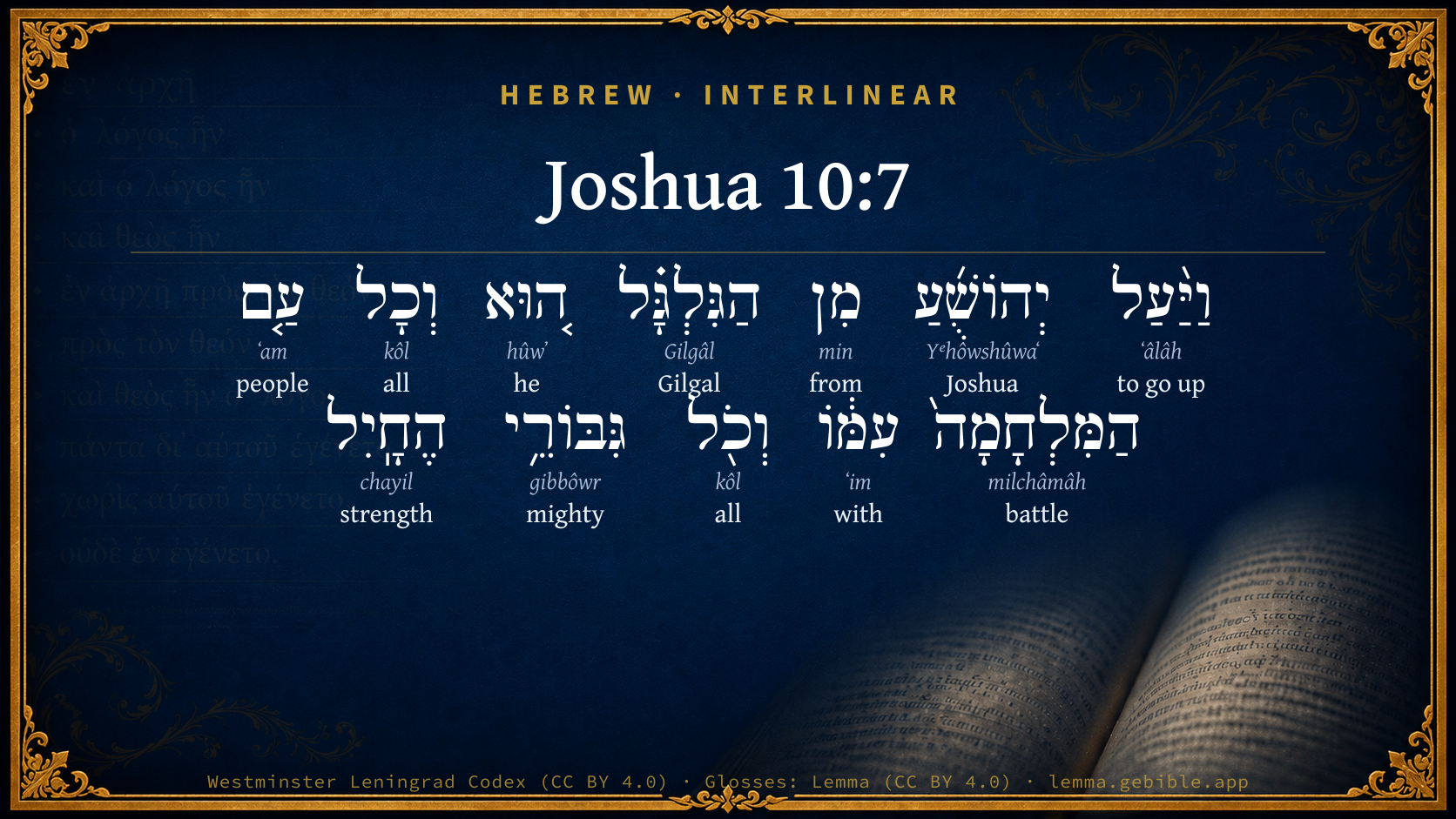
Hebrew (Westminster Leningrad Codex) Joshua 10:7 appears in the Hebrew Old Testament. The text above is from the Westminster Leningrad Codex. Each word links to its Strong’s number, a concise gloss, and parsing drawn from the Open Scriptures Hebrew Bible morphology. Click any word for its full Brown-Driver-Briggs (BDB) entry.
Download image
Cite this verse

Joshua 10:7 (World English Bible). Public Domain. Lemma interlinear Bible study tool, https://lemma.gebible.app/v/joshua/10/7.

Show BibTeX & RIS
BibTeX
RIS
English Translation
So Joshua went up from Gilgal, he, and all the people of war with him, and all the mighty men of valor.
World English Bible · Public Domain
Download a study sheet

One document with this verse’s original text, its word-by-word gloss line, the meaning frame, cross-references with their text, attributed commentary, and full source and license credits — printable, and it pastes into notes with its structure intact.

This verse Autodidact and up

Study sheet (.html) Plain text (.txt)

A passage Seminary Student

Up to 50 verses in one chapter. A passage sheet keeps up to 6 commentary sources and 12 cross-references per verse, in the order this page ranks them, and says so on the sheet whenever that leaves anything out. Ask for a single verse and you get the Autodidact verse sheet above.

Everything on this page stays free to read, with no account — the sheet is a download of what is already on screen, not access to it.

Want to remove ads? Support Godless Engineer
Compare translations 3

The same verse in 3 English versions, stacked beneath the original-language interlinear above. Click any original word for its lexicon entry.

Each is an independent rendering of the whole verse — the interlinear is not word-aligned to these translations.

Highlighted words mark where these versions differ — a whole-verse word diff, not a word-by-word alignment.

  • World English Bible Public Domain
    So Joshua went up from Gilgal, he, and all the people of war with him, and all the mighty men of valor.
  • King James Version Public Domain
    So Joshua ascended from Gilgal, he, and all the people of war with him, and all the mighty men of valor.
  • unfoldingWord Literal Text CC BY-SA 4.0
    And Joshua went up from Gilgal, he and all of the people of war with him, and all of the warriors of valor.

unfoldingWord Literal Text — © unfoldingWord, licensed CC BY-SA 4.0. Word-aligned USFM3 via Door43 (git.door43.org/unfoldingWord/en_ult).

Versions to compare (up to 4)

3 of 4 selected

Show all 18 translations

Every available English version of this verse, each an independent rendering of the whole verse.

  • World English Bible Public Domain
    So Joshua went up from Gilgal, he, and all the people of war with him, and all the mighty men of valor.
  • Berean Standard Bible Public Domain
    So Joshua and his whole army, including all the mighty men of valor, came from Gilgal.
  • Majority Standard Bible Public Domain
    So Joshua and his whole army, including all the mighty men of valor, came from Gilgal.
  • King James Version Public Domain
    So Joshua ascended from Gilgal, he, and all the people of war with him, and all the mighty men of valor.
  • American Standard Version (1901) Public Domain
    So Joshua went up from Gilgal, he, and all the people of war with him, and all the mighty men of valor.
  • Revised Version (1885) Public Domain
    So Joshua went up from Gilgal, he, and all the people of war with him, and all the mighty men of valour.
  • Geneva Bible (1599) Public Domain
    So Ioshua ascended from Gilgal, he, and all the people of warre with him, and all the men of might.
  • Douay-Rheims (1899) Public Domain
    And Josue went up from Galgal, and all the army of the warriors with him, most valiant men.
  • Young's Literal Translation Public Domain
    And Joshua goeth up from Gilgal, he, and all the people of war with him, even all the mighty men of valour.
  • Literal Standard Version CC BY-SA 4.0
    And Joshua goes up from Gilgal, he, and all the people of war with him, even all the mighty men of valor.
  • Unlocked Literal Bible CC BY-SA 4.0
    Joshua went up from Gilgal, he and all the men of war with him, and all the fighting men.
  • unfoldingWord Literal Text CC BY-SA 4.0
    And Joshua went up from Gilgal, he and all of the people of war with him, and all of the warriors of valor.
  • Darby Bible Public Domain
    So Joshua went up from Gilgal, he and all the people of war with him, even all the valiant men.
  • World Messianic Bible Public Domain
    So Joshua went up from Gilgal, he and the whole army with him, including all the mighty men of valor.
  • Webster's Bible Public Domain
    So Joshua ascended from Gilgal, he, and all the people of war with him, and all the mighty men of valor.
  • Free Bible Version CC BY-SA 4.0
    So Joshua, all his fighting men and best fighters, set off from Gilgal.
  • Bible in Basic English Public Domain
    So Joshua went up from Gilgal with all his army and all his men of war.
  • JPS Tanakh (1917) Public Domain
    So Joshua went up from Gilgal, he, and all the people of war with him, and all the mighty men of valour.

Literal Standard Version (2020), Covenant Press — licensed CC BY-SA 4.0. Text via the HelloAO Bible API (eBible.org). Unlocked Literal Bible (unfoldingWord) — licensed CC BY-SA 4.0. Text via the HelloAO Bible API (eBible.org). unfoldingWord Literal Text — © unfoldingWord, licensed CC BY-SA 4.0. Word-aligned USFM3 via Door43 (git.door43.org/unfoldingWord/en_ult). Free Bible Version, Dr. Jonathan Gallagher — licensed CC BY-SA 4.0. Text via the HelloAO Bible API (eBible.org).

Word by word

More ways to search: Search by grammar → Find every occurrence → Compare this word →

Practice this passage: Drill this verse → Learn its vocabulary →

הַגִּלְגָּ֗ל
Gilgâl
H1537
“the · Gilgal”
Particle, Definite Article + Noun, Proper
Part of Speech
Particle + Noun
Type
Proper
Full BDB Definition

Origin: the same as H1536

TWOT: None

Gilgal = "a wheel, rolling" - the first site of an Israelite camp west of the Jordan, east of Jericho, here Samuel was judge, and Saul was made king; later used for illicit worship - dwelling place of prophets in northern Israel about four miles - a region conquered by Joshua, site unsure
  1. וַיַּ֨עַל ʻâlâh H5927 “and · to go up” Conjunction + Verb, Qal, Sequential Imperfect, 3rd Person, Masculine, Singular
  2. יְהוֹשֻׁ֜עַ Yᵉhôwshûwaʻ H3091 “Joshua” Noun, Proper
  3. מִן min H4480 “from” Preposition
  4. ה֚וּא hûwʼ H1931 “he” Pronoun, Personal, 3rd Person, Masculine, Singular
  5. וְכָל kôl H3605 “and · all of” Conjunction + Noun, Common, Masculine, Singular, Construct
  6. עַ֤ם ʻam H5971 “people of” Noun, Common, Masculine, Singular, Construct
  7. הַמִּלְחָמָה֙ milchâmâh H4421 “the · battle” Particle, Definite Article + Noun, Common, Feminine, Singular, Absolute
  8. עִמּ֔וֹ ʻim H5973 “with · him” Preposition + Suffix, Personal, 3rd Person, Masculine, Singular
  9. וְכֹ֖ל kôl H3605 “and · all of” Conjunction + Noun, Common, Masculine, Singular, Construct
  10. גִּבּוֹרֵ֥י gibbôwr H1368 “mighty of” Adjective, Adjective, Masculine, Plural, Construct
  11. הֶחָֽיִל chayil H2428 “the · strength” Particle, Definite Article + Noun, Common, Masculine, Singular, Absolute

About this verse

These counts appear in no published source. They are computed here, from the morphology-tagged text and Lemma’s own curated glosses. What Lemma adds →

12
words
11
distinct lemmas
Historical
section

Shared distinctive vocabulary

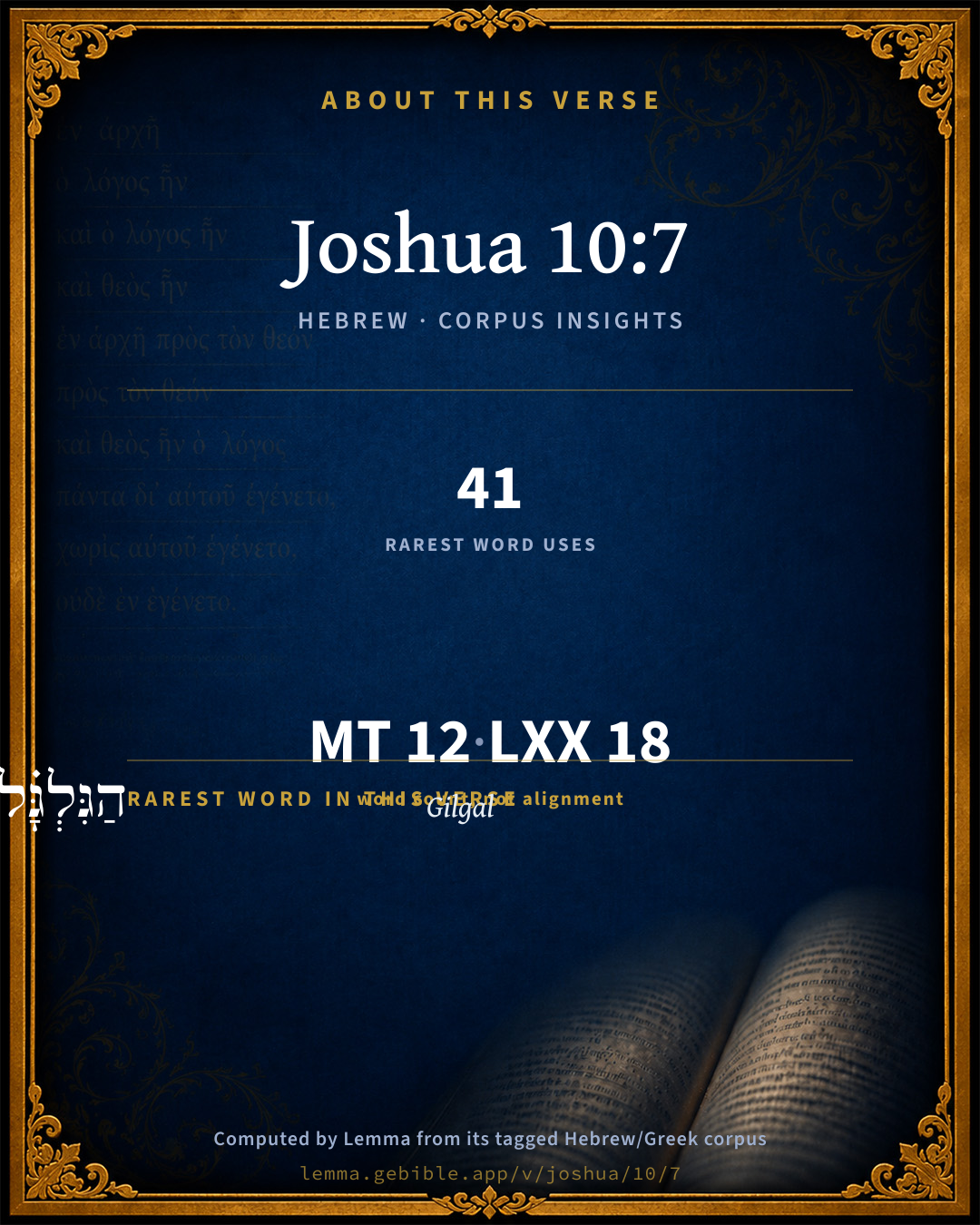
הַגִּלְגָּ֗ל Gilgal H1537 occurs in 39 verses of the Hebrew Bible. Also found in:

Grammatical profile

  • 1 verb
  • 7 nouns
  • 1 adjective
  • 1 pronoun
  • 2 prepositions

Verb forms

  • וַיַּ֨עַל Qal · Sequential Imperfect

Repetition

A word recurs within this verse — often emphatic in Hebrew:

  • וְכָל all H3605 ×2

Hebrew & Septuagint length

In English translation the verse runs 22 words from the Hebrew and 20 from the Septuagint (LXX English) — closely comparable.

A rough comparison of the two English renderings, which tokenize alike — not a word-level alignment.

Word counts can differ between the Hebrew and the Greek without any difference in meaning — e.g. the Hebrew direct-object marker אֵת has no separate Greek word, and Greek often adds the article ὁ.

In the original languages it is 12 Hebrew tokens and 18 Greek tokens — but the two are counted differently (Hebrew bundles its prefixes and suffixes into one token; the Greek is in lemma form), so that isn’t a like-for-like length.

Cross-references

3

Topical passages linked to Joshua 10:7 in the Treasury of Scripture Knowledge — connected by theme and wording, ordered by reader-vote popularity; previews shown in the World English Bible.

  • Joshua 8:1 Yahweh said to Joshua, Don't be afraid, neither be dismayed: take all the people of war with you, and arise, go up to Ai; behold, I have given into your hand the king of Ai, and his people, and his city, and his land;
  • Isaiah 8:12 Don't you say, "A conspiracy!" concerning all about which this people shall say, "A conspiracy!" neither fear their fear, nor be in dread [of it].
  • Isaiah 8:14 He shall be for a sanctuary; but for a stone of stumbling and for a rock of offense to both the houses of Israel, for a gin and for a snare to the inhabitants of Jerusalem.

Cross-references courtesy of OpenBible.info (CC BY 4.0).

Hebrew and Greek witnesses Masoretic Hebrew ↔ Greek Septuagint

The same verse in the two great witnesses to the Old Testament, shown verse-for-verse.

These are two independent witnesses, not word-aligned to each other, and the Septuagint is shown in lemma (dictionary) form.

Hebrew Joshua 10:7 Masoretic · Westminster Leningrad Codex

וַיַּ֨עַל יְהוֹשֻׁ֜עַ מִן הַגִּלְגָּ֗ל ה֚וּא וְכָל עַ֤ם הַמִּלְחָמָה֙ עִמּ֔וֹ וְכֹ֖ל גִּבּוֹרֵ֥י הֶחָֽיִל

So Joshua went up from Gilgal, he, and all the people of war with him, and all the mighty men of valor.

World English Bible · Public Domain

Greek LXX Joshua 10:7 Septuagint · lemma form

καί ἀναβαίνω ἰησοῦς ἐκ γάλγαλα αὐτός καί πᾶς ὁ λαός ὁ πολεμιστής μετά αὐτός πᾶς δυνατός ἐν ἰσχύς

And Joshua went up from Galgala, he and all the people of war with him, every one mighty in strength.

LXX2012 (modern English Septuagint) · Public Domain

Hebrew: Westminster Leningrad Codex (CC BY 4.0). Greek: Septuagint (public domain); English from LXX2012 (modern English Septuagint) (Public Domain). How the Septuagint differs from the Hebrew →

Targum (Aramaic paraphrase)

1

The Targum is the ancient Jewish Aramaic paraphrase of the Hebrew Scriptures — an interpretive translation, not the Hebrew text itself. Onkelos (literal) and Pseudo-Jonathan (expansive) render the Torah, and Jonathan the Prophets. Coverage is partial: where no permissively-licensed English translation exists for a verse, only the Aramaic is shown. This is verse-level text, not a word-by-word alignment to the Hebrew.

  1. Targum Jonathan Prophets (Joshua–Malachi)
    וּסְלֵיק יְהוֹשֻׁעַ מִן גִלְגָלָא הוּא וְכָל עַמָא עָבְדֵי קְרָבָא עִמֵיהּ וְכָל גִבָּרֵי חֵילָא:

    (no public-domain English translation for this verse)

    Targum Jonathan — Aramaic: “Mikraot Gedolot” (public domain). English: “Sefaria Community Translation” (CC0 1.0 (public-domain dedication)); “London "Chaldee Paraphrase," 1871” (public domain). Text via Sefaria.

Commentary

Notes on Joshua 10:7 from classic Christian and Jewish commentators (each source and its license shown beneath its notes). The classic Christian expositions comment on the surrounding passage and are grouped to its opening verse, so a note may address several verses; the Jewish commentaries on the Tanakh (Rashi and others) are per-verse, so they appear only where the commentator wrote on this verse.

Lemma curates 59 commentaries, every one of them public domain or Creative Commons licensed, each selected and text-cleaned for this edition rather than reprinted as found. About our sources →

Matthew Henry's Commentary

Here, I. Joshua resolves to assist the Gibeonites, and God encourages him in this resolve. 1. He ascended from Gilgal (Jos 10:7), that is, he designed, determined, and prepared for, this expedition to relieve Gibeon, for it is probable it was before he stirred a step that God spoke to him to encourage him. It was generous and just in Joshua to help his new allies, though perhaps the king of Jerusalem, when he attacked them, little thought that Joshua would be so ready to help them, but expected he would abandon them as Canaanites, the rather because they had obtained their league with him by fraud; therefore he speaks with assurance (Jos 10:4) of smiting Gibeon. But Joshua knew that his promise to let them live obliged him, not only not to slay them himself, but not to stand by and see them slain when it was in the power of his hand to prevent it, Pro 24:11, Pro 24:12. He knew that when they embraced the faith and worship of the God of Israel they came to trust under the shadow of his wings (Rut 2:12), and therefore, as his servants, he was bound to protect them. 2. God animated him for his undertaking, (Jos 10:8): Fear not, that is, (1.) "Doubt not of the goodness of thy cause and the clearness of thy call; though it be to assist Gibeonites, thou art in the way of duty, and God is with thee of a truth." (2.) "Dread not the power of the enemy; though so many kings are confederate against thee, and are resolved to make their utmost efforts for the reduction of Gibeon, and it may be will fight desperately in a desperate cause, yet let not this discourage thee, I have delivered them into thy hand;" and those can make neither resistance nor escape whom God has marked for destruction.

II. Joshua applies himself to execute this resolve, and God assists him in the execution. Here we have,

1. The great industry of Joshua, and the power of God working with it for the defeat of the enemy. In this action, (1.) Joshua showed his good-will in the haste he made for the relief of Gibeon (Jos 10:9): He came unto them suddenly, for the extremity was such as would not admit delay. If one of the tribes of Israel had been in danger, he could not have shown more care or zeal for its relief than here for Gibeon, remembering in this, as in other cases, there must be one law for the stranger that was proselyted and for him that was born in the land. Scarcely had the confederate princes got their forces together, and sat down before Gibeon, when Joshua was upon them, the surprise of which would put them into the greatest confusion. Now that the enemy were actually drawn up into a body, which had all as it were but one neck, despatch was as serviceable to his cause as before delay was, while he waited for this general rendezvous; and now that things were ripe for execution no man more expeditious than Joshua, who before had seemed slow. Now it shall never be said, He left that to be done tomorrow which he could do today. When Joshua found he could not reach Gibeon in a day, lest he should lose any real advantages against the enemy, or so much as seem to come short or to neglect his new allies, he marched all night, resolving not to give sleep to his eyes, nor slumber to his eye-lids, till he had accomplished this enterprise. It was well the forces he took with him were mighty men of valour, not only able-bodied men, but men of spirit and resolution, and hearty in the cause, else they neither could nor would have borne this fatigue, but would have murmured at their leader and would have asked, "Is this the rest we were promised in Canaan?" But they well considered that the present toil was in order to a happy settlement, and therefore were reconciled to it. Let the good soldiers of Jesus Christ learn hence to endure hardness, in following the Lamb whithersoever he goes, and not think themselves undone if their religion lose them now and then a night's sleep; it will be enough to rest when we come to heaven. But why needed Joshua to put himself and his men so much to the stretch? Had not God promised him that without fail he would deliver the enemies into his hand? It is true he had; but God's promises are intended, not to slacken and supersede, but to quicken and encourage our endeavours. He that believeth doth not make haste to anticipate providence, but doth make haste to attend it, with a diligent, not a distrustful, speed. (2.) God showed his great power in defeating the enemies whom Joshua so vigorously attacked, Jos 10:10, Jos 10:11. Joshua had a very numerous and powerful army with him, hands enough to despatch a dispirited enemy, so that the enemy might have been scattered by the ordinary fate of war; but God himself would appear in this great and decisive battle, and draw up the artillery of heaven against the Canaanites, to demonstrate to this people that they got not this land in possession by their own sword, neither did their own arm save them, but God's right hand and his arm, Psa 44:3. The Lord discomfited them before Israel. Israel did what they could, and yet God did all. [1.] It must needs be a very great terror and confusion to the enemy to perceive that heaven itself fought against them; for who can contest with, flee from, or fence against, the powers of heaven? They had affronted the true God and robbed him of his honour by worshipping the host of heaven, giving that worship to the creature which is due to the Creator only; and now the host of heaven fights against them, and even that part of the creation which they had idolized is at war with them, and even triumphs in their ruin, Jer 8:2. There is no way of making any creature propitious to us, no, not by sacrifice nor offering, but only by making our peace with God and keeping ourselves in his love. This had been enough to make them an easy prey to the victorious Israelites, yet this was not all. [2.] Besides the terror struck upon them, there was a great slaughter made of them by hail-stones, which were so large, and came down with such a force, that more were killed by the hail-stones than by the sword of the Israelites, though no doubt they were busy. God himself speaks to Job of treasures, or magazines, of snow and hail, which he has reserved for the day of battle and war (Job 38:22, Job 38:23), and here they are made use of to destroy the Canaanites. Here was hail, shot from God's great ordnance, that, against whomsoever it was directed, was sure to hit (and never glanced upon the Israelites mixed with them), and wherever it hit was sure to kill. See here how miserable those are that have God for their enemy, and how sure to perish; it is a fearful thing to fall into his hands, for there is no fleeing out of them. Some observe that Beth-horon lay north of Gibeon, Azekah and Makkedah lay south, so that they fled each way but, which way soever they fled, the hail-stones pursued them, and met them at every turn.

2. The great faith of Joshua, and the power of God crowning it with the miraculous arrest of the sun, that the day of Israel's victories might be prolonged, and so the enemy totally defeated. The hail-stones had their rise no higher than the clouds, but, to show that Israel's help came from above the clouds, the sun itself, who by his constant motion serves the whole earth, by halting when there was occasion served the Israelites, and did them a kindness. The sun and moon stood still in their habitation, at the light of thy arrows which gave the signal, Hab 3:11.

(1.) Here is the prayer of Joshua that the sun might stand still. I call it his prayer, because it is said (Jos 10:12) he spoke to the Lord; as Elijah, though we read (Kg1 17:1) only of his prophesying of the drought, yet is said (Jam 5:17) to pray for it. Observe, [1.] An instance of Joshua's unwearied activity in the service of God and Israel, that though he had marched all night and fought all day, and, one might expect, would be inclined to repose himself and get a little sleep, and give his army some time to rest - that, like the hireling, he would earnestly desire the shadow, and bid the night welcome, when he had done such a good day's work - yet, instead of this, he wishes for nothing so much as the prolonging of the day. Note, Those that wait on the Lord and work for him shall renew their strength, shall run and not be weary, shall walk and not faint, Isa 40:31. [2.] An instance of his great faith in the almighty power of God, as above the power of nature, and able to control and alter the usual course of it. No doubt Joshua had an extraordinary impulse or impression upon his spirit, which he knew to be of divine origin, prompting him to desire that this miracle might be wrought upon this occasion, else it would have been presumption in him to desire or expect; the prayer would not have been granted by the divine power, if it had not been dictated by the divine grace. God wrought this faith in him, and then said, "According to thy faith, and thy prayer of faith, be it unto thee." It cannot be imagined, however, that such a thing as this should have entered into his mind if God had not put it there; a man would have had a thousand projects in his head for the completing of the victory before he would have thought of desiring the sun to stand still; but even in the Old Testament saints the Spirit made intercession according to the will of God. What God will give he inclines the hearts of his praying people to ask, and for what he will do he will be enquired of, Eze 36:37. Now, First, It looked great for Joshua to say, Sun, stand thou still. His ancestor Joseph had indeed dreamed that the sun and moon did homage to him; but who would have thought that, after it had been fulfilled in the figure, it should be again fulfilled in the letter to one of his posterity? The prayer is thus expressed with authority, because it was not an ordinary prayer, such as is directed and supported only by God's common providence or promise, but the prayer of a prophet at this time divinely inspired for this purpose; and yet it intimates to us the prevalency of prayer in general, so far as it is regulated by the word of God, and may remind us of that honour put upon prayer (Isa 45:11), Concerning the work of my hands command you me. He bids the sun stand still upon Gibeon, the place of action and the seat of war, intimating that what he designed in this request was the advantage of Israel against their enemies; it is probable that the sun was now declining, and that he did not call for the lengthening out of the day until he observed it hastening towards it period. He does likewise, in the name of the King of kings, arrest the moon, perhaps because it was requisite for the preserving of the harmony and good order of the spheres that the course of the rest of the heavenly bodies should be stayed likewise, otherwise, while the sun shone, he needed not the moon; and here he mentions the valley of Ajalon, which was near to Gibeon, because there he was at that time. Secondly, It was bold indeed to say so before Israel, and argues a very strong assurance of faith. If the event had not answered the demand, nothing could have been a greater slur upon him; the Israelites would have concluded he was certainly going mad, or he would never have talked so extravagantly. But he knew very well God would own and answer a petition which he himself directed to be drawn up and presented, and therefore was not afraid to say before all Israel, calling them to observe this work of wonder, Sun, stand thou still, for he was confident in him whom he had trusted. He believed the almighty power of God, else he could not have expected that the sun, going on in its strength, driving in a full career, and rejoicing as a strong man to run a race, should be stopped in an instant. He believed the sovereignty of God in the kingdom of nature, else he could not have expected that the established law and course of nature should be changed and interrupted, the ordinances of heaven, and the constant usage according to these ordinances, broken in upon. And he believed God's particular favour to Israel above all people under the sun, else he could not have expected that, to favour them upon an emergency with a double day, he should (which must follow of course) amaze and terrify so great a part of the terrestrial globe with a double night at the same time. It is true, he causeth the sun to shine upon the just and the unjust; but for this once the unjust shall wait for it beyond the usual time, while, in favour to righteous Israel, it stands still.

(2.) The wonderful answer to this prayer. No sooner said than done (Jos 10:13): The sun stood still, and the moon staid. Notwithstanding the vast distance between the earth and the sun, at the word of Joshua the sun stopped immediately; for the same God that rules in heaven above rules at the same time on this earth, and, when he pleases, even the heavens shall hear the earth, as here. Concerning this great miracle it is here said, [1.] That it continued a whole day, that is, the sun continued as long again above the horizon as otherwise it would have done. It is commonly supposed to have been about the middle of summer that this happened, when, in that country, it was about fourteen hours between sun and sun, so that this day was about twenty-eight hours long; yet, if we suppose it to have been at that time of the year when the days are at the shortest, it will be the more probable that Joshua should desire and pray for the prolonging of the day. [2.] That hereby the people had full time to avenge themselves of their enemies, and to give them a total defeat. We often read in history of battles which the night put an end to, the shadows of which favoured the retreat of the conquered; to prevent this advantage to the enemy in their flight, the day was doubled, that the hand of Israel might find out all their enemies; but the eye and hand of God can find them out without the help of the sun's light, for to him the night shineth as the day, Psa 139:12. Note, Sometimes God completes a great salvation in a little time, and makes but one day's work of it. Perhaps this miracle is alluded to Zac 14:6, Zac 14:7, where the day of God's fighting against the nations is said to be one day, and that at evening time it shall be light, as here. And, [3.] That there was never any day like it, before or since, in which God put such an honour upon faith and prayer, and upon Israel's cause; never did he so wonderfully comply with the request of a man, nor so wonderfully fight for his people. [4.] This is said to be written in the book of Jasher, a collection of state-poems, in which the poem made upon this occasion was preserved among the rest; probably the same with that book of the wars of the Lord (Num 21:14), which afterwards was continued and carried on by one Jasher. Those words, Sun, stand thou still upon Gibeon, and thou moon in the valley of Ajalon, sounding metrical, are supposed to be taken from the narrative of this event as it was found in the book of Jasher. Not that the divine testimony of the book of Joshua needed confirmation from the book of Jasher, a human composition; but to those who had that book in their hands it would be of use to compare this history with it, which warrants the appeals the learned make to profane history for corroborating the proofs of the truth of sacred history. [5.] But surely this stupendous miracle of the standing still of the sun was intended for something more than merely to give Israel so much the more time to find out and kill their enemies, which, without this, might have been done the next day. First, God would hereby magnify Joshua (Jos 3:7), as a particular favourite, and one whom he did delight to honour, being a type of him who has all power both in heaven and in earth and whom the winds and the seas obey. Secondly, He would hereby notify to all the world what he was doing for his people Israel here in Canaan; the sun, the eye of the world, must be fixed for some hours upon Gibeon and the valley of Ajalon, as if to contemplate the great works of God there for Israel, and so to engage the children of men to look that way, and to enquire of this wonder done in the land, Ch2 32:31. Proclamation was hereby made to all the neighbouring nations. Come, behold the works of the Lord (Psa 46:8), and say, What nation is there so great as Israel is, who has God so nigh unto them? One would have supposed that this would bring such real ambassadors as the Gibeonites pretended to be from a very far country, to court the friendship of Israel because of the name of the Lord their God. Thirdly, He would hereby convince and confound those idolaters that worshipped the sun and moon and gave divine honours to them, by demonstrating that they were subject to the command of the God of Israel, and that, as high as they were, he was above them; and thus he would fortify his people against temptations to this idolatry, which he foresaw they would be addicted to (Deu 4:19), and which, notwithstanding this, they afterwards corrupted themselves with. Fourthly, This miracle signified (it is the learned bishop Pierson's notion) that in the latter days, when the light of the world was tending towards a light of darkness, the Sun of righteousness, even our Joshua, should arise (Mal 4:2), give check to the approaching night, and be the true light. To which let me add that when Christ conquered our spiritual enemies upon the cross the miracle wrought on the sun was the reverse of this; it was then darkened as if it had gone down at noon, for Christ needed not the light of the sun to carry on his victories: he then made darkness his pavilion. And, Lastly, The arresting of the sun and moon in this day of battle prefigured the turning of the sun into darkness, and the moon into blood, in the last great and terrible day of the Lord.

Matthew Henry's Commentary on the Whole Bible (1708–1710) — public domain (CC PDM 1.0). Text via the HelloAO Bible API.

Trapp's Complete Commentary

John Trapp

Jos 10:7 So Joshua ascended from Gilgal, he, and all the people of war with him, and all the mighty men of valour.

Ver. 7. So Joshua ascended from Gilgal.] Having first consulted with God, and received encouragement from him, as Jos 10:8.

John Trapp, A Commentary or Exposition upon All the Books of the Old and New Testament (1647–1656) — public domain. Text from a community e-Sword module.

Whedon's Commentary on the Bible

Daniel D. Whedon

JOSHUA’S NIGHT-MARCH TO GIBEON, Jos_10:7-9.

7. Ascended — This expression (repeated in Jos_10:9) most obviously has reference to the ascent from the Jordan valley to the interior of Palestine. See notes on Jos_8:10; Jos_9:6. All the people of war is an expression limited by its appositive in the next clause, all the mighty men of valour, which is the Hebrew way of saying, all the bravest men of the army.

Daniel D. Whedon (gen. ed.), Commentary on the Old and New Testaments (1874–1909) — public domain. Text from a community e-Sword module.

Tyndale Open Study Notes

Tyndale Open Resources

10:7 Joshua had sworn to rescue Gibeon, so now he set out to do it.

Tyndale Open Study Notes — © Tyndale Open Resources, licensed CC BY-SA 4.0. Text via the HelloAO Bible API.

The Cambridge Bible for Schools and Colleges

gen. ed. J. J. S. Perowne

7. So Joshua ascended] “Not a moment was to be lost. As in the battle of Marathon, everything depended on the suddenness of the blow which should break in pieces the hostile confederation.” Stanley’s Sinai and Palestine, p. 209.

The Cambridge Bible for Schools and Colleges (gen. ed. J. J. S. Perowne; Cambridge University Press, 1878–1918) — public domain. Text from a community e-Sword module.

John Gill's Exposition

So Joshua ascended from Gilgal,.... Which lay low in the plains of Jericho:

he and all the men of war with him; which must not be understood of the whole camp of Israel, which consisted of five hundred thousand fighting men at least; since such a number was unnecessary for this expedition, and could not have proceeded with that haste the case required; nor would it have been prudent and advisable to have left the unarmed people, old men, women, and children, defenceless; but these were a select company of able men, fit for travel as well as war:

and all the mighty men of valour; or "even all", as many as were picked out for the purpose, being men of strength, activity, and courage.

John Gill's Exposition of the Whole Bible (1746–1763) — public domain (CC PDM 1.0). Text via the HelloAO Bible API.

Matthew Poole's English Annotations

Having, no doubt, asked advice of God first, which is implied by the answer God gives to him, Jos 10:8.

And all the mighty men, or, even, or that is, as this particle is oft used, as hath been noted before. So it seems put here by way of explication and restriction; having said

all the people of war, he now adds, even all the mighty men, &c., i.e. an army of the most valiant men picked out from the rest; for it is not probable, either that he would take so many hundred thousands with him, which would have hindered one another, or that he would leave the camp without an army to defend it.

Matthew Poole's English Annotations on the Holy Bible (1683–1685) — public domain. Text from a community e-Sword/MySword module.

The Pulpit Commentary

Joshua ascended. Keil insists upon the military sense here, as against the literal one, "went up." He believes in the second Gilgal, which was on higher ground than the first, (see Jos_9:6) where, however, we learn that the second Gilgal was not so elevated as Gibeon. And all the mighty men of valour. A selection of the bravest troops seems to be implied here, by the copulative particle. Cf. Gen_3:16, "Thy pain and (especially in the time of) thy pregnancy."

The Pulpit Commentary (1880–1919), ed. H.D.M. Spence-Jones & Joseph S. Exell — public domain. Text from a community e-Sword module.

John Wesley's Explanatory Notes

Joshua ascended - Having no doubt asked advice of God first, which is implied by the answer God gives him, ver. 8. All the mighty men - That is, an army of the most valiant men picked out from the rest; for it is not probable, either that he would take so many hundred thousands with him, which would have hindered one another, or that he would leave the camp without an army to defend it.

John Wesley, Explanatory Notes Upon the Whole Bible (1754–1765) — public domain. Text via the GEBible commentary corpus.

Lesson kit

Teaching starters — assembled from the data on this page, not authored interpretation. Every prompt links to the verse data it draws on. Edit before teaching.

Joshua, in the Historical, opens this verse with 12 words (11 distinct Hebrew lemmas). Its most distinctive word is Gilgâl (“Gilgal”). A historical commentator’s framing appears above. Read the whole chapter for the surrounding context.

Discussion questions

  1. The word Gilgâl carries the sense “Gilgal.” How does it shape the verse?
  2. Deuteronomy 11:30 shares the word «Gilgal» with this verse. How do the two illuminate each other?
  3. “all” occurs 2× in this one verse. What is the effect of the repetition?
  4. These translations render this verse differently; the difference is in the English rendering, not the original. What questions does that raise?
  5. The verb «וַיַּ֨עַל» is Qal Sequential Imperfect. How does its form color the action?
  6. Reading how Matthew Henry's Commentary and Trapp's Complete Commentary read this verse, where do the two commentators agree and where do they part?

Things to notice

Reading settings

Reading text

Shown beneath each verse's original-language words.

Old Testament
Old Testament edition

Read the OT as the Masoretic Hebrew (MT) or the Greek Septuagint (LXX).

English shown for the Greek Septuagint (in the Hebrew ↔ Greek comparison).

Comparing translations? Open the Compare panel on any verse page to stack up to four side by side.