Jeremiah 46:22

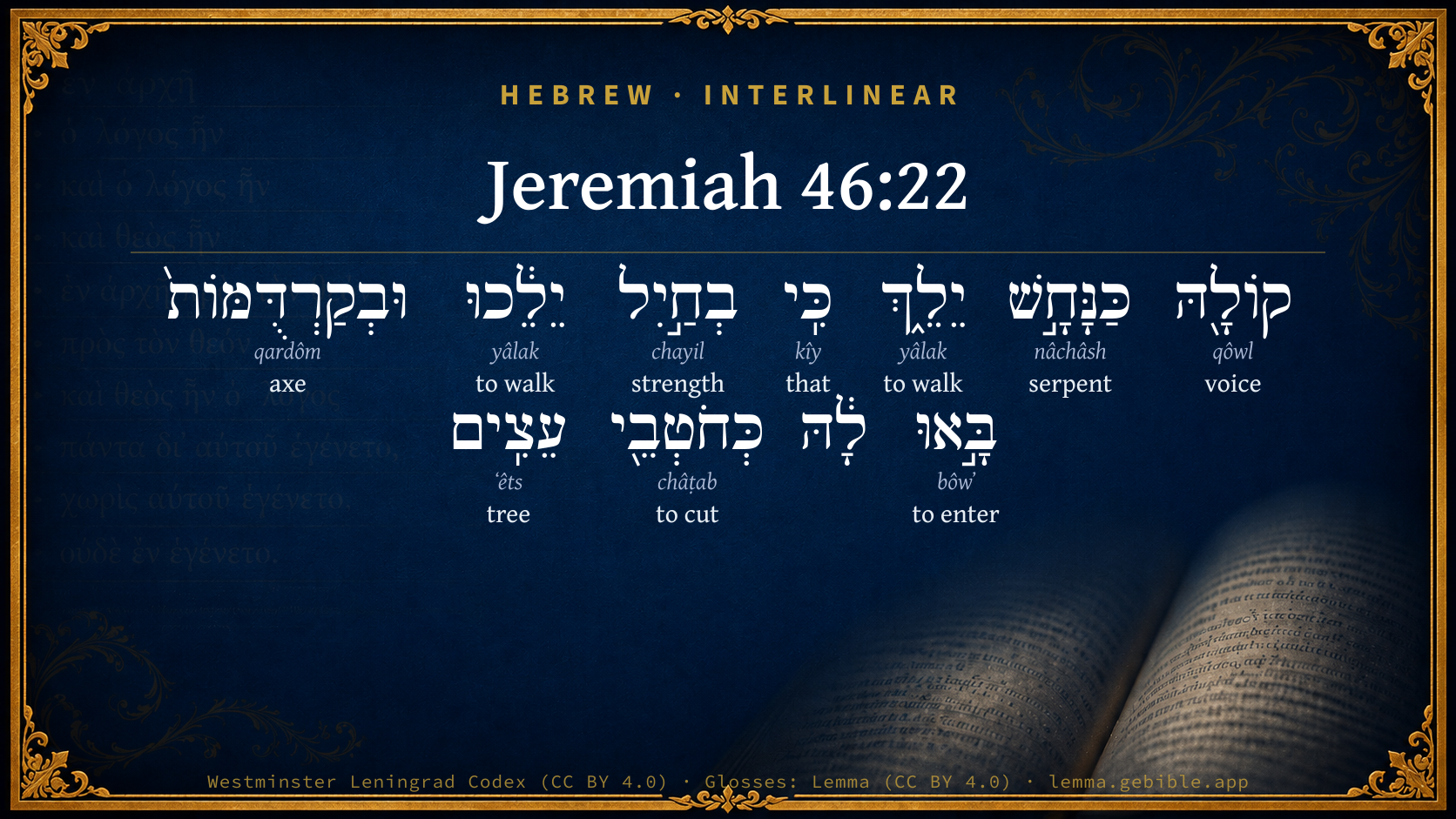
Hebrew (Westminster Leningrad Codex) Jeremiah 46:22 appears in the Hebrew Old Testament. The text above is from the Westminster Leningrad Codex. Each word links to its Strong’s number, a concise gloss, and parsing drawn from the Open Scriptures Hebrew Bible morphology. Click any word for its full Brown-Driver-Briggs (BDB) entry.
Download image
Cite this verse

Jeremiah 46:22 (World English Bible). Public Domain. Lemma interlinear Bible study tool, https://lemma.gebible.app/v/jeremiah/46/22.

Show BibTeX & RIS
BibTeX
RIS
English Translation
The sound of it shall go like the serpent; for they shall march with an army, and come against her with axes, as wood cutters.
World English Bible · Public Domain
Download a study sheet

One document with this verse’s original text, its word-by-word gloss line, the meaning frame, cross-references with their text, attributed commentary, and full source and license credits — printable, and it pastes into notes with its structure intact.

This verse Autodidact and up

Study sheet (.html) Plain text (.txt)

A passage Seminary Student

Up to 50 verses in one chapter. A passage sheet keeps up to 6 commentary sources and 12 cross-references per verse, in the order this page ranks them, and says so on the sheet whenever that leaves anything out. Ask for a single verse and you get the Autodidact verse sheet above.

Everything on this page stays free to read, with no account — the sheet is a download of what is already on screen, not access to it.

Want to remove ads? Support Godless Engineer
Compare translations 3

The same verse in 3 English versions, stacked beneath the original-language interlinear above. Click any original word for its lexicon entry.

Each is an independent rendering of the whole verse — the interlinear is not word-aligned to these translations.

Highlighted words mark where these versions differ — a whole-verse word diff, not a word-by-word alignment.

  • World English Bible Public Domain
    The sound of it shall go like the serpent; for they shall march with an army, and come against her with axes, as wood cutters.
  • King James Version Public Domain
    The voice thereof shall go like a serpent; for they shall march with an army, and come against her with axes, as hewers of wood.
  • unfoldingWord Literal Text CC BY-SA 4.0
    Egypt hisses like a snake and crawls away, for her enemies are marching against her. They are going toward her like woodcutters with axes.

unfoldingWord Literal Text — © unfoldingWord, licensed CC BY-SA 4.0. Word-aligned USFM3 via Door43 (git.door43.org/unfoldingWord/en_ult).

Versions to compare (up to 4)

3 of 4 selected

Show all 18 translations

Every available English version of this verse, each an independent rendering of the whole verse.

  • World English Bible Public Domain
    The sound of it shall go like the serpent; for they shall march with an army, and come against her with axes, as wood cutters.
  • Berean Standard Bible Public Domain
    Egypt will hiss like a fleeing serpent, for the enemy will advance in force; with axes they will come against her like woodsmen cutting down trees.
  • Majority Standard Bible Public Domain
    Egypt will hiss like a fleeing serpent, for the enemy will advance in force; with axes they will come against her like woodsmen cutting down trees.
  • King James Version Public Domain
    The voice thereof shall go like a serpent; for they shall march with an army, and come against her with axes, as hewers of wood.
  • American Standard Version (1901) Public Domain
    The sound thereof shall go like the serpent; for they shall march with an army, and come against her with axes, as hewers of wood.
  • Revised Version (1885) Public Domain
    The sound thereof shall go like the serpent; for they shall march with an army, and come against her with axes, as hewers of wood.
  • Geneva Bible (1599) Public Domain
    The voyce thereof shall goe foorth like a serpent: for they shall march with an armie, and come against her with axes, as hewers of wood.
  • Douay-Rheims (1899) Public Domain
    Her voice shall sound like brass, for they shall hasten with an army, and with axes they shall come against her, as hewers of wood.
  • Young's Literal Translation Public Domain
    Its voice as a serpent goeth on, For with a force they go, And with axes they have come in to her, As hewers of trees.
  • Literal Standard Version CC BY-SA 4.0
    Its voice goes on as a serpent, || For they go with a force, || And they have come in to her with axes, || As hewers of trees.
  • Unlocked Literal Bible CC BY-SA 4.0
    Egypt hisses like a snake and crawls away, for her enemies are marching against her. They are going toward her like woodcutters with axes.
  • unfoldingWord Literal Text CC BY-SA 4.0
    Egypt hisses like a snake and crawls away, for her enemies are marching against her. They are going toward her like woodcutters with axes.
  • Darby Bible Public Domain
    Her voice shall go like a serpent's; for they shall march with an army, and come against her with axes, as hewers of wood.
  • World Messianic Bible Public Domain
    Its sound will go like the serpent, for they will march with an army, and come against her with axes, as wood cutters.
  • Webster's Bible Public Domain
    The voice thereof shall go like a serpent; for they shall march with an army, and come against her with axes, as hewers of wood.
  • Free Bible Version CC BY-SA 4.0
    The Egyptians will retreat with a rustle like a snake sliding away, because the enemy will attack them with axes, coming at them like wood-cutters chopping down trees.
  • Bible in Basic English Public Domain
    She makes a sound like the hiss of a snake when they come on with strength; they go against her with axes, like wood-cutters.
  • JPS Tanakh (1917) Public Domain
    The sound thereof shall go like the serpent's; for they march with an army, and come against her with axes, as hewers of wood.

Literal Standard Version (2020), Covenant Press — licensed CC BY-SA 4.0. Text via the HelloAO Bible API (eBible.org). Unlocked Literal Bible (unfoldingWord) — licensed CC BY-SA 4.0. Text via the HelloAO Bible API (eBible.org). unfoldingWord Literal Text — © unfoldingWord, licensed CC BY-SA 4.0. Word-aligned USFM3 via Door43 (git.door43.org/unfoldingWord/en_ult). Free Bible Version, Dr. Jonathan Gallagher — licensed CC BY-SA 4.0. Text via the HelloAO Bible API (eBible.org).

Word by word

More ways to search: Search by grammar → Find every occurrence → Compare this word →

Practice this passage: Drill this verse → Learn its vocabulary →

וּבְקַרְדֻּמּוֹת֙
qardôm
H7134
“and · in/at · axes”
Conjunction + Preposition + Noun, Common, Both, Plural, Absolute
Part of Speech
Conjunction + Preposition + Noun
Type
Common
Gender
Both
Number
Plural
State
Absolute
Full BDB Definition

Origin: perhaps from H6923 in the sense of striking upon

TWOT: 2067

axe
  1. קוֹלָ֖הּ qôwl H6963 “voice · her” Noun, Common, Masculine, Singular, Construct + Suffix, Personal, 3rd Person, Feminine, Singular
  2. כַּנָּחָ֣שׁ nâchâsh H5175 “like/as the · serpent” Preposition, Determined + Noun, Common, Masculine, Singular, Absolute
  3. יֵלֵ֑ךְ yâlak H3212 “to walk” Verb, Qal, Imperfect, 3rd Person, Masculine, Singular
  4. כִּֽי kîy H3588 “that” Conjunction
  5. בְחַ֣יִל chayil H2428 “in/at · strength” Preposition + Noun, Common, Masculine, Singular, Absolute
  6. יֵלֵ֔כוּ yâlak H3212 “to walk” Verb, Qal, Imperfect, 3rd Person, Masculine, Plural
  7. בָּ֣אוּ bôwʼ H935 “to enter” Verb, Qal, Perfect, 3rd Person, Common, Plural
  8. כְּחֹטְבֵ֖י châṭab H2404 “like/as · cutting” Preposition + Verb, Qal, Participle Active, Masculine, Plural, Construct
  9. עֵצִֽים ʻêts H6086 “trees” Noun, Common, Masculine, Plural, Absolute

About this verse

These counts appear in no published source. They are computed here, from the morphology-tagged text and Lemma’s own curated glosses. What Lemma adds →

11
words
9
distinct lemmas
Prophets
section

Notable vocabulary

The rarest word here is וּבְקַרְדֻּמּוֹת֙ axe H7134 — appearing just 5 times in the whole Hebrew Bible.

Shared distinctive vocabulary

וּבְקַרְדֻּמּוֹת֙ axe H7134 occurs in 5 verses of the Hebrew Bible. Also found in:

Grammatical profile

  • 4 verbs
  • 5 nouns
  • 1 preposition
  • 1 conjunction

Verb forms

  • יֵלֵ֑ךְ Qal · Imperfect
  • יֵלֵ֔כוּ Qal · Imperfect
  • בָּ֣אוּ Qal · Perfect
  • כְּחֹטְבֵ֖י Qal · Participle Active

Repetition

A word recurs within this verse — often emphatic in Hebrew:

  • יֵלֵ֑ךְ to walk H3212 ×2

Cross-references

9

Topical passages linked to Jeremiah 46:22 in the Treasury of Scripture Knowledge — connected by theme and wording, ordered by reader-vote popularity; previews shown in the World English Bible.

  • Isaiah 14:8 Yes, the fir trees rejoice at you, [and] the cedars of Lebanon, [saying], Since you are laid low, no lumberjack is come up against us.
  • Isaiah 29:4 You shall be brought down, and shall speak out of the ground, and your speech shall be low out of the dust; and your voice shall be as of one who has a familiar spirit, out of the ground, and your speech shall whisper out of the dust.
  • Isaiah 10:15 Shall the axe boast itself against him who hews therewith? Shall the saw magnify itself against him who wields it? as if a rod should wield those who lift it up, [or] as if a staff should lift up [him who is] not wood.
  • Isaiah 10:33–34 Behold, the Lord, Yahweh of Hosts, will lop the boughs with terror: and the high of stature shall be hewn down, and the lofty shall be brought low.
  • Isaiah 37:24 By your servants have you defied the Lord, and have said, With the multitude of my chariots am I come up to the height of the mountains, to the innermost parts of Lebanon; and I will cut down the tall cedars of it, and the choice fir trees of it; and I will enter into its farthest height, the forest of its fruitful field;
  • Jeremiah 51:20–23 You are my battle-axe and weapons of war: and with you will I break in pieces the nations; and with you will I destroy kingdoms;
  • Micah 1:8 For this I will lament and wail; I will go stripped and naked; I will howl like the jackals, And moan like the daughters of owls.
  • Micah 7:16 The nations will see and be ashamed of all their might. They will lay their hand on their mouth. Their ears will be deaf.
  • Zechariah 11:2 Wail, fir tree, for the cedar has fallen, Because the stately ones are destroyed. Wail, you oaks of Bashan, For the strong forest has come down.

Cross-references courtesy of OpenBible.info (CC BY 4.0).

Hebrew and Greek witnesses Masoretic Hebrew ↔ Greek Septuagint

The same verse in the two great witnesses to the Old Testament, shown verse-for-verse.

These are two independent witnesses, not word-aligned to each other, and the Septuagint is shown in lemma (dictionary) form.

Hebrew Jeremiah 46:22 Masoretic · Westminster Leningrad Codex

קוֹלָ֖הּ כַּנָּחָ֣שׁ יֵלֵ֑ךְ כִּֽי בְחַ֣יִל יֵלֵ֔כוּ וּבְקַרְדֻּמּוֹת֙ בָּ֣אוּ לָ֔הּ כְּחֹטְבֵ֖י עֵצִֽים

The sound of it shall go like the serpent; for they shall march with an army, and come against her with axes, as wood cutters.

World English Bible · Public Domain

Greek LXX Structure differs

In the Septuagint, Jeremiah is about an eighth shorter than the Hebrew and arranges its material differently — the Oracles Against the Nations (Hebrew chapters 46–51) appear in the middle of the Greek book, after 25:13. Because the chapter and verse boundaries do not line up, a verse-for-verse comparison with the Hebrew is not shown.

A verse-for-verse comparison isn’t shown here because the chapters and verses don’t line up. Switch to the LXX edition with the MT / LXX toggle above to read the Greek directly.

On this verse, The Cambridge Bible for Schools and Colleges discusses the Septuagint’s reading. Read the note in Commentary ↓

Hebrew: Westminster Leningrad Codex (CC BY 4.0). Greek: Septuagint (public domain); English from a public-domain English Septuagint. How the Septuagint differs from the Hebrew →

Targum (Aramaic paraphrase)

1

The Targum is the ancient Jewish Aramaic paraphrase of the Hebrew Scriptures — an interpretive translation, not the Hebrew text itself. Onkelos (literal) and Pseudo-Jonathan (expansive) render the Torah, and Jonathan the Prophets. Coverage is partial: where no permissively-licensed English translation exists for a verse, only the Aramaic is shown. This is verse-level text, not a word-by-word alignment to the Hebrew.

  1. Targum Jonathan Prophets (Joshua–Malachi)
    קַל נִיקוּשׁ זְיָנֵיהוֹן כְּחֵיוָן זָחֲלִין אֲרֵי בְמַשִׁרְיָן יְהָכוּן עֲלֵיכוֹן וּכְמָא דְעָלִין בְּכַשִׁילִין לְמֵיקַץ אָעֵי חוּרְשָׁא:

    (no public-domain English translation for this verse)

    Targum Jonathan — Aramaic: “Mikraot Gedolot” (public domain). English: “Sefaria Community Translation” (CC0 1.0 (public-domain dedication)); “London "Chaldee Paraphrase," 1871” (public domain). Text via Sefaria.

Commentary

Notes on Jeremiah 46:22 from classic Christian and Jewish commentators (each source and its license shown beneath its notes). The classic Christian expositions comment on the surrounding passage and are grouped to its opening verse, so a note may address several verses; the Jewish commentaries on the Tanakh (Rashi and others) are per-verse, so they appear only where the commentator wrote on this verse.

Lemma curates 59 commentaries, every one of them public domain or Creative Commons licensed, each selected and text-cleaned for this edition rather than reprinted as found. About our sources →

Trapp's Complete Commentary

John Trapp

Jer 46:22 The voice thereof shall go like a serpent; for they shall march with an army, and come against her with axes, as hewers of wood.

Ver. 22. The voice thereof (of Egypt) shall go like a serpent.] {a} Submissa voce loquetur. She shall hiss and whisper, as being daunted and damped, scarce able to mutter or utter aught for fear. {Isa 29:4}

{a} Vox trepida et prae metu instar serpentum stridula.

John Trapp, A Commentary or Exposition upon All the Books of the Old and New Testament (1647–1656) — public domain. Text from a community e-Sword module.

Joseph Benson's Commentary

Jer 46:22-23. The voice thereof shall go like a serpent — “That is, her (Egypt’s) voice shall be low and inarticulate through fear. This passage seems to be an imitation of Isa 29:4, where we find the same threat denounced against Jerusalem, namely, Thy speech shall be low out of the dust, and thy voice shall be as one that hath a familiar spirit, out of the ground. The cause which is assigned is the same in both places, the irresistible attack of powerful enemies.” — Dr. Durell. See note on Isa 29:4. For they shall march with an army — For the Chaldeans shall come with powerful forces; with axes, as hewers of wood — As if they came to fell timber in a wood. They shall cut down her forest — Here Egypt is compared to a forest, either for the multitude of cities and their stately buildings, or of people in that country; and its destruction is described by the metaphor of cutting down the trees of a forest. Though it cannot be searched, &c. — Though the forest be very thick, and the trees thereof innumerable. Because they are more than the grasshoppers — Because the army of the Chaldeans shall be as numerous as the inhabitants of Egypt. In other words, though the cities and inhabitants of Egypt be never so numerous and large; yet the Chaldean army shall plunder and destroy them, because their number is proportionable to such an enterprise. Armies are often compared to grasshoppers and such like insects, both for their multitudes, and because they make a general consumption, grasshoppers devouring all before them, wherever they come: see Jdg 6:5; Jdg 7:12; Joe 2:4-5.

Joseph Benson's Commentary on the Old and New Testaments (1811–1818) — public domain. Text from a community e-Sword module.

Tyndale Open Study Notes

Tyndale Open Resources

46:22-23 The picture of a serpent gliding away illustrates the panic that gripped Egypt. The invaders would chop the people to pieces like woodsmen after swarming into the country like locusts.

Tyndale Open Study Notes — © Tyndale Open Resources, licensed CC BY-SA 4.0. Text via the HelloAO Bible API.

Geneva Bible (1599)

Geneva Bible translators

They shall be scarce able to speak for fear of the Chaldeans.

Meaning, Egypt.

Geneva Bible (1599) marginal notes — public domain. Text via Bolls.life.

Jamieson, Fausset & Brown

Robert Jamieson, A. R. Fausset & David Brown

The cry of Egypt when invaded shall be like the hissing of a serpent roused by the woodcutters from its lair. No longer shall she loudly roar like a heifer, but with a low murmur of fear, as a serpent hissing.

with axes--the Scythian mode of armor. The Chaldeans shall come with such confidence as if not about to have to fight with soldiers, but merely to cut down trees offering no resistance.

Jamieson, Fausset & Brown — Commentary Critical and Explanatory on the Whole Bible (1871) — public domain (CC PDM 1.0). Text via the HelloAO Bible API.

Adam Clarke's Commentary

Verse 22. The voice - shall go like a serpent] See Isa 29:4, and the note there.

Adam Clarke's Commentary on the Bible (1810–1826) — public domain. Text from a community e-Sword/MySword module.

John Calvin's Commentaries

To study elegance was not so much the object of the Prophet, as to confirm what he had taught. The figures, then, which he now uses, were not intended as ornaments of speech, but rather for the purpose of giving force and power to what he had said; for, as it has been said, prophecies had no credit with stupid men, unless stimulants were added to them.

He says now, that the voice of Egypt would go forth like that of a serpent: some read, “as though it were a serpent;” but I prefer to render it in the genitive case, and it is more suitable; for the Prophet means that the complaints of Egypt would not be obstreperous; as serpents, in creeping, send forth their hisses, so he intimates that the Egyptians, being overthrown, would be so broken down, as not to dare to utter open complaints, as those who freely cry out, but such as would remain alive would be so smitten with fear as only to mutter, as it has been said of serpents, who hiss as they creep. We now understand the real meaning of the Prophet: he says that the Egyptians would be so east down as not to dare openly to complain of their miseries, for they would only mutter, not otherwise than serpents who, on the ground, indistinctly hiss: its voice, then, shall advance, or go forth, like that of a serpent; and thus he points out their uneasiness, for they would seek hiding-places, and flee here and there, and never dare to remain in the same place. It is, indeed, a proof of the most miserable trepidation, when he who succumbs under his evils finds no place to set his foot on, but is forced, like serpents, to wander here and there. Jerome’s rendering is, “as that of brass,” as though it was written, נחשת, nuchashet; but I have already shewn what the Prophet meant.

He adds, For they shall come with an army, or with power. The word חיל, chil, means both. He now speaks of the Chaldeans. He said that the Egyptians would tremble, and be so broken down, as not to dare to utter their groans openly. Now follows the reason, because the Chaldeans would come with power, or with an army; they would come not only as soldiers to fight, but also as hewers of wood with their axes He intimates that the issue of the war would by no means be doubtful, but that the Chaldeans would come into Egypt as hired men come to cut down trees. Soldiers are, indeed, armed with swords and lances; for they have to do with enemies, nor can they overcome without danger, at least they cannot conquer without striving; but the Prophet says that the Chaldeans would be so filled with confidence, that they would not regard the Egyptians as enemies, for they would come, as it were, to cut down trees which offer no resistance: They shall come, then, as hewers of wood There is here an implied contrast between swords, lances, and axes, as there is between soldiers and hewers of wood. It follows, —

John Calvin's Commentaries (1540-1563) — public domain. Text from the Calvin Translation Society English edition (1840s-50s) via the Christian Classics Ethereal Library (ccel.org). Calvin's coverage is partial (roughly two-thirds of the Bible); uncommented books and verses are honest gaps, never fabricated. The 19th-century editor's footnotes and remarks are omitted so the notes are faithfully Calvin's own voice.

Ellicott's Commentary for English Readers

(22) The voice thereof shall go like a serpent.—Better, her voice—i.e., the voice of Egypt. In early prophecies Egypt had been compared to a “dragon” or “serpent” (Isa_27:1; Isa_51:9; Psa_74:13). Here the serpent is represented as hissing in its rage and terror in the forest against which the enemies are advancing. The sign then gives way to the thing signified, and the latter clause of the verse brings before us the hosts of the Chaldæan allies, barbarous tribes like the Scythians, Massagetæ, and Sacæ, armed with axes instead of swords or spears (Herod. i. 275, iv. 5). They come, but it is to cut down the trees of the forest, i.e., the symbols of the power of Egypt, and there is no power to resist them (Isa_10:33). The forest is so dense that the trees cannot be counted, but the fellers of the trees are as numerous, and the forest is destined to destruction at the hands of “the people of the north.”

A Bible Commentary for English Readers, edited by Charles John Ellicott (1878–1897) — public domain. Text from a community e-Sword module.

The Cambridge Bible for Schools and Colleges

gen. ed. J. J. S. Perowne

22. The sound thereof shall go like the serpent] better, as mg. Her sound is like that of the serpent as it goeth. The voice of Egypt in her feebleness as she flees away from the enemy shall be like the voice of a serpent hissing, i.e. like a serpent hissing impotently at the woodcutters who disturb its retreat through the thick underwood. For “as it goeth” the LXX (but probably through an early confusion between two Greek words on the part of a scribe) read “hissing.” The serpent formed an important feature in the religion of the Egyptians, who worshipped Kneph under this form. The hostile army is likened in these. vv. to a host of persons clearing away a forest for firewood. The denseness of the forest represents the number and populous character of the cities of Egypt. Dr. compares Isa_10:18 f., 33 f.

with axes] This would make a deep impression upon the mind of nations like the Jews, who had no such custom. “The battle-axe was a weapon but rarely employed by the Assyrians. It is only in the very latest sculptures, and in a very few instances, that we find axes represented as used by the warriors for any other purpose besides the felling of trees. Where they are seen in use against the enemy, the handle is short, the head somewhat large, and the weapon wielded with one hand.” Rawlinson, Anc. Mon. I. 459.

hewers] or, less well, gatherers of firewood.

The Cambridge Bible for Schools and Colleges (gen. ed. J. J. S. Perowne; Cambridge University Press, 1878–1918) — public domain. Text from a community e-Sword module.

John Gill's Exposition

The voice thereof shall go like a serpent,.... That is, the voice of Egypt, before compared to a heifer, when in its glory; but now it shall not bellow like a heifer in fat pasture, bat hiss like a serpent, when drove out of its hole, and pursued; signifying, that their voice should be low and submissive, and should not speak one big or murmuring word to their conquerors. The voice of the serpent is, by Aristotle (m) said to be small and weak; so Aelianus (n). Though Jarchi, Kimchi, and Abarbinel, understand it of the voice of serpents heard afar off; and so it may respect the dreadful lamentation the Egyptians should make, when they should see the Chaldeans come upon them to destroy them; just as serpents in woods make a horrible noise, when they are set on fire, or are cut down, to which there is an allusion in some following clauses. The Targum seems to interpret this of the Chaldean army thus,

"the voice of the clashing of their arms as serpents creeping;''

and of them the following words are certainly meant:

for they shall march with an army; the Targum adds, against you; the meaning is, that the Chaldeans should come with a great army, and march against the Egyptians with great strength, force, and fury:

and come against her with axes, as hewers of wood; with battle axes, as if they came to cut down trees; nor would they spare the Egyptians any more than such hewers do the trees; nor would they be able any more to resist them than trees can resist hewers of wood.

(m) Hist. Animal. l. 4. c. 9. (n) De Animal. l. 15. c. 13.

John Gill's Exposition of the Whole Bible (1746–1763) — public domain (CC PDM 1.0). Text via the HelloAO Bible API.

Albert Barnes' Notes on the Bible

The voice thereof - Her voice, i. e., the voice of Egypt. The word here probably means the busy sound of life and activity in the towns of Egypt, the tramping of her hosts, and the turmoil of camp and city. All this at the approach of the Chaldaean army shall depart, as the snake flees away when disturbed in its haunts by the wood-cutters.

March with an army - Advance with might.

With axes - The comparison of the Chaldaean warriors to woodcutters arose from their being armed with axes. As the Israelites did not use the battle-axe, their imagination would be the more forcibly struck by this weapon.

Albert Barnes' Notes on the Bible (1834–1885) — public domain. Text from a community e-Sword/MySword module.

Haydock's Catholic Bible Commentary

Brass. Septuagint, "hissing serpent;" lamenting in secret, Isaias xxix. 4. --- Wood. Battle-axes were then used. Great cities and monarchs shall fall, Zacharias xi. 2., and Ezechiel xxxi. 3. (Calmet)

George Leo Haydock (1774–1849), Haydock's Catholic Family Bible and Commentary, 1859 edition — public domain. Excludes Psalms (Douay-Rheims chapter numbering differs from Protestant) and Deuterocanonical books (Catholic canon only).

Matthew Poole's English Annotations

Egypt is now like a heifer that makes a great bellowing, but the time shall come when she shall make a lesser noise, like the hissing of a serpent when it seeth itself set upon. For the Chaldeans shall come with a great army, armed with battle-axes, as if they came to fell down some wood in a forest or wood.

Matthew Poole's English Annotations on the Holy Bible (1683–1685) — public domain. Text from a community e-Sword/MySword module.

Whedon's Commentary on the Bible

Daniel D. Whedon

22. Voice thereof — Of Egypt. As the serpent disturbed in his lair by the wood choppers flees away, so Egypt shall flee before the axes of the Chaldean army.

Daniel D. Whedon (gen. ed.), Commentary on the Old and New Testaments (1874–1909) — public domain. Text from a community e-Sword module.

The Pulpit Commentary

The voice thereof shall go like a serpent; rather, her voice is like (the sound of) a serpent gliding away. Egypt (like Jerusalem, in Isa_29:4) is imagined as a maiden (comp. ver. 19) seated on the ground, and faintly sighing; and her feeble voice is likened to the rustling sound of a serpent in motion. Come against her with axes. A sudden change of figure. Egypt, or, more strictly, Egypt"s grandeur its rich and complex national life, its splendid cities, its powerful army, all combined in one, is now compared to a forest. (comp. Jer_21:14 Jer_22:6, 7 Isa_2:13 Isa_10:18, Isa_10:19, Isa_10:33, Isa_10:34) It seems far fetched to suppose, with Graf and Dr. Payne Smith, that the comparison of the Chaldean warriors to wood cutters arose from their being armed with axes. It is probably true that the Israelites did not use the battle axe, but the axe is merely an accident of the description. It is the forest which suggests the mention of the axe, not the axe that of the forest, and forests were familiar enough to the Israelites.

The Pulpit Commentary (1880–1919), ed. H.D.M. Spence-Jones & Joseph S. Exell — public domain. Text from a community e-Sword module.

Rashi

Rabbi Shlomo Yitzchaki (Rashi)

Its voice shall go like [that of] the snake The “snake” comes to teach us about Egypt but ends by learning. For we learn from here that when the Holy One, blessed be He, said to the serpent, “You shall walk on your belly” (Gen. 3:14), He severed his feet, and his voice went to the end of the world. So we learned in the ‘Thirty-two Methods of Rabbi Eliezer the son of Rabbi Jose the Galilean’ (Method 12).

for they will march with an army against her.

Rashi on the Tanakh — English translations: “The Judaica Press complete Tanach with Rashi, translated by A. J. Rosenberg” (CC BY 4.0); “Pentateuch with Rashi's commentary by M. Rosenbaum and A.M. Silbermann, 1929-1934” (public domain); “The Metsudah Tanach series, Lakewood, N.J” (CC BY 4.0); and “The Book of Joshua, Metsudah Publications, 1997” (CC BY 4.0). Text via Sefaria.

Lesson kit

Teaching starters — assembled from the data on this page, not authored interpretation. Every prompt links to the verse data it draws on. Edit before teaching.

Jeremiah, in the Prophets, opens this verse with 11 words (9 distinct Hebrew lemmas). Its most distinctive word is qardôm (“axe”). A historical commentator’s framing appears above. Read the whole chapter for the surrounding context.

Discussion questions

  1. What does “axe” (qardôm) contribute to the verse as a whole?
  2. How does Judges 9:48, which shares the word «axe», read alongside this verse?
  3. What does the repetition of “to walk” (2× in this one verse) do in this verse?
  4. These translations render this verse differently. What is at stake in choosing one wording over another?
  5. «יֵלֵ֑ךְ» is a Qal Imperfect verb. How does that grammatical form shape the action described?
  6. Compare how Trapp's Complete Commentary and Joseph Benson's Commentary read this verse. Where do they agree or differ?

Things to notice

Reading settings

Reading text

Shown beneath each verse's original-language words.

Old Testament
Old Testament edition

Read the OT as the Masoretic Hebrew (MT) or the Greek Septuagint (LXX).

English shown for the Greek Septuagint (in the Hebrew ↔ Greek comparison).

Comparing translations? Open the Compare panel on any verse page to stack up to four side by side.