
Psalms 118:15

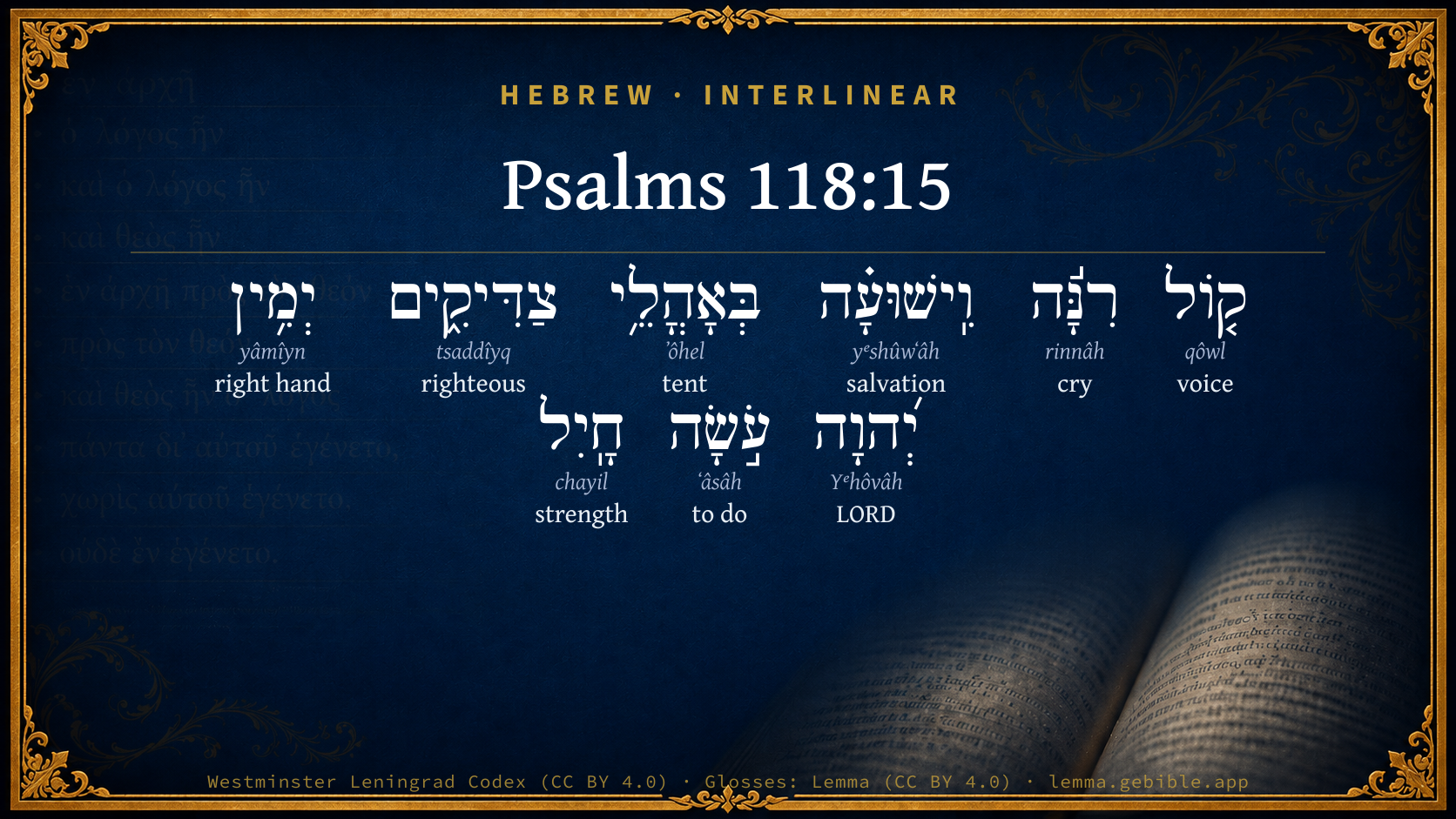
Hebrew (Westminster Leningrad Codex) Psalms 118:15 appears in the Hebrew Old Testament. The text above is from the Westminster Leningrad Codex. Each word links to its Strong’s number, a concise gloss, and parsing drawn from the Open Scriptures Hebrew Bible morphology. Click any word for its full Brown-Driver-Briggs (BDB) entry.
Download image
Cite this verse

Psalms 118:15 (World English Bible). Public Domain. Lemma interlinear Bible study tool, https://lemma.gebible.app/v/psalms/118/15.

Show BibTeX & RIS
BibTeX
RIS
English Translation
The voice of rejoicing and salvation is in the tents of the righteous. "The right hand of Yahweh does valiantly.
World English Bible · Public Domain
Download a study sheet

One document with this verse’s original text, its word-by-word gloss line, the meaning frame, cross-references with their text, attributed commentary, and full source and license credits — printable, and it pastes into notes with its structure intact.

This verse Autodidact and up

Study sheet (.html) Plain text (.txt)

A passage Seminary Student

Up to 50 verses in one chapter. A passage sheet keeps up to 6 commentary sources and 12 cross-references per verse, in the order this page ranks them, and says so on the sheet whenever that leaves anything out. Ask for a single verse and you get the Autodidact verse sheet above.

Everything on this page stays free to read, with no account — the sheet is a download of what is already on screen, not access to it.

Want to remove ads? Support Godless Engineer
Compare translations 3

The same verse in 3 English versions, stacked beneath the original-language interlinear above. Click any original word for its lexicon entry.

Each is an independent rendering of the whole verse — the interlinear is not word-aligned to these translations.

Highlighted words mark where these versions differ — a whole-verse word diff, not a word-by-word alignment.

  • World English Bible Public Domain
    The voice of rejoicing and salvation is in the tents of the righteous. "The right hand of Yahweh does valiantly.
  • King James Version Public Domain
    The voice of rejoicing and salvation is in the tabernacles of the righteous: the right hand of the LORD doeth valiantly.
  • unfoldingWord Literal Text CC BY-SA 4.0
    The voice of a shout and salvation in the tents of the righteous; the right hand of Yahweh does valor!

unfoldingWord Literal Text — © unfoldingWord, licensed CC BY-SA 4.0. Word-aligned USFM3 via Door43 (git.door43.org/unfoldingWord/en_ult).

Versions to compare (up to 4)

3 of 4 selected

Show all 18 translations

Every available English version of this verse, each an independent rendering of the whole verse.

  • World English Bible Public Domain
    The voice of rejoicing and salvation is in the tents of the righteous. "The right hand of Yahweh does valiantly.
  • Berean Standard Bible Public Domain
    Shouts of joy and salvation resound in the tents of the righteous: “The right hand of the LORD performs with valor!
  • Majority Standard Bible Public Domain
    Shouts of joy and salvation resound in the tents of the righteous: “The right hand of the LORD performs with valor!
  • King James Version Public Domain
    The voice of rejoicing and salvation is in the tabernacles of the righteous: the right hand of the LORD doeth valiantly.
  • American Standard Version (1901) Public Domain
    The voice of rejoicing and salvation is in the tents of the righteous: The right hand of Jehovah doeth valiantly.
  • Revised Version (1885) Public Domain
    The voice of rejoicing and salvation is in the tents of the righteous: the right hand of the LORD doeth valiantly.
  • Geneva Bible (1599) Public Domain
    The voice of ioy and deliuerance shall be in the tabernacles of the righteous, saying, The right hand of the Lord hath done valiantly.
  • Douay-Rheims (1899) Public Domain
    The voice of rejoicing and of salvation is in the tabernacles of the just.
  • Young's Literal Translation Public Domain
    A voice of singing and salvation, `Is' in the tents of the righteous, The right hand of Jehovah is doing valiantly.
  • Literal Standard Version CC BY-SA 4.0
    A voice of singing and salvation, || [Is] in the tents of the righteous, || The right hand of YHWH is doing valiantly.
  • Unlocked Literal Bible CC BY-SA 4.0
    The joyful shout of victory is heard in the tents of the righteous; the right hand of Yahweh conquers.
  • unfoldingWord Literal Text CC BY-SA 4.0
    The voice of a shout and salvation in the tents of the righteous; the right hand of Yahweh does valor!
  • Darby Bible Public Domain
    The voice of triumph and salvation is in the tents of the righteous: the right hand of Jehovah doeth valiantly;
  • World Messianic Bible Public Domain
    The voice of rejoicing and salvation [yeshu`ah] is in the tents of the righteous. “The right hand of the LORD does valiantly.
  • Webster's Bible Public Domain
    The voice of rejoicing and salvation is in the tabernacles of the righteous: the right hand of the LORD doeth valiantly.
  • Free Bible Version CC BY-SA 4.0
    Songs of celebration and victory come from the tents of the faithful. The Lord's powerful hand has done amazing things!
  • Bible in Basic English Public Domain
    The sound of joy and salvation is in the tents of the upright; the right hand of the Lord does works of power.
  • JPS Tanakh (1917) Public Domain
    The voice of rejoicing and salvation is in the tents of the righteous; the right hand of the LORD doeth valiantly.

Literal Standard Version (2020), Covenant Press — licensed CC BY-SA 4.0. Text via the HelloAO Bible API (eBible.org). Unlocked Literal Bible (unfoldingWord) — licensed CC BY-SA 4.0. Text via the HelloAO Bible API (eBible.org). unfoldingWord Literal Text — © unfoldingWord, licensed CC BY-SA 4.0. Word-aligned USFM3 via Door43 (git.door43.org/unfoldingWord/en_ult). Free Bible Version, Dr. Jonathan Gallagher — licensed CC BY-SA 4.0. Text via the HelloAO Bible API (eBible.org).

Word by word

More ways to search: Search by grammar → Find every occurrence → Compare this word →

Practice this passage: Drill this verse → Learn its vocabulary →

About this verse

These counts appear in no published source. They are computed here, from the morphology-tagged text and Lemma’s own curated glosses. What Lemma adds →

9
words
9
distinct lemmas
Wisdom
section

Shared distinctive vocabulary

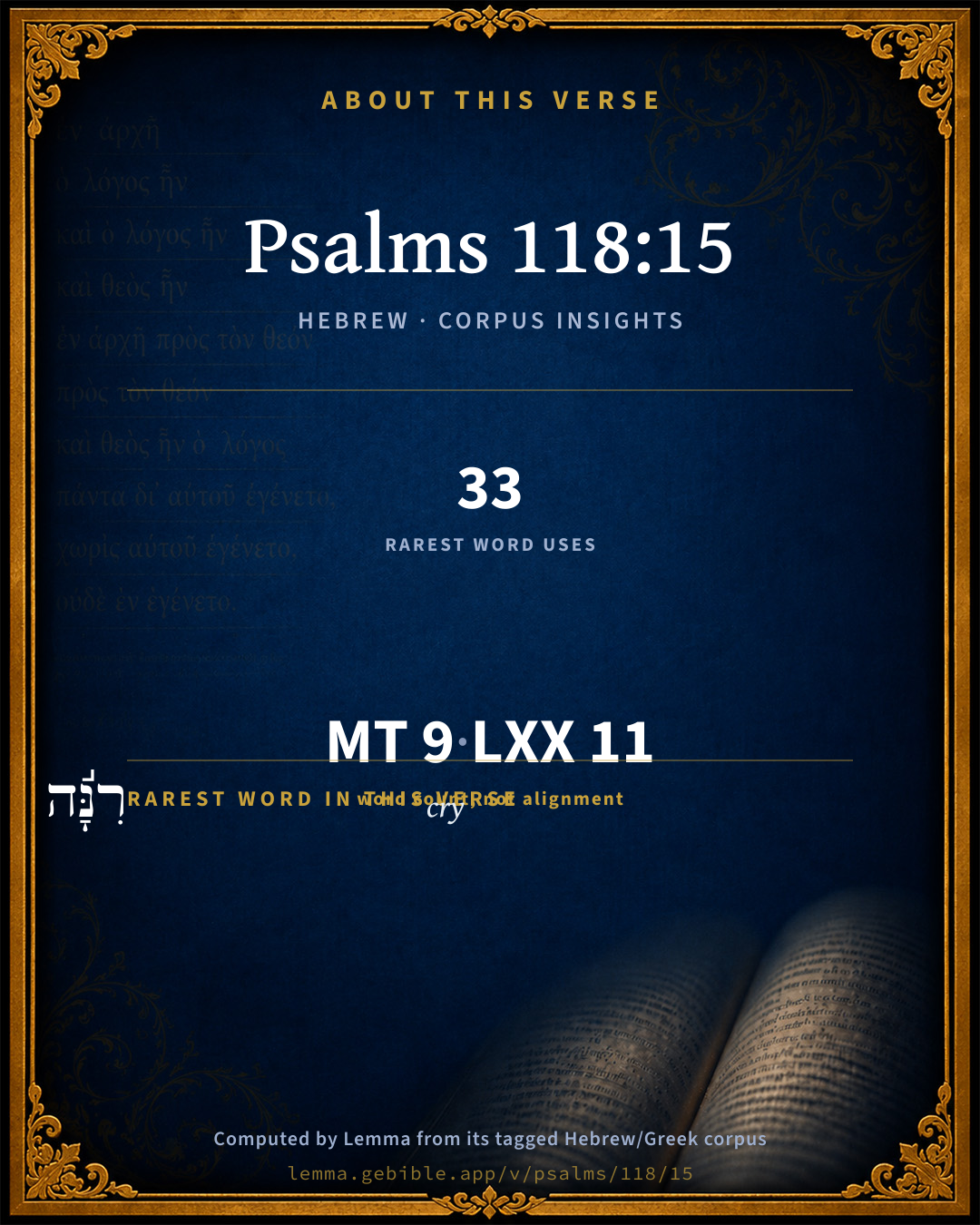
רִנָּ֬ה cry H7440 occurs in 33 verses of the Hebrew Bible. Also found in:

Grammatical profile

  • 1 verb
  • 7 nouns
  • 1 adjective

Verb forms

  • עֹ֣שָׂה Qal · Participle Active

Hebrew & Septuagint length

In English translation the verse runs 20 words from the Hebrew and 22 from the Septuagint (LXX English) — closely comparable.

A rough comparison of the two English renderings, which tokenize alike — not a word-level alignment.

Word counts can differ between the Hebrew and the Greek without any difference in meaning — e.g. the Hebrew direct-object marker אֵת has no separate Greek word, and Greek often adds the article ὁ.

In the original languages it is 9 Hebrew tokens and 11 Greek tokens — but the two are counted differently (Hebrew bundles its prefixes and suffixes into one token; the Greek is in lemma form), so that isn’t a like-for-like length.

Cross-references

19

Topical passages linked to Psalms 118:15 in the Treasury of Scripture Knowledge — connected by theme and wording, ordered by reader-vote popularity; previews shown in the World English Bible.

  • Psalms 89:13 You have a mighty arm. Your hand is strong, and your right hand is exalted.
  • Acts 2:46–47 Day by day, continuing steadfastly with one accord in the temple, and breaking bread at home, they took their food with gladness and singleness of heart,
  • Psalms 60:12 Through God we shall do valiantly, For it is he who will tread down our adversaries.
  • Exodus 15:6 Your right hand, Yahweh, is glorious in power, Your right hand, Yahweh, dashes the enemy in pieces.
  • Psalms 98:1 Sing to Yahweh a new song, For he has done marvelous things! His right hand, and his holy arm, have worked salvation for him.
  • Luke 1:51 He has shown strength with his arm. He has scattered the proud in the imagination of their heart.
  • Psalms 44:3 For they didn't get the land in possession by their own sword, Neither did their own arm save them; But your right hand, and your arm, and the light of your face, Because you were favorable to them.
  • Isaiah 65:13 Therefore thus says the Lord Yahweh, Behold, my servants shall eat, but you shall be hungry; behold, my servants shall drink, but you shall be thirsty; behold, my servants shall rejoice, but you shall be disappointed;
  • Acts 16:34 He brought them up into his house, and set food before them, and rejoiced greatly, with all his household, having believed in God.
  • Revelation 18:20 Rejoice over her, O heaven, you saints, apostles, and prophets; for God has judged your judgment on her."
  • Psalms 32:11–33:1 Be glad in Yahweh, and rejoice, you righteous! Shout for joy, all you who are upright in heart!
  • Psalms 68:3 But let the righteous be glad. Let them rejoice before God. Yes, let them rejoice with gladness.
  • Psalms 119:111 I have taken your testimonies as a heritage forever, For they are the joy of my heart.
  • Deuteronomy 12:12 You shall rejoice before Yahweh your God, you, and your sons, and your daughters, and your men-servants, and your maid-servants, and the Levite who is within your gates, because he has no portion nor inheritance with you.
  • Psalms 30:11–12 You have turned my mourning into dancing for me. You have removed my sackcloth, and clothed me with gladness,
  • Psalms 45:4 In your majesty ride on victoriously on behalf of truth, humility, and righteousness. Let your right hand display awesome deeds.
  • Isaiah 51:9–11 Awake, awake, put on strength, arm of Yahweh; awake, as in the days of old, the generations of ancient times. Isn't it you who did cut Rahab in pieces, who pierced the monster?
  • Revelation 19:1–5 After these things I heard something like a loud voice of a great multitude in heaven, saying, "Hallelujah! Salvation, power, and glory belong to our God:
  • Psalms 119:54 Your statutes have been my songs, In the house where I live.

Cross-references courtesy of OpenBible.info (CC BY 4.0).

Hebrew and Greek witnesses Masoretic Hebrew ↔ Greek Septuagint

The same verse in the two great witnesses to the Old Testament, shown verse-for-verse.

You’re reading Greek Psalm 117 (Hebrew Psalm 118). The Septuagint counts the superscription, so verse numbers can differ from the Hebrew — chapter-level alignment, not verse-by-verse. Numbering follows Rahlfs.

These are two independent witnesses, not word-aligned to each other, and the Septuagint is shown in lemma (dictionary) form.

Hebrew Psalms 118:15 Masoretic · Westminster Leningrad Codex

ק֤וֹל רִנָּ֬ה וִֽישׁוּעָ֗ה בְּאָהֳלֵ֥י צַדִּיקִ֑ים יְמִ֥ין יְ֝הוָה עֹ֣שָׂה חָֽיִל

The voice of rejoicing and salvation is in the tents of the righteous. "The right hand of Yahweh does valiantly.

World English Bible · Public Domain

Greek LXX Greek Psalm 117:15 Septuagint · lemma form

φωνή ἀγαλλίασις καί σωτηρία ἐν σκηνή δίκαιος δεξιός κύριος ποιέω δύναμις

The voice of exultation and salvation is in the tabernacles of the righteous: the right hand of the Lord has wrought mightily.

LXX2012 (modern English Septuagint) · Public Domain

Hebrew: Westminster Leningrad Codex (CC BY 4.0). Greek: Septuagint (public domain); English from LXX2012 (modern English Septuagint) (Public Domain). How the Septuagint differs from the Hebrew →

Commentary

Notes on Psalms 118:15 from classic Christian and Jewish commentators (each source and its license shown beneath its notes). The classic Christian expositions comment on the surrounding passage and are grouped to its opening verse, so a note may address several verses; the Jewish commentaries on the Tanakh (Rashi and others) are per-verse, so they appear only where the commentator wrote on this verse.

Lemma curates 59 commentaries, every one of them public domain or Creative Commons licensed, each selected and text-cleaned for this edition rather than reprinted as found. About our sources →

The Cambridge Bible for Schools and Colleges

gen. ed. J. J. S. Perowne

15. tabernacles] Tents, i.e. dwellings (Psa_91:10), unless the reference be to the tents of pilgrims to the feast pitched outside Jerusalem. The rendering ‘tabernacles’ might seem to connect the Psalm with the Feast of Tabernacles, but the word for the ‘booths’ used on that occasion is a different one. The righteous are Israel, regarded in the light of their calling, and contrasted with ‘the wicked,’ the heathen who sought to frustrate God’s purpose by destroying them. Cp. Psa_33:1; Hab_1:13. Psa_118:15 b, Psa_118:16 are the joyous shout of the righteous, and are based on Exo_15:6; Exo_15:12.

15–18. The rejoicings of the festival in gratitude to Jehovah for preserving the nation’s life.

The Cambridge Bible for Schools and Colleges (gen. ed. J. J. S. Perowne; Cambridge University Press, 1878–1918) — public domain. Text from a community e-Sword module.

Trapp's Complete Commentary

John Trapp

Psa 118:15 The voice of rejoicing and salvation [is] in the tabernacles of the righteous: the right hand of the LORD doeth valiantly.

Ver. 15. The voice of rejoicing, &c.] q.d. Though themselves are but travellers, and their habitatious tabernacles or tents; yet are they not without the joy of their salvation, which is unspeakable and full of glory; so that they go merrily on their way, feeding on this honeycomb (as once Samson), and God’s statutes are their songs in the house of their pilgrimage, Psa 119:54.

The right hand of the Lord, &c.] This and that which followeth is the righteous man’s ditty, which he singeth incessantly. See on Psa 118:4.

John Trapp, A Commentary or Exposition upon All the Books of the Old and New Testament (1647–1656) — public domain. Text from a community e-Sword module.

The Biblical Illustrator

Joseph S. Exell

Psa_118:15-16

The voice of rejoicing and salvation is in the tabernacles of the righteous.

The joy of holy households

A believer in Christ is not long without finding joy. He is in the land which floweth with milk and honey, and he will get a sip of sweetness very soon. Like Nicodemus, he comes to Jesus in the dark, but the sun is rising. This joy is in him and abounds, so that he belongs to a happy people.

I. There is joy in the families of the righteous.

1. To some extent, this is in proportion to the salvation that is found in the family. Many among us can say, All my children are children of God: they go with me from my table to the Lords table: I have a church in my house, and all nay household are in the church. Here is a picture, a pattern, a paragon, a paradise. Seek, then, the salvation of the whole of your household.

2. The joy which is here alluded to is mainly spiritual: a joy of the father, because he is saved in the Lord with an everlasting salvation; a joy of the mother, because she, too, has had her heart opened, like Lydia, to hear and to receive the Word; a joy of the dear children, as they offer their little prayers, and as they talk of Jesus, whom their soul loves.

3. This kind of joy, while it is spiritual, is not dependent upon external circumstances; it hangs not on wealth or honour. They said of old that philosophers could be merry without music, and I am sure that it is truer still of Christians that they can be happy in the Lord when temporal circumstances are against them. Our bells need no silken ropes to set them ringing, neither must they be hung in lofty towers.

4. Christian joy, whether in the individual or the family, can be abundantly justified. If God is pleased with us, we may well be pleased with Him.

II. This joy should be expressed. The voice, etc. We should put a tongue in our joys, and let them speak. The voice should be heard daily, from morn till eve, and till the silence of sleep steals over all; but it should never fail to sound forth in the daily gatherings for family prayer. It should be a happy occasion when we meet to read the Word of God, and to pray together. It is well if we can also sing at such times. Matthew Henry says, concerning family prayer, They that pray do well; they that pray and read the Scriptures do better; they that pray, and read the Scriptures, and sing a hymn, do best of all. There will be frequent occasions for holy joy in all Christian families, and these ought always to be used right heartily. Holy joy breeds no ill, however much we have of it. You can easily eat too much honey, but you can never enjoy too much delight in God. Birthdays and anniversaries of all sorts, with family meetings of various kinds, should find us setting life to music right heartily. Moreover, it would be well if our houses more generally resounded with song. It drives dull care away, it wards off evil thought, it tends to a general exultation, for the members of a household to be accustomed individually and collectively to sing. If you really cannot sing at all, yet the voice of rejoicing and salvation may be in your tabernacles by a constant cheerfulness, bearing up under pain and poverty, losses and crosses. God give you more and more of this spirit in all your households! The whole Church shall be blessed when every family is thus made happy in the Lord and in His great salvation.

III. This joy of holy households is a joy concerning what the Lord hath done.

1. How we should joy in God, in our families, when we think of all that He has done in conquering sin and Satan, death and hell! Christ hath led captivity captive; therefore, let us sing unto the Lord, for He hath triumphed gloriously.

2. Then let us think of what the Lord has done for each one of us individually.

3. Since then, the Lord has helped us in providence, and delivered us from fierce temptations, and made us to stand steadfastly when the adversary has thrust sore at us that we might fall.

4. And when you see great sinners converted, when the drunkard leaves his cups, when the swearer washes out his filthy mouth, and sings the praises of God, when a hardened, irreligious, sceptical man bows like a child at Jesus feet, should not our families as well as ourselves be made acquainted with it, and should it not be a subject for joy at the family altar? (C. H. Spurgeon.)

Domestic happiness

I. Its importance.

1. In reference to our avocations and cares. These are numerous and diversified, and demand relaxation and relief. Who could endure perpetual drudgery and fatigue?--and what so refreshing, so soothing, so satisfying, as the placid joys of home!

2. In reference to the afflictions of life. It looks like a general remedy, furnished by the kindness of Providence, to alleviate the troubles which from various quarters we unavoidably feel while passing through this world of vanity and vexation of spirit. How many little sighing vacancies does it fill up! How many cloudy nervous vapours does it chase from the mind!

3. In reference to the good things of this life. Without this, all will be insipid, all will be useless. Imagine yourselves prosperous in your affairs; trade pouring in wealth, your grounds bringing forth plentifully, your cup running over--misery under your own roof would be sufficient to canker your gold and silver; to corrupt your abundance; to embitter every pleasure.

4. In reference to the seductions and snares of the world. From the danger of these there is no better preservative than the attractions of a family. The more a man feels his welfare lodged in his own house, the more will he prize and love it. The more he is attached to his wife and children, the less will he risk their peace and comfort by hazardous speculations, and mad enterprises in trade.

II. To open its sources, and examine on what it depends.

1. Without order you can never rule well your own house. God is not the God of confusion. He loves order: order pervades all His works.

2. Many things will arise to try your temper: and he is unqualified for social life who has no rule over his own spirit; who cannot bear the frailties of his fellow-creatures with common charity, and the vexations of life with common patience.

3. The influence and advantage of good sense are incalculable. This will preserve us from censoriousness; will lead us to distinguish circumstances; to draw things from the dark situation of prejudice which rendered them frightful, that we may candidly survey them in open day.

4. We must go beyond all this, and remind you of those religious principles by which you are to be governed These are to be found in the Word of God; and as many as walk according to this rule, mercy and peace shall be upon them. God has engaged that if you will walk in His way, you shall find rest unto your souls. If it be said, There are happy families without religion, I would answer--

(1) There is a difference between appearances and reality.

(2) If we believe the Scripture, this is impossible--the way of transgressors is hard: there is no peace, saith my God, unto the wicked.

(3) Religion secures those duties, upon the performance of which the happiness of households depends.

(4) Religion attracts the Divine blessing--and all we possess depends upon its smiles. (W. Jay.)

The happiness o/ the righteous

I. Explain. The joy of the righteous is--

1. Intense.

2. Satisfying.

3. Abiding. You rejoice in that which rust cannot destroy, and which the tongues of men cannot injure.

II. Apply.

1. How miserable is the state of the wicked.

2. How important is vital piety. (C. Clayton, M.A.)

The cultivation of piety

I. True piety has a voice ringing with the note of joy and health. Could we set forth the beauty of its offices, the beauty of prayer, the joyousness of worship, the peace of Divine fellowship; could we restore the bloom of health to its wan countenance; could we put the mountain air end breezes into our religion and make it a strong, healthy, living thing; could we make it a voice of rejoicing and salvation in the dwellings of our land, how grand, how triumphant, how sovereign a power it would become!

II. The place of true piety is the home. We need better homes; homes ruled in the fear of the Lord, where father and mother are prophet, priest and king; homes sweetened by the incense of prayer and worship and well-ordered discipline; homes where the Sabbath is honoured and all needless toil and travelling on the day of the Lord areavoided, and worship and edification as becometh immortal beings are the order of the day; homes where reverence has her abode, and holy beauty and the gladness of Christian faith and charity; homes that are none other than the house of God, none other than the gate of heaven. (H. F. Henderson, M.A.)

Union of gladness and goodness

It demoralizes life and religion to believe that God does not desire the happiness of His creatures, just as surely as it demoralizes life and religion to imagine that He has no higher aim for them than that they should be happy. It was a wise, as well as a Scriptural, answer which was given to the first question of the Westminster Shorter Catechism as to mans chief end. Mans chief end is to glorify God and to enjoy Him for ever. It is not without reason that spiritual life and blessedness are always in some form joined together; for goodness and happiness were not meant to be divided. Culture and restraint. (Hugh Black.)

The Biblical Illustrator, edited by Joseph S. Exell (c. 1880s–1900s) — public domain. Text from a community e-Sword module.

Joseph Benson's Commentary

Psa 118:15-18. The voice of rejoicing and salvation — That is, of rejoicing and thanksgiving for the deliverances God hath wrought for them; is in the tabernacle of the righteous — Because they clearly see God’s hand in the work, and therefore take pleasure in it. “There is a noise of them that sing for joy,” says Dr. Horne, “in the camp of the saints; the church militant resounds with thanksgiving and the voice of melody; paradise is restored below, and earth bears some resemblance of heaven, while these transporting hymns are sung in honour of our great Redeemer.” The right hand of the Lord doeth valiantly — These seem to be the words of that song of joy and praise now mentioned. The right hand, &c., is exalted — That is, hath appeared evidently, and wrought powerfully and gloriously on our behalf: for what difficulty can stand before God’s zeal and omnipotence? There is a spirit, as well as strength, in all his operations for his people. I shall not die — By the hands of my enemies that seek my life; but live, and declare the works of the Lord — That is, I shall live a monument of God’s mercy and power; his works shall be declared in me and by me; and I will make it the business of my life to praise and magnify God, looking upon that as the end of my preservation. Indeed, it is not worth while to live for any other purpose than to declare the works of God, for his honour, and the encouragement of others to serve and trust in him. Such as these were the triumphs of the Son of David; in the assurance he had of the success of his undertaking, and that the good pleasure of the Lord should prosper in his hands.

Joseph Benson's Commentary on the Old and New Testaments (1811–1818) — public domain. Text from a community e-Sword module.

J. A. Alexander on Psalms

Joseph Addison Alexander

15. (Psa 118:15) The voice of joy and salvation in the tents of the righteous--the right hand of Jehovah has made strength. The word translated joy means properly the audible expression of it by shout or song, and is sometimes applied even to a cry of distress. Compare Psa 30:5; Psa 42:4; Psa 47:1, with Psa 17:1; Psa 61:1. Joy and salvation are related as cause and effect, joy occasioned by salvation. Tents, a poetical expression for dwellings. See above, on Psa 91:10. The righteous, the true Israel, the people of God, as such considered. See above, on Psa 33:1. The substantive verb (is) may be supplied in this verse, so as to make it a complete proposition; or it may be a kind of exclamation, as if he had said, Hark! the voice of joy, &c. Compare Isa 11:3; Isa 11:6. The last clause may then be understood as containing the words uttered by the voice. The idiomatic phrase at the end may either mean that God has acquired or exerted strength. See above, on Psa 60:12, Psalms 108.

Joseph Addison Alexander, The Psalms Translated and Explained (1850) — public domain. Text from a community e-Sword module.

Geneva Bible (1599)

Geneva Bible translators

He promiseth both to render graces himself, and to cause others to do the same, because that in his person the Church was restored.

Geneva Bible (1599) marginal notes — public domain. Text via Bolls.life.

Adam Clarke's Commentary

Verse 15. The voice of rejoicing] Formerly there was nothing but wailings; but now there is universal joy because of the salvation-the deliverance, which God has wrought for us.

Adam Clarke's Commentary on the Bible (1810–1826) — public domain. Text from a community e-Sword/MySword module.

John Calvin's Commentaries

15. The voice of shouting and salvation is in the tabernacles of the just. He affirms that the kindness which God had conferred upon him was so extensive, that it would not do to render thanks to him privately. In the benefits which he had received, God’s power appeared both remarkable and memorable, and the fruit of it also was extended to the whole Church. Therefore, as David’s deliverance was wonderful and advantageous generally to all the godly, he promises that he would make a public thanksgiving; and invites them to join him in this holy exercise. By this circumstance, he chiefly aims at magnifying the grace of God, and also by its effects to demonstrate, that not merely his individual preservation, but that of the whole Church, in his person, was accomplished. Intercommunion among believers does, indeed, bind them alternately to render thanks to God for each other; in David’s case, there was the specific reason which I have mentioned, his wonderful preservation from many deaths, and his having assigned to him the sovereignty of God’s chosen people. It is worthy of notice, that he combines the voice of joy and gladness with the praise of God, by which he shows that believers ought to mingle with their mirth a sense of the grace of God. To do valiantly, is tantamount to a magnificent display of his power, so that there may be a bright manifestation of its effulgence. God ofttimes secretly, and when apparently feeble, grants deliverance to his faithful people, that they may be sensible that it comes from him; but this is not so well known to others. Here, however, David asserts that the operation of God was so plainly developed, no one could doubt whence his safety came. The other phrase, that the right hand of God was exalted, refers to the same subject, because, by working powerfully and unwontedly, God had exalted his hand.

John Calvin's Commentaries (1540-1563) — public domain. Text from the Calvin Translation Society English edition (1840s-50s) via the Christian Classics Ethereal Library (ccel.org). Calvin's coverage is partial (roughly two-thirds of the Bible); uncommented books and verses are honest gaps, never fabricated. The 19th-century editor's footnotes and remarks are omitted so the notes are faithfully Calvin's own voice.

Ellicott's Commentary for English Readers

(15) In the tabernacles of the righteous.—Whether we are to see an allusion here to an actual encampment, as the context seems to indicate, or whether tents are put poetically for dwellings, depends on the view taken of the date and occasion of the psalm.

A Bible Commentary for English Readers, edited by Charles John Ellicott (1878–1897) — public domain. Text from a community e-Sword module.

John Gill's Exposition

I shall not die, but live,.... Not that he should never die, David knew he should; but that his present afflictions would not issue in death; or he should not die by the hands of his enemies, he sometimes feared he should; but now believed he should live, as he did, to a good old age: he knew he should live spiritually and eternally, and not die a second death; and so may all true believers and members of Christ say. Yea, these words may be considered as the words of Christ; who, though he came into the world to die, and did die for the sins of his people; yet he knew he should not die before his time, nor should he continue long under the power of death; but should live again, and live for evermore, and not die; death should have no more dominion over him; see Psa 16:10;

and declare the works of the Lord; the wonderful appearances of God in a providential way, and all his marvellous works of grace; as David did, and as all the people of God more or less do; and which is the end of their living; not to eat and drink, and gratify their carnal senses, but to glorify God, by declaring what he has done for themselves and others. So the Messiah declared the name of God, his nature, perfections, mind and will, word and works, among his brethren in the great congregation, Psa 22:22.

John Gill's Exposition of the Whole Bible (1746–1763) — public domain (CC PDM 1.0). Text via the HelloAO Bible API.

Albert Barnes' Notes on the Bible

The voice of rejoicing and salvation - Rejoicing for salvation; song, praise, thanksgiving. Luther renders this beautifully; “They sing with joy for victory in the houses of the righteous.”

Is in the tabernacles of the righteous - The tents of the righteous; their dwellings. That is,

(a) it is a fact that the voice of joy and rejoicing is there;

(b) it is appropriate that it should be so, or that a righteous family should be happy - the dwelling-place of praise;

(c) God will add to the happiness of the righteous, or will make their habitation happy, peaceful, blessed.

There is nothing that diffuses so much happiness through a family as religion; there is no joy like that when a member of a family is converted; there is no place on earth more happy than that where a family bows before God with the feeling that all are children of God and heirs of salvation.

The right hand of the Lord doeth valiantly - Hebrew “Doeth strength.” That is, God does great things, laying the foundation for joy and praise.

Albert Barnes' Notes on the Bible (1834–1885) — public domain. Text from a community e-Sword/MySword module.

Matthew Poole's English Annotations

The voice of rejoicing and salvation, of rejoicing and thanksgiving for the salvation and deliverance which God hall wrought for me, is in the tabernacles of the righteous; partly because they clearly saw God’s hand in the work, and therefore took pleasure in it; and partly because all good men suffered great inconveniences under Saul’s government, as David complains in divers of the foregoing Psalms, and expected and received singular benefits by David’s advancement, both in their civil and religious concernments.

The right hand of the Lord doeth valiantly: these are the words of that song of joy and praise now mentioned.

Matthew Poole's English Annotations on the Holy Bible (1683–1685) — public domain. Text from a community e-Sword/MySword module.

The Treasury of David

Charles H. Spurgeon

Ver. 15. The voice of rejoicing and salvation is in the tabernacles of the righteous. They sympathised in the delight of their leader and they abode in their tents in peace, rejoicing that one had been raised up who, in the name of the Lord, would protect them from their adversaries. The families of believers are happy, and they should take pains to give their happiness a voice by their family devotion. The dwelling place of saved men should be the temple of praise; it is but righteous that the righteous should praise the righteous God, who is their righteousness. The struggling hero knew that the voice of woe and lamentation was heard in the tents of his adversaries, for they had suffered severe defeat at his hands; but he was delighted by the remembrance that the nation for whom he had struggled would rejoice from one end of the land to the other at the deliverance which God had wrought by his means. That hero of heroes, the conquering Saviour, gives to all the families of his people abundant reasons for incessant song now that he has led captivity captive and ascended up on high. Let none of us be silent in our households: if we have salvation let us have joy, and if we have joy let us give it a tongue wherewith it may magnify the Lord. If we hearken carefully to the music which comes from Israel's tents, we shall catch a stanza to this effect,

the right hand of the Lord doeth valiantly: Jehovah has manifested his strength, given victory to his chosen champion, and overthrown all the armies of the foe. "The Lord is a man of war, the Lord is his name." When he comes to blows, woe to his mightiest opponent.

Ver. 15. Thy voice of rejoicing and salvation is in the tabernacles of the righteous. Every one should be careful that his dwelling is one of the tabernacles of the righteous, and that he himself together with his household should walk in righteousness (Lu 1:75). And he should be so diligent in hymns and sacred songs, that his rooms should resound with them. Martin Geier.

Ver. 15. The joy of Christian households. It is joy in salvation: it is expressed, "The voice": it abides: "the voice is":it is joy in the protection and honour given by the Lord's right hand.

Ver. 15-16.

1. True joy is peculiar to the righteous.

2. In their tabernacles: in their pilgrimage state.

3. For salvation: rejoicing and salvation go together.

4. From God: "the right hand, "etc.: three right hands; both the salvation and the joy are from the hand of the Father and the Son and the Holy Ghost; the right hand of each doeth valiantly. G. R.

Psalms 118:16*

Charles H. Spurgeon's The Treasury of David (1869–1885) — public domain. Psalms only. Text from a community e-Sword/MySword module.

Whedon's Commentary on the Bible

Daniel D. Whedon

15. Tabernacles—Or tents, poetically for dwellings. The exiles had recently kept the feast of tabernacles, (Ezr_3:4,) and probably most of them still dwelt in tents until their old homes could be rebuilt. Righteous, here, applies to the true Israel, as opposed to the world who are not in covenant with God.

Daniel D. Whedon (gen. ed.), Commentary on the Old and New Testaments (1874–1909) — public domain. Text from a community e-Sword module.

The Pulpit Commentary

The voice of rejoicing and salvation is in the tabernacles of the righteous. (comp. Ezr_6:16, Ezr_6:22) "Tabernacles," or "tents," is continually used by the sacred writers as a synonym for "dwellings." The use of the expression here by no means implies that the Israelites of the time were actually living in tents. The right hand of the Lord doeth valiantly. (scrap. Exo_15:6, Exo_15:12) God"s right hand was at the time stretched out to protect and preserve Israel.

The Pulpit Commentary (1880–1919), ed. H.D.M. Spence-Jones & Joseph S. Exell — public domain. Text from a community e-Sword module.

John Wesley's Explanatory Notes

Doth valiantly - These are the words of that song of praise now mentioned.

John Wesley, Explanatory Notes Upon the Whole Bible (1754–1765) — public domain. Text via the GEBible commentary corpus.

unfoldingWord translationNotes

Door43 World Missions Community

The joyful shout of victory is heard in the tents of the righteous

This can be stated in active form. AT: "People hear the joyful shout of victory in the tents of the righteous" or "The righteous shout joyfully for victory in their tents" (See: Active or Passive)

the right hand of Yahweh conquers

Here the word "hand" represents Yahweh's power. AT: "Yahweh has conquered by his great strength" (See: Metonymy)

The right hand of Yahweh is exalted

Here, to raise one's hand is a gesture of victory. This can be stated in active form. AT: "Yahweh has exalted his right hand" or "Yahweh has raised his right hand in victory" (See: Symbolic Action and Active or Passive)

translationWords

joy

tent

righteous

right hand

exalt

unfoldingWord translationNotes — © Distant Shores Media and the Door43 World Missions Community, licensed CC BY-SA 4.0. Source: git.door43.org/Door43/en_tn.

Rashi

Rabbi Shlomo Yitzchaki (Rashi)

A voice of singing praises and salvation will in the future be in the tents of the righteous, and what is that voice of singing praises? “The right hand of the Lord deals valiantly.” They will sing, “The right hand of the Lord is exalted, etc.”

Rashi on the Tanakh — English translations: “The Judaica Press complete Tanach with Rashi, translated by A. J. Rosenberg” (CC BY 4.0); “Pentateuch with Rashi's commentary by M. Rosenbaum and A.M. Silbermann, 1929-1934” (public domain); “The Metsudah Tanach series, Lakewood, N.J” (CC BY 4.0); and “The Book of Joshua, Metsudah Publications, 1997” (CC BY 4.0). Text via Sefaria.

Lesson kit

Teaching starters — assembled from the data on this page, not authored interpretation. Every prompt links to the verse data it draws on. Edit before teaching.

Psalms, in the Wisdom, opens this verse with 9 words (9 distinct Hebrew lemmas). Its most distinctive word is rinnâh (“cry”). A historical commentator’s framing appears above. Read the whole chapter for the surrounding context.

Discussion questions

  1. The word rinnâh carries the sense “cry.” How does it shape the verse?
  2. 1 Kings 8:28 shares the word «cry» with this verse. How do the two illuminate each other?
  3. These translations render this verse differently. What is at stake in choosing one wording over another?
  4. The verb «עֹ֣שָׂה» is Qal Participle Active. How does its form color the action?
  5. Reading how The Cambridge Bible for Schools and Colleges and Trapp's Complete Commentary read this verse, where do the two commentators agree and where do they part?

Things to notice

Reading settings

Reading text

Shown beneath each verse's original-language words.

Old Testament
Old Testament edition

Read the OT as the Masoretic Hebrew (MT) or the Greek Septuagint (LXX).

English shown for the Greek Septuagint (in the Hebrew ↔ Greek comparison).

Comparing translations? Open the Compare panel on any verse page to stack up to four side by side.