
1 Chronicles 11:26

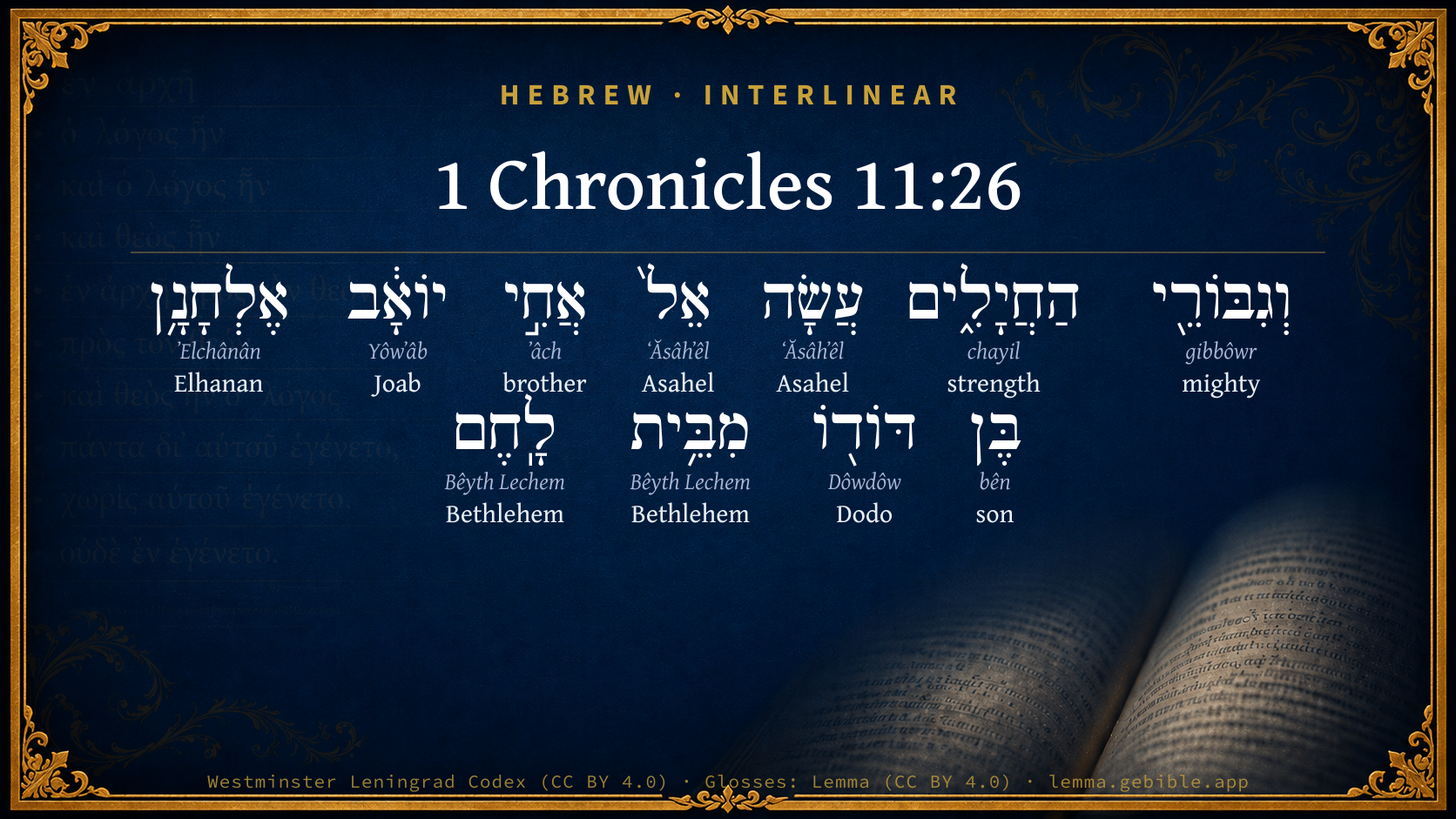
Hebrew (Westminster Leningrad Codex) 1 Chronicles 11:26 appears in the Hebrew Old Testament. The text above is from the Westminster Leningrad Codex. Each word links to its Strong’s number, a concise gloss, and parsing drawn from the Open Scriptures Hebrew Bible morphology. Click any word for its full Brown-Driver-Briggs (BDB) entry.
Download image
Cite this verse

1 Chronicles 11:26 (World English Bible). Public Domain. Lemma interlinear Bible study tool, https://lemma.gebible.app/v/1-chronicles/11/26.

Show BibTeX & RIS
BibTeX
RIS
English Translation
Also the mighty men of the armies: Asahel the brother of Joab, Elhanan the son of Dodo of Bethlehem,
World English Bible · Public Domain
Download a study sheet

One document with this verse’s original text, its word-by-word gloss line, the meaning frame, cross-references with their text, attributed commentary, and full source and license credits — printable, and it pastes into notes with its structure intact.

This verse Autodidact and up

Study sheet (.html) Plain text (.txt)

A passage Seminary Student

Up to 50 verses in one chapter. A passage sheet keeps up to 6 commentary sources and 12 cross-references per verse, in the order this page ranks them, and says so on the sheet whenever that leaves anything out. Ask for a single verse and you get the Autodidact verse sheet above.

Everything on this page stays free to read, with no account — the sheet is a download of what is already on screen, not access to it.

Want to remove ads? Support Godless Engineer
Compare translations 3

The same verse in 3 English versions, stacked beneath the original-language interlinear above. Click any original word for its lexicon entry.

Each is an independent rendering of the whole verse — the interlinear is not word-aligned to these translations.

Highlighted words mark where these versions differ — a whole-verse word diff, not a word-by-word alignment.

  • World English Bible Public Domain
    Also the mighty men of the armies: Asahel the brother of Joab, Elhanan the son of Dodo of Bethlehem,
  • King James Version Public Domain
    Also the valiant men of the armies were, Asahel the brother of Joab, Elhanan the son of Dodo of Bethlehem,
  • unfoldingWord Literal Text CC BY-SA 4.0
    And the warriors of valors Asahel, the brother of Joab; Elhanan, the son of Dodo, from Bethlehem;

unfoldingWord Literal Text — © unfoldingWord, licensed CC BY-SA 4.0. Word-aligned USFM3 via Door43 (git.door43.org/unfoldingWord/en_ult).

Versions to compare (up to 4)

3 of 4 selected

Show all 18 translations

Every available English version of this verse, each an independent rendering of the whole verse.

  • World English Bible Public Domain
    Also the mighty men of the armies: Asahel the brother of Joab, Elhanan the son of Dodo of Bethlehem,
  • Berean Standard Bible Public Domain
    Now these were the mighty men: Asahel the brother of Joab, Elhanan son of Dodo of Bethlehem,
  • Majority Standard Bible Public Domain
    Now these were the mighty men: Asahel the brother of Joab, Elhanan son of Dodo of Bethlehem,
  • King James Version Public Domain
    Also the valiant men of the armies were, Asahel the brother of Joab, Elhanan the son of Dodo of Bethlehem,
  • American Standard Version (1901) Public Domain
    Also the mighty men of the armies: Asahel the brother of Joab, Elhanan the son of Dodo of Beth-lehem,
  • Revised Version (1885) Public Domain
    Also the mighty men of the armies; Asahel the brother of Joab, Elhanan the son of Dodo of Beth-lehem;
  • Geneva Bible (1599) Public Domain
    These also were valiant men of warre, Asahel the brother of Ioab, Elhanan the sonne of Dodo of Beth-lehem,
  • Douay-Rheims (1899) Public Domain
    Moreover the most valiant men of the army, were Asahel brother of Joab, and Elchanan the son of his uncle of Bethlehem,
  • Young's Literal Translation Public Domain
    And the mighty ones of the forces `are' Asahel brother of Joab, Elhanan son of Dodo of Beth-Lehem,
  • Literal Standard Version CC BY-SA 4.0
    And the mighty ones of the forces [are] Asahel brother of Joab, Elhanan son of Dodo of Beth-Lehem,
  • Unlocked Literal Bible CC BY-SA 4.0
    The mighty men were Asahel brother of Joab, Elhanan son of Dodo of Bethlehem,
  • unfoldingWord Literal Text CC BY-SA 4.0
    And the warriors of valors Asahel, the brother of Joab; Elhanan, the son of Dodo, from Bethlehem;
  • Darby Bible Public Domain
    And the valiant men of the forces were: Asahel the brother of Joab, Elhanan the son of Dodo of Bethlehem,
  • World Messianic Bible Public Domain
    The mighty men of the armies also include Asahel the brother of Joab, Elhanan the son of Dodo of Bethlehem,
  • Webster's Bible Public Domain
    Also the valiant men of the armies were, Asahel the brother of Joab, Elhanan the son of Dodo of Beth-lehem,
  • Free Bible Version CC BY-SA 4.0
    Other leading warriors were: Asahel, Joab's brother; Elhanan, son of Dodo, from Bethlehem;
  • Bible in Basic English Public Domain
    And these were the great men of war: Asahel, the brother of Joab, Elhanan, the son of Dodo of Beth-lehem,
  • JPS Tanakh (1917) Public Domain
    Also the mighty men of valour: Asahel the brother of Joab, Elhanan the son of Dodo of Beth-lehem;

Literal Standard Version (2020), Covenant Press — licensed CC BY-SA 4.0. Text via the HelloAO Bible API (eBible.org). Unlocked Literal Bible (unfoldingWord) — licensed CC BY-SA 4.0. Text via the HelloAO Bible API (eBible.org). unfoldingWord Literal Text — © unfoldingWord, licensed CC BY-SA 4.0. Word-aligned USFM3 via Door43 (git.door43.org/unfoldingWord/en_ult). Free Bible Version, Dr. Jonathan Gallagher — licensed CC BY-SA 4.0. Text via the HelloAO Bible API (eBible.org).

Word by word

More ways to search: Search by grammar → Find every occurrence → Compare this word →

Practice this passage: Drill this verse → Learn its vocabulary →

About this verse

These counts appear in no published source. They are computed here, from the morphology-tagged text and Lemma’s own curated glosses. What Lemma adds →

11
words
9
distinct lemmas
Historical
section

Notable vocabulary

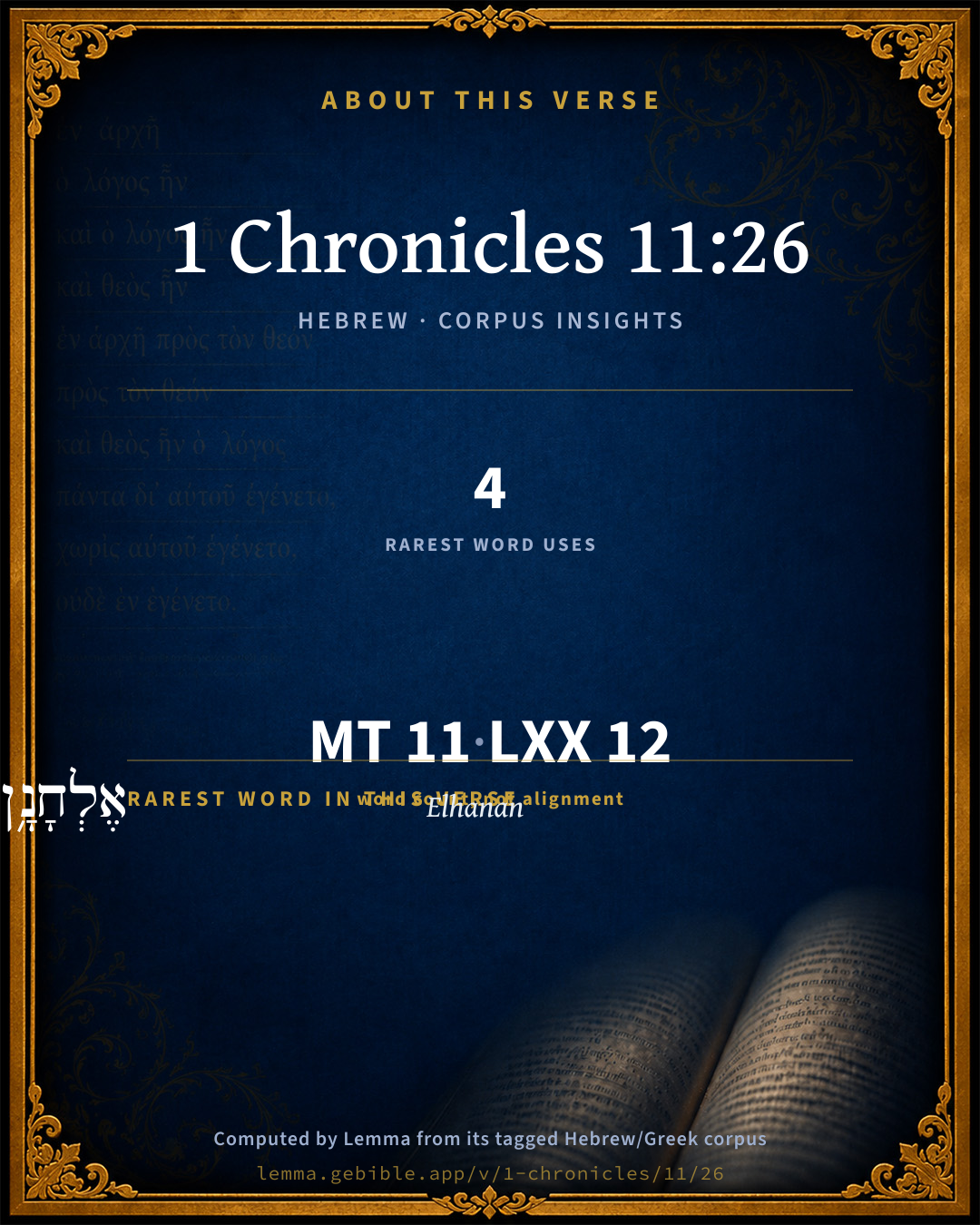
The rarest word here is אֶלְחָנָ֥ן Elhanan H445 — appearing just 4 times in the whole Hebrew Bible.

Shared distinctive vocabulary

אֶלְחָנָ֥ן Elhanan H445 occurs in 4 verses of the Hebrew Bible. Also found in:

Grammatical profile

  • 10 nouns
  • 1 adjective

Repetition

Words recur within this verse — often emphatic in Hebrew:

  • עֲשָׂה Asahel H6214 ×2
  • מִבֵּ֥ית Bethlehem H1035 ×2

Hebrew & Septuagint length

In English translation the verse runs 19 words from the Hebrew and 20 from the Septuagint (LXX English) — closely comparable.

A rough comparison of the two English renderings, which tokenize alike — not a word-level alignment.

Word counts can differ between the Hebrew and the Greek without any difference in meaning — e.g. the Hebrew direct-object marker אֵת has no separate Greek word, and Greek often adds the article ὁ.

In the original languages it is 11 Hebrew tokens and 12 Greek tokens — but the two are counted differently (Hebrew bundles its prefixes and suffixes into one token; the Greek is in lemma form), so that isn’t a like-for-like length.

Cross-references

5

Topical passages linked to 1 Chronicles 11:26 in the Treasury of Scripture Knowledge — connected by theme and wording, ordered by reader-vote popularity; previews shown in the World English Bible.

  • 1 Chronicles 27:7 The fourth [captain] for the fourth month was Asahel the brother of Joab, and Zebadiah his son after him: and in his division were twenty-four thousand.
  • 2 Samuel 2:18–23 The three sons of Zeruiah were there, Joab, and Abishai, and Asahel: and Asahel was as light of foot as a wild gazelle.
  • 2 Samuel 3:30 So Joab and Abishai his brother killed Abner, because he had killed their brother Asahel at Gibeon in the battle.
  • 2 Samuel 21:19 There was again war with the Philistines at Gob; and Elhanan the son of Jaareoregim the Bethlehemite killed Goliath the Gittite's brother, the staff of whose spear was like a weaver's beam.
  • 2 Samuel 23:24 Asahel the brother of Joab was one of the thirty; Elhanan the son of Dodo of Bethlehem,

Cross-references courtesy of OpenBible.info (CC BY 4.0).

Hebrew and Greek witnesses Masoretic Hebrew ↔ Greek Septuagint

The same verse in the two great witnesses to the Old Testament, shown verse-for-verse.

These are two independent witnesses, not word-aligned to each other, and the Septuagint is shown in lemma (dictionary) form.

Hebrew 1 Chronicles 11:26 Masoretic · Westminster Leningrad Codex

וְגִבּוֹרֵ֖י הַחֲיָלִ֑ים עֲשָׂה אֵל֙ אֲחִ֣י יוֹאָ֔ב אֶלְחָנָ֥ן בֶּן דּוֹד֖וֹ מִבֵּ֥ית לָֽחֶם

Also the mighty men of the armies: Asahel the brother of Joab, Elhanan the son of Dodo of Bethlehem,

World English Bible · Public Domain

Greek LXX 1 Chronicles 11:26 Septuagint · lemma form

καί δυνατός ὁ δύναμις ασαηλ ἀδελφός ιωαβ ελεαναν υἱός δωδω ἐκ βαιθλαεμ

And the mighty men of the forces were, Asael the brother of Joab, Eleanan the son of Dodoe of Bethleem,

LXX2012 (modern English Septuagint) · Public Domain

Hebrew: Westminster Leningrad Codex (CC BY 4.0). Greek: Septuagint (public domain); English from LXX2012 (modern English Septuagint) (Public Domain). How the Septuagint differs from the Hebrew →

Commentary

Notes on 1 Chronicles 11:26 from classic Christian and Jewish commentators (each source and its license shown beneath its notes). The classic Christian expositions comment on the surrounding passage and are grouped to its opening verse, so a note may address several verses; the Jewish commentaries on the Tanakh (Rashi and others) are per-verse, so they appear only where the commentator wrote on this verse.

Lemma curates 59 commentaries, every one of them public domain or Creative Commons licensed, each selected and text-cleaned for this edition rather than reprinted as found. About our sources →

Trapp's Complete Commentary

John Trapp

1Ch 11:26 Also the valiant men of the armies [were], Asahel the brother of Joab, Elhanan the son of Dodo of Bethlehem,

Ver. 26. Asahel the brother of Joab.] Joab himself is not mentioned, nor Amasa. This had lost himself for his conspiracy with Absalom, and the other for his hypocrisy and cruelty: hence some think that they were left out of this list as vile persons. See Dan 11:21.

John Trapp, A Commentary or Exposition upon All the Books of the Old and New Testament (1647–1656) — public domain. Text from a community e-Sword module.

Jamieson, Fausset & Brown

Robert Jamieson, A. R. Fausset & David Brown

Also the valiant men of the armies--This was the third degree of military rank, and Asahel was their chief; the names of few of those mentioned are historically known.

Jamieson, Fausset & Brown — Commentary Critical and Explanatory on the Whole Bible (1871) — public domain (CC PDM 1.0). Text via the HelloAO Bible API.

Ellicott's Commentary for English Readers

(26) Also the valiant men of the armies.—The Heb. phrase has this meaning (1Ch_12:8); but elsewhere it denotes “valiant heroes” (1Ch_7:5; 1Ch_7:7, &c). and so here. 2Sa_23:24 has “Asahel brother of Joab was among the thirty.” It thus appears that the warriors of this list are none other than the famous baud of thirty warriors already spoken of (1Ch_11:15; 1Ch_11:25). From having been the original number, thirty may have become the conventional name of the corps even when its limits had been enlarged. It is notice. able that so far as to 1Ch_11:41 the heroes are arranged in pairs, and that the gentilic or cantonal name is usually added to that of the hero. They mostly belong to Judah and Benjamin; whereas the sixteen additional names, so far as known, belong to the transjordanic tribes, and the northern tribes are not represented at all.

Elhanan.—Dodo is very much like David. Is this a third alias of the slayer of Goliath? See Note on 1Ch_20:5.

(26-47) A catalogue of forty-eight “doughty warriors.” Sixteen names are here added to the list as given in Samuel. The chronicler, therefore, possessed a source more complete than our Book of Samuel. Variations of spelling abound in the names common to the two texts, the transcription of proper names being especially liable to error.

A Bible Commentary for English Readers, edited by Charles John Ellicott (1878–1897) — public domain. Text from a community e-Sword module.

The Cambridge Bible for Schools and Colleges

gen. ed. J. J. S. Perowne

26. Also the valiant men of the armies were, Asahel] Render, And the valiant men of might; Asahel. Cp. 1Ch_2:16; 2Sa_2:18 ff; 2Sa_3:27.

Elhanan] Called here (= 2Sa_23:14) “son of Dodo,” but probably to be identified with “Elhanan the son of Jair” of 1Ch_20:5 (= 2Sa_21:19) “son of Jaare-oregim,” for “Jaare-oregim” is not to be taken as his father’s name, and the “Jair” of Chron. appears to be a corruption of “Jaare.” Elhanan was son of Dodo and belonged to a place the name of which was something like Jaare-oregim.

The Cambridge Bible for Schools and Colleges (gen. ed. J. J. S. Perowne; Cambridge University Press, 1878–1918) — public domain. Text from a community e-Sword module.

Albert Barnes' Notes on the Bible

etc. The list of names here given corresponds generally with that in 2 Sam. 23:24-39, but presents several remarkable differences.

(1) the number in Chronicles is 47; the number in Samuel is 31.

(2) Four names in the list of Chronicles are not in Samuel.

(3) five names in Samuel are not in Chronicles.

(4) many of the other names, both personal and local, vary in the two lists.

It is quite possible that the two lists varied to some extent originally. The writer of Chronicles distinctly states that he gives the list as it stood at the time of David’s becoming king over all Israel 1Ch 11:10. The writer of Samuel does not assign his list to any definite period of David’s reign, but probably delivers it to us as it was constituted at a later date. It is quite possible therefore that the names which occur only in Chronicles are those of persons who had died or quitted the army before the other list was made out, and that the new names in Samuel are the names of those who had taken their places. See the 2Sa 23:39 note.

Albert Barnes' Notes on the Bible (1834–1885) — public domain. Text from a community e-Sword/MySword module.

Haydock's Catholic Bible Commentary

Moreover. Nothing particular is here recorded of Asahel, and therefore he is barely mentioned with the rest. But the Book of Kings had been more particular in determining their rank, and had said, "Asahel, brother of Joab, was over the Thirty," being the last of the second ternary. The preposition b (Kennicott) frequently means, "over." (Nold., &c.) --- Arabic, "head of Thirty, whose names are these." (Kennicott) --- Elchanan; probably the son of Jair, 2 Kings xxi. 18. (Calmet)

George Leo Haydock (1774–1849), Haydock's Catholic Family Bible and Commentary, 1859 edition — public domain. Excludes Psalms (Douay-Rheims chapter numbering differs from Protestant) and Deuterocanonical books (Catholic canon only).

The Pulpit Commentary

Vers. 26-41. These verses correspond with vers. 24-39 in 2Sa 23., and with them the subject ends there, though not here. The list announced here as comprising "the valiant men of the armies," is unannounced there, but, beginning with the same name, Asahel, it calls him "one of the thirty," and suggests the inference that those who follow will make up the rest. The number that follows (coinciding in this respect strictly with our list here) is itself thirty, which, though one too many, may be considered satisfactorily accounted for in the fact of the untimely death of Asahel, already recorded. (2Sa_2:23) Considering the exact crisis at which he died, it is very likely that his place should be compensated for, although his name were unremoved from the honourable list. Amid the difficulties that develop themselves in the contents of these lists, when compared, the comparison of them aids the conviction that, so far as they go together, they do stand for "the thirty" spoken of in both places, and that a sentence or two here and there, now lost or corrupted beyond recognition, would clear up the whole subject. The comparison also seems to make it clear that the compiler of Chronicles, meaning to go beyond an enumeration of the thirty, nowhere speaks of thirty after ver. 25. On the other hand, the writer of the account in Samuel carefully sums up all (ver. 39) in the words, thirty and seven in all an addition which means either the actual thirty-one given and the two sets of three each; or the thirty, with the two sets of three each and Joab ever all. Our present chapter, however, goes on to the number forty-eight in all, vers. 41-47, adding sixteen to the thirty-two which precede. Beside some minor differences, it must be said that at fewest three names, Hepher, Ahijah, and Mibhar, in Chronicles, resist identification with those that should (from position) correspond with them in the list of Samuel and with any others. And the same thing may be said of the same number in the list of Samuel (Elika, Eliam, Bani) when compared with the list now before us. The points of contact and clearest identification are, therefore, in so great a majority and are so uniformly distributed that, although it is left hard to decide the causes of them, these differences cannot throw any discredit upon the list as a whole. Perhaps the most probable suggestion to be offered is that the knowledge of the writer of the Book of Samuel enabled him to supersede the names of such as were soon lost to their brave career by death by other names; or, resting on the same fundamental reason, there may have been two different editions of the list, to one of which the writer of Samuel was indebted, and to the other the compiler of Chronicles.

The Pulpit Commentary (1880–1919), ed. H.D.M. Spence-Jones & Joseph S. Exell — public domain. Text from a community e-Sword module.

unfoldingWord translationNotes

Door43 World Missions Community

General Information:

This begins a list of David's thirty most important warriors. The list contains the names of the men and the clans to which they belonged. The list continues through 1 Chronicles 11:47. (See: How to Translate Names)

translationWords

might

Joab

Bethlehem

unfoldingWord translationNotes — © Distant Shores Media and the Door43 World Missions Community, licensed CC BY-SA 4.0. Source: git.door43.org/Door43/en_tn.

Rashi

Rabbi Shlomo Yitzchaki (Rashi)

And the mighty warriors but not like those above.

Rashi on the Tanakh — English translations: “The Judaica Press complete Tanach with Rashi, translated by A. J. Rosenberg” (CC BY 4.0); “Pentateuch with Rashi's commentary by M. Rosenbaum and A.M. Silbermann, 1929-1934” (public domain); “The Metsudah Tanach series, Lakewood, N.J” (CC BY 4.0); and “The Book of Joshua, Metsudah Publications, 1997” (CC BY 4.0). Text via Sefaria.

Lesson kit

Teaching starters — assembled from the data on this page, not authored interpretation. Every prompt links to the verse data it draws on. Edit before teaching.

1 Chronicles, in the Historical, opens this verse with 11 words (9 distinct Hebrew lemmas). Its most distinctive word is ʼElchânân (“Elhanan”). A historical commentator’s framing appears above. Read the whole chapter for the surrounding context.

Discussion questions

  1. The word ʼElchânân carries the sense “Elhanan.” How does it shape the verse?
  2. How does 2 Samuel 21:19, which shares the word «Elhanan», read alongside this verse?
  3. What does the repetition of “Asahel” (2× in this one verse) do in this verse?
  4. The translations on this page render this verse differently — a whole-verse word diff, not a word-by-word alignment. What might account for the different wordings?
  5. Compare how Trapp's Complete Commentary and Jamieson, Fausset & Brown read this verse. Where do they agree or differ?

Things to notice

Reading settings

Reading text

Shown beneath each verse's original-language words.

Old Testament
Old Testament edition

Read the OT as the Masoretic Hebrew (MT) or the Greek Septuagint (LXX).

English shown for the Greek Septuagint (in the Hebrew ↔ Greek comparison).

Comparing translations? Open the Compare panel on any verse page to stack up to four side by side.