
1 Chronicles 7:11

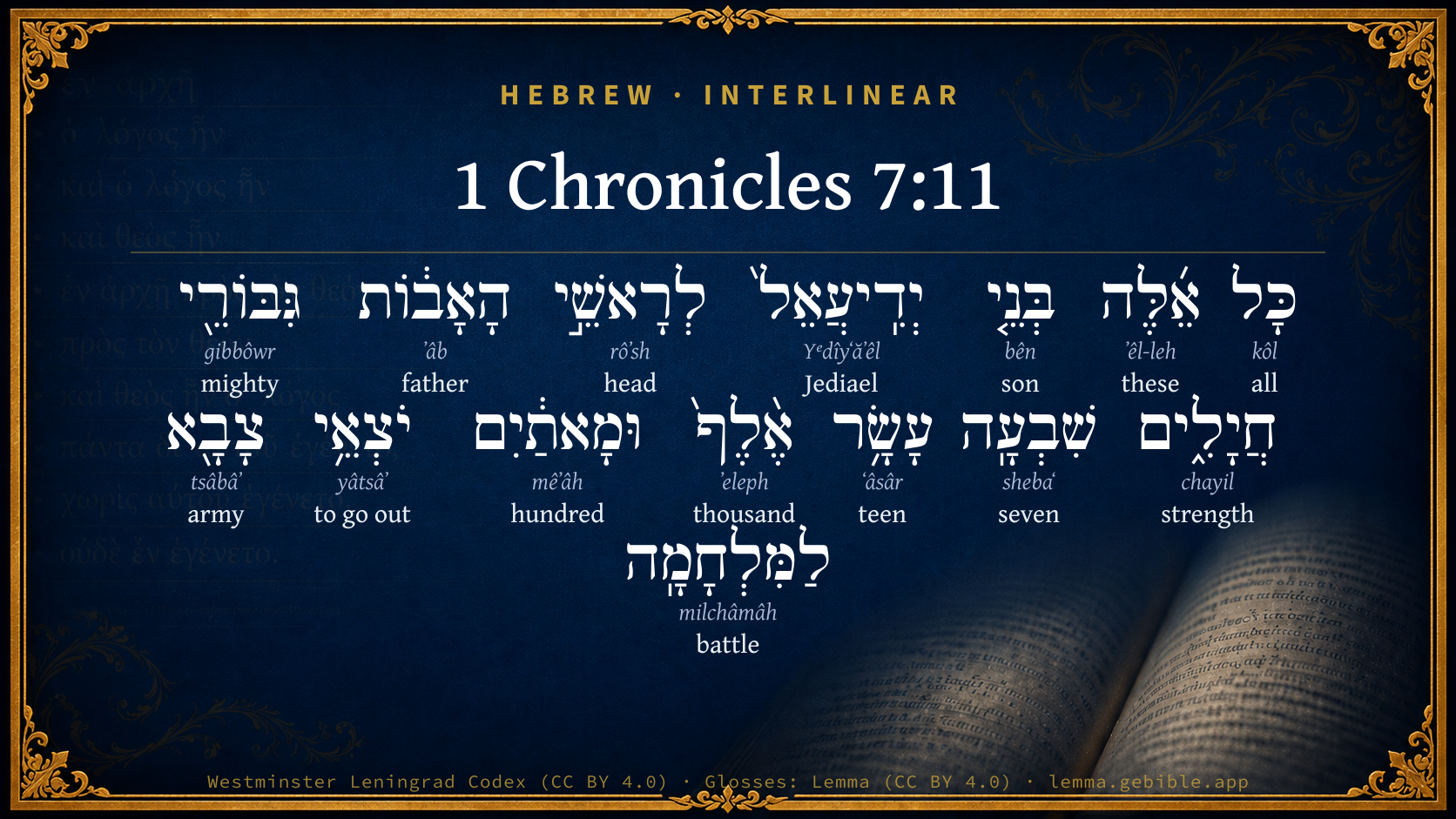
Hebrew (Westminster Leningrad Codex) 1 Chronicles 7:11 appears in the Hebrew Old Testament. The text above is from the Westminster Leningrad Codex. Each word links to its Strong’s number, a concise gloss, and parsing drawn from the Open Scriptures Hebrew Bible morphology. Click any word for its full Brown-Driver-Briggs (BDB) entry.
Download image
Cite this verse

1 Chronicles 7:11 (World English Bible). Public Domain. Lemma interlinear Bible study tool, https://lemma.gebible.app/v/1-chronicles/7/11.

Show BibTeX & RIS
BibTeX
RIS
English Translation
All these were sons of Jediael, according to the heads of their fathers' [houses], mighty men of valor, seventeen thousand and two hundred, who were able to go forth in the host for war.
World English Bible · Public Domain
Download a study sheet

One document with this verse’s original text, its word-by-word gloss line, the meaning frame, cross-references with their text, attributed commentary, and full source and license credits — printable, and it pastes into notes with its structure intact.

This verse Autodidact and up

Study sheet (.html) Plain text (.txt)

A passage Seminary Student

Up to 50 verses in one chapter. A passage sheet keeps up to 6 commentary sources and 12 cross-references per verse, in the order this page ranks them, and says so on the sheet whenever that leaves anything out. Ask for a single verse and you get the Autodidact verse sheet above.

Everything on this page stays free to read, with no account — the sheet is a download of what is already on screen, not access to it.

Want to remove ads? Support Godless Engineer
Compare translations 3

The same verse in 3 English versions, stacked beneath the original-language interlinear above. Click any original word for its lexicon entry.

Each is an independent rendering of the whole verse — the interlinear is not word-aligned to these translations.

Highlighted words mark where these versions differ — a whole-verse word diff, not a word-by-word alignment.

  • World English Bible Public Domain
    All these were sons of Jediael, according to the heads of their fathers' [houses], mighty men of valor, seventeen thousand and two hundred, who were able to go forth in the host for war.
  • King James Version Public Domain
    All these the sons of Jediael, by the heads of their fathers, mighty men of valor, were seventeen thousand and two hundred soldiers, fit to go out for war and battle.
  • unfoldingWord Literal Text CC BY-SA 4.0
    All of these sons of Jediael heads of their fathers, warriors of valors, 17,200, going out an army to battle.

unfoldingWord Literal Text — © unfoldingWord, licensed CC BY-SA 4.0. Word-aligned USFM3 via Door43 (git.door43.org/unfoldingWord/en_ult).

Versions to compare (up to 4)

3 of 4 selected

Show all 18 translations

Every available English version of this verse, each an independent rendering of the whole verse.

  • World English Bible Public Domain
    All these were sons of Jediael, according to the heads of their fathers' [houses], mighty men of valor, seventeen thousand and two hundred, who were able to go forth in the host for war.
  • Berean Standard Bible Public Domain
    All these sons of Jediael were heads of their families, mighty men of valor; there were 17,200 fit for battle.
  • Majority Standard Bible Public Domain
    All these sons of Jediael were heads of their families, mighty men of valor; there were 17,200 fit for battle.
  • King James Version Public Domain
    All these the sons of Jediael, by the heads of their fathers, mighty men of valor, were seventeen thousand and two hundred soldiers, fit to go out for war and battle.
  • American Standard Version (1901) Public Domain
    All these were sons of Jediael, according to the heads of their fathers' `houses', mighty men of valor, seventeen thousand and two hundred, that were able to go forth in the host for war.
  • Revised Version (1885) Public Domain
    All these were sons of Jediael; according to the heads of their father’s houses, mighty men of valour, seventeen thousand and two hundred, that were able to go forth in the host for war.
  • Geneva Bible (1599) Public Domain
    All these were the sonnes of Iediael, chiefe of the fathers, valiant men of warre, seuenteene thousand and two hundreth, marching in battel aray to the warre.
  • Douay-Rheims (1899) Public Domain
    All these were sons of Jadihel, heads of their kindreds, most valiant men, seventeen thousand and two hundred fit to go out to war.
  • Young's Literal Translation Public Domain
    All these `are' sons of Jediael, even heads of the fathers, mighty in valour, seventeen thousand and two hundred going out to the host for battle.
  • Literal Standard Version CC BY-SA 4.0
    All these [are] sons of Jediael, even heads of the fathers, mighty in valor, seventeen thousand and two hundred going out to the host for battle.
  • Unlocked Literal Bible CC BY-SA 4.0
    All these were sons of Jediael. Listed in their clan lists were 17,200 heads of houses and fighting men fit for military service.
  • unfoldingWord Literal Text CC BY-SA 4.0
    All of these sons of Jediael heads of their fathers, warriors of valors, 17,200, going out an army to battle.
  • Darby Bible Public Domain
    All these were the sons of Jediael, by the heads of their fathers, mighty men of valour, seventeen thousand two hundred, fit for service for war.
  • World Messianic Bible Public Domain
    All these were sons of Jediael, according to the heads of their fathers’ households, mighty men of valor, seventeen thousand two hundred, who were able to go out in the army for war.
  • Webster's Bible Public Domain
    All these the sons of Jediael, by the heads of their fathers, mighty men of valor, were seventeen thousand and two hundred soldiers, fit to go out for war and battle.
  • Free Bible Version CC BY-SA 4.0
    All these sons of Jediael were family heads. They had 17,200 battle-ready warriors.
  • Bible in Basic English Public Domain
    All these were the sons of Jediael, by the heads of their families, seventeen thousand, two hundred men of war, able to go out with the army for war.
  • JPS Tanakh (1917) Public Domain
    All these were sons of Jediael, even heads of their fathers' houses, mighty men of valour, seventeen thousand and two hundred, that were able to go forth in the host for war.

Literal Standard Version (2020), Covenant Press — licensed CC BY-SA 4.0. Text via the HelloAO Bible API (eBible.org). Unlocked Literal Bible (unfoldingWord) — licensed CC BY-SA 4.0. Text via the HelloAO Bible API (eBible.org). unfoldingWord Literal Text — © unfoldingWord, licensed CC BY-SA 4.0. Word-aligned USFM3 via Door43 (git.door43.org/unfoldingWord/en_ult). Free Bible Version, Dr. Jonathan Gallagher — licensed CC BY-SA 4.0. Text via the HelloAO Bible API (eBible.org).

Word by word

More ways to search: Search by grammar → Find every occurrence → Compare this word →

Practice this passage: Drill this verse → Learn its vocabulary →

יְדִֽיעֲאֵל֙
Yᵉdîyʻăʼêl
H3043
“Jediael”
Noun, Proper
Part of Speech
Noun
Type
Proper
Full BDB Definition

Origin: from H3045 and H410

TWOT: None

Jediael = "God makes known" - a chief patriarch of the tribe of Benjamin; maybe the same as 'Ashbel' - the 2nd son of Meshelemiah and a Korahite gatekeeper - son of Shimri and one of David's mighty warriors - one of the chiefs of the thousands of Manasseh who joined David on his march to Ziklag; maybe the same man as 3 above
  1. כָּל kôl H3605 “all of” Noun, Common, Masculine, Singular, Construct
  2. אֵ֜לֶּה ʼêl-leh H428 “these” Pronoun, Demonstrative, Common, Plural
  3. בְּנֵ֤י bên H1121 “sons of” Noun, Common, Masculine, Plural, Construct
  4. לְרָאשֵׁ֣י rôʼsh H7218 “to/for · heads of” Preposition + Noun, Common, Masculine, Plural, Construct
  5. הָאָב֔וֹת ʼâb H1 “the · fathers” Particle, Definite Article + Noun, Common, Masculine, Plural, Absolute
  6. גִּבּוֹרֵ֖י gibbôwr H1368 “mighty of” Adjective, Adjective, Masculine, Plural, Construct
  7. חֲיָלִ֑ים chayil H2428 “forces” Noun, Common, Masculine, Plural, Absolute
  8. שִׁבְעָֽה shebaʻ H7651 “seven” Adjective, Cardinal number, Masculine, Singular, Absolute
  9. עָשָׂ֥ר ʻâsâr H6240 “teen” Adjective, Cardinal number, Masculine, Singular, Absolute
  10. אֶ֨לֶף֙ ʼeleph H505 “thousand” Adjective, Cardinal number, Both, Singular, Absolute
  11. וּמָאתַ֔יִם mêʼâh H3967 “and · hundred” Conjunction + Adjective, Cardinal number, Both, Dual, Absolute
  12. יֹצְאֵ֥י yâtsâʼ H3318 “going out” Verb, Qal, Participle Active, Masculine, Plural, Construct
  13. צָבָ֖א tsâbâʼ H6635 “army” Noun, Common, Both, Singular, Absolute
  14. לַמִּלְחָמָֽה milchâmâh H4421 “to/for the · battle” Preposition, Determined + Noun, Common, Feminine, Singular, Absolute

About this verse

These counts appear in no published source. They are computed here, from the morphology-tagged text and Lemma’s own curated glosses. What Lemma adds →

15
words
15
distinct lemmas
Historical
section

Notable vocabulary

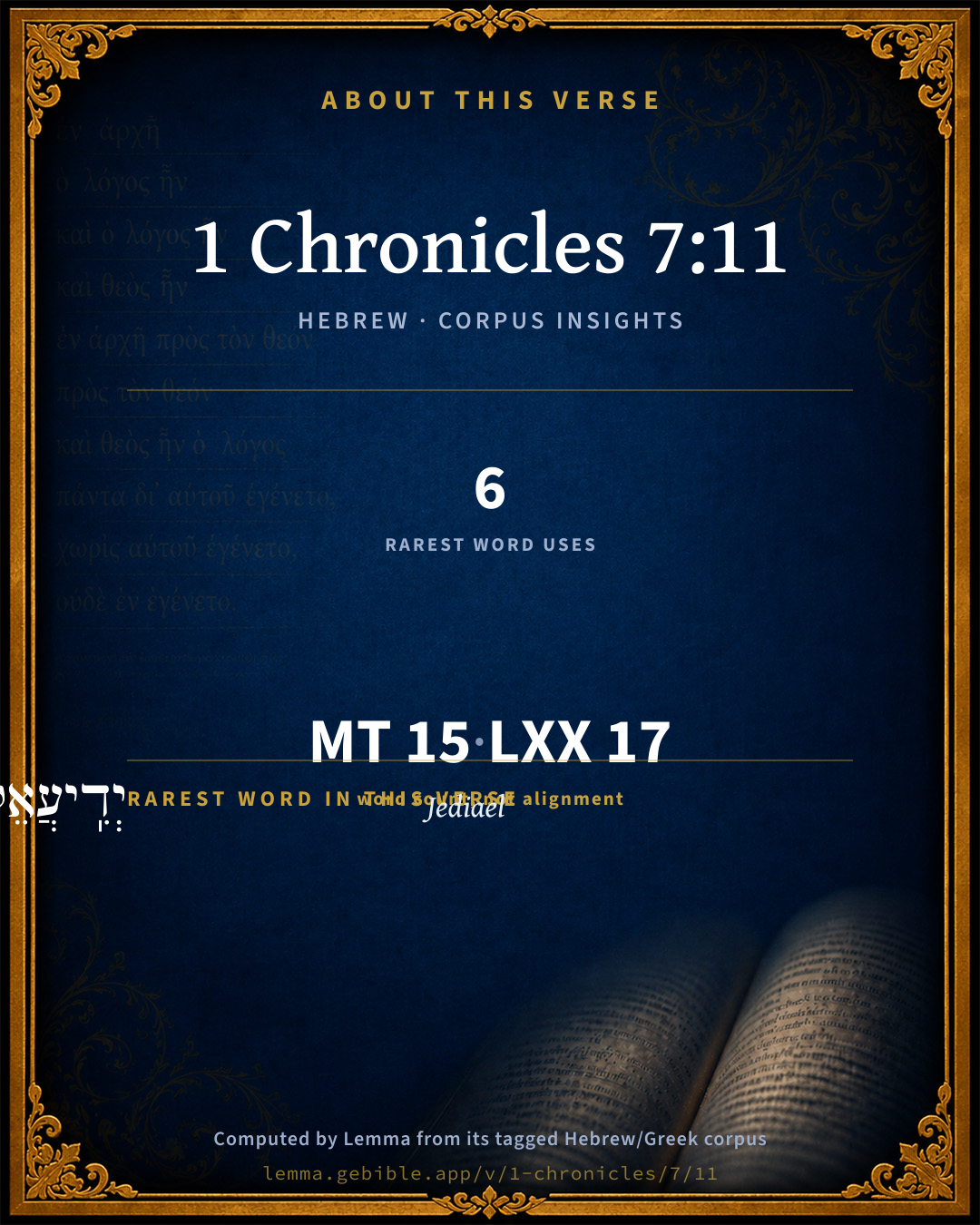
The rarest word here is יְדִֽיעֲאֵל֙ Jediael H3043 — appearing just 6 times in the whole Hebrew Bible.

Shared distinctive vocabulary

יְדִֽיעֲאֵל֙ Jediael H3043 occurs in 6 verses of the Hebrew Bible. Also found in:

Grammatical profile

  • 1 verb
  • 8 nouns
  • 5 adjectives
  • 1 pronoun

Verb forms

  • יֹצְאֵ֥י Qal · Participle Active

Hebrew & Septuagint length

In English translation the verse runs 34 words from the Hebrew and 25 from the Septuagint (LXX English) — closely comparable.

A rough comparison of the two English renderings, which tokenize alike — not a word-level alignment.

Word counts can differ between the Hebrew and the Greek without any difference in meaning — e.g. the Hebrew direct-object marker אֵת has no separate Greek word, and Greek often adds the article ὁ.

In the original languages it is 15 Hebrew tokens and 17 Greek tokens — but the two are counted differently (Hebrew bundles its prefixes and suffixes into one token; the Greek is in lemma form), so that isn’t a like-for-like length.

Cross-references

1

Topical passages linked to 1 Chronicles 7:11 in the Treasury of Scripture Knowledge — connected by theme and wording, ordered by reader-vote popularity; previews shown in the World English Bible.

  • 2 Chronicles 17:13–19 He had many works in the cities of Judah; and men of war, mighty men of valor, in Jerusalem.

Cross-references courtesy of OpenBible.info (CC BY 4.0).

Hebrew and Greek witnesses Masoretic Hebrew ↔ Greek Septuagint

The same verse in the two great witnesses to the Old Testament, shown verse-for-verse.

These are two independent witnesses, not word-aligned to each other, and the Septuagint is shown in lemma (dictionary) form.

Hebrew 1 Chronicles 7:11 Masoretic · Westminster Leningrad Codex

כָּל אֵ֜לֶּה בְּנֵ֤י יְדִֽיעֲאֵל֙ לְרָאשֵׁ֣י הָאָב֔וֹת גִּבּוֹרֵ֖י חֲיָלִ֑ים שִׁבְעָֽה עָשָׂ֥ר אֶ֨לֶף֙ וּמָאתַ֔יִם יֹצְאֵ֥י צָבָ֖א לַמִּלְחָמָֽה

All these were sons of Jediael, according to the heads of their fathers' [houses], mighty men of valor, seventeen thousand and two hundred, who were able to go forth in the host for war.

World English Bible · Public Domain

Greek LXX 1 Chronicles 7:11 Septuagint · lemma form

πᾶς οὗτος υἱός ιαδιηλ ἄρχων ὁ πατριά ἰσχυρός δύναμις ἑπτακαίδεκα χιλιάς καί διακόσιοι ἐκπορεύομαι δύναμις ὁ πολεμέω

All these were the sons of Jediel, chiefs of their families, men of might, seventeen thousand and two hundred, going forth to war with might.

LXX2012 (modern English Septuagint) · Public Domain

Hebrew: Westminster Leningrad Codex (CC BY 4.0). Greek: Septuagint (public domain); English from LXX2012 (modern English Septuagint) (Public Domain). How the Septuagint differs from the Hebrew →

Commentary

Notes on 1 Chronicles 7:11 from classic Christian and Jewish commentators (each source and its license shown beneath its notes). The classic Christian expositions comment on the surrounding passage and are grouped to its opening verse, so a note may address several verses; the Jewish commentaries on the Tanakh (Rashi and others) are per-verse, so they appear only where the commentator wrote on this verse.

Lemma curates 59 commentaries, every one of them public domain or Creative Commons licensed, each selected and text-cleaned for this edition rather than reprinted as found. About our sources →

The Cambridge Bible for Schools and Colleges

gen. ed. J. J. S. Perowne

11. by the heads of their fathers] R.V. according to the heads of their fathers’ houses.

soldiers, fit to go out for war and battle] R.V. that were able to go forth in the host for war. The total armed strength of Benjamin acc. to 1Ch_7:7; 1Ch_7:9; 1Ch_7:11 was 59,434; cp. Num_1:37; Num_26:41.

The Cambridge Bible for Schools and Colleges (gen. ed. J. J. S. Perowne; Cambridge University Press, 1878–1918) — public domain. Text from a community e-Sword module.

The Biblical Illustrator

Joseph S. Exell

1Ch_7:11

Fit to go out for war and battle.

The need for preparation

Fit to go is an expression which points to the matter of qualification. Mere age does not make a man fit to sit in the council, or to go forth to battle, or to assume the position of dignity, We must undergo discipline, instruction, mortification. Do not go out until you are qualified. When you are truly qualified you will know the fact by the using of holy impulses, by the pressure as of an invisible hand urging you on in the right way, the way of Divine decree and destiny. To-day should always be a preparation for to-morrow; everything we learn should have in it something more than itself. When the gymnast undergoes his discipline, it is that he may use his acquired strength in other and better directions than mere amusement. Let all eating and drinking, all reading and study, all companionship and travel, have before it a high purpose, a purpose of preparation for battle and race, for conflict and suffering. (J. Parker, D. D.)

Fit for war

Genius, say some, is but a capacity for hard work. This is not a whole truth; there must be work in accordance with law. The miner who digs for gold on the seashore will never find it, though he dig ever so laboriously; but if he study gold and the geologic strata in which it lives, he has begun to put himself in harmony with law. Mere work, unless properly directed, is like riding a hobby-horse; there is energy and motion, but no progress For years Napoleon was living in miniature the battles he was to fight, analysing strategic moves and positions, and training his mind to thus grasp a new situation on the instant. Von Moltke studied the military topography of all Europe, and with marvellous foresight thought out how to win. His victory was no triumph of mere fortune or special inspiration. It was but the logical outcome of his trained mind, and a trained mind ever lights the torch of its own inspiration. Leonardo da Vinci always carried in his girdle his sketch-book in his walks in Florence, constantly looking for picturesque faces. In the silence of the night, he would counsel himself, recall the ideas of the things you have studied. Design in your spirit the contours and outlines of the figures you have seen during the day. (New Science Review.)

The Biblical Illustrator, edited by Joseph S. Exell (c. 1880s–1900s) — public domain. Text from a community e-Sword module.

Ellicott's Commentary for English Readers

(11) All these the sons of Jediael.—Render, “All these were sons of Jediael; (according) to the heads of the clans, valiant warriors; 17,200 going out in host to the battle.” Perhaps the particle (according to) should be omitted. In any case, the chiefs or the clans are regarded as one with their warriors.

The sum of the warriors of Benjamin is thus 54,434. The Mosaic census (Num_26:41) gave 45,600. An increase of barely 14,000 in the course of atleast three centuries may seem too small. But the tribe was well-nigh exterminated in the vengeance which Israel took for the crime of Gibeah (Jdg_20:47).

A Bible Commentary for English Readers, edited by Charles John Ellicott (1878–1897) — public domain. Text from a community e-Sword module.

John Gill's Exposition

The sons of Manasseh; Ashriel, whom she bare,.... The wife of Manasseh, as distinguished from his concubine in the next clause; though the Targum reads, in connection with that,"whom his Aramitess (or Syrian) concubine bare;''

and then adds:

who also bare Machir the father of Gilead; so that Ashriel and Machir were brethren; from which Ashriel sprung the family of the Ashrielites, Num 26:29 as from Machir the Machirites, Num 26:29.

John Gill's Exposition of the Whole Bible (1746–1763) — public domain (CC PDM 1.0). Text via the HelloAO Bible API.

Keil & Delitzsch

C. F. Keil & F. Delitzsch

The sons of Manasseh; Ashriel, whom she bare,.... The wife of Manasseh, as distinguished from his concubine in the next clause; though the Targum reads, in connection with that,"whom his Aramitess (or Syrian) concubine bare;''

and then adds:

who also bare Machir the father of Gilead; so that Ashriel and Machir were brethren; from which Ashriel sprung the family of the Ashrielites, Num 26:29 as from Machir the Machirites, Num 26:29.

Keil & Delitzsch — Biblical Commentary on the Old Testament (1861–1891) — public domain (CC PDM 1.0). Text via the HelloAO Bible API. (Old Testament only.)

unfoldingWord translationNotes

Door43 World Missions Community

Jediael ... Ir ... Aher

These are names of men. (See: How to Translate Names)

Listed in their clan lists were 17,200

"The clan lists contained 17,200"

17,200 heads of houses

"seventeen thousand two hundred heads of houses" (See: Numbers)

Shuppites ... Huppites ... Hushites

These are names of clans of people. (See: How to Translate Names)

translationWords

servant

unfoldingWord translationNotes — © Distant Shores Media and the Door43 World Missions Community, licensed CC BY-SA 4.0. Source: git.door43.org/Door43/en_tn.

Lesson kit

Teaching starters — assembled from the data on this page, not authored interpretation. Every prompt links to the verse data it draws on. Edit before teaching.

1 Chronicles, in the Historical, opens this verse with 15 words (15 distinct Hebrew lemmas). Its most distinctive word is Yᵉdîyʻăʼêl (“Jediael”). A historical commentator’s framing appears above. Read the whole chapter for the surrounding context.

Discussion questions

  1. How does “Jediael” (Yᵉdîyʻăʼêl) shape what this verse is saying?
  2. 1 Chronicles 7:6 shares the word «Jediael» with this verse. How do the two illuminate each other?
  3. These translations render this verse differently. What is at stake in choosing one wording over another?
  4. The verb «יֹצְאֵ֥י» is Qal Participle Active. How does its form color the action?
  5. Reading how The Cambridge Bible for Schools and Colleges and The Biblical Illustrator read this verse, where do the two commentators agree and where do they part?

Things to notice

Reading settings

Reading text

Shown beneath each verse's original-language words.

Old Testament
Old Testament edition

Read the OT as the Masoretic Hebrew (MT) or the Greek Septuagint (LXX).

English shown for the Greek Septuagint (in the Hebrew ↔ Greek comparison).

Comparing translations? Open the Compare panel on any verse page to stack up to four side by side.