
2 Kings 15:20

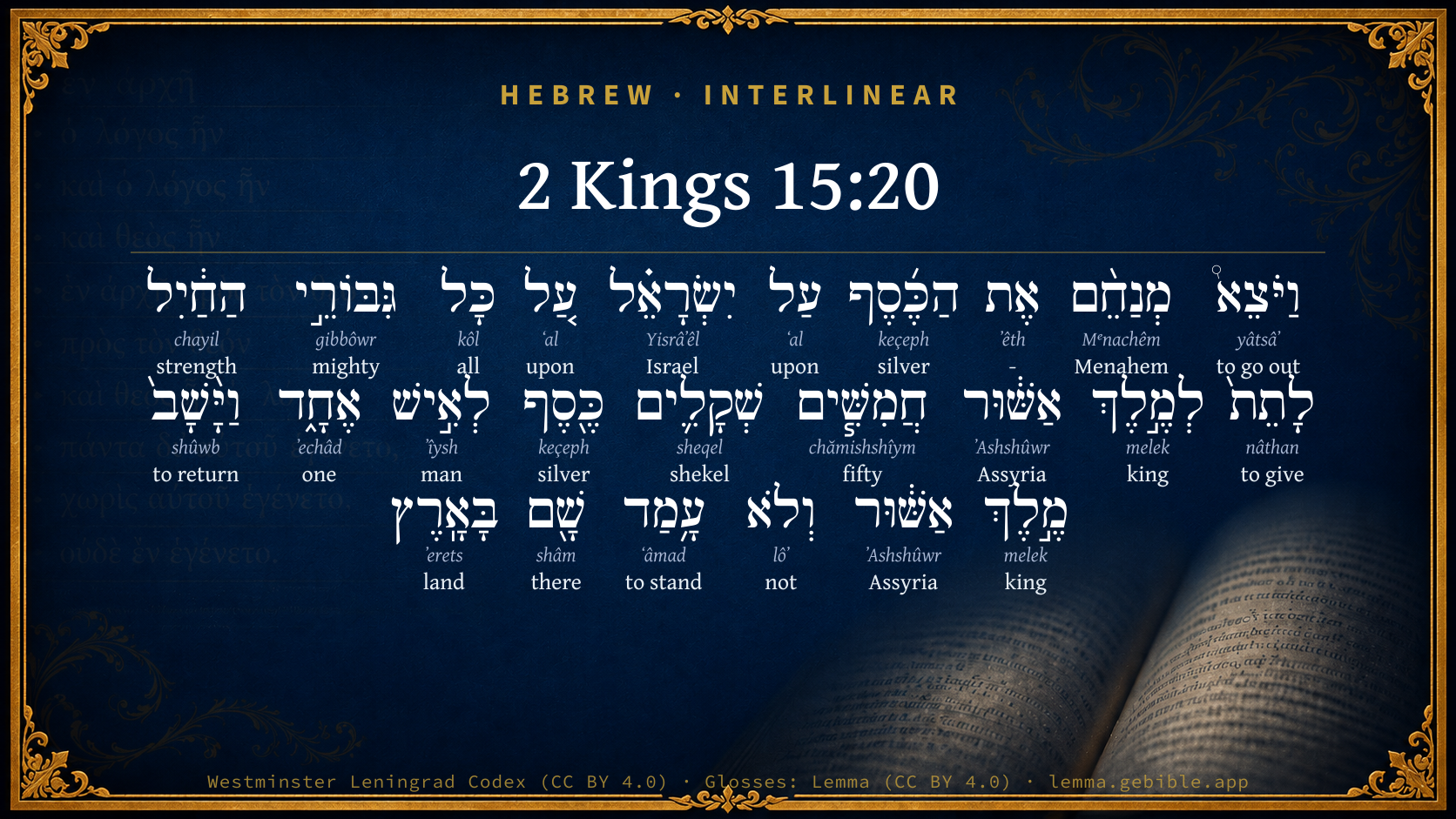
Hebrew (Westminster Leningrad Codex) 2 Kings 15:20 appears in the Hebrew Old Testament. The text above is from the Westminster Leningrad Codex. Each word links to its Strong’s number, a concise gloss, and parsing drawn from the Open Scriptures Hebrew Bible morphology. Click any word for its full Brown-Driver-Briggs (BDB) entry.
Download image
Cite this verse

2 Kings 15:20 (World English Bible). Public Domain. Lemma interlinear Bible study tool, https://lemma.gebible.app/v/2-kings/15/20.

Show BibTeX & RIS
BibTeX
RIS
English Translation
Menahem exacted the money of Israel, even of all the mighty men of wealth, of each man fifty shekels of silver, to give to the king of Assyria. So the king of Assyria turned back, and didn't stay there in the land.
World English Bible · Public Domain
Download a study sheet

One document with this verse’s original text, its word-by-word gloss line, the meaning frame, cross-references with their text, attributed commentary, and full source and license credits — printable, and it pastes into notes with its structure intact.

This verse Autodidact and up

Study sheet (.html) Plain text (.txt)

A passage Seminary Student

Up to 50 verses in one chapter. A passage sheet keeps up to 6 commentary sources and 12 cross-references per verse, in the order this page ranks them, and says so on the sheet whenever that leaves anything out. Ask for a single verse and you get the Autodidact verse sheet above.

Everything on this page stays free to read, with no account — the sheet is a download of what is already on screen, not access to it.

Want to remove ads? Support Godless Engineer
Compare translations 3

The same verse in 3 English versions, stacked beneath the original-language interlinear above. Click any original word for its lexicon entry.

Each is an independent rendering of the whole verse — the interlinear is not word-aligned to these translations.

Highlighted words mark where these versions differ — a whole-verse word diff, not a word-by-word alignment.

  • World English Bible Public Domain
    Menahem exacted the money of Israel, even of all the mighty men of wealth, of each man fifty shekels of silver, to give to the king of Assyria. So the king of Assyria turned back, and didn't stay there in the land.
  • King James Version Public Domain
    And Menahem exacted the money of Israel, even of all the mighty men of wealth, of each man fifty shekels of silver, to give to the king of Assyria. So the king of Assyria turned back, and stayed not there in the land.
  • unfoldingWord Literal Text CC BY-SA 4.0
    And Menahem brought forth the silver over Israel, over all of the mighty of valor, to give to the king of Assyria, 50 silver shekels to one man. And the king of Assyria returned, and he did not stay there in the land.

unfoldingWord Literal Text — © unfoldingWord, licensed CC BY-SA 4.0. Word-aligned USFM3 via Door43 (git.door43.org/unfoldingWord/en_ult).

Versions to compare (up to 4)

3 of 4 selected

Show all 18 translations

Every available English version of this verse, each an independent rendering of the whole verse.

  • World English Bible Public Domain
    Menahem exacted the money of Israel, even of all the mighty men of wealth, of each man fifty shekels of silver, to give to the king of Assyria. So the king of Assyria turned back, and didn't stay there in the land.
  • Berean Standard Bible Public Domain
    Menahem exacted this money from each of the wealthy men of Israel—fifty shekels of silver from each man—to give to the king of Assyria. So the king of Assyria withdrew and did not remain in the land.
  • Majority Standard Bible Public Domain
    Menahem exacted this money from each of the wealthy men of Israel—fifty shekels of silver from each man—to give to the king of Assyria. So the king of Assyria withdrew and did not remain in the land.
  • King James Version Public Domain
    And Menahem exacted the money of Israel, even of all the mighty men of wealth, of each man fifty shekels of silver, to give to the king of Assyria. So the king of Assyria turned back, and stayed not there in the land.
  • American Standard Version (1901) Public Domain
    And Menahem exacted the money of Israel, even of all the mighty men of wealth, of each man fifty shekels of silver, to give to the king of Assyria. So the king of Assyria turned back, and stayed not there in the land.
  • Revised Version (1885) Public Domain
    And Menahem exacted the money of Israel, even of all the mighty men of wealth, of each man fifty shekels of silver, to give to the king of Assyria. So the king of Assyria turned back, and stayed not there in the land.
  • Geneva Bible (1599) Public Domain
    And Menahem exacted the money in Israel, that all men of substance shoulde giue the King of Asshur fiftie shekels of siluer a piece: so the king of Asshur returned and taried not there in the land.
  • Douay-Rheims (1899) Public Domain
    And Manahem laid a tax upon Israel, on all that were mighty and rich, to give the king of the Assyrians, each man fifty sides of silver: so the king of the Assyrians turned back, and did not stay in the land.
  • Young's Literal Translation Public Domain
    And Menahem bringeth out the silver `from' Israel, `from' all the mighty men of wealth, to give to the king of Asshur, fifty shekels of silver for each one, and the king of Asshur turneth back and hath not stayed there in the land.
  • Literal Standard Version CC BY-SA 4.0
    And Menahem brings out the silver [from] Israel, [from] all the mighty men of wealth, to give to the king of Asshur, fifty shekels of silver for each one, and the king of Asshur turns back and has not stayed there in the land.
  • Unlocked Literal Bible CC BY-SA 4.0
    Menahem exacted this money from Israel by requiring each of the wealthy men to pay fifty shekels of silver to him to give to the king of Assyria. So the king of Assyria turned back and did not stay there in the land.
  • unfoldingWord Literal Text CC BY-SA 4.0
    And Menahem brought forth the silver over Israel, over all of the mighty of valor, to give to the king of Assyria, 50 silver shekels to one man. And the king of Assyria returned, and he did not stay there in the land.
  • Darby Bible Public Domain
    And Menahem exacted the money of Israel, of all those who were wealthy, of each man fifty shekels of silver, to give to the king of Assyria. And the king of Assyria turned back, and stayed not there in the land.
  • World Messianic Bible Public Domain
    Menahem exacted the money from Israel, even from all the mighty men of wealth, from each man fifty shekels of silver, to give to the king of Assyria. So the king of Assyria turned back, and didn’t stay there in the land.
  • Webster's Bible Public Domain
    And Menahem exacted the money of Israel, even of all the mighty men of wealth, of each man fifty shekels of silver, to give to the king of Assyria. So the king of Assyria turned back, and stayed not there in the land.
  • Free Bible Version CC BY-SA 4.0
    Menahem demanded payment from all the wealthy men of Israel, fifty shekels of silver each, to give to the king of Assyria. So the king of Assyria retreated and did not stay in the country.
  • Bible in Basic English Public Domain
    And Menahem got the money from Israel, from all the men of wealth, fifty silver shekels from every man, to give to the king of Assyria. So the king of Assyria went back without stopping in the land.
  • JPS Tanakh (1917) Public Domain
    And Menahem exacted the money of Israel, even of all the mighty men of wealth, of each man fifty shekels of silver, to give to the king of Assyria. So the king of Assyria turned back, and stayed not there in the land.

Literal Standard Version (2020), Covenant Press — licensed CC BY-SA 4.0. Text via the HelloAO Bible API (eBible.org). Unlocked Literal Bible (unfoldingWord) — licensed CC BY-SA 4.0. Text via the HelloAO Bible API (eBible.org). unfoldingWord Literal Text — © unfoldingWord, licensed CC BY-SA 4.0. Word-aligned USFM3 via Door43 (git.door43.org/unfoldingWord/en_ult). Free Bible Version, Dr. Jonathan Gallagher — licensed CC BY-SA 4.0. Text via the HelloAO Bible API (eBible.org).

Word by word

More ways to search: Search by grammar → Find every occurrence → Compare this word →

Practice this passage: Drill this verse → Learn its vocabulary →

מְנַחֵ֨ם
Mᵉnachêm
H4505
“Menahem”
Noun, Proper
Part of Speech
Noun
Type
Proper
Full BDB Definition

Origin: from H5162

TWOT: None

Menahem = "comforter" - son of Gadi and king of the northern kingdom of Israel; slew the usurper Shallum to ascend the throne and reigned for ten years; contemporary with prophets Hosea and Amos
  1. וַיֹּצֵא֩ yâtsâʼ H3318 “and · to go out” Conjunction + Verb, Hiphil, Sequential Imperfect, 3rd Person, Masculine, Singular
  2. אֶת ʼêth H853 “-” Particle, Direct Object
  3. הַכֶּ֜סֶף keçeph H3701 “the · silver” Particle, Definite Article + Noun, Common, Masculine, Singular, Absolute
  4. עַל ʻal H5921 “upon” Preposition
  5. יִשְׂרָאֵ֗ל Yisrâʼêl H3478 “Israel” Noun, Proper
  6. עַ֚ל ʻal H5921 “upon” Preposition
  7. כָּל kôl H3605 “all of” Noun, Common, Masculine, Singular, Construct
  8. גִּבּוֹרֵ֣י gibbôwr H1368 “mighty of” Adjective, Adjective, Masculine, Plural, Construct
  9. הַחַ֔יִל chayil H2428 “the · strength” Particle, Definite Article + Noun, Common, Masculine, Singular, Absolute
  10. לָתֵת֙ nâthan H5414 “to give” Preposition + Verb, Qal, Infinitive Construct
  11. לְמֶ֣לֶךְ melek H4428 “to/for · king of” Preposition + Noun, Common, Masculine, Singular, Construct
  12. אַשּׁ֔וּר ʼAshshûwr H804 “Assyria” Noun, Proper
  13. חֲמִשִּׁ֧ים chămishshîym H2572 “fifty” Adjective, Cardinal number, Both, Plural, Absolute
  14. שְׁקָלִ֛ים sheqel H8255 “shekels” Noun, Common, Masculine, Plural, Absolute
  15. כֶּ֖סֶף keçeph H3701 “silver” Noun, Common, Masculine, Singular, Absolute
  16. לְאִ֣ישׁ ʼîysh H376 “to/for · man” Preposition + Noun, Common, Masculine, Singular, Absolute
  17. אֶחָ֑ד ʼechâd H259 “one” Adjective, Cardinal number, Masculine, Singular, Absolute
  18. וַיָּ֨שָׁב֙ shûwb H7725 “and · to return” Conjunction + Verb, Qal, Sequential Imperfect, 3rd Person, Masculine, Singular
  19. מֶ֣לֶךְ melek H4428 “king of” Noun, Common, Masculine, Singular, Construct
  20. אַשּׁ֔וּר ʼAshshûwr H804 “Assyria” Noun, Proper
  21. וְלֹא lôʼ H3808 “and · not” Conjunction + Particle, Negative
  22. עָ֥מַד ʻâmad H5975 “to stand” Verb, Qal, Perfect, 3rd Person, Masculine, Singular
  23. שָׁ֖ם shâm H8033 “there” Adverb
  24. בָּאָֽרֶץ ʼerets H776 “in/at the · land” Preposition, Determined + Noun, Common, Both, Singular, Absolute

About this verse

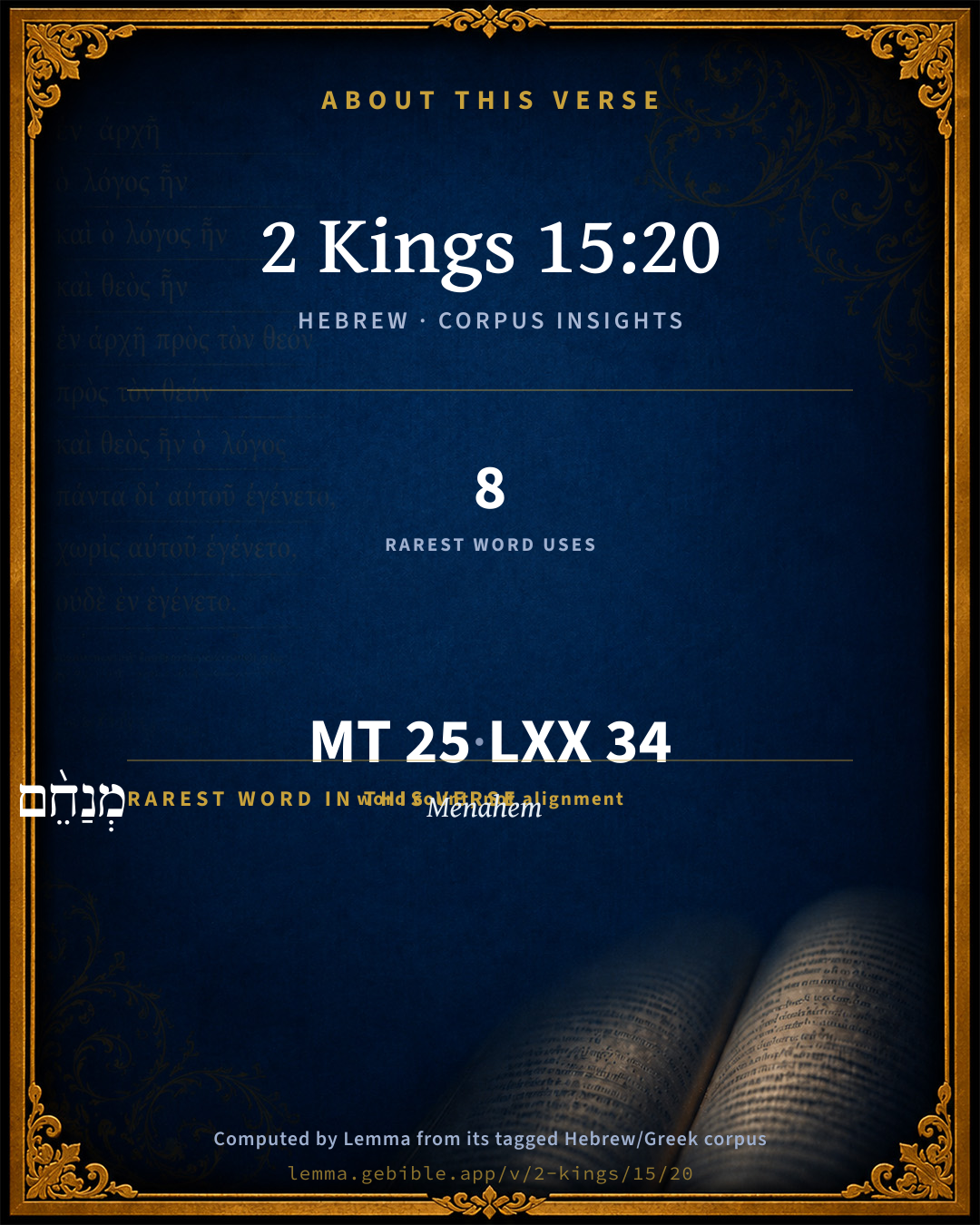
These counts appear in no published source. They are computed here, from the morphology-tagged text and Lemma’s own curated glosses. What Lemma adds →

25
words
21
distinct lemmas
Historical
section

Notable vocabulary

The rarest word here is מְנַחֵ֨ם Menahem H4505 — appearing just 8 times in the whole Hebrew Bible.

Shared distinctive vocabulary

מְנַחֵ֨ם Menahem H4505 occurs in 8 verses of the Hebrew Bible. Also found in:

Grammatical profile

  • 4 verbs
  • 13 nouns
  • 3 adjectives
  • 2 prepositions
  • 1 adverb
  • 2 particles

Verb forms

  • וַיֹּצֵא֩ Hiphil · Sequential Imperfect
  • לָתֵת֙ Qal · Infinitive Construct
  • וַיָּ֨שָׁב֙ Qal · Sequential Imperfect
  • עָ֥מַד Qal · Perfect

Repetition

Words recur within this verse — often emphatic in Hebrew:

  • הַכֶּ֜סֶף silver H3701 ×2
  • עַל upon H5921 ×2
  • לְמֶ֣לֶךְ king H4428 ×2
  • אַשּׁ֔וּר Assyria H804 ×2

Hebrew & Septuagint length

In English translation the verse runs 42 words from the Hebrew and 45 from the Septuagint (LXX English) — closely comparable.

A rough comparison of the two English renderings, which tokenize alike — not a word-level alignment.

Word counts can differ between the Hebrew and the Greek without any difference in meaning — e.g. the Hebrew direct-object marker אֵת has no separate Greek word, and Greek often adds the article ὁ.

In the original languages it is 25 Hebrew tokens and 34 Greek tokens — but the two are counted differently (Hebrew bundles its prefixes and suffixes into one token; the Greek is in lemma form), so that isn’t a like-for-like length.

Cross-references

7

Topical passages linked to 2 Kings 15:20 in the Treasury of Scripture Knowledge — connected by theme and wording, ordered by reader-vote popularity; previews shown in the World English Bible.

  • Ruth 2:1 Naomi had a kinsman of her husband's, a mighty man of wealth, of the family of Elimelech, and his name was Boaz.
  • 2 Samuel 19:32 Now Barzillai was a very aged man, even eighty years old: and he had provided the king with sustenance while he lay at Mahanaim; for he was a very great man.
  • 2 Kings 15:29 In the days of Pekah king of Israel came Tiglath Pileser king of Assyria, and took Ijon, and Abel Beth Maacah, and Janoah, and Kedesh, and Hazor, and Gilead, and Galilee, all the land of Naphtali; and he carried them captive to Assyria.
  • 2 Kings 17:3–4 Against him came up Shalmaneser king of Assyria; and Hoshea became his servant, and brought him tribute.
  • 2 Kings 18:14–17 Hezekiah king of Judah sent to the king of Assyria to Lachish, saying, I have offended; return from me: that which you put on me will I bear. The king of Assyria appointed to Hezekiah king of Judah three hundred talents of silver and thirty talents of gold.
  • 2 Kings 23:35 Jehoiakim gave the silver and the gold to Pharaoh; but he taxed the land to give the money according to the commandment of Pharaoh: he exacted the silver and the gold of the people of the land, of everyone according to his taxation, to give it to Pharaoh Necoh.
  • Job 1:3 His possessions also were seven thousand sheep, three thousand camels, five hundred yoke of oxen, five hundred she-donkeys, and a very great household; so that this man was the greatest of all the children of the east.

Cross-references courtesy of OpenBible.info (CC BY 4.0).

Hebrew and Greek witnesses Masoretic Hebrew ↔ Greek Septuagint

The same verse in the two great witnesses to the Old Testament, shown verse-for-verse.

These are two independent witnesses, not word-aligned to each other, and the Septuagint is shown in lemma (dictionary) form.

Hebrew 2 Kings 15:20 Masoretic · Westminster Leningrad Codex

וַיֹּצֵא֩ מְנַחֵ֨ם אֶת הַכֶּ֜סֶף עַל יִשְׂרָאֵ֗ל עַ֚ל כָּל גִּבּוֹרֵ֣י הַחַ֔יִל לָתֵת֙ לְמֶ֣לֶךְ אַשּׁ֔וּר חֲמִשִּׁ֧ים שְׁקָלִ֛ים כֶּ֖סֶף לְאִ֣ישׁ אֶחָ֑ד וַיָּ֨שָׁב֙ מֶ֣לֶךְ אַשּׁ֔וּר וְלֹא עָ֥מַד שָׁ֖ם בָּאָֽרֶץ

Menahem exacted the money of Israel, even of all the mighty men of wealth, of each man fifty shekels of silver, to give to the king of Assyria. So the king of Assyria turned back, and didn't stay there in the land.

World English Bible · Public Domain

Greek LXX 2 Kings 15:20 Septuagint · lemma form

καί ἐκφέρω μαναημ ὁ ἀργύριον ἐπί ὁ ἰσραήλ ἐπί πᾶς δυνατός ἰσχύς δίδωμι ὁ βασιλεύς ὁ ἀσσύριος πεντήκοντα σίκλος ὁ ἀνήρ ὁ εἷς καί ἀποστρέφω βασιλεύς ἀσσύριος καί οὐ ἵστημι ἐκεῖ ἐν ὁ γῆ

And Manaem raised the silver by a tax upon Israel, even on every mighty man in wealth, to give to the king of the Assyrians, fifty shekels levied on each man; and the king of the Assyrians departed, and remained not there in the land.

LXX2012 (modern English Septuagint) · Public Domain

Hebrew: Westminster Leningrad Codex (CC BY 4.0). Greek: Septuagint (public domain); English from LXX2012 (modern English Septuagint) (Public Domain). How the Septuagint differs from the Hebrew →

Targum (Aramaic paraphrase)

1

The Targum is the ancient Jewish Aramaic paraphrase of the Hebrew Scriptures — an interpretive translation, not the Hebrew text itself. Onkelos (literal) and Pseudo-Jonathan (expansive) render the Torah, and Jonathan the Prophets. Coverage is partial: where no permissively-licensed English translation exists for a verse, only the Aramaic is shown. This is verse-level text, not a word-by-word alignment to the Hebrew.

  1. Targum Jonathan Prophets (Joshua–Malachi)
    וּרְמָא מְנַחֵם יַת כַּסְפָּא עַל יִשְׂרָאֵל וְעַל כָּל גִבָּרֵי חֵילָא לְמִתַּן לְמַלְכָּא דְאַתּוּר חַמְשִׁין סַלְעִין דִכְסַף לְגַבְרָא חָד וְתַב מַלְכָּא דְאַתּוּר וְלָא אַנְזִיק תַּמָן בְּאַרְעָא:

    (no public-domain English translation for this verse)

    Targum Jonathan — Aramaic: “Mikraot Gedolot” (public domain). English: “Sefaria Community Translation” (CC0 1.0 (public-domain dedication)); “London "Chaldee Paraphrase," 1871” (public domain). Text via Sefaria.

Commentary

Notes on 2 Kings 15:20 from classic Christian and Jewish commentators (each source and its license shown beneath its notes). The classic Christian expositions comment on the surrounding passage and are grouped to its opening verse, so a note may address several verses; the Jewish commentaries on the Tanakh (Rashi and others) are per-verse, so they appear only where the commentator wrote on this verse.

Lemma curates 59 commentaries, every one of them public domain or Creative Commons licensed, each selected and text-cleaned for this edition rather than reprinted as found. About our sources →

John Gill's Exposition

And he did that which was evil in the sight of the Lord,.... Not only in committing the above crimes of usurpation and murder, but idolatry, and particularly the worshipping of the calves, hinted at in the text.

And he did that which was evil in the sight of the Lord,.... Not only in committing the above crimes of usurpation and murder, but idolatry, and particularly the worshipping of the calves, hinted at in the text.

2 Kings 15:29

kg2 15:29

kg2 15:29

kg2 15:29In the days of Pekah king of Israel came Tiglathpileser king of Assyria,.... Into the land of Israel; he is called by a Jewish chronologer (c), Pul-Asir; so Phul-Assar by Metasthenes (d), who says he reigned twenty five years; he very probably was the son of Pul the Assyrian king, mentioned Kg2 15:19, and is thought to be the same that Aelianus (e) calls Tilgamos; some think he had the first part of his name from Diglath, or Diglito, by which the river Tigris is called in Pliny (f), with which Assyria was washed; and that Pil, or Pul, is Baal, Bel, Jupiter, and Azar is Mars (g); of all which his name is composed:

and took Ijon, and Abelbethmaachah; of which see Kg1 15:20,

and Janoah; a city in the tribe of Ephraim, Jos 16:6.

and Kedesh, and Hazor; cities in Naphtali: Jos 19:36.

and Gilead; a country beyond Jordan, which belonged to the Reubenites, Gadites, and half tribe of Manasseh:

and Galilee, all the land of Naphtali; that is, upper Galilee, which lay in Naphtali:

and carried them captive to Assyria; which was the first captivity of Israel in which half their tribes were carried away.

(c) David Ganz. Ut supra. (Tzemach David, par. 2. fol. 3. 2.) (d) Ut supra. (De Judicio Temp. & Annal. Pers. fol. 221. 2.) (e) De Animal. l. 12. c. 21. (f) Nat. Hist. l. 6. c. 27. (g) Hyde Hist. Relig. Pers. p. 65, 66.

John Gill's Exposition of the Whole Bible (1746–1763) — public domain (CC PDM 1.0). Text via the HelloAO Bible API.

Trapp's Complete Commentary

John Trapp

2Ki 15:20 And Menahem exacted the money of Israel, [even] of all the mighty men of wealth, of each man fifty shekels of silver, to give to the king of Assyria. So the king of Assyria turned back, and stayed not there in the land.

Ver. 20. And Menahem exacted.] Heb., Caused to come forth, sc., by his exactors, who received from his rich subjects no less sums of curses than of coin.

John Trapp, A Commentary or Exposition upon All the Books of the Old and New Testament (1647–1656) — public domain. Text from a community e-Sword module.

Joseph Benson's Commentary

2Ki 15:20. Of all the mighty men of wealth — By exacting the money only of the rich, it is likely, he thought he should ingratiate himself with the common people, upon whom he laid no tax. Fifty shekels of silver, demanded of each man of wealth, were a sum equal to f7. 10s. of our money.

Joseph Benson's Commentary on the Old and New Testaments (1811–1818) — public domain. Text from a community e-Sword module.

Adam Clarke's Commentary

Verse 20. Each man fifty shekels of silver] Upwards of five pounds sterling a man.

Adam Clarke's Commentary on the Bible (1810–1826) — public domain. Text from a community e-Sword/MySword module.

Ellicott's Commentary for English Readers

(20) Exacted.—Literally, caused to go out; a word already used in the sense of to lay out, expend money (2Ki_12:12). Probably, therefore, laid (vayyissâ), i.e., imposed, should be read here (Gen_31:17).

Of.—Heb., upon.

The mighty men of wealth.—A later use of the Hebrew phrase, which, in older parlance, means “the heroes of the host” (Jdg_6:12; 1Sa_9:1).

Fifty shekels.—The talent of silver was worth 3,000 shekels. The payment of 1,000 talents (3,000,000 shekels) therefore implies a total of 60,000 persons able to contribute. Fifty shekels were one maneh (Assyrian, mana; Greek, μνῦ, and Latin, mina). There was no great Temple treasury to draw from in the northern kingdom, and any palace hoards would have disappeared in the confusions attending the frequent revolutions of the time.

There.—Or, then (Psa_14:5).

A Bible Commentary for English Readers, edited by Charles John Ellicott (1878–1897) — public domain. Text from a community e-Sword module.

The Cambridge Bible for Schools and Colleges

gen. ed. J. J. S. Perowne

20. Menahem exacted the money] Fifty shekels=one maneh, was the sixtieth part of a talent of silver. Hence the mighty men of wealth must have numbered 60,000, a number which tells of the richness of the time. The population of Israel in David’s time had 800,000 soldiers (2Sa_24:9).

stayed not there] He had evidently made his approach to the very border, and perhaps over it.

The Cambridge Bible for Schools and Colleges (gen. ed. J. J. S. Perowne; Cambridge University Press, 1878–1918) — public domain. Text from a community e-Sword module.

Albert Barnes' Notes on the Bible

Menahem exacted the money - The kings of Israel had no such ready resource in difficulties as that possessed by the kings of Judah in the temple treasury 2Ki 12:18; 2Ki 16:8. Hence, the forced contribution from the people, the odium of which was diminished by confining the levy to the comparatively rich.

Each man fifty shekels - As the silver talent contained 3,000 shekels, the levy of fifty shekels a head must have extended to 60,000 persons.

Albert Barnes' Notes on the Bible (1834–1885) — public domain. Text from a community e-Sword/MySword module.

Haydock's Catholic Bible Commentary

Rich. The lower classes were not perhaps entirely exempted.

George Leo Haydock (1774–1849), Haydock's Catholic Family Bible and Commentary, 1859 edition — public domain. Excludes Psalms (Douay-Rheims chapter numbering differs from Protestant) and Deuterocanonical books (Catholic canon only).

Matthew Poole's English Annotations

Of each man, i.e. of each of those wealthy Israelites. But as each of these were not equally wealthy, so it is not probable that he taxed them equally. Others therefore render it to or for each man, i.e. for every Assyrian soldier; which interpretation is favoured by the placing of the words in the Hebrew text, which differs from that in our translation.

Matthew Poole's English Annotations on the Holy Bible (1683–1685) — public domain. Text from a community e-Sword/MySword module.

Whedon's Commentary on the Bible

Daniel D. Whedon

20. Turned back — But according to 1Ch_5:26, he carried away with him a number of Israelitish captives.

Pul is the first Assyrian king whose invasion of Israel is mentioned in the Bible, and it is deeply interesting to know that the recently exhumed monuments of the valley of the Euphrates and Tigris throw much light on the biblical history, and often strikingly confirm its statements. But antiquarian research has thus far failed to identify the biblical Pul with any king mentioned in the Assyrian inscriptions. At one time Rawlinson thought the name might be an abbreviation of Vullush, but the discovery of the Assyrian Canon showed that three kings reigned between him and Tiglath-pileser, neither of whose names could possibly be represented by Pul. Accordingly, says Rawlinson, a high authority on this subject, “the Assyrian records do not merely omit Pul, but exclude him; and we have to inquire how this can be accounted for, and who the biblical Pul is, if he is not a regular and recognised Assyrian monarch.”

Some propose to identify him with Tiglath-pileser; others regard him as merely the general of the Assyrian army, but confounded in the Jewish records with the reigning monarch; but according to the latest views of the writer last quoted, “perhaps the most probable supposition is, that he was a pretender to the Assyrian crown, never acknowledged at Nineveh, but established in the western and southern provinces so firmly, that he could venture to conduct an expedition into Lower Syria, and to claim there the fealty of Assyria’s vassals. Or possibly he may have been a Babylonian monarch, who in the troublous times that had now evidently come upon the northern empire, possessed himself of the Euphrates valley, and thence descended upon Syria and Palestine. Berosus represented Pul as a Chaldean king, and the name itself, which is wholly alien to the ordinary Assyrian type, has at least one counterpart [Porus, in Ptolemy’s Canon] among known Babylonian names.” — Ancient Monarchies, vol. ii, p. 123.

Daniel D. Whedon (gen. ed.), Commentary on the Old and New Testaments (1874–1909) — public domain. Text from a community e-Sword module.

The Pulpit Commentary

And Menahem exacted the money of Israel. Either he was not possessed of any accumulated treasure, such as the kings of Judah could commonly draw upon (1Ki_15:18; 2Ki_12:18 2Ki_16:8 2Ki_18:15, 2Ki_18:16) or he thought it more prudent to keep his stores untouched, and obtain the money from his subjects. Even of all the mighty men of wealth. The context shows this to be the meaning; and the rendering is justified by Rth_2:1; 1Sa_9:1. "Mighty men of valor " cannot possibly be intended. Of each man fifty shekels of silver, to give to the King of Assyria. Fifty shekels was a heavy tax, not less than or of our money. To produce a thousand talents, this tax had to be levied on some sixty thousand persons. Tiglath-pileser mentions his receipt of tribute from "Minikhimmi of Tsammirin" (Menahem of Someron or Samaria) but does not tell us the amount (see "Epouym Canon," p. 120, line 29). So the King of Assyria turned back, and stayed not there in the land. Kings of Assyria usually returned home at the end of each campaign, and wintered in their own territory.

The Pulpit Commentary (1880–1919), ed. H.D.M. Spence-Jones & Joseph S. Exell — public domain. Text from a community e-Sword module.

Keil & Delitzsch

C. F. Keil & F. Delitzsch

To collect the requisite amount, Menahem imposed upon all persons of property a tax of fifty shekels each. יצא with על, he caused to arise, i.e., made a collection. הציא in a causative sense, from יצא, to arise, to be paid (Kg2 12:13). חיל גּבּורי: not warriors, but men of property, as in Ruth. Kg2 2:1; Sa1 9:1. אחד לאישׁ, for the individual. Pul was the first king of Assyria who invaded the kingdom of Israel and prepared the way for the conquest of this kingdom by his successors, and for the extension of the Assyrian power as far as Egypt. According to the thorough investigation made by Marc. v. Niebuhr (Gesch. Assurs u. Babels, pp. 128ff.), Pul, whose name has not yet been discovered upon the Assyrian monuments, was the last king of Nineveh of the family of the Derketades, who still ruled over Babylon according to Berosus, and the last king but one of this dynasty.

(Note: It is true that some trace of his expedition has been found in the monuments, since an inscription has been deciphered with tolerable certainty, stating that king Minikhimmi of Samirina (Menahem of Shomron or Samaria) paid tribute to an Assyrian king. But the name of this Assyrian king is not determined with certainty, as Rawlinson, and Oppert read it Tiglat-palassar, and suppose Tiglath-pileser to be intended; whereas M. v. Niebuhr (p. 132, note 1) imagines it to be the full name of Pul, since no Assyrian king ever had a name of one syllable like Pul as his official name, and even before that Hincks had detected in the name Minikhimmi the king Menahem who had to purchase the friendship of the Assyrian ruler Pul with 1000 talents of silver. (Comp. J. Brandis, uber d. histor. Gewinn aus der Entzifferung der assyr. Inschriften, Berl. 1856, p. 50.))

Keil & Delitzsch — Biblical Commentary on the Old Testament (1861–1891) — public domain (CC PDM 1.0). Text via the HelloAO Bible API. (Old Testament only.)

Radak

Rabbi David Kimhi (Radak)

He did not stay there but returned to his home seeing that he recived the money and no longer protect him from other enemies

Radak on the Tanakh — English translations: “Sefaria Community Translation” (CC0 1.0 (public-domain dedication)); “Eliyahu Munk, HaChut Hameshulash” (CC BY 4.0); “Rabbi Mike Feuer, Jerusalem Anthology” (CC BY 4.0); and “R. David Kimhi on the first book of Psalms, Translated by R.G. Finch, London, 1919” (public domain). Text via Sefaria.

Lesson kit

Teaching starters — assembled from the data on this page, not authored interpretation. Every prompt links to the verse data it draws on. Edit before teaching.

2 Kings, in the Historical, opens this verse with 25 words (21 distinct Hebrew lemmas). Its most distinctive word is Mᵉnachêm (“Menahem”). A historical commentator’s framing appears above. Read the whole chapter for the surrounding context.

Discussion questions

  1. The word Mᵉnachêm carries the sense “Menahem.” How does it shape the verse?
  2. 2 Kings 15:14 shares the word «Menahem» with this verse. How do the two illuminate each other?
  3. “silver” occurs 2× in this one verse. What is the effect of the repetition?
  4. These translations render this verse differently; the difference is in the English rendering, not the original. What questions does that raise?
  5. The verb «וַיֹּצֵא֩» is Hiphil Sequential Imperfect. How does its form color the action?
  6. Reading how John Gill's Exposition and Trapp's Complete Commentary read this verse, where do the two commentators agree and where do they part?

Things to notice

Reading settings

Reading text

Shown beneath each verse's original-language words.

Old Testament
Old Testament edition

Read the OT as the Masoretic Hebrew (MT) or the Greek Septuagint (LXX).

English shown for the Greek Septuagint (in the Hebrew ↔ Greek comparison).

Comparing translations? Open the Compare panel on any verse page to stack up to four side by side.