
1 Kings 15:20

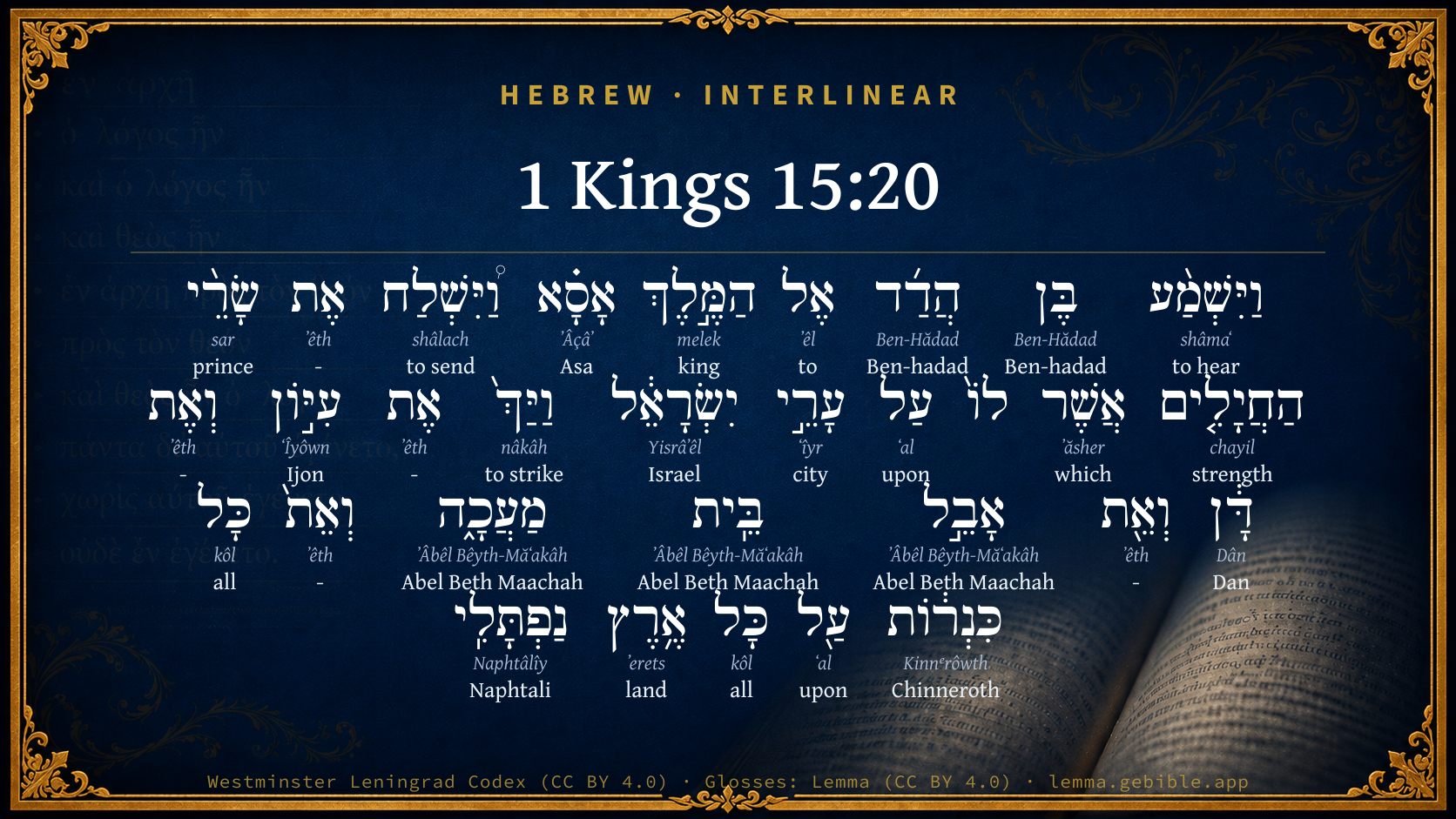
Hebrew (Westminster Leningrad Codex) 1 Kings 15:20 appears in the Hebrew Old Testament. The text above is from the Westminster Leningrad Codex. Each word links to its Strong’s number, a concise gloss, and parsing drawn from the Open Scriptures Hebrew Bible morphology. Click any word for its full Brown-Driver-Briggs (BDB) entry.
Download image
Cite this verse

1 Kings 15:20 (World English Bible). Public Domain. Lemma interlinear Bible study tool, https://lemma.gebible.app/v/1-kings/15/20.

Show BibTeX & RIS
BibTeX
RIS
English Translation
Ben Hadad listened to king Asa, and sent the captains of his armies against the cities of Israel, and struck Ijon, and Dan, and Abel Beth Maacah, and all Chinneroth, with all the land of Naphtali.
World English Bible · Public Domain
Highlights
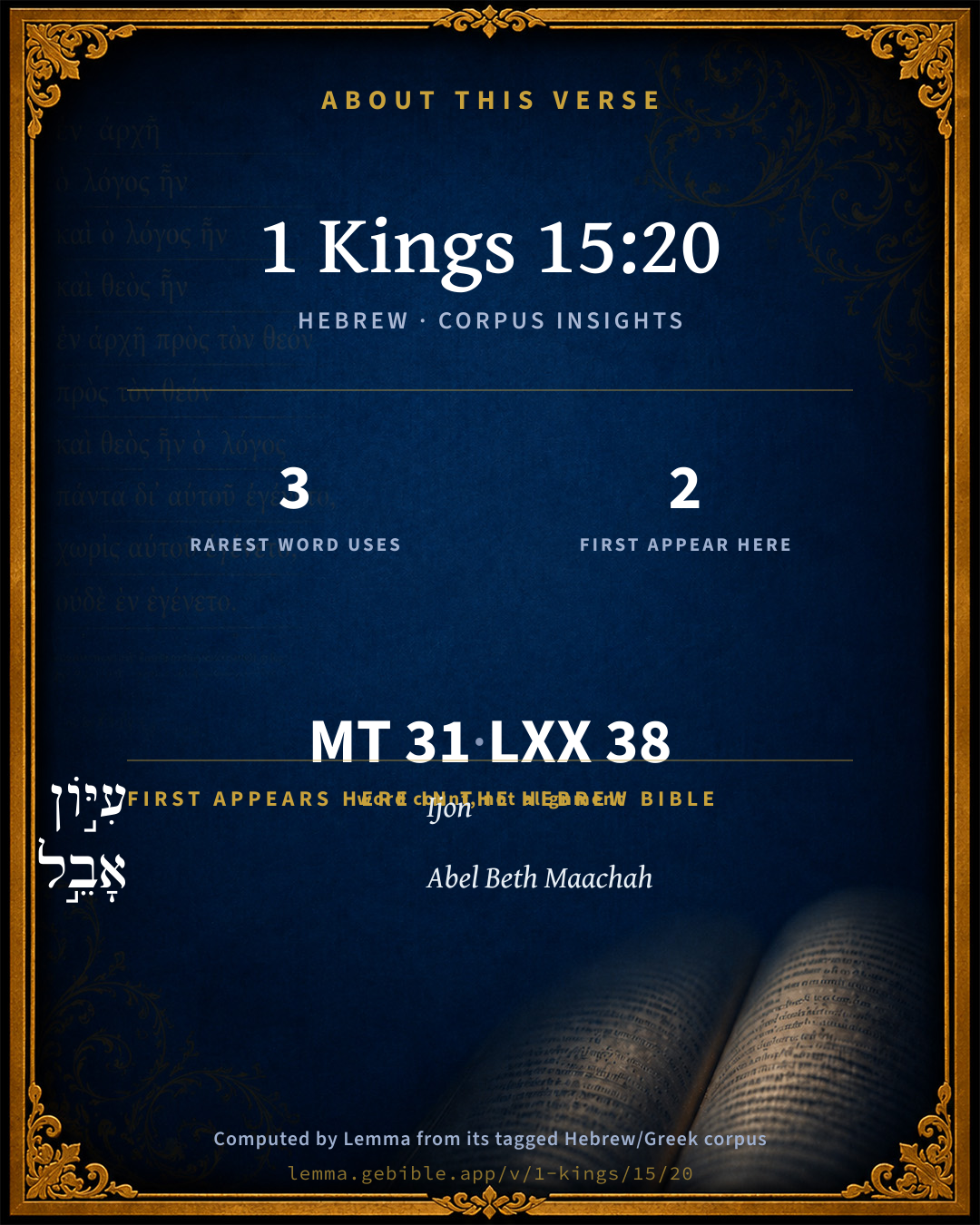
  • 2 first appearances in the Hebrew Bible
Full analysis ↓
Download a study sheet

One document with this verse’s original text, its word-by-word gloss line, the meaning frame, cross-references with their text, attributed commentary, and full source and license credits — printable, and it pastes into notes with its structure intact.

This verse Autodidact and up

Study sheet (.html) Plain text (.txt)

A passage Seminary Student

Up to 50 verses in one chapter. A passage sheet keeps up to 6 commentary sources and 12 cross-references per verse, in the order this page ranks them, and says so on the sheet whenever that leaves anything out. Ask for a single verse and you get the Autodidact verse sheet above.

Everything on this page stays free to read, with no account — the sheet is a download of what is already on screen, not access to it.

Want to remove ads? Support Godless Engineer
Compare translations 3

The same verse in 3 English versions, stacked beneath the original-language interlinear above. Click any original word for its lexicon entry.

Each is an independent rendering of the whole verse — the interlinear is not word-aligned to these translations.

Highlighted words mark where these versions differ — a whole-verse word diff, not a word-by-word alignment.

  • World English Bible Public Domain
    Ben Hadad listened to king Asa, and sent the captains of his armies against the cities of Israel, and struck Ijon, and Dan, and Abel Beth Maacah, and all Chinneroth, with all the land of Naphtali.
  • King James Version Public Domain
    So Benhadad hearkened unto king Asa, and sent the captains of the hosts which he had against the cities of Israel, and smote Ijon, and Dan, and Abelbethmaachah, and all Cinneroth, with all the land of Naphtali.
  • unfoldingWord Literal Text CC BY-SA 4.0
    And Ben Hadad listened to King Asa, and he sent the commanders of the armies that to him against the cities of Israel. And he struck Ijon and Dan and Abel Beth Maacah and all of Chinnereth, with all of the land of Naphtali.

unfoldingWord Literal Text — © unfoldingWord, licensed CC BY-SA 4.0. Word-aligned USFM3 via Door43 (git.door43.org/unfoldingWord/en_ult).

Versions to compare (up to 4)

3 of 4 selected

Show all 18 translations

Every available English version of this verse, each an independent rendering of the whole verse.

  • World English Bible Public Domain
    Ben Hadad listened to king Asa, and sent the captains of his armies against the cities of Israel, and struck Ijon, and Dan, and Abel Beth Maacah, and all Chinneroth, with all the land of Naphtali.
  • Berean Standard Bible Public Domain
    And Ben-hadad listened to King Asa and sent the commanders of his armies against the cities of Israel, conquering Ijon, Dan, Abel-beth-maacah, and the whole land of Naphtali, including the region of Chinnereth.
  • Majority Standard Bible Public Domain
    And Ben-hadad listened to King Asa and sent the commanders of his armies against the cities of Israel, conquering Ijon, Dan, Abel-beth-maacah, and the whole land of Naphtali, including the region of Chinnereth.
  • King James Version Public Domain
    So Benhadad hearkened unto king Asa, and sent the captains of the hosts which he had against the cities of Israel, and smote Ijon, and Dan, and Abelbethmaachah, and all Cinneroth, with all the land of Naphtali.
  • American Standard Version (1901) Public Domain
    And Ben-hadad hearkened unto king Asa, and sent the captains of his armies against the cities of Israel, and smote Ijon, and Dan, and Abel-beth-maacah, and all Chinneroth, with all the land of Naphtali.
  • Revised Version (1885) Public Domain
    And Ben-hadad hearkened unto king Asa, and sent the captains of his armies against the cities of Israel, and smote Ijon, and Dan, and Abel-beth-maacah, and all Chinneroth, with all the land of Naphtali.
  • Geneva Bible (1599) Public Domain
    So Ben-hadad hearkened vnto King Asa, and sent the captaines of the hosts, which he had, against the cities of Israel, and smote lion, and Dan, and Abel-beth-maachah, and all Cinneroth, with all the land of Naphtali.
  • Douay-Rheims (1899) Public Domain
    Benadad hearkening to king Asa, sent the captains of his army against the cities of Israel, and they smote Ahion, and Dan, and Abeldomum Maacha, and all Cenneroth, that is all the land of Nephtali.
  • Young's Literal Translation Public Domain
    And Ben-Hadad hearkeneth unto king Asa, and sendeth the heads of the forces that he hath against cities of Israel, and smiteth Ijon, and Dan, and Abel-Beth-Maachah, and all Chinneroth, besides all the land of Naphtali;
  • Literal Standard Version CC BY-SA 4.0
    And Ben-Hadad listens to King Asa, and sends the heads of the forces that he has against cities of Israel, and strikes Ijon, and Dan, and Abel-Beth-Maachah, and all Chinneroth, besides all the land of Naphtali;
  • Unlocked Literal Bible CC BY-SA 4.0
    Ben Hadad listened to King Asa and sent the commanders of his armies, and they attacked the cities of Israel. They attacked Ijon, Dan, Abel of Beth Maacah, and all Kinnereth, together with all the land of Naphtali.
  • unfoldingWord Literal Text CC BY-SA 4.0
    And Ben Hadad listened to King Asa, and he sent the commanders of the armies that to him against the cities of Israel. And he struck Ijon and Dan and Abel Beth Maacah and all of Chinnereth, with all of the land of Naphtali.
  • Darby Bible Public Domain
    And Ben-Hadad hearkened to king Asa, and sent the captains of his forces against the cities of Israel, and smote Ijon, and Dan, and Abel-Beth-Maachah, and all Kinneroth, with all the land of Naphtali.
  • World Messianic Bible Public Domain
    Ben Hadad listened to King Asa, and sent the captains of his armies against the cities of Israel, and struck Ijon, and Dan, and Abel Beth Maacah, and all Chinneroth, with all the land of Naphtali.
  • Webster's Bible Public Domain
    So Ben-hadad hearkened to king Asa, and sent the captains of the armies which he had against the cities of Israel, and smote Ijon, and Dan, and Abel-beth-maachah, and all Cinneroth, with all the land of Naphtali.
  • Free Bible Version CC BY-SA 4.0
    Ben-hadad accepted Asa's proposal and sent his army with its commanders to attack the towns of Israel. They captured the towns of Ijon, Dan, Abel-beth-maacah, and all Kinnereth, including all the land of Naphtali.
  • Bible in Basic English Public Domain
    So Ben-hadad did as King Asa said, and sent the captains of his armies against the towns of Israel, attacking Ijon and Dan and Abel-beth-maacah, and all Chinneroth as far as all the land of Naphtali.
  • JPS Tanakh (1917) Public Domain
    And Ben-hadad hearkened unto king Asa, and sent the captains of his armies against the cities of Israel, and smote Ijon, and Dan, and Abel-beth-maacah, and all Chinneroth, with all the land of Naphtali.

Literal Standard Version (2020), Covenant Press — licensed CC BY-SA 4.0. Text via the HelloAO Bible API (eBible.org). Unlocked Literal Bible (unfoldingWord) — licensed CC BY-SA 4.0. Text via the HelloAO Bible API (eBible.org). unfoldingWord Literal Text — © unfoldingWord, licensed CC BY-SA 4.0. Word-aligned USFM3 via Door43 (git.door43.org/unfoldingWord/en_ult). Free Bible Version, Dr. Jonathan Gallagher — licensed CC BY-SA 4.0. Text via the HelloAO Bible API (eBible.org).

Word by word

More ways to search: Search by grammar → Find every occurrence → Compare this word →

Practice this passage: Drill this verse → Learn its vocabulary →

עִיּ֣וֹן
ʻÎyôwn
H5859
“Ijon”
Noun, Proper
Part of Speech
Noun
Type
Proper
Full BDB Definition

Origin: from H5856

TWOT: None

Ijon = "a ruin" - a place in the north of Palestine belonging to the tribe of Naphtali
  1. וַיִּשְׁמַ֨ע shâmaʻ H8085 “and · to hear” Conjunction + Verb, Qal, Sequential Imperfect, 3rd Person, Masculine, Singular
  2. בֶּן Ben-Hădad H1130 “Ben-hadad” Noun, Proper
  3. הֲדַ֜ד Ben-Hădad H1130 “Ben-hadad” Noun, Proper
  4. אֶל ʼêl H413 “to” Preposition
  5. הַמֶּ֣לֶךְ melek H4428 “the · king” Particle, Definite Article + Noun, Common, Masculine, Singular, Absolute
  6. אָסָ֗א ʼÂçâʼ H609 “Asa” Noun, Proper
  7. וַ֠יִּשְׁלַח shâlach H7971 “and · to send” Conjunction + Verb, Qal, Sequential Imperfect, 3rd Person, Masculine, Singular
  8. אֶת ʼêth H853 “-” Particle, Direct Object
  9. שָׂרֵ֨י sar H8269 “princes of” Noun, Common, Masculine, Plural, Construct
  10. הַחֲיָלִ֤ים chayil H2428 “the · forces” Particle, Definite Article + Noun, Common, Masculine, Plural, Absolute
  11. אֲשֶׁר ʼăsher H834 “which” Particle, Relative
  12. עַל ʻal H5921 “upon” Preposition
  13. עָרֵ֣י ʻîyr H5892 “cities of” Noun, Common, Feminine, Plural, Construct
  14. יִשְׂרָאֵ֔ל Yisrâʼêl H3478 “Israel” Noun, Proper
  15. וַיַּךְ֙ nâkâh H5221 “and · to strike” Conjunction + Verb, Hiphil, Sequential Imperfect, 3rd Person, Masculine, Singular
  16. אֶת ʼêth H853 “-” Particle, Direct Object
  17. וְאֶת ʼêth H853 “and · -” Conjunction + Particle, Direct Object
  18. דָּ֔ן Dân H1835 “Dan” Noun, Proper
  19. וְאֵ֖ת ʼêth H853 “and · -” Conjunction + Particle, Direct Object
  20. אָבֵ֣ל ʼÂbêl Bêyth-Măʻakâh H62 “Abel Beth Maachah” Noun, Proper
  21. בֵּֽית ʼÂbêl Bêyth-Măʻakâh H62 “Abel Beth Maachah” Noun, Proper
  22. מַעֲכָ֑ה ʼÂbêl Bêyth-Măʻakâh H62 “Abel Beth Maachah” Noun, Proper
  23. וְאֵת֙ ʼêth H853 “and · -” Conjunction + Particle, Direct Object
  24. כָּל kôl H3605 “all of” Noun, Common, Masculine, Singular, Construct
  25. כִּנְר֔וֹת Kinnᵉrôwth H3672 “Chinneroth” Noun, Proper
  26. עַ֖ל ʻal H5921 “upon” Preposition
  27. כָּל kôl H3605 “all of” Noun, Common, Masculine, Singular, Construct
  28. אֶ֥רֶץ ʼerets H776 “land of” Noun, Common, Both, Singular, Construct
  29. נַפְתָּלִֽי Naphtâlîy H5321 “Naphtali” Noun, Proper

About this verse

These counts appear in no published source. They are computed here, from the morphology-tagged text and Lemma’s own curated glosses. What Lemma adds →

31
words
21
distinct lemmas
Historical
section

Notable vocabulary

The rarest word here is עִיּ֣וֹן Ijon H5859 — appearing just 3 times in the whole Hebrew Bible.

First appearance in Scripture

These words make their first canonical appearance in the Hebrew Bible here:

  • עִיּ֣וֹן Ijon H5859
  • אָבֵ֣ל Abel Beth Maachah H62

Shared distinctive vocabulary

עִיּ֣וֹן Ijon H5859 occurs in 3 verses of the Hebrew Bible. Also found in:

Grammatical profile

  • 3 verbs
  • 18 nouns
  • 4 prepositions
  • 6 particles

Verb forms

  • וַיִּשְׁמַ֨ע Qal · Sequential Imperfect
  • וַ֠יִּשְׁלַח Qal · Sequential Imperfect
  • וַיַּךְ֙ Hiphil · Sequential Imperfect

Repetition

Words recur within this verse — often emphatic in Hebrew:

  • אָבֵ֣ל Abel Beth Maachah H62 ×3
  • בֶּן Ben-hadad H1130 ×2
  • עַל upon H5921 ×2
  • כָּל all H3605 ×2

Hebrew & Septuagint length

In English translation the verse runs 36 words from the Hebrew and 44 from the Septuagint (LXX English) — closely comparable.

A rough comparison of the two English renderings, which tokenize alike — not a word-level alignment.

Word counts can differ between the Hebrew and the Greek without any difference in meaning — e.g. the Hebrew direct-object marker אֵת has no separate Greek word, and Greek often adds the article ὁ.

In the original languages it is 31 Hebrew tokens and 38 Greek tokens — but the two are counted differently (Hebrew bundles its prefixes and suffixes into one token; the Greek is in lemma form), so that isn’t a like-for-like length.

Cross-references

7

Topical passages linked to 1 Kings 15:20 in the Treasury of Scripture Knowledge — connected by theme and wording, ordered by reader-vote popularity; previews shown in the World English Bible.

  • 2 Kings 15:29 In the days of Pekah king of Israel came Tiglath Pileser king of Assyria, and took Ijon, and Abel Beth Maacah, and Janoah, and Kedesh, and Hazor, and Gilead, and Galilee, all the land of Naphtali; and he carried them captive to Assyria.
  • Judges 18:29 They called the name of the city Dan, after the name of Dan their father, who was born to Israel: however the name of the city was Laish at the first.
  • Joshua 11:2 and to the kings who were on the north, in the hill-country, and in the Arabah south of Chinneroth, and in the lowland, and in the heights of Dor on the west,
  • Joshua 12:3 and the Arabah to the sea of Chinneroth, eastward, and to the sea of the Arabah, even the Salt Sea, eastward, the way to Beth-jeshimoth; and on the south, under the slopes of Pisgah:
  • 2 Samuel 20:14–15 He went through all the tribes of Israel to Abel, and to Beth Maacah, and all the Berites: and they were gathered together, and went also after him.
  • 1 Kings 12:29 He set the one in Bethel, and the other put he in Dan.
  • Genesis 14:14 When Abram heard that his relative was taken captive, he led forth his trained men, born in his house, three hundred and eighteen, and pursued as far as Dan.

Cross-references courtesy of OpenBible.info (CC BY 4.0).

Hebrew and Greek witnesses Masoretic Hebrew ↔ Greek Septuagint

The same verse in the two great witnesses to the Old Testament, shown verse-for-verse.

These are two independent witnesses, not word-aligned to each other, and the Septuagint is shown in lemma (dictionary) form.

Hebrew 1 Kings 15:20 Masoretic · Westminster Leningrad Codex

וַיִּשְׁמַ֨ע בֶּן הֲדַ֜ד אֶל הַמֶּ֣לֶךְ אָסָ֗א וַ֠יִּשְׁלַח אֶת שָׂרֵ֨י הַחֲיָלִ֤ים אֲשֶׁר לוֹ֙ עַל עָרֵ֣י יִשְׂרָאֵ֔ל וַיַּךְ֙ אֶת עִיּ֣וֹן וְאֶת דָּ֔ן וְאֵ֖ת אָבֵ֣ל בֵּֽית מַעֲכָ֑ה וְאֵת֙ כָּל כִּנְר֔וֹת עַ֖ל כָּל אֶ֥רֶץ נַפְתָּלִֽי

Ben Hadad listened to king Asa, and sent the captains of his armies against the cities of Israel, and struck Ijon, and Dan, and Abel Beth Maacah, and all Chinneroth, with all the land of Naphtali.

World English Bible · Public Domain

Greek LXX 1 Kings 15:20 Septuagint · lemma form

καί ἀκούω υἱός αδερ ὁ βασιλεύς ασα καί ἀποστέλλω ὁ ἄρχων ὁ δύναμις ὁ αὐτός ὁ πόλις ὁ ἰσραήλ καί πατάσσω ὁ αιν καί ὁ δαν καί ὁ αβελμαα καί πᾶς ὁ χεζραθ ἕως πᾶς ὁ γῆ νεφθαλι

And the son of Ader listened to king Asa, and sent the chiefs of his forces to the cities of Israel; and they struck Ain, Dan, and Abel of the house of Maacha, and all Chennereth, as far as the whole land of Nephthali.

LXX2012 (modern English Septuagint) · Public Domain

Hebrew: Westminster Leningrad Codex (CC BY 4.0). Greek: Septuagint (public domain); English from LXX2012 (modern English Septuagint) (Public Domain). How the Septuagint differs from the Hebrew →

Targum (Aramaic paraphrase)

1

The Targum is the ancient Jewish Aramaic paraphrase of the Hebrew Scriptures — an interpretive translation, not the Hebrew text itself. Onkelos (literal) and Pseudo-Jonathan (expansive) render the Torah, and Jonathan the Prophets. Coverage is partial: where no permissively-licensed English translation exists for a verse, only the Aramaic is shown. This is verse-level text, not a word-by-word alignment to the Hebrew.

  1. Targum Jonathan Prophets (Joshua–Malachi)
    וְקַבֵּל בַּר הֲדַד מִן מַלְכָּא אָסָא וּשְׁדַר יַת רַבָּנֵי חֵילְוָתָא דִילֵיהּ עַל קִרְוֵי יִשְׂרָאֵל וּמְחָא יַת עִיוֹן וְיַת דָן וְיַת אָבֵל בֵּית מַעֲכָה וְיַת כָּל גִינוֹסַר עַל כָּל אֲרַע שִׁבְטָא דְבֵית נַפְתָּלִי:

    (no public-domain English translation for this verse)

    Targum Jonathan — Aramaic: “Mikraot Gedolot” (public domain). English: “Sefaria Community Translation” (CC0 1.0 (public-domain dedication)); “London "Chaldee Paraphrase," 1871” (public domain). Text via Sefaria.

Commentary

Notes on 1 Kings 15:20 from classic Christian and Jewish commentators (each source and its license shown beneath its notes). The classic Christian expositions comment on the surrounding passage and are grouped to its opening verse, so a note may address several verses; the Jewish commentaries on the Tanakh (Rashi and others) are per-verse, so they appear only where the commentator wrote on this verse.

Lemma curates 59 commentaries, every one of them public domain or Creative Commons licensed, each selected and text-cleaned for this edition rather than reprinted as found. About our sources →

Trapp's Complete Commentary

John Trapp

1Ki 15:20 So Benhadad hearkened unto king Asa, and sent the captains of the hosts which he had against the cities of Israel, and smote Ijon, and Dan, and Abelbethmaachah, and all Cinneroth, with all the land of Naphtali.

Ver. 20. So Benhadad hearkened unto king Asa.] Though against his oath. The Turks’ leagues, grounded upon the law of nations, be they with never so strong capitulations concluded, or solemnity of oath confirmed, have with them no longer force than standeth with their own profit. {a}

{a} Turk Hist., pref.

John Trapp, A Commentary or Exposition upon All the Books of the Old and New Testament (1647–1656) — public domain. Text from a community e-Sword module.

Joseph Benson's Commentary

1Ki 15:20-21. And smote Ijon and Dan, &c. — He fell upon the northern part of the kingdom of Israel, which was nearest to Damascus; while Baasha was busy at Ramah, which was in the more southern part. And dwelt in Tirzah — Now the royal city of Israel. There he abode to defend his own kingdoms, and durst not return to oppose Asa, lest the Syrian king should make a second invasion. So Asa met with success in this ungodly course, as good men sometimes meet with disappointment in a good cause and course. So there is no judging of causes by events.

Joseph Benson's Commentary on the Old and New Testaments (1811–1818) — public domain. Text from a community e-Sword module.

Tyndale Open Study Notes

Tyndale Open Resources

15:20-22 As a result of King Asa’s request, the war with Baasha quickly turned to Asa’s advantage. Ben-hadad swiftly captured several sections of northern Israel and secured important northern trade routes, forcing Baasha to cease operations in Ramah in order to meet the emergency on his northern frontier. Asa retook Ramah and used its building materials to fortify other strategic border towns against further moves by Baasha.

Tyndale Open Study Notes — © Tyndale Open Resources, licensed CC BY-SA 4.0. Text via the HelloAO Bible API.

Adam Clarke's Commentary

Verse 20. Ijon, and Dan, &c.] He appears to have attacked and taken those towns which constituted the principal strength of the kingdom of Israel.

Adam Clarke's Commentary on the Bible (1810–1826) — public domain. Text from a community e-Sword/MySword module.

Ellicott's Commentary for English Readers

(20) Smote.—The portion smitten now, as hereafter in the Assyrian invasion (2Ki_15:29), is the mountain country near the source of the Jordan, which lay most exposed to the great approach to Israel from the north by “the entering in of Hamath,” through the wide valley between Lebanon and Ante-Lebanon, called by the Greeks Cœle-Syria.

Ijon is only mentioned in these two passages as belonging to the territory of Naphtali. It is supposed to have stood not far from Dan, close to the nearer, but fuller, source of the Jordan, in a position of great natural beauty and some strength, identified with the modern Tel-Dibbin.

Abel-beth-Maachah (see 2Sa_20:14-15) (“the meadow of the house of Maachah”), or (2Ch_16:4) Abel-maim (“the meadow upon the waters”), lay probably in the marshy ground north of the water of Merom.

Cinneroth or Chinneroth, is the name afterwards corrupted into Gennesareth, signifying evidently a region in the neighbourhood of the lake.

A Bible Commentary for English Readers, edited by Charles John Ellicott (1878–1897) — public domain. Text from a community e-Sword module.

The Cambridge Bible for Schools and Colleges

gen. ed. J. J. S. Perowne

20. So [R.V. And] Ben-hadad hearkened] The conjunction is the simple copulative, and is so rendered in the parallel place in Chronicles.

the captains of the hosts which he had] This is an attempt to represent the Hebrew construction. But it is not nearly so idiomatic as the translation in Chronicles which the R.V. has followed, that the same Hebrew might have in both places the same English rendering: the captains of his armies.

and smote Ijon] This town lay in the north of Palestine and belonged to the tribe of Naphtali. It was attacked and plundered again in later days by Tiglath-pileser (2Ki_15:29).

and Dan] This was the town formerly called Laish, which had been seized in the days of the Judges by some Danites from the south (Jos_19:47; Jdg_18:29). It lay on the extreme north of the country, so that ‘from Dan to Beersheba’ became an expression to describe the whole country from north to south.

and Abel-beth-maachah] This city, like the rest, lay quite in the north, and was early a place of some importance. It is called ‘a city and a mother in Israel’ (2Sa_20:9). In the parallel passage in Chronicles the name is given as ‘Abel-maim,’ i.e. ‘Abel on the waters.’

all Cinneroth] R.V. Chinneroth. From the way in which it is here mentioned this appears to have been a district and not a town. It was probably named from the lake of Gennesareth, or sea of Tiberias, which was in that neighbourhood, and was anciently called ‘the sea of Chinnereth’ (Num_24:11; Jos_13:27).

Naphtali] This tribe lay directly in the way of Syrian and Assyrian invaders.

The Cambridge Bible for Schools and Colleges (gen. ed. J. J. S. Perowne; Cambridge University Press, 1878–1918) — public domain. Text from a community e-Sword module.

John Gill's Exposition

And Nadab the son of Jeroboam began to reign over Israel in the second year of Asa king of Judah,.... Before Baasha did:

and reigned over Israel two years, not two whole years; for he began in the second of Asa, and in the third of that king's reign Baasha slew him, and reigned in his stead, Kg1 15:28.

John Gill's Exposition of the Whole Bible (1746–1763) — public domain (CC PDM 1.0). Text via the HelloAO Bible API.

Albert Barnes' Notes on the Bible

Ijon is probably marked by the ruins called “Tel-Dibbin,” which are situated a few miles northwest of the site of Dan, in a fertile and beautiful little plain which bears the name of “Merj’ Ayun” or “meadow of fountains.” On Abel-beth-maachah, or Abel-maim (“Abel-on-the waters”) and Dan, see the marginal references

For Cinneroth or Genesareth see Jos 11:2.

Albert Barnes' Notes on the Bible (1834–1885) — public domain. Text from a community e-Sword/MySword module.

Haydock's Catholic Bible Commentary

Ahion, or Ain, remote in the north, whence Theglathphalasar took away captives, (4 Kings xv. 29.) is perhaps the Enan of Ezechiel xlviii. 1., and Numbers xxxiv. 9. --- Maacha. In Paralipomenon, Abel-maim, "Abela of the waters," 2 Kings xx. 14. --- Ceneroth, near the sea of Tiberias, Josue xi. 2. Benadad kept possession of some of these places, and even built streets in Samaria, chap. xx. 34.

George Leo Haydock (1774–1849), Haydock's Catholic Family Bible and Commentary, 1859 edition — public domain. Excludes Psalms (Douay-Rheims chapter numbering differs from Protestant) and Deuterocanonical books (Catholic canon only).

Matthew Poole's English Annotations

The northern parts of Baasha’s kingdom, which were nearest to his own kingdom of Damascus, and most remote from those parts where Baasha was now employed, which were in the most southern parts of his dominions.

Matthew Poole's English Annotations on the Holy Bible (1683–1685) — public domain. Text from a community e-Sword/MySword module.

Whedon's Commentary on the Bible

Daniel D. Whedon

20. Ijon — “At the base of the mountains of Naphtali, a few miles northwest of the city of Dan, is a fertile and beautiful plain called Merj Ayun, (the Arabic word Ayun, though different in meaning, is radically identical with the Hebrew עיון,) and near its northern end is a large mound, called Tell Dibbin. The writer visited it some years ago, and found there the traces of a strong and ancient city. This, in all probability, is the site of the long lost Ijon.” — J.L. Porter. The spot was visited in 1852 by Robinson, who regarded it as the site of the ancient Ijon, and described it as “a noble site for a city, overlooking, as it does, the whole plain of the Merj, and commanding one of the great roads between the seacoast and the interior. Unmistakable traces likewise show that in very ancient times the place was occupied by a city.”

Dan — See on Jdg_18:29. Here Jeroboam had erected one of his golden calves. 1Ki_12:29.

Abel-bethmaachah — See on 2Sa_20:14.

All Chinneroth — This was probably a district lying in the territory of Naphtali, and adjoining the sea of Galilee, which was anciently called the sea of Cinneroth. See at Num_34:11; Jos_12:3. It may have taken its name either from the sea or from some city. See on Jos_11:2.

Daniel D. Whedon (gen. ed.), Commentary on the Old and New Testaments (1874–1909) — public domain. Text from a community e-Sword module.

The Pulpit Commentary

So Heb. and Ben-hadad hearkened unto king Asa, and sent the captains or princes; same word as in 1Ki_22:31; cf. 20:24 of the hosts which he had against the cities of Israel, and smote Ijon now represented by Tell Dibbin, a mound near the north end of the Merj "Ayun (which probably preserves the name), a "meadow of fountains," a few miles northwest of Daniel This hill would offer a commanding site for a stronghold, and traces are found there of a large and ancient city (Robinson, 3 p. 375; Dict. Bib., 1. p. 863, and Dan, near the northern extremity of Palestine (1Ki_4:25; 1Sa_3:20, etc.) Now certainly identified with Tell el Kadi the "hill of the Judge" (which preserves the meaning of the name), near the main source of the Jordan. The Tell, apparently an extinct crater, is covered with ruins. Stanley, S. and P., p. 395-6. Thomson, "Land and Book," 1. p. 320. Van de Velde, if. p. 420. The situation is described as superb, and the country as extremely fertile. This is the last mention of the place in Scripture. Retribution has soon fallen on one of the centres of Jeroboam"s schism, and Abel-beth-maachah now known as Abil el Kamh (Robinson, 3. p. 372; but see Stanley, S. and P., p. 390, note 6; Thomson, 1. p. 324. Rawlinson argues 2Sa_20:14 that there were originally two towns, but ver. 15 leads us to question the present text of ver. 14. Ver. 19 shows it to have been a place of considerable importance. In 2Ch_16:4. it is called Abel Maim, "the meadow of the waters," not only, it is probable, because of the lake, but of the huge marsh, the Ard el Huleh, which drains into it (see Stanley, l.c. ) All these towns are in the neighbourhood of Lake Huleh (Merom), and all being in the extreme north, bore the brunt of the invasion. The name Maachah is to be noticed in connection with ver. 2, and all Cinneroth in Num_34:11; Deu_3:17, Cinnereth; in the New Testament, Gennesaret." "The expression all Cinneroth" is unusual, and may be compared with "all Bithron," probably like this, a district and not a town" (Grove, Dict. Bib., 1. p. 330). It is the district on the western shore of the lake of Galilee, north of Tiberias, which gave its name to the adjoining sheet of water. A city Chinnereth, perhaps the capital of the district is mentioned, (Jos_19:35) with l" not uncommonly has this meaning. Cf., Gen_32:12 (Hebrews) "the mother with the children;" Exo_35:22, "men with women." all the land of Naphtali Not only were the fortresses of Naphtali just mentioned smitten by the Syrians, but they laid waste all the surrounding district.

The Pulpit Commentary (1880–1919), ed. H.D.M. Spence-Jones & Joseph S. Exell — public domain. Text from a community e-Sword module.

unfoldingWord translationNotes

Door43 World Missions Community

It came about that

This phrase is used here to mark an important event in the story. If your language has a way for doing this, you could consider using it here.

he stopped building up Ramah

King Baasha did this by telling his workers to do this. AT: "he had his workers stop building up Ramah" (See: Metonymy)

Tirzah

This is the name of a city. See how you translated it in 1 Kings 14:17.

No one was exempted

This can also be stated positively. AT: "Every one had to obey King Asa's proclamation"

translationWords

commander

Dan

Naphtali

preach

Benjamin

Mizpah

unfoldingWord translationNotes — © Distant Shores Media and the Door43 World Missions Community, licensed CC BY-SA 4.0. Source: git.door43.org/Door43/en_tn.

Lesson kit

Teaching starters — assembled from the data on this page, not authored interpretation. Every prompt links to the verse data it draws on. Edit before teaching.

1 Kings, in the Historical, opens this verse with 31 words (21 distinct Hebrew lemmas). Its most distinctive word is ʻÎyôwn (“Ijon”). A historical commentator’s framing appears above. Read the whole chapter for the surrounding context.

Discussion questions

  1. How does “Ijon” (ʻÎyôwn) shape what this verse is saying?
  2. 2 words make their first appearance in Scripture here. What does this debut establish?
  3. How does 2 Kings 15:29, which shares the word «Ijon», read alongside this verse?
  4. What does the repetition of “Abel Beth Maachah” (3× in this one verse) do in this verse?
  5. These translations render this verse differently; the difference is in the English rendering, not the original. What questions does that raise?
  6. «וַיִּשְׁמַ֨ע» is a Qal Sequential Imperfect verb. How does that grammatical form shape the action described?
  7. Compare how Trapp's Complete Commentary and Joseph Benson's Commentary read this verse. Where do they agree or differ?

Things to notice

Reading settings

Reading text

Shown beneath each verse's original-language words.

Old Testament
Old Testament edition

Read the OT as the Masoretic Hebrew (MT) or the Greek Septuagint (LXX).

English shown for the Greek Septuagint (in the Hebrew ↔ Greek comparison).

Comparing translations? Open the Compare panel on any verse page to stack up to four side by side.