
Obadiah 1:13

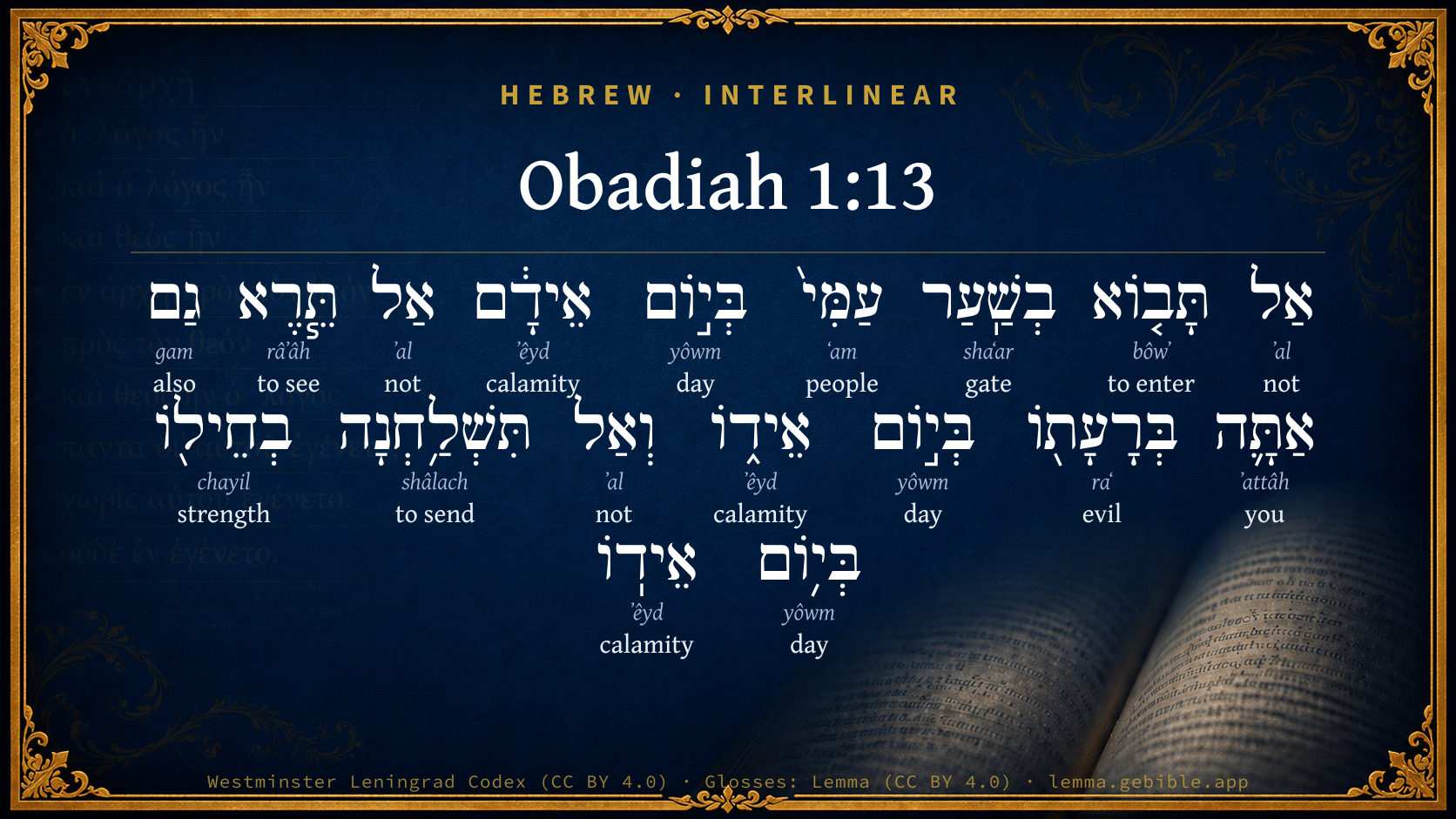
Hebrew (Westminster Leningrad Codex) Obadiah 1:13 appears in the Hebrew Old Testament. The text above is from the Westminster Leningrad Codex. Each word links to its Strong’s number, a concise gloss, and parsing drawn from the Open Scriptures Hebrew Bible morphology. Click any word for its full Brown-Driver-Briggs (BDB) entry.
Download image
Cite this verse

Obadiah 1:13 (World English Bible). Public Domain. Lemma interlinear Bible study tool, https://lemma.gebible.app/v/obadiah/1/13.

Show BibTeX & RIS
BibTeX
RIS
English Translation
Don't enter into the gate of my people in the day of their calamity. Don't look down on their affliction in the day of their calamity, neither seize their wealth on the day of their calamity.
World English Bible · Public Domain
Download a study sheet

One document with this verse’s original text, its word-by-word gloss line, the meaning frame, cross-references with their text, attributed commentary, and full source and license credits — printable, and it pastes into notes with its structure intact.

This verse Autodidact and up

Study sheet (.html) Plain text (.txt)

A passage Seminary Student

Up to 50 verses in one chapter. A passage sheet keeps up to 6 commentary sources and 12 cross-references per verse, in the order this page ranks them, and says so on the sheet whenever that leaves anything out. Ask for a single verse and you get the Autodidact verse sheet above.

Everything on this page stays free to read, with no account — the sheet is a download of what is already on screen, not access to it.

Want to remove ads? Support Godless Engineer
Compare translations 3

The same verse in 3 English versions, stacked beneath the original-language interlinear above. Click any original word for its lexicon entry.

Each is an independent rendering of the whole verse — the interlinear is not word-aligned to these translations.

Highlighted words mark where these versions differ — a whole-verse word diff, not a word-by-word alignment.

  • World English Bible Public Domain
    Don't enter into the gate of my people in the day of their calamity. Don't look down on their affliction in the day of their calamity, neither seize their wealth on the day of their calamity.
  • King James Version Public Domain
    Thou shouldest not have entered into the gate of my people in the day of their calamity; yea, thou shouldest not have looked on their affliction in the day of their calamity, nor have laid hands on their substance in the day of their calamity;
  • unfoldingWord Literal Text CC BY-SA 4.0
    You should not have entered the gate of my people in the day of their calamity. You should not have looked—yes, you!—on his evil in the day of his calamity. And you women should not have looted his wealth in the day of his calamity.

unfoldingWord Literal Text — © unfoldingWord, licensed CC BY-SA 4.0. Word-aligned USFM3 via Door43 (git.door43.org/unfoldingWord/en_ult).

Versions to compare (up to 4)

3 of 4 selected

Show all 18 translations

Every available English version of this verse, each an independent rendering of the whole verse.

  • World English Bible Public Domain
    Don't enter into the gate of my people in the day of their calamity. Don't look down on their affliction in the day of their calamity, neither seize their wealth on the day of their calamity.
  • Berean Standard Bible Public Domain
    You should not enter the gate of My people in the day of their disaster, nor gloat over their affliction in the day of their disaster, nor loot their wealth in the day of their disaster.
  • Majority Standard Bible Public Domain
    You should not enter the gate of My people in the day of their disaster, nor gloat over their affliction in the day of their disaster, nor loot their wealth in the day of their disaster.
  • King James Version Public Domain
    Thou shouldest not have entered into the gate of my people in the day of their calamity; yea, thou shouldest not have looked on their affliction in the day of their calamity, nor have laid hands on their substance in the day of their calamity;
  • American Standard Version (1901) Public Domain
    Enter not into the gate of my people in the day of their calamity; yea, look not thou on their affliction in the day of their calamity, neither lay ye `hands' on their substance in the day of their calamity.
  • Revised Version (1885) Public Domain
    Enter not into the gate of my people in the day of their calamity; yea, look not thou on their affliction in the day of their calamity, neither lay ye hands on their substance in the day of their calamity.
  • Geneva Bible (1599) Public Domain
    Thou shouldest not haue entred into the gate of my people, in the day of their destruction, neither shouldest thou haue once looked on their affliction in the day of their destruction, nor haue layde hands on their substance in the day of their destruction.
  • Douay-Rheims (1899) Public Domain
    Neither shalt thou enter into the gate of my people in the day of their ruin: neither shalt thou also look on in his evils in the day of his calamity: and thou shalt not be sent out against his army in the day of his desolation.
  • Young's Literal Translation Public Domain
    Nor come into a gate of My people in a day of their calamity, Nor look, even thou, on its misfortune in a day of its calamity, Nor send forth against its force in a day of its calamity,
  • Literal Standard Version CC BY-SA 4.0
    Nor come into a gate of My people in a day of their calamity, || Nor look, even you, on its misfortune in a day of its calamity, || Nor send forth against its force in a day of its calamity,
  • Unlocked Literal Bible CC BY-SA 4.0
    Do not enter my people's gate in the day of their calamity; do not gloat over their affliction in the day of their disaster, do not loot their wealth in the day of their ruin.
  • unfoldingWord Literal Text CC BY-SA 4.0
    You should not have entered the gate of my people in the day of their calamity. You should not have looked—yes, you!—on his evil in the day of his calamity. And you women should not have looted his wealth in the day of his calamity.
  • Darby Bible Public Domain
    Thou shouldest not have entered into the gate of my people in the day of their calamity, nor have looked, even thou, on their affliction in the day of their calamity, neither shouldest thou have laid [hands] on their substance in the day of their calamity;
  • World Messianic Bible Public Domain
    Don’t enter into the gate of my people in the day of their calamity. Don’t look down on their affliction in the day of their calamity, neither seize their wealth on the day of their calamity.
  • Webster's Bible Public Domain
    Thou shouldst not have entered into the gate of my people in the day of their calamity; yes, thou shouldst not have looked on their affliction in the day of their calamity, nor have laid hands on their substance in the day of their calamity;
  • Free Bible Version CC BY-SA 4.0
    You should not have marched through the city gates of my people on their day of disaster. You should not have gloated over them on the day of their disaster. You should not have looted their wealth on the day of their disaster.
  • Bible in Basic English Public Domain
    Do not go into the doors of my people on the day of their downfall; do not be looking on their trouble with pleasure on the day of their downfall, or put your hands on their goods on the day of their downfall.
  • JPS Tanakh (1917) Public Domain
    Thou shouldest not have entered into the gate of My people in the day of their calamity; yea, thou shouldest not have gazed on their affliction in the day of their calamity, nor have laid hands on their substance in the day of their calamity.

Literal Standard Version (2020), Covenant Press — licensed CC BY-SA 4.0. Text via the HelloAO Bible API (eBible.org). Unlocked Literal Bible (unfoldingWord) — licensed CC BY-SA 4.0. Text via the HelloAO Bible API (eBible.org). unfoldingWord Literal Text — © unfoldingWord, licensed CC BY-SA 4.0. Word-aligned USFM3 via Door43 (git.door43.org/unfoldingWord/en_ult). Free Bible Version, Dr. Jonathan Gallagher — licensed CC BY-SA 4.0. Text via the HelloAO Bible API (eBible.org).

Word by word

More ways to search: Search by grammar → Find every occurrence → Compare this word →

Practice this passage: Drill this verse → Learn its vocabulary →

אֵידָ֔ם
ʼêyd
H343
“calamity · their”
Noun, Common, Masculine, Singular, Construct + Suffix, Personal, 3rd Person, Masculine, Plural
Part of Speech
Noun
Type
Common
Gender
Masculine
Number
Singular
State
Construct
Full BDB Definition

Origin: from the same as H181 (in the sense of bending down)

TWOT: 38c

distress, burden, calamity - burden (of the righteous) - calamity (of nation) - disaster (of wicked) - day of calamity
  1. אַל ʼal H408 “not” Particle, Negative
  2. תָּב֤וֹא bôwʼ H935 “to enter” Verb, Qal, Jussive, 2nd Person, Masculine, Singular
  3. בְשַֽׁעַר shaʻar H8179 “in/at · gate of” Preposition + Noun, Common, Masculine, Singular, Construct
  4. עַמִּי֙ ʻam H5971 “people · my” Noun, Common, Masculine, Singular, Construct + Suffix, Personal, 1st Person, Common, Singular
  5. בְּי֣וֹם yôwm H3117 “in/at · day of” Preposition + Noun, Common, Masculine, Singular, Construct
  6. אַל ʼal H408 “not” Particle, Negative
  7. תֵּ֧רֶא râʼâh H7200 “to see” Verb, Qal, Jussive, 2nd Person, Masculine, Singular
  8. גַם gam H1571 “also” Adverb
  9. אַתָּ֛ה ʼattâh H859 “you” Pronoun, Personal, 2nd Person, Masculine, Singular
  10. בְּרָעָת֖וֹ raʻ H7451 “in/at · evil · his” Preposition + Noun, Common, Feminine, Singular, Construct + Suffix, Personal, 3rd Person, Masculine, Singular
  11. בְּי֣וֹם yôwm H3117 “in/at · day of” Preposition + Noun, Common, Masculine, Singular, Construct
  12. אֵיד֑וֹ ʼêyd H343 “calamity · his” Noun, Common, Masculine, Singular, Construct + Suffix, Personal, 3rd Person, Masculine, Singular
  13. וְאַל ʼal H408 “and · not” Conjunction + Particle, Negative
  14. תִּשְׁלַ֥חְנָה shâlach H7971 “to send” Verb, Qal, Jussive, 2nd Person, Feminine, Plural
  15. בְחֵיל֖וֹ chayil H2428 “in/at · strength · his” Preposition + Noun, Common, Masculine, Singular, Construct + Suffix, Personal, 3rd Person, Masculine, Singular
  16. בְּי֥וֹם yôwm H3117 “in/at · day of” Preposition + Noun, Common, Masculine, Singular, Construct
  17. אֵידֽוֹ ʼêyd H343 “calamity · his” Noun, Common, Masculine, Singular, Construct + Suffix, Personal, 3rd Person, Masculine, Singular

About this verse

These counts appear in no published source. They are computed here, from the morphology-tagged text and Lemma’s own curated glosses. What Lemma adds →

18
words
12
distinct lemmas
Prophets
section

Notable vocabulary

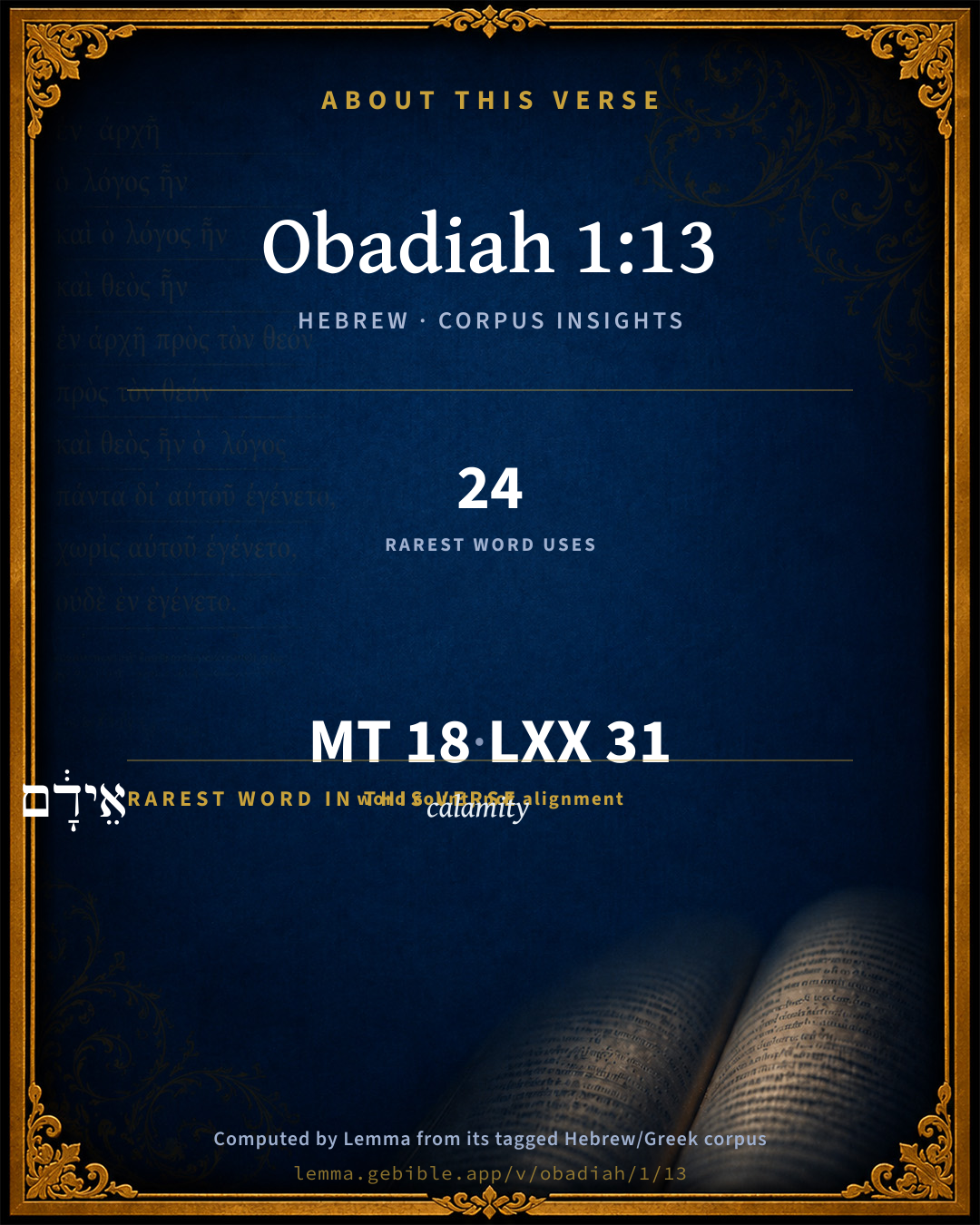
The rarest word here is אֵידָ֔ם calamity H343 — appearing just 24 times in the whole Hebrew Bible.

Shared distinctive vocabulary

אֵידָ֔ם calamity H343 occurs in 22 verses of the Hebrew Bible. Also found in:

Grammatical profile

  • 3 verbs
  • 10 nouns
  • 1 pronoun
  • 1 adverb
  • 3 particles

Verb forms

  • תָּב֤וֹא Qal · Jussive
  • תֵּ֧רֶא Qal · Jussive
  • תִּשְׁלַ֥חְנָה Qal · Jussive

Repetition

Words recur within this verse — often emphatic in Hebrew:

  • בְּי֣וֹם day H3117 ×3
  • אֵידָ֔ם calamity H343 ×3
  • אַל not H408 ×3

Hebrew & Septuagint length

In English translation the verse runs 36 words from the Hebrew and 45 from the Septuagint (LXX English) — closely comparable.

A rough comparison of the two English renderings, which tokenize alike — not a word-level alignment.

Word counts can differ between the Hebrew and the Greek without any difference in meaning — e.g. the Hebrew direct-object marker אֵת has no separate Greek word, and Greek often adds the article ὁ.

In the original languages it is 18 Hebrew tokens and 31 Greek tokens — but the two are counted differently (Hebrew bundles its prefixes and suffixes into one token; the Greek is in lemma form), so that isn’t a like-for-like length.

Cross-references

5

Topical passages linked to Obadiah 1:13 in the Treasury of Scripture Knowledge — connected by theme and wording, ordered by reader-vote popularity; previews shown in the World English Bible.

  • Ezekiel 35:5 Because you have had a perpetual enmity, and have given over the children of Israel to the power of the sword in the time of their calamity, in the time of the iniquity of the end;
  • Zechariah 1:15 I am very angry with the nations that are at ease; for I was but a little displeased, but they added to the calamity."
  • 2 Samuel 16:12 It may be that Yahweh will look on the wrong done to me, and that Yahweh will requite me good for [his] cursing of me this day.
  • Psalms 22:17 I can count all of my bones. They look and stare at me.
  • Ezekiel 35:10 Because you have said, These two nations and these two countries shall be mine, and we will possess it; whereas Yahweh was there:

Cross-references courtesy of OpenBible.info (CC BY 4.0).

Hebrew and Greek witnesses Masoretic Hebrew ↔ Greek Septuagint

The same verse in the two great witnesses to the Old Testament, shown verse-for-verse.

These are two independent witnesses, not word-aligned to each other, and the Septuagint is shown in lemma (dictionary) form.

Hebrew Obadiah 1:13 Masoretic · Westminster Leningrad Codex

אַל תָּב֤וֹא בְשַֽׁעַר עַמִּי֙ בְּי֣וֹם אֵידָ֔ם אַל תֵּ֧רֶא גַם אַתָּ֛ה בְּרָעָת֖וֹ בְּי֣וֹם אֵיד֑וֹ וְאַל תִּשְׁלַ֥חְנָה בְחֵיל֖וֹ בְּי֥וֹם אֵידֽוֹ

Don't enter into the gate of my people in the day of their calamity. Don't look down on their affliction in the day of their calamity, neither seize their wealth on the day of their calamity.

World English Bible · Public Domain

Greek LXX Obadiah 1:13 Septuagint · lemma form

μηδέ εἰςἔρχομαι εἰς πύλη λαός ἐν ἡμέρα πόνος αὐτός μηδέ ἐπιδέω καί σύ ὁ συναγωγή αὐτός ἐν ἡμέρα ὄλεθρος αὐτός μηδέ συν ἐπιτίθημι ἐπί ὁ δύναμις αὐτός ἐν ἡμέρα ἀπώλεια αὐτός

Neither should you have gone into the gates of the people in the day of their troubles; nor yet should you have looked upon their gathering in the day of their destruction, nor should you have attacked their host in the day of their perishing.

LXX2012 (modern English Septuagint) · Public Domain

On this verse, Haydock's Catholic Bible Commentary discusses the Septuagint’s reading. Read the note in Commentary ↓

Hebrew: Westminster Leningrad Codex (CC BY 4.0). Greek: Septuagint (public domain); English from LXX2012 (modern English Septuagint) (Public Domain). How the Septuagint differs from the Hebrew →

Targum (Aramaic paraphrase)

1

The Targum is the ancient Jewish Aramaic paraphrase of the Hebrew Scriptures — an interpretive translation, not the Hebrew text itself. Onkelos (literal) and Pseudo-Jonathan (expansive) render the Torah, and Jonathan the Prophets. Coverage is partial: where no permissively-licensed English translation exists for a verse, only the Aramaic is shown. This is verse-level text, not a word-by-word alignment to the Hebrew.

  1. Targum Jonathan Prophets (Joshua–Malachi)
    וּדְעַלְתָּא בְתַרְעֵי עַמִי בְּיוֹם תְּבִירְהוֹן וְדַחֲזֵיתָא אַף אַתְּ בְּבִישְׁתֵּיהּ בְּיוֹם תְּבִירֵיהּ וּדְאוֹשִׁיטְתָא יְדָךְ בְּנִכְסוֹהִי בְּיוֹם תְּבִירֵיהּ:

    (no public-domain English translation for this verse)

    Targum Jonathan — Aramaic: “Mikraot Gedolot” (public domain). English: “Sefaria Community Translation” (CC0 1.0 (public-domain dedication)); “London "Chaldee Paraphrase," 1871” (public domain). Text via Sefaria.

Commentary

Notes on Obadiah 1:13 from classic Christian and Jewish commentators (each source and its license shown beneath its notes). The classic Christian expositions comment on the surrounding passage and are grouped to its opening verse, so a note may address several verses; the Jewish commentaries on the Tanakh (Rashi and others) are per-verse, so they appear only where the commentator wrote on this verse.

Lemma curates 59 commentaries, every one of them public domain or Creative Commons licensed, each selected and text-cleaned for this edition rather than reprinted as found. About our sources →

Trapp's Complete Commentary

John Trapp

Oba 1:13 Thou shouldest not have entered into the gate of my people in the day of their calamity; yea, thou shouldest not have looked on their affliction in the day of their calamity, nor have laid [hands] on their substance in the day of their calamity;

Ver. 13. Thou shouldest not have entered into the gate, &c.] But have looked upon them as my people, though under a cloud of calamity; which will soon blow over. To enter, therefore, into their gates for prey and spoil is to burden yourselves with that burdensome stone that shall break you; to drink of that poisonous cup that shall bane you; to lay your hands upon that hearth of fire that will burn you, Zec 12:2-3; Zec 12:6. Look to it, hands off, keep you far from so evil a matter, lest it prove as that gold of Toulouse, Aurum Tholosanum, a mischief to all that meddle with it.

Thou shouldest not have looked] See Oba 1:12. The repetition shows the heinousness of the sin. The Holy Ghost doth not open his mouth in vain (whatever Job did, Job 35:16), nor multiply words without reason.

In the day of their calamity] This is thrice mentioned, to show how sensible God was of this savage dealing of theirs with his poor people, who now lay under the strokes and stripes of a displeased mercy. The Hebrew word here rendered calamity signifieth a fog, vapour, or misty cloud, Gen 2:6 Job 36:27; and by a metaphor, it is put for affliction and misery, as it is also in Latin. Tempera si fuerint nubila, solus eris (Ovid.). Nubecula est, cito transibit, said Athanasius.

John Trapp, A Commentary or Exposition upon All the Books of the Old and New Testament (1647–1656) — public domain. Text from a community e-Sword module.

Joseph Benson's Commentary

Oba 1:13-14. Thou shouldest not have entered into the gate of my people, &c. — Thou shouldest not have entered into the cities of my people by way of spoiling them, or of feasting thy eyes with the slaughter, when their enemies made themselves masters of them. Neither shouldest thou have stood in the cross-way — Or, in the goings forth; to cut off those that did escape — Thou shouldest not have posted thyself in the passages that were left unguarded by the enemy, in order to cut off those who endeavoured to escape by such ways. Neither have delivered up those —

Or shut up those, as the margin reads it, that did remain — The word סגר, here used, signifies to shut up all the ways of escaping to the conquered, in order to deliver them up to the enemy.

Joseph Benson's Commentary on the Old and New Testaments (1811–1818) — public domain. Text from a community e-Sword module.

Jamieson, Fausset & Brown

Robert Jamieson, A. R. Fausset & David Brown

substance--translated "forces" in .

Jamieson, Fausset & Brown — Commentary Critical and Explanatory on the Whole Bible (1871) — public domain (CC PDM 1.0). Text via the HelloAO Bible API.

John Calvin's Commentaries

It follows, Thou shouldest not enter the gates of my people in the day of their destruction, nor shouldest thou look on in their calamity. Probably the Idumeans had made an irruption in company with the Assyrians and Chaldeans, when they ought to have remained at home, and there to lament the slaughter of their brethren. For if I cannot save my friend from death or from a calamity, I shall yet withdraw myself, for I could not bear to look on: but were I constrained to look on my friend, and be not able to succor him in his necessity, I should rather close my eyes; for there is in the eyes, we know, the tenderest sympathy. As then the Idumeans willingly went forth and entered Jerusalem with the enemies, it was hence evident that they were no better than wild beasts. Thou shouldest not then, he says, enter the gates of my people in the day of slaughter, nor shouldest thou especially then, look on. He again repeats גם אתה gam ate, thou also, or, especially thou: “If other neighbors do this, yet thou shouldest abstain, for thou art of the same blood; if thou can’t not bring help, show at least some token of grief and of sympathy: but as thou willingly and gladly lookest on their calamities, it is quite evident that there is not in thee a particle of right feeling.”

He afterwards adds, Thou shouldest not stretch forth thy hand to his substance. Here he accuses the Idumeans of having been implicated in taking the spoils with other enemies, as though he said, “Ye have not only suffered your brethren to be pillaged, but ye became robbers yourselves. Ye ought to have felt sorrow in seeing them distressed by foreign enemies; but ye have plundered with them, and enriched yourselves with spoils; this certainly is by no means to be endured.”

John Calvin's Commentaries (1540-1563) — public domain. Text from the Calvin Translation Society English edition (1840s-50s) via the Christian Classics Ethereal Library (ccel.org). Calvin's coverage is partial (roughly two-thirds of the Bible); uncommented books and verses are honest gaps, never fabricated. The 19th-century editor's footnotes and remarks are omitted so the notes are faithfully Calvin's own voice.

The Cambridge Bible for Schools and Colleges

gen. ed. J. J. S. Perowne

13. Thou shouldest not have entered … looked … laid hands] rather, enter not, look not, lay not hands.

The gate of my people] i. e. the city of Jerusalem, comp. “he is come unto the gate of my people, even to Jerusalem.” Mic_1:9. The emphatic “thou also,” thou the brother as well as they the aliens, follows the word “look” in the Hebrew, though it is unnoticed in A.V., “look not thou also on his affliction.” “If other neighbours do it, yet do thou abstain, seeing thou art of one blood. If thou canst not render assistance, at least shew some sign of sorrow and sympathy.” Calvin.

The Cambridge Bible for Schools and Colleges (gen. ed. J. J. S. Perowne; Cambridge University Press, 1878–1918) — public domain. Text from a community e-Sword module.

John Gill's Exposition

Thou shouldest not have entered into the gate of my people in the day of their calamity,.... Or gates, as the Targum; the gates of any of their cities, and particularly those of Jerusalem; into which the Edomites entered along with the Chaldeans, exulting over the Jews, and insulting them, and joining with the enemy in distressing and plundering them:

yea, thou shouldest not have looked on their affliction in the day of their calamity: which is repeated, as being exceeding cruel and inhuman, and what was highly resented by the Lord; that, instead of looking upon the affliction of his people and their brethren with an eye of pity and compassion, they looked upon it with the utmost pleasure and delight:

nor laid hands on their substance in the day of their calamity; or "on their forces" (x); they laid violent hands on their armed men, and either killed or took them captive: and they laid hands on their goods, their wealth and riches, and made a spoil of them. The phrase, "in the day of their calamity", is three times used in this verse, to show the greatness of it; and as an aggravation of the sin of the Edomites, in behaving and doing as they did at such a time.

(x) "is exercitum ejus", Drusius; "in copius eorum", Castalio; "in copiam ejus", Cocceius.

John Gill's Exposition of the Whole Bible (1746–1763) — public domain (CC PDM 1.0). Text via the HelloAO Bible API.

Haydock's Catholic Bible Commentary

CHAPTER I.

Army. Hebrew also, "goods." Septuagint, "thou wilt not join their army in the day of ruin." (Haydock) --- Thou wilt have other things to think about.

George Leo Haydock (1774–1849), Haydock's Catholic Family Bible and Commentary, 1859 edition — public domain. Excludes Psalms (Douay-Rheims chapter numbering differs from Protestant) and Deuterocanonical books (Catholic canon only).

Matthew Poole's English Annotations

Thou shouldest not have entered, as an enemy, a conqueror, into the gate; by synecdoche, city is meant by gate. The Edomites warring among the Babylonians, did with them enter the gates of conquered Jerusalem, appeared a proud, insulting enemy of Judah.

My people; thou shouldst have remembered that the Jews thy brethren were my people, my peculiar people.

In the day of their calamity; when their city was broken up, their king imprisoned, and captive with his nobles and other subjects.

Thou shouldest not have looked on their affliction, as before, Oba 1:12.

Nor have laid hands on their substance, or strength, the word notes both: Edom seized the persons of the Jews, and made them prisoners, and they plundered the city, seized the goods of the citizens; this they did with delight, but God will punish for it.

Matthew Poole's English Annotations on the Holy Bible (1683–1685) — public domain. Text from a community e-Sword/MySword module.

The Pulpit Commentary

In this verse it is the making common cause with the enemy in the plundering of Jerusalem that is complained of. Thou shouldest not have entered. Do not enter; so below, "do not look," "lay not hands" (see note on ver. 12). The gate of my people; i.e. Jerusalem, the capital, as Mic_1:9. In the day of their calamity, repeated thrice with sorrowful emphasis, as making the Edomites" conduct more reproachful. Yea, thou shouldest not have looked. Hebrew, "look not thou also thou, as well as the alien enemies. What is natural in them is a crime in thee. (comp. Psa_22:17) Their affliction; Septuagint, th , "their gathering a different reading from the Masoretic. Substance, as in ver. 11. This was a further aggravation; they helped to plunder Jerusalem. Septuagint, mh megalorrhmonh , "Do not set upon their host;" Vulgate, Et non emitteris adverus exercitum ejus. This implies a warning against being instigated by the enemy to attack the Jewish forces. But the rendering in the text is doubtless correct.

The Pulpit Commentary (1880–1919), ed. H.D.M. Spence-Jones & Joseph S. Exell — public domain. Text from a community e-Sword module.

John Wesley's Explanatory Notes

Entered - As an enemy.

John Wesley, Explanatory Notes Upon the Whole Bible (1754–1765) — public domain. Text via the GEBible commentary corpus.

Rashi

Rabbi Shlomo Yitzchaki (Rashi)

and you should not have stretched out upon their possessions—You should not have stretched out your hand upon their possessions. So did Jonathan render. And this is an ellipsis, to which we must add: “your hands.”

Rashi on the Tanakh — English translations: “The Judaica Press complete Tanach with Rashi, translated by A. J. Rosenberg” (CC BY 4.0); “Pentateuch with Rashi's commentary by M. Rosenbaum and A.M. Silbermann, 1929-1934” (public domain); “The Metsudah Tanach series, Lakewood, N.J” (CC BY 4.0); and “The Book of Joshua, Metsudah Publications, 1997” (CC BY 4.0). Text via Sefaria.

Lesson kit

Teaching starters — assembled from the data on this page, not authored interpretation. Every prompt links to the verse data it draws on. Edit before teaching.

Obadiah, in the Prophets, opens this verse with 18 words (12 distinct Hebrew lemmas). Its most distinctive word is ʼêyd (“calamity”). A historical commentator’s framing appears above. Read the whole chapter for the surrounding context.

Discussion questions

  1. The word ʼêyd carries the sense “calamity.” How does it shape the verse?
  2. How does Deuteronomy 32:35, which shares the word «calamity», read alongside this verse?
  3. What does the repetition of “day” (3× in this one verse) do in this verse?
  4. These translations render this verse differently; the difference is in the English rendering, not the original. What questions does that raise?
  5. «תָּב֤וֹא» is a Qal Jussive verb. How does that grammatical form shape the action described?
  6. Compare how Trapp's Complete Commentary and Joseph Benson's Commentary read this verse. Where do they agree or differ?

Things to notice

Reading settings

Reading text

Shown beneath each verse's original-language words.

Old Testament
Old Testament edition

Read the OT as the Masoretic Hebrew (MT) or the Greek Septuagint (LXX).

English shown for the Greek Septuagint (in the Hebrew ↔ Greek comparison).

Comparing translations? Open the Compare panel on any verse page to stack up to four side by side.