
2 Kings 9:5

Hebrew (Westminster Leningrad Codex) 2 Kings 9:5 appears in the Hebrew Old Testament. The text above is from the Westminster Leningrad Codex. Each word links to its Strong’s number, a concise gloss, and parsing drawn from the Open Scriptures Hebrew Bible morphology. Click any word for its full Brown-Driver-Briggs (BDB) entry.
Download image
Cite this verse

2 Kings 9:5 (World English Bible). Public Domain. Lemma interlinear Bible study tool, https://lemma.gebible.app/v/2-kings/9/5.

Show BibTeX & RIS
BibTeX
RIS
English Translation
When he came, behold, the captains of the host were sitting; and he said, I have an errand to you, captain. Jehu said, To which of us all? He said, To you, O captain.
World English Bible · Public Domain
Download a study sheet

One document with this verse’s original text, its word-by-word gloss line, the meaning frame, cross-references with their text, attributed commentary, and full source and license credits — printable, and it pastes into notes with its structure intact.

This verse Autodidact and up

Study sheet (.html) Plain text (.txt)

A passage Seminary Student

Up to 50 verses in one chapter. A passage sheet keeps up to 6 commentary sources and 12 cross-references per verse, in the order this page ranks them, and says so on the sheet whenever that leaves anything out. Ask for a single verse and you get the Autodidact verse sheet above.

Everything on this page stays free to read, with no account — the sheet is a download of what is already on screen, not access to it.

Want to remove ads? Support Godless Engineer
Compare translations 3

The same verse in 3 English versions, stacked beneath the original-language interlinear above. Click any original word for its lexicon entry.

Each is an independent rendering of the whole verse — the interlinear is not word-aligned to these translations.

Highlighted words mark where these versions differ — a whole-verse word diff, not a word-by-word alignment.

  • World English Bible Public Domain
    When he came, behold, the captains of the host were sitting; and he said, I have an errand to you, captain. Jehu said, To which of us all? He said, To you, O captain.
  • King James Version Public Domain
    And when he came, behold, the captains of the host were sitting; and he said, I have an errand to thee, O captain. And Jehu said, Unto which of all us? And he said, To thee, O captain.
  • unfoldingWord Literal Text CC BY-SA 4.0
    And he came, and behold, the commanders of the army were sitting, and he said, “A word to me for you, O commander.” And Jehu said, “For whom, from all of us?” And he said, “For you, O commander.”

unfoldingWord Literal Text — © unfoldingWord, licensed CC BY-SA 4.0. Word-aligned USFM3 via Door43 (git.door43.org/unfoldingWord/en_ult).

Versions to compare (up to 4)

3 of 4 selected

Show all 18 translations

Every available English version of this verse, each an independent rendering of the whole verse.

  • World English Bible Public Domain
    When he came, behold, the captains of the host were sitting; and he said, I have an errand to you, captain. Jehu said, To which of us all? He said, To you, O captain.
  • Berean Standard Bible Public Domain
    and when he arrived, the army commanders were sitting there. “I have a message for you, commander,” he said. “For which of us?” asked Jehu. “For you, commander,” he replied.
  • Majority Standard Bible Public Domain
    and when he arrived, the army commanders were sitting there. “I have a message for you, commander,” he said. “For which of us?” asked Jehu. “For you, commander,” he replied.
  • King James Version Public Domain
    And when he came, behold, the captains of the host were sitting; and he said, I have an errand to thee, O captain. And Jehu said, Unto which of all us? And he said, To thee, O captain.
  • American Standard Version (1901) Public Domain
    And when he came, behold, the captains of the host were sitting; and he said, I have an errand to thee, O captain. And Jehu said, Unto which of us all? And he said, To thee, O captain.
  • Revised Version (1885) Public Domain
    And when he came, behold, the captains of the host were sitting; and he said, I have an errand to thee, O captain. And Jehu said, Unto which of all us? And he said, To thee, O captain.
  • Geneva Bible (1599) Public Domain
    And when he came in, behold, the captaines of the armie were sitting. And he sayde, I haue a message to thee, O captaine. And Iehu sayd, Vnto which of all vs? And he answered, To thee, O captaine.
  • Douay-Rheims (1899) Public Domain
    And went in thither: and behold the captains of the army were sitting: and he said: I have a word to thee, O prince. And Jehu said: Unto whom of us all? And he said: To thee, O prince.
  • Young's Literal Translation Public Domain
    and cometh in, and lo, chiefs of the force are sitting, and he saith, `I have a word unto thee, O chief!' and Jehu saith, `Unto which of all of us?' and he saith, `Unto thee, O chief.'
  • Literal Standard Version CC BY-SA 4.0
    and comes in, and behold, chiefs of the force are sitting, and he says, “I have a word for you, O chief!” And Jehu says, “To which of all of us?” And he says, “To you, O chief.”
  • Unlocked Literal Bible CC BY-SA 4.0
    When he arrived, behold, the captains of the army were sitting. So the young prophet said, “I have come on an errand to you, captain.” Jehu replied, “To which of us?” The young prophet answered, “To you, captain.”
  • unfoldingWord Literal Text CC BY-SA 4.0
    And he came, and behold, the commanders of the army were sitting, and he said, “A word to me for you, O commander.” And Jehu said, “For whom, from all of us?” And he said, “For you, O commander.”
  • Darby Bible Public Domain
    And when he came, behold, the captains of the host were sitting. And he said, I have an errand to thee, captain. And Jehu said, To which of all of us? And he said, To thee, captain.
  • World Messianic Bible Public Domain
    When he came, behold, the captains of the army were sitting. Then he said, “I have a message for you, captain.” Jehu said, “To which one of us?” He said, “To you, O captain.”
  • Webster's Bible Public Domain
    And when he came, behold, the captains of the host were sitting; and he said, I have an errand to thee, O captain. And Jehu said, To which of us all? And he said, To thee, O captain.
  • Free Bible Version CC BY-SA 4.0
    When he arrived, he saw the army commanders sitting around. “I've got a message for you, commander,” he said. “For which one of us?” Jehu asked. “For you, commander,” he replied.
  • Bible in Basic English Public Domain
    And when he came, he saw the captains of the army seated together; and he said, I have something to say to you, O captain. And Jehu said, To which of us? And he said, To you, O captain.
  • JPS Tanakh (1917) Public Domain
    And when he came, behold, the captains of the host were sitting; and he said: 'I have an errand to thee, O captain.' And Jehu said: 'Unto which of us all?' And he said: 'To thee, O captain.'

Literal Standard Version (2020), Covenant Press — licensed CC BY-SA 4.0. Text via the HelloAO Bible API (eBible.org). Unlocked Literal Bible (unfoldingWord) — licensed CC BY-SA 4.0. Text via the HelloAO Bible API (eBible.org). unfoldingWord Literal Text — © unfoldingWord, licensed CC BY-SA 4.0. Word-aligned USFM3 via Door43 (git.door43.org/unfoldingWord/en_ult). Free Bible Version, Dr. Jonathan Gallagher — licensed CC BY-SA 4.0. Text via the HelloAO Bible API (eBible.org).

Word by word

More ways to search: Search by grammar → Find every occurrence → Compare this word →

Practice this passage: Drill this verse → Learn its vocabulary →

יֵהוּא֙
Yêhûwʼ
H3058
“Jehu”
Noun, Proper
Part of Speech
Noun
Type
Proper
Full BDB Definition

Origin: from H3068 and H1931

TWOT: None

Jehu = "Jehovah is He" - the king of the northern kingdom Israel who overthrew the dynasty of Omri - son of Hanani and an Israelite prophet in the time of Baasha and Jehoshaphat - the Antothite, a Benjamite, one of David's mighty warriors - a descendant of Judah of the house of Hezron - son of Josibiah and a chief of the tribe of Simeon
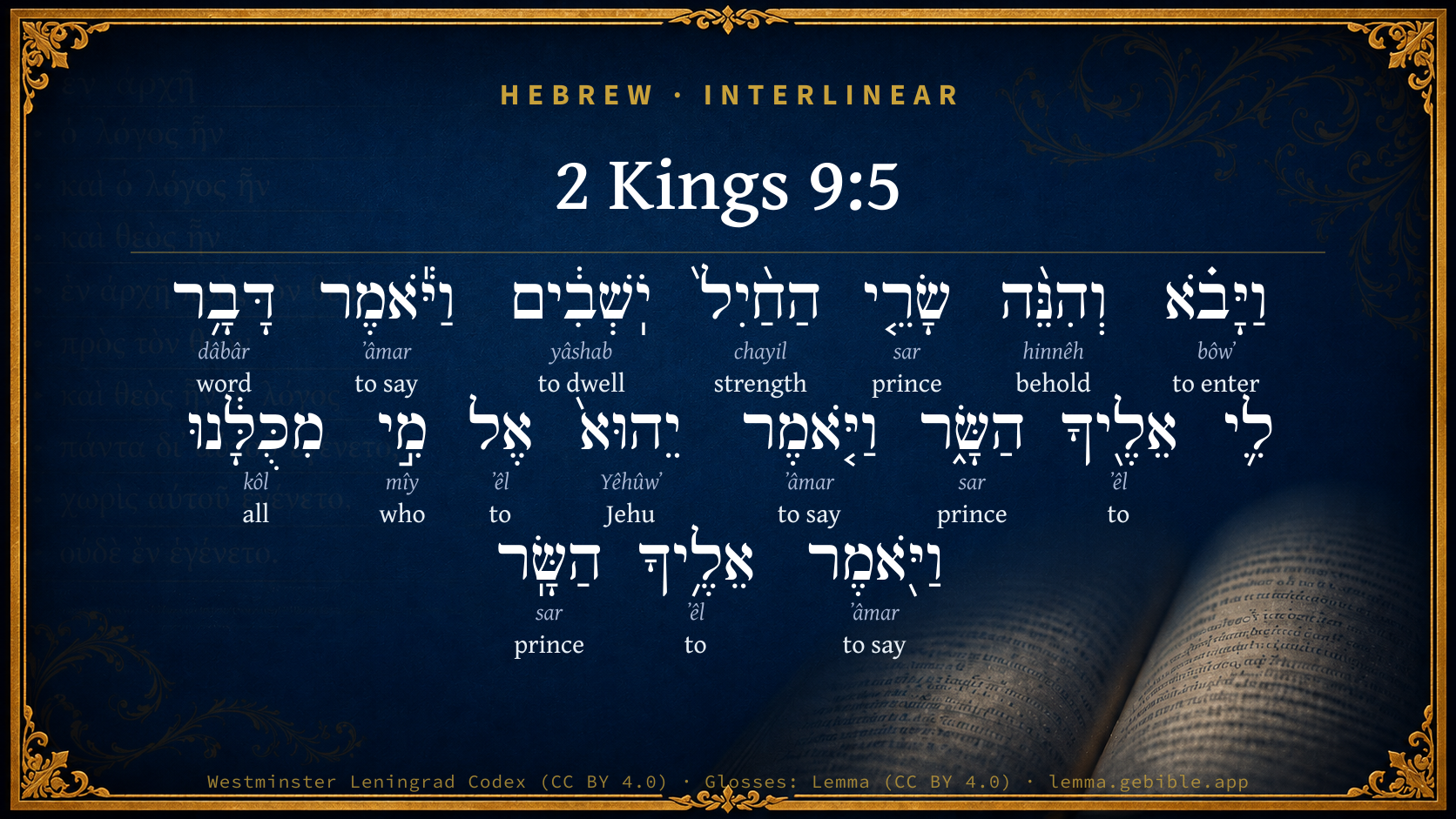
  1. וַיָּבֹ֗א bôwʼ H935 “and · to enter” Conjunction + Verb, Qal, Sequential Imperfect, 3rd Person, Masculine, Singular
  2. וְהִנֵּ֨ה hinnêh H2009 “and · behold” Conjunction + Particle, Demonstrative
  3. שָׂרֵ֤י sar H8269 “princes of” Noun, Common, Masculine, Plural, Construct
  4. הַחַ֨יִל֙ chayil H2428 “the · strength” Particle, Definite Article + Noun, Common, Masculine, Singular, Absolute
  5. יֹֽשְׁבִ֔ים yâshab H3427 “dwelling” Verb, Qal, Participle Active, Masculine, Plural, Absolute
  6. וַיֹּ֕אמֶר ʼâmar H559 “and · to say” Conjunction + Verb, Qal, Sequential Imperfect, 3rd Person, Masculine, Singular
  7. דָּבָ֥ר dâbâr H1697 “word” Noun, Common, Masculine, Singular, Absolute
  8. אֵלֶ֖יךָ ʼêl H413 “to · you” Preposition + Suffix, Personal, 2nd Person, Masculine, Singular
  9. הַשָּׂ֑ר sar H8269 “the · prince” Particle, Definite Article + Noun, Common, Masculine, Singular, Absolute
  10. וַיֹּ֤אמֶר ʼâmar H559 “and · to say” Conjunction + Verb, Qal, Sequential Imperfect, 3rd Person, Masculine, Singular
  11. אֶל ʼêl H413 “to” Preposition
  12. מִ֣י mîy H4310 “who” Particle, Interrogative
  13. מִכֻּלָּ֔נוּ kôl H3605 “from · all · our” Preposition + Noun, Common, Masculine, Singular, Construct + Suffix, Personal, 1st Person, Common, Plural
  14. וַיֹּ֖אמֶר ʼâmar H559 “and · to say” Conjunction + Verb, Qal, Sequential Imperfect, 3rd Person, Masculine, Singular
  15. אֵלֶ֥יךָ ʼêl H413 “to · you” Preposition + Suffix, Personal, 2nd Person, Masculine, Singular
  16. הַשָּֽׂר sar H8269 “the · prince” Particle, Definite Article + Noun, Common, Masculine, Singular, Absolute

About this verse

These counts appear in no published source. They are computed here, from the morphology-tagged text and Lemma’s own curated glosses. What Lemma adds →

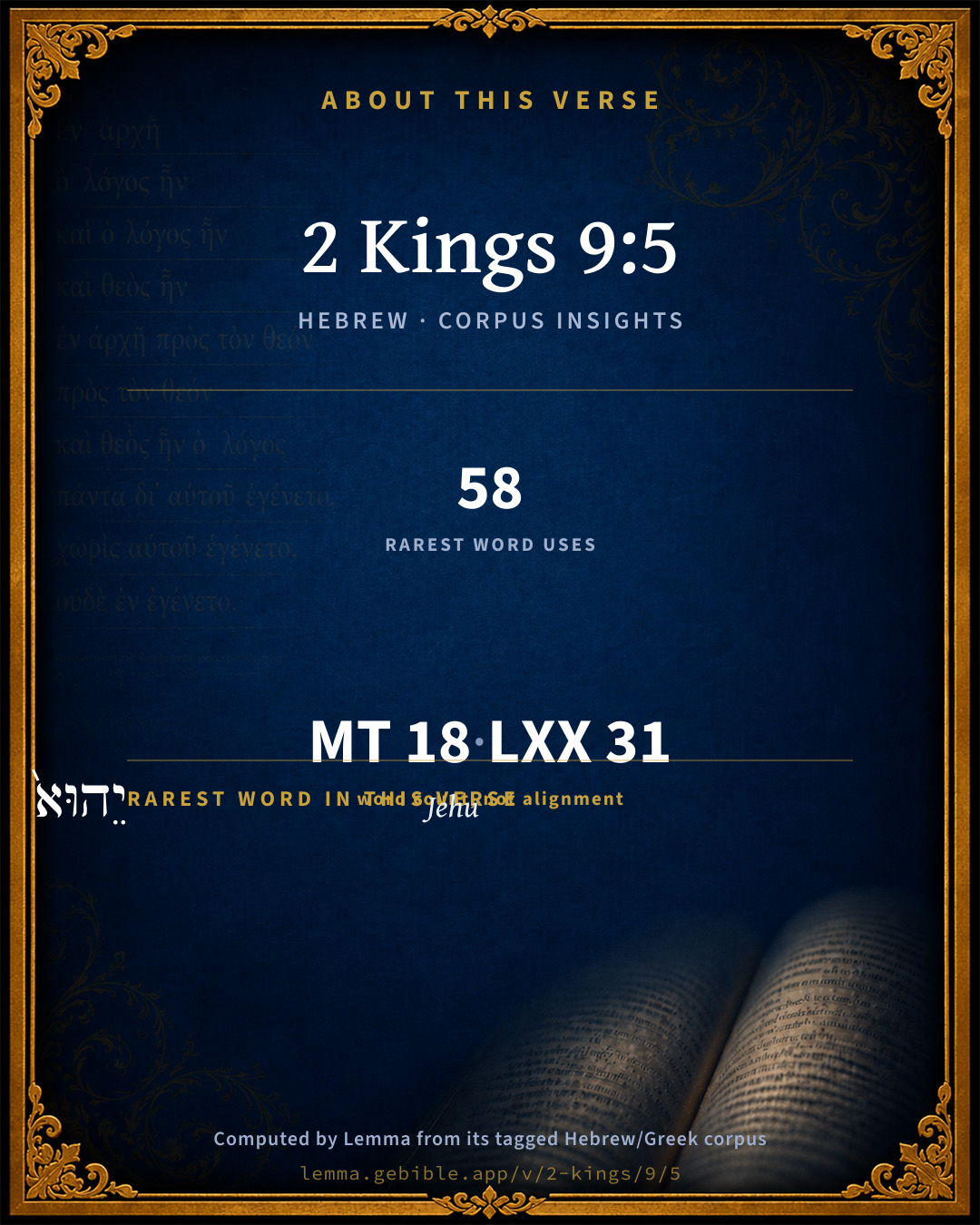
18
words
11
distinct lemmas
Historical
section

Shared distinctive vocabulary

יֵהוּא֙ Jehu H3058 occurs in 54 verses of the Hebrew Bible. Also found in:

Grammatical profile

  • 5 verbs
  • 7 nouns
  • 4 prepositions
  • 2 particles

Verb forms

  • וַיָּבֹ֗א Qal · Sequential Imperfect
  • יֹֽשְׁבִ֔ים Qal · Participle Active
  • וַיֹּ֕אמֶר Qal · Sequential Imperfect
  • וַיֹּ֤אמֶר Qal · Sequential Imperfect
  • וַיֹּ֖אמֶר Qal · Sequential Imperfect

Repetition

Words recur within this verse — often emphatic in Hebrew:

  • שָׂרֵ֤י prince H8269 ×3
  • וַיֹּ֕אמֶר to say H559 ×3
  • אֵלֶ֖יךָ to H413 ×3

Hebrew & Septuagint length

In English translation the verse runs 34 words from the Hebrew and 39 from the Septuagint (LXX English) — closely comparable.

A rough comparison of the two English renderings, which tokenize alike — not a word-level alignment.

Word counts can differ between the Hebrew and the Greek without any difference in meaning — e.g. the Hebrew direct-object marker אֵת has no separate Greek word, and Greek often adds the article ὁ.

In the original languages it is 18 Hebrew tokens and 31 Greek tokens — but the two are counted differently (Hebrew bundles its prefixes and suffixes into one token; the Greek is in lemma form), so that isn’t a like-for-like length.

Cross-references

1

Topical passages linked to 2 Kings 9:5 in the Treasury of Scripture Knowledge — connected by theme and wording, ordered by reader-vote popularity; previews shown in the World English Bible.

  • Judges 3:19 But he himself turned back from the quarries that were by Gilgal, and said, I have a secret errand to you, king. He said, Keep silence. All who stood by him went out from him.

Cross-references courtesy of OpenBible.info (CC BY 4.0).

Hebrew and Greek witnesses Masoretic Hebrew ↔ Greek Septuagint

The same verse in the two great witnesses to the Old Testament, shown verse-for-verse.

These are two independent witnesses, not word-aligned to each other, and the Septuagint is shown in lemma (dictionary) form.

Hebrew 2 Kings 9:5 Masoretic · Westminster Leningrad Codex

וַיָּבֹ֗א וְהִנֵּ֨ה שָׂרֵ֤י הַחַ֨יִל֙ יֹֽשְׁבִ֔ים וַיֹּ֕אמֶר דָּבָ֥ר לִ֛י אֵלֶ֖יךָ הַשָּׂ֑ר וַיֹּ֤אמֶר יֵהוּא֙ אֶל מִ֣י מִכֻּלָּ֔נוּ וַיֹּ֖אמֶר אֵלֶ֥יךָ הַשָּֽׂר

When he came, behold, the captains of the host were sitting; and he said, I have an errand to you, captain. Jehu said, To which of us all? He said, To you, O captain.

World English Bible · Public Domain

Greek LXX 2 Kings 9:5 Septuagint · lemma form

καί εἰςἔρχομαι καί ἰδού ὁ ἄρχων ὁ δύναμις καταἧμαι καί εἶπον λόγος ἐγώ πρός σύ ὁ ἄρχω καί εἶπον ιου πρός τίς ἐκ πᾶς ἐγώ καί εἶπον πρός σύ ὁ ἄρχω

And he went in, and, behold, the captains of the host were sitting; and he said, I have a message to you, O captain. And Ju said, To which of all us? And he said, To you, O captain.

LXX2012 (modern English Septuagint) · Public Domain

Hebrew: Westminster Leningrad Codex (CC BY 4.0). Greek: Septuagint (public domain); English from LXX2012 (modern English Septuagint) (Public Domain). How the Septuagint differs from the Hebrew →

Targum (Aramaic paraphrase)

1

The Targum is the ancient Jewish Aramaic paraphrase of the Hebrew Scriptures — an interpretive translation, not the Hebrew text itself. Onkelos (literal) and Pseudo-Jonathan (expansive) render the Torah, and Jonathan the Prophets. Coverage is partial: where no permissively-licensed English translation exists for a verse, only the Aramaic is shown. This is verse-level text, not a word-by-word alignment to the Hebrew.

  1. Targum Jonathan Prophets (Joshua–Malachi)
    וַאֲתָא וְהָא רַבָּנֵי חֵילָא יַתְבִין וַאֲמַר פִּתְגַם אִית לִי לְמַלָלָא עִמָךְ רַבָּא וַאֲמַר יֵהוּא לְמַן מִכּוּלָנָא וַאֲמַר עִמָךְ רַבָּא:

    (no public-domain English translation for this verse)

    Targum Jonathan — Aramaic: “Mikraot Gedolot” (public domain). English: “Sefaria Community Translation” (CC0 1.0 (public-domain dedication)); “London "Chaldee Paraphrase," 1871” (public domain). Text via Sefaria.

Commentary

Notes on 2 Kings 9:5 from classic Christian and Jewish commentators (each source and its license shown beneath its notes). The classic Christian expositions comment on the surrounding passage and are grouped to its opening verse, so a note may address several verses; the Jewish commentaries on the Tanakh (Rashi and others) are per-verse, so they appear only where the commentator wrote on this verse.

Lemma curates 59 commentaries, every one of them public domain or Creative Commons licensed, each selected and text-cleaned for this edition rather than reprinted as found. About our sources →

Trapp's Complete Commentary

John Trapp

2Ki 9:5 And when he came, behold, the captains of the host [were] sitting; and he said, I have an errand to thee, O captain. And Jehu said, Unto which of all us? And he said, To thee, O captain.

Ver. 5. To thee, O captain.] Jehu was captain general of all Jehoram’s forces, and so had the fairer opportunity of taking the kingdom.

John Trapp, A Commentary or Exposition upon All the Books of the Old and New Testament (1647–1656) — public domain. Text from a community e-Sword module.

Joseph Benson's Commentary

2Ki 9:5. Jehu said, Unto which of us all? — It does not appear that Jehu aimed at the government, or that he ever thought of it, but the commission given him was a perfect surprise to him. Some indeed think he had been anointed before by Elijah, but privately, and with an intimation that he must not act till he received further orders, as Samuel anointed David long before he was to come to the throne. But this is not at all probable.

Joseph Benson's Commentary on the Old and New Testaments (1811–1818) — public domain. Text from a community e-Sword module.

Ellicott's Commentary for English Readers

(5) And when he came, behold.—Rather, And he went in, and behold. He went into Jehu’s headquarters.

The captains of the host were sitting.—In council with Jehu.

A Bible Commentary for English Readers, edited by Charles John Ellicott (1878–1897) — public domain. Text from a community e-Sword module.

The Cambridge Bible for Schools and Colleges

gen. ed. J. J. S. Perowne

5. the captains of the host were sitting] Perhaps discussing some matter connected with the defence of the city. Jehu is the one who speaks to the new-comer. We may take it that he was the moving spirit in the war-council, and hence had gained a popularity beyond that of king Joram.

The Cambridge Bible for Schools and Colleges (gen. ed. J. J. S. Perowne; Cambridge University Press, 1878–1918) — public domain. Text from a community e-Sword module.

John Gill's Exposition

And he arose, and went into the house,.... Into the inner chamber in it:

and he poured the oil on his head, and said unto him, thus saith the Lord God of Israel, I have anointed thee king over the people of the Lord, even over Israel; for though they were fallen into idolatry, and from the pure worship of God, yet the Lord had still a right unto them, and as yet he had not wrote a "Loammi" Hos 1:9 upon them; and there were many among them which had not bowed the knee to Baal.

John Gill's Exposition of the Whole Bible (1746–1763) — public domain (CC PDM 1.0). Text via the HelloAO Bible API.

Albert Barnes' Notes on the Bible

The chief officers - the generals - were assembled together in Jehu’s quarters, perhaps holding a council of war. The place of assembly seems to have been the great court. Hence, Jehu “went into the house” 2Ki 9:6 entered, that is, one of the rooms opening into the court.

Albert Barnes' Notes on the Bible (1834–1885) — public domain. Text from a community e-Sword/MySword module.

The Pulpit Commentary

And when he came, behold, the captains of the host were sitting either "sitting in council," or, at any rate, collected together in one place, not engaged in any active work, but seatedand he said, I have an errand literally, a wordto thee, O captain. Probably he knew Jehu by sight, and looked at him as he spoke; but, as he addressed no one by name, there might be a doubt who was intended. Jehu, therefore, causes the doubt to be resolved by his question. And Jehu said, Unto which of all us? And he saidi.e. , the young man the prophet answeredTo thee, O captain. Jehu was thus singled out as the object of the message the person to whom alone it was addressed, and whose special attention was, consequently, required to it.

The Pulpit Commentary (1880–1919), ed. H.D.M. Spence-Jones & Joseph S. Exell — public domain. Text from a community e-Sword module.

Lesson kit

Teaching starters — assembled from the data on this page, not authored interpretation. Every prompt links to the verse data it draws on. Edit before teaching.

2 Kings, in the Historical, opens this verse with 18 words (11 distinct Hebrew lemmas). Its most distinctive word is Yêhûwʼ (“Jehu”). A historical commentator’s framing appears above. Read the whole chapter for the surrounding context.

Discussion questions

  1. The word Yêhûwʼ carries the sense “Jehu.” How does it shape the verse?
  2. 1 Kings 16:1 shares the word «Jehu» with this verse. How do the two illuminate each other?
  3. “prince” occurs 3× in this one verse. What is the effect of the repetition?
  4. These translations render this verse differently. What is at stake in choosing one wording over another?
  5. The verb «וַיָּבֹ֗א» is Qal Sequential Imperfect. How does its form color the action?
  6. Reading how Trapp's Complete Commentary and Joseph Benson's Commentary read this verse, where do the two commentators agree and where do they part?

Things to notice

Reading settings

Reading text

Shown beneath each verse's original-language words.

Old Testament
Old Testament edition

Read the OT as the Masoretic Hebrew (MT) or the Greek Septuagint (LXX).

English shown for the Greek Septuagint (in the Hebrew ↔ Greek comparison).

Comparing translations? Open the Compare panel on any verse page to stack up to four side by side.