
1 Chronicles 7:40

Hebrew (Westminster Leningrad Codex) 1 Chronicles 7:40 appears in the Hebrew Old Testament. The text above is from the Westminster Leningrad Codex. Each word links to its Strong’s number, a concise gloss, and parsing drawn from the Open Scriptures Hebrew Bible morphology. Click any word for its full Brown-Driver-Briggs (BDB) entry.
Download image
Cite this verse

1 Chronicles 7:40 (World English Bible). Public Domain. Lemma interlinear Bible study tool, https://lemma.gebible.app/v/1-chronicles/7/40.

Show BibTeX & RIS
BibTeX
RIS
English Translation
All these were the children of Asher, heads of the fathers' houses, choice and mighty men of valor, chief of the princes. The number of them reckoned by genealogy for service in war was twenty-six thousand men.
World English Bible · Public Domain
Download a study sheet

One document with this verse’s original text, its word-by-word gloss line, the meaning frame, cross-references with their text, attributed commentary, and full source and license credits — printable, and it pastes into notes with its structure intact.

This verse Autodidact and up

Study sheet (.html) Plain text (.txt)

A passage Seminary Student

Up to 50 verses in one chapter. A passage sheet keeps up to 6 commentary sources and 12 cross-references per verse, in the order this page ranks them, and says so on the sheet whenever that leaves anything out. Ask for a single verse and you get the Autodidact verse sheet above.

Everything on this page stays free to read, with no account — the sheet is a download of what is already on screen, not access to it.

Want to remove ads? Support Godless Engineer
Compare translations 3

The same verse in 3 English versions, stacked beneath the original-language interlinear above. Click any original word for its lexicon entry.

Each is an independent rendering of the whole verse — the interlinear is not word-aligned to these translations.

Highlighted words mark where these versions differ — a whole-verse word diff, not a word-by-word alignment.

  • World English Bible Public Domain
    All these were the children of Asher, heads of the fathers' houses, choice and mighty men of valor, chief of the princes. The number of them reckoned by genealogy for service in war was twenty-six thousand men.
  • King James Version Public Domain
    All these were the children of Asher, heads of their father's house, choice and mighty men of valor, chief of the princes. And the number throughout the genealogy of them that were apt to the war and to battle was twenty and six thousand men.
  • unfoldingWord Literal Text CC BY-SA 4.0
    All of these sons of Asher, heads of the house of their fathers, chosen, warriors of valors, heads of chiefs, enrolled in the army for battle. Their number 26,000 men.

unfoldingWord Literal Text — © unfoldingWord, licensed CC BY-SA 4.0. Word-aligned USFM3 via Door43 (git.door43.org/unfoldingWord/en_ult).

Versions to compare (up to 4)

3 of 4 selected

Show all 18 translations

Every available English version of this verse, each an independent rendering of the whole verse.

  • World English Bible Public Domain
    All these were the children of Asher, heads of the fathers' houses, choice and mighty men of valor, chief of the princes. The number of them reckoned by genealogy for service in war was twenty-six thousand men.
  • Berean Standard Bible Public Domain
    All these were the descendants of Asher—heads of their families, choice and mighty men of valor, and chiefs among the leaders. The number of men fit for battle, recorded in their genealogies, was 26,000.
  • Majority Standard Bible Public Domain
    All these were the descendants of Asher—heads of their families, choice and mighty men of valor, and chiefs among the leaders. The number of men fit for battle, recorded in their genealogies, was 26,000.
  • King James Version Public Domain
    All these were the children of Asher, heads of their father's house, choice and mighty men of valor, chief of the princes. And the number throughout the genealogy of them that were apt to the war and to battle was twenty and six thousand men.
  • American Standard Version (1901) Public Domain
    All these were the children of Asher, heads of the fathers' houses, choice and mighty men of valor, chief of the princes. And the number of them reckoned by genealogy for service in war was twenty and six thousand men.
  • Revised Version (1885) Public Domain
    All these were the children of Asher, heads of the fathers’ houses, choice and mighty men of valour, chief of the princes. And the number of them reckoned by genealogy for service in war was twenty and six thousand men.
  • Geneva Bible (1599) Public Domain
    All these were the children of Asher, the heads of their fathers houses, noble men, valiant men of warre and chiefe princes, and they were rekoned by their genealogies for warre and for battell to the nomber of sixe and twentie thousand men.
  • Douay-Rheims (1899) Public Domain
    All these were sons of Aser, heads of their families, choice and most valiant captains of captains: and the number of them that were of the age that was fit for war, was six and twenty thousand.
  • Young's Literal Translation Public Domain
    All these `are' sons of Asher, heads of the house of the fathers, chosen ones, mighty in valour, heads of the princes, with their genealogy, for the host, for battle, their number `is' twenty and six thousand men.
  • Literal Standard Version CC BY-SA 4.0
    All these [are] sons of Asher, heads of the house of the fathers, chosen ones, mighty in valor, heads of the princes, with their genealogy, for the host, for battle, their number [is] twenty-six thousand men.
  • Unlocked Literal Bible CC BY-SA 4.0
    All these were descendants of Asher. They were ancestors of the clans, heads of fathers' houses, distinguished men, fighting men, and chief among the leaders. There were twenty-six thousand men listed who were fit for military service, according to their numbered lists.
  • unfoldingWord Literal Text CC BY-SA 4.0
    All of these sons of Asher, heads of the house of their fathers, chosen, warriors of valors, heads of chiefs, enrolled in the army for battle. Their number 26,000 men.
  • Darby Bible Public Domain
    All these were the sons of Asher, heads of fathers' houses, choice men, mighty of valour, chiefs of the princes. And their number according to their genealogy, registered as fit for service for war, was twenty-six thousand men.
  • World Messianic Bible Public Domain
    All these were the children of Asher, heads of the fathers’ houses, choice and mighty men of valor, chief of the princes. The number of them listed by genealogy for service in war was twenty-six thousand men.
  • Webster's Bible Public Domain
    All these were the children of Asher, heads of their father's house, choice and mighty men of valor, chief of the princes. And the number throughout the genealogy of them that were fit for war and for battle was twenty and six thousand men.
  • Free Bible Version CC BY-SA 4.0
    These were all descendants of Asher—family heads, proven men, strong warriors, and great leaders. According to their genealogy, they had 26,000 battle-ready warriors.
  • Bible in Basic English Public Domain
    All these were the children of Asher, heads of their families, specially strong men of war, chiefs of the rulers. They were recorded in the army for war, twenty-six thousand men in number.
  • JPS Tanakh (1917) Public Domain
    All these were the children of Asher, heads of the fathers' houses, choice and mighty men of valour, chief of the princes. And the number of them reckoned by genealogy for service in war was twenty and six thousand men.

Literal Standard Version (2020), Covenant Press — licensed CC BY-SA 4.0. Text via the HelloAO Bible API (eBible.org). Unlocked Literal Bible (unfoldingWord) — licensed CC BY-SA 4.0. Text via the HelloAO Bible API (eBible.org). unfoldingWord Literal Text — © unfoldingWord, licensed CC BY-SA 4.0. Word-aligned USFM3 via Door43 (git.door43.org/unfoldingWord/en_ult). Free Bible Version, Dr. Jonathan Gallagher — licensed CC BY-SA 4.0. Text via the HelloAO Bible API (eBible.org).

Word by word

More ways to search: Search by grammar → Find every occurrence → Compare this word →

Practice this passage: Drill this verse → Learn its vocabulary →

בְּרוּרִים֙
bârar
H1305
“purified”
Verb, Qal, Participle Passive, Masculine, Plural, Absolute
Part of Speech
Verb
Stem
Qal
Form
Participle Passive
Gender
Masculine
Number
Plural
State
Absolute
Full BDB Definition

Origin: a primitive root

TWOT: 288

to purify, select, polish, choose, purge, cleanse or make bright, test or prove - (Qal) - to purge, purge out, purify - to choose, select - to cleanse, make shining, polish - to test, prove - (Niphal) to purify oneself - (Piel) to purify - (Hiphil) - to purify - to polish arrows - (Hithpael) - to purify oneself - to show oneself pure, just, kind
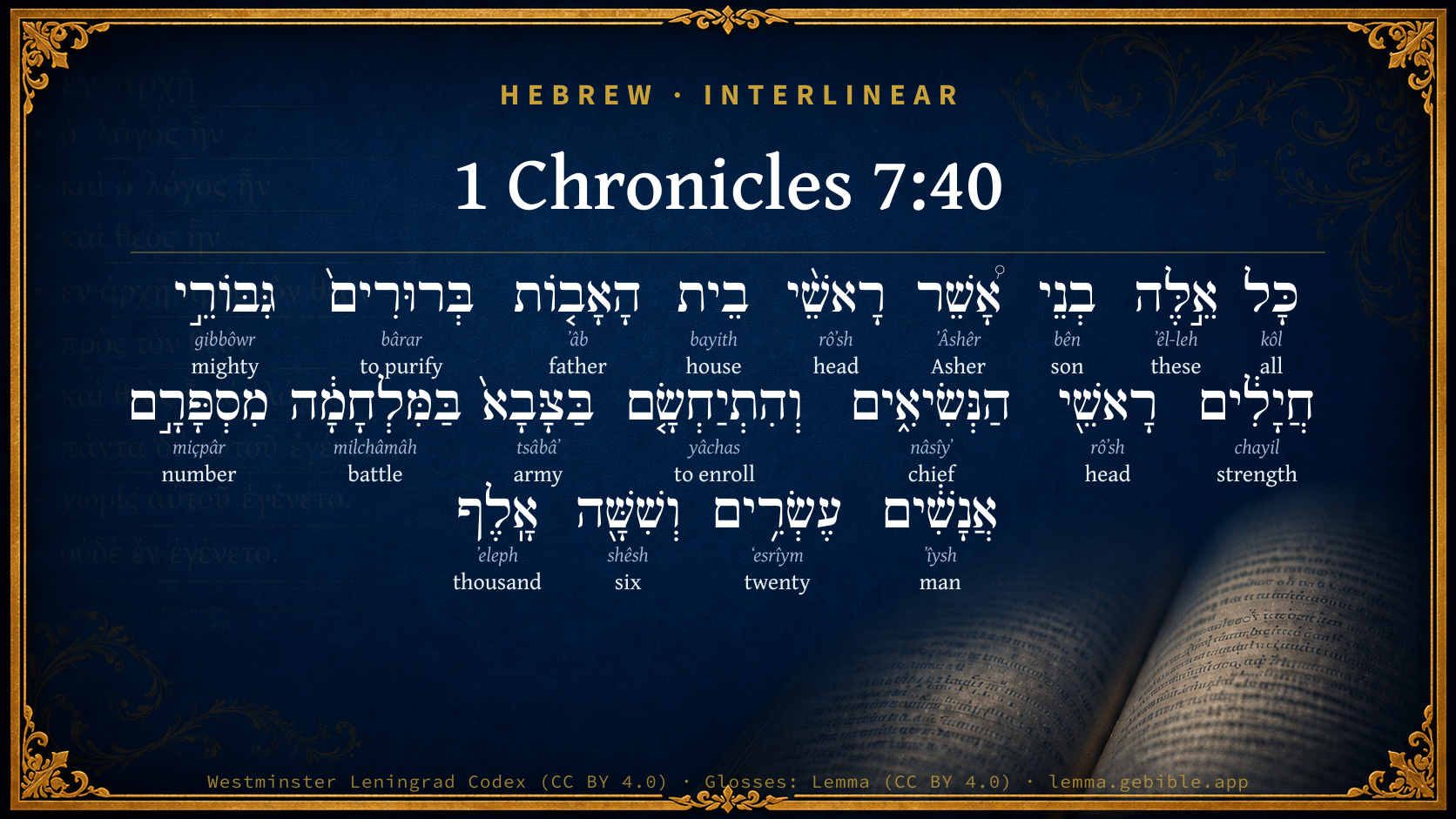
  1. כָּל kôl H3605 “all of” Noun, Common, Masculine, Singular, Construct
  2. אֵ֣לֶּה ʼêl-leh H428 “these” Pronoun, Demonstrative, Common, Plural
  3. בְנֵי bên H1121 “sons of” Noun, Common, Masculine, Plural, Construct
  4. אָ֠שֵׁר ʼÂshêr H836 “Asher” Noun, Proper
  5. רָאשֵׁ֨י rôʼsh H7218 “heads of” Noun, Common, Masculine, Plural, Construct
  6. בֵית bayith H1004 “house of” Noun, Common, Masculine, Singular, Construct
  7. הָאָב֤וֹת ʼâb H1 “the · fathers” Particle, Definite Article + Noun, Common, Masculine, Plural, Absolute
  8. גִּבּוֹרֵ֣י gibbôwr H1368 “mighty of” Adjective, Adjective, Masculine, Plural, Construct
  9. חֲיָלִ֔ים chayil H2428 “forces” Noun, Common, Masculine, Plural, Absolute
  10. רָאשֵׁ֖י rôʼsh H7218 “heads of” Noun, Common, Masculine, Plural, Construct
  11. הַנְּשִׂיאִ֑ים nâsîyʼ H5387 “the · chiefs” Particle, Definite Article + Noun, Common, Masculine, Plural, Absolute
  12. וְהִתְיַחְשָׂ֤ם yâchas H3187 “and · to enroll · them” Conjunction + Verb, Hithpael, Infinitive Construct + Suffix, Personal, 3rd Person, Masculine, Plural
  13. בַּצָּבָא֙ tsâbâʼ H6635 “in/at the · army” Preposition, Determined + Noun, Common, Both, Singular, Absolute
  14. בַּמִּלְחָמָ֔ה milchâmâh H4421 “in/at the · battle” Preposition, Determined + Noun, Common, Feminine, Singular, Absolute
  15. מִסְפָּרָ֣ם miçpâr H4557 “number · their” Noun, Common, Masculine, Singular, Construct + Suffix, Personal, 3rd Person, Masculine, Plural
  16. אֲנָשִׁ֔ים ʼîysh H376 “men” Noun, Common, Masculine, Plural, Absolute
  17. עֶשְׂרִ֥ים ʻesrîym H6242 “twenty” Adjective, Cardinal number, Both, Plural, Absolute
  18. וְשִׁשָּׁ֖ה shêsh H8337 “and · six” Conjunction + Adjective, Cardinal number, Masculine, Singular, Absolute
  19. אָֽלֶף ʼeleph H505 “thousand” Adjective, Cardinal number, Both, Singular, Absolute

About this verse

These counts appear in no published source. They are computed here, from the morphology-tagged text and Lemma’s own curated glosses. What Lemma adds →

20
words
19
distinct lemmas
Historical
section

Notable vocabulary

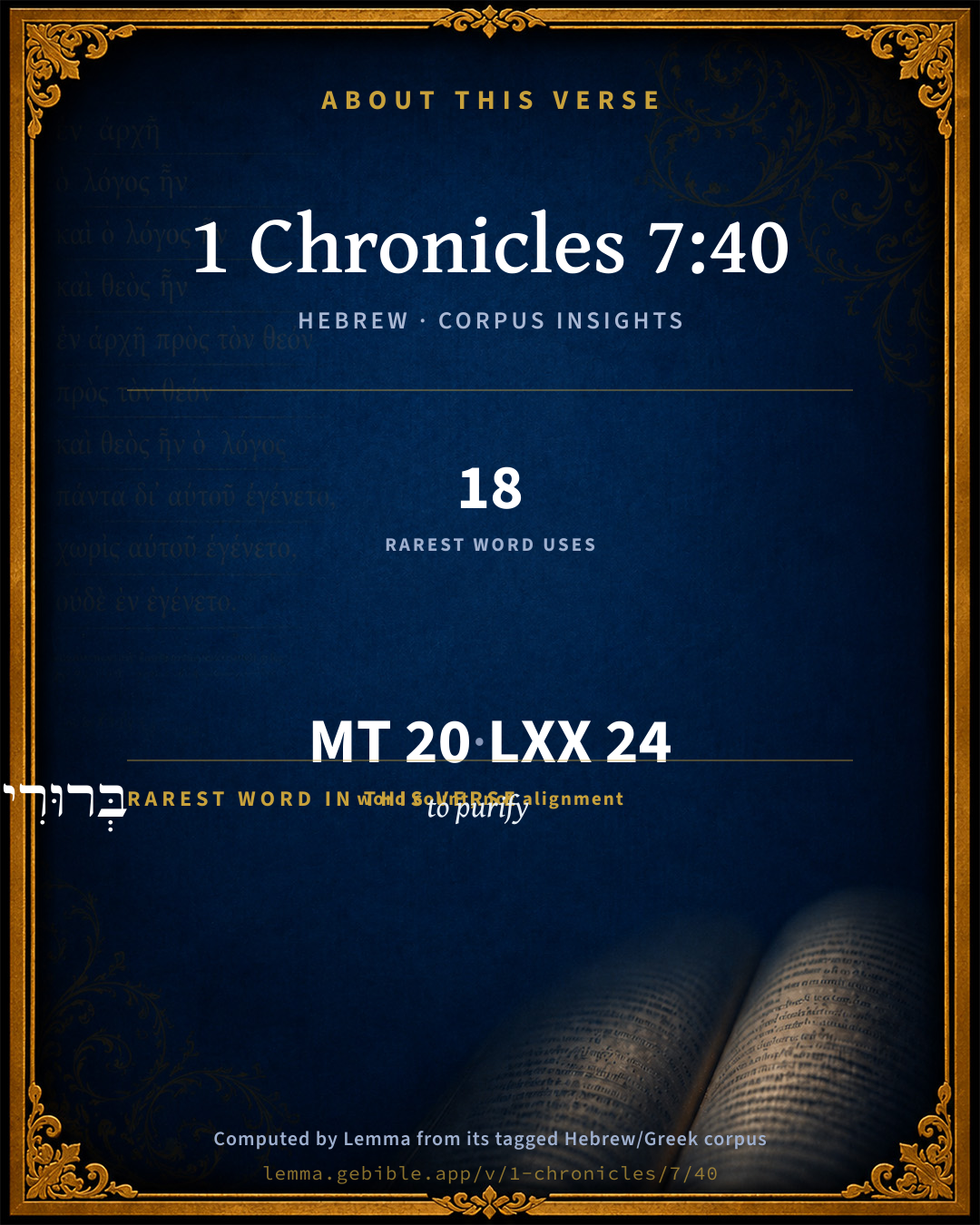
The rarest word here is בְּרוּרִים֙ to purify H1305 — appearing just 18 times in the whole Hebrew Bible.

Shared distinctive vocabulary

בְּרוּרִים֙ to purify H1305 occurs in 16 verses of the Hebrew Bible. Also found in:

Grammatical profile

  • 2 verbs
  • 13 nouns
  • 4 adjectives
  • 1 pronoun

Verb forms

  • בְּרוּרִים֙ Qal · Participle Passive
  • וְהִתְיַחְשָׂ֤ם Hithpael · Infinitive Construct

Repetition

A word recurs within this verse — often emphatic in Hebrew:

  • רָאשֵׁ֨י head H7218 ×2

Hebrew & Septuagint length

In English translation the verse runs 37 words from the Hebrew and 26 from the Septuagint (LXX English) — the Septuagint runs noticeably shorter here. See the side-by-side →

A rough comparison of the two English renderings, which tokenize alike — not a word-level alignment.

Word counts can differ between the Hebrew and the Greek without any difference in meaning — e.g. the Hebrew direct-object marker אֵת has no separate Greek word, and Greek often adds the article ὁ.

In the original languages it is 20 Hebrew tokens and 24 Greek tokens — but the two are counted differently (Hebrew bundles its prefixes and suffixes into one token; the Greek is in lemma form), so that isn’t a like-for-like length.

Cross-references

2

Topical passages linked to 1 Chronicles 7:40 in the Treasury of Scripture Knowledge — connected by theme and wording, ordered by reader-vote popularity; previews shown in the World English Bible.

  • 2 Samuel 24:1–9 Again the anger of Yahweh was kindled against Israel, and he moved David against them, saying, Go, number Israel and Judah.
  • 1 Chronicles 21:1–5 Satan stood up against Israel, and moved David to number Israel.

Cross-references courtesy of OpenBible.info (CC BY 4.0).

Hebrew and Greek witnesses Masoretic Hebrew ↔ Greek Septuagint

The same verse in the two great witnesses to the Old Testament, shown verse-for-verse.

Here the Septuagint runs noticeably shorter than the Hebrew — LXX2012 (modern English Septuagint) 26 words vs World English Bible 37. A rough length comparison of the two English translations, not a word-level alignment — read both below.

These are two independent witnesses, not word-aligned to each other, and the Septuagint is shown in lemma (dictionary) form.

Hebrew 1 Chronicles 7:40 Masoretic · Westminster Leningrad Codex

כָּל אֵ֣לֶּה בְנֵי אָ֠שֵׁר רָאשֵׁ֨י בֵית הָאָב֤וֹת בְּרוּרִים֙ גִּבּוֹרֵ֣י חֲיָלִ֔ים רָאשֵׁ֖י הַנְּשִׂיאִ֑ים וְהִתְיַחְשָׂ֤ם בַּצָּבָא֙ בַּמִּלְחָמָ֔ה מִסְפָּרָ֣ם אֲנָשִׁ֔ים עֶשְׂרִ֥ים וְשִׁשָּׁ֖ה אָֽלֶף

All these were the children of Asher, heads of the fathers' houses, choice and mighty men of valor, chief of the princes. The number of them reckoned by genealogy for service in war was twenty-six thousand men.

World English Bible · Public Domain

Greek LXX 1 Chronicles 7:40 Septuagint · lemma form

πᾶς οὗτος υἱός ασηρ πᾶς ἄρχων πατριά ἐκλεκτός ἰσχυρός δύναμις ἄρχων ἡγέομαι ἀριθμός αὐτός εἰς παράταξις ὁ πολεμέω ἀριθμός αὐτός ἀνήρ εἴκοσι ἕξ χιλιάς

All these were the sons of Aser, all heads of families, choice, mighty men, chief leaders: their number for battle array—their number was twenty-six thousand men.

LXX2012 (modern English Septuagint) · Public Domain

Hebrew: Westminster Leningrad Codex (CC BY 4.0). Greek: Septuagint (public domain); English from LXX2012 (modern English Septuagint) (Public Domain). How the Septuagint differs from the Hebrew →

Commentary

Notes on 1 Chronicles 7:40 from classic Christian and Jewish commentators (each source and its license shown beneath its notes). The classic Christian expositions comment on the surrounding passage and are grouped to its opening verse, so a note may address several verses; the Jewish commentaries on the Tanakh (Rashi and others) are per-verse, so they appear only where the commentator wrote on this verse.

Lemma curates 59 commentaries, every one of them public domain or Creative Commons licensed, each selected and text-cleaned for this edition rather than reprinted as found. About our sources →

Trapp's Complete Commentary

John Trapp

1Ch 7:40 All these [were] the children of Asher, heads of [their] father’s house, choice [and] mighty men of valour, chief of the princes. And the number throughout the genealogy of them that were apt to the war [and] to battle [was] twenty and six thousand men.

Ver. 40. Chief of the princes.] Duces ducum, to whom the princes were to give an account. See Dan 6:1-2.

Was twenty and six thousand.] So happy was Asher, according to Moses’s blessing left with him. {Deu 33:24-25}

John Trapp, A Commentary or Exposition upon All the Books of the Old and New Testament (1647–1656) — public domain. Text from a community e-Sword module.

Adam Clarke's Commentary

Verse 40. The children of Asher] The rabbins say that the daughters of Asher were very beautiful, and were all matched with kings or priests. Several things relative to the subjects in this chapter may be found explained in the parallel places marked in the margin.

Adam Clarke's Commentary on the Bible (1810–1826) — public domain. Text from a community e-Sword/MySword module.

Ellicott's Commentary for English Readers

(40) The summing up of the list. “All these were sons of Asher, picked chiefs of the father-houses, valiant warriors, chiefs of the princes.” This declares that the names in the foregoing series are those of the chiefs of the different Asherite clans. They are called “choice,” picked men, eximii, and chiefs of the princes or emirs. The clans appear to be identified with their chieftains.

And the number throughout the genealogy.—Better, and their census, in the host, in the battle—their number in men was 26,000.” Perhaps we should render in the case of service in war. The census here given has reference only to the number of males qualified for military service. In the Mosaic census (Num_1:41) the total of males of the tribe of Asher was 41,500; and a generation later, the fighting men were 53,000 (Num_26:47). The date of the present census is not assigned. If it be that of David, which appears likely, the tribe may have declined in numbers and importance by his day. (Comp. Jdg_5:17. “Asher continued at the sea-shore, and abode on his creeks;” i.e., did not bestir himself for the war).

A Bible Commentary for English Readers, edited by Charles John Ellicott (1878–1897) — public domain. Text from a community e-Sword module.

The Cambridge Bible for Schools and Colleges

gen. ed. J. J. S. Perowne

40. of their fathers’ house] R.V. of the fathers’ houses.

the number … to battle was] R.V. the number of them reckoned by genealogy for service in war was, etc.

twenty and six thousand] In 1Ch_12:36 the men of war of Asher are reckoned at forty thousand (cp. Num_1:41; Num_26:47, where still higher reckonings are given). The numbers here and in 1Ch_7:5; 1Ch_7:7; 1Ch_7:9; 1Ch_7:11 (as well as in 1Ch_7:2, which see) seem to refer to the time of David. The numbers may be based on family traditions, but it would be unsafe to draw any important conclusions from them.

The Cambridge Bible for Schools and Colleges (gen. ed. J. J. S. Perowne; Cambridge University Press, 1878–1918) — public domain. Text from a community e-Sword module.

Haydock's Catholic Bible Commentary

Of captains; a Hebrew idiom, to denote the most excellent. (Haydock) --- Hebrew, "chief of the princes." All mentioned from ver. 30, were at the hand of their tribe, in succession, and led their brethren to battle. (Calmet)

George Leo Haydock (1774–1849), Haydock's Catholic Family Bible and Commentary, 1859 edition — public domain. Excludes Psalms (Douay-Rheims chapter numbering differs from Protestant) and Deuterocanonical books (Catholic canon only).

The Pulpit Commentary

Twenty and six thousand. The number of Asherites, "of twenty years old and upwards, able to go forth to war," given in Num_1:40, Num_1:41, was forty-one thousand five hundred. Forty years Num_26:44-47; comp. ver. 2) the number was fifty-three thousand four hundred. But it is supposed that the twenty-six thousand of this verse may refer only to a portion of the tribe, i.e. to the large and distinguished family of Heber. It is to be noticed that the name of the tribe of Asher is not found in the list of the "chief rulers" lower down in this. (1Ch_27:16-22) The tone also in which reference is made to Asher and Manasseh and Zebulun coming to Jerusalem to Hezekiah"s Passover (2Ch_30:11) is very noticeable. This tribe, with Simeon, gave no judge to the nation, and of all the tribes west of the Jordan they stand by themselves in this respect. There is an ancient legend that the parents of St. Paul lived within the territories of Asher, at the place called Ahlab in Jud 1:31, otherwise Giscala, or Gush Chaleb. Against the uncertainty of the legend we may gratefully remember the certainty of the history of the "Anna, daughter of Phanuel, of the tribe of. (Luk_2:36)

The Pulpit Commentary (1880–1919), ed. H.D.M. Spence-Jones & Joseph S. Exell — public domain. Text from a community e-Sword module.

Lesson kit

Teaching starters — assembled from the data on this page, not authored interpretation. Every prompt links to the verse data it draws on. Edit before teaching.

1 Chronicles, in the Historical, opens this verse with 20 words (19 distinct Hebrew lemmas). Its most distinctive word is bârar (“to purify”). The Greek Septuagint runs shorter here. A historical commentator’s framing appears above. Read the whole chapter for the surrounding context.

Discussion questions

  1. How does “to purify” (bârar) shape what this verse is saying?
  2. 2 Samuel 22:27 shares the word «to purify» with this verse. How do the two illuminate each other?
  3. “head” occurs 2× in this one verse. What is the effect of the repetition?
  4. Compared with the Hebrew, the Septuagint runs shorter here. What questions does that raise?
  5. These translations render this verse differently. What is at stake in choosing one wording over another?
  6. The verb «בְּרוּרִים֙» is Qal Participle Passive. How does its form color the action?
  7. Reading how Trapp's Complete Commentary and Adam Clarke's Commentary read this verse, where do the two commentators agree and where do they part?

Things to notice

Reading settings

Reading text

Shown beneath each verse's original-language words.

Old Testament
Old Testament edition

Read the OT as the Masoretic Hebrew (MT) or the Greek Septuagint (LXX).

English shown for the Greek Septuagint (in the Hebrew ↔ Greek comparison).

Comparing translations? Open the Compare panel on any verse page to stack up to four side by side.