Jeremiah 42:8

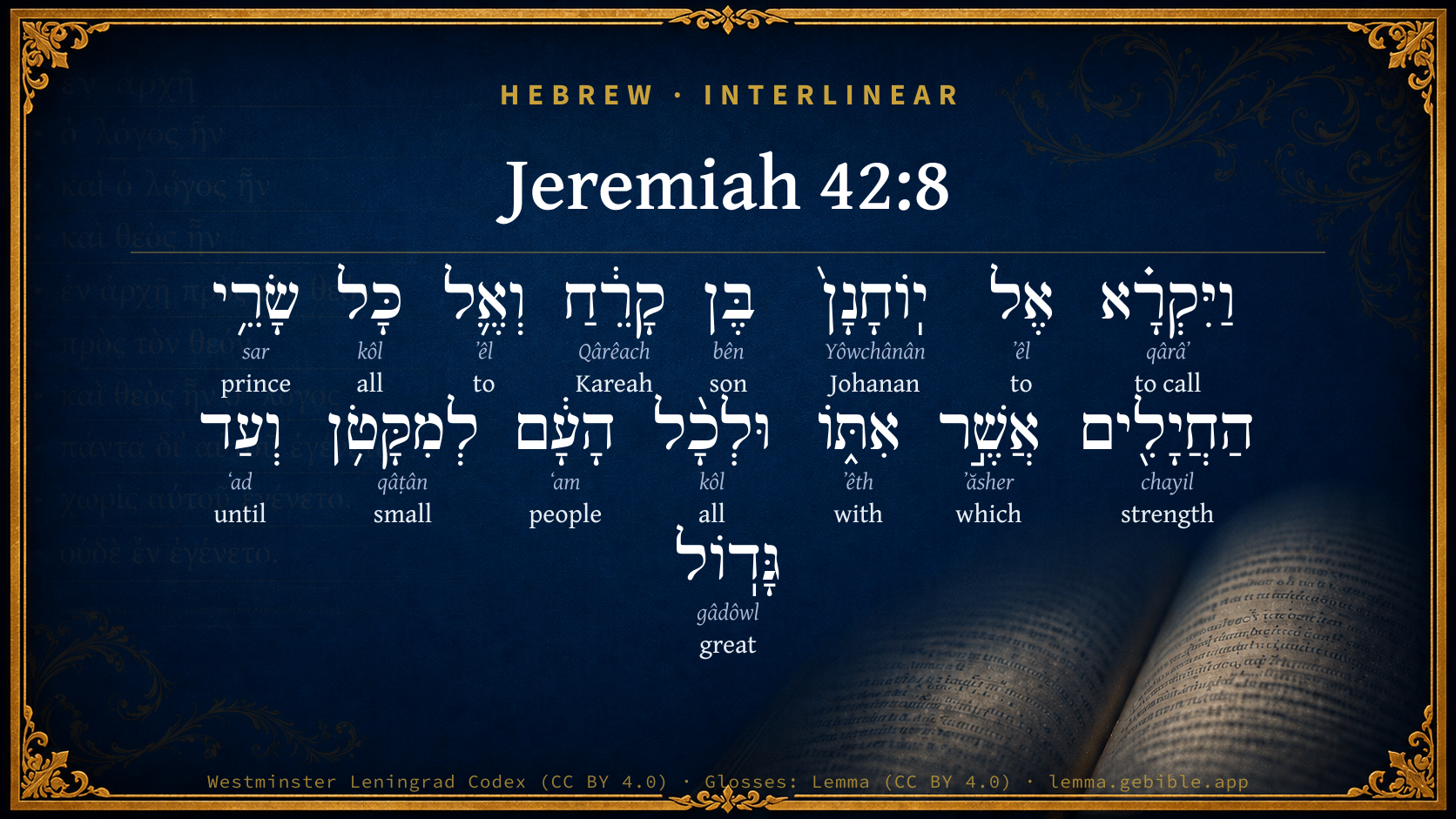
Hebrew (Westminster Leningrad Codex) Jeremiah 42:8 appears in the Hebrew Old Testament. The text above is from the Westminster Leningrad Codex. Each word links to its Strong’s number, a concise gloss, and parsing drawn from the Open Scriptures Hebrew Bible morphology. Click any word for its full Brown-Driver-Briggs (BDB) entry.
Download image
Cite this verse

Jeremiah 42:8 (World English Bible). Public Domain. Lemma interlinear Bible study tool, https://lemma.gebible.app/v/jeremiah/42/8.

Show BibTeX & RIS
BibTeX
RIS
English Translation
Then called he Johanan the son of Kareah, and all the captains of the forces who were with him, and all the people from the least even to the greatest,
World English Bible · Public Domain
Download a study sheet

One document with this verse’s original text, its word-by-word gloss line, the meaning frame, cross-references with their text, attributed commentary, and full source and license credits — printable, and it pastes into notes with its structure intact.

This verse Autodidact and up

Study sheet (.html) Plain text (.txt)

A passage Seminary Student

Up to 50 verses in one chapter. A passage sheet keeps up to 6 commentary sources and 12 cross-references per verse, in the order this page ranks them, and says so on the sheet whenever that leaves anything out. Ask for a single verse and you get the Autodidact verse sheet above.

Everything on this page stays free to read, with no account — the sheet is a download of what is already on screen, not access to it.

Want to remove ads? Support Godless Engineer
Compare translations 3

The same verse in 3 English versions, stacked beneath the original-language interlinear above. Click any original word for its lexicon entry.

Each is an independent rendering of the whole verse — the interlinear is not word-aligned to these translations.

Highlighted words mark where these versions differ — a whole-verse word diff, not a word-by-word alignment.

  • World English Bible Public Domain
    Then called he Johanan the son of Kareah, and all the captains of the forces who were with him, and all the people from the least even to the greatest,
  • King James Version Public Domain
    Then called he Johanan the son of Kareah, and all the captains of the forces which were with him, and all the people from the least even to the greatest,
  • unfoldingWord Literal Text CC BY-SA 4.0
    So Jeremiah called to Johanan son of Kareah and all the army commanders with him, and to all the people from the least to the greatest.

unfoldingWord Literal Text — © unfoldingWord, licensed CC BY-SA 4.0. Word-aligned USFM3 via Door43 (git.door43.org/unfoldingWord/en_ult).

Versions to compare (up to 4)

3 of 4 selected

Show all 18 translations

Every available English version of this verse, each an independent rendering of the whole verse.

  • World English Bible Public Domain
    Then called he Johanan the son of Kareah, and all the captains of the forces who were with him, and all the people from the least even to the greatest,
  • Berean Standard Bible Public Domain
    and he summoned Johanan son of Kareah, all the commanders of the forces who were with him, and all the people from the least to the greatest.
  • Majority Standard Bible Public Domain
    and he summoned Johanan son of Kareah, all the commanders of the forces who were with him, and all the people from the least to the greatest.
  • King James Version Public Domain
    Then called he Johanan the son of Kareah, and all the captains of the forces which were with him, and all the people from the least even to the greatest,
  • American Standard Version (1901) Public Domain
    Then called he Johanan the son of Kareah, and all the captains of the forces that were with him, and all the people from the least even to the greatest,
  • Revised Version (1885) Public Domain
    Then called he Johanan the son of Kareah, and all the captains of the forces which were with him, and all the people from the least even to the greatest,
  • Geneva Bible (1599) Public Domain
    Then called he Iohanan the sonne of Kareah, and all the captaines of the hoste, which were with him, and all ye people from ye least to the most,
  • Douay-Rheims (1899) Public Domain
    And he called Johanan the son of Caree, and all the captains of the fighting men that were with him, and all the people from the least to the greatest.
  • Young's Literal Translation Public Domain
    and he calleth unto Johanan son of Kareah, and unto all the heads of the forces that `are' with him, and to all the people, from the least even unto the greatest,
  • Literal Standard Version CC BY-SA 4.0
    and he calls to Johanan son of Kareah, and to all the heads of the forces that [are] with him, and to all the people, from the least even to the greatest,
  • Unlocked Literal Bible CC BY-SA 4.0
    So Jeremiah called to Johanan son of Kareah and all the army commanders with him, and to all the people from the least to the greatest.
  • unfoldingWord Literal Text CC BY-SA 4.0
    So Jeremiah called to Johanan son of Kareah and all the army commanders with him, and to all the people from the least to the greatest.
  • Darby Bible Public Domain
    And he called Johanan the son of Kareah, and all the captains of the forces that were with him, and all the people from the least even unto the greatest,
  • World Messianic Bible Public Domain
    Then he called Yochanan the son of Kareah, and all the captains of the forces who were with him, and all the people from the least even to the greatest,
  • Webster's Bible Public Domain
    Then called he Johanan the son of Kareah, and all the captains of the forces who were with him, and all the people from the least even to the greatest,
  • Free Bible Version CC BY-SA 4.0
    He summoned Johanan, all the army commanders, and everyone from the least to the most important.
  • Bible in Basic English Public Domain
    And he sent for Johanan, the son of Kareah, and all the captains of the forces who were still with him, and all the people, from the least to the greatest,
  • JPS Tanakh (1917) Public Domain
    Then called he Johanan the son of Kareah, and all the captains of the forces that were with him, and all the people from the least even to the greatest,

Literal Standard Version (2020), Covenant Press — licensed CC BY-SA 4.0. Text via the HelloAO Bible API (eBible.org). Unlocked Literal Bible (unfoldingWord) — licensed CC BY-SA 4.0. Text via the HelloAO Bible API (eBible.org). unfoldingWord Literal Text — © unfoldingWord, licensed CC BY-SA 4.0. Word-aligned USFM3 via Door43 (git.door43.org/unfoldingWord/en_ult). Free Bible Version, Dr. Jonathan Gallagher — licensed CC BY-SA 4.0. Text via the HelloAO Bible API (eBible.org).

Word by word

More ways to search: Search by grammar → Find every occurrence → Compare this word →

Practice this passage: Drill this verse → Learn its vocabulary →

קָרֵ֔חַ
Qârêach
H7143
“Kareah”
Noun, Proper
Part of Speech
Noun
Type
Proper
Full BDB Definition

Origin: from H7139

TWOT: None

Kareah = "bald" - father of Johanan and Jonathan who supported Gedaliah's authority and avenged his murder
  1. וַיִּקְרָ֗א qârâʼ H7121 “and · to call” Conjunction + Verb, Qal, Sequential Imperfect, 3rd Person, Masculine, Singular
  2. אֶל ʼêl H413 “to” Preposition
  3. יֽוֹחָנָן֙ Yôwchânân H3110 “Johanan” Noun, Proper
  4. בֶּן bên H1121 “son of” Noun, Common, Masculine, Singular, Construct
  5. וְאֶ֛ל ʼêl H413 “and · to” Conjunction + Preposition
  6. כָּל kôl H3605 “all of” Noun, Common, Masculine, Singular, Construct
  7. שָׂרֵ֥י sar H8269 “princes of” Noun, Common, Masculine, Plural, Construct
  8. הַחֲיָלִ֖ים chayil H2428 “the · forces” Particle, Definite Article + Noun, Common, Masculine, Plural, Absolute
  9. אֲשֶׁ֣ר ʼăsher H834 “which” Particle, Relative
  10. אִתּ֑וֹ ʼêth H854 “with · him” Preposition + Suffix, Personal, 3rd Person, Masculine, Singular
  11. וּלְכָ֨ל kôl H3605 “and · to/for · all of” Conjunction + Preposition + Noun, Common, Masculine, Singular, Construct
  12. הָעָ֔ם ʻam H5971 “the · people” Particle, Definite Article + Noun, Common, Masculine, Singular, Absolute
  13. לְמִקָּטֹ֥ן qâṭân H6996 “to/for · from · small” Preposition + Preposition + Adjective, Adjective, Masculine, Singular, Absolute
  14. וְעַד ʻad H5704 “and · until” Conjunction + Preposition
  15. גָּדֽוֹל gâdôwl H1419 “great” Adjective, Adjective, Masculine, Singular, Absolute

About this verse

These counts appear in no published source. They are computed here, from the morphology-tagged text and Lemma’s own curated glosses. What Lemma adds →

16
words
14
distinct lemmas
Prophets
section

Notable vocabulary

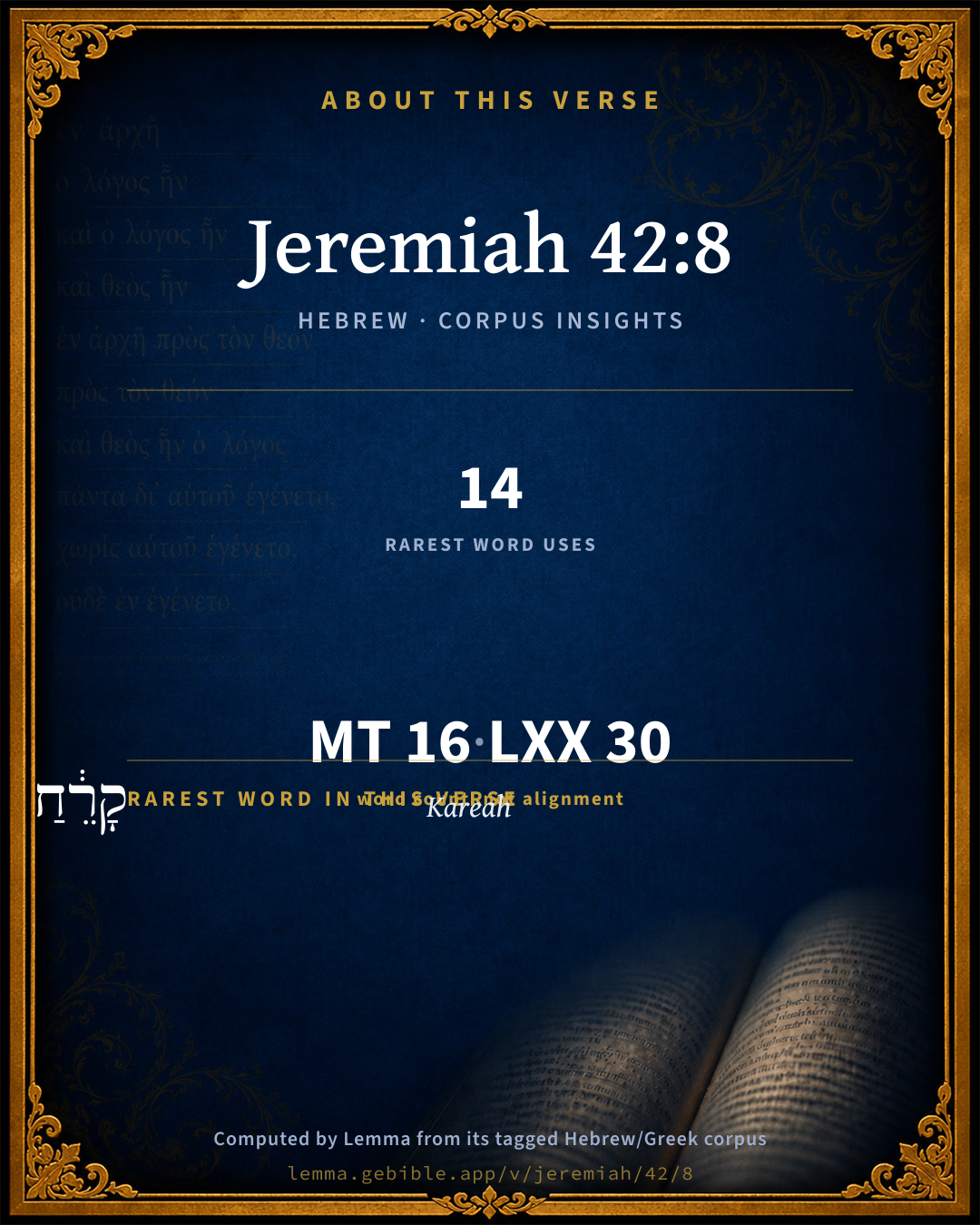
The rarest word here is קָרֵ֔חַ Kareah H7143 — appearing just 14 times in the whole Hebrew Bible.

Shared distinctive vocabulary

קָרֵ֔חַ Kareah H7143 occurs in 14 verses of the Hebrew Bible. Also found in:

Grammatical profile

  • 1 verb
  • 8 nouns
  • 2 adjectives
  • 4 prepositions
  • 1 particle

Verb forms

  • וַיִּקְרָ֗א Qal · Sequential Imperfect

Repetition

Words recur within this verse — often emphatic in Hebrew:

Hebrew & Septuagint length

In the original languages it is 16 Hebrew tokens and 30 Greek tokens — but the two are counted differently (Hebrew bundles its prefixes and suffixes into one token; the Greek is in lemma form), so that isn’t a like-for-like length.

Cross-references

5

Topical passages linked to Jeremiah 42:8 in the Treasury of Scripture Knowledge — connected by theme and wording, ordered by reader-vote popularity; previews shown in the World English Bible.

  • Jeremiah 42:1 Then all the captains of the forces, and Johanan the son of Kareah, and Jezaniah the son of Hoshaiah, and all the people from the least even to the greatest, came near,
  • Jeremiah 40:8 then they came to Gedaliah to Mizpah, [to wit], Ishmael the son of Nethaniah, and Johanan and Jonathan the sons of Kareah, and Seraiah the son of Tanhumeth, and the sons of Ephai the Netophathite, and Jezaniah the son of the Maacathite, they and their men.
  • Jeremiah 40:13 Moreover Johanan the son of Kareah, and all the captains of the forces who were in the fields, came to Gedaliah to Mizpah,
  • Jeremiah 41:11–16 But when Johanan the son of Kareah, and all the captains of the forces who were with him, heard of all the evil that Ishmael the son of Nethaniah had done,
  • Jeremiah 43:2–5 then spoke Azariah the son of Hoshaiah, and Johanan the son of Kareah, and all the proud men, saying to Jeremiah, You speak falsely: Yahweh our God has not sent you to say, You shall not go into Egypt to sojourn there;

Cross-references courtesy of OpenBible.info (CC BY 4.0).

Hebrew and Greek witnesses Masoretic Hebrew ↔ Greek Septuagint

The same verse in the two great witnesses to the Old Testament, shown verse-for-verse.

These are two independent witnesses, not word-aligned to each other, and the Septuagint is shown in lemma (dictionary) form.

Hebrew Jeremiah 42:8 Masoretic · Westminster Leningrad Codex

וַיִּקְרָ֗א אֶל יֽוֹחָנָן֙ בֶּן קָרֵ֔חַ וְאֶ֛ל כָּל שָׂרֵ֥י הַחֲיָלִ֖ים אֲשֶׁ֣ר אִתּ֑וֹ וּלְכָ֨ל הָעָ֔ם לְמִקָּטֹ֥ן וְעַד גָּדֽוֹל

Then called he Johanan the son of Kareah, and all the captains of the forces who were with him, and all the people from the least even to the greatest,

World English Bible · Public Domain

Greek LXX Structure differs

In the Septuagint, Jeremiah is about an eighth shorter than the Hebrew and arranges its material differently — the Oracles Against the Nations (Hebrew chapters 46–51) appear in the middle of the Greek book, after 25:13. Because the chapter and verse boundaries do not line up, a verse-for-verse comparison with the Hebrew is not shown.

A verse-for-verse comparison isn’t shown here because the chapters and verses don’t line up. Switch to the LXX edition with the MT / LXX toggle above to read the Greek directly.

Hebrew: Westminster Leningrad Codex (CC BY 4.0). Greek: Septuagint (public domain); English from a public-domain English Septuagint. How the Septuagint differs from the Hebrew →

Targum (Aramaic paraphrase)

1

The Targum is the ancient Jewish Aramaic paraphrase of the Hebrew Scriptures — an interpretive translation, not the Hebrew text itself. Onkelos (literal) and Pseudo-Jonathan (expansive) render the Torah, and Jonathan the Prophets. Coverage is partial: where no permissively-licensed English translation exists for a verse, only the Aramaic is shown. This is verse-level text, not a word-by-word alignment to the Hebrew.

  1. Targum Jonathan Prophets (Joshua–Malachi)
    וּקְרָא לְיוֹחָנָן בַּר קָרֵחַ וּלְכָל רַבָּנֵי חֵילְוָתָא דְעִמֵיהּ וּלְכָל עַמָא לְמִזְעֵירָא וְעַד רַבָּא:

    (no public-domain English translation for this verse)

    Targum Jonathan — Aramaic: “Mikraot Gedolot” (public domain). English: “Sefaria Community Translation” (CC0 1.0 (public-domain dedication)); “London "Chaldee Paraphrase," 1871” (public domain). Text via Sefaria.

Commentary

Notes on Jeremiah 42:8 from classic Christian and Jewish commentators (each source and its license shown beneath its notes). The classic Christian expositions comment on the surrounding passage and are grouped to its opening verse, so a note may address several verses; the Jewish commentaries on the Tanakh (Rashi and others) are per-verse, so they appear only where the commentator wrote on this verse.

Lemma curates 59 commentaries, every one of them public domain or Creative Commons licensed, each selected and text-cleaned for this edition rather than reprinted as found. About our sources →

Trapp's Complete Commentary

John Trapp

Jer 42:8 Then called he Johanan the son of Kareah, and all the captains of the forces which [were] with him, and all the people from the least even to the greatest,

Ver. 8. And all the people, from the least unto the greatest.] For the Word of God belongeth to all of all sorts; and as the smaller fish bite first, so the poor are evangelized {Mat 11:5} when the richer stand off.

John Trapp, A Commentary or Exposition upon All the Books of the Old and New Testament (1647–1656) — public domain. Text from a community e-Sword module.

John Calvin's Commentaries

Jeremiah says, that he called John and the other leaders of the forces and all the people, from the least to the greatest This is expressed that we may know that it happened, not through the fault of one or two, that this prophecy was disregarded, but that all the people were united together. The people themselves, then, could not have pretended that they were free from blame; for we see that they were all implicated. The leaders are particularly mentioned, and on the other hand the people, so that the leaders could not object and say that they were forced by a popular tumult, nor could the people throw the blame on the leaders. The Prophet then shews that they all rebelled against God, and that there was no exception.

John Calvin's Commentaries (1540-1563) — public domain. Text from the Calvin Translation Society English edition (1840s-50s) via the Christian Classics Ethereal Library (ccel.org). Calvin's coverage is partial (roughly two-thirds of the Bible); uncommented books and verses are honest gaps, never fabricated. The 19th-century editor's footnotes and remarks are omitted so the notes are faithfully Calvin's own voice.

John Gill's Exposition

And said unto them, thus saith the Lord, the God of Israel,.... That had chosen Israel; had a favour for that people, and bestowed many blessings on them, and continued in a covenant relation to them; and therefore what he said should be regarded by them. This preface is made by the prophet, to show that what he was about to say was not of himself, and in his own name; but was from the Lord, and who bore a good will to them; and therefore whatever he said should be taken in good part, and as what was best for them:

unto whom ye sent me, to present your supplication before him; or, "to cause your supplication to fall before him" (t); to make it in the most humble and submissive manner; and which carries in it other arguments to engage them to obey the word of the Lord he brought to them; both because they had sent him to the Lord on this errand, to get a word from him; and by him had entreated him for it, in the most suppliant manner. The word from the Lord follows:

(t) "ut cadere facerem preces vestras coram ipso", Schmidt.

John Gill's Exposition of the Whole Bible (1746–1763) — public domain (CC PDM 1.0). Text via the HelloAO Bible API.

Lesson kit

Teaching starters — assembled from the data on this page, not authored interpretation. Every prompt links to the verse data it draws on. Edit before teaching.

Jeremiah, in the Prophets, opens this verse with 16 words (14 distinct Hebrew lemmas). Its most distinctive word is Qârêach (“Kareah”). A historical commentator’s framing appears above. Read the whole chapter for the surrounding context.

Discussion questions

  1. How does “Kareah” (Qârêach) shape what this verse is saying?
  2. How does 2 Kings 25:23, which shares the word «Kareah», read alongside this verse?
  3. What does the repetition of “all” (2× in this one verse) do in this verse?
  4. These translations render this verse differently; the difference is in the English rendering, not the original. What questions does that raise?
  5. «וַיִּקְרָ֗א» is a Qal Sequential Imperfect verb. How does that grammatical form shape the action described?
  6. Compare how Trapp's Complete Commentary and John Calvin's Commentaries read this verse. Where do they agree or differ?

Things to notice

Reading settings

Reading text

Shown beneath each verse's original-language words.

Old Testament
Old Testament edition

Read the OT as the Masoretic Hebrew (MT) or the Greek Septuagint (LXX).

English shown for the Greek Septuagint (in the Hebrew ↔ Greek comparison).

Comparing translations? Open the Compare panel on any verse page to stack up to four side by side.