
Isaiah 5:22

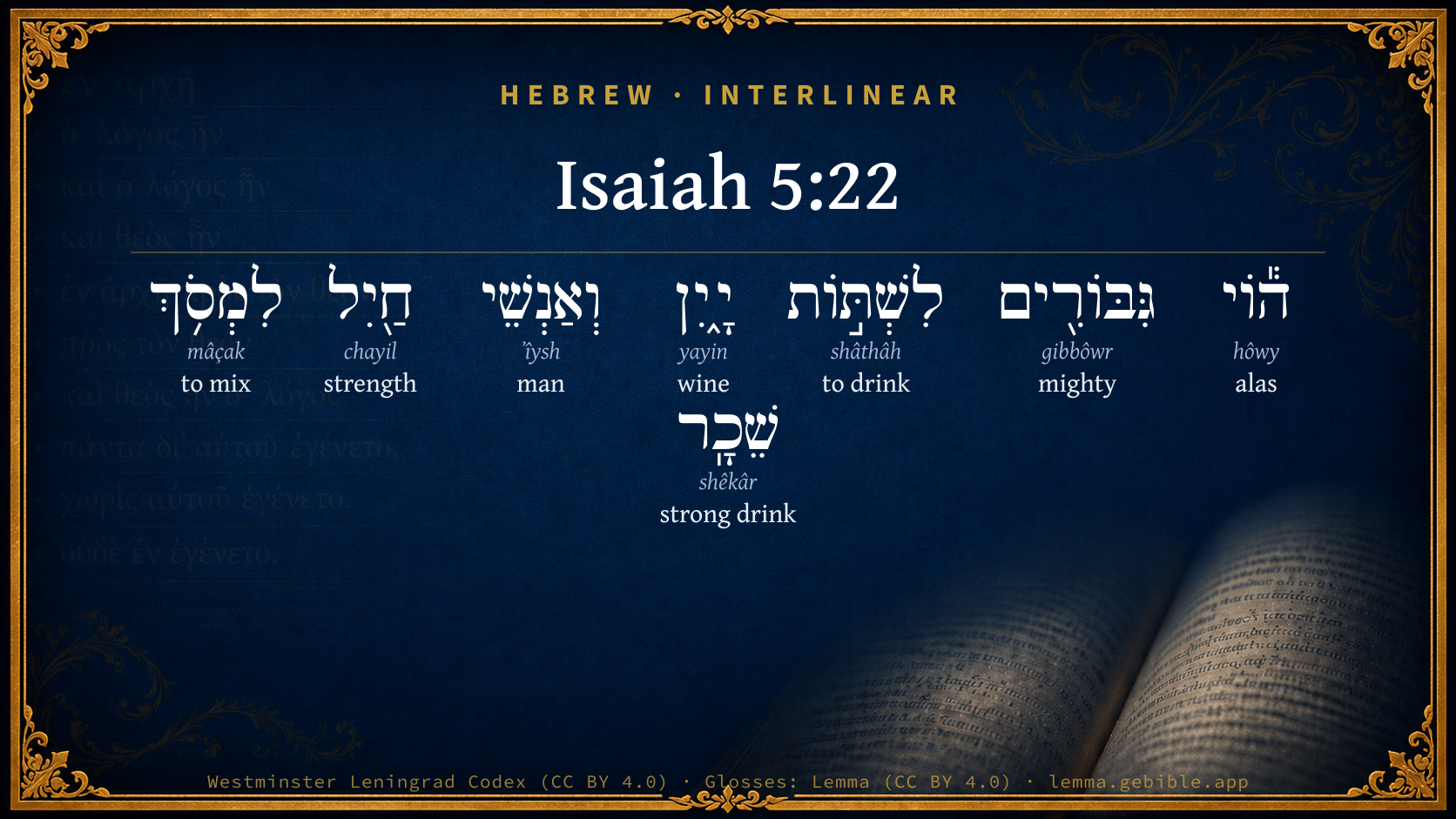
Hebrew (Westminster Leningrad Codex) Isaiah 5:22 appears in the Hebrew Old Testament. The text above is from the Westminster Leningrad Codex. Each word links to its Strong’s number, a concise gloss, and parsing drawn from the Open Scriptures Hebrew Bible morphology. Click any word for its full Brown-Driver-Briggs (BDB) entry.
Download image
Cite this verse

Isaiah 5:22 (World English Bible). Public Domain. Lemma interlinear Bible study tool, https://lemma.gebible.app/v/isaiah/5/22.

Show BibTeX & RIS
BibTeX
RIS
English Translation
Woe to those who are mighty to drink wine, And champions at mixing strong drink;
World English Bible · Public Domain
Download a study sheet

One document with this verse’s original text, its word-by-word gloss line, the meaning frame, cross-references with their text, attributed commentary, and full source and license credits — printable, and it pastes into notes with its structure intact.

This verse Autodidact and up

Study sheet (.html) Plain text (.txt)

A passage Seminary Student

Up to 50 verses in one chapter. A passage sheet keeps up to 6 commentary sources and 12 cross-references per verse, in the order this page ranks them, and says so on the sheet whenever that leaves anything out. Ask for a single verse and you get the Autodidact verse sheet above.

Everything on this page stays free to read, with no account — the sheet is a download of what is already on screen, not access to it.

Want to remove ads? Support Godless Engineer
Compare translations 3

The same verse in 3 English versions, stacked beneath the original-language interlinear above. Click any original word for its lexicon entry.

Each is an independent rendering of the whole verse — the interlinear is not word-aligned to these translations.

Highlighted words mark where these versions differ — a whole-verse word diff, not a word-by-word alignment.

  • World English Bible Public Domain
    Woe to those who are mighty to drink wine, And champions at mixing strong drink;
  • King James Version Public Domain
    Woe unto them that are mighty to drink wine, and men of strength to mingle strong drink:
  • unfoldingWord Literal Text CC BY-SA 4.0
    Woe to the champions at drinking wine and the men of valor at mixing beer,

unfoldingWord Literal Text — © unfoldingWord, licensed CC BY-SA 4.0. Word-aligned USFM3 via Door43 (git.door43.org/unfoldingWord/en_ult).

Versions to compare (up to 4)

3 of 4 selected

Show all 18 translations

Every available English version of this verse, each an independent rendering of the whole verse.

  • World English Bible Public Domain
    Woe to those who are mighty to drink wine, And champions at mixing strong drink;
  • Berean Standard Bible Public Domain
    Woe to those who are heroes in drinking wine and champions in mixing strong drink,
  • Majority Standard Bible Public Domain
    Woe to those who are heroes in drinking wine and champions in mixing strong drink,
  • King James Version Public Domain
    Woe unto them that are mighty to drink wine, and men of strength to mingle strong drink:
  • American Standard Version (1901) Public Domain
    Woe unto them that are mighty to drink wine, and men of strength to mingle strong drink;
  • Revised Version (1885) Public Domain
    Woe unto them that are mighty to drink wine, and men of strength to mingle strong drink:
  • Geneva Bible (1599) Public Domain
    Wo vnto them that are mightie to drinke wine, and to them that are strong to powre in strong drinke:
  • Douay-Rheims (1899) Public Domain
    Woe to you that are mighty to drink wine, and stout men at drunkenness.
  • Young's Literal Translation Public Domain
    Wo `to' the mighty to drink wine, And men of strength to mingle strong drink.
  • Literal Standard Version CC BY-SA 4.0
    Woe [to] the mighty to drink wine, || And men of strength to mingle strong drink.
  • Unlocked Literal Bible CC BY-SA 4.0
    Woe to those who are champions at drinking wine, and masters at mixing strong drinks;
  • unfoldingWord Literal Text CC BY-SA 4.0
    Woe to the champions at drinking wine and the men of valor at mixing beer,
  • Darby Bible Public Domain
    Woe unto them that are mighty for drinking wine, and men valiant to mix strong drink;
  • World Messianic Bible Public Domain
    Woe to those who are mighty to drink wine, and champions at mixing strong drink;
  • Webster's Bible Public Domain
    Woe to them that are mighty to drink wine, and men of strength to mingle strong drink:
  • Free Bible Version CC BY-SA 4.0
    Tragedy is coming to you who are wine-drinking champions, and experts at mixing alcoholic drinks;
  • Bible in Basic English Public Domain
    Cursed are those who are strong to take wine, and great in making mixed drinks!
  • JPS Tanakh (1917) Public Domain
    Woe unto them that are mighty to drink wine, and men of strength to mingle strong drink;

Literal Standard Version (2020), Covenant Press — licensed CC BY-SA 4.0. Text via the HelloAO Bible API (eBible.org). Unlocked Literal Bible (unfoldingWord) — licensed CC BY-SA 4.0. Text via the HelloAO Bible API (eBible.org). unfoldingWord Literal Text — © unfoldingWord, licensed CC BY-SA 4.0. Word-aligned USFM3 via Door43 (git.door43.org/unfoldingWord/en_ult). Free Bible Version, Dr. Jonathan Gallagher — licensed CC BY-SA 4.0. Text via the HelloAO Bible API (eBible.org).

Word by word

More ways to search: Search by grammar → Find every occurrence → Compare this word →

Practice this passage: Drill this verse → Learn its vocabulary →

About this verse

These counts appear in no published source. They are computed here, from the morphology-tagged text and Lemma’s own curated glosses. What Lemma adds →

8
words
8
distinct lemmas
Prophets
section

Notable vocabulary

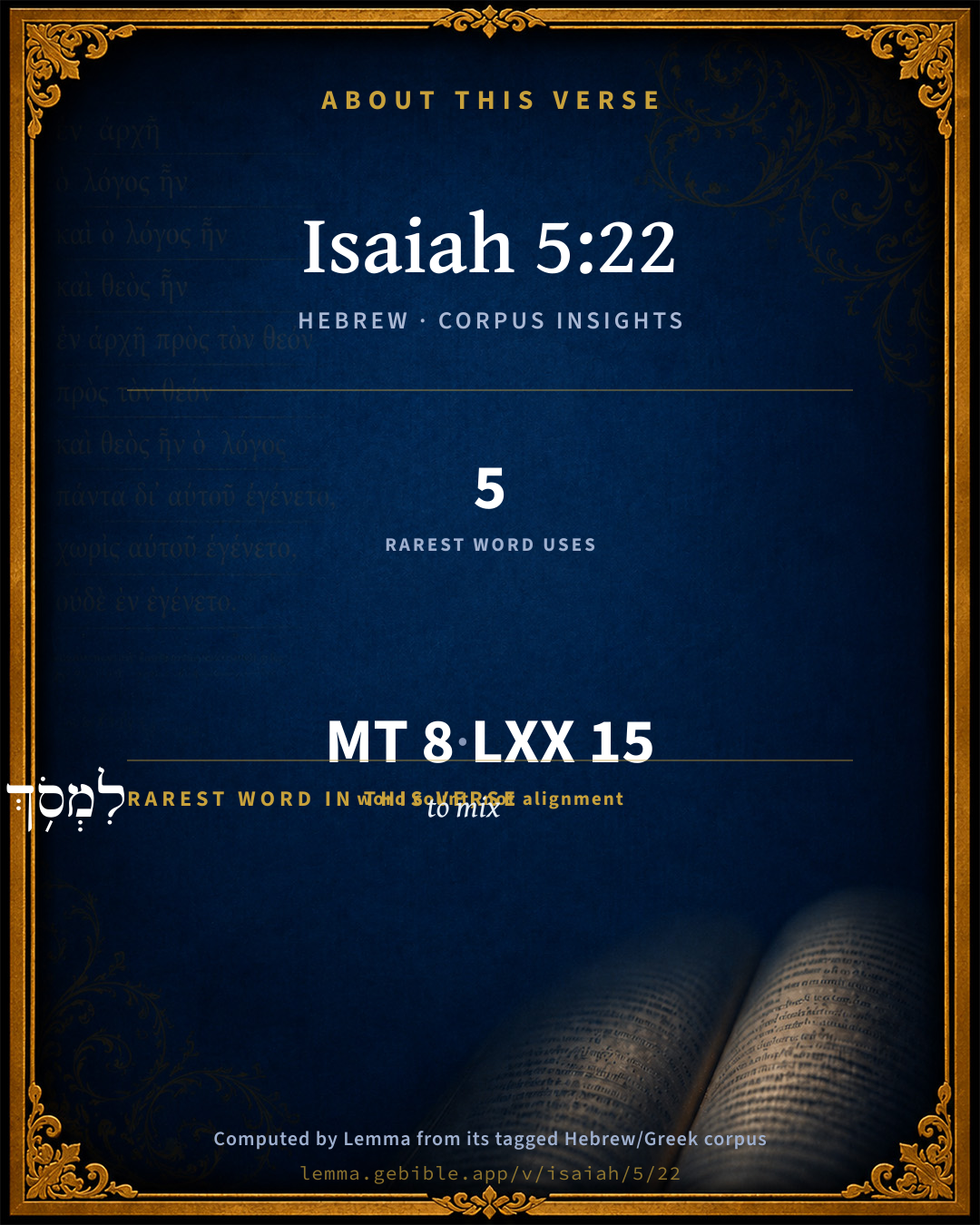
The rarest word here is לִמְסֹ֥ךְ to mix H4537 — appearing just 5 times in the whole Hebrew Bible.

Shared distinctive vocabulary

לִמְסֹ֥ךְ to mix H4537 occurs in 5 verses of the Hebrew Bible. Also found in:

Grammatical profile

  • 2 verbs
  • 4 nouns
  • 1 adjective
  • 1 particle

Verb forms

  • לִשְׁתּ֣וֹת Qal · Infinitive Construct
  • לִמְסֹ֥ךְ Qal · Infinitive Construct

Hebrew & Septuagint length

In English translation the verse runs 15 words from the Hebrew and 18 from the Septuagint (LXX English) — closely comparable.

A rough comparison of the two English renderings, which tokenize alike — not a word-level alignment.

Word counts can differ between the Hebrew and the Greek without any difference in meaning — e.g. the Hebrew direct-object marker אֵת has no separate Greek word, and Greek often adds the article ὁ.

In the original languages it is 8 Hebrew tokens and 15 Greek tokens — but the two are counted differently (Hebrew bundles its prefixes and suffixes into one token; the Greek is in lemma form), so that isn’t a like-for-like length.

Cross-references

6

Topical passages linked to Isaiah 5:22 in the Treasury of Scripture Knowledge — connected by theme and wording, ordered by reader-vote popularity; previews shown in the World English Bible.

  • Isaiah 5:11 Woe to those who rise up early in the morning, that they may follow strong drink; Who stay late into the night, until wine inflames them!
  • Habakkuk 2:15 "Woe to him who gives his neighbor drink, pouring your inflaming wine until they are drunk, so that you may gaze at their naked bodies!
  • Isaiah 28:7 Even these reel with wine, and stagger with strong drink; the priest and the prophet reel with strong drink, they are swallowed up of wine, they stagger with strong drink; they err in vision, they stumble in judgment.
  • Proverbs 23:19–20 Listen, my son, and be wise, And keep your heart on the right path!
  • Isaiah 56:12 Come you, [say they], I will get wine, and we will fill ourselves with strong drink; and tomorrow shall be as this day, [a day] great beyond measure.
  • Isaiah 28:1–3 Woe to the crown of pride of the drunkards of Ephraim, and to the fading flower of his glorious beauty, which is on the head of the fat valley of those who are overcome with wine!

Cross-references courtesy of OpenBible.info (CC BY 4.0).

Hebrew and Greek witnesses Masoretic Hebrew ↔ Greek Septuagint

The same verse in the two great witnesses to the Old Testament, shown verse-for-verse.

These are two independent witnesses, not word-aligned to each other, and the Septuagint is shown in lemma (dictionary) form.

Hebrew Isaiah 5:22 Masoretic · Westminster Leningrad Codex

ה֕וֹי גִּבּוֹרִ֖ים לִשְׁתּ֣וֹת יָ֑יִן וְאַנְשֵׁי חַ֖יִל לִמְסֹ֥ךְ שֵׁכָֽר

Woe to those who are mighty to drink wine, And champions at mixing strong drink;

World English Bible · Public Domain

Greek LXX Isaiah 5:22 Septuagint · lemma form

οὐαί ὁ ἰσχύω σύ ὁ ὁ οἶνος πίνω καί ὁ δυνάστης ὁ κεράννυμι ὁ σίκερα

Woe to the strong ones of you that drink wine, and the mighty ones that mingle strong drink:

LXX2012 (modern English Septuagint) · Public Domain

Hebrew: Westminster Leningrad Codex (CC BY 4.0). Greek: Septuagint (public domain); English from LXX2012 (modern English Septuagint) (Public Domain). How the Septuagint differs from the Hebrew →

Targum (Aramaic paraphrase)

1

The Targum is the ancient Jewish Aramaic paraphrase of the Hebrew Scriptures — an interpretive translation, not the Hebrew text itself. Onkelos (literal) and Pseudo-Jonathan (expansive) render the Torah, and Jonathan the Prophets. Coverage is partial: where no permissively-licensed English translation exists for a verse, only the Aramaic is shown. This is verse-level text, not a word-by-word alignment to the Hebrew.

  1. Targum Jonathan Prophets (Joshua–Malachi)
    וַי דְגִבָּרִין לְמִשְׁתֵּי חֲמַר וְגִבָּרִין מָרֵי נִכְסִין לְאִתְרַוָאָה מִן עַתִּיק:

    Woe unto them that are mighty to drink wine, and mighty lords of riches, to make themselves drunk with old wine.

    Targum Jonathan — Aramaic: “Mikraot Gedolot” (public domain). English: “Sefaria Community Translation” (CC0 1.0 (public-domain dedication)); “London "Chaldee Paraphrase," 1871” (public domain). Text via Sefaria.

Commentary

Notes on Isaiah 5:22 from classic Christian and Jewish commentators (each source and its license shown beneath its notes). The classic Christian expositions comment on the surrounding passage and are grouped to its opening verse, so a note may address several verses; the Jewish commentaries on the Tanakh (Rashi and others) are per-verse, so they appear only where the commentator wrote on this verse.

Lemma curates 59 commentaries, every one of them public domain or Creative Commons licensed, each selected and text-cleaned for this edition rather than reprinted as found. About our sources →

Trapp's Complete Commentary

John Trapp

Isa 5:22 Woe unto [them that are] mighty to drink wine, and men of strength to mingle strong drink:

Ver. 22. Woe unto them that are mighty to drink wine.] Iterate taxat hoc vitium, eo quod invaluerat. The prophet inveigheth against this vice a second time, because it was grown so common. Drunkards also are a sottish kind of creatures, and had therefore more than need to be double dealt with; like as physicians use to give double quantities to such as have palsies or epilepsies, so to awaken their dull, drowsy senses. Many of these sots take it for a great glory that they are mighty to drink wine; as did Darius King of Persia, who caused it to be written upon his tomb, I was a great hunter; I could also drink much wine, and bear it bravely. {a} This was, as one well saith, to glory in his shame; it being rather the commendation of a tun {b} than of a man, for a beast will scarce abide it, to be able to take in and contain much liquor. When Bonosus the drunken Roman had hanged himself, it went for a by-word Amphoram pendere non hominem, {c} that a tun or tankard hung there, and not a man. And when one was commended to King Alphonsus for a great drinker, and able to bear it, he answered that that was a good praise in a sponge, but not in a prince. {d} This, if Alexander the Great and Tiberius the Emperor - those great drinkers and encouragers of others to that vice - had well remembered, they would not have been so infamous as they are and will be to all posterity.

And men of strength.] Or, Valour. But to do what? Pινειν και βινειν μονον, {e} as the comedian hath it: To drink and do worse only. A goodly prize surely, a fair commendation. {e} Fortes esse et strenuos non contra hostes, sed ad exhauriendos calices; gigantes esse non ad bellandum, sed ad potandum. To be carpet knights, not of Mars, but of Bacchus, and fitter for a canopy than a camp.

To mingle.] Or, To pour in. Whether into their own wide gullets, or into the cup to make others drunk; for preventing whereof Minos, King of Crete, made a law that men should not drink one to another, εις μεθην, to drunkenness. So did Lycurgus at Lacedemon. And our King Edgar made an ordinance for putting pins in cups that none should quaff whole ones, or cause others to do so.

{a} Kυνηγειν εκρατουν, οινον πολυν πινειν εδυναμην και τουτον φερειν καλως. - Athen.

{b} A large cask or barrel, usually for liquids, esp. wine, ale, or beer, or for various provisions. Now less common than cask.

{c} Vopsic. in Bonoso.

{d} Gentiles ipsi risere tales athletas.

{e} Arist, in Ranis.

{f} Civilis est irrisio non carens sale. - Oecolamp.

John Trapp, A Commentary or Exposition upon All the Books of the Old and New Testament (1647–1656) — public domain. Text from a community e-Sword module.

The Biblical Illustrator

Joseph S. Exell

Isa_5:22-23

Woe unto them that are mighty to drink wine . . . which justify the wicked for reward

Wine-loving lawyers and judges

Among the men whom Isaiah denounces as the corrupters and destroyers of the society of which they are the leaders, are the unjust lawyers and judges: he mentions as characteristic of them, that they are heroes at drinking, and spice their wine to make it stronger; by which, perhaps, we are to understand, not that their heads and senses were overcome with wine like the drunkards spoken of above, but that the effect on their hearts and consciences was such as to harden them in their criminal perversion of the law.

Perhaps the passage might be illustrated by instances of the professional character of hard-drinking but strong-headed judges of other times. (Sir E. Strachey, Bart.)

Aromatites

The Romans called this spiced wine Aromatites. (Sir E. Strachey, Bart.)

Drunkenness

The woe denounced in the text against those notorious for drunkenness is made up of the unavoidable effects it produces, and these effects are too dear a price to be paid by a reasonable creature for all the sensual pleasures of this life, did they even accompany this single sin.

I. THE DRUNKARDS EXCUSES.

1. His first excuse is charged to the account of good fellowship. But surely, friendship can never be founded on anything else than an amiable and affectionate disposition, a likeness of temper, and true honesty of heart on both sides. Will strong drink bestow these on us? Can mutual love and confidence be built on vice? And how doth drunkenness pro mote the gaiety of conversation? Does it not rather destroy all conversation, for what is conversation, but the communication of rational and agreeable thoughts?

2. The next excuse for drinking to excess is, that it stupefies the cares and troubles of the drunkard, which arise from three different quarters,--his ill state of health, the unfortunate posture of his worldly affairs, or the stings of his guilty conscience.

3. The drunkard hath other more common and accidental excuses for his vice. He says he is so exposed to company and business, that it is impossible for him to avoid drinking to excess. Then, he is of so easy and flexible a temper, that he cannot resist the importunities of his friends, as he calls them. Thus, he is for softening his vice into a sort of virtue, and calling that mere good nature, which his creditor calls villainy, and his family cruelty.

II. THE WOE DENOUNCED BY ALMIGHTY GOD; or, in other words, the miserable effects, as well temporal as spiritual, of his favourite vice.

1. Poverty.

2. Universal contempt.

3. Ill health and an untimely death.

4. These evils are as nothing compared to the spiritual evils that spring from drunkenness. In destroying his health he shortens his life, and so far is guilty of self-murder. In impairing his reason he makes his life useless and burdensome to the world. (J. Skelton.)

Mighty to drink wine

Strength is a great blessing, but if it is used in the service of sin it becomes a curse.

I. THE GREAT DRINKERS of that day were just the same sort of men as they are now here in our country.

1. They are grasping and selfish (Isa_5:8). They are often willing to take bribes if they are magistrates (Isa_5:23), and to condemn the innocent rather than lose their money or credit.

2. They are dull of understanding of the things of God (Isa_5:12).

3. They are greedy of sire Drink makes men pull destruction upon themselves (Isa_5:18).

4. They are liars (Isa_5:20). It would be difficult to find one lover of drink who was truthful. However kind and generous a sot may be, his word can never be depended upon. Deceiving and being deceived is his exact portrait.

5. Clever in their own eyes (Isa_5:21).

II. THE WOES the prophet declares are sure to come on these men mighty to drink wine.

1. Poverty (Isa_5:9-10). The great and beautiful houses will soon be vacant, and the neglected fields will soon be like the sluggards garden. More than half the empty houses and the farms that are given up in this country represent the doings of drink.

2. Degradation (Isa_5:13). Captivity to a Jew meant more than poverty--loss of honour, of position, of hope, grinding toil, pollution, horrid slavery. What can degrade body and mind like drink? (Isa_5:15.)

3. Death (Isa_5:14). There is a sin unto death. More than 60,000 drunkards go down to their dishonoured graves every year in Britain. Think of death and hell gaping to take in these hosts of slain. (Josiah Mee.)

The bane and antidote

(with Hab_2:15):--

I. THE EVIL.

1. As affecting the individual. It is no trivial result to demoralise the human spirit.

2. As it ramifies itself throughout the framework of society.

(1) As respects the family.

(2) The wider circle of the general community.

II. THE CURE.

1. Total abstinence.

2. Legislative prohibition. (J. Guthrie, M. A.)

The unworthy glorying of the intemperate

They gloried in it as a great accomplishment, that they were able to bear a great deal of strong liquor, without being overcome by it. Let drunkards know from this Scripture that--

1. They ungratefully abuse their bodily strength, which God hath given them for good purposes, and by degrees cannot but weaken it.

2. It will not excuse them from the guilt of drunkenness that they can drink hard, and yet keep their feet.

3. Those that boast of their drinking down others glory in their shame.

4. How light soever men make of their drunkenness, it is a sin which will certainly lay them open to the wrath and curse of God. (M. Henry.)

Intemperance a fine art

Cyrus, writing the Lacedaemonians for assistance, spoke in very high terms of himself, telling them he had a greater and more prince y heart than his brother; that he was the better philosopher, being instructed in the doctrines of the Magi, and that he could drink and bear more wine than his brother. (Plutarchs Artaxerxes.)

Mighty to drink wine

When Bonosus the drunken Roman had hanged himself, it went for a byword that a tun or tankard hung there and not a man. And when one was commended to King Alphonsus for a great drinker, and able to bear it, he answered that that was a good praise in a sponge but not in a prince. (J. Trapp.)

Darius, King of Persia, caused it to be engraved upon his tomb, I could drink much wine, and bear it bravely. Perhaps he was proud of it, but it was his shame. (J. Mee.)

Intemperance destroys character

The title of Rois faineants--do-nothing kings--expresses very aptly the character of the last descendants of the house of Clovis. At the moment when circumstances demanded from the occupants of the Frankish throne a more than ordinary share of talent and force of character, they lapsed into a state of imbecility and insignificance, both bodily and mental. Intemperance and debauchery entailed on them premature decrepitude; few attained the mature age of manhood; they rarely appeared in public, except at the annual pageant of the Champ de Mars. (Students France.)

A Japanese proverb

The Japanese have a true proverb which describes millions of sad cases: A man took a drink, then the drink took a drink, then the drink took the man. Effects of wine drinking:--Whilst the drunkard swallows wine, wine swallows him. God disregards him, angels despise him; men deride him, virtue declines him, the devil destroys him. (Augustine.)

The Biblical Illustrator, edited by Joseph S. Exell (c. 1880s–1900s) — public domain. Text from a community e-Sword module.

Whedon's Commentary on the Bible

Daniel D. Whedon

Sixth woe — on public dissoluteness, Isa_5:22-23.

Drunkards, too, again receive their woe; (see Isa_5:11;) where the people indulge in thoughtless, rollicking dissoluteness.

22, 23. Drink wine… strong drink — Here the terrible evil is contemplated as affecting those intrusted with the administrative interests of the nation. How can magistrates with reeling brain and besotted soul adjudge the rights of the poor and the weak?

Daniel D. Whedon (gen. ed.), Commentary on the Old and New Testaments (1874–1909) — public domain. Text from a community e-Sword module.

The Preacher's Complete Homiletical Commentary

Joseph S. Exell (gen. ed.)

THE WOE OF THE DRUNKARD

Isa_5:22. Woe unto them that are mighty to drink wine, and men of strength to mingle strong drink.

There are certain vices which the customs of certain countries seem to place only in the number of human infirmities; and yet, if we look at their effects, we shall see that really they are as black as those sins which God and man visits with the severest punishments.

I. The Drunkard’s excuses, by which he endeavours to defend or palliate his crime.

1. Good fellowship. But can friendship be founded on vice? especially on a vice which notoriously impairs the memory and the sense of obligation, leads to the betrayal of secrets, and stirs up strife and contention? Instead of promoting conversation it destroys it by destroying the very capability of communicating rational and agreeable thoughts. The drunkard may make his company merry, but they laugh at, not with, him, and merely because they are delighted with the sight of one even sillier than themselves.

2. “It drowns care.” But the drunkard’s care must arise either from his ill state of health, the unfortunate posture of his worldly affairs, or the stings of his guilty conscience; and, in either case, his temporary oblivion is purchased at the cost of an aggravation of the evils which cause him to desire it. To drink to drown remorse is especially absurd, for all that the drunkard can expect from this course is the benefit of travelling some part of the road to eternal misery with his eyes covered.

3. The drunkard has other excuses: he says that he is so exposed to company and business, that he cannot avoid drinking to excess, or that he is of so easy and flexible a temper, that he cannot resist the importunities of his friends, as he calls them. Thus he is for softening his vice into a sort of virtue, and calling that good nature, which his creditor calls villany, and his family cruelty.

II. The drunkard’s woe. This is made up of the miserable effects, as well temporal as spiritual, of his favourite vice.

1. Poverty.

2. Contempt.

3. Ill-health.

4. An untimely death. Consider, too, the spiritual evils that spring from and punish the vice of drunkenness.

1. The understanding is depraved and darkened.

2. The will is enfeebled and dethroned.

3. The passions are inflamed and rendered ungovernable.

4. Regard for men and reverence for God are destroyed. Drunkenness travels with a whole train of other vices, and requires the whole width of the broad way to give it room. Where its journey is to end, we know; so that if the guilt and misery which attend it here, be not enough, there, at least, the drunkard, having opened his eyes and recovered the use of his reason, will perceive the truth of the text.—Skelton, in Clapham’s Selected Sermons, ii. 384–392.

THE WOE OF THE DRUNKARD

Isa_5:22. Woe unto them that are mighty to drink wine, and men of strength to mingle strong drink.

Woe to the drunkard. I. To his reputation [673] II. To his interests. III. To his health. IV. To his family. V. To his soul [676]J. Lyth, D.D.

[673] Some of you glory in your shame, that you have drunk down your companions, and carried it away,—the honour of a sponge or a tub, which can drink up or hold liquor as well as you.—Baxter, 1615–1691.

[676] We commend wine for the excellency of it; but if it could speak, as it can take away speech, it would complain, that by our abuse both the excellencies are lost; for the excellent man doth so spoil the excellent wine, until the excellent wine hath spoiled the excellent man. Oh, that a man should take pleasure in that which makes him no man; that he should let a thief in at his mouth to steal away his wit; that for a little throat-indulgence, he should kill in himself both the first Adam, his reason, and even the second Adam, his regeneration, and so commit two murders at once.—Adams, 1653.

How base a price dost thou set upon thy Saviour and salvation, that will not forbear so much as a cup of drink for them? The smallness of the thing showeth the smallness of thy love to God, and the smallness of thy regard to His Word and to thy soul. Is that loving God as God, when thou lovest a cup of drink better? Art thou not ashamed of thy hypocrisy, when thou sayest thou lovest God above all, when thou lovest Him not so well as thy wine and ale? Surely he that loveth Him not above ale, loveth Him not above all! Thy choice showeth what thou lovest best, more certainly than thy tongue doth. It is the dish that a man greedily eateth of that he loveth, and not that which he commendeth but will not meddle with. God trieth men’s love to Him, by their keeping His commandments. It was the aggravation of the first sin, that they would not deny so small a thing as the forbidden fruit, in obedience to God! And so it is of thine, that wilt not leave a forbidden cup for Him! O miserable wretch! dost thou not know thou canst not be Christ’s disciple, if thou forsake not all for Him, and hate not even thy life in comparison of Him, and wouldst not rather die than forsake Him! And art thou like to lay down thy life for Him that wilt not leave a cup of drink for Him? Canst thou burn at a stake for Him, that canst not leave an alehouse, or vain company, or excess for Him? What a sentence of condemnation dost thou pass upon thyself!—Baxter, 1615–1691.

DRINK AND ITS WOES

Isa_5:22. Woe unto them that are mighty to drink wine, and men of strength to mingle strong drink.

Human depravity and iniquity have existed in all ages and countries. The vices flowing therefrom have been much the same—selfishness, pride, sensualism, oppression, drunkenness. Alcohol acting directly on the brain, the seat of the mind, tends not only to derange, but to enfeeble and pervert, and produces moral obliquity, moral infatuation, and intensified delusion. All sorts of deceits are the consequence. Observe—I. THE CHARACTERS INTRODUCED (Isa_5:22). Observe also Isa_5:11-12. In the last verses there is reference to confirmed drunkards, daily, early, and late; the sensual debauchees—their ignorance, want of thought and reflection. In the text, notorious drinkers, bold, impudent wager-layers, boasters, &c., and those who have got the victory over the usual drinks, and now make them stronger to meet the cravings of appetite and to keep up the excitement. Observe, this is the great peril of moderate drinking. It creates the appetite, it increases the appetite; last of all, it gives the appetite the control, and the man or woman becomes the slave and then the victim.

II. THE INFATUATION PORTRAYED—by

1. Giving false names to things (Isa_5:20). Call

(1) evil good: drinks (poisons) are called beverages; evil things made by men are called God’s good creatures. And so they call

(2) good evil; despise the really good and safe; pour contempt on water and safe fluids, and treat them as evil or worthless. How drinks have secured the most alluring titles—strong cordials, dew, &c., generous. Not only false names, but

2. False qualities (Isa_5:20), “Bitter for sweet.” Now intoxicating drinks are not sweet or palatable to the natural taste; they blister the mouth of children; do burn the delicate nerves of the stomach; the tongue and lips have to be trained, drilled, hardened. Observe, they call sweet bitter; things really so are treated as insipid. Ask the spirit-drinker to take milk or tea, or water, and see how his poisoned taste revolts, &c.

Then there is presented to us—

3. Infatuated results. Put darkness for light; men plead and say these drinks—

(1) Brighten the intellect. How false! See the bloated faces, the diseased eyes, the sensual expression, the stupid look, the stupor. The light is artificial, momentary, false—no better than the effects of certain gases or deadly stimulants, as opium, Indian hemp, &c. But they refer to men, to Burns, Pitt, Sheridan, and other drinking wits. But they were intellectually great in spite, &c. Look at Milton, Sir Isaac Newton; look at the inspired prophets—the seraphic Isaiah, the writer of the text.

(2) They who drink say their drinks lighten the heart, give social joyousness. Right; but is it not sensual, spurious, evanescent, ends in darkness? So they put light for darkness. The calm, equable sobriety of soul they called dulness, darkness. But this is real, abiding, and rational. So, both in name and quality, and in effects, they call “evil good,” &c.

III. THE WOES DENOUNCED.

1. There is the woe of physical consequences. The seed and the harvest, the poisons and their effects, fire, deranged stomach, plague, diseased liver, excited heart, fevered brain, all tending to a host of maladies, shortened life, and an early grave. There is—

2. Woe of a distracted mind. Reason beclouded; reflection, perception, all marred. The guiding star eclipsed, the light obscured with darkness. There is the—

3. Woe of moral defects. The man is vitiated, made worse and worse; his affections, his desires, his conscience, his heart, the whole soul. There is—

4. The woe of perverted powers. Gifts, talents, &c., all poisoned; influence deadly; the man a curse—a curse to all.

5. The woe of God’s malediction. God’s woe, His displeasure, His threatening, His curse; this is written in both volumes of the Scriptures—in frightful representation, in declared eternal condemnation.

APPLICATION.—Learn—

1. The horrors associated with strong drink;

2. The advantages of absolute temperance;

3. The value of these associations;

4. The encouragement for labours—staying curses, bringing down blessings; The necessity of immediate decision; The solemn importance of earnest prayer for the Divine benediction;

7. Let us avoid exaggerated conclusions. This is not the only evil; temperance not the only good. To all we say, “One thing is needful;” “Except ye be converted,” &c.—Jabez Burns, D.D., L.L.D., Sketches of Temperance Sermons.

The Preacher's Complete Homiletical Commentary (gen. ed. Joseph S. Exell; Funk & Wagnalls, c. 1892) — public domain (pre-1929). A full-Bible homiletical/sermon-outline anthology covering 65 of 66 books (2 John is absent from the source module). Text from a community e-Sword module.

Keil & Delitzsch

C. F. Keil & F. Delitzsch

The sixth woe: "Woe to those who are heroes to drink wine, and brave men to mix strong drink; who acquit criminals for a bribe, and take away from every one the righteousness of the righteous." We see from Isa 5:23 that the drinkers in Isa 5:22 are unjust judges. The threat denounced against these is Isaiah's universal ceterum censeo; and accordingly it forms, in this instance also, the substance of his sixth and last woe. They are heroes; not, however, in avenging wrong, but in drinking wine; they are men of renown, though not for deciding between guilt and innocence, but for mixing up the ingredients of strong artistic wines. For the terms applied to such mixed wines, see Psa 75:9; Pro 23:30, Sol 7:3. It must be borne in mind, however, that what is here called shecâr was not, properly speaking, wine, but an artificial mixture, like date wine and cider. For such things as these they were noteworthy and strong; whereas they judged unjustly, and took bribes that they might consume the reward of their injustice in drink and debauchery (Isa 28:7-8; Pro 31:5). "For reward:" ēkeb (Arab. ‛ukb; different from âkēb, a heel, = ‛akib) is an adverbial accusative, "in recompense," or "for pay." "From him" (mimmennu) is distributive, and refers back to tsaddikim (the righteous); as, for example, in Hos 4:8.

Keil & Delitzsch — Biblical Commentary on the Old Testament (1861–1891) — public domain (CC PDM 1.0). Text via the HelloAO Bible API. (Old Testament only.)

Tyndale Open Study Notes

Tyndale Open Resources

5:22-24 What sorrow: The sixth threat of judgment was against the indulgent lifestyle of the wicked.

Tyndale Open Study Notes — © Tyndale Open Resources, licensed CC BY-SA 4.0. Text via the HelloAO Bible API.

Geneva Bible (1599)

Geneva Bible translators

Which are never weary, but show their strength, and brag in gluttony and drunkenness.

Geneva Bible (1599) marginal notes — public domain. Text via Bolls.life.

Jamieson, Fausset & Brown

Robert Jamieson, A. R. Fausset & David Brown

Sixth Woe--against corrupt judges, who, "mighty" in drinking "wine" (a boast still not uncommon), if not in defending their country, obtain the means of self-indulgence by taking bribes ("reward"). The two verses are closely joined [MAURER].

mingle strong drink--not with water, but spices to make it intoxicating (Pro 9:2, Pro 9:5; Sol 8:2).

take away the righteousness--set aside the just claims of those having a righteous cause.

Jamieson, Fausset & Brown — Commentary Critical and Explanatory on the Whole Bible (1871) — public domain (CC PDM 1.0). Text via the HelloAO Bible API.

Adam Clarke's Commentary

Verse 22. Mighty to drink wine] "They show not," says Kimchi, "their strength in combating their enemies, but in drunkenness and debauchery."

Adam Clarke's Commentary on the Bible (1810–1826) — public domain. Text from a community e-Sword/MySword module.

Ellicott's Commentary for English Readers

(22) Woe unto them that are mighty to drink. . . . strong drink.—The words in part reproduce the “woe” of Isa_5:11-12, but with the distinctive feature that there the revellers were simply of the careless self-indulgent type, while here they are identified with the unjust and corrupt rulers. They were heroes and valiant men only in and for their cups. To such men it seemed a light matter to acquit the guilty and condemn the guiltless. The prophet dwells on the familiar truth, Judex damnatur cum nocens absolvitur. The Targum, it may be noticed, has “the mammon of falsehood” (comp. Luke xvi, 9), for the “reward” of the Hebrew.

A Bible Commentary for English Readers, edited by Charles John Ellicott (1878–1897) — public domain. Text from a community e-Sword module.

The Cambridge Bible for Schools and Colleges

gen. ed. J. J. S. Perowne

22. them that are mighty] heroes.

to mingle strong drink] This was a delicate operation, almost a fine art, demanding a refined taste and much experience (Pro_23:30). The phrase does not mean to dilute with water, which was common among Greeks and Romans, but rather to enhance by the addition of aromatic herbs (cf. “spiced wine” in Son_8:2).

22, 23. The sixth woe, against dissolute and corrupt judges. In Isa_5:11 f. drunkenness was denounced as destructive of all serious thought; here it is spoken of as the parent of injustice on the bench. Cf. Pro_31:4 f.

The Cambridge Bible for Schools and Colleges (gen. ed. J. J. S. Perowne; Cambridge University Press, 1878–1918) — public domain. Text from a community e-Sword module.

John Gill's Exposition

Woe unto them that are mighty to drink wine,.... That can bear a great deal, and not be overcome and intoxicated with it; that try their strength this way with others, and get the mastery and glory in it: not mighty to fight their enemies, as Kimchi observes, and defend their country, but to drink wine; by which their strength was weakened: wherefore some think soldiers are particularly designed, given to drinking, who are derided and mocked, as being valiant in the warfare of Bacchus, and not of Mars:

and men of strength, to mingle strong drink; in the cup, and then drink it: or "men of war"; the same with "mighty" before. The Targum interprets it, "men of riches": who can afford to drink wine and strong drink; which carries the sense not to the strength of their bodies, but of their purses: the former sense seems best. The Scribes and Pharisees loved the cup and the platter, and to be at feasts, and to have the uppermost seats there, Mat 23:6 and that those that sat in Moses's chair are intended appears from the following words.

John Gill's Exposition of the Whole Bible (1746–1763) — public domain (CC PDM 1.0). Text via the HelloAO Bible API.

Albert Barnes' Notes on the Bible

Wo unto them that are mighty ... - This is the sixth specification of crime. He had already denounced the intemperate in Isa 5:11. But probably this was a prevailing sin. Perhaps there was no evidence of reform; and it was needful to “repeat” the admonition, in order that people might be brought to regard it. The prophet repeats a similar denunciation in Isa 56:12.

Mighty - Perhaps those who prided themselves on their ability to drink “much” without becoming intoxicated; who had been so accustomed to it, that they defied its effects, and boasted of their power to resist its usual influence. A similar idea is expressed in Isa 56:12.

Men of strength - The Chaldee understands this of “rich” men; but, probably, the reference is to those who boasted that they were able to bear “much” strong drink.

To mingle - To mix wine with spices, dates, drugs, etc., to make it more intoxicating; Pro 9:2, Pro 9:5. They boasted that they were able to drink, without injury, liquor of extraordinary intoxicating qualities.

Strong drink - Note, Isa 5:11. On the subject of the strong drink used in the East, “see Harmer’s Observations,” vol. ii. pp. 140-148. Ed. Lond. 1808.

Albert Barnes' Notes on the Bible (1834–1885) — public domain. Text from a community e-Sword/MySword module.

Haydock's Catholic Bible Commentary

Drink. Hebrew, "mix shecar." People generally mixed wine and water. They also strove who could drink most, and the Greeks had a feast for this purpose, (Calmet) which they styled Choas, for the measure which was to be swallowed down. (Aristophanes, Acharn. act. iv. 4. and 5. ultra) --- Cyrus the younger boasted to the Greek ambassadors, that "he could drink and bear more wine than his brother." (Plut.[Plutarch?] in Artax.)

George Leo Haydock (1774–1849), Haydock's Catholic Family Bible and Commentary, 1859 edition — public domain. Excludes Psalms (Douay-Rheims chapter numbering differs from Protestant) and Deuterocanonical books (Catholic canon only).

Matthew Poole's English Annotations

That are mighty to drink wine; that can drink much without intoxication, in which they gloried, as too many do at this day.

To mingle, i.e. to drink; the antecedent being put for the consequent, which is usual; for they mingled it in order to drinking.

Matthew Poole's English Annotations on the Holy Bible (1683–1685) — public domain. Text from a community e-Sword/MySword module.

The Pulpit Commentary

Woe unto them that are mighty to drink wine. The sixth woe seems at first sight a repetition of the second. But there is this difference, that the drinkers in the present verse do not succumb to their liquor, or remain at the banquet all day, but proceed to the business of their lives, attend courts and judge causes, but with brain obfuscated and moral vision bedimmed, so that they are easily induced to pervert justice on receipt of a bribe. The sixth woe may be considered to be pronounced rather upon their corruption than upon their drinking, and so to be really quite distinct from the second. (comp. Pro_31:4, Pro_31:5)

The Pulpit Commentary (1880–1919), ed. H.D.M. Spence-Jones & Joseph S. Exell — public domain. Text from a community e-Sword module.

John Wesley's Explanatory Notes

To mingle - To drink: the antecedent being put for the consequent: for they mingled it in order to drinking.

John Wesley, Explanatory Notes Upon the Whole Bible (1754–1765) — public domain. Text via the GEBible commentary corpus.

J. A. Alexander on Isaiah

Joseph Addison Alexander

The sixth woe, like the second, is directed against drunkards, but with special reference to drunken judges (vs. 22, 23). The tone of this verse is sarcastic, from its using terms which commonly express not only strength but courage and heroic spirit, in application to exploits of drunkenness. There may indeed be a particular allusion to a species of fool-hardiness and brutal ambition not uncommon in our own times; leading men to show the vigor of their frames by mad excess, and to seek eminence in this way no less eagerly than superior spirits seek true glory. Of such it may indeed be said, their god is their belly and they glory in their shame. “Woe to the mighty men or heroes (who are heroes only) to drink wine, and men of strength to mingle strong drink,” (i.e., according to the usual interpretation, to mix wine with spices, thereby making it more stimulating and exciting), a practice spoken of by Pliny and other ancient writers. Some understand the Prophet as referring to the mixture of wine with water. In either case the mixing is here mentioned only as a customary act in the offering or drinking of liquors, just as making tea might be mentioned as a common act of modern hospitality, whatever part of the preparatory process the phrase may properly denote.

Joseph Addison Alexander, The Prophecies of Isaiah (1846–1847; New York: Scribner, 1870–1878) — public domain. Text from a community e-Sword module.

unfoldingWord translationNotes

Door43 World Missions Community

who acquit the wicked for payment

This passage is speaking about corrupt judges in courts of law.

acquit the wicked

"declare guilty people innocent"

deprive the innocent of his rights

"do not treat innocent people fairly"

translationWords

woe

wine

strong drink

acquit

evil

innocent

unfoldingWord translationNotes — © Distant Shores Media and the Door43 World Missions Community, licensed CC BY-SA 4.0. Source: git.door43.org/Door43/en_tn.

Rashi

Rabbi Shlomo Yitzchaki (Rashi)

to mix strong wine Heb. לִמְסֹךְ. To mix (לִמְזֹג) strong wine. Preparation [of the beverage] is called מֶסֶךְ.

Rashi on the Tanakh — English translations: “The Judaica Press complete Tanach with Rashi, translated by A. J. Rosenberg” (CC BY 4.0); “Pentateuch with Rashi's commentary by M. Rosenbaum and A.M. Silbermann, 1929-1934” (public domain); “The Metsudah Tanach series, Lakewood, N.J” (CC BY 4.0); and “The Book of Joshua, Metsudah Publications, 1997” (CC BY 4.0). Text via Sefaria.

Ibn Ezra

Rabbi Abraham ibn Ezra

Woe unto them that are mighty to drink wine, etc. They lose their reason through drunkenness.

לנסוך ═ למסוך To pour out, though these words have different roots, נסך and מסך. Comp. מסכה she poured (Prov. 9:2)

Ibn Ezra on the Tanakh — English translations: “Sefaria Community Translation” (CC0 1.0 (public-domain dedication)); “Yalkut, Sifsei Chachomim Chumash, Metsudah Publications, 2009” (CC BY 4.0); and “Commentary of Ibn Ezra on Isaiah - trans. by M. Friedlander, 1873” (public domain). Text via Sefaria.

Lesson kit

Teaching starters — assembled from the data on this page, not authored interpretation. Every prompt links to the verse data it draws on. Edit before teaching.

Isaiah, in the Prophets, opens this verse with 8 words (8 distinct Hebrew lemmas). Its most distinctive word is mâçak (“to mix”). A historical commentator’s framing appears above. Read the whole chapter for the surrounding context.

Discussion questions

  1. The word mâçak carries the sense “to mix.” How does it shape the verse?
  2. Psalms 102:9 shares the word «to mix» with this verse. How do the two illuminate each other?
  3. These translations render this verse differently. What is at stake in choosing one wording over another?
  4. The verb «לִשְׁתּ֣וֹת» is Qal Infinitive Construct. How does its form color the action?
  5. Reading how Trapp's Complete Commentary and The Biblical Illustrator read this verse, where do the two commentators agree and where do they part?

Things to notice

Reading settings

Reading text

Shown beneath each verse's original-language words.

Old Testament
Old Testament edition

Read the OT as the Masoretic Hebrew (MT) or the Greek Septuagint (LXX).

English shown for the Greek Septuagint (in the Hebrew ↔ Greek comparison).

Comparing translations? Open the Compare panel on any verse page to stack up to four side by side.