1 Chronicles 26:6

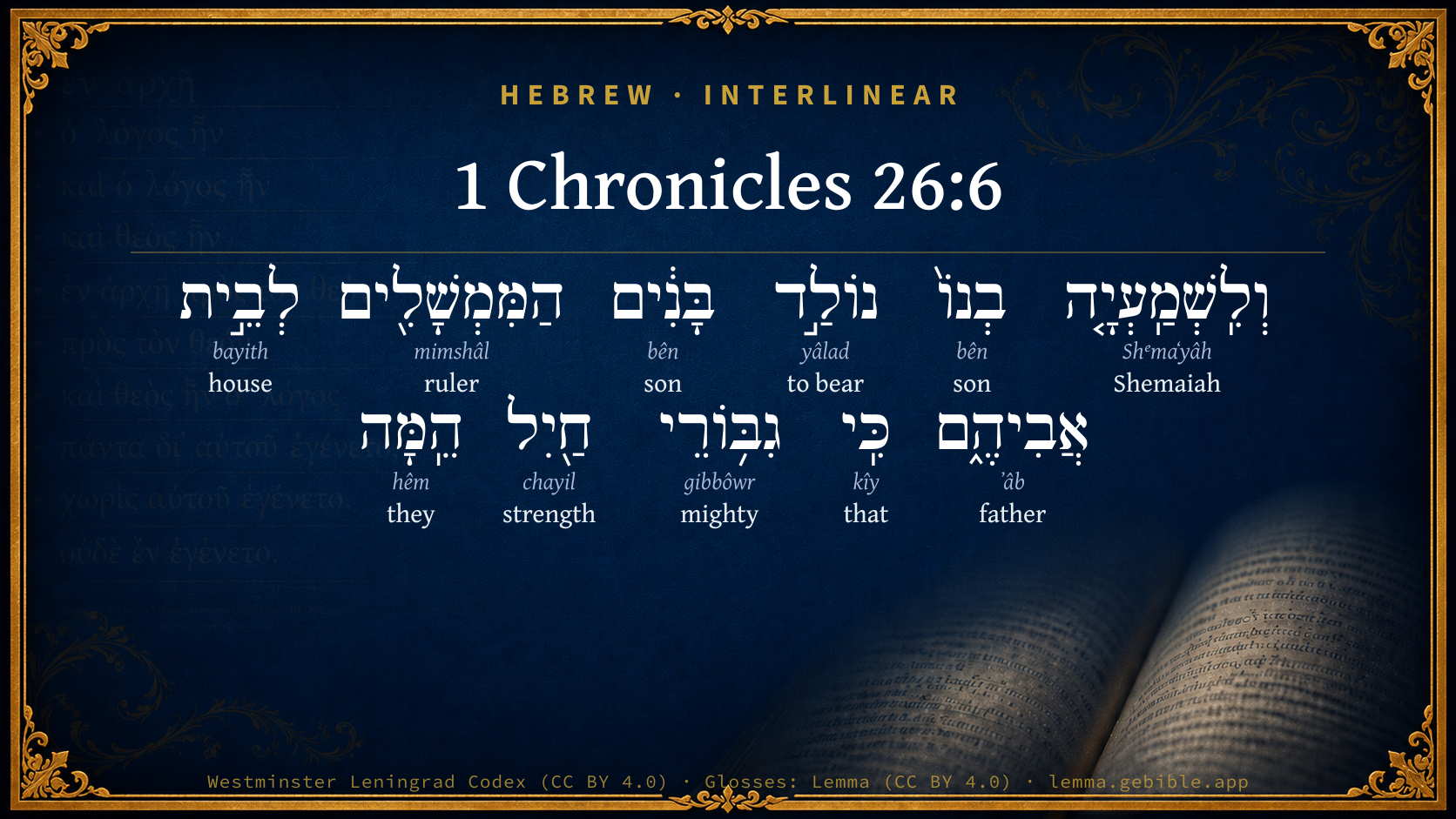
Hebrew (Westminster Leningrad Codex) 1 Chronicles 26:6 appears in the Hebrew Old Testament. The text above is from the Westminster Leningrad Codex. Each word links to its Strong’s number, a concise gloss, and parsing drawn from the Open Scriptures Hebrew Bible morphology. Click any word for its full Brown-Driver-Briggs (BDB) entry.
Download image
Cite this verse

1 Chronicles 26:6 (World English Bible). Public Domain. Lemma interlinear Bible study tool, https://lemma.gebible.app/v/1-chronicles/26/6.

Show BibTeX & RIS
BibTeX
RIS
English Translation
Also to Shemaiah his son were sons born, who ruled over the house of their father; for they were mighty men of valor.
World English Bible · Public Domain
Download a study sheet

One document with this verse’s original text, its word-by-word gloss line, the meaning frame, cross-references with their text, attributed commentary, and full source and license credits — printable, and it pastes into notes with its structure intact.

This verse Autodidact and up

Study sheet (.html) Plain text (.txt)

A passage Seminary Student

Up to 50 verses in one chapter. A passage sheet keeps up to 6 commentary sources and 12 cross-references per verse, in the order this page ranks them, and says so on the sheet whenever that leaves anything out. Ask for a single verse and you get the Autodidact verse sheet above.

Everything on this page stays free to read, with no account — the sheet is a download of what is already on screen, not access to it.

Want to remove ads? Support Godless Engineer
Compare translations 3

The same verse in 3 English versions, stacked beneath the original-language interlinear above. Click any original word for its lexicon entry.

Each is an independent rendering of the whole verse — the interlinear is not word-aligned to these translations.

Highlighted words mark where these versions differ — a whole-verse word diff, not a word-by-word alignment.

  • World English Bible Public Domain
    Also to Shemaiah his son were sons born, who ruled over the house of their father; for they were mighty men of valor.
  • King James Version Public Domain
    Also unto Shemaiah his son were sons born, that ruled throughout the house of their father: for they were mighty men of valor.
  • unfoldingWord Literal Text CC BY-SA 4.0
    And sons were born to Shemaiah his son, rulers in the house of their father; for they warriors of valor.

unfoldingWord Literal Text — © unfoldingWord, licensed CC BY-SA 4.0. Word-aligned USFM3 via Door43 (git.door43.org/unfoldingWord/en_ult).

Versions to compare (up to 4)

3 of 4 selected

Show all 18 translations

Every available English version of this verse, each an independent rendering of the whole verse.

  • World English Bible Public Domain
    Also to Shemaiah his son were sons born, who ruled over the house of their father; for they were mighty men of valor.
  • Berean Standard Bible Public Domain
    Also to his son Shemaiah were born sons who ruled over their families because they were strong, capable men.
  • Majority Standard Bible Public Domain
    Also to his son Shemaiah were born sons who ruled over their families because they were strong, capable men.
  • King James Version Public Domain
    Also unto Shemaiah his son were sons born, that ruled throughout the house of their father: for they were mighty men of valor.
  • American Standard Version (1901) Public Domain
    Also unto Shemaiah his son were sons born, that ruled over the house of their father; for they were mighty men of valor.
  • Revised Version (1885) Public Domain
    Also unto Shemaiah his son were sons born, that ruled over the house of their father: for they were mighty men of valour.
  • Geneva Bible (1599) Public Domain
    And to Shemaiah his sonne, were sonnes borne, that ruled in the house of their father, for they were men of might.
  • Douay-Rheims (1899) Public Domain
    And to Semei his son were born sons, herds of their families: for they were men of great valour.
  • Young's Literal Translation Public Domain
    And to Shemaiah his son have sons been born, who are ruling throughout the house of their father, for they `are' mighty of valour.
  • Literal Standard Version CC BY-SA 4.0
    And sons have been born to his son Shemaiah, who are ruling throughout the house of their father, for they [are] mighty men of valor.
  • Unlocked Literal Bible CC BY-SA 4.0
    To Shemaiah his son were born sons who ruled over their families; they were men with many abilities.
  • unfoldingWord Literal Text CC BY-SA 4.0
    And sons were born to Shemaiah his son, rulers in the house of their father; for they warriors of valor.
  • Darby Bible Public Domain
    And to Shemaiah his son were sons born, who were rulers in their father's house; for they were mighty men of valour.
  • World Messianic Bible Public Domain
    Sons were also born to Shemaiah his son, who ruled over the house of their father; for they were mighty men of valor.
  • Webster's Bible Public Domain
    Also to Shemaiah his son were sons born, that ruled throughout the house of their father: for they were mighty men of valor.
  • Free Bible Version CC BY-SA 4.0
    Shemaiah, Obed-edom's son, had sons who were capable leaders and had great authority in their father's family
  • Bible in Basic English Public Domain
    And Shemaiah his son had sons, rulers over the family of their father, for they were able men.
  • JPS Tanakh (1917) Public Domain
    Also unto Shemaiah his son were sons born, that ruled over the house of their father; for they were mighty men of valour.

Literal Standard Version (2020), Covenant Press — licensed CC BY-SA 4.0. Text via the HelloAO Bible API (eBible.org). Unlocked Literal Bible (unfoldingWord) — licensed CC BY-SA 4.0. Text via the HelloAO Bible API (eBible.org). unfoldingWord Literal Text — © unfoldingWord, licensed CC BY-SA 4.0. Word-aligned USFM3 via Door43 (git.door43.org/unfoldingWord/en_ult). Free Bible Version, Dr. Jonathan Gallagher — licensed CC BY-SA 4.0. Text via the HelloAO Bible API (eBible.org).

Word by word

More ways to search: Search by grammar → Find every occurrence → Compare this word →

Practice this passage: Drill this verse → Learn its vocabulary →

הַמִּמְשָׁלִ֖ים
mimshâl
H4474
“the · rulers”
Particle, Definite Article + Noun, Common, Both, Plural, Absolute
Part of Speech
Particle + Noun
Type
Common
Gender
Both
Number
Plural
State
Absolute
Full BDB Definition

Origin: from H4910

TWOT: 1259b

dominion, ruler - dominion - ruler
  1. וְלִֽשְׁמַֽעְיָ֤ה Shᵉmaʻyâh H8098 “and · to/for · Shemaiah” Conjunction + Preposition + Noun, Proper
  2. בְנוֹ֙ bên H1121 “son · his” Noun, Common, Masculine, Singular, Construct + Suffix, Personal, 3rd Person, Masculine, Singular
  3. נוֹלַ֣ד yâlad H3205 “to bear” Verb, Niphal, Perfect, 3rd Person, Masculine, Singular
  4. בָּנִ֔ים bên H1121 “sons” Noun, Common, Masculine, Plural, Absolute
  5. לְבֵ֣ית bayith H1004 “to/for · house of” Preposition + Noun, Common, Masculine, Singular, Construct
  6. אֲבִיהֶ֑ם ʼâb H1 “father · their” Noun, Common, Masculine, Singular, Construct + Suffix, Personal, 3rd Person, Masculine, Plural
  7. כִּֽי kîy H3588 “that” Conjunction
  8. גִבּ֥וֹרֵי gibbôwr H1368 “mighty of” Adjective, Adjective, Masculine, Plural, Construct
  9. חַ֖יִל chayil H2428 “strength” Noun, Common, Masculine, Singular, Absolute
  10. הֵֽמָּה hêm H1992 “they” Pronoun, Personal, 3rd Person, Masculine, Plural

About this verse

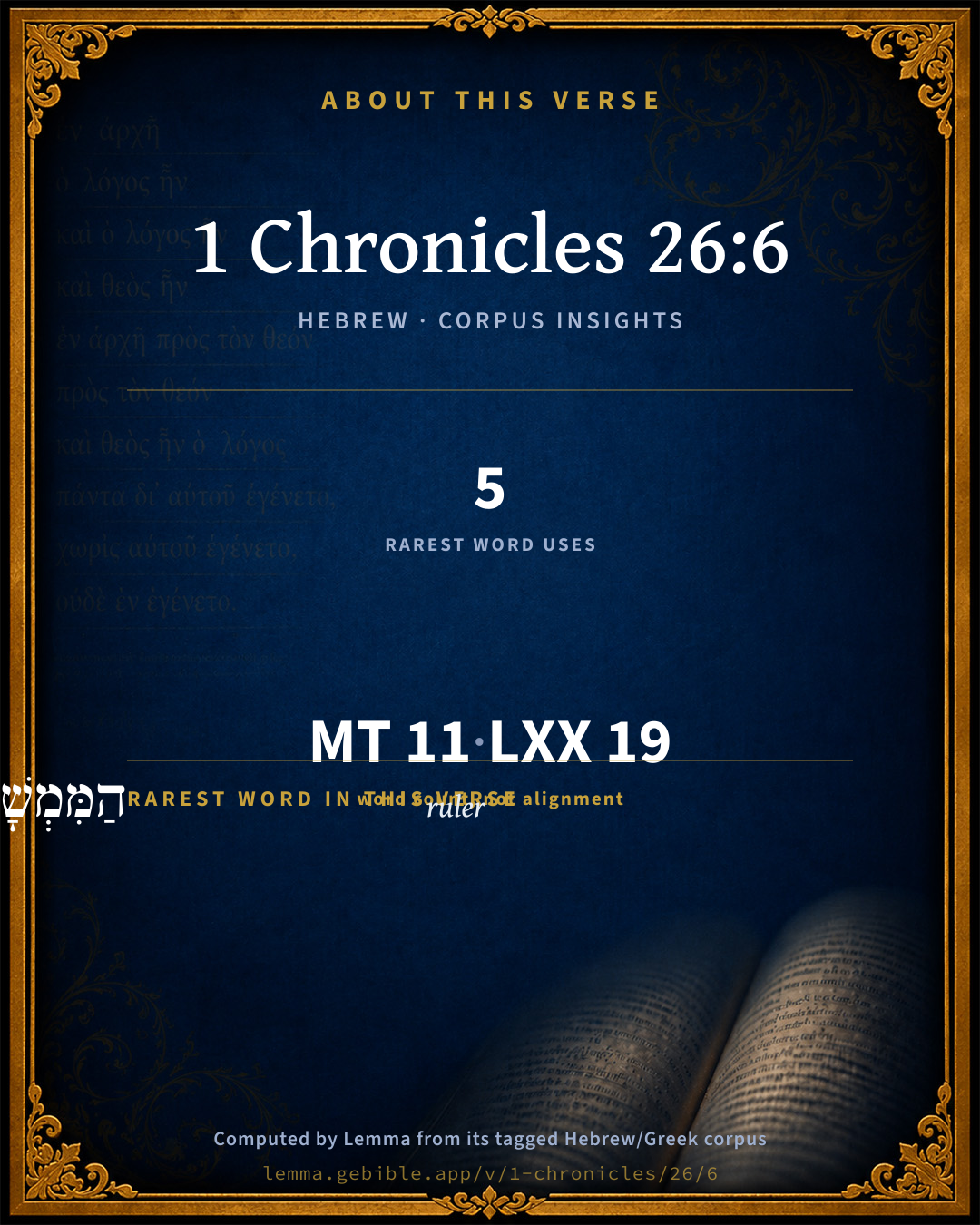
These counts appear in no published source. They are computed here, from the morphology-tagged text and Lemma’s own curated glosses. What Lemma adds →

11
words
10
distinct lemmas
Historical
section

Notable vocabulary

The rarest word here is הַמִּמְשָׁלִ֖ים ruler H4474 — appearing just 5 times in the whole Hebrew Bible.

Shared distinctive vocabulary

הַמִּמְשָׁלִ֖ים ruler H4474 occurs in 5 verses of the Hebrew Bible. Also found in:

Grammatical profile

  • 1 verb
  • 7 nouns
  • 1 adjective
  • 1 pronoun
  • 1 conjunction

Verb forms

  • נוֹלַ֣ד Niphal · Perfect

Repetition

A word recurs within this verse — often emphatic in Hebrew:

  • בְנוֹ֙ son H1121 ×2

Hebrew & Septuagint length

In English translation the verse runs 23 words from the Hebrew and 23 from the Septuagint (LXX English) — the same length.

A rough comparison of the two English renderings, which tokenize alike — not a word-level alignment.

Word counts can differ between the Hebrew and the Greek without any difference in meaning — e.g. the Hebrew direct-object marker אֵת has no separate Greek word, and Greek often adds the article ὁ.

In the original languages it is 11 Hebrew tokens and 19 Greek tokens — but the two are counted differently (Hebrew bundles its prefixes and suffixes into one token; the Greek is in lemma form), so that isn’t a like-for-like length.

Cross-references

8

Topical passages linked to 1 Chronicles 26:6 in the Treasury of Scripture Knowledge — connected by theme and wording, ordered by reader-vote popularity; previews shown in the World English Bible.

  • Judges 6:12 The angel of Yahweh appeared to him, and said to him, Yahweh is with you, you mighty man of valor.
  • 2 Samuel 2:7 Now therefore let your hands be strong, and be you valiant; for Saul your lord is dead, and also the house of Judah have anointed me king over them.
  • 1 Chronicles 12:28 and Zadok, a young man mighty of valor, and of his father's house twenty-two captains.
  • 1 Chronicles 26:8 All these were of the sons of Obed-edom: they and their sons and their brothers, able men in strength for the service; sixty-two of Obed-edom.
  • 2 Chronicles 26:17 Azariah the priest went in after him, and with him eighty priests of Yahweh, who were valiant men:
  • Nehemiah 11:14 and their brothers, mighty men of valor, one hundred twenty-eight; and their overseer was Zabdiel, the son of Haggedolim.
  • 1 Timothy 6:12 Fight the good fight of faith. Lay hold of the eternal life to which you were called, and you confessed the good confession in the sight of many witnesses.
  • 2 Timothy 2:3 You therefore must endure hardship, as a good soldier of Christ Jesus.

Cross-references courtesy of OpenBible.info (CC BY 4.0).

Hebrew and Greek witnesses Masoretic Hebrew ↔ Greek Septuagint

The same verse in the two great witnesses to the Old Testament, shown verse-for-verse.

These are two independent witnesses, not word-aligned to each other, and the Septuagint is shown in lemma (dictionary) form.

Hebrew 1 Chronicles 26:6 Masoretic · Westminster Leningrad Codex

וְלִֽשְׁמַֽעְיָ֤ה בְנוֹ֙ נוֹלַ֣ד בָּנִ֔ים הַמִּמְשָׁלִ֖ים לְבֵ֣ית אֲבִיהֶ֑ם כִּֽי גִבּ֥וֹרֵי חַ֖יִל הֵֽמָּה

Also to Shemaiah his son were sons born, who ruled over the house of their father; for they were mighty men of valor.

World English Bible · Public Domain

Greek LXX 1 Chronicles 26:6 Septuagint · lemma form

καί ὁ σαμαια υἱός αὐτός τίκτω υἱός ὁ πρωτότοκος ρωσαι εἰς ὁ οἶκος ὁ πατρικός αὐτός ὅτι δυνατός εἰμί

And to Samaias his son were born the sons of his firstborn, chiefs over the house of their father, for they were mighty.

LXX2012 (modern English Septuagint) · Public Domain

On this verse, Haydock's Catholic Bible Commentary discusses the Septuagint’s reading. Read the note in Commentary ↓

Hebrew: Westminster Leningrad Codex (CC BY 4.0). Greek: Septuagint (public domain); English from LXX2012 (modern English Septuagint) (Public Domain). How the Septuagint differs from the Hebrew →

Commentary

Notes on 1 Chronicles 26:6 from classic Christian and Jewish commentators (each source and its license shown beneath its notes). The classic Christian expositions comment on the surrounding passage and are grouped to its opening verse, so a note may address several verses; the Jewish commentaries on the Tanakh (Rashi and others) are per-verse, so they appear only where the commentator wrote on this verse.

Lemma curates 59 commentaries, every one of them public domain or Creative Commons licensed, each selected and text-cleaned for this edition rather than reprinted as found. About our sources →

Trapp's Complete Commentary

John Trapp

1Ch 26:6 Also unto Shemaiah his son were sons born, that ruled throughout the house of their father: for they [were] mighty men of valour.

Ver. 6. That ruled throughout the house of their father.] Or, Were like to the house of their father: i.e., they were mighty men of valour, able to execute their office, and to suppress all tumults that might arise at the gates of the temple, by reason of the great concourse of people resorting thereunto, at the three great feasts especially.

John Trapp, A Commentary or Exposition upon All the Books of the Old and New Testament (1647–1656) — public domain. Text from a community e-Sword module.

Joseph Benson's Commentary

1Ch 26:6. They were mighty men of valour — This clause is divers times mentioned, because their office required both strength and courage: for they were to shut the doors of the temple, one whereof was so great and weighty that in the second temple it required twenty men to open and shut it. They were also to keep the guard, to keep out all unclean or forbidden persons, to prevent or suppress any tumults or disorders which might happen in the temple or in its courts, to keep the treasures of the temple, (1Ch 26:20; 1Ch 26:22; 1Ch 26:24; 1Ch 26:26,) to be officers and judges over Israel, (1Ch 26:29,) and to manage every matter pertaining to God and the affairs of the king, 1Ch 26:32.

Joseph Benson's Commentary on the Old and New Testaments (1811–1818) — public domain. Text from a community e-Sword module.

Geneva Bible (1599)

Geneva Bible translators

Or, like their father’s house, meaning, worthy men, and valiant.

Geneva Bible (1599) marginal notes — public domain. Text via Bolls.life.

Jamieson, Fausset & Brown

Robert Jamieson, A. R. Fausset & David Brown

mighty men of valour--The circumstance of physical strength is prominently noticed in this chapter, as the office of the porters required them not only to act as sentinels of the sacred edifice and its precious furniture against attacks of plunderers or popular insurrection--to be, in fact, a military guard--but, after the temple was built, to open and shut the gates, which were extraordinarily large and ponderous.

Jamieson, Fausset & Brown — Commentary Critical and Explanatory on the Whole Bible (1871) — public domain (CC PDM 1.0). Text via the HelloAO Bible API.

Adam Clarke's Commentary

Verse 6. They were mighty men of valour.] They were not only porters or door-keepers in the ordinary sense of the word, but they were a military guard for the gates: and perhaps in this sense alone we are to understand their office.

Adam Clarke's Commentary on the Bible (1810–1826) — public domain. Text from a community e-Sword/MySword module.

Ellicott's Commentary for English Readers

(6) That ruled throughout the house of their father.—Rather, The lords of their clan. The word translated “that ruled,” is not a verb, but an abstract noun (mimshâl), like our expression “the authorities,” or “the government.” It only occurs besides in Dan_11:3; Dan_11:5.

Mighty men of valour.—See Note on 1Ch_9:13.

A Bible Commentary for English Readers, edited by Charles John Ellicott (1878–1897) — public domain. Text from a community e-Sword module.

The Cambridge Bible for Schools and Colleges

gen. ed. J. J. S. Perowne

6. throughout the house] R.V. over the house.

The Cambridge Bible for Schools and Colleges (gen. ed. J. J. S. Perowne; Cambridge University Press, 1878–1918) — public domain. Text from a community e-Sword module.

John Gill's Exposition

Also unto Shemaiah his son,.... His firstborn, Ch1 26:4.

were sons born, that ruled throughout the house of their father; were heads of families, eminent and principal men:

for they were mighty men of valour; which their office sometimes required them to be, to guard the temple at night as well as day from thieves and robbers, and to hinder resolute men entering in, unfit for it, and seize on rioters, and quell tumults raised.

John Gill's Exposition of the Whole Bible (1746–1763) — public domain (CC PDM 1.0). Text via the HelloAO Bible API.

Haydock's Catholic Bible Commentary

Semei, who is called Semeias, ver. 4., and 7. The last syllable is not lost in Hebrew or Septuagint. (Haydock) --- Valour. Their post was of a military nature, and required strength. Josephus says, some of the gates could hardly be shut by twenty men.

George Leo Haydock (1774–1849), Haydock's Catholic Family Bible and Commentary, 1859 edition — public domain. Excludes Psalms (Douay-Rheims chapter numbering differs from Protestant) and Deuterocanonical books (Catholic canon only).

Matthew Poole's English Annotations

That ruled throughout the house of their father; that had the command of their brethren and families, being, as some say, captains of hundreds or of thousands; of which see Exo 18:25; 2Ki 11:9.

They were mighty men of valor: this clause is divers times mentioned, because their office returned both strength and courage; for they were to shut the doors of the temple, one whereof was so great and weighty, that in the second temple it required the help of twenty men to open and shut it, as Josephus, an eye-witness, reports. They were also to keep the guard, and to keep out all unclean or forbidden persons, who might sometimes presumptuously attempt to enter into the temple, as Uzziah did, and to prevent or suppress any tumults or disorders which might happen in the temple or in its courts, and to keep the treasures of the temple. 1Ch 26:20,22,24,26, and to be officers and judges over Israel, 1Ch 26:29, and to manage every matter pertaining to God and the affairs of the king, 1Ch 26:32.

Matthew Poole's English Annotations on the Holy Bible (1683–1685) — public domain. Text from a community e-Sword/MySword module.

The Pulpit Commentary

Vers. 6, 7. In the former of these verses, eulogy is pronounced by anticipation on the six grandsons of Obed-edom through his son Shemaiah, about to be mentioned in the latter verse. The singular number of the verb (dlwOn), with a plural nominative, as found here, often occurs elsewhere, and repeatedly, even in this book, in cases where the relative pronoun rva intervenes between the subject and its verb. That ruled throughout the house of their father. The plural masculine abstract noun ( here employed, in place of a verbal or participial form, is intended to gain force. A similar use of the feminine form of the same noun in the singular, and with suffix, may be cited from 2Ch_32:9. Whose brethren. An erroneous translation for his brethren; a correction, however, rendering more patent the inconvenience of the unexplained absence of the conjunction, which seems to be called for before both "Elzabad," and "his brethren." Bertheau suggests that other names are wanting which should fill up the meaning of "his brethren." The brethren intended were probably Elihu and Semachiah.

The Pulpit Commentary (1880–1919), ed. H.D.M. Spence-Jones & Joseph S. Exell — public domain. Text from a community e-Sword module.

John Wesley's Explanatory Notes

Of valour - This clause is divers times mentioned, because their office required both strength and courage: for they were to shut the doors of the temple, one whereof was so great and weighty, that in the second temple it required twenty men to open and shut it. They were also to keep the guard, to keep out all unclean or forbidden persons, to prevent or suppress any tumults or disorders which might happen in the temple or in its courts, to keep the treasures of the temple, ver. 20, 22, 24, 26, to be officers and Judges over Israel, ver. 29, and to manage every matter pertaining to God, and the affairs of the king, ver. 32.

John Wesley, Explanatory Notes Upon the Whole Bible (1754–1765) — public domain. Text via the GEBible commentary corpus.

Keil & Delitzsch

C. F. Keil & F. Delitzsch

Also unto Shemaiah his son,.... His firstborn, Ch1 26:4.

were sons born, that ruled throughout the house of their father; were heads of families, eminent and principal men:

for they were mighty men of valour; which their office sometimes required them to be, to guard the temple at night as well as day from thieves and robbers, and to hinder resolute men entering in, unfit for it, and seize on rioters, and quell tumults raised.

Keil & Delitzsch — Biblical Commentary on the Old Testament (1861–1891) — public domain (CC PDM 1.0). Text via the HelloAO Bible API. (Old Testament only.)

Rashi

Rabbi Shlomo Yitzchaki (Rashi)

who ruled through their father’s house The meaning is that those ruling were doing so through their father, and a similarity is [found] at the end of Daniel (11:3): “and rule a great dominion (וּמָשַל מִמְשַל רַב).”

Rashi on the Tanakh — English translations: “The Judaica Press complete Tanach with Rashi, translated by A. J. Rosenberg” (CC BY 4.0); “Pentateuch with Rashi's commentary by M. Rosenbaum and A.M. Silbermann, 1929-1934” (public domain); “The Metsudah Tanach series, Lakewood, N.J” (CC BY 4.0); and “The Book of Joshua, Metsudah Publications, 1997” (CC BY 4.0). Text via Sefaria.

Lesson kit

Teaching starters — assembled from the data on this page, not authored interpretation. Every prompt links to the verse data it draws on. Edit before teaching.

1 Chronicles, in the Historical, opens this verse with 11 words (10 distinct Hebrew lemmas). Its most distinctive word is mimshâl (“ruler”). A historical commentator’s framing appears above. Read the whole chapter for the surrounding context.

Discussion questions

  1. How does “ruler” (mimshâl) shape what this verse is saying?
  2. How does 2 Kings 20:13, which shares the word «ruler», read alongside this verse?
  3. What does the repetition of “son” (2× in this one verse) do in this verse?
  4. These translations render this verse differently. What is at stake in choosing one wording over another?
  5. «נוֹלַ֣ד» is a Niphal Perfect verb. How does that grammatical form shape the action described?
  6. Compare how Trapp's Complete Commentary and Joseph Benson's Commentary read this verse. Where do they agree or differ?

Things to notice

Reading settings

Reading text

Shown beneath each verse's original-language words.

Old Testament
Old Testament edition

Read the OT as the Masoretic Hebrew (MT) or the Greek Septuagint (LXX).

English shown for the Greek Septuagint (in the Hebrew ↔ Greek comparison).

Comparing translations? Open the Compare panel on any verse page to stack up to four side by side.