
1 Kings 1:42

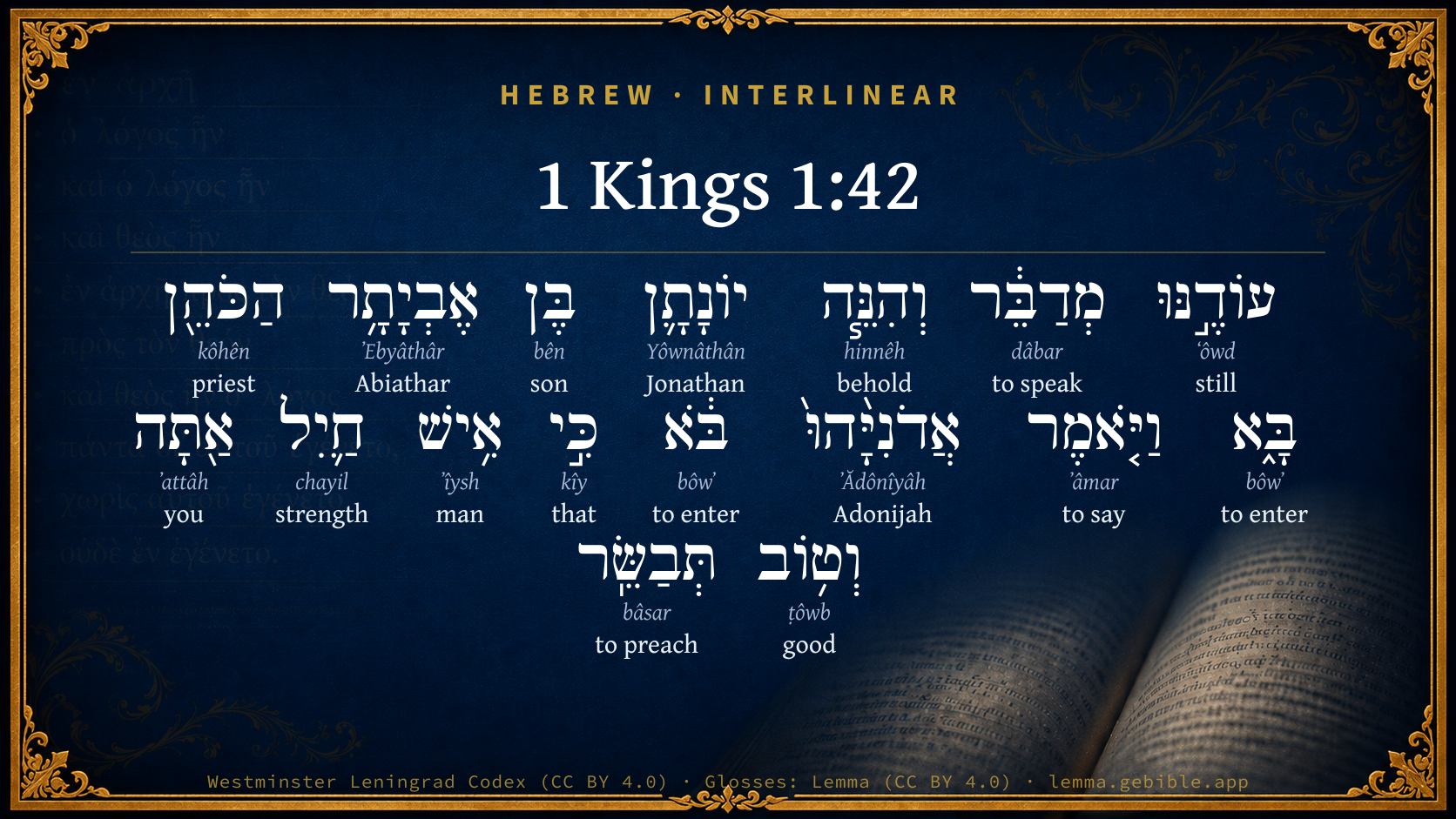
Hebrew (Westminster Leningrad Codex) 1 Kings 1:42 appears in the Hebrew Old Testament. The text above is from the Westminster Leningrad Codex. Each word links to its Strong’s number, a concise gloss, and parsing drawn from the Open Scriptures Hebrew Bible morphology. Click any word for its full Brown-Driver-Briggs (BDB) entry.
Download image
Cite this verse

1 Kings 1:42 (World English Bible). Public Domain. Lemma interlinear Bible study tool, https://lemma.gebible.app/v/1-kings/1/42.

Show BibTeX & RIS
BibTeX
RIS
English Translation
While he yet spoke, behold, Jonathan the son of Abiathar the priest came: and Adonijah said, Come in; for you are a worthy man, and bring good news.
World English Bible · Public Domain
Download a study sheet

One document with this verse’s original text, its word-by-word gloss line, the meaning frame, cross-references with their text, attributed commentary, and full source and license credits — printable, and it pastes into notes with its structure intact.

This verse Autodidact and up

Study sheet (.html) Plain text (.txt)

A passage Seminary Student

Up to 50 verses in one chapter. A passage sheet keeps up to 6 commentary sources and 12 cross-references per verse, in the order this page ranks them, and says so on the sheet whenever that leaves anything out. Ask for a single verse and you get the Autodidact verse sheet above.

Everything on this page stays free to read, with no account — the sheet is a download of what is already on screen, not access to it.

Want to remove ads? Support Godless Engineer
Compare translations 3

The same verse in 3 English versions, stacked beneath the original-language interlinear above. Click any original word for its lexicon entry.

Each is an independent rendering of the whole verse — the interlinear is not word-aligned to these translations.

Highlighted words mark where these versions differ — a whole-verse word diff, not a word-by-word alignment.

  • World English Bible Public Domain
    While he yet spoke, behold, Jonathan the son of Abiathar the priest came: and Adonijah said, Come in; for you are a worthy man, and bring good news.
  • King James Version Public Domain
    And while he yet spake, behold, Jonathan the son of Abiathar the priest came; and Adonijah said unto him, Come in; for thou art a valiant man, and bringest good tidings.
  • unfoldingWord Literal Text CC BY-SA 4.0
    He was still speaking, and behold, Jonathan, the son of Abiathar the priest, came. And Adonijah said, “Come, for you are a man of valor, and you will bring good news.”

unfoldingWord Literal Text — © unfoldingWord, licensed CC BY-SA 4.0. Word-aligned USFM3 via Door43 (git.door43.org/unfoldingWord/en_ult).

Versions to compare (up to 4)

3 of 4 selected

Show all 18 translations

Every available English version of this verse, each an independent rendering of the whole verse.

  • World English Bible Public Domain
    While he yet spoke, behold, Jonathan the son of Abiathar the priest came: and Adonijah said, Come in; for you are a worthy man, and bring good news.
  • Berean Standard Bible Public Domain
    As he was speaking, suddenly Jonathan the son of Abiathar the priest arrived. “Come in,” said Adonijah, “for you are a man of valor. You must be bringing good news.”
  • Majority Standard Bible Public Domain
    As he was speaking, suddenly Jonathan the son of Abiathar the priest arrived. “Come in,” said Adonijah, “for you are a man of valor. You must be bringing good news.”
  • King James Version Public Domain
    And while he yet spake, behold, Jonathan the son of Abiathar the priest came; and Adonijah said unto him, Come in; for thou art a valiant man, and bringest good tidings.
  • American Standard Version (1901) Public Domain
    While he yet spake, behold, Jonathan the son of Abiathar the priest came: and Adonijah said, Come in; for thou art a worthy man, and bringest good tidings.
  • Revised Version (1885) Public Domain
    While he yet spake, behold, Jonathan the son of Abiathar the priest came: and Adonijah said, Come in; for thou art a worthy man, and bringest good tidings.
  • Geneva Bible (1599) Public Domain
    And as he yet spake, beholde, Ionathan the sonne of Abiathar the Priest came: and Adoniiah said, Come in: for thou art a worthie man, and bringest good tidings.
  • Douay-Rheims (1899) Public Domain
    While he yet spoke, Jonathan the son of Abiathar the priest came: and Adonias said to him: Come in, because thou art a valiant man, and bringest good news.
  • Young's Literal Translation Public Domain
    He is yet speaking, and lo, Jonathan son of Abiathar the priest hath come in, and Adonijah saith, `Come in, for a man of valour thou `art', and thou bearest good tidings.'
  • Literal Standard Version CC BY-SA 4.0
    He is yet speaking, and behold, Jonathan son of Abiathar the priest has come in, and Adonijah says, “Come in, for you [are] a man of valor, and you bear good tidings.”
  • Unlocked Literal Bible CC BY-SA 4.0
    While he was still speaking, Jonathan son of Abiathar the priest came. Adonijah said, “Come in, for you are a worthy man and bring good news.”
  • unfoldingWord Literal Text CC BY-SA 4.0
    He was still speaking, and behold, Jonathan, the son of Abiathar the priest, came. And Adonijah said, “Come, for you are a man of valor, and you will bring good news.”
  • Darby Bible Public Domain
    While he yet spoke, behold, Jonathan the son of Abiathar the priest came; and Adonijah said [to him], Come in; for thou art a valiant man, and bringest good news.
  • World Messianic Bible Public Domain
    While he yet spoke, behold, Jonathan the son of Abiathar the priest came; and Adonijah said, “Come in; for you are a worthy man, and bring good news.”
  • Webster's Bible Public Domain
    And while he yet spoke, behold, Jonathan the son of Abiathar the priest came: and Adonijah said to him, Come in; for thou art a valiant man, and bringest good tidings.
  • Free Bible Version CC BY-SA 4.0
    While he was speaking, Jonathan, son of Abiathar the priest, suddenly arrived. “Come on in,” said Adonijah. “A good man like you must be bringing good news.”
  • Bible in Basic English Public Domain
    And while the words were on his lips, Jonathan, the son of Abiathar the priest, came; and Adonijah said, Come in; for you are a man of good faith and the news which you have for us will be good.
  • JPS Tanakh (1917) Public Domain
    While he yet spoke, behold, Jonathan the son of Abiathar the priest came; and Adonijah said: 'Come in; for thou art a worthy man, and bringest good tidings.'

Literal Standard Version (2020), Covenant Press — licensed CC BY-SA 4.0. Text via the HelloAO Bible API (eBible.org). Unlocked Literal Bible (unfoldingWord) — licensed CC BY-SA 4.0. Text via the HelloAO Bible API (eBible.org). unfoldingWord Literal Text — © unfoldingWord, licensed CC BY-SA 4.0. Word-aligned USFM3 via Door43 (git.door43.org/unfoldingWord/en_ult). Free Bible Version, Dr. Jonathan Gallagher — licensed CC BY-SA 4.0. Text via the HelloAO Bible API (eBible.org).

Word by word

More ways to search: Search by grammar → Find every occurrence → Compare this word →

Practice this passage: Drill this verse → Learn its vocabulary →

תְּבַשֵּֽׂר
bâsar
H1319
“to preach”
Verb, Piel, Imperfect, 2nd Person, Masculine, Singular
Part of Speech
Verb
Stem
Piel
Form
Imperfect
Person
2nd Person
Gender
Masculine
Number
Singular
Full BDB Definition

Origin: a primitive root

TWOT: 291

to bear news, bear tidings, publish, preach, show forth - (Piel) - to gladden with good news - to bear news - to announce (salvation) as good news, preach - (Hithpael) to receive good news
  1. עוֹדֶ֣נּוּ ʻôwd H5750 “still · his” Adverb + Suffix, Personal, 3rd Person, Masculine, Singular
  2. מְדַבֵּ֔ר dâbar H1696 “speaking” Verb, Piel, Participle Active, Masculine, Singular, Absolute
  3. וְהִנֵּ֧ה hinnêh H2009 “and · behold” Conjunction + Particle, Demonstrative
  4. יוֹנָתָ֛ן Yôwnâthân H3129 “Jonathan” Noun, Proper
  5. בֶּן bên H1121 “son of” Noun, Common, Masculine, Singular, Construct
  6. אֶבְיָתָ֥ר ʼEbyâthâr H54 “Abiathar” Noun, Proper
  7. הַכֹּהֵ֖ן kôhên H3548 “the · priest” Particle, Definite Article + Noun, Common, Masculine, Singular, Absolute
  8. בָּ֑א bôwʼ H935 “to enter” Verb, Qal, Perfect, 3rd Person, Masculine, Singular
  9. וַיֹּ֤אמֶר ʼâmar H559 “and · to say” Conjunction + Verb, Qal, Sequential Imperfect, 3rd Person, Masculine, Singular
  10. אֲדֹנִיָּ֨הוּ֙ ʼĂdônîyâh H138 “Adonijah” Noun, Proper
  11. בֹּ֔א bôwʼ H935 “enter” Verb, Qal, Imperative, 2nd Person, Masculine, Singular
  12. כִּ֣י kîy H3588 “that” Conjunction
  13. אִ֥ישׁ ʼîysh H376 “man of” Noun, Common, Masculine, Singular, Construct
  14. חַ֛יִל chayil H2428 “strength” Noun, Common, Masculine, Singular, Absolute
  15. אַ֖תָּה ʼattâh H859 “you” Pronoun, Personal, 2nd Person, Masculine, Singular
  16. וְט֥וֹב ṭôwb H2896 “and · good” Conjunction + Adjective, Adjective, Masculine, Singular, Absolute

About this verse

These counts appear in no published source. They are computed here, from the morphology-tagged text and Lemma’s own curated glosses. What Lemma adds →

17
words
16
distinct lemmas
Historical
section

Notable vocabulary

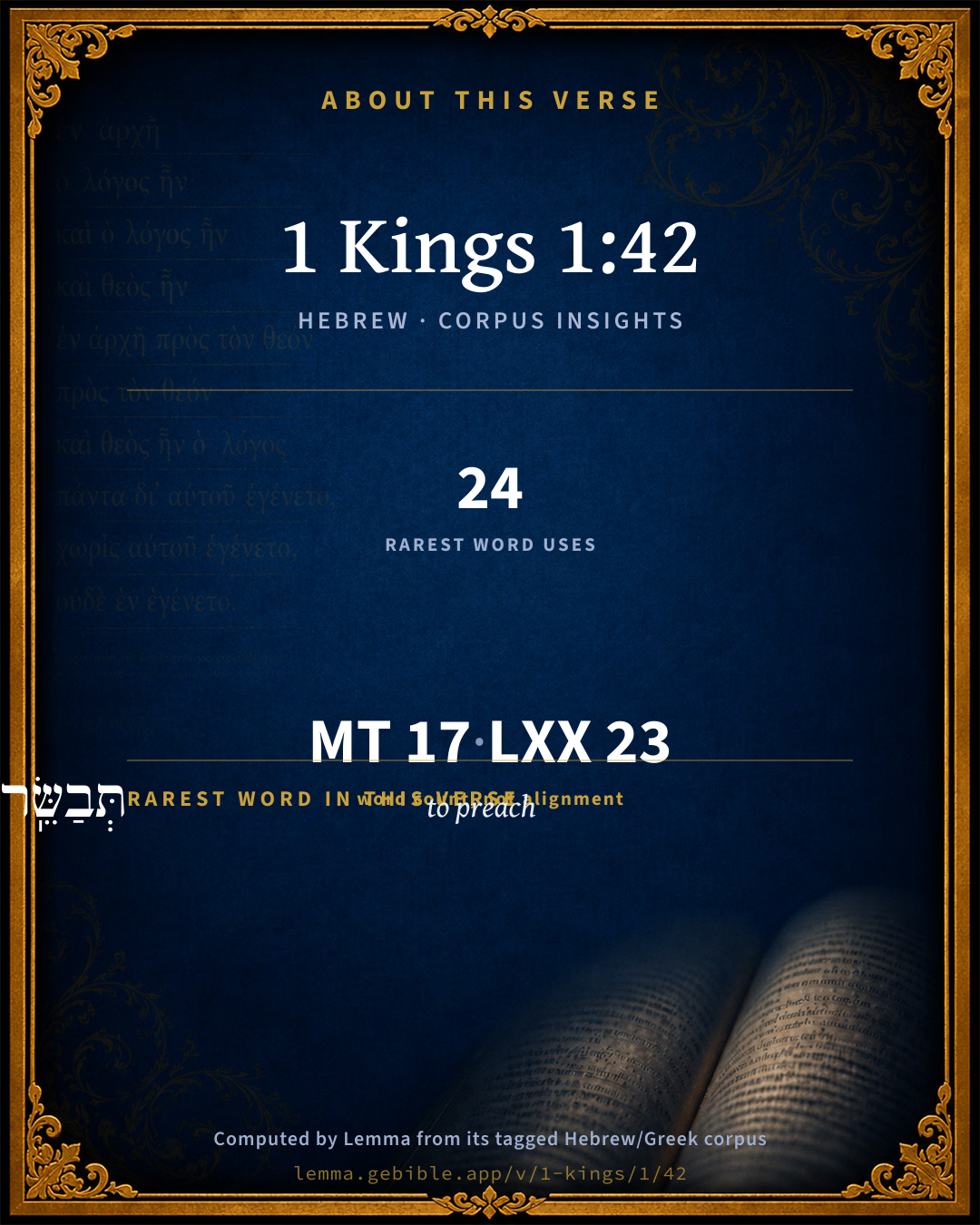
The rarest word here is תְּבַשֵּֽׂר to preach H1319 — appearing just 24 times in the whole Hebrew Bible.

Shared distinctive vocabulary

תְּבַשֵּֽׂר to preach H1319 occurs in 21 verses of the Hebrew Bible. Also found in:

Grammatical profile

  • 5 verbs
  • 7 nouns
  • 1 adjective
  • 1 pronoun
  • 1 conjunction
  • 1 adverb
  • 1 particle

Verb forms

  • מְדַבֵּ֔ר Piel · Participle Active
  • בָּ֑א Qal · Perfect
  • וַיֹּ֤אמֶר Qal · Sequential Imperfect
  • בֹּ֔א Qal · Imperative
  • תְּבַשֵּֽׂר Piel · Imperfect

Repetition

A word recurs within this verse — often emphatic in Hebrew:

  • בָּ֑א to enter H935 ×2

Hebrew & Septuagint length

In English translation the verse runs 28 words from the Hebrew and 33 from the Septuagint (LXX English) — closely comparable.

A rough comparison of the two English renderings, which tokenize alike — not a word-level alignment.

Word counts can differ between the Hebrew and the Greek without any difference in meaning — e.g. the Hebrew direct-object marker אֵת has no separate Greek word, and Greek often adds the article ὁ.

In the original languages it is 17 Hebrew tokens and 23 Greek tokens — but the two are counted differently (Hebrew bundles its prefixes and suffixes into one token; the Greek is in lemma form), so that isn’t a like-for-like length.

Cross-references

8

Topical passages linked to 1 Kings 1:42 in the Treasury of Scripture Knowledge — connected by theme and wording, ordered by reader-vote popularity; previews shown in the World English Bible.

  • 2 Samuel 15:36 Behold, they have there with them their two sons, Ahimaaz, Zadok's son, and Jonathan, Abiathar's son; and by them you shall send to me everything that you shall hear.
  • 2 Samuel 17:17 Now Jonathan and Ahimaaz were staying by En Rogel; and a maid-servant used to go and tell them; and they went and told king David: for they might not be seen to come into the city.
  • 2 Samuel 18:27 The watchman said, I think the running of the foremost is like the running of Ahimaaz the son of Zadok. The king said, He is a good man, and comes with good news.
  • 2 Samuel 15:27 The king said also to Zadok the priest, "Aren't you a seer? Return into the city in peace, and your two sons with you, Ahimaaz your son, and Jonathan the son of Abiathar.
  • 1 Kings 22:18 The king of Israel said to Jehoshaphat, Didn't I tell you that he would not prophesy good concerning me, but evil?
  • 2 Kings 9:22 It happened, when Joram saw Jehu, that he said, Is it peace, Jehu? He answered, What peace, so long as the prostitution of your mother Jezebel and her witchcraft abound?
  • Isaiah 57:21 There is no peace, says my God, to the wicked.
  • 1 Thessalonians 5:2–3 For you yourselves know well that the day of the Lord comes like a thief in the night.

Cross-references courtesy of OpenBible.info (CC BY 4.0).

Hebrew and Greek witnesses Masoretic Hebrew ↔ Greek Septuagint

The same verse in the two great witnesses to the Old Testament, shown verse-for-verse.

These are two independent witnesses, not word-aligned to each other, and the Septuagint is shown in lemma (dictionary) form.

Hebrew 1 Kings 1:42 Masoretic · Westminster Leningrad Codex

עוֹדֶ֣נּוּ מְדַבֵּ֔ר וְהִנֵּ֧ה יוֹנָתָ֛ן בֶּן אֶבְיָתָ֥ר הַכֹּהֵ֖ן בָּ֑א וַיֹּ֤אמֶר אֲדֹנִיָּ֨הוּ֙ בֹּ֔א כִּ֣י אִ֥ישׁ חַ֛יִל אַ֖תָּה וְט֥וֹב תְּבַשֵּֽׂר

While he yet spoke, behold, Jonathan the son of Abiathar the priest came: and Adonijah said, Come in; for you are a worthy man, and bring good news.

World English Bible · Public Domain

Greek LXX 1 Kings 1:42 Septuagint · lemma form

ἔτι αὐτός λαλέω καί ἰδού ιωναθαν υἱός αβιαθαρ ὁ ἱερεύς ἔρχομαι καί εἶπον αδωνίας εἰςἔρχομαι ὅτι ἀνήρ δύναμις εἰμί σύ καί ἀγαθός εὐαγγελίζω

While he was yet speaking, behold, Jonathan the son of Abiathar the priest came in: and Adonias said, Come in, for you are a mighty man, and you come to bring glad tidings.

LXX2012 (modern English Septuagint) · Public Domain

On this verse, The Pulpit Commentary discusses the Septuagint’s reading. Read the note in Commentary ↓

Hebrew: Westminster Leningrad Codex (CC BY 4.0). Greek: Septuagint (public domain); English from LXX2012 (modern English Septuagint) (Public Domain). How the Septuagint differs from the Hebrew →

Targum (Aramaic paraphrase)

1

The Targum is the ancient Jewish Aramaic paraphrase of the Hebrew Scriptures — an interpretive translation, not the Hebrew text itself. Onkelos (literal) and Pseudo-Jonathan (expansive) render the Torah, and Jonathan the Prophets. Coverage is partial: where no permissively-licensed English translation exists for a verse, only the Aramaic is shown. This is verse-level text, not a word-by-word alignment to the Hebrew.

  1. Targum Jonathan Prophets (Joshua–Malachi)
    עַד דְהוּא מַלֵיל וְהָא יְהוֹנָתָן בַּר אֶבְיָתָר כַּהֲנָא אֲתָא וַאֲמַר אֲדֹנִיָה עוֹל אֲרֵי גְבַר דָחֵיל חֶטְאִין אַתְּ וְטַב תְּבַשֵׂר:

    (no public-domain English translation for this verse)

    Targum Jonathan — Aramaic: “Mikraot Gedolot” (public domain). English: “Sefaria Community Translation” (CC0 1.0 (public-domain dedication)); “London "Chaldee Paraphrase," 1871” (public domain). Text via Sefaria.

Commentary

Notes on 1 Kings 1:42 from classic Christian and Jewish commentators (each source and its license shown beneath its notes). The classic Christian expositions comment on the surrounding passage and are grouped to its opening verse, so a note may address several verses; the Jewish commentaries on the Tanakh (Rashi and others) are per-verse, so they appear only where the commentator wrote on this verse.

Lemma curates 59 commentaries, every one of them public domain or Creative Commons licensed, each selected and text-cleaned for this edition rather than reprinted as found. About our sources →

Trapp's Complete Commentary

John Trapp

1Ki 1:42 And while he yet spake, behold, Jonathan the son of Abiathar the priest came: and Adonijah said unto him, Come in; for thou [art] a valiant man, and bringest good tidings.

Ver. 42. And bringest good tidings.] So Adonijah would have had it; but the expectation of the wicked shall perish; when they are at the height of their joys and hopes, God oft confoundeth all their devices, and layeth them open to the scorn of the world, and to the anguish of their own guilty hearts.

John Trapp, A Commentary or Exposition upon All the Books of the Old and New Testament (1647–1656) — public domain. Text from a community e-Sword module.

Tyndale Open Study Notes

Tyndale Open Resources

1:42-49 Solomon was proclaimed as king and warmly welcomed by the people. Adonijah and his followers panicked and fled, aborting the attempted coup.

Tyndale Open Study Notes — © Tyndale Open Resources, licensed CC BY-SA 4.0. Text via the HelloAO Bible API.

Geneva Bible (1599)

Geneva Bible translators

Hebrew, a man of power.

He praised Jonathan, thinking to have heard comfortable news but God wrought things contrary to his expectation, and so did beat down his pride.

Geneva Bible (1599) marginal notes — public domain. Text via Bolls.life.

Ellicott's Commentary for English Readers

(42) Jonathan the son of Abiathar.—See 2Sa_15:27; 2Sa_17:17-21, where he is named, with Ahimaaz, as a swift runner, fit to be a messenger. It is curious that a similar greeting to his companion Ahimaaz is used by David in 2Sa_18:27—possibly as a kind of omen of good fortune.

A Bible Commentary for English Readers, edited by Charles John Ellicott (1878–1897) — public domain. Text from a community e-Sword module.

The Cambridge Bible for Schools and Colleges

gen. ed. J. J. S. Perowne

42. Jonathan the son of Abiathar] They had left in the city some who should bring them word of any stir which their doings might cause. Jonathan had discharged the same office of watchman and newsbringer at the time of Absalom’s revolt. See 2Sa_15:27; 2Sa_17:17. But then he was to bring word to David.

a valiant man] Perhaps rather, a worthy man. The same word, which is often translated by ‘valour,’ ‘wealth,’ ‘might,’ is also used of any special excellence. Thus Pro_12:4; Pro_31:10 it is used in the description of ‘the virtuous woman’; also in this chapter, 1Ki_1:52, we have the word translated worthy; and in 1Ch_9:13 it is used of those who were ‘very able men’ for the work of the service of the house of the Lord. In the present case it was not so much a man of valour as of discretion who was needed in the messenger.

and bringest good tidings] The expression is somewhat redundant in the Hebrew, and might be rendered ‘bringest good tidings of good’. The same words are thus translated Isa_52:7.

The Cambridge Bible for Schools and Colleges (gen. ed. J. J. S. Perowne; Cambridge University Press, 1878–1918) — public domain. Text from a community e-Sword module.

John Gill's Exposition

And while he yet spake, behold, Jonathan the son of Abiathar the priest came,.... Whom his father had left in the city, to observe what passed there, and give him notice of it:

and Adonijah said unto him, come in, for thou art a valiant man, and bringest good tidings; which seems to be not a very wise speech, as if there was a connection between being valiant, and bringing good news, or that the one had any influence upon the other; though perhaps it means no more than a good man, "a man of virtue" (i), as it may be rendered; one that fears sin, as the Targum, and so would report nothing but what was true, and therefore might be depended on; see Sa2 18:27; the same phrase is rendered "a worthy man", Kg1 1:52.

(i) "vir virtutis", Montanus, Vatablus.

John Gill's Exposition of the Whole Bible (1746–1763) — public domain (CC PDM 1.0). Text via the HelloAO Bible API.

Albert Barnes' Notes on the Bible

Jonathan had acted in a similar capacity, as a carrier of intelligence, in the time of Absalom’s attempt 2Sa 15:36; 2Sa 17:17; but at that time, like his father, he was faithful to David, and “a valiant man,” “a virtuous man,” or “a man of worth.” (See 1Ki 1:52; Pro 12:4.)

Albert Barnes' Notes on the Bible (1834–1885) — public domain. Text from a community e-Sword/MySword module.

Matthew Poole's English Annotations

Jonathan it seems was left at Jerusalem for a spy, as he had formerly been under Absalom.

Thou art a valiant man; or,

a man of virtue or worth, as this Hebrew word is used, Pro 12:4; and therefore a happy man, and hast good news for thyself and us. Compare 2Sa 18:27.

Matthew Poole's English Annotations on the Holy Bible (1683–1685) — public domain. Text from a community e-Sword/MySword module.

Whedon's Commentary on the Bible

Daniel D. Whedon

42. Jonathan the son of Abiathar — The fleet messenger that in the time of Absalom’s rebellion had been the bearer of important tidings. See 2Sa_15:27-28; 2Sa_15:36; 2Sa_17:16-21. He announces his tidings most vividly, and with greatest accuracy of detail.

Daniel D. Whedon (gen. ed.), Commentary on the Old and New Testaments (1874–1909) — public domain. Text from a community e-Sword module.

The Pulpit Commentary

And while he yet spake, behold, Jonathan the son of Abiathar the priest Cf. 2Sa_15:36 2Sa_17:17. His experience had marked him out for the post of watchman came That he bad not arrived before shows how prompt, and even hurried, had been the measures taken by Solomon"s party and Adonijah said unto him Hebrews and LXX omit "unto him". Come in Heb. come. See on ver. 22. "Come in" suggests the idea of a house or tent, whereas the feast was al fresco; for thou art a valiant man it is Adonijah (not Joab, as Bahr of course by an oversight says) who speaks thus. Perhaps "able," "honest," or "worthy man" (cf. ver. 52; same word in Hebrews; also Pro_12:4) would be nearer the mark. "Valiant" is clearly out of place and bringest good tidings. A similar expression 2Sa_18:27. It was evidently a familiar saying. The idea, "a good man will bring good news" corresponds with that of the proverb of 1Sa_24:13. Adonijah"s misgivings reveal themselves in these words. He fears the worst, but strives to put on a cheerful face and to encourage his guests.

The Pulpit Commentary (1880–1919), ed. H.D.M. Spence-Jones & Joseph S. Exell — public domain. Text from a community e-Sword module.

Lesson kit

Teaching starters — assembled from the data on this page, not authored interpretation. Every prompt links to the verse data it draws on. Edit before teaching.

1 Kings, in the Historical, opens this verse with 17 words (16 distinct Hebrew lemmas). Its most distinctive word is bâsar (“to preach”). A historical commentator’s framing appears above. Read the whole chapter for the surrounding context.

Discussion questions

  1. How does “to preach” (bâsar) shape what this verse is saying?
  2. 1 Samuel 4:17 shares the word «to preach» with this verse. How do the two illuminate each other?
  3. “to enter” occurs 2× in this one verse. What is the effect of the repetition?
  4. These translations render this verse differently; the difference is in the English rendering, not the original. What questions does that raise?
  5. The verb «מְדַבֵּ֔ר» is Piel Participle Active. How does its form color the action?
  6. Reading how Trapp's Complete Commentary and Tyndale Open Study Notes read this verse, where do the two commentators agree and where do they part?

Things to notice

Reading settings

Reading text

Shown beneath each verse's original-language words.

Old Testament
Old Testament edition

Read the OT as the Masoretic Hebrew (MT) or the Greek Septuagint (LXX).

English shown for the Greek Septuagint (in the Hebrew ↔ Greek comparison).

Comparing translations? Open the Compare panel on any verse page to stack up to four side by side.