

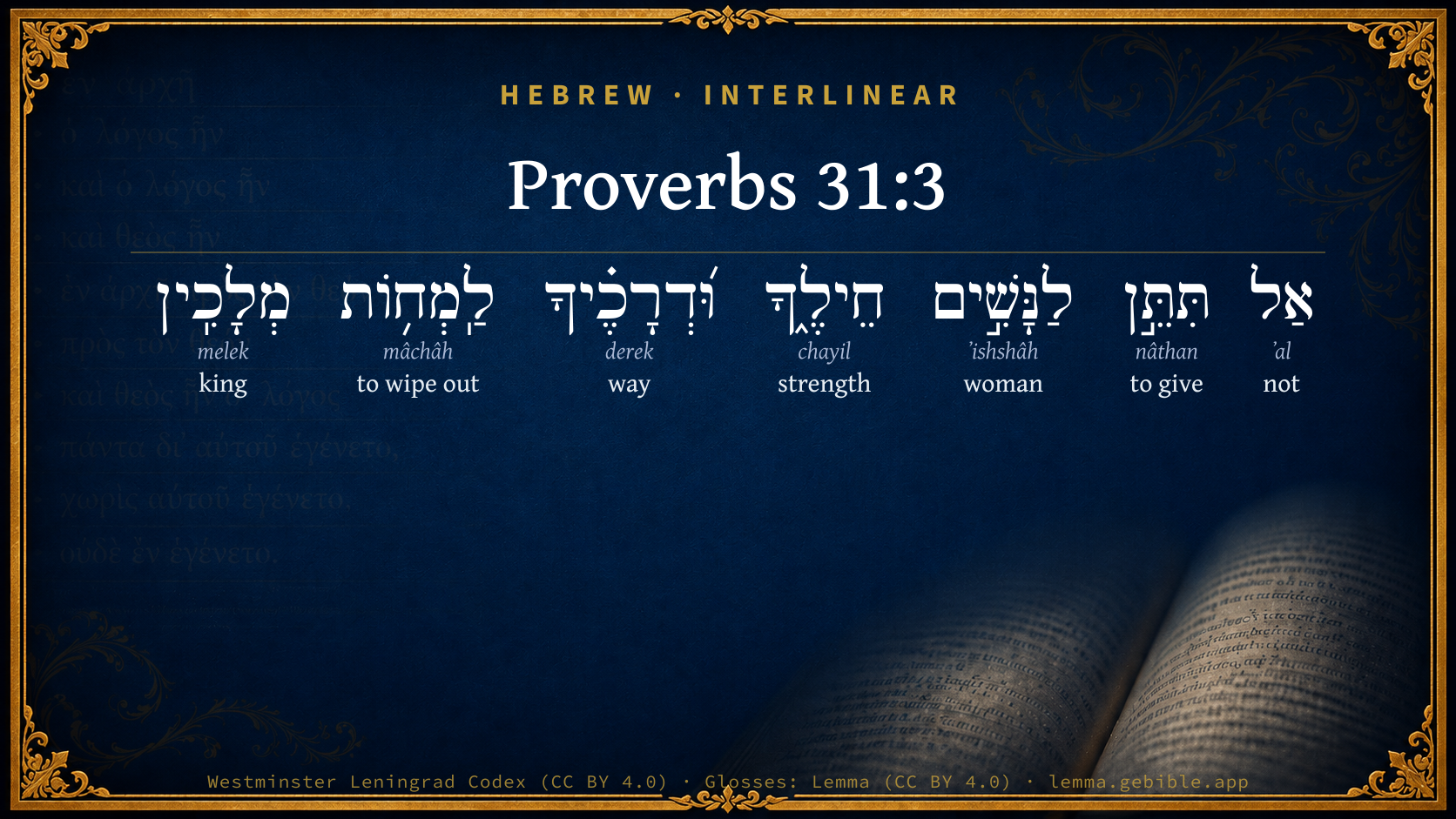
אַל תִּתֵּ֣ן לַנָּשִׁ֣ים חֵילֶ֑ךָ וּ֝דְרָכֶ֗יךָ לַֽמְח֥וֹת מְלָכִֽין
Don't give your strength to women, Nor your ways to that which destroys kings.
World English Bible · Public Domain
Don't give your strength to women, Nor your ways to that which destroys kings.
One document with this verse’s original text, its word-by-word gloss line, the meaning frame, cross-references with their text, attributed commentary, and full source and license credits — printable, and it pastes into notes with its structure intact.
This verse Autodidact and up
A passage Seminary Student
Up to 50 verses in one chapter. A passage sheet keeps up to 6 commentary sources and 12 cross-references per verse, in the order this page ranks them, and says so on the sheet whenever that leaves anything out. Ask for a single verse and you get the Autodidact verse sheet above.
Everything on this page stays free to read, with no account — the sheet is a download of what is already on screen, not access to it.
The same verse in 3 English versions, stacked beneath the original-language interlinear above. Click any original word for its lexicon entry.
Each is an independent rendering of the whole verse — the interlinear is not word-aligned to these translations.
Highlighted words mark where these versions differ — a whole-verse word diff, not a word-by-word alignment.
Don't give your strength to women, Nor your ways to that which destroys kings.
Give not thy strength unto women, nor thy ways to that which destroyeth kings.
Do not give to women your strength or your ways to cause kings to be wiped out.
unfoldingWord Literal Text — © unfoldingWord, licensed CC BY-SA 4.0. Word-aligned USFM3 via Door43 (git.door43.org/unfoldingWord/en_ult).
Every available English version of this verse, each an independent rendering of the whole verse.
Don't give your strength to women, Nor your ways to that which destroys kings.
Do not spend your strength on women or your vigor on those who ruin kings.
Do not spend your strength on women or your vigor on those who ruin kings.
Give not thy strength unto women, nor thy ways to that which destroyeth kings.
Give not thy strength unto women, Nor thy ways to that which destroyeth kings.
Give not thy strength unto women, nor thy ways to that which destroyeth kings.
Giue not thy strength vnto women, nor thy wayes, which is to destroy Kings.
Give not thy substance to women, and thy riches to destroy kings.
Give not to women thy strength, And thy ways to wiping away of kings.
Do not give your strength to women, || And your ways to wiping away of kings.
Do not give your strength to women, or your ways to those who destroy kings.
Do not give to women your strength or your ways to cause kings to be wiped out.
Give not thy strength unto women, nor thy ways to them that destroy kings.
Don’t give your strength to women, nor your ways to that which destroys kings.
Give not thy strength to women, nor thy ways to that which destroyeth kings.
Don't waste your strength sleeping with women, those that bring down kings.
Do not give your strength to women, or your ways to that which is the destruction of kings.
Give not thy strength unto women, nor thy ways to that which destroyeth kings.
Literal Standard Version (2020), Covenant Press — licensed CC BY-SA 4.0. Text via the HelloAO Bible API (eBible.org). Unlocked Literal Bible (unfoldingWord) — licensed CC BY-SA 4.0. Text via the HelloAO Bible API (eBible.org). unfoldingWord Literal Text — © unfoldingWord, licensed CC BY-SA 4.0. Word-aligned USFM3 via Door43 (git.door43.org/unfoldingWord/en_ult). Free Bible Version, Dr. Jonathan Gallagher — licensed CC BY-SA 4.0. Text via the HelloAO Bible API (eBible.org).
More ways to search: Search by grammar → Find every occurrence → Compare this word →
Practice this passage: Drill this verse → Learn its vocabulary →
These counts appear in no published source. They are computed here, from the morphology-tagged text and Lemma’s own curated glosses. What Lemma adds →
Shared distinctive vocabulary
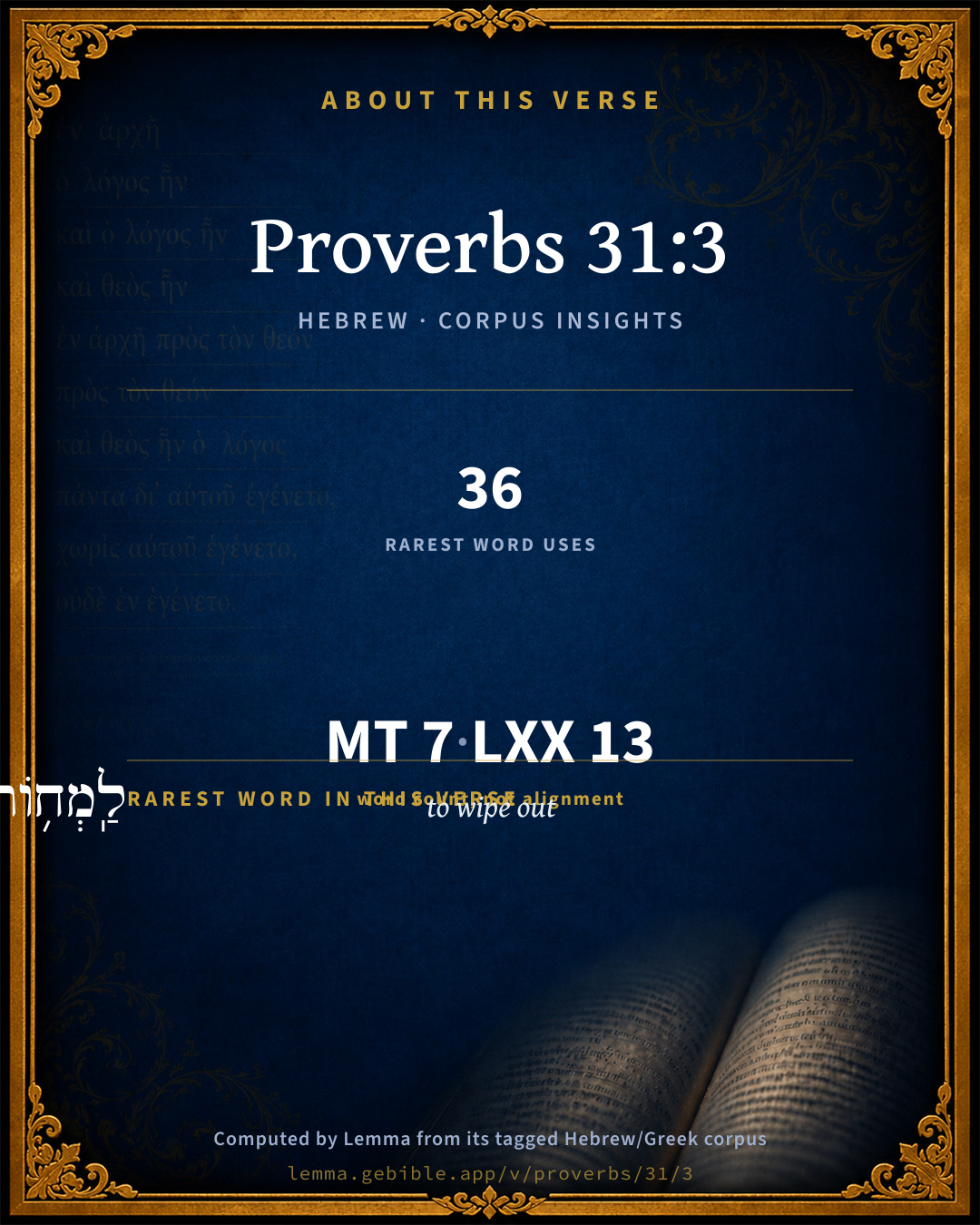
לַֽמְח֥וֹת to wipe out H4229 occurs in 32 verses of the Hebrew Bible. Also found in:
Grammatical profile
Verb forms
Hebrew & Septuagint length
In English translation the verse runs 14 words from the Hebrew and 22 from the Septuagint (LXX English) — the Septuagint runs noticeably longer here. See the side-by-side →
A rough comparison of the two English renderings, which tokenize alike — not a word-level alignment.
Word counts can differ between the Hebrew and the Greek without any difference in meaning — e.g. the Hebrew direct-object marker אֵת has no separate Greek word, and Greek often adds the article ὁ.
In the original languages it is 7 Hebrew tokens and 13 Greek tokens — but the two are counted differently (Hebrew bundles its prefixes and suffixes into one token; the Greek is in lemma form), so that isn’t a like-for-like length.
Topical passages linked to Proverbs 31:3 in the Treasury of Scripture Knowledge — connected by theme and wording, ordered by reader-vote popularity; previews shown in the World English Bible.
Cross-references courtesy of OpenBible.info (CC BY 4.0).
The same verse in the two great witnesses to the Old Testament, shown verse-for-verse.
Here the Septuagint runs noticeably longer than the Hebrew — LXX2012 (modern English Septuagint) 22 words vs World English Bible 14. A rough length comparison of the two English translations, not a word-level alignment — read both below.
These are two independent witnesses, not word-aligned to each other, and the Septuagint is shown in lemma (dictionary) form.
אַל תִּתֵּ֣ן לַנָּשִׁ֣ים חֵילֶ֑ךָ וּ֝דְרָכֶ֗יךָ לַֽמְח֥וֹת מְלָכִֽין
Don't give your strength to women, Nor your ways to that which destroys kings.
World English Bible · Public Domain
μή δίδωμι γυνή σός πλοῦτος καί ὁ σός νοῦς καί βίος εἰς ὑστεροβουλία
Give not your wealth to women, nor your mind and living to remorse. Do all things with counsel: drink wine with counsel.
LXX2012 (modern English Septuagint) · Public Domain
On this verse, John Gill's Exposition discusses the Septuagint’s reading. Read the note in Commentary ↓
Hebrew: Westminster Leningrad Codex (CC BY 4.0). Greek: Septuagint (public domain); English from LXX2012 (modern English Septuagint) (Public Domain). How the Septuagint differs from the Hebrew →
Teaching starters — assembled from the data on this page, not authored interpretation. Every prompt links to the verse data it draws on. Edit before teaching.
Proverbs, in the Wisdom, opens this verse with 7 words (7 distinct Hebrew lemmas). Its most distinctive word is mâchâh (“to wipe out”). The Greek Septuagint runs longer here. A historical commentator’s framing appears above. Read the whole chapter for the surrounding context.
Commentary
Notes on Proverbs 31:3 from classic Christian and Jewish commentators (each source and its license shown beneath its notes). The classic Christian expositions comment on the surrounding passage and are grouped to its opening verse, so a note may address several verses; the Jewish commentaries on the Tanakh (Rashi and others) are per-verse, so they appear only where the commentator wrote on this verse.
Lemma curates 59 commentaries, every one of them public domain or Creative Commons licensed, each selected and text-cleaned for this edition rather than reprinted as found. About our sources →
Trapp's Complete Commentary
John Trapp
John Trapp, A Commentary or Exposition upon All the Books of the Old and New Testament (1647–1656) — public domain. Text from a community e-Sword module.
Joseph Benson's Commentary
Joseph Benson's Commentary on the Old and New Testaments (1811–1818) — public domain. Text from a community e-Sword module.
Whedon's Commentary on the Bible
Daniel D. Whedon
Daniel D. Whedon (gen. ed.), Commentary on the Old and New Testaments (1874–1909) — public domain. Text from a community e-Sword module.
Geneva Bible (1599)
Geneva Bible translators
Geneva Bible (1599) marginal notes — public domain. Text via Bolls.life.
Jamieson, Fausset & Brown
Robert Jamieson, A. R. Fausset & David Brown
Jamieson, Fausset & Brown — Commentary Critical and Explanatory on the Whole Bible (1871) — public domain (CC PDM 1.0). Text via the HelloAO Bible API.
Adam Clarke's Commentary
Adam Clarke's Commentary on the Bible (1810–1826) — public domain. Text from a community e-Sword/MySword module.
Ellicott's Commentary for English Readers
A Bible Commentary for English Readers, edited by Charles John Ellicott (1878–1897) — public domain. Text from a community e-Sword module.
The Cambridge Bible for Schools and Colleges
gen. ed. J. J. S. Perowne
The Cambridge Bible for Schools and Colleges (gen. ed. J. J. S. Perowne; Cambridge University Press, 1878–1918) — public domain. Text from a community e-Sword module.
John Gill's Exposition
John Gill's Exposition of the Whole Bible (1746–1763) — public domain (CC PDM 1.0). Text via the HelloAO Bible API.
Albert Barnes' Notes on the Bible
Albert Barnes' Notes on the Bible (1834–1885) — public domain. Text from a community e-Sword/MySword module.
Haydock's Catholic Bible Commentary
George Leo Haydock (1774–1849), Haydock's Catholic Family Bible and Commentary, 1859 edition — public domain. Excludes Psalms (Douay-Rheims chapter numbering differs from Protestant) and Deuterocanonical books (Catholic canon only).
Matthew Poole's English Annotations
Matthew Poole's English Annotations on the Holy Bible (1683–1685) — public domain. Text from a community e-Sword/MySword module.
The Pulpit Commentary
The Pulpit Commentary (1880–1919), ed. H.D.M. Spence-Jones & Joseph S. Exell — public domain. Text from a community e-Sword module.
John Wesley's Explanatory Notes
John Wesley, Explanatory Notes Upon the Whole Bible (1754–1765) — public domain. Text via the GEBible commentary corpus.
Keil & Delitzsch
C. F. Keil & F. Delitzsch
Keil & Delitzsch — Biblical Commentary on the Old Testament (1861–1891) — public domain (CC PDM 1.0). Text via the HelloAO Bible API. (Old Testament only.)
Bridges on Proverbs
Charles Bridges
Charles Bridges, An Exposition of the Book of Proverbs (1846) — public domain. Text from a community e-Sword module.
Rashi
Rabbi Shlomo Yitzchaki (Rashi)
Rashi on the Tanakh — English translations: “The Judaica Press complete Tanach with Rashi, translated by A. J. Rosenberg” (CC BY 4.0); “Pentateuch with Rashi's commentary by M. Rosenbaum and A.M. Silbermann, 1929-1934” (public domain); “The Metsudah Tanach series, Lakewood, N.J” (CC BY 4.0); and “The Book of Joshua, Metsudah Publications, 1997” (CC BY 4.0). Text via Sefaria.