
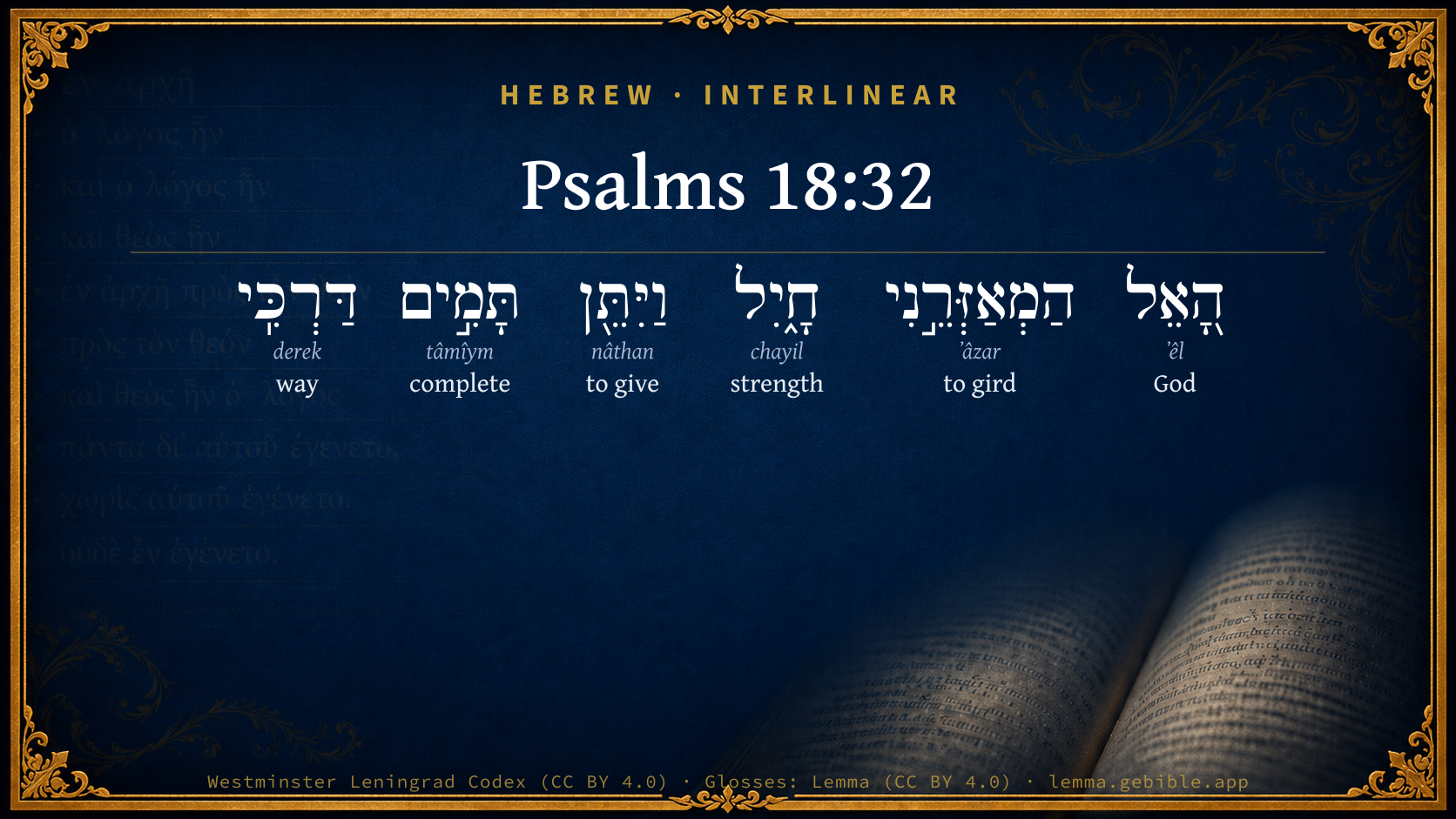
Psalms 18:32

Hebrew (Westminster Leningrad Codex) Psalms 18:32 appears in the Hebrew Old Testament. The text above is from the Westminster Leningrad Codex. Each word links to its Strong’s number, a concise gloss, and parsing drawn from the Open Scriptures Hebrew Bible morphology. Click any word for its full Brown-Driver-Briggs (BDB) entry.
Download image
Cite this verse

Psalms 18:32 (World English Bible). Public Domain. Lemma interlinear Bible study tool, https://lemma.gebible.app/v/psalms/18/32.

Show BibTeX & RIS
BibTeX
RIS
English Translation
The God who arms me with strength, and makes my way perfect?
World English Bible · Public Domain
Download a study sheet

One document with this verse’s original text, its word-by-word gloss line, the meaning frame, cross-references with their text, attributed commentary, and full source and license credits — printable, and it pastes into notes with its structure intact.

This verse Autodidact and up

Study sheet (.html) Plain text (.txt)

A passage Seminary Student

Up to 50 verses in one chapter. A passage sheet keeps up to 6 commentary sources and 12 cross-references per verse, in the order this page ranks them, and says so on the sheet whenever that leaves anything out. Ask for a single verse and you get the Autodidact verse sheet above.

Everything on this page stays free to read, with no account — the sheet is a download of what is already on screen, not access to it.

Want to remove ads? Support Godless Engineer
Compare translations 3

The same verse in 3 English versions, stacked beneath the original-language interlinear above. Click any original word for its lexicon entry.

Each is an independent rendering of the whole verse — the interlinear is not word-aligned to these translations.

Highlighted words mark where these versions differ — a whole-verse word diff, not a word-by-word alignment.

  • World English Bible Public Domain
    The God who arms me with strength, and makes my way perfect?
  • King James Version Public Domain
    It is God that girdeth me with strength, and maketh my way perfect.
  • unfoldingWord Literal Text CC BY-SA 4.0
    This God is the one girding me valor, and he makes my way perfect,

unfoldingWord Literal Text — © unfoldingWord, licensed CC BY-SA 4.0. Word-aligned USFM3 via Door43 (git.door43.org/unfoldingWord/en_ult).

Versions to compare (up to 4)

3 of 4 selected

Show all 18 translations

Every available English version of this verse, each an independent rendering of the whole verse.

  • World English Bible Public Domain
    The God who arms me with strength, and makes my way perfect?
  • Berean Standard Bible Public Domain
    It is God who arms me with strength and makes my way clear.
  • Majority Standard Bible Public Domain
    It is God who arms me with strength and makes my way clear.
  • King James Version Public Domain
    It is God that girdeth me with strength, and maketh my way perfect.
  • American Standard Version (1901) Public Domain
    The God that girdeth me with strength, And maketh my way perfect?
  • Revised Version (1885) Public Domain
    The God that girdeth me with strength, and maketh my way perfect.
  • Geneva Bible (1599) Public Domain
    God girdeth me with strength, and maketh my way vpright.
  • Douay-Rheims (1899) Public Domain
    For who is God but the Lord? or who is God but our God?
  • Young's Literal Translation Public Domain
    God! who is girding me `with' strength, And He maketh perfect my way.
  • Literal Standard Version CC BY-SA 4.0
    God—who is girding me [with] strength, || And He makes my way perfect.
  • Unlocked Literal Bible CC BY-SA 4.0
    It is God who puts strength on me like a belt, who places the blameless person on his path.
  • unfoldingWord Literal Text CC BY-SA 4.0
    This God is the one girding me valor, and he makes my way perfect,
  • Darby Bible Public Domain
    The ùGod who girdeth me with strength, and maketh my way perfect,
  • World Messianic Bible Public Domain
    the God who arms me with strength, and makes my way perfect?
  • Webster's Bible Public Domain
    \\18:31\\For who is God save the LORD? or who is a rock save our God?
  • Free Bible Version CC BY-SA 4.0
    God makes me strong and keeps me safe.
  • Bible in Basic English Public Domain
    God puts a strong band about me, guiding me in a straight way.
  • JPS Tanakh (1917) Public Domain
    (18-33) The God that girdeth me with strength, and maketh my way straight;

Literal Standard Version (2020), Covenant Press — licensed CC BY-SA 4.0. Text via the HelloAO Bible API (eBible.org). Unlocked Literal Bible (unfoldingWord) — licensed CC BY-SA 4.0. Text via the HelloAO Bible API (eBible.org). unfoldingWord Literal Text — © unfoldingWord, licensed CC BY-SA 4.0. Word-aligned USFM3 via Door43 (git.door43.org/unfoldingWord/en_ult). Free Bible Version, Dr. Jonathan Gallagher — licensed CC BY-SA 4.0. Text via the HelloAO Bible API (eBible.org).

Word by word

More ways to search: Search by grammar → Find every occurrence → Compare this word →

Practice this passage: Drill this verse → Learn its vocabulary →

הַמְאַזְּרֵ֣נִי
ʼâzar
H247
“the · girding · me”
Particle, Definite Article + Verb, Piel, Participle Active, Masculine, Singular, Construct + Suffix, Personal, 1st Person, Common, Singular
Part of Speech
Particle + Verb
Stem
Piel
Form
Participle Active
Gender
Masculine
Number
Singular
State
Construct
Full BDB Definition

Origin: a primitive root

TWOT: 59

gird, encompass, equip, clothe - (Qal) to gird, gird on (metaphorical of strength) - (Niphal) be girded - (Piel) hold close, clasp - (Hithpael) gird oneself (for war)
  1. הָ֭אֵל ʼêl H410 “the · God” Particle, Definite Article + Noun, Common, Masculine, Singular, Absolute
  2. חָ֑יִל chayil H2428 “strength” Noun, Common, Masculine, Singular, Absolute
  3. וַיִּתֵּ֖ן nâthan H5414 “and · to give” Conjunction + Verb, Qal, Sequential Imperfect, 3rd Person, Masculine, Singular
  4. תָּמִ֣ים tâmîym H8549 “complete” Adjective, Adjective, Masculine, Singular, Absolute
  5. דַּרְכִּֽי derek H1870 “way · my” Noun, Common, Both, Singular, Construct + Suffix, Personal, 1st Person, Common, Singular

About this verse

These counts appear in no published source. They are computed here, from the morphology-tagged text and Lemma’s own curated glosses. What Lemma adds →

6
words
6
distinct lemmas
Wisdom
section

Notable vocabulary

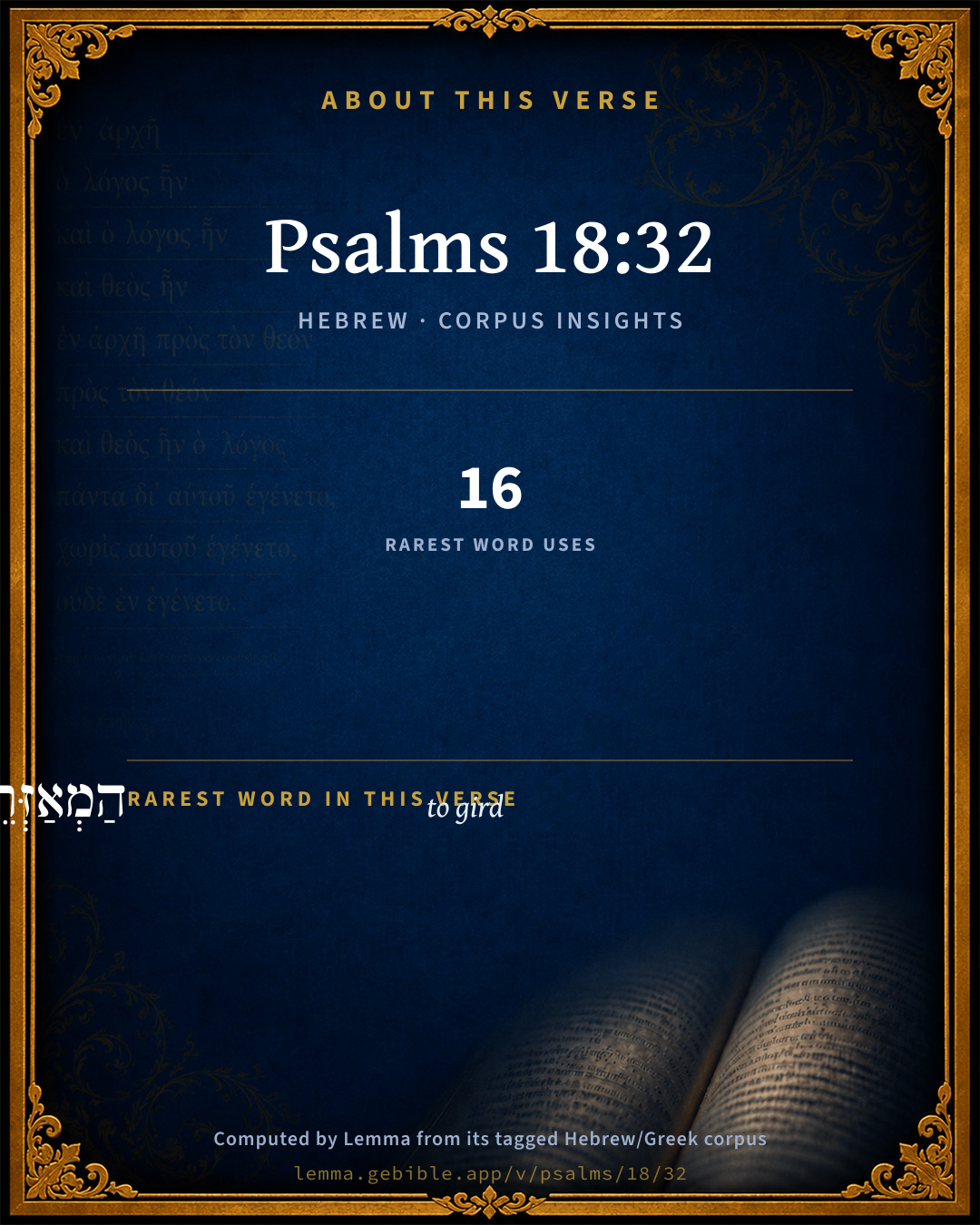
The rarest word here is הַמְאַזְּרֵ֣נִי to gird H247 — appearing just 16 times in the whole Hebrew Bible.

Shared distinctive vocabulary

הַמְאַזְּרֵ֣נִי to gird H247 occurs in 15 verses of the Hebrew Bible. Also found in:

Grammatical profile

  • 2 verbs
  • 3 nouns
  • 1 adjective

Verb forms

  • הַמְאַזְּרֵ֣נִי Piel · Participle Active
  • וַיִּתֵּ֖ן Qal · Sequential Imperfect

Hebrew & Septuagint length

In English translation the verse runs 12 words from the Hebrew and 14 from the Septuagint (LXX English) — closely comparable.

A rough comparison of the two English renderings, which tokenize alike — not a word-level alignment.

Word counts can differ between the Hebrew and the Greek without any difference in meaning — e.g. the Hebrew direct-object marker אֵת has no separate Greek word, and Greek often adds the article ὁ.

Cross-references

6

Topical passages linked to Psalms 18:32 in the Treasury of Scripture Knowledge — connected by theme and wording, ordered by reader-vote popularity; previews shown in the World English Bible.

  • Isaiah 45:5 I am Yahweh, and there is none else; besides me there is no God. I will gird you, though you have not known me;
  • 2 Samuel 22:33 God is my strong fortress; He guides the perfect in his way.
  • Psalms 28:7 Yahweh is my strength and my shield. My heart has trusted in him, and I am helped. Therefore my heart greatly rejoices. With my song I will thank him.
  • 2 Corinthians 3:5 not that we are sufficient of ourselves, to account anything as from ourselves; but our sufficiency is from God;
  • Psalms 91:2 I will say of Yahweh, "He is my refuge and my fortress; My God, in whom I trust."
  • Psalms 93:1 Yahweh reigns! He is clothed with majesty! Yahweh is armed with strength. The world also is established. It can't be moved.

Cross-references courtesy of OpenBible.info (CC BY 4.0).

Hebrew and Greek witnesses Masoretic Hebrew ↔ Greek Septuagint

The same verse in the two great witnesses to the Old Testament, shown verse-for-verse.

You’re reading Greek Psalm 17 (Hebrew Psalm 18). The Septuagint counts the superscription, so verse numbers can differ from the Hebrew — chapter-level alignment, not verse-by-verse. Numbering follows Rahlfs.

These are two independent witnesses, not word-aligned to each other, and the Septuagint is shown in lemma (dictionary) form.

Hebrew Psalms 18:32 Masoretic · Westminster Leningrad Codex

הָ֭אֵל הַמְאַזְּרֵ֣נִי חָ֑יִל וַיִּתֵּ֖ן תָּמִ֣ים דַּרְכִּֽי

The God who arms me with strength, and makes my way perfect?

World English Bible · Public Domain

Greek LXX Greek Psalm 17:32 Septuagint · lemma form

ὅτι τίς θεός πλήν ὁ κύριος καί τίς θεός πλήν ὁ θεός ἐγώ

It is God that girds me with strength, and has made my way blameless:

LXX2012 (modern English Septuagint) · Public Domain

Hebrew: Westminster Leningrad Codex (CC BY 4.0). Greek: Septuagint (public domain); English from LXX2012 (modern English Septuagint) (Public Domain). How the Septuagint differs from the Hebrew →

Commentary

Notes on Psalms 18:32 from classic Christian and Jewish commentators (each source and its license shown beneath its notes). The classic Christian expositions comment on the surrounding passage and are grouped to its opening verse, so a note may address several verses; the Jewish commentaries on the Tanakh (Rashi and others) are per-verse, so they appear only where the commentator wrote on this verse.

Lemma curates 59 commentaries, every one of them public domain or Creative Commons licensed, each selected and text-cleaned for this edition rather than reprinted as found. About our sources →

Trapp's Complete Commentary

John Trapp

Psa 18:32 [It is] God that girdeth me with strength, and maketh my way perfect.

Ver. 32. It is God that girdeth me with strength] It is a metaphor, saith Vatablus, either from a soldier’s belt, which buckleth his armour close to him, and maketh him more steady; or else from the reins themselves, in which the Scripture sometimes placeth strength and vigour. God did all for David; and hath here the glory of all his valour and victories.

And maketh my way perfect] i.e. Completeth and prospereth all my designs and enterprises. For want hereof many attempt much, but effect little or nothing. Antiochus, king of Syria, was called Magnus for undertaking much and performing little. Guicciardin saith of Charles VIII, in his expedition to Naples, that he came into the field like thunder and lightning, but went out like a snuff; more than a man at first, and less than a woman at last.

John Trapp, A Commentary or Exposition upon All the Books of the Old and New Testament (1647–1656) — public domain. Text from a community e-Sword module.

Joseph Benson's Commentary

Psa 18:32. It is God that girdeth me with strength — That inspires me with courage, fortitude, and resolution, and gives me strength both of mind and body in battle and war. It is a metaphor taken, either from a military girdle, or a common girdle, wherewith their loose garments were girded about them, and whereby they were rendered fitter for any action. He maketh my way perfect — Perfectly plain, and clear from impediments, as pioneers use to prepare the way for the march of an army. Or, the meaning is, he guides me in all my counsels and enterprises, so that I neither miss my way, nor stumble in it, nor come short of my end. “A man’s way, in the pursuit of any end, is perfect when the means he uses to attain it are proper and direct, and will finally render him successful in it: and thus God made David’s way perfect as he gave him the surest directions how to act, and prospered him in all his measures, to support the dignity of his crown and government.” — Chandler.

Joseph Benson's Commentary on the Old and New Testaments (1811–1818) — public domain. Text from a community e-Sword module.

J. A. Alexander on Psalms

Joseph Addison Alexander

33. (Psa 18:32). The Almighty girding me with strength, and (who) has given (or rendered) my way perfect. The connection of the verses is the same as that between Psa 18:31 (30) and Psa 18:32 (31). The our God of the preceding verse is here described as the Almighty girding me, etc. For the true sense of the divine name here and in Psa 18:32 (31), see above, on Psa 5:5 (4). Psa 7:12, (11), Psa 10:11-12, Psa 16:1; Psa 17:6. The imparting of a quality or bestowing of a gift is in various languages described as clothing. Thus the English words endue and invest have almost lost their original mean ing. The figure of girding is peculiarly significant, because in the oriental dress the girdle is essential to all free and active motion. Compare Psa 65:13 (12), as translated in the margin of the English Bible, and Isa 11:5. The last clause may either mean, "who is faultless in the way by which he leads me," i. e. whose dispensations towards me are free from all injustice; or, "who gives my conduct the perfection which belongs to it." The first construction gives the words the same sense as in Psa 18:31 (30); but the other is by far the simplest and most natural, and as such entitled to the preference.

Joseph Addison Alexander, The Psalms Translated and Explained (1850) — public domain. Text from a community e-Sword module.

Tyndale Open Study Notes

Tyndale Open Resources

18:32-34 The psalmist’s victories come from the Lord. He completely depends on God.

Tyndale Open Study Notes — © Tyndale Open Resources, licensed CC BY-SA 4.0. Text via the HelloAO Bible API.

Geneva Bible (1599)

Geneva Bible translators

He giveth good success to all mine enterprises.

Geneva Bible (1599) marginal notes — public domain. Text via Bolls.life.

Adam Clarke's Commentary

Verse 32. God - girdeth me with strength] The girdle was a necessary part of the Eastern dress; it strengthened and supported the loins; served to confine the garments close to the body; and in it they tucked them up when journeying. The strength of God was to his soul what the girdle was to the body. I need not add, that the girdle was also an ornamental part of the dress, and from it the sword was suspended.

And maketh my way perfect.] He directs me so that I do not go astray; he blesses me in my undertakings; and by him the issue of my labours is crowned with prosperity.

Adam Clarke's Commentary on the Bible (1810–1826) — public domain. Text from a community e-Sword/MySword module.

John Calvin's Commentaries

32. It is God who hath girded. This is a metaphor taken either from the belt or girdle of a warrior, or from the reins, in which the Scripture sometimes places a man’s vigor or strength. It is, therefore, as if he had said, I, who would otherwise have been feeble and effeminate, have been made strong and courageous by the power of God. He afterwards speaks of the success itself with which God had favored him; for it would not be enough for persons to have prompt and active courage, nor even to excel in strength, if their undertakings were not at the same time crowned with a prosperous issue. Irreligious men imagine that this proceeds from their own prudence, or from fortune; but David ascribes it to God alone: It is God who hath made my way perfect. The word way is here to be understood of the course of our actions, and the language implies, that whatever David undertook, God, by his blessing, directed it to a successful issue.

John Calvin's Commentaries (1540-1563) — public domain. Text from the Calvin Translation Society English edition (1840s-50s) via the Christian Classics Ethereal Library (ccel.org). Calvin's coverage is partial (roughly two-thirds of the Bible); uncommented books and verses are honest gaps, never fabricated. The 19th-century editor's footnotes and remarks are omitted so the notes are faithfully Calvin's own voice.

Ellicott's Commentary for English Readers

(32) The verse should run on closely from the last. The italics spoil it.

Girdeth.—The importance of the girdle in a country where the dress was loose and flowing is shown by many passages of Scripture. It is essential to the warrior as here (comp. Eph_6:14, and the Greek expression, “to be girt” = to be armed), but also for all active exertion.

Way.—Here, not of conduct, but the military path, the march. Notice the variation in Samuel.

A Bible Commentary for English Readers, edited by Charles John Ellicott (1878–1897) — public domain. Text from a community e-Sword module.

The Cambridge Bible for Schools and Colleges

gen. ed. J. J. S. Perowne

32. It is God] R.V., The God [El] that girdeth me with strength. Cp. Psa_18:39; Psa_93:1; 1Sa_2:4.

maketh my way perfect] Removing the obstacles which might have hindered me from the complete accomplishment of the career He has marked out for me. Observe the analogy between the perfection of God’s way (Psa_18:30) and His servant’s. Cp. Mat_5:48 for a higher development of the same thought.

The traditional reading (Qrç) in 2 Sam. is, “God is my strong fortress, and guideth my way in perfectness”; while the written text (Kthîbh) has, “he guideth the perfect in his way”: but the exact meaning is obscure. A simpler word has apparently been substituted in the text of the Psalm.

The Cambridge Bible for Schools and Colleges (gen. ed. J. J. S. Perowne; Cambridge University Press, 1878–1918) — public domain. Text from a community e-Sword module.

John Gill's Exposition

He maketh my feet like hind's feet,.... As light and swift as theirs, as the Targum; that is, either to flee, when there was a necessity for it, as Kimchi observes; or rather to pursue after the enemy, to run through a troop, and leap over a wall, as before; see Ch1 12:8; the same phrase is used in Hab 3:19; and may be understood in a spiritual sense of that readiness and cheerfulness with which the saints run the ways of God's commandments, when their hearts are enlarged with his love and grace; and may very well be applied to Christ, who is often compared to a roe, or a young hart, for swiftness; who readily and at once engaged to come and do the will of God, and whose coming in the flesh, at the appointed time, was swift; and who made haste to do the work of God, in which he took the utmost pleasure; and who is a speedy and present help to his people in time of trouble; see Sol 2:8;

and setteth me upon my high places; the towers and fortresses, and strong and fortified places, where he was safe from his enemies; and: in a spiritual sense, may design the everlasting love of God, the covenant of grace, its blessings and promises; and Christ himself, with the fulness of grace in him, on which believers may be said to be set, when their faith is directed to them, and they live and dwell upon them; see Hab 3:19; and, the words were fulfilled in Christ, when God highly exalted him at his right hand, and set him above all principalities and powers, and made him higher than the heavens.

John Gill's Exposition of the Whole Bible (1746–1763) — public domain (CC PDM 1.0). Text via the HelloAO Bible API.

Albert Barnes' Notes on the Bible

It is God that girdeth me with strength - Who gives me strength. The word girdeth contains an allusion to the mode of dress among the orientals, the long flowing robe, which was girded up when they ran or labored, that it might not impede them; and, probably, with the additional idea that girding the loins contributed to strength. It is a common custom now for men who run a race, or leap, or engage in a strife of pugilism, to gird or bind up their loins. See Job 40:7, note; and Mat 5:38-41, notes.

And maketh my way perfect - Gives me complete success in my undertakings; or, enables me so to carry them out that none of them fail.

Albert Barnes' Notes on the Bible (1834–1885) — public domain. Text from a community e-Sword/MySword module.

Matthew Poole's English Annotations

That girdeth me with strength; that gives me strength both of mind and body for battle. It is a metaphor taken either from a military girdle, or from a common girdle, wherewith their loose garments were girt about them, whereby they were rendered fitter for any action.

Perfect, i.e. perfectly plain and smooth, and clear from impediments, as pioneers use to prepare the way for the march of an army. He guided me in all my counsels and enterprises, so that I neither miss my way, nor stumble in it, nor come short of my end.

Matthew Poole's English Annotations on the Holy Bible (1683–1685) — public domain. Text from a community e-Sword/MySword module.

The Treasury of David

Charles H. Spurgeon

Ver. 32. Surveying all the armour in which he fought and conquered, the joyful victor praises the Lord for every part of the panoply. The girdle of his loins earns the first stanza:

It is God that girdeth me with strength, and maketh my way perfect. Girt about the loins with power from heaven, the warrior was filled with vigour, far above all created might; and, whereas, without this wondrous belt he would have been feeble and effeminate, with relaxed energies and scattered forces, he felt himself, when braced with the girdle of truth, to be compact in purpose, courageous in daring, and concentrated in power; so that his course was a complete success, so undisturbed by disastrous defeat as to be called "perfect." Have we been made more than conquerors over sin, and has our life hitherto been such as becometh the gospel? Then let us ascribe all the glory to him who girt us with his own inexhaustible strength, that we might be unconquered in battle and unwearied in pilgrimage.

Ver. 32. It is God that girdeth me with strength. One of the few articles of Eastern dress which I wore in the East, was the girdle, which was of great use as a support to the body in the long and weary camel rides through the Desert. The support and strengthening I received in this way, gave me a clearer idea than I had before of the meaning of the psalmist. John Anderson, in "Bible Light from Bible Lands, "1856.

Ver. 32-34. Trying positions, gracious adaptations, graceful accomplishments, secure abidings, grateful acknowledgment.

Psalms 18:33*

Ver. 32-34. Trying positions, gracious adaptations, graceful accomplishments, secure abidings, grateful acknowledgment.

Psalms 18:34*

Ver. 32-34. Trying positions, gracious adaptations, graceful accomplishments, secure abidings, grateful acknowledgment.

Psalms 18:35*

Charles H. Spurgeon's The Treasury of David (1869–1885) — public domain. Psalms only. Text from a community e-Sword/MySword module.

Whedon's Commentary on the Bible

Daniel D. Whedon

32. Girdeth— “The figure of girding is significant, because, in the Oriental dress, the girdle is essential to all free and active motion.”—Alexander.

My way perfect—Upright before God.

Daniel D. Whedon (gen. ed.), Commentary on the Old and New Testaments (1874–1909) — public domain. Text from a community e-Sword module.

The Pulpit Commentary

It is God that girdeth me with strength (comp. ver. 39). And maketh my way perfect. Keeps me, i.e. , in the right way the way of his commandments.

The Pulpit Commentary (1880–1919), ed. H.D.M. Spence-Jones & Joseph S. Exell — public domain. Text from a community e-Sword module.

John Wesley's Explanatory Notes

Perfect - Perfectly plain and smooth, and clear from impediments.

John Wesley, Explanatory Notes Upon the Whole Bible (1754–1765) — public domain. Text via the GEBible commentary corpus.

Lesson kit

Teaching starters — assembled from the data on this page, not authored interpretation. Every prompt links to the verse data it draws on. Edit before teaching.

Psalms, in the Wisdom, opens this verse with 6 words (6 distinct Hebrew lemmas). Its most distinctive word is ʼâzar (“to gird”). A historical commentator’s framing appears above. Read the whole chapter for the surrounding context.

Discussion questions

  1. The word ʼâzar carries the sense “to gird.” How does it shape the verse?
  2. 1 Samuel 2:4 shares the word «to gird» with this verse. How do the two illuminate each other?
  3. These translations render this verse differently. What is at stake in choosing one wording over another?
  4. The verb «הַמְאַזְּרֵ֣נִי» is Piel Participle Active. How does its form color the action?
  5. Reading how Trapp's Complete Commentary and Joseph Benson's Commentary read this verse, where do the two commentators agree and where do they part?

Things to notice

Reading settings

Reading text

Shown beneath each verse's original-language words.

Old Testament
Old Testament edition

Read the OT as the Masoretic Hebrew (MT) or the Greek Septuagint (LXX).

English shown for the Greek Septuagint (in the Hebrew ↔ Greek comparison).

Comparing translations? Open the Compare panel on any verse page to stack up to four side by side.