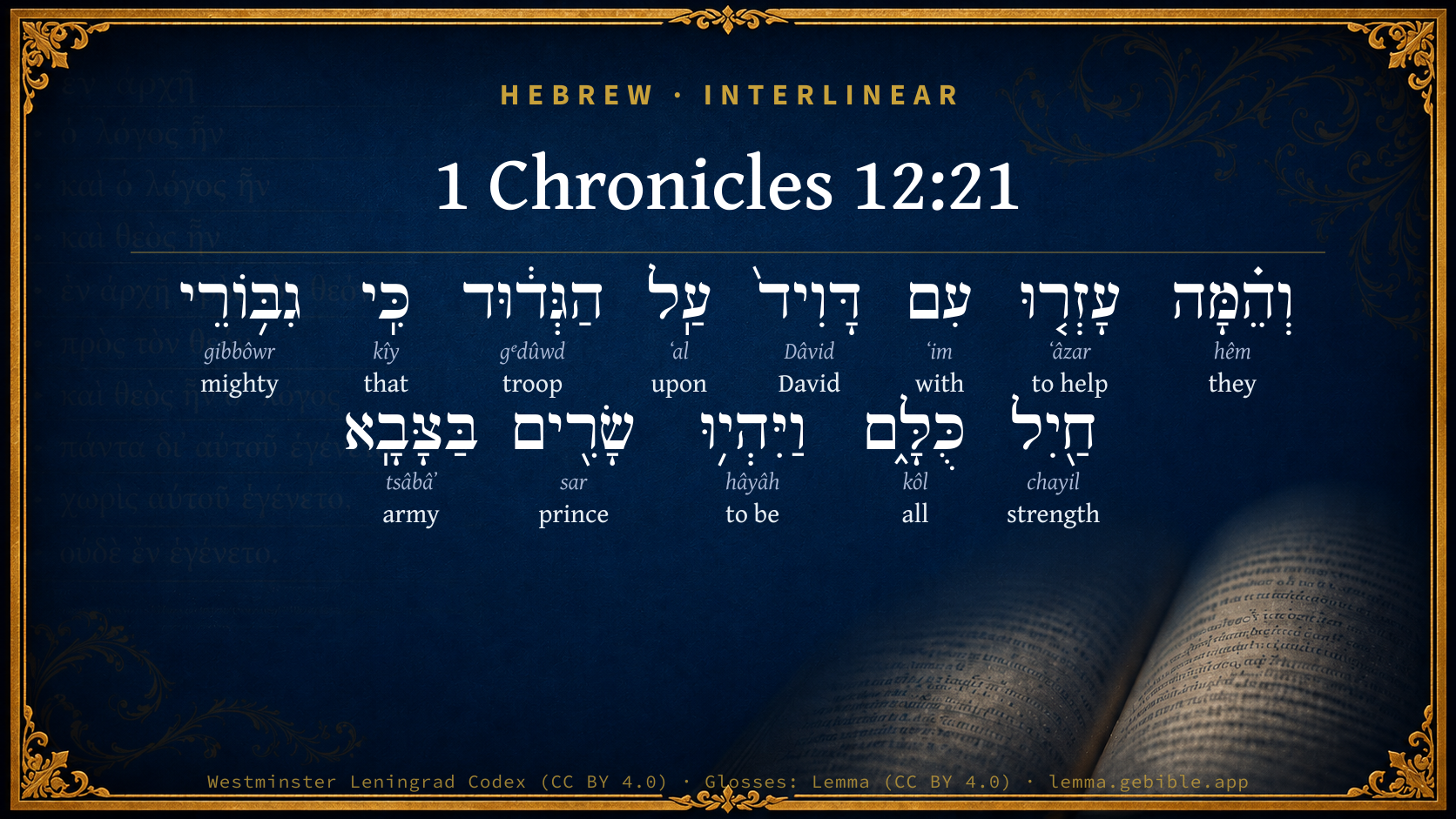
1 Chronicles 12:21

Hebrew (Westminster Leningrad Codex) 1 Chronicles 12:21 appears in the Hebrew Old Testament. The text above is from the Westminster Leningrad Codex. Each word links to its Strong’s number, a concise gloss, and parsing drawn from the Open Scriptures Hebrew Bible morphology. Click any word for its full Brown-Driver-Briggs (BDB) entry.
Download image
Cite this verse

1 Chronicles 12:21 (World English Bible). Public Domain. Lemma interlinear Bible study tool, https://lemma.gebible.app/v/1-chronicles/12/21.

Show BibTeX & RIS
BibTeX
RIS
English Translation
They helped David against the band of rovers: for they were all mighty men of valor, and were captains in the host.
World English Bible · Public Domain
Download a study sheet

One document with this verse’s original text, its word-by-word gloss line, the meaning frame, cross-references with their text, attributed commentary, and full source and license credits — printable, and it pastes into notes with its structure intact.

This verse Autodidact and up

Study sheet (.html) Plain text (.txt)

A passage Seminary Student

Up to 50 verses in one chapter. A passage sheet keeps up to 6 commentary sources and 12 cross-references per verse, in the order this page ranks them, and says so on the sheet whenever that leaves anything out. Ask for a single verse and you get the Autodidact verse sheet above.

Everything on this page stays free to read, with no account — the sheet is a download of what is already on screen, not access to it.

Want to remove ads? Support Godless Engineer
Compare translations 3

The same verse in 3 English versions, stacked beneath the original-language interlinear above. Click any original word for its lexicon entry.

Each is an independent rendering of the whole verse — the interlinear is not word-aligned to these translations.

Highlighted words mark where these versions differ — a whole-verse word diff, not a word-by-word alignment.

  • World English Bible Public Domain
    They helped David against the band of rovers: for they were all mighty men of valor, and were captains in the host.
  • King James Version Public Domain
    And they helped David against the band of the rovers: for they were all mighty men of valor, and were captains in the host.
  • unfoldingWord Literal Text CC BY-SA 4.0
    And they, they helped with David against the troop, for all of them warriors of valor, and they were commanders in the army.

unfoldingWord Literal Text — © unfoldingWord, licensed CC BY-SA 4.0. Word-aligned USFM3 via Door43 (git.door43.org/unfoldingWord/en_ult).

Versions to compare (up to 4)

3 of 4 selected

Show all 18 translations

Every available English version of this verse, each an independent rendering of the whole verse.

  • World English Bible Public Domain
    They helped David against the band of rovers: for they were all mighty men of valor, and were captains in the host.
  • Berean Standard Bible Public Domain
    They helped David against the raiders, for they were all mighty men of valor and commanders in the army.
  • Majority Standard Bible Public Domain
    They helped David against the raiders, for they were all mighty men of valor and commanders in the army.
  • King James Version Public Domain
    And they helped David against the band of the rovers: for they were all mighty men of valor, and were captains in the host.
  • American Standard Version (1901) Public Domain
    And they helped David against the band of rovers: for they were all mighty men of valor, and were captains in the host.
  • Revised Version (1885) Public Domain
    And they helped David against the band of rovers: for they were all mighty men of valour, and were captains in the host.
  • Geneva Bible (1599) Public Domain
    And they helped Dauid against that bad: for they were all valiant men and were captaines in the hoste.
  • Douay-Rheims (1899) Public Domain
    These helped David against the rovers: for they were all most valiant men, and were made commanders in the army.
  • Young's Literal Translation Public Domain
    and they have helped with David over the troop, for mighty of valour `are' all of them, and they are captains in the host,
  • Literal Standard Version CC BY-SA 4.0
    and they have helped with David over the troop, for all of them [are] mighty men of valor, and they are captains in the host,
  • Unlocked Literal Bible CC BY-SA 4.0
    They helped David fight against the roving bands, for they were fighting men. Later they became commanders in the army.
  • unfoldingWord Literal Text CC BY-SA 4.0
    And they, they helped with David against the troop, for all of them warriors of valor, and they were commanders in the army.
  • Darby Bible Public Domain
    And they helped David in his expeditions; for they were all mighty men of valour, and were captains in the host.
  • World Messianic Bible Public Domain
    They helped David against the band of raiders, for they were all mighty men of valor and were captains in the army.
  • Webster's Bible Public Domain
    And they helped David against the band of the rovers: for they were all mighty men of valor, and were captains in the host.
  • Free Bible Version CC BY-SA 4.0
    They helped David against raiders for they were all strong and experienced warriors and commanders in the army.
  • Bible in Basic English Public Domain
    And they gave David help against the armed bands, for they were all great men of war, and captains in the army.
  • JPS Tanakh (1917) Public Domain
    (12-22) And they helped David against the troop, for they were all mighty men of valour, and were captains in the host.

Literal Standard Version (2020), Covenant Press — licensed CC BY-SA 4.0. Text via the HelloAO Bible API (eBible.org). Unlocked Literal Bible (unfoldingWord) — licensed CC BY-SA 4.0. Text via the HelloAO Bible API (eBible.org). unfoldingWord Literal Text — © unfoldingWord, licensed CC BY-SA 4.0. Word-aligned USFM3 via Door43 (git.door43.org/unfoldingWord/en_ult). Free Bible Version, Dr. Jonathan Gallagher — licensed CC BY-SA 4.0. Text via the HelloAO Bible API (eBible.org).

Word by word

More ways to search: Search by grammar → Find every occurrence → Compare this word →

Practice this passage: Drill this verse → Learn its vocabulary →

הַגְּד֔וּד
gᵉdûwd
H1416
“the · troop”
Particle, Definite Article + Noun, Common, Masculine, Singular, Absolute
Part of Speech
Particle + Noun
Type
Common
Gender
Masculine
Number
Singular
State
Absolute
Full BDB Definition

Origin: from H1413

TWOT: 313a

a band, troop, marauding band - marauding band, raiding band - troop, band (of divisions of army) - foray, raid
  1. וְהֵ֗מָּה hêm H1992 “and · they” Conjunction + Pronoun, Personal, 3rd Person, Masculine, Plural
  2. עָזְר֤וּ ʻâzar H5826 “to help” Verb, Qal, Perfect, 3rd Person, Common, Plural
  3. עִם ʻim H5973 “with” Preposition
  4. דָּוִיד֙ Dâvid H1732 “David” Noun, Proper
  5. עַֽל ʻal H5921 “upon” Preposition
  6. כִּֽי kîy H3588 “that” Conjunction
  7. גִבּ֥וֹרֵי gibbôwr H1368 “mighty of” Adjective, Adjective, Masculine, Plural, Construct
  8. חַ֖יִל chayil H2428 “strength” Noun, Common, Masculine, Singular, Absolute
  9. כֻּלָּ֑ם kôl H3605 “all · their” Noun, Common, Masculine, Singular, Construct + Suffix, Personal, 3rd Person, Masculine, Plural
  10. וַיִּהְי֥וּ hâyâh H1961 “and · to be” Conjunction + Verb, Qal, Sequential Imperfect, 3rd Person, Masculine, Plural
  11. שָׂרִ֖ים sar H8269 “princes” Noun, Common, Masculine, Plural, Absolute
  12. בַּצָּבָֽא tsâbâʼ H6635 “in/at the · army” Preposition, Determined + Noun, Common, Both, Singular, Absolute

About this verse

These counts appear in no published source. They are computed here, from the morphology-tagged text and Lemma’s own curated glosses. What Lemma adds →

13
words
13
distinct lemmas
Historical
section

Shared distinctive vocabulary

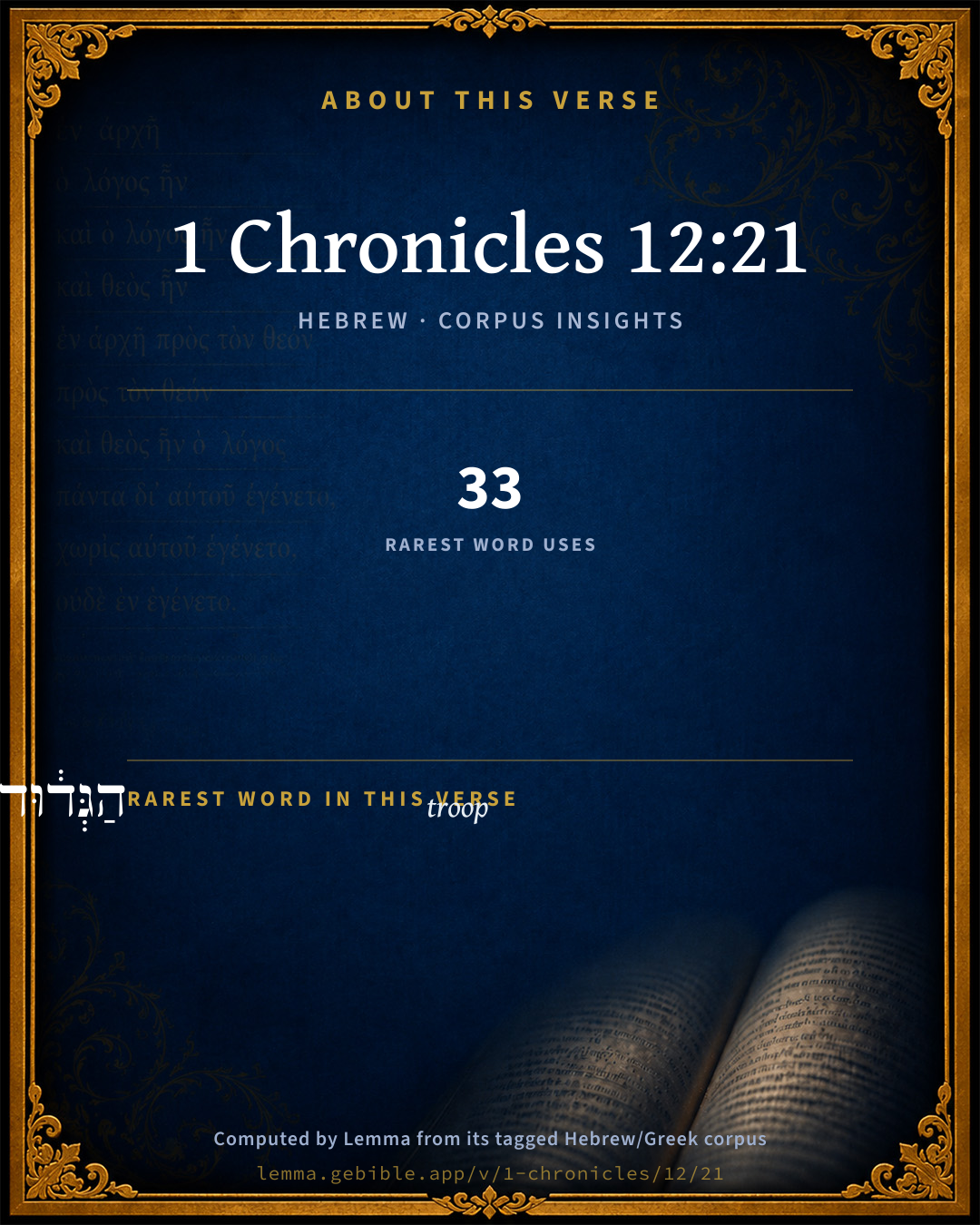
הַגְּד֔וּד troop H1416 occurs in 29 verses of the Hebrew Bible. Also found in:

Grammatical profile

  • 2 verbs
  • 6 nouns
  • 1 adjective
  • 1 pronoun
  • 2 prepositions
  • 1 conjunction

Verb forms

  • עָזְר֤וּ Qal · Perfect
  • וַיִּהְי֥וּ Qal · Sequential Imperfect

Hebrew & Septuagint length

In English translation the verse runs 22 words from the Hebrew and 29 from the Septuagint (LXX English) — closely comparable.

A rough comparison of the two English renderings, which tokenize alike — not a word-level alignment.

Word counts can differ between the Hebrew and the Greek without any difference in meaning — e.g. the Hebrew direct-object marker אֵת has no separate Greek word, and Greek often adds the article ὁ.

Cross-references

5

Topical passages linked to 1 Chronicles 12:21 in the Treasury of Scripture Knowledge — connected by theme and wording, ordered by reader-vote popularity; previews shown in the World English Bible.

  • 1 Samuel 30:1–17 It happened, when David and his men were come to Ziklag on the third day, that the Amalekites had made a raid on the South, and on Ziklag, and had struck Ziklag, and burned it with fire,
  • 1 Chronicles 5:24 These were the heads of their fathers' houses: even Epher, and Ishi, and Eliel, and Azriel, and Jeremiah, and Hodaviah, and Jahdiel, mighty men of valor, famous men, heads of their fathers' houses.
  • 1 Chronicles 11:10 Now these are the chief of the mighty men whom David had, who shown themselves strong with him in his kingdom, together with all Israel, to make him king, according to the word of Yahweh concerning Israel.
  • 1 Chronicles 11:21–22 Of the three, he was more honorable than the two, and was made their captain: however he didn't attain to the [first] three.
  • 1 Chronicles 12:20 As he went to Ziklag, there fell to him of Manasseh, Adnah, and Jozabad, and Jediael, and Michael, and Jozabad, and Elihu, and Zillethai, captains of thousands who were of Manasseh.

Cross-references courtesy of OpenBible.info (CC BY 4.0).

Hebrew and Greek witnesses Masoretic Hebrew ↔ Greek Septuagint

The same verse in the two great witnesses to the Old Testament, shown verse-for-verse.

These are two independent witnesses, not word-aligned to each other, and the Septuagint is shown in lemma (dictionary) form.

Hebrew 1 Chronicles 12:21 Masoretic · Westminster Leningrad Codex

וְהֵ֗מָּה עָזְר֤וּ עִם דָּוִיד֙ עַֽל הַגְּד֔וּד כִּֽי גִבּ֥וֹרֵי חַ֖יִל כֻּלָּ֑ם וַיִּהְי֥וּ שָׂרִ֖ים בַּצָּבָֽא

They helped David against the band of rovers: for they were all mighty men of valor, and were captains in the host.

World English Bible · Public Domain

Greek LXX 1 Chronicles 12:21 Septuagint · lemma form

ἐν ὁ πορεύομαι αὐτός εἰς σωκλαγ προςχωρέω αὐτός ἀπό μανασσή εδνα καί ιωζαβαθ καί ιωδιηλ καί μιχαηλ καί ιωσαβεθ καί ελιμουθ καί σελαθι ἀρχηγός χιλιάς εἰμί ὁ μανασσή

And they fought on the side of David against a troop, for they were all men of might; and they were commanders in the army, because of their might.

LXX2012 (modern English Septuagint) · Public Domain

Hebrew: Westminster Leningrad Codex (CC BY 4.0). Greek: Septuagint (public domain); English from LXX2012 (modern English Septuagint) (Public Domain). How the Septuagint differs from the Hebrew →

Commentary

Notes on 1 Chronicles 12:21 from classic Christian and Jewish commentators (each source and its license shown beneath its notes). The classic Christian expositions comment on the surrounding passage and are grouped to its opening verse, so a note may address several verses; the Jewish commentaries on the Tanakh (Rashi and others) are per-verse, so they appear only where the commentator wrote on this verse.

Lemma curates 59 commentaries, every one of them public domain or Creative Commons licensed, each selected and text-cleaned for this edition rather than reprinted as found. About our sources →

Ellicott's Commentary for English Readers

(21) And they helped David against the band of the rovers.—So the Vulg. and Syr. The Heb. text has been called “brief and unintelligible,” and its explanation has been sought in 1Sa_30:8; 1Sa_30:15, where “the band” (haggedûd, as here) of Amalek, which had captured and burnt Ziklag in David’s absence, is spoken of. But why may we not render, “And these helped David over the band,” i.e., in the joint command of his forces. (Comp. 1Ch_12:18, “made them captains of the band.”) It is pretty clear that the names enumerated (1Ch_12:1-20) are those of captains and chiefs, not of ordinary warriors. (Comp, 1Ch_12:14; 1Ch_12:18.) Consequently 1Ch_12:21-22 form a subscription or concluding remark to the entire list.

A Bible Commentary for English Readers, edited by Charles John Ellicott (1878–1897) — public domain. Text from a community e-Sword module.

Joseph Benson's Commentary

1Ch 12:21-22. They helped David against the band, &c. — Against the Amalekites, who had taken and burned Ziklag, and whom David and his six hundred men were now pursuing. Or, as in the margin, with a band, or troop of soldiers, which they brought along with them to David’s assistance. They were all mighty men of valour — Therefore they readily came to David’s help. At that time, day by day — While David was at Ziklag, and in his march to Hebron, and principally at Hebron. There came to David — like the host of God — An innumerable multitude, like the stars or angels of God, both which are called God’s host.

Joseph Benson's Commentary on the Old and New Testaments (1811–1818) — public domain. Text from a community e-Sword module.

Geneva Bible (1599)

Geneva Bible translators

To wit, of the Amalekites which had burned the city Ziklag, 1 Sam. 30:1,9.

Geneva Bible (1599) marginal notes — public domain. Text via Bolls.life.

Jamieson, Fausset & Brown

Robert Jamieson, A. R. Fausset & David Brown

they helped David against the band--that is, the Amalekites who had pillaged Ziklag in David's absence. This military expedition was made by all his men (Sa1 30:9), who, as David's early helpers, are specially distinguished from those who are mentioned in the latter portion of the chapter.

Jamieson, Fausset & Brown — Commentary Critical and Explanatory on the Whole Bible (1871) — public domain (CC PDM 1.0). Text via the HelloAO Bible API.

The Cambridge Bible for Schools and Colleges

gen. ed. J. J. S. Perowne

21. against the band of the rovers] The reference is to the Amalekites who burnt Ziklag (1Sa_30:1 ff). The Heb. word gĕdûd, here translated “band,” is translated “troop” (ib. 1Sa_30:8; 1Sa_30:15, R.V.).

and were captains] Render, and they became captains.

The Cambridge Bible for Schools and Colleges (gen. ed. J. J. S. Perowne; Cambridge University Press, 1878–1918) — public domain. Text from a community e-Sword module.

John Gill's Exposition

All these men of war that could keep rank,.... Well disciplined men:

came with a perfect heart to Hebron to make David king over Israel; they were all of one mind, and quite hearty and sincere in fixing David on the throne of all Israel:

and all the rest also of Israel were of one heart also to make David king; those who came not were of the same mind; it was the unanimous voice of the people that he should be their king.

John Gill's Exposition of the Whole Bible (1746–1763) — public domain (CC PDM 1.0). Text via the HelloAO Bible API.

Albert Barnes' Notes on the Bible

The band of the rovers - See the marginal reference.

Albert Barnes' Notes on the Bible (1834–1885) — public domain. Text from a community e-Sword/MySword module.

Haydock's Catholic Bible Commentary

Rovers of Amalec, 1 Kings xxx. 1.

George Leo Haydock (1774–1849), Haydock's Catholic Family Bible and Commentary, 1859 edition — public domain. Excludes Psalms (Douay-Rheims chapter numbering differs from Protestant) and Deuterocanonical books (Catholic canon only).

Matthew Poole's English Annotations

Against the band of the rovers, i.e. against the Amalekites who had taken and burned Ziklag, whom David and his six hundred men were now pursuing, whom these accompanied in that expedition. Or, with a band or troop of soldiers, which they brought along with them to David’s assistance.

They were all mighty men of valour; therefore they readily came to David’s help.

Were captains in the host; therefore they brought others along with them.

Matthew Poole's English Annotations on the Holy Bible (1683–1685) — public domain. Text from a community e-Sword/MySword module.

Whedon's Commentary on the Bible

Daniel D. Whedon

21. They helped David against the band — The predatory horde of Amalekites, which, during David’s absence, had fallen upon Ziklag, and taken the women and children captive. See 1 Samuel 30.

Daniel D. Whedon (gen. ed.), Commentary on the Old and New Testaments (1874–1909) — public domain. Text from a community e-Sword module.

The Pulpit Commentary

The band. The band referred to is evidently that of Amalek in 1Sa_30:8, 1Sa_30:9. Were captains; better, became captains.

The Pulpit Commentary (1880–1919), ed. H.D.M. Spence-Jones & Joseph S. Exell — public domain. Text from a community e-Sword module.

John Wesley's Explanatory Notes

Against - Against the Amalekites who had taken and burnt Ziklag, whom David and his six hundred men were now pursuing.

John Wesley, Explanatory Notes Upon the Whole Bible (1754–1765) — public domain. Text via the GEBible commentary corpus.

Keil & Delitzsch

C. F. Keil & F. Delitzsch

All these men of war that could keep rank,.... Well disciplined men:

came with a perfect heart to Hebron to make David king over Israel; they were all of one mind, and quite hearty and sincere in fixing David on the throne of all Israel:

and all the rest also of Israel were of one heart also to make David king; those who came not were of the same mind; it was the unanimous voice of the people that he should be their king.

Keil & Delitzsch — Biblical Commentary on the Old Testament (1861–1891) — public domain (CC PDM 1.0). Text via the HelloAO Bible API. (Old Testament only.)

unfoldingWord translationNotes

Door43 World Missions Community

the roving bands

"the groups of robbers." This refers to groups of people who robbed people traveling through the countryside.

Day after day

"Each day"

a great army, like the army of God

Possible meanings are 1) the phrase "like the army of God" means "like an army that God assembled" or 2) the word "God" is used as an idiom that refers to the great size of the army. AT: "a very large army" (See: Idiom)

translationWords

commander

unfoldingWord translationNotes — © Distant Shores Media and the Door43 World Missions Community, licensed CC BY-SA 4.0. Source: git.door43.org/Door43/en_tn.

Lesson kit

Teaching starters — assembled from the data on this page, not authored interpretation. Every prompt links to the verse data it draws on. Edit before teaching.

1 Chronicles, in the Historical, opens this verse with 13 words (13 distinct Hebrew lemmas). Its most distinctive word is gᵉdûwd (“troop”). A historical commentator’s framing appears above. Read the whole chapter for the surrounding context.

Discussion questions

  1. The word gᵉdûwd carries the sense “troop.” How does it shape the verse?
  2. How does Genesis 49:19, which shares the word «troop», read alongside this verse?
  3. The translations on this page render this verse differently — a whole-verse word diff, not a word-by-word alignment. What might account for the different wordings?
  4. «עָזְר֤וּ» is a Qal Perfect verb. How does that grammatical form shape the action described?
  5. Compare how Ellicott's Commentary for English Readers and Joseph Benson's Commentary read this verse. Where do they agree or differ?

Things to notice

Reading settings

Reading text

Shown beneath each verse's original-language words.

Old Testament
Old Testament edition

Read the OT as the Masoretic Hebrew (MT) or the Greek Septuagint (LXX).

English shown for the Greek Septuagint (in the Hebrew ↔ Greek comparison).

Comparing translations? Open the Compare panel on any verse page to stack up to four side by side.