
Isaiah 61:6

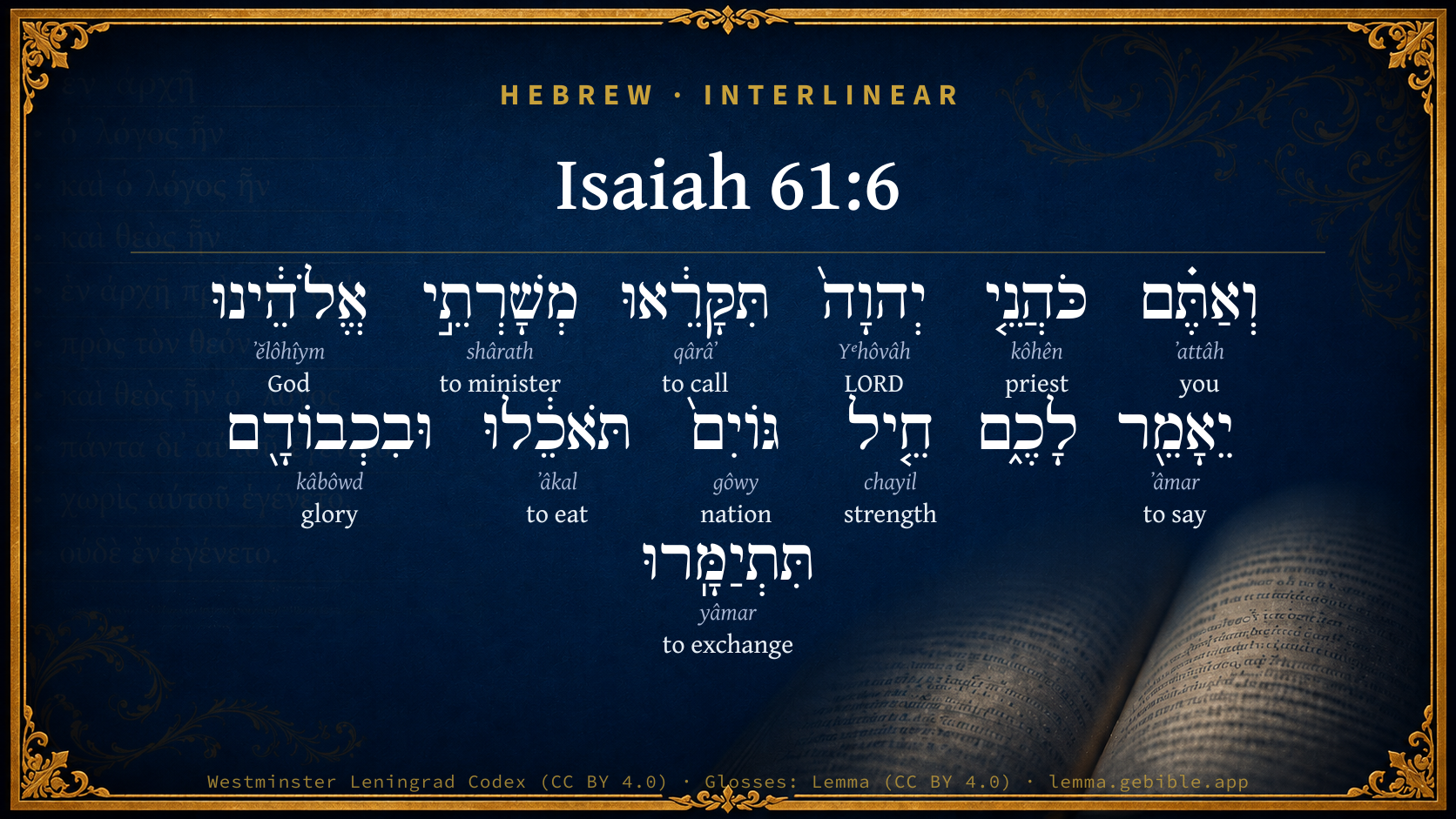
Hebrew (Westminster Leningrad Codex) Isaiah 61:6 appears in the Hebrew Old Testament. The text above is from the Westminster Leningrad Codex. Each word links to its Strong’s number, a concise gloss, and parsing drawn from the Open Scriptures Hebrew Bible morphology. Click any word for its full Brown-Driver-Briggs (BDB) entry.
Download image
Cite this verse

Isaiah 61:6 (World English Bible). Public Domain. Lemma interlinear Bible study tool, https://lemma.gebible.app/v/isaiah/61/6.

Show BibTeX & RIS
BibTeX
RIS
English Translation
But you shall be named the priests of Yahweh; men shall call you the ministers of our God: you shall eat the wealth of the nations, and in their glory shall you boast yourselves.
World English Bible · Public Domain
Highlights
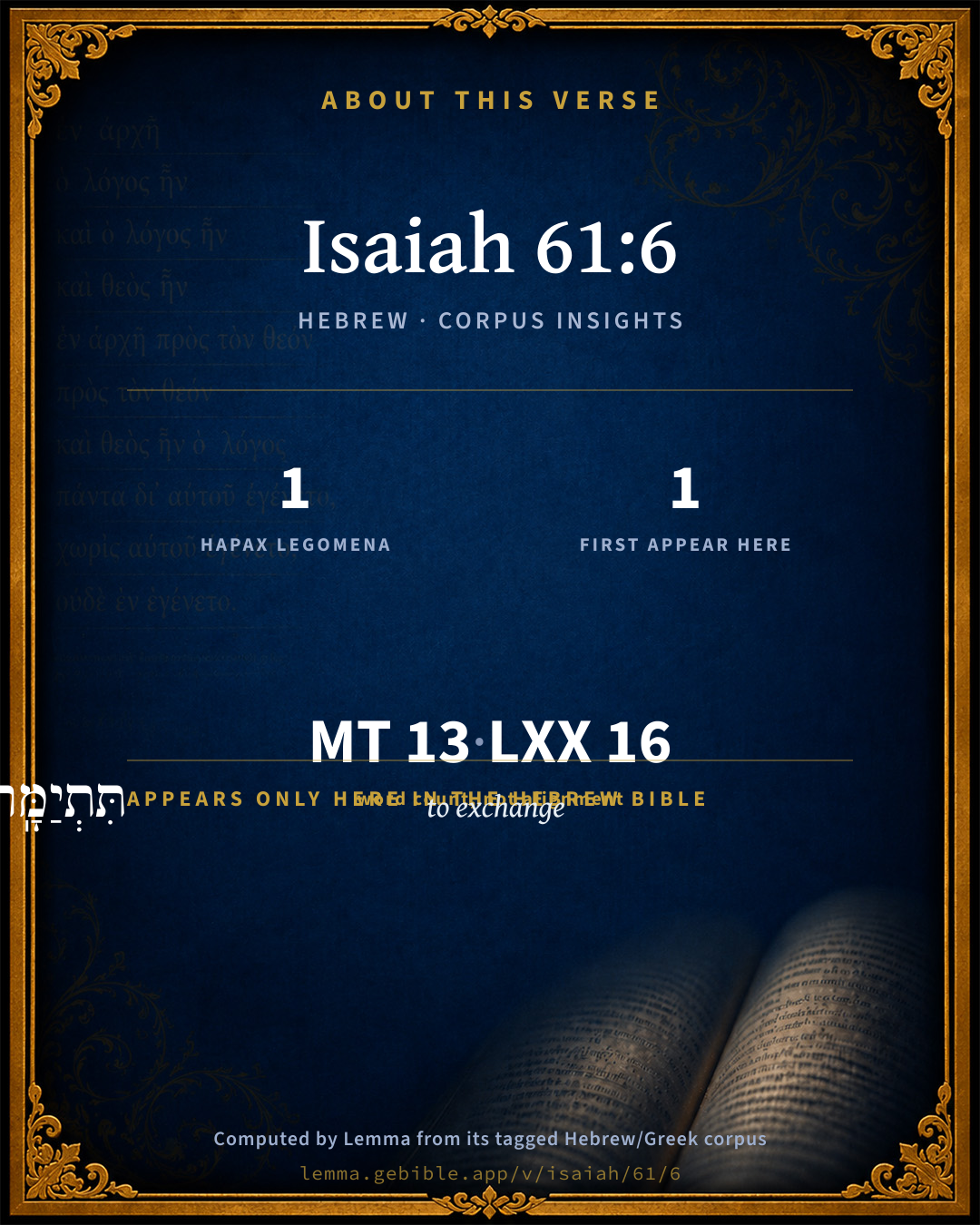
  • 1 hapax legomenon — only here in the Hebrew Bible
  • 1 first appearance in the Hebrew Bible
Full analysis ↓
Download a study sheet

One document with this verse’s original text, its word-by-word gloss line, the meaning frame, cross-references with their text, attributed commentary, and full source and license credits — printable, and it pastes into notes with its structure intact.

This verse Autodidact and up

Study sheet (.html) Plain text (.txt)

A passage Seminary Student

Up to 50 verses in one chapter. A passage sheet keeps up to 6 commentary sources and 12 cross-references per verse, in the order this page ranks them, and says so on the sheet whenever that leaves anything out. Ask for a single verse and you get the Autodidact verse sheet above.

Everything on this page stays free to read, with no account — the sheet is a download of what is already on screen, not access to it.

Want to remove ads? Support Godless Engineer
Compare translations 3

The same verse in 3 English versions, stacked beneath the original-language interlinear above. Click any original word for its lexicon entry.

Each is an independent rendering of the whole verse — the interlinear is not word-aligned to these translations.

Highlighted words mark where these versions differ — a whole-verse word diff, not a word-by-word alignment.

  • World English Bible Public Domain
    But you shall be named the priests of Yahweh; men shall call you the ministers of our God: you shall eat the wealth of the nations, and in their glory shall you boast yourselves.
  • King James Version Public Domain
    But ye shall be named the Priests of the LORD: men shall call you the Ministers of our God: ye shall eat the riches of the Gentiles, and in their glory shall ye boast yourselves.
  • unfoldingWord Literal Text CC BY-SA 4.0
    And you, you will be called priests of Yahweh; “servants of our God” will be said to you. You will eat the wealth of nations, and you will boast yourself in their glory.

unfoldingWord Literal Text — © unfoldingWord, licensed CC BY-SA 4.0. Word-aligned USFM3 via Door43 (git.door43.org/unfoldingWord/en_ult).

Versions to compare (up to 4)

3 of 4 selected

Show all 18 translations

Every available English version of this verse, each an independent rendering of the whole verse.

  • World English Bible Public Domain
    But you shall be named the priests of Yahweh; men shall call you the ministers of our God: you shall eat the wealth of the nations, and in their glory shall you boast yourselves.
  • Berean Standard Bible Public Domain
    But you will be called the priests of the LORD; they will speak of you as ministers of our God; you will feed on the wealth of nations, and you will boast in their riches.
  • Majority Standard Bible Public Domain
    But you will be called the priests of the LORD; they will speak of you as ministers of our God; you will feed on the wealth of nations, and you will boast in their riches.
  • King James Version Public Domain
    But ye shall be named the Priests of the LORD: men shall call you the Ministers of our God: ye shall eat the riches of the Gentiles, and in their glory shall ye boast yourselves.
  • American Standard Version (1901) Public Domain
    But ye shall be named the priests of Jehovah; men shall call you the ministers of our God: ye shall eat the wealth of the nations, and in their glory shall ye boast yourselves.
  • Revised Version (1885) Public Domain
    But ye shall be named the priests of the LORD: men shall call you the ministers of our God: ye shall eat the wealth of the nations, and in their glory shall ye boast yourselves.
  • Geneva Bible (1599) Public Domain
    But ye shall be named the Priestes of the Lord, and men shall say vnto you, The ministers of our God, Ye shall eate the riches of the Gentiles, and shalbe exalted with their glorie.
  • Douay-Rheims (1899) Public Domain
    But you shall be called the priests of the Lord: to you it shall be said: Ye ministers of our God: you shall eat the riches of the Gentiles, and you shall pride yourselves in their glory.
  • Young's Literal Translation Public Domain
    And ye are called `Priests of Jehovah,' `Ministers of our God,' is said of you, The strength of nations ye consume, And in their honour ye do boast yourselves.
  • Literal Standard Version CC BY-SA 4.0
    And you are called priests of YHWH, || It is said of you [that you are] ministers of our God, || You consume the strength of nations, || And you boast yourselves in their glory.
  • Unlocked Literal Bible CC BY-SA 4.0
    You will be called the priests of Yahweh; they will call you servants of our God. You will eat the wealth of the nations, and you will boast in their riches.
  • unfoldingWord Literal Text CC BY-SA 4.0
    And you, you will be called priests of Yahweh; “servants of our God” will be said to you. You will eat the wealth of nations, and you will boast yourself in their glory.
  • Darby Bible Public Domain
    But as for you, ye shall be called priests of Jehovah; it shall be said of you: Ministers of our God. Ye shall eat the wealth of the nations, and into their glory shall ye enter.
  • World Messianic Bible Public Domain
    But you will be called the LORD’s priests. Men will call you the servants of our God. You will eat the wealth of the nations. You will boast in their glory.
  • Webster's Bible Public Domain
    But ye shall be named the Priests of the LORD: men shall call you the Ministers of our God: ye shall eat the riches of the Gentiles, and in their glory shall ye boast yourselves.
  • Free Bible Version CC BY-SA 4.0
    You will be called priests of the Lord, identified as ministers of our God. You will enjoy the wealth of nations and be proud that you have it.
  • Bible in Basic English Public Domain
    But you will be named the priests of the Lord, the servants of our God: you will have the wealth of the nations for your food, and you will be clothed with their glory.
  • JPS Tanakh (1917) Public Domain
    But ye shall be named the priests of the LORD, men shall call you the ministers of our God; ye shall eat the wealth of the nations, and in their splendour shall ye revel.

Literal Standard Version (2020), Covenant Press — licensed CC BY-SA 4.0. Text via the HelloAO Bible API (eBible.org). Unlocked Literal Bible (unfoldingWord) — licensed CC BY-SA 4.0. Text via the HelloAO Bible API (eBible.org). unfoldingWord Literal Text — © unfoldingWord, licensed CC BY-SA 4.0. Word-aligned USFM3 via Door43 (git.door43.org/unfoldingWord/en_ult). Free Bible Version, Dr. Jonathan Gallagher — licensed CC BY-SA 4.0. Text via the HelloAO Bible API (eBible.org).

Word by word

More ways to search: Search by grammar → Find every occurrence → Compare this word →

Practice this passage: Drill this verse → Learn its vocabulary →

תִּתְיַמָּֽרוּ
yâmar
H3235
“to exchange”
Verb, Hithpael, Imperfect, 2nd Person, Masculine, Plural
Part of Speech
Verb
Stem
Hithpael
Form
Imperfect
Person
2nd Person
Gender
Masculine
Number
Plural
Full BDB Definition

Origin: a primitive root

TWOT: 118

to exchange - (Hiphil) to exchange - (Hithpael) to enter into, be changed into - (TWOT) to promise
  1. וְאַתֶּ֗ם ʼattâh H859 “and · you” Conjunction + Pronoun, Personal, 2nd Person, Masculine, Plural
  2. כֹּהֲנֵ֤י kôhên H3548 “priests of” Noun, Common, Masculine, Plural, Construct
  3. יְהוָה֙ Yᵉhôvâh H3068 “LORD” Noun, Proper
  4. תִּקָּרֵ֔אוּ qârâʼ H7121 “to call” Verb, Niphal, Imperfect, 2nd Person, Masculine, Plural
  5. מְשָׁרְתֵ֣י shârath H8334 “ministering” Verb, Piel, Participle Active, Masculine, Plural, Construct
  6. אֱלֹהֵ֔ינוּ ʼĕlôhîym H430 “God(s) · our” Noun, Common, Masculine, Plural, Construct + Suffix, Personal, 1st Person, Common, Plural
  7. יֵאָמֵ֖ר ʼâmar H559 “to say” Verb, Niphal, Imperfect, 3rd Person, Masculine, Singular
  8. חֵ֤יל chayil H2428 “strength of” Noun, Common, Masculine, Singular, Construct
  9. גּוֹיִם֙ gôwy H1471 “nations” Noun, Common, Masculine, Plural, Absolute
  10. תֹּאכֵ֔לוּ ʼâkal H398 “to eat” Verb, Qal, Imperfect, 2nd Person, Masculine, Plural
  11. וּבִכְבוֹדָ֖ם kâbôwd H3519 “and · in/at · glory · their” Conjunction + Preposition + Noun, Common, Both, Singular, Construct + Suffix, Personal, 3rd Person, Masculine, Plural

About this verse

These counts appear in no published source. They are computed here, from the morphology-tagged text and Lemma’s own curated glosses. What Lemma adds →

13
words
12
distinct lemmas
Prophets
section

Notable vocabulary

1 hapax legomenon — a word that appears only here in the entire Hebrew Bible:

  • תִּתְיַמָּֽרוּ to exchange H3235

First appearance in Scripture

This word makes its first canonical appearance in the Hebrew Bible here:

  • תִּתְיַמָּֽרוּ to exchange H3235

Grammatical profile

  • 5 verbs
  • 6 nouns
  • 1 pronoun
  • 1 preposition

Verb forms

  • תִּקָּרֵ֔אוּ Niphal · Imperfect
  • מְשָׁרְתֵ֣י Piel · Participle Active
  • יֵאָמֵ֖ר Niphal · Imperfect
  • תֹּאכֵ֔לוּ Qal · Imperfect
  • תִּתְיַמָּֽרוּ Hithpael · Imperfect

Hebrew & Septuagint length

In English translation the verse runs 34 words from the Hebrew and 28 from the Septuagint (LXX English) — closely comparable.

A rough comparison of the two English renderings, which tokenize alike — not a word-level alignment.

Word counts can differ between the Hebrew and the Greek without any difference in meaning — e.g. the Hebrew direct-object marker אֵת has no separate Greek word, and Greek often adds the article ὁ.

In the original languages it is 13 Hebrew tokens and 16 Greek tokens — but the two are counted differently (Hebrew bundles its prefixes and suffixes into one token; the Greek is in lemma form), so that isn’t a like-for-like length.

Cross-references

21

Topical passages linked to Isaiah 61:6 in the Treasury of Scripture Knowledge — connected by theme and wording, ordered by reader-vote popularity; previews shown in the World English Bible.

  • Exodus 19:6 and you shall be to me a kingdom of priests, and a holy nation.' These are the words which you shall speak to the children of Israel."
  • 1 Peter 2:5 You also, as living stones, are built up as a spiritual house, to be a holy priesthood, to offer up spiritual sacrifices, acceptable to God through Jesus Christ.
  • 1 Peter 2:9 But you are a chosen race, a royal priesthood, a holy nation, a people for God's own possession, that you may show forth the excellencies of him who called you out of darkness into his marvelous light:
  • Isaiah 60:5–7 Then you shall see and be radiant, and your heart shall thrill and be enlarged; because the abundance of the sea shall be turned to you, the wealth of the nations shall come to you.
  • Isaiah 66:21 Of them also will I take for priests [and] for Levites, says Yahweh.
  • Revelation 5:10 And made them kings and priests to our God, And they reign on earth."
  • 2 Corinthians 11:23 Are they servants of Christ? (I speak as one beside himself) I am more so; in labors more abundantly, in prisons more abundantly, in stripes above measure, in deaths often.
  • Revelation 20:6 Blessed and holy is he who has part in the first resurrection. Over these, the second death has no power, but they will be priests of God and of Christ, and will reign with him one thousand years.
  • Isaiah 60:16–17 You shall also suck the milk of the nations, and shall suck the breast of kings; and you shall know that I, Yahweh, am your Savior, and your Redeemer, the Mighty One of Jacob.
  • Isaiah 66:12 For thus says Yahweh, Behold, I will extend peace to her like a river, and the glory of the nations like an overflowing stream: and you shall suck [of it]; you shall be borne on the side, and shall be dandled on the knees.
  • Ezekiel 14:11 that the house of Israel may go no more astray from me, neither defile themselves any more with all their transgressions; but that they may be my people, and I may be their God, says the Lord Yahweh.
  • Romans 12:1 Therefore I urge you, brothers, by the mercies of God, to present your bodies a living sacrifice, holy, acceptable to God, which is your spiritual service.
  • 1 Corinthians 4:1 So let a man think of us as Christ's servants, and stewards of God's mysteries.
  • Isaiah 23:18 Her merchandise and her hire shall be holiness to Yahweh: it shall not be treasured nor laid up; for her merchandise shall be for those who dwell before Yahweh, to eat sufficiently, and for durable clothing.
  • Isaiah 60:10–11 Foreigners shall build up your walls, and their kings shall minister to you: for in my wrath I struck you, but in my favor have I had mercy on you.
  • Acts 11:28–30 One of them named Agabus stood up, and indicated by the Spirit that there should be a great famine all over the world, which also happened in the days of Claudius.
  • Romans 15:26–27 For it has been the good pleasure of Macedonia and Achaia to make a certain contribution for the poor among the saints who are at Jerusalem.
  • 1 Corinthians 3:5 Who then is Apollos, and who is Paul, but servants through whom you believed; and each as the Lord gave to him?
  • 2 Corinthians 6:4 but in everything commending ourselves, as servants of God, in great endurance, in afflictions, in hardships, in distresses,
  • Ephesians 4:11–12 He gave some to be apostles; and some, prophets; and some, evangelists; and some, shepherds and teachers;
  • Revelation 1:6 and he made us to be a Kingdom, priests to his God and Father; to him be the glory and the dominion forever and ever. Amen.

Cross-references courtesy of OpenBible.info (CC BY 4.0).

Hebrew and Greek witnesses Masoretic Hebrew ↔ Greek Septuagint

The same verse in the two great witnesses to the Old Testament, shown verse-for-verse.

These are two independent witnesses, not word-aligned to each other, and the Septuagint is shown in lemma (dictionary) form.

Hebrew Isaiah 61:6 Masoretic · Westminster Leningrad Codex

וְאַתֶּ֗ם כֹּהֲנֵ֤י יְהוָה֙ תִּקָּרֵ֔אוּ מְשָׁרְתֵ֣י אֱלֹהֵ֔ינוּ יֵאָמֵ֖ר לָכֶ֑ם חֵ֤יל גּוֹיִם֙ תֹּאכֵ֔לוּ וּבִכְבוֹדָ֖ם תִּתְיַמָּֽרוּ

But you shall be named the priests of Yahweh; men shall call you the ministers of our God: you shall eat the wealth of the nations, and in their glory shall you boast yourselves.

World English Bible · Public Domain

Greek LXX Isaiah 61:6 Septuagint · lemma form

σύ δέ ἱερεύς κύριος καλέω λειτουργός θεός ἰσχύς ἔθνος καταἐσθίω καί ἐν ὁ πλοῦτος αὐτός θαυμάζω

But you⌃ shall be called priests of the Lord, the ministers of God: you⌃ shall eat the strength of nations, and shall be admired because of their wealth.

LXX2012 (modern English Septuagint) · Public Domain

On this verse, Joseph Benson's Commentary discusses the Septuagint’s reading. Read the note in Commentary ↓

Hebrew: Westminster Leningrad Codex (CC BY 4.0). Greek: Septuagint (public domain); English from LXX2012 (modern English Septuagint) (Public Domain). How the Septuagint differs from the Hebrew →

Targum (Aramaic paraphrase)

1

The Targum is the ancient Jewish Aramaic paraphrase of the Hebrew Scriptures — an interpretive translation, not the Hebrew text itself. Onkelos (literal) and Pseudo-Jonathan (expansive) render the Torah, and Jonathan the Prophets. Coverage is partial: where no permissively-licensed English translation exists for a verse, only the Aramaic is shown. This is verse-level text, not a word-by-word alignment to the Hebrew.

  1. Targum Jonathan Prophets (Joshua–Malachi)
    וְאַתּוּן כַּהֲנַיָא דַייָ תִּתְקְרוּן דִמְשַׁמְשִׁין קֳדָם אֱלָהָנָא יִתְאֲמַר לְכוֹן נִכְסֵי פַּלְחֵי כּוֹכְבַיָא תֵּיכְלוּן וּבִיקָרְהוֹן תִּתְפַּנְקוּן:

    But ye shall be called the Priests of the Lord: it shall be said of you that ye are those who minister before our God: ye shall eat the riches of the Gentiles, and in their glory ye shall delight yourselves.

    Targum Jonathan — Aramaic: “Mikraot Gedolot” (public domain). English: “Sefaria Community Translation” (CC0 1.0 (public-domain dedication)); “London "Chaldee Paraphrase," 1871” (public domain). Text via Sefaria.

Commentary

Notes on Isaiah 61:6 from classic Christian and Jewish commentators (each source and its license shown beneath its notes). The classic Christian expositions comment on the surrounding passage and are grouped to its opening verse, so a note may address several verses; the Jewish commentaries on the Tanakh (Rashi and others) are per-verse, so they appear only where the commentator wrote on this verse.

Lemma curates 59 commentaries, every one of them public domain or Creative Commons licensed, each selected and text-cleaned for this edition rather than reprinted as found. About our sources →

Trapp's Complete Commentary

John Trapp

Isa 61:6 But ye shall be named the Priests of the LORD: [men] shall call you the Ministers of our God: ye shall eat the riches of the Gentiles, and in their glory shall ye boast yourselves.

Ver. 6. But ye shall be named the Priests of the Lord.] Or, Princes of the Lord, as the word is used 2Sa 8:18. See Exo 19:6 Rev 1:6 1Pe 2:9 Rom 12:1 Heb 13:15.

Ye shall eat the riches of the Gentiles.] Ye shall have the double honour of countenance and maintenance.

John Trapp, A Commentary or Exposition upon All the Books of the Old and New Testament (1647–1656) — public domain. Text from a community e-Sword module.

The Biblical Illustrator

Joseph S. Exell

Isa_61:6

But ye shall be named the Priests of the Lord

Israels priesthood among the nations

The meaning is simply that in relation to the Gentiles, Israel shall enjoy a position of priesthood analogous to the relation between priests and laymen.

It was Israels calling to be a kingdom of priests (Exo_19:6), and in the latter days this destiny will be fulfilled in their mediatorial relation to the outer world. Although prophecy in general accords a position of supremacy to Israelites in the future kingdom of God, the distinction is, perhaps, nowhere so definitely formulated as here. (Prof. J. Skinner, D. D.)

New Testament privileges expressed in Old Testament phraseology

Regarding the position assigned to the Hebrew nation after it has become the teacher of other peoples and the leader of their worship, as here declared, we can form no conception that will harmonize with the spirit of New Testament liberty and the abolition of all dividing-walls between the nations,--the prophet predicts New Testament matters in Old Testament fashion. (F. Delitzsch, D. D.)

Gods priesthood v mans priestcraft

When Christ came, all earthly priesthoods were abolished, and of all members of His kingdom it was to be said, Ye shall be named the priests of the Lord.

I. HOW IS THE OFFICE OF THE PRIESTHOOD ENTERED? Aaron and his sons are the types of Christs high priesthood and the priesthood of all believers. The Holy Ghost has most clearly taught by this type the order of entrance into spiritual priesthood.

1. The priests become so by virtue of their union with the high priest (Exo_28:1). And the call of Christ unto His high priesthood also includes the call of all His sons into their spiritual priesthood.

2. In the consecration of Aarons sons to the priesthood there was also blood sprinkling. Christs high priesthood rests on an accomplished sacrifice. What does my priesthood rest on? On blood, too.

3. The anointing gives the qualification for priesthood (1Jn_2:20; 1Jn_2:27).

4. The qualification of garments (Exo_28:4; Exo_28:40).

II. THE PRIVILEGES AND DUTIES APPERTAINING TO THIS PRIESTHOOD.

1. To offer up spiritual sacrifices (1Pe_2:5). Our bodies (Rom_12:1); our prayers; our praise; our intercessions.

2. It was the priests duty and privilege to maintain the service of the sanctuary. Every believer, being a priest, has equal right with every other believer to engage in maintaining the service of the sanctuary. (A. G. Brown.)

The Biblical Illustrator, edited by Joseph S. Exell (c. 1880s–1900s) — public domain. Text from a community e-Sword module.

Joseph Benson's Commentary

Isa 61:6-7. But ye shall be named the Priests, &c. — The whole body of you shall now be as near to God as the priests were formerly, and shall be a royal priesthood, 1Pe 2:9. This is most certainly true of all the faithful under the gospel; hence they have also their spiritual sacrifices, Rom 12:1; Heb 13:15-16; 1Pe 2:5. Ye shall eat the riches of the Gentiles — Partake of their plenty; and in their glory shall ye boast — You shall be highly advanced by the addition of all that is glorious in them. The LXX. render it, εν τω πλουτω αυτων θαυμασθησεσθε, you shall be wonderful, or the objects of admiration, through their riches; that is, by the glory which they shall bring to you, namely, in riches, parts, learning, chap. 60:5, 11. For your shame ye shall have double — Honour; though you have been little accounted of among the Gentiles, yet now you shall be highly esteemed by them; you shall have double damages. See on chap. 40:2. They shall rejoice in their portion — Namely, of honour, which God will give them. It is a repetition of that which is asserted in the former clause. Therefore, or, rather, because, they shall possess the double — Because of the doubling of their portion; everlasting joy shall be unto them — Joy that shall continue long here, and shall be everlasting hereafter. The meaning of this prediction seems to be, that though the first Christians should have a large share of shame or ignominy thrown upon them, yet their descendants should, in return, receive a double share of honour and glory. This accordingly came to pass: Christianity, from being considered as the greatest infamy, and being loaded with the greatest shame, came into the highest repute when Constantine became emperor, and received the highest honours that could possibly be paid, and was, as it were, loaded with glory, riches, and honour.”

Joseph Benson's Commentary on the Old and New Testaments (1811–1818) — public domain. Text from a community e-Sword module.

The Preacher's Complete Homiletical Commentary

Joseph S. Exell (gen. ed.)

GOD’S PRIESTHOOD v. MAN’S PRIESTCRAFT

Isa_61:6. But ye shall be named the priests of the Lord.

To such low purposes has the noble word of “priest” been prostituted, so vilely has it been dishonoured, and so repulsive are all its present associations, that I confess it does not seem to me any very great compliment, or anything to rejoice much about, when my text declares, “And ye shall be named priests.” “Ye are,” said the Holy Ghost of all believers, “a royal priesthood.” This chapter has reference to the kingdom of Christ. It looks forward to the time when He should come who could say, “The Spirit of the Lord is upon me,” &c. When He came, all earthly priesthoods were abolished, and of all members of His kingdom it was to be said, “And ye shall be named the priests of the Lord.”

I. How is the office of the priesthood entered? You may glean this from the induction of Aaron and his sons into the priestly office, for they are the types of Christ’s high priesthood and the priesthood of all believers. The Holy Ghost has most clearly taught by this type the order of entrance into spiritual priesthood.

1. The priests became so by virtue of their union with the high priest (Exo_28:1). And the call of Christ unto His high priesthood also includes the call of all His sons into their spiritual priesthood. The question of right to priesthood was not at all a question of personal qualities or social advantages. Carry out this argument in reference to all believers. Just as by virtue of their union and identification with Aaron his sons became priests, do you and I, by virtue of our union and identification with Christ, become the Lord’s priests.

2. In the consecration of Aaron’s sons to the priesthood there was not only union with the high priest, but there was also blood sprinkling. Christ’s high priesthood rests on an accomplished sacrifice—on blood. What does my priesthood rest on? Why, on blood too. Not only was the blood put on Aaron, but on Aaron’s sons; and believers enter into priesthood by virtue of the same blood that forms the basis of Christ’s high priesthood. Unless we have the blood sprinkled upon us, we are no priests.

3. The anointing gives the qualification for priesthood. If we are believers, have not we received the anointing which qualifies for priesthood? (1Jn_2:20; 1Jn_2:27).

4. The qualification of garments. They were dressed for priestly service (Exo_28:40).

II. The privileges and duties appertaining to this priesthood.

1. To offer up spiritual sacrifices (1Pe_2:5). Our bodies (Rom_12:1); our prayers; our praise; our intercessions.

2. It was the priest’s duty and privilege to maintain the service of the sanctuary. Every believer, being a priest, has equal right with every other believer to engage in maintaining the service of the sanctuary. How long shall clerical intolerance pervade the land, and how long will the people submit to it? Preach up the priesthood of believers, and the priestcraft of a clique must fall. Know of no priesthood concerning which it cannot be said, “This honour have all the saints.”—Archibald G. Brown: Penny Pulpit, New Series, No. 750.

I. The office of God’s people. Priests to intercede. Ministers to execute God’s will: II. Their privileges—supply—honour.—Dr. Lyth.

Isa_61:7. I. The present condition of God’s people. Shame. Confusion. II. Their future condition. Joy—proportionate, everlasting.

Isa_61:8. I. The principles of the Divine administration in His Church. God loves judgment. Hates hypocrisy. II. The mode in which these principles are applied. God directs His people by His Word. And by the agency of His Spirit. III. The manner in which they are permanently secured. By the New Testament covenant—sealed with blood.—Dr. Lyth.

The Preacher's Complete Homiletical Commentary (gen. ed. Joseph S. Exell; Funk & Wagnalls, c. 1892) — public domain (pre-1929). A full-Bible homiletical/sermon-outline anthology covering 65 of 66 books (2 John is absent from the source module). Text from a community e-Sword module.

Tyndale Open Study Notes

Tyndale Open Resources

61:6 priests . . . ministers: The nation would fulfill its original calling (Exod 19:6).

Tyndale Open Study Notes — © Tyndale Open Resources, licensed CC BY-SA 4.0. Text via the HelloAO Bible API.

Geneva Bible (1599)

Geneva Bible translators

This is accomplished in the time of Christ, by whom all the faithful are made Priests and Kings, 1 Pet. 2:9; Rev. 1:6 and 5:10.

Read Isa. 6:11, 16.

Geneva Bible (1599) marginal notes — public domain. Text via Bolls.life.

Jamieson, Fausset & Brown

Robert Jamieson, A. R. Fausset & David Brown

But ye--as contrasted with the strangers. Ye shall have no need to attend to your flocks and lands: "strangers" will do that for you; your exclusive business will be the service of Jehovah as His "priests" (Exo 19:6, which remains yet to be realized; compare as to the spiritual Israel, Isa 66:21; Pe1 2:5, Pe1 2:9; Rev 1:6; Rev 5:10).

Ministers-- (Eze 44:11).

eat . . . riches of . . . Gentiles-- (Isa 60:5-11).

in their glory . . . boast yourselves--rather, "in their splendor ye shall be substituted in their stead"; ye shall substitute yourselves [MAURER].

Jamieson, Fausset & Brown — Commentary Critical and Explanatory on the Whole Bible (1871) — public domain (CC PDM 1.0). Text via the HelloAO Bible API.

Ellicott's Commentary for English Readers

(6) But ye shall be named the Priests of the Lord . . .—This had been the original ideal of the nation’s life (Exo_19:6), forfeited for a time through the sins of the people (Exo_28:1), to be fulfilled at last in the citizens of the new Jerusalem. (Comp. 1Pe_2:9.) The thought implies, it may be noted, that as Israel has succeeded to the position of the sons of Aaron, so mankind at large is to occupy the position of Israel, as chosen and redeemed. Even the heathen Gentiles shall speak of the new Israel as “Ministers of our God.”

Ye shall eat the riches of the Gentiles . . .—St. Paul seems to see a partial fulfilment of the promise in the collection made among the Gentiles for the Church at Jerusalem (Rom_15:27). On the other hand, the phrase that the conversion of the Jews shall be the riches of the Gentiles (Rom_11:12), affords an illustration of the varying aspects of prophetic imagery.

A Bible Commentary for English Readers, edited by Charles John Ellicott (1878–1897) — public domain. Text from a community e-Sword module.

The Cambridge Bible for Schools and Colleges

gen. ed. J. J. S. Perowne

6. the riches of the Gentiles] the wealth of nations, as ch. Isa_60:5; Isa_60:11.

in their glory shall you boast yourselves] So the chief Ancient Versions. Another rendering is to their glory shall ye succeed (R.V. marg.); the exact idea being that Israel and the heathen shall “exchange places,” the glory that now belongs to the latter being transferred to the former.

The Cambridge Bible for Schools and Colleges (gen. ed. J. J. S. Perowne; Cambridge University Press, 1878–1918) — public domain. Text from a community e-Sword module.

John Gill's Exposition

But ye shall be named the priests of the Lord,.... Or, "and ye shall be named", &c. which Jerom understands of the builders of cities, pastors of flocks, the ploughmen and vinedressers, the strangers and the sons of the alien, that these also should be called priests: but rather it designs the Jews, when they shall be called and converted, and when there will be no more the distinction of priests and common people, but they shall all be kings and priests unto God, a royal priesthood, to offer spiritual sacrifices to him, all ceremonial ones being at an end:

men shall call you the ministers of our God; Christian men shall call, own, and acknowledge you to be the servants of Christ, of Immanuel, God with us, having professed faith in him, and submitted to his ordinances:

ye shall eat the riches of the Gentiles; converted Gentiles, who shall join themselves with Jewish converts in the same church state; who shall bring their wealth with them, and with it support the interest of Christ; see Isa 60:5, or this may be understood of their spiritual riches, the unsearchable riches of Christ revealed in the Gospel, which the Gentiles have long possessed, but now the Jews shall have a share with them:

and in their glory shall you boast yourselves; not in being the seed of Abraham, as formerly; in birth privileges, in carnal rites and ceremonies, such as circumcision and others; but in what is the glory of the Gentiles, Christ himself, who is their glory, and of whom they glory; as also his Gospel, and the ordinances of it, which are the glory of every nation possessed of them: or, "ye shall delight yourselves" (z); in the Lord; in communion and conversation with his people, and in the enjoyment of the privileges of his house with them: or, "ye shall lift up or exalt yourselves", or "be exalted" (a); to the same degree of honour and glory, being all kings and priests unto God.

(z) "oblectabitis", Tigurine, version. So the Targum. (a) "Summe efferetis vos", Junius & Tremellius, Piscator, Vitringa; "exaltabimini", Munster, Pagninus. So Ben Melech, and R. Sol. Urbin. Ohel Moed, fol. 89. 2.

John Gill's Exposition of the Whole Bible (1746–1763) — public domain (CC PDM 1.0). Text via the HelloAO Bible API.

Albert Barnes' Notes on the Bible

But ye shall be named - The idea here literally is, ‘There will be no need of your engaging in the business of agriculture. All that will be done by others; and you, as ministers of God, may engage wholly in the duties of religion. The world shall be tributary to you, and you shall enjoy the productions of all lands; and you may, therefore, devote yourselves exclusively to the service of Yahweh, as a kingdom of priests.’ A similar promise occurs in Exo 19:6 : ‘And ye shall be unto me a kingdom of priests, and an holy nation.’ The idea is, that there would be a degree of spiritual prosperity, as great as if they were permitted to enjoy all the productions of other climes; as if all menial and laborious service were performed by others; and as if they were to be entirely free from the necessity of toil, and were permitted to devote themselves exclusively to the services of religion.

Ye shall eat the riches of the Gentiles - (See the notes at Isa 60:5-11).

And in their glory - In what constitutes their glory, or what they regard as valuable; that is, their wealth, their talents, and their power.

Shall you boast yourselves? - There has been considerable variety of interpretation in regard to the meaning of the word used here. Jerome renders it, Et in gloria earum superbietis. The Septuagint, ‘In their wealth ye shall be admired’ (θαυμασθήσεσθε thaumasthēsesthe). The Chaldee and Syriac render it, ‘In their splendor ye shall glory.’ The word used is ימר yâmar. It occurs nowhere else, it is believed, except in Jer 2:11, twice, where it is tendered ‘changed.’ ‘Hath a nation changed (ההימיר hahēymiyr) their gods, which are yet no gods? But my people have changed ( המיר hēmiyr) their glory for that which doth not profit.’ In the passage before us, it is used in Hithpael, and means properly to exchange oneself with anyone. Here it means, ‘In their splendor we shall take their places,’ that is, we shall enjoy it in their stead. We shall avail ourselves of it as if we were to enter into their possessions, and as if it were our own. The sense is, it shall come to enrich and adorn the church. It shall cleavage places, and shall all belong to the penple of God - in accordance with that which has been so often said by Isaiah, that the wealth of the world would become tributary to the church.

Albert Barnes' Notes on the Bible (1834–1885) — public domain. Text from a community e-Sword/MySword module.

Haydock's Catholic Bible Commentary

Priests. They were greatly honoured, (Exodus xix. 6.) so that the sons of David had the appellation. The Jews had still to labour as before. Christians become heirs to these promises, and are styled a royal priesthood, 1 Peter ii. 9., and Apocalypse i. 6. They have received the Scriptures from the Jews, and employ human sciences for the advancement of religion. The wisest pagans yield to the force of truth.

George Leo Haydock (1774–1849), Haydock's Catholic Family Bible and Commentary, 1859 edition — public domain. Excludes Psalms (Douay-Rheims chapter numbering differs from Protestant) and Deuterocanonical books (Catholic canon only).

Matthew Poole's English Annotations

But ye shall be named the Priests; for your part, ye emphatically shall be as priests; either,

1. For maintenance; as the priests of old were plentifully provided for without their labour, so shall you by the labour of strangers. Or,

2. For countenance; you shall be every where as greatly valued as the priests were wont to be; you shall be esteemed as princes; for so the word is often used, the word priest being applied not only to the sacred function, but to one that was of great note among the people, and was supplied with all necessaries from others, without any labour of his own. Thus David’s sons were called priests, or princes. Or rather,

3. For privilege; the whole body of them shall now be as peculiar and as near to God as the priests were formerly, and shall be a royal priesthood, 1Pe 2:9. This is most certainly true of all the faithful under the gospel; hence they have also their spiritual sacrifices, Rom 12:1; Heb 13:15-16; 1Pe 2:5.

Ye shall eat the richs of the Gentiles: it relates to the riches of the Gentiles, which did consist most in flocks and herds: or, what you eat shall be purchased by the riches of the Gentiles.

Shall ye boast yourselves; you shall exalt yourselves, or be renowned by others. The LXX. render it, you shall be wonderful, or to admiration; or grow high by the access of that glory which they shall bring unto you, viz. in riches, parts, learning, Isa 60:5,11.

Matthew Poole's English Annotations on the Holy Bible (1683–1685) — public domain. Text from a community e-Sword/MySword module.

Whedon's Commentary on the Bible

Daniel D. Whedon

6. Ye shall be named… Priests… Ministers — Redeemed Israel is now intermingled with crowds of converted Gentiles giving help to the building up of the “wastes” of Isa_61:4. Priority gives to Israel the prerogatives of the priesthood; yet all, in a sense, are embodied into “a kingdom of priests and a holy nation.” 1Pe_2:5-9. See, also, Exo_19:6. Spiritual service, rendered by Gentiles, is the wealth of the Israel, and the glory achieved by them for the divine cause shall be the fruit of Israel’s fidelity.

Daniel D. Whedon (gen. ed.), Commentary on the Old and New Testaments (1874–1909) — public domain. Text from a community e-Sword module.

The Pulpit Commentary

But ye shall be named the Priests of the Lord. By the covenant made at Sinai, Israel was to be "a kingdom of priests, and a holy nation". (Exo_19:6) Had they risen to the height of their calling when our Lord and his disciples offered them salvation before offering it to the Gentiles, they might have "been in the midst of the heathen who had entered into the congregation of Jehovah and become the people of God, what the Aaronites formerly were in the midst of Israel itself" (Delitzsch). Will they ever now obtain this position? Ye shall eat the riches of the Gentiles. (comp. Isa_60:5-9, Isa_60:16) The Gentiles, when they came in, would freely offer to the Church of their substance.

Vers. 6-9. Privilege, reputation, hope.

We have here

I AN OPEN PRIVILEGE to be eagerly employed. "Ye shall be named the Priests of the Lord." Under the Law the priesthood was limited to one family of one tribe; the rest of the nation had rights and duties outside and inferior. There stand, indeed, the ancient words, "Ye shall be unto me a kingdom of priests," but this promise finds no complete fulfilment in the history of Israel. It is realized only in the kingdom of Christ. Under him the whole community is a "holy priesthood," a "royal priesthood." Christ "has made us (all) kings and priests unto God." It is open to every one of us to draw nigh unto God in closest spiritual communion; to intercede with him in earnest, believing prayer; to present unto him "spiritual sacrifices" of obedience, of resignation, of consecration. The way is open now into the holiest of all, and they please God most who approach him most frequently, and offer to him most continually the sacrifice which comes from clean hands and a pure and loving heart.

II AN ENVIABLE REPUTATION to be greatly coveted. "Men shall call you the Ministers servants of our God." What is it that we would have men say about us? By what do we most desire to be distinguished and remembered? By our bodily strength or muscular skill? By our intellectual powers? By our possessions? These things "profit a little;" they "have their reward" in momentary satisfaction, in pleasure that lives awhile and dies. But they are not significant of the best and worthiest, of that which endures amid the wreck and passage of the things which perish. The one reputation worth possessing is that of being a true "servant of God." It is worth while doing much and endeavouring much, if need be, that the thing which our contemporaries shall associate with our name, and by which those who survive us shall distinguish us from others, is our faithful and devoted service of the Divine Master. So let us live that the first thought which will arise in men"s minds concerning us is that we are servants of our God.

III AN INVALUABLE HOPE to be devoutly cherished. "All that see them their offspring shall acknowledge them, that they are the seed which the Lord hath blessed." What are our deepest solicitudes concerning our children? That they will rise, will be enriched, will be honoured of men? These might prove curses rather than blessings. The wise parent will hope, will live and strive, will pray that his children may be such in spirit, in character, in behaviour, that all who see them will feel about them that the blessing of God is in their heart and upon their head. C.

The world"s priests and preachers.

"Men shall call you the Ministers of our God." Dean Plumptre says of this verse, "This had been the original ideal of the nation"s life, (Exo_19:6) forfeited for a time through the sins of the people, (Exo_28:1) to be fulfilled at last in the citizens of the New Jerusalem". (comp. 1Pe_2:9) Matthew Arnold says, "The Jews, a nation of God"s servants appointed to initiate the rest of the world into his service, are to give themselves to this sacred and priestly labour, while the rest of the world do their secular labour for them." Matthew Henry says, "All believers are made to our God kings and priests; and they ought to conduct themselves as such in their devotions, and in their whole conversation, with "holiness to the Lord" written upon their foreheads, that men may call them the "priests of the Lord. We learn from this passage what are the views we may rightly take of our "priests and preachers.

I THEY BELONG TO OUR GOD. Importance attaches to the personal appropriation indicated in the expression" our God." Only those who are themselves in right relations with God will ever put ministers into their right place, or keep them in their right place. A man who does not know God for himself will want his minister to become a priest, and do too much for him. The man who, in covenant relations, can say "my God," will thankfully accept, and wisely use, all that God"s servants can do for him.

II THEY MINISTER FOR OUR GOD. And they can do nothing but minister. They are, like their Lord and Master Jesus Christ, among us "as he that serveth." "We preach Christ Jesus the Lord; and ourselves your servants for Jesus" sake." Ministers bring to us messages from God, but we must never let them stand before God. There is peril for our souls whenever officiating priest or popular preacher takes all our attention, and keeps us from direct dealing with God. We must never let even apostles have "dominion over our faith;" they are only "helpers of our joy." Very possibly some of our souls are hindered from attaining the best in Christian life, because our outlook is stopped by the figure of a man, and we cannot see God.

III THEY SERVE US IN THE NAME OF OUR GOD. Emphasis is put on the word "us." It is peculiar to all faithful and wise ministers that they have a "passion for souls," the "enthusiasm of humanity:" and are ever seeking to gain adaptation to us. Some men are more interested in truth than in persons; but the real priests and preachers and pastors of our God follow after the great apostle and say, "We seek not yours, but you. R.T.

The Pulpit Commentary (1880–1919), ed. H.D.M. Spence-Jones & Joseph S. Exell — public domain. Text from a community e-Sword module.

John Wesley's Explanatory Notes

The priests - The whole body of them shall now be as near to God as the priests were formerly, and shall be a royal priesthood. This is most certainly true of all the faithful under the gospel.

John Wesley, Explanatory Notes Upon the Whole Bible (1754–1765) — public domain. Text via the GEBible commentary corpus.

J. A. Alexander on Isaiah

Joseph Addison Alexander

“And ye (or more emphatically, as for you), the priests of Jehovah shall ye be called, the ministers of Our God shall be said to you, (or of you), the strength of nations shall ye eat, and in their glory shall ye substitute yourselves (or into their glory shall ye enter by exchange).” Most of the earlier writers agree substantially in the version of the last word, which they regard as an orthographical variation of yith’ameru in Psa 94:4, where it seems to denote talking of one’s self, and, by a natural transition, glorying or boasting. But all the latest writers have gone back to the explanation of the word as denoting mutual exchange or substitution. This word is important as determining the sense, not only of the whole verse, but of that before it, by requiring both to be considered as descriptive not of exaltation and subjection, but of mutual exchange, implying intimate association. Some, it is true, attempt to carry out the first idea even here, by making this last word denote an absolute exclusive substitution, (i.e., the dispossession of the Gentiles by the Jews). But the context, etymology, and usage, all combine to recommend the idea of reciprocal exchange or mutual substitution. Interpreters, in seeking a factitious antithesis between the verses, have entirely overlooked the natural antithesis between the clauses of this one verse. They have supposed the contrast intended to be that between servitude and priesthood: ‘they shall be your servants, and ye shall be their priests.’ But we have seen already that the fifth verse cannot, in consistency with Isa 66:10, denote anything but intimate conjunction and participation. The true antithesis is: ‘ye shall be their priests, and they shall be your purveyors; you shall supply their spiritual wants, and they shall supply your temporal wants.’ This explanation of the verse, to which we have been naturally led by philological induction and the context, coincides, in a manner too remarkable to be considered accidental, with the words of Paul in writing to the Romans of the contribution made by the churches of Macedonia and Achaia for the poor saints at Jerusalem. ‘It hath pleased them verily, and their debtors they are (i.e., they have chosen to do it, and indeed were bound to do it); for if the Gentiles have been made partakers of their spiritual things, their duly is also to minister unto them in carnal things (Rom 15:27). This may seem, however, to determine the object of address to be the Jews; but no such inference can fairly be deduced from the words of the Apostle, who is only making one specific application of the general truth taught by the Prophet. What was true of the Gentile converts then, in relation to the Jewish Christians as their mother-church, is no less true of the heathen now, or even of the converted Jews, in reference to the Christians who impart the gospel to them. The essential idea in both places is, that the church, the chosen people, or the Israel of God, is charged with the duty of communicating spiritual things to those without, and entitled in return to an increase of outward strength from those who thus become incorporated with it. But it is not merely in this lower sense that the people of God are, in the law and the gospel, as well as in the prophets, represented as the ministers and priests of God. Not only as instructors and reclaimers of the unbelieving world do they enjoy this sacred dignity, but also as the only representatives of their Great High Priest, in Him and through Him possessing free access to the fountain of salvation and the throne of grace (Heb 4:14-16). In this respect, as in every other which concerns the method of salvation and access to God, there is no distinction of Jew and Gentile, any more than of Greek and barbarian, male and female, bond and free; but all are Christ’s, and Christ is God’s, and all alike are priests and ministers of God.

Joseph Addison Alexander, The Prophecies of Isaiah (1846–1847; New York: Scribner, 1870–1878) — public domain. Text from a community e-Sword module.

unfoldingWord translationNotes

Door43 World Missions Community

General Information:

Yahweh's servant continues speaking to the people of Israel with each line a parallelism. (See: Parallelism)

You will be called

This can be stated in active form. AT: "People will call you" (See: Active or Passive)

you will have double

This probably refers to a double portion of land.

they will rejoice over their share ... they will ... their land ... will be theirs

This still refers to the people of Israel. This can be stated in second person. AT: "you will rejoice over your share ... you will ... your land ... will be yours" (See: First, Second, or Third Person)

translationWords

call

priest

servant

nation

boast

shame

dishonor

joy

eternity

unfoldingWord translationNotes — © Distant Shores Media and the Door43 World Missions Community, licensed CC BY-SA 4.0. Source: git.door43.org/Door43/en_tn.

Rashi

Rabbi Shlomo Yitzchaki (Rashi)

priests of the Lord Princes of the Holy One, blessed be He.

the possessions of the nations Heb. חֵיל גּוֹיִם, the possessions of the nations [after Jonathan].

you shall succeed [them] Heb. תִּתְיַמָּרוּ [derived from תְּמוּרָה, exchange]. You shall enter in their stead into the glory they have taken until now.

Rashi on the Tanakh — English translations: “The Judaica Press complete Tanach with Rashi, translated by A. J. Rosenberg” (CC BY 4.0); “Pentateuch with Rashi's commentary by M. Rosenbaum and A.M. Silbermann, 1929-1934” (public domain); “The Metsudah Tanach series, Lakewood, N.J” (CC BY 4.0); and “The Book of Joshua, Metsudah Publications, 1997” (CC BY 4.0). Text via Sefaria.

Ibn Ezra

Rabbi Abraham ibn Ezra

כהני The priests. I said already that the meaning of כהן is, one that ministers; it is therefore qualified here by the genitive of our God. The other nations will resemble the Israelites, and the Israelites will be like the Aaronites; the Israelites will therefore receive the abundance of nations as their tithes.

תתאמרו═תתימרו Shall ye boast yourselves. Comp. האמרת thou hast boasted (Deut. 26:17).

Ibn Ezra on the Tanakh — English translations: “Sefaria Community Translation” (CC0 1.0 (public-domain dedication)); “Yalkut, Sifsei Chachomim Chumash, Metsudah Publications, 2009” (CC BY 4.0); and “Commentary of Ibn Ezra on Isaiah - trans. by M. Friedlander, 1873” (public domain). Text via Sefaria.

Lesson kit

Teaching starters — assembled from the data on this page, not authored interpretation. Every prompt links to the verse data it draws on. Edit before teaching.

Isaiah, in the Prophets, opens this verse with 13 words (12 distinct Hebrew lemmas). Its most distinctive word is yâmar (“to exchange”). A historical commentator’s framing appears above. Read the whole chapter for the surrounding context.

Discussion questions

  1. How does “to exchange” (yâmar) shape what this verse is saying?
  2. This verse holds 1 word here found nowhere else in the Hebrew Bible. What might the rare word draw attention to?
  3. The word “to exchange” first appears here in Scripture. What is being introduced at this debut?
  4. Exodus 19:6 shares this passage’s theme. How do the two illuminate each other?
  5. These translations render this verse differently; the difference is in the English rendering, not the original. What questions does that raise?
  6. The verb «תִּקָּרֵ֔אוּ» is Niphal Imperfect. How does its form color the action?
  7. Reading how Trapp's Complete Commentary and The Biblical Illustrator read this verse, where do the two commentators agree and where do they part?

Things to notice

Reading settings

Reading text

Shown beneath each verse's original-language words.

Old Testament
Old Testament edition

Read the OT as the Masoretic Hebrew (MT) or the Greek Septuagint (LXX).

English shown for the Greek Septuagint (in the Hebrew ↔ Greek comparison).

Comparing translations? Open the Compare panel on any verse page to stack up to four side by side.