
Ezekiel 26:12

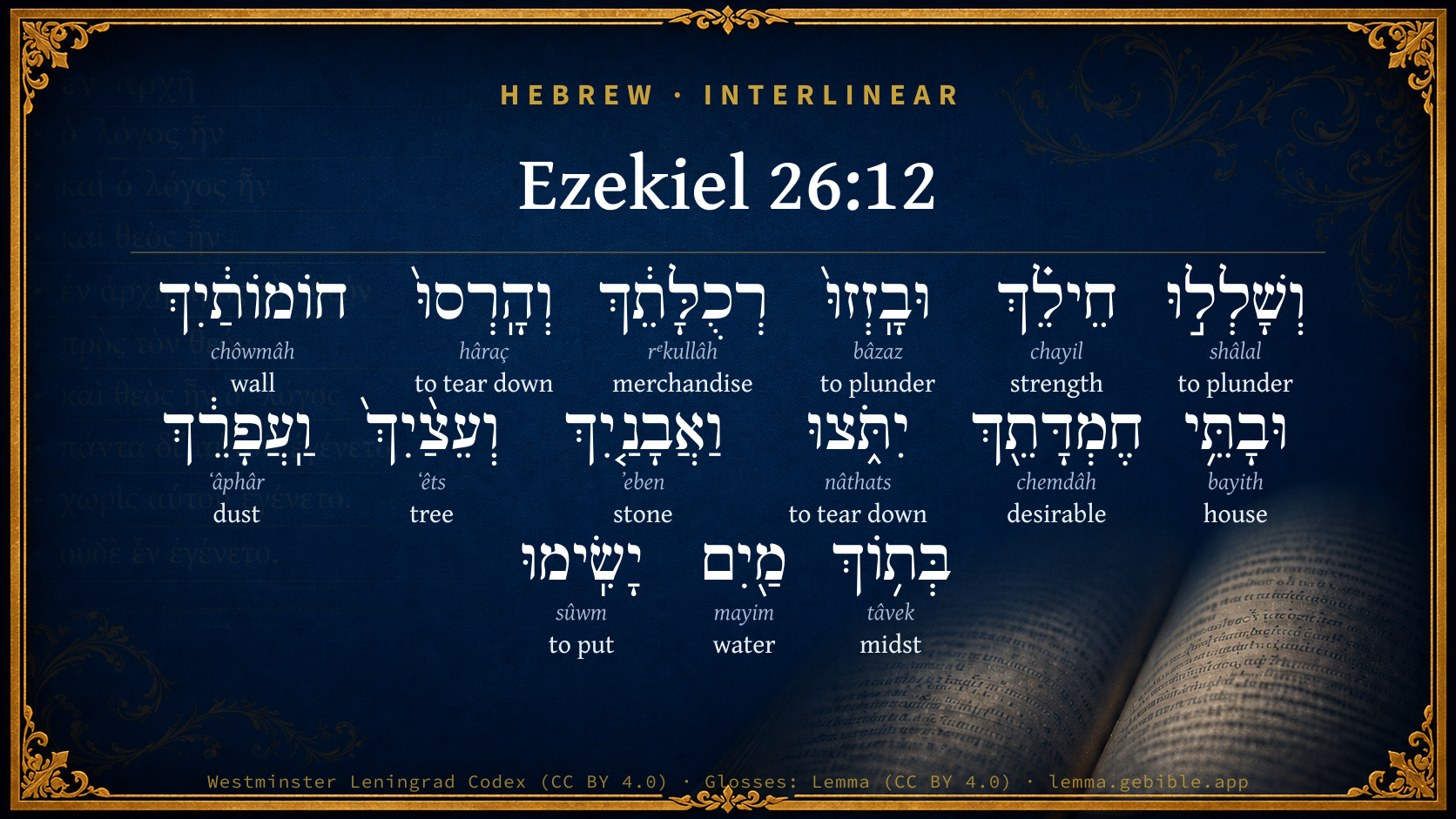
Hebrew (Westminster Leningrad Codex) Ezekiel 26:12 appears in the Hebrew Old Testament. The text above is from the Westminster Leningrad Codex. Each word links to its Strong’s number, a concise gloss, and parsing drawn from the Open Scriptures Hebrew Bible morphology. Click any word for its full Brown-Driver-Briggs (BDB) entry.
Download image
Cite this verse

Ezekiel 26:12 (World English Bible). Public Domain. Lemma interlinear Bible study tool, https://lemma.gebible.app/v/ezekiel/26/12.

Show BibTeX & RIS
BibTeX
RIS
English Translation
They shall make a spoil of your riches, and make a prey of your merchandise; and they shall break down your walls, and destroy your pleasant houses; and they shall lay your stones and your timber and your dust in the midst of the waters.
World English Bible · Public Domain
Highlights
  • 1 first appearance in the Hebrew Bible
Full analysis ↓
Download a study sheet

One document with this verse’s original text, its word-by-word gloss line, the meaning frame, cross-references with their text, attributed commentary, and full source and license credits — printable, and it pastes into notes with its structure intact.

This verse Autodidact and up

Study sheet (.html) Plain text (.txt)

A passage Seminary Student

Up to 50 verses in one chapter. A passage sheet keeps up to 6 commentary sources and 12 cross-references per verse, in the order this page ranks them, and says so on the sheet whenever that leaves anything out. Ask for a single verse and you get the Autodidact verse sheet above.

Everything on this page stays free to read, with no account — the sheet is a download of what is already on screen, not access to it.

Want to remove ads? Support Godless Engineer
Compare translations 3

The same verse in 3 English versions, stacked beneath the original-language interlinear above. Click any original word for its lexicon entry.

Each is an independent rendering of the whole verse — the interlinear is not word-aligned to these translations.

Highlighted words mark where these versions differ — a whole-verse word diff, not a word-by-word alignment.

  • World English Bible Public Domain
    They shall make a spoil of your riches, and make a prey of your merchandise; and they shall break down your walls, and destroy your pleasant houses; and they shall lay your stones and your timber and your dust in the midst of the waters.
  • King James Version Public Domain
    And they shall make a spoil of thy riches, and make a prey of thy merchandise: and they shall break down thy walls, and destroy thy pleasant houses: and they shall lay thy stones and thy timber and thy dust in the midst of the water.
  • unfoldingWord Literal Text CC BY-SA 4.0
    They will plunder your riches and loot your merchandise. They will tear down your walls and destroy your luxurious homes. Your stones, your timber, and the rubble they will throw into the waters.

unfoldingWord Literal Text — © unfoldingWord, licensed CC BY-SA 4.0. Word-aligned USFM3 via Door43 (git.door43.org/unfoldingWord/en_ult).

Versions to compare (up to 4)

3 of 4 selected

Show all 18 translations

Every available English version of this verse, each an independent rendering of the whole verse.

  • World English Bible Public Domain
    They shall make a spoil of your riches, and make a prey of your merchandise; and they shall break down your walls, and destroy your pleasant houses; and they shall lay your stones and your timber and your dust in the midst of the waters.
  • Berean Standard Bible Public Domain
    They will plunder your wealth and pillage your merchandise. They will demolish your walls, tear down your beautiful homes, and throw your stones and timber and soil into the water.
  • Majority Standard Bible Public Domain
    They will plunder your wealth and pillage your merchandise. They will demolish your walls, tear down your beautiful homes, and throw your stones and timber and soil into the water.
  • King James Version Public Domain
    And they shall make a spoil of thy riches, and make a prey of thy merchandise: and they shall break down thy walls, and destroy thy pleasant houses: and they shall lay thy stones and thy timber and thy dust in the midst of the water.
  • American Standard Version (1901) Public Domain
    And they shall make a spoil of thy riches, and make a prey of thy merchandise; and they shall break down thy walls, and destroy thy pleasant houses; and they shall lay thy stones and thy timber and thy dust in the midst of the waters.
  • Revised Version (1885) Public Domain
    And they shall make a spoil of thy riches, and make a prey of thy merchandise: and they shall break down thy walls, and destroy thy pleasant houses: and they shall lay thy stones and thy timber and thy dust in the midst of the waters.
  • Geneva Bible (1599) Public Domain
    And they shall robbe thy riches, and spoyle thy marchandise, and they shall breake downe thy walles, and destroy thy pleasant houses, and they shall cast thy stones and thy timber and thy dust into the middes of the water.
  • Douay-Rheims (1899) Public Domain
    They shall waste thy riches, they shall make a spoil of thy merchandise: and they shall destroy thy walls, and pull down thy fine houses: and they shall lay thy stones and thy timber, and thy dust in the midst of the waters.
  • Young's Literal Translation Public Domain
    And they have spoiled thy wealth, And they have plundered thy merchandise, And they have thrown down thy walls, And thy desirable houses they break down, And thy stones, and thy wood, and thy dust, In the midst of the waters they place.
  • Literal Standard Version CC BY-SA 4.0
    And they have spoiled your wealth, || And they have plundered your merchandise, || And they have thrown down your walls, || And they break down your desirable houses, || And your stones, and your wood, and your dust, || They place in the midst of the waters.
  • Unlocked Literal Bible CC BY-SA 4.0
    They will plunder your riches and loot your merchandise. They will tear down your walls and destroy your luxurious homes. Your stones, your timber, and the rubble they will throw into the waters.
  • unfoldingWord Literal Text CC BY-SA 4.0
    They will plunder your riches and loot your merchandise. They will tear down your walls and destroy your luxurious homes. Your stones, your timber, and the rubble they will throw into the waters.
  • Darby Bible Public Domain
    And they shall make a spoil of thy riches, and make a prey of thy wares; and they shall break down thy walls, and destroy thy pleasant houses; and they shall lay thy stones and thy timber and thy dust in the midst of the waters.
  • World Messianic Bible Public Domain
    They will make a plunder of your riches and make a prey of your merchandise. They will break down your walls and destroy your pleasant houses. They will lay your stones, your timber, and your dust in the middle of the waters.
  • Webster's Bible Public Domain
    And they shall make a spoil of thy riches, and make a prey of thy merchandise: and they shall break down thy walls, and destroy thy pleasant houses: and they shall lay thy stones and thy timber and thy dust in the midst of the water.
  • Free Bible Version CC BY-SA 4.0
    They will steal your wealth and loot your goods. They will knock down your walls, demolish the houses you love so much, and dump the debris and rubble into the sea.
  • Bible in Basic English Public Domain
    They will take by force all your wealth and go off with the goods with which you do trade: they will have your walls broken down and all the houses of your desire given up to destruction: they will put your stones and your wood and your dust deep in the water.
  • JPS Tanakh (1917) Public Domain
    And they shall make a spoil of thy riches, and make a prey of thy merchandise; and they shall break down thy walls, and destroy the houses of thy delight; and thy stones and thy timber and thy dust shall they lay in the midst of the waters.

Literal Standard Version (2020), Covenant Press — licensed CC BY-SA 4.0. Text via the HelloAO Bible API (eBible.org). Unlocked Literal Bible (unfoldingWord) — licensed CC BY-SA 4.0. Text via the HelloAO Bible API (eBible.org). unfoldingWord Literal Text — © unfoldingWord, licensed CC BY-SA 4.0. Word-aligned USFM3 via Door43 (git.door43.org/unfoldingWord/en_ult). Free Bible Version, Dr. Jonathan Gallagher — licensed CC BY-SA 4.0. Text via the HelloAO Bible API (eBible.org).

Word by word

More ways to search: Search by grammar → Find every occurrence → Compare this word →

Practice this passage: Drill this verse → Learn its vocabulary →

רְכֻלָּתֵ֔ךְ
rᵉkullâh
H7404
“merchandise · your”
Noun, Common, Feminine, Singular, Construct + Suffix, Personal, 2nd Person, Feminine, Singular
Part of Speech
Noun
Type
Common
Gender
Feminine
Number
Singular
State
Construct
Full BDB Definition

Origin: pass part of H7402

TWOT: 2165a

merchandise, traffic, trade
  1. וְשָׁלְל֣וּ shâlal H7997 “and · to plunder” Conjunction + Verb, Qal, Sequential Perfect, 3rd Person, Common, Plural
  2. חֵילֵ֗ךְ chayil H2428 “strength · your” Noun, Common, Masculine, Singular, Construct + Suffix, Personal, 2nd Person, Feminine, Singular
  3. וּבָֽזְזוּ֙ bâzaz H962 “and · to plunder” Conjunction + Verb, Qal, Sequential Perfect, 3rd Person, Common, Plural
  4. וְהָֽרְסוּ֙ hâraç H2040 “and · to tear down” Conjunction + Verb, Qal, Sequential Perfect, 3rd Person, Common, Plural
  5. חוֹמוֹתַ֔יִךְ chôwmâh H2346 “walls · your” Noun, Common, Feminine, Plural, Construct + Suffix, Personal, 2nd Person, Feminine, Singular
  6. וּבָתֵּ֥י bayith H1004 “and · houses of” Conjunction + Noun, Common, Masculine, Plural, Construct
  7. חֶמְדָּתֵ֖ךְ chemdâh H2532 “desirable · your” Noun, Common, Feminine, Singular, Construct + Suffix, Personal, 2nd Person, Feminine, Singular
  8. יִתֹּ֑צוּ nâthats H5422 “to tear down” Verb, Qal, Imperfect, 3rd Person, Masculine, Plural
  9. וַאֲבָנַ֤יִךְ ʼeben H68 “and · stones · your” Conjunction + Noun, Common, Feminine, Plural, Construct + Suffix, Personal, 2nd Person, Feminine, Singular
  10. וְעֵצַ֨יִךְ֙ ʻêts H6086 “and · trees · your” Conjunction + Noun, Common, Masculine, Plural, Construct + Suffix, Personal, 2nd Person, Feminine, Singular
  11. וַֽעֲפָרֵ֔ךְ ʻâphâr H6083 “and · dust · your” Conjunction + Noun, Common, Masculine, Singular, Construct + Suffix, Personal, 2nd Person, Feminine, Singular
  12. בְּת֥וֹךְ tâvek H8432 “in/at · midst of” Preposition + Noun, Common, Masculine, Singular, Construct
  13. מַ֖יִם mayim H4325 “water(s)” Noun, Common, Masculine, Plural, Absolute
  14. יָשִֽׂימוּ sûwm H7760 “to put” Verb, Qal, Imperfect, 3rd Person, Masculine, Plural

About this verse

These counts appear in no published source. They are computed here, from the morphology-tagged text and Lemma’s own curated glosses. What Lemma adds →

15
words
15
distinct lemmas
Prophets
section

Notable vocabulary

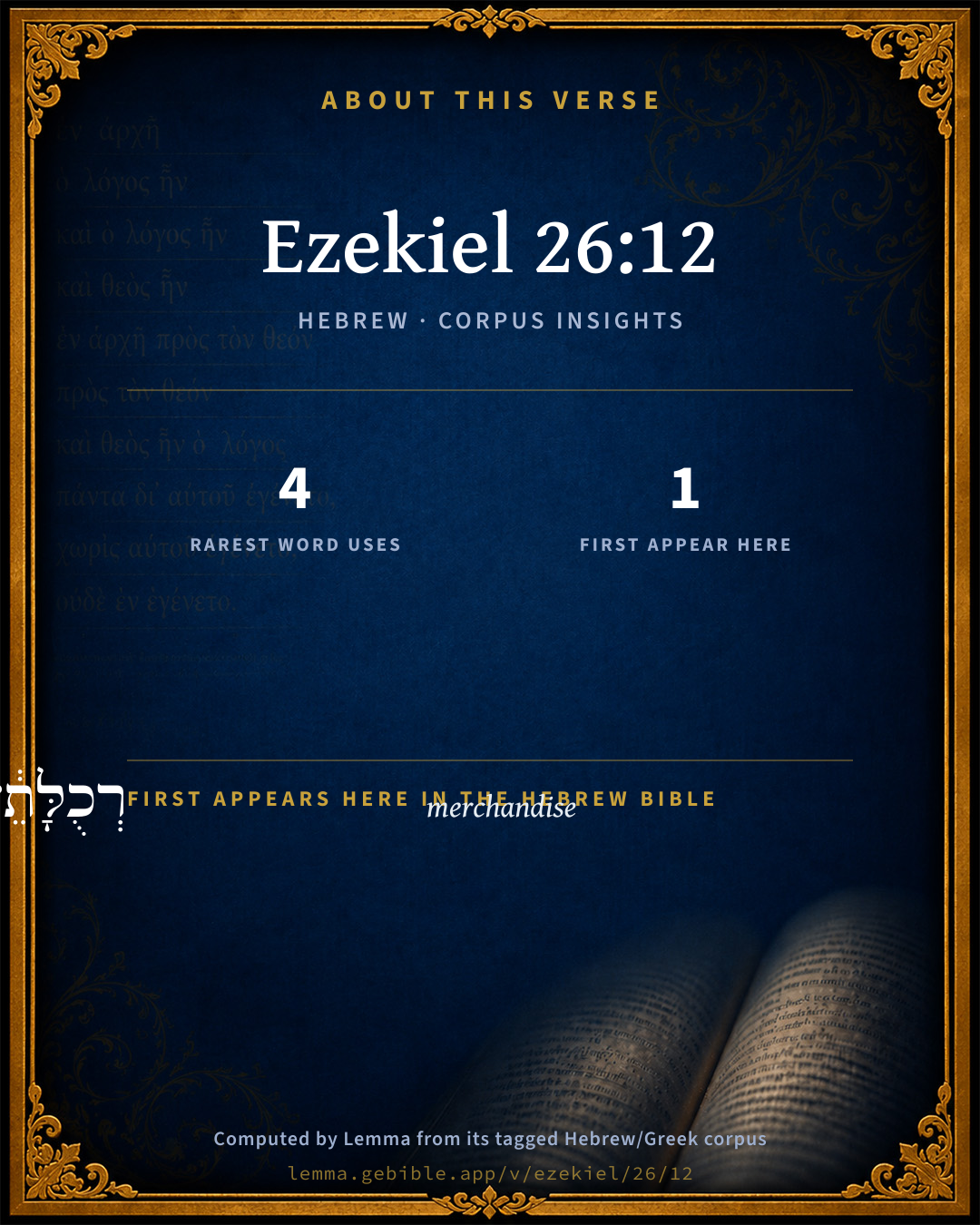
The rarest word here is רְכֻלָּתֵ֔ךְ merchandise H7404 — appearing just 4 times in the whole Hebrew Bible.

First appearance in Scripture

This word makes its first canonical appearance in the Hebrew Bible here:

  • רְכֻלָּתֵ֔ךְ merchandise H7404

Shared distinctive vocabulary

רְכֻלָּתֵ֔ךְ merchandise H7404 occurs in 4 verses of the Hebrew Bible. Also found in:

Grammatical profile

  • 5 verbs
  • 10 nouns

Verb forms

  • וְשָׁלְל֣וּ Qal · Sequential Perfect
  • וּבָֽזְזוּ֙ Qal · Sequential Perfect
  • וְהָֽרְסוּ֙ Qal · Sequential Perfect
  • יִתֹּ֑צוּ Qal · Imperfect
  • יָשִֽׂימוּ Qal · Imperfect

Hebrew & Septuagint length

In English translation the verse runs 45 words from the Hebrew and 41 from the Septuagint (LXX English) — closely comparable.

A rough comparison of the two English renderings, which tokenize alike — not a word-level alignment.

Word counts can differ between the Hebrew and the Greek without any difference in meaning — e.g. the Hebrew direct-object marker אֵת has no separate Greek word, and Greek often adds the article ὁ.

Cross-references

18

Topical passages linked to Ezekiel 26:12 in the Treasury of Scripture Knowledge — connected by theme and wording, ordered by reader-vote popularity; previews shown in the World English Bible.

  • Isaiah 23:8 Who has purposed this against Tyre, the giver of crowns, whose merchants are princes, whose traffickers are the honorable of the earth?
  • 2 Chronicles 32:27 Hezekiah had exceeding much riches and honor: and he provided him treasuries for silver, and for gold, and for precious stones, and for spices, and for shields, and for all manner of goodly vessels;
  • Amos 5:11 Forasmuch therefore as you trample on the poor, And take taxes from him of wheat: You have built houses of hewn stone, But you will not dwell in them. You have planted pleasant vineyards, But you shall not drink their wine.
  • Zechariah 9:3–4 Tyre built herself a stronghold, And heaped up silver like the dust, And fine gold like the mire of the streets.
  • 2 Chronicles 36:10 At the return of the year king Nebuchadnezzar sent, and brought him to Babylon, with the goodly vessels of the house of Yahweh, and made Zedekiah his brother king over Judah and Jerusalem.
  • Isaiah 23:11 He has stretched out his hand over the sea, he has shaken the kingdoms: Yahweh has given commandment concerning Canaan, to destroy the strongholds of it.
  • Isaiah 23:17–18 It shall happen after the end of seventy years, that Yahweh will visit Tyre, and she shall return to her hire, and shall play the prostitute with all the kingdoms of the world on the surface of the earth.
  • Isaiah 32:12 They shall strike on the breasts for the pleasant fields, for the fruitful vine.
  • Jeremiah 25:34 Wail, you shepherds, and cry; and wallow [in ashes], you principal of the flock; for the days of your slaughter and of your dispersions are fully come, and you shall fall like a goodly vessel.
  • Ezekiel 26:5 She shall be a place for the spreading of nets in the midst of the sea; for I have spoken it, says the Lord Yahweh; and she shall become a spoil to the nations.
  • Ezekiel 27:3–36 and tell Tyre, you who dwell at the entry of the sea, who are the merchant of the peoples to many isles, thus says the Lord Yahweh: You, Tyre, have said, I am perfect in beauty.
  • Ezekiel 28:8 They shall bring you down to the pit; and you shall die the death of those who are slain, in the heart of the seas.
  • Daniel 11:8 Also their gods, with their molten images, [and] with their goodly vessels of silver and of gold, shall he carry captive into Egypt; and he shall refrain some years from the king of the north.
  • Hosea 13:15 Though he is fruitful among his brothers, an east wind will come, The breath of Yahweh coming up from the wilderness; And his spring will become dry, And his fountain will be dried up. He will plunder the storehouse of treasure.
  • Nahum 2:9 Take the spoil of silver. Take the spoil of gold, for there is no end of the store, the glory of all goodly furniture.
  • Zechariah 7:14 "but I will scatter them with a whirlwind among all the nations which they have not known. Thus the land was desolate after them, so that no man passed through nor returned: for they made the pleasant land desolate."
  • Matthew 6:19–20 "Don't lay up treasures for yourselves on the earth, where moth and rust consume, and where thieves break through and steal;
  • Revelation 18:11–13 The merchants of the earth weep and mourn over her, for no one buys their merchandise any more;

Cross-references courtesy of OpenBible.info (CC BY 4.0).

Hebrew and Greek witnesses Masoretic Hebrew ↔ Greek Septuagint

The same verse in the two great witnesses to the Old Testament, shown verse-for-verse.

These are two independent witnesses, not word-aligned to each other, and the Septuagint is shown in lemma (dictionary) form.

Hebrew Ezekiel 26:12 Masoretic · Westminster Leningrad Codex

וְשָׁלְל֣וּ חֵילֵ֗ךְ וּבָֽזְזוּ֙ רְכֻלָּתֵ֔ךְ וְהָֽרְסוּ֙ חוֹמוֹתַ֔יִךְ וּבָתֵּ֥י חֶמְדָּתֵ֖ךְ יִתֹּ֑צוּ וַאֲבָנַ֤יִךְ וְעֵצַ֨יִךְ֙ וַֽעֲפָרֵ֔ךְ בְּת֥וֹךְ מַ֖יִם יָשִֽׂימוּ

They shall make a spoil of your riches, and make a prey of your merchandise; and they shall break down your walls, and destroy your pleasant houses; and they shall lay your stones and your timber and your dust in the midst of the waters.

World English Bible · Public Domain

Greek LXX Ezekiel 26:12 Septuagint · lemma form

καί προνομεύω ὁ δύναμις σύ καί σκυλεύω ὁ ὑποἄρχω σύ καί καταβάλλω σύ ὁ τεῖχος καί ὁ οἶκος σύ ὁ ἐπιθυμητής κατααἱρέω καί ὁ λίθος σύ καί ὁ ξύλον σύ καί ὁ χοῦς σύ εἰς μέσος ὁ θάλασσα ἐνβάλλω

And he shall prey upon your power, and plunder your substance, and shall cast down your walls, and break down your pleasant houses: and he shall cast your stones and your timber and your dust into the midst of your sea.

LXX2012 (modern English Septuagint) · Public Domain

Hebrew: Westminster Leningrad Codex (CC BY 4.0). Greek: Septuagint (public domain); English from LXX2012 (modern English Septuagint) (Public Domain). How the Septuagint differs from the Hebrew →

Targum (Aramaic paraphrase)

1

The Targum is the ancient Jewish Aramaic paraphrase of the Hebrew Scriptures — an interpretive translation, not the Hebrew text itself. Onkelos (literal) and Pseudo-Jonathan (expansive) render the Torah, and Jonathan the Prophets. Coverage is partial: where no permissively-licensed English translation exists for a verse, only the Aramaic is shown. This is verse-level text, not a word-by-word alignment to the Hebrew.

  1. Targum Jonathan Prophets (Joshua–Malachi)
    וְיִבְזוּן נִכְסָךְ וְיִשְׁבּוּן סְחוֹרְתִּיךְ וִיפַגְרוּן שׁוּרָךְ וּבָתֵּי חֶמְדָתֵךְ יִתְרְעוּן וַאֲבָנֵיךְ וְאָעָךְ וְעַפְרָךְ בְּגוֹ יַמָא יְשַׁווּן:

    (no public-domain English translation for this verse)

    Targum Jonathan — Aramaic: “Mikraot Gedolot” (public domain). English: “Sefaria Community Translation” (CC0 1.0 (public-domain dedication)); “London "Chaldee Paraphrase," 1871” (public domain). Text via Sefaria.

Commentary

Notes on Ezekiel 26:12 from classic Christian and Jewish commentators (each source and its license shown beneath its notes). The classic Christian expositions comment on the surrounding passage and are grouped to its opening verse, so a note may address several verses; the Jewish commentaries on the Tanakh (Rashi and others) are per-verse, so they appear only where the commentator wrote on this verse.

Lemma curates 59 commentaries, every one of them public domain or Creative Commons licensed, each selected and text-cleaned for this edition rather than reprinted as found. About our sources →

Ellicott's Commentary for English Readers

(12) They shall make.—In Eze_26:12 the nominative changes. It is no longer Nebuchadnezzar who does these things, but “they.” This may intimate that the prophet’s vision now again passes beyond the immediate future to the long succession of calamities, beginning indeed with Nebuchadnezzar’s conquest, with which Tyre was to be visited. The “spoil” and “prey” is to be understood more of what the Tyrians lost than of what the conquerors gained. In the long-continued sieges to which the city was subjected there was great waste of its substance; but their command of the water generally enabled them before the close to send away their moveable wealth, so that the booty of the victor was small. (With the close of the verse comp. Eze_26:4.) The situation of Tyre led naturally to her ruins being thrown into the sea. Robinson saw in one place as many as forty or fifty marble columns beneath the water.

A Bible Commentary for English Readers, edited by Charles John Ellicott (1878–1897) — public domain. Text from a community e-Sword module.

Trapp's Complete Commentary

John Trapp

Eze 26:12 And they shall make a spoil of thy riches, and make a prey of thy merchandise: and they shall break down thy walls, and destroy thy pleasant houses: and they shall lay thy stones and thy timber and thy dust in the midst of the water.

Ver. 12. And they shall make a spoil of thy riches.] Raked together by right and wrong. See on Eze 26:2. Male parta male dilabuntur. {a}

{a} Sallust.

John Trapp, A Commentary or Exposition upon All the Books of the Old and New Testament (1647–1656) — public domain. Text from a community e-Sword module.

The Biblical Illustrator

Joseph S. Exell

Eze_26:12

And they shall make a spoil of thy riches.

Spoliation of treasure is a moral gain

Scholars and artists have mourned for ages over the almost universal destruction of the works of ancient genius. I suppose that many a second-rate city, in the time of Christ, possessed a collection of works of surpassing beauty, which could not be equalled by all the specimens now existing that have been discovered. The Alexandrian library is believed to have contained a greater treasure of intellectual riches than has ever since been hoarded in a single city. These, we know, have all vanished from the earth. The Apollo Belvidere and the Venus de Medicis stand in almost solitary grandeur to remind us of the perfection to which the plastic art of the ancients had attained. The Alexandrian library furnished fuel for years for the baths of illiterate Moslems. I used myself frequently to wonder why it had pleased God to blot out of existence these magnificent productions of ancient genres It seemed to me strange that the pail of oblivion should thus be thrown over all to which man, in the flower of his age, had given birth. But the solution of this mystery is found, I think, in the remains of Herculaneum and Pompeii. We discover that every work of man was so penetrated by corruption, every production of genius was so defiled with uncleanness, that God, in introducing a better dispensation, determined to cleanse the world from the pollution of preceding ages. As when all flesh had corrupted his way, He purified the world by the waters of the flood, so, when genius had covered the earth with images of sin, He overwhelmed the works of ancient civilisation with a deluge of barbarism. It was too bad to exist: and He swept it all away. (F. Wayland.)

The Biblical Illustrator, edited by Joseph S. Exell (c. 1880s–1900s) — public domain. Text from a community e-Sword module.

Joseph Benson's Commentary

Eze 26:12-14. And they shall make a spoil of thy riches — The Chaldean army shall hinder thy trade during the war, and plunder thee in the end of it. And make a prey of thy merchandise — Of the fruit, or gains, of thy merchandise. And destroy thy pleasant houses — The houses of thy desire, as the margin reads it, or, Thy desirable houses. And shall lay thy stones, &c., in the midst of the water — Shall cast thy ruins into the midst of the sea. And I will cause the noise of thy songs to cease — All signs or indications of mirth shall cease from the midst of thee. Great cities are full of all kinds of gayety and luxury: this had been the case with Tyre, but it is here foretold that all this should be turned into a melancholy silence. I will make thee like the top of a rock — See note on Eze 26:4. Thou shalt be built no more — This was fulfilled; for though the inhabitants built a new city, and called it New Tyre, yet it was situated in a quite different place, namely, on an island, at some distance from the continent on which the former city stood: see note on Isa 23:1. It was also fulfilled with respect to the new city, which “received a great blow from Alexander, not only by his taking and burning it, but much more by his building of Alexandria in Egypt, which in time deprived it of much of its trade, and thereby contributed more effectually to its ruin. It had the misfortune afterward of changing its masters often, being sometimes in the hands of the Ptolemies, kings of Egypt, and sometimes of the Seleucidæ, kings of Syria, till at length it fell under the dominion of the Romans. It was taken by the Saracens about the year of Christ 639, in the reign of Omar, their third emperor. It was retaken by the Christians, during the time of the holy war, in the year 1124: Baldwin, the second of that name, being then king of Jerusalem, and assisted by a fleet of the Venetians. From the Christians it was taken again, in the year 1289, by the Mamelukes of Egypt, under their sultan, Alphix, who sacked and razed this, and Zidon, and other strong towns, that they might not ever again afford any harbour or shelter to the Christians. From the Mamelukes it was again taken, in the year 1516, by Selim, the ninth emperor of the Turks, and under their dominion it continues at present. But, alas! how fallen! how changed from what it was formerly! for, from being the centre of trade, frequented by all the merchant ships of the east and west, it is now become a heap of ruins, visited only by the boats of a few poor fisher-men: see note on Eze 26:4. So that as to this New Tyre, or this part of Tyre, the prophecy hath likewise been literally fulfilled: I will make thee like the top of a rock; thou shalt be a place to spread nets upon.” — Bishop Newton.

Joseph Benson's Commentary on the Old and New Testaments (1811–1818) — public domain. Text from a community e-Sword module.

Tyndale Open Study Notes

Tyndale Open Resources

26:12-14 The end result was exactly as the prophet had described earlier in metaphorical language. Tyre would become a bare rock, a desolate haunt for local fishermen to spread their nets to dry, instead of a bustling center for long-distance trading vessels and caravans from the east (26:2). According to Josephus, Tyre was besieged by Nebuchadnezzar for thirteen years, although it was not finally destroyed until the time of Alexander the Great (332 BC).

Tyndale Open Study Notes — © Tyndale Open Resources, licensed CC BY-SA 4.0. Text via the HelloAO Bible API.

Jamieson, Fausset & Brown

Robert Jamieson, A. R. Fausset & David Brown

lay thy stones . . . timber . . . in . . . midst of . . . water--referring to the insular New Tyre (Eze 26:3, Eze 26:5; Eze 27:4, Eze 27:25-26). When its lofty buildings and towers fall, surrounded as it was with the sea which entered its double harbor and washed its ramparts, the "stones . . . timbers . . . and dust" appropriately are described as thrown down "in the midst of the water." Though Ezekiel attributes the capture of Tyre to Nebuchadnezzar (see on Eze 29:18), yet it does not follow that the final destruction of it described is attributed by him to the same monarch. The overthrow of Tyre by Nebuchadnezzar was the first link in the long chain of evil--the first deadly blow which prepared for, and was the earnest of, the final doom. The change in this verse from the individual conqueror "he," to the general "they," marks that what he did was not the whole, but only paved the way for others to complete the work begun by him. It was to be a progressive work until she was utterly destroyed. Thus the words here answer exactly to what Alexander did. With the "stones, timber," and rubbish of Old Tyre, he built a causeway in seven months to New Tyre on the island and so took it [CURTIUS, 4, 2], 322 B.C.

Jamieson, Fausset & Brown — Commentary Critical and Explanatory on the Whole Bible (1871) — public domain (CC PDM 1.0). Text via the HelloAO Bible API.

Adam Clarke's Commentary

Verse 12. And they shall lay thy stones and thy timber and thy dust in the midst of the water.] This answers to the taking of Tyre by Alexander; he actually took the timbers, stones, rubbish, c. of old Tyre, and filled up the space between it and new Tyre, and thus connected the latter with the main land and this he was obliged to do before he could take it.

Adam Clarke's Commentary on the Bible (1810–1826) — public domain. Text from a community e-Sword/MySword module.

John Gill's Exposition

And they shall make a spoil of thy riches,.... The Chaldean army, when they entered the city, and got possession of it, would plunder it, and divide the riches of it among them:

and make a prey of thy merchandise; of the merchants' goods, laid up in their warehouses for sale, which was greatly hindered by this long siege; compare with this Rev 18:11,

and they shall break down thy walls; the walls of their houses; mention being made before of breaking down the walls of the city, towers, and garrisons:

and destroy thy pleasant houses; or, "houses of thy desire" (l); the most desirable ones in the city; the houses of their princes and chief magistrates; their summer houses; or which were most delightfully situated towards the sea, to have the prospect and advantage of that:

and they shall lay thy stones and thy timber and thy dust in the midst of the water; of the sea, near unto or about it; into which they cast the rubbish of the demolished houses, stones, timber, and dust, and so left it bare and naked: or rather this was fulfilled when Alexander, with the ruins of old Tyre, its stones, timber, and rubbish, and trees from Lebanon, made a causeway from the continent to the island; and by that means took it, after seven months' toil and labour of this sort (m).

(l) "domos desiderii tui", Montanus, Vatablus. (m) Curt. Hist, l. 4. c. 2. 4.

John Gill's Exposition of the Whole Bible (1746–1763) — public domain (CC PDM 1.0). Text via the HelloAO Bible API.

Matthew Poole's English Annotations

They; Chaldean soldiers.

Make a spoil; hinder thy trade during the war, and plunder thee in the end of the war.

Make a prey of thy merchandise; intercepting much, as it is coming to thee whilst besieged, and taking what they find, when they conquer.

Break down thy walls: see Eze 26:4,9; there he speaks of the walls of the city, here of the walls of private houses, as appears by that which follows. Pleasant houses, that the Tyrians dwelt in with delight, or diverted themselves in as houses of pleasure; summerhouses.

Lay thy stones, & c.

in the midst of the water: it had been a quicker and easier way to have burnt all, but it is like the greedy soldier might dream of treasure hid in walls or under the timber, and therefore they take the pains to pull all down, and throw it into the sea; the very dust too. Thus God fulfils his word, and scraped Tyrus.

Matthew Poole's English Annotations on the Holy Bible (1683–1685) — public domain. Text from a community e-Sword/MySword module.

The Pulpit Commentary

Thy pleasant houses; Hebrew, houses of desire. The palaces of the merchant-princes of Tyro, stately as those of Genoa or Venice. In the midst of the water. We are again reminded that it is the island city of which the prophet speaks.

The Pulpit Commentary (1880–1919), ed. H.D.M. Spence-Jones & Joseph S. Exell — public domain. Text from a community e-Sword module.

John Wesley's Explanatory Notes

Shall lay - It had been a quicker way, to have burnt all; but the greedy soldier might dream of treasures hid in walls, or under the timber, and therefore take the pains to pull all down, and throw it into the sea.

John Wesley, Explanatory Notes Upon the Whole Bible (1754–1765) — public domain. Text via the GEBible commentary corpus.

unfoldingWord translationNotes

Door43 World Missions Community

Connecting Statement:

Yahweh continues giving Ezekiel his message to Tyre.

General Information:

The word "They" in these verses refers to the soldiers in the armies of Nebuchadnezzar. The words "your" and "you" refer to the city of Tyre.

They will plunder your riches and loot your merchandise

The phrases "plunder your riches" and "loot your merchandise" mean about the same thing and are repeated for emphasis. (See: Parallelism)

luxurious

expensive and comfortable

Your stones, your timber, and the rubble

These refer to what is left after the walls and homes are torn down.

into the waters

"into the sea"

The sound of your harps will be heard no more

This can be stated in active form. AT: "No one will hear the sound of your harps anymore" (See: Active or Passive)

I will make you a bare rock

This metaphor describes the results after Yahweh completely destroys Tyre. See how you translated a similar phrase in Ezekiel 26:4. (See: Metaphor)

you will become a place where nets are spread out to dry

This metaphor also describes the results after Yahweh destroys Tyre. See how you translated a similar phrase in Ezekiel 26:5. (See: Metaphor)

you will become a place where nets

This can be stated in active form. AT: "I will make you a place where nets" (See: Active or Passive)

translationWords

harp

declare

Lord Yahweh

unfoldingWord translationNotes — © Distant Shores Media and the Door43 World Missions Community, licensed CC BY-SA 4.0. Source: git.door43.org/Door43/en_tn.

Rashi

Rabbi Shlomo Yitzchaki (Rashi)

your merchandise [as translated], your merchandise.

Rashi on the Tanakh — English translations: “The Judaica Press complete Tanach with Rashi, translated by A. J. Rosenberg” (CC BY 4.0); “Pentateuch with Rashi's commentary by M. Rosenbaum and A.M. Silbermann, 1929-1934” (public domain); “The Metsudah Tanach series, Lakewood, N.J” (CC BY 4.0); and “The Book of Joshua, Metsudah Publications, 1997” (CC BY 4.0). Text via Sefaria.

Lesson kit

Teaching starters — assembled from the data on this page, not authored interpretation. Every prompt links to the verse data it draws on. Edit before teaching.

Ezekiel, in the Prophets, opens this verse with 15 words (15 distinct Hebrew lemmas). Its most distinctive word is rᵉkullâh (“merchandise”). A historical commentator’s framing appears above. Read the whole chapter for the surrounding context.

Discussion questions

  1. What does “merchandise” (rᵉkullâh) contribute to the verse as a whole?
  2. The word “merchandise” first appears here in Scripture. What is being introduced at this debut?
  3. Ezekiel 28:5 shares the word «merchandise» with this verse. How do the two illuminate each other?
  4. These translations render this verse differently; the difference is in the English rendering, not the original. What questions does that raise?
  5. The verb «וְשָׁלְל֣וּ» is Qal Sequential Perfect. How does its form color the action?
  6. Reading how Ellicott's Commentary for English Readers and Trapp's Complete Commentary read this verse, where do the two commentators agree and where do they part?

Things to notice

Reading settings

Reading text

Shown beneath each verse's original-language words.

Old Testament
Old Testament edition

Read the OT as the Masoretic Hebrew (MT) or the Greek Septuagint (LXX).

English shown for the Greek Septuagint (in the Hebrew ↔ Greek comparison).

Comparing translations? Open the Compare panel on any verse page to stack up to four side by side.