
Isaiah 8:4

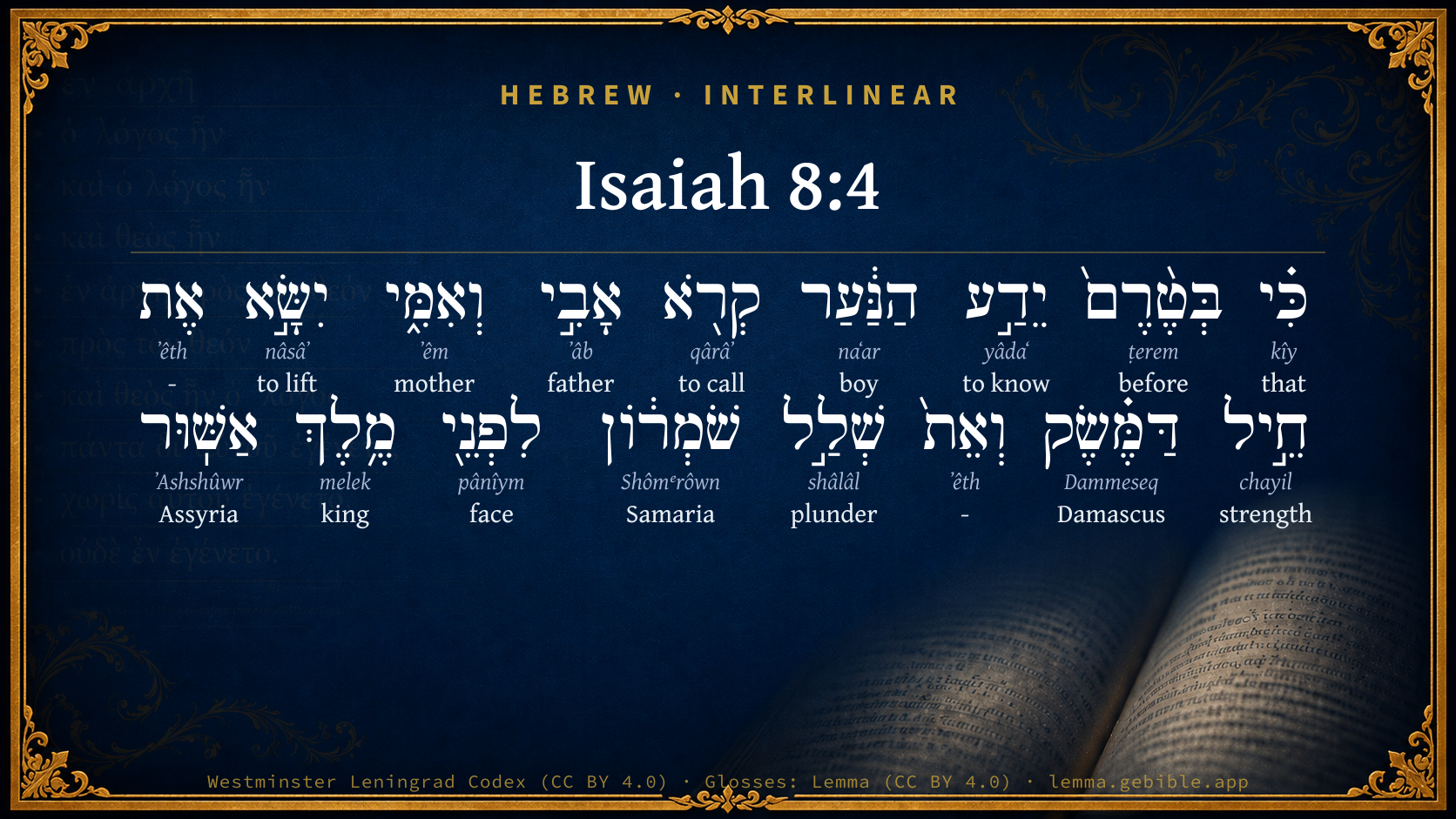
Hebrew (Westminster Leningrad Codex) Isaiah 8:4 appears in the Hebrew Old Testament. The text above is from the Westminster Leningrad Codex. Each word links to its Strong’s number, a concise gloss, and parsing drawn from the Open Scriptures Hebrew Bible morphology. Click any word for its full Brown-Driver-Briggs (BDB) entry.
Download image
Cite this verse

Isaiah 8:4 (World English Bible). Public Domain. Lemma interlinear Bible study tool, https://lemma.gebible.app/v/isaiah/8/4.

Show BibTeX & RIS
BibTeX
RIS
English Translation
For before the child shall have knowledge to cry, My father, and, My mother, the riches of Damascus and the spoil of Samaria shall be carried away before the king of Assyria.
World English Bible · Public Domain
Download a study sheet

One document with this verse’s original text, its word-by-word gloss line, the meaning frame, cross-references with their text, attributed commentary, and full source and license credits — printable, and it pastes into notes with its structure intact.

This verse Autodidact and up

Study sheet (.html) Plain text (.txt)

A passage Seminary Student

Up to 50 verses in one chapter. A passage sheet keeps up to 6 commentary sources and 12 cross-references per verse, in the order this page ranks them, and says so on the sheet whenever that leaves anything out. Ask for a single verse and you get the Autodidact verse sheet above.

Everything on this page stays free to read, with no account — the sheet is a download of what is already on screen, not access to it.

Want to remove ads? Support Godless Engineer
Compare translations 3

The same verse in 3 English versions, stacked beneath the original-language interlinear above. Click any original word for its lexicon entry.

Each is an independent rendering of the whole verse — the interlinear is not word-aligned to these translations.

Highlighted words mark where these versions differ — a whole-verse word diff, not a word-by-word alignment.

  • World English Bible Public Domain
    For before the child shall have knowledge to cry, My father, and, My mother, the riches of Damascus and the spoil of Samaria shall be carried away before the king of Assyria.
  • King James Version Public Domain
    For before the child shall have knowledge to cry, My father, and my mother, the riches of Damascus and the spoil of Samaria shall be taken away before the king of Assyria.
  • unfoldingWord Literal Text CC BY-SA 4.0
    for before the boy knows to call out ‘my father’ or ‘my mother,’ one will carry away the wealth of Damascus and the spoil of Samaria to the face of the king of Assyria.”

unfoldingWord Literal Text — © unfoldingWord, licensed CC BY-SA 4.0. Word-aligned USFM3 via Door43 (git.door43.org/unfoldingWord/en_ult).

Versions to compare (up to 4)

3 of 4 selected

Show all 18 translations

Every available English version of this verse, each an independent rendering of the whole verse.

  • World English Bible Public Domain
    For before the child shall have knowledge to cry, My father, and, My mother, the riches of Damascus and the spoil of Samaria shall be carried away before the king of Assyria.
  • Berean Standard Bible Public Domain
    For before the boy knows how to cry ‘Father’ or ‘Mother,’ the wealth of Damascus and the plunder of Samaria will be carried off by the king of Assyria.”
  • Majority Standard Bible Public Domain
    For before the boy knows how to cry ‘Father’ or ‘Mother,’ the wealth of Damascus and the plunder of Samaria will be carried off by the king of Assyria.”
  • King James Version Public Domain
    For before the child shall have knowledge to cry, My father, and my mother, the riches of Damascus and the spoil of Samaria shall be taken away before the king of Assyria.
  • American Standard Version (1901) Public Domain
    For before the child shall have knowledge to cry, My father, and, My mother, the riches of Damascus and the spoil of Samaria shall be carried away before the king of Assyria.
  • Revised Version (1885) Public Domain
    For before the child shall have knowledge to cry, My father, and, My mother, the riches of Damascus and the spoil of Samaria shall be carried away before the king of Assyria.
  • Geneva Bible (1599) Public Domain
    For before the childe shall haue knowledge to crye, My father, and my mother, he shall take away the riches of Damascus and the spoyle of Samaria, before the King of Asshur.
  • Douay-Rheims (1899) Public Domain
    For before the child know to call his father and his mother, the strength of Damascus, and the spoils of Samaria shall be taken away before the king of the Assyrians.
  • Young's Literal Translation Public Domain
    for before the youth doth know to cry, My father, and My mother, one taketh away the wealth of Damascus and the spoil of Samaria, before the king of Asshur.'
  • Literal Standard Version CC BY-SA 4.0
    for before the youth knows to cry, My father, and, My mother, one takes away the wealth of Damascus and the spoil of Samaria, before the king of Asshur.”
  • Unlocked Literal Bible CC BY-SA 4.0
    For before the child knows to cry, 'My father,' and, 'My mother,' the riches of Damascus and the plunder of Samaria will be carried away by the king of Assyria.”
  • unfoldingWord Literal Text CC BY-SA 4.0
    for before the boy knows to call out ‘my father’ or ‘my mother,’ one will carry away the wealth of Damascus and the spoil of Samaria to the face of the king of Assyria.”
  • Darby Bible Public Domain
    For before the lad knoweth to cry, My father! and, My mother! the riches of Damascus and the spoil of Samaria shall be taken away before the king of Assyria.
  • World Messianic Bible Public Domain
    For before the child knows how to say, ‘My father’ and ‘My mother,’ the riches of Damascus and the plunder of Samaria will be carried away by the king of Assyria.”
  • Webster's Bible Public Domain
    For before the child shall have knowledge to cry, My father, and my mother, the riches of Damascus and the spoil of Samaria shall be taken away before the king of Assyria.
  • Free Bible Version CC BY-SA 4.0
    For even before the boy knows how to say ‘Daddy’ or ‘Mommy,’ the king of Assyria will carry off Damascus' wealth and Samaria's possessions.”
  • Bible in Basic English Public Domain
    For before the child is able to say, Father, or, Mother, the wealth of Damascus and the goods of Samaria will be taken away by the king of Assyria.
  • JPS Tanakh (1917) Public Domain
    For before the child shall have knowledge to cry: My father, and: My mother, the riches of Damascus and the spoil of Samaria shall be carried away before the king of Assyria.'

Literal Standard Version (2020), Covenant Press — licensed CC BY-SA 4.0. Text via the HelloAO Bible API (eBible.org). Unlocked Literal Bible (unfoldingWord) — licensed CC BY-SA 4.0. Text via the HelloAO Bible API (eBible.org). unfoldingWord Literal Text — © unfoldingWord, licensed CC BY-SA 4.0. Word-aligned USFM3 via Door43 (git.door43.org/unfoldingWord/en_ult). Free Bible Version, Dr. Jonathan Gallagher — licensed CC BY-SA 4.0. Text via the HelloAO Bible API (eBible.org).

Word by word

More ways to search: Search by grammar → Find every occurrence → Compare this word →

Practice this passage: Drill this verse → Learn its vocabulary →

דַּמֶּ֗שֶׂק
Dammeseq
H1834
“Damascus”
Noun, Proper
Part of Speech
Noun
Type
Proper
Full BDB Definition

Origin: of foreign origin

TWOT: None

Damascus = "silent is the sackcloth weaver" - an ancient trading city, capital of Syria, located in the plain east of Hermon, 130 (205 kilometers) miles northeast of Jerusalem
  1. כִּ֗י kîy H3588 “that” Conjunction
  2. בְּטֶ֨רֶם֙ ṭerem H2962 “in/at · before” Preposition + Adverb
  3. יֵדַ֣ע yâdaʻ H3045 “to know” Verb, Qal, Imperfect, 3rd Person, Masculine, Singular
  4. הַנַּ֔עַר naʻar H5288 “the · boy” Particle, Definite Article + Noun, Common, Masculine, Singular, Absolute
  5. קְרֹ֖א qârâʼ H7121 “to call” Verb, Qal, Infinitive Construct
  6. אָבִ֣י ʼâb H1 “father · my” Noun, Common, Masculine, Singular, Construct + Suffix, Personal, 1st Person, Common, Singular
  7. וְאִמִּ֑י ʼêm H517 “and · mother · my” Conjunction + Noun, Common, Feminine, Singular, Construct + Suffix, Personal, 1st Person, Common, Singular
  8. יִשָּׂ֣א nâsâʼ H5375 “to lift” Verb, Qal, Imperfect, 3rd Person, Masculine, Singular
  9. אֶת ʼêth H853 “-” Particle, Direct Object
  10. חֵ֣יל chayil H2428 “strength of” Noun, Common, Masculine, Singular, Construct
  11. וְאֵת֙ ʼêth H853 “and · -” Conjunction + Particle, Direct Object
  12. שְׁלַ֣ל shâlâl H7998 “plunder of” Noun, Common, Masculine, Singular, Construct
  13. שֹׁמְר֔וֹן Shômᵉrôwn H8111 “Samaria” Noun, Proper
  14. לִפְנֵ֖י pânîym H6440 “to/for · face(s) of” Preposition + Noun, Common, Both, Plural, Construct
  15. מֶ֥לֶךְ melek H4428 “king of” Noun, Common, Masculine, Singular, Construct
  16. אַשּֽׁוּר ʼAshshûwr H804 “Assyria” Noun, Proper

About this verse

These counts appear in no published source. They are computed here, from the morphology-tagged text and Lemma’s own curated glosses. What Lemma adds →

17
words
16
distinct lemmas
Prophets
section

Shared distinctive vocabulary

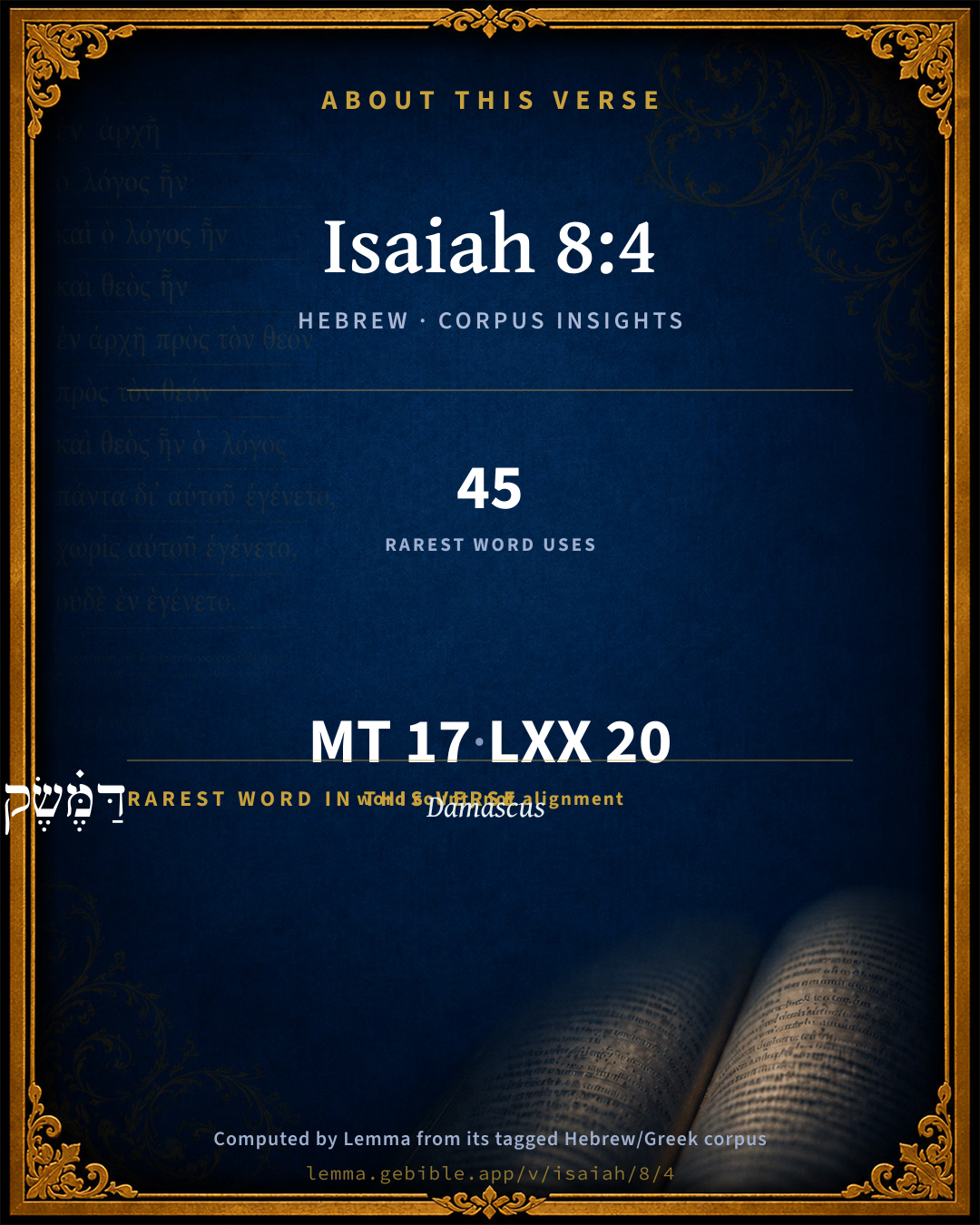
דַּמֶּ֗שֶׂק Damascus H1834 occurs in 40 verses of the Hebrew Bible. Also found in:

Grammatical profile

  • 3 verbs
  • 10 nouns
  • 1 conjunction
  • 1 adverb
  • 2 particles

Verb forms

  • יֵדַ֣ע Qal · Imperfect
  • קְרֹ֖א Qal · Infinitive Construct
  • יִשָּׂ֣א Qal · Imperfect

Hebrew & Septuagint length

In English translation the verse runs 32 words from the Hebrew and 32 from the Septuagint (LXX English) — the same length.

A rough comparison of the two English renderings, which tokenize alike — not a word-level alignment.

Word counts can differ between the Hebrew and the Greek without any difference in meaning — e.g. the Hebrew direct-object marker אֵת has no separate Greek word, and Greek often adds the article ὁ.

In the original languages it is 17 Hebrew tokens and 20 Greek tokens — but the two are counted differently (Hebrew bundles its prefixes and suffixes into one token; the Greek is in lemma form), so that isn’t a like-for-like length.

Cross-references

11

Topical passages linked to Isaiah 8:4 in the Treasury of Scripture Knowledge — connected by theme and wording, ordered by reader-vote popularity; previews shown in the World English Bible.

  • Romans 9:11 For being not yet born, neither having done anything good or bad, that the purpose of God according to election might stand, not of works, but of him who calls,
  • Deuteronomy 1:39 Moreover your little ones, whom you said should be a prey, and your children, who this day have no knowledge of good or evil, they shall go in there, and to them will I give it, and they shall possess it.
  • 2 Kings 16:9 The king of Assyria listened to him; and the king of Assyria went up against Damascus, and took it, and carried [the people of] it captive to Kir, and killed Rezin.
  • 2 Kings 17:3 Against him came up Shalmaneser king of Assyria; and Hoshea became his servant, and brought him tribute.
  • 2 Kings 17:5–6 Then the king of Assyria came up throughout all the land, and went up to Samaria, and besieged it three years.
  • Isaiah 7:8–9 For the head of Syria is Damascus, and the head of Damascus is Rezin; and within sixty-five years Ephraim shall be broken in pieces, so that it shall not be a people;
  • Isaiah 7:15–16 He shall eat butter and honey when he knows to refuse the evil, and choose the good.
  • Isaiah 10:6–14 I will send him against a profane nation, and against the people of my wrath will I give him a charge, to take the spoil, and to take the prey, and to tread them down like the mire of the streets.
  • Jonah 4:11 Shouldn't I be concerned for Nineveh, that great city, in which are more than one hundred twenty thousand persons who can't discern between their right hand and their left hand; and also much cattle?"
  • 2 Kings 15:29 In the days of Pekah king of Israel came Tiglath Pileser king of Assyria, and took Ijon, and Abel Beth Maacah, and Janoah, and Kedesh, and Hazor, and Gilead, and Galilee, all the land of Naphtali; and he carried them captive to Assyria.
  • Isaiah 17:3 The fortress shall cease from Ephraim, and the kingdom from Damascus, and the remnant of Syria; they shall be as the glory of the children of Israel, says Yahweh of Hosts.

Cross-references courtesy of OpenBible.info (CC BY 4.0).

Hebrew and Greek witnesses Masoretic Hebrew ↔ Greek Septuagint

The same verse in the two great witnesses to the Old Testament, shown verse-for-verse.

These are two independent witnesses, not word-aligned to each other, and the Septuagint is shown in lemma (dictionary) form.

Hebrew Isaiah 8:4 Masoretic · Westminster Leningrad Codex

כִּ֗י בְּטֶ֨רֶם֙ יֵדַ֣ע הַנַּ֔עַר קְרֹ֖א אָבִ֣י וְאִמִּ֑י יִשָּׂ֣א אֶת חֵ֣יל דַּמֶּ֗שֶׂק וְאֵת֙ שְׁלַ֣ל שֹׁמְר֔וֹן לִפְנֵ֖י מֶ֥לֶךְ אַשּֽׁוּר

For before the child shall have knowledge to cry, My father, and, My mother, the riches of Damascus and the spoil of Samaria shall be carried away before the king of Assyria.

World English Bible · Public Domain

Greek LXX Isaiah 8:4 Septuagint · lemma form

διότι πρίν ἤ γιγνώσκω ὁ παιδίον καλέω πατήρ ἤ μήτηρ λαμβάνω δύναμις δαμασκος καί ὁ σκῦλον σαμαρεία ἔναντι βασιλεύς ἀσσύριος

For before the child shall know how to call his father or his mother, one shall take the power of Damascus and the spoils of Samaria before the king of the Assyrians.

LXX2012 (modern English Septuagint) · Public Domain

Hebrew: Westminster Leningrad Codex (CC BY 4.0). Greek: Septuagint (public domain); English from LXX2012 (modern English Septuagint) (Public Domain). How the Septuagint differs from the Hebrew →

Targum (Aramaic paraphrase)

1

The Targum is the ancient Jewish Aramaic paraphrase of the Hebrew Scriptures — an interpretive translation, not the Hebrew text itself. Onkelos (literal) and Pseudo-Jonathan (expansive) render the Torah, and Jonathan the Prophets. Coverage is partial: where no permissively-licensed English translation exists for a verse, only the Aramaic is shown. This is verse-level text, not a word-by-word alignment to the Hebrew.

  1. Targum Jonathan Prophets (Joshua–Malachi)
    אֲרֵי עַד לָא יְדַע עוּלֵימָא מִקְרֵי אַבָּא וְאִמָא יִשְׁבֵי יַת נִכְסֵי דַמֶשֶׂק וְיַת עֲדָאֵי שֹׁמְרוֹן קֳדָם מַלְכָּא דְאַתּוּר:

    For before the child shall have knowledge to cry, My father, and my mother, the riches of Damascus and the spoil of Samaria shall be led into captivity before the king of Assyria.

    Targum Jonathan — Aramaic: “Mikraot Gedolot” (public domain). English: “Sefaria Community Translation” (CC0 1.0 (public-domain dedication)); “London "Chaldee Paraphrase," 1871” (public domain). Text via Sefaria.

Commentary

Notes on Isaiah 8:4 from classic Christian and Jewish commentators (each source and its license shown beneath its notes). The classic Christian expositions comment on the surrounding passage and are grouped to its opening verse, so a note may address several verses; the Jewish commentaries on the Tanakh (Rashi and others) are per-verse, so they appear only where the commentator wrote on this verse.

Lemma curates 59 commentaries, every one of them public domain or Creative Commons licensed, each selected and text-cleaned for this edition rather than reprinted as found. About our sources →

Trapp's Complete Commentary

John Trapp

Isa 8:4 For before the child shall have knowledge to cry, My father, and my mother, the riches of Damascus and the spoil of Samaria shall be taken away before the king of Assyria.

Ver. 4. For before the child, &c.] That is, within a year or two; for it was an extraordinary thing that is reported of Maximilian the Emperor, that he was eight years old at least ere he spake anything, but afterwards he became a fluent and elegant speaker.

The riches of Damascus.] Riches do many times change their masters, and kingdoms are oft turned upside down, when they fall to persecuting the people of God especially, as did these Syrians and Israelites.

Before the king of Assyria.] Spoils taken from the enemy were and are usually carried in triumph before the conqueror.

John Trapp, A Commentary or Exposition upon All the Books of the Old and New Testament (1647–1656) — public domain. Text from a community e-Sword module.

Joseph Benson's Commentary

Isa 8:4. Before the child shall have knowledge to cry, My father, &c. — To speak and know his parents; which is within the space of two years. And this agrees with the other prophecy, Isa 7:16. For it requires a longer time for a child to know to refuse the evil, and choose the good, than to distinguish his parents from strangers; and Shear-jashub, being born some years before this child, was capable of that higher degree of knowledge as soon as this was capable of the lower degree. The riches of Damascus, &c., shall be taken away — The kingdoms of Syria and Israel, here signified by their two capital cities, shall be stripped of their wealth and power, as they were by Tiglath-pileser, within the time here limited, 2Ki 15:29.

Joseph Benson's Commentary on the Old and New Testaments (1811–1818) — public domain. Text from a community e-Sword module.

Tyndale Open Study Notes

Tyndale Open Resources

8:4 before this child is old enough: See also 7:16. • Damascus and Samaria were ruined and destroyed in 732 BC, fulfilling this verse along with 7:8, 19-20.

Tyndale Open Study Notes — © Tyndale Open Resources, licensed CC BY-SA 4.0. Text via the HelloAO Bible API.

Geneva Bible (1599)

Geneva Bible translators

That is, the army of Assyria.

Before any child be able to speak.

Geneva Bible (1599) marginal notes — public domain. Text via Bolls.life.

Jamieson, Fausset & Brown

Robert Jamieson, A. R. Fausset & David Brown

before, &c.--within a year.

Jamieson, Fausset & Brown — Commentary Critical and Explanatory on the Whole Bible (1871) — public domain (CC PDM 1.0). Text via the HelloAO Bible API.

Adam Clarke's Commentary

Verse 4. For before the child] For my father and my mother, one MS. and the Vulgate have his father and his mother. The prophecy was accordingly accomplished within three years; when Tiglath-pileser, king of Assyria, went up against Damascus and took it, and carried the people of it captive to Kir, and slew Rezin, and also took the Reubenites and the Gadites, and the half-tribe of Manasseh, and carried them captive to Assyria, 2Kg 15:29; 2Kg 16:9; 1Ch 5:26.

Adam Clarke's Commentary on the Bible (1810–1826) — public domain. Text from a community e-Sword/MySword module.

Ellicott's Commentary for English Readers

(4) For before the child shall have knowledge to cry . . .—Here then was another sign like that of Isa_7:14-16. The two witnesses of Isa_8:2 were probably summoned to the circumcision and naming of the child, and the mysterious name at which all Jerusalem had gazed with wonder was given to the new-born infant. The prediction is even more definite than before. Before the first cries of childhood (Heb. Abi, Ami) should be uttered, i.e., within a year of its birth, the spoils of the two capitals of the kings of the confederate armies should be carried to the king of Assyria. The conclusion of the period thus defined would coincide more or less closely with the longer period assigned at an earlier date (Isa_7:16). Historically the trans-Jordanic region and Damascus fell before Tiglath-pilneser; Samaria, besieged by Salmaneser, before his successor Sargon (2Ki_15:29; 2Ki_16:9; 2Ki_17:6).

A Bible Commentary for English Readers, edited by Charles John Ellicott (1878–1897) — public domain. Text from a community e-Sword module.

The Cambridge Bible for Schools and Colleges

gen. ed. J. J. S. Perowne

4. The period here indicated, about a year, is of course shorter than in ch. Isa_7:16, the date of the prediction being about a year later.

The Cambridge Bible for Schools and Colleges (gen. ed. J. J. S. Perowne; Cambridge University Press, 1878–1918) — public domain. Text from a community e-Sword module.

John Gill's Exposition

For before the child shall have knowledge to cry, my father, and my mother,.... Which are commonly the first words children learn to say; and so it signifies that what follows should happen in a year or two; as it did:

the riches of Damascus, and the spoil of Samaria, shall be taken away before the king of Assyria; or, "he shall take away the riches" (q), &c.; not the child, unless he is considered as the sign of taking them away; but the soldier, put for the whole Assyrian army, which carried off the riches and spoil of these places, in the presence, and by the order, of the king of Assyria; the first of these, namely, Damascus, the metropolis of Syria, with its riches, wealth, and army, were taken and carried away by Tilgathpilneser, king of Assyria, within the time here mentioned, Kg2 16:9 but the latter, Samaria, the metropolis of the kingdom of Israel, was not taken and spoiled until the sixth year of Hezekiah, and ninth of Hoshea, Kg2 17:6 but because the prophecy began to be fulfilled, and was fulfilled in part, within the time mentioned, the whole is attributed to it; though it should be observed, that before this, after Pekah the son of Remaliah was slain, and Hoshea reigned in his stead, the king of Assyria came up against him, and Hoshea became his servant, and gave him presents; which may be called the spoil of Samaria, Kg2 17:3.

(q) "asportabit, opulentiam----servus regis Assyriae", Junius & Tremellius "auferet opes----is qui stet coram facie regis Assyriae", Piscator.

John Gill's Exposition of the Whole Bible (1746–1763) — public domain (CC PDM 1.0). Text via the HelloAO Bible API.

Albert Barnes' Notes on the Bible

For before ... - This must have occurred in a short time - probably before the expiration of three years. A child would usually learn to address his parents in that time. In fact, the event here predicted occurred in less than three years from the time when the prophecy was spoken; see the notes at Isa 7:16.

Before the king of Assyria - By the king, or by his conquests. By the spoil of Samaria here, is to be understood, not the plunder which should be carried away from the city, but from the kingdom of Samaria. In other places, the land is called by the name of the capital; compare 2Ki 17:26; 2Ki 23:19; Jer 31:5. The city of Samaria was not plundered until eighteen years after the time mentioned here by the prophet; Isa 8:5-6. These verses introduce again what was predicted in Isa 7:17, following, respecting the invasion of the land by the king of Assyria. The cause of the invasion is specified, and the consequences are foretold.

Albert Barnes' Notes on the Bible (1834–1885) — public domain. Text from a community e-Sword/MySword module.

Haydock's Catholic Bible Commentary

Assyrians. Theglathphalassar, the next year, took the Damascenes to Kir, and Nephthali, Reuben, Gad, and Manasses into captivity. Yet the kingdom continued some time longer. Never was prediction more explicit. Can the pagans produce any thing similar?

George Leo Haydock (1774–1849), Haydock's Catholic Family Bible and Commentary, 1859 edition — public domain. Excludes Psalms (Douay-Rheims chapter numbering differs from Protestant) and Deuterocanonical books (Catholic canon only).

Matthew Poole's English Annotations

To cry, My father, and my mother; to speak, and to know his parents; which is within the space of two years. And this agrees with the other prophecy, Isa 7:16,

Before the child shall know to refuse the evil, and choose the good, which requires a longer time than to distinguish his parents from strangers; which suits well to Shear-jashub, who, being born some years before this, was capable of that further degree of knowledge as soon as this was capable of the lower degree.

The riches of Damascus and the spoil of Samaria shall be taken away; the kingdoms of Syria and Israel, here signified by their two capital cities, shall be stripped of their wealth and power, as they were by Tiglath-pileser, within the time here limited, 2Ki 15:29.

Before the king of Assyria; in his presence, and by himself and his forces; for in Scripture use that is said to be before a man, which is in or is put into a man’s power, as Gen 13:9; 20:15, &c.; and men are said to be smitten before their enemies, when they are smitten by them, as Num 14:42; Deu 1:42; Jdg 20:39, and oft elsewhere. Others refer this phrase to the ancient custom of conquerors, of sending or carrying their spoils before them into their own country.

Matthew Poole's English Annotations on the Holy Bible (1683–1685) — public domain. Text from a community e-Sword/MySword module.

Whedon's Commentary on the Bible

Daniel D. Whedon

4. Before this it was known the inscription meant “plunder and spoils;” but which the plundered party was to be was not known.

Shall have knowledge to cry — Shall know how to speak the name My father. The date of the prophecy’s fulfilment is determined by the infant’s growth, about two years from its birth. And now who the vanquished party are becomes known. The Assyrian power, hired by Ahaz, will pillage Damascus, and spoil Samaria before the boy-child shall know how to lisp “My father,” etc.

Denunciation of the foreign parties in Judah, and assertion for Jehovah and his adherents, Isa_8:5-22.

The prophet denounces the despisers of Siloah, the emblem of the mild Davidic kingdom, and threatens that they shall be overwhelmed with the Euphrates, the emblem of the terrible Assyrian empire, 5-8. He bids the enemies of Jehovah defiance, 8-10; calls upon the people to reject their clamors, and to turn to the law and to the Jehovistic signs presented in himself and family, 11-18. He denounces the deserters from God’s law who resort to sorcerers for guidance.

Daniel D. Whedon (gen. ed.), Commentary on the Old and New Testaments (1874–1909) — public domain. Text from a community e-Sword module.

The Pulpit Commentary

My father... my mother. "Abi," "Immi," would have been among the first utterances of childhood simple sounds, combinations of primary vowels with labials, corresponding in easiness of utterance to "Pappy," "Mammy," rather than to the expressions of the text. A child commonly utters such sounds when it is about a year old. The riches of Damascus. The position of Damascus lay in the direct path of the main trade that was carried on between the West and East, which was conducted by the merchants of Tyro chiefly, and passed from the Syrian coast by way of Damascus and Tadmor to Nineveh and Babylon. This commerce greatly enriched the cities lying upon its route. "Damascus," says Ezekiel, addressing Tyre, "was thy merchant in the multitude of the wares of thy making, for the multitude of all riches; in the wine of Helbon, and white. (Eze_27:18) The "palaces of Benhadad" seem to have been noted for their magnificence. (Jer_49:27 Amo_1:4) The spoil of Samaria shall be taken away before the King of Assyria. Scripture does not record the fulfillment of this prophecy, which makes the same Assyrian king carry off the spoil of Samaria and the spoil of Damascus, fixing also the time of the carrying off as within a few years of the time when the prophecy was given. But the inscriptions of Tiglath-Pileser himself supply the deficiency. They state that this monarch "sent the population, the goods of the people of Beth-Omri, and their furniture to the land of Assyria;" after which he "appointed Husih (Hoshea) to the dominion ever them," and fixed their annual tribute at two talents of gold and a thousand talents of silver (see "Records of the Past," vol. 5. p. 52).

The Pulpit Commentary (1880–1919), ed. H.D.M. Spence-Jones & Joseph S. Exell — public domain. Text from a community e-Sword module.

John Wesley's Explanatory Notes

To cry - To speak and to know his parents; which is within the space of two years. And his agrees with the other prophecy, chap. vii, 16. Before the child shall know to refuse the evil and chuse the good, which requires a longer time than to distinguish his parents, and suits well to Shear-Jashub, who, being born some years before, was capable of that farther degree of knowledge, as soon as this was capable of the lower degree. Before - In his presence, and by himself and his forces.

John Wesley, Explanatory Notes Upon the Whole Bible (1754–1765) — public domain. Text via the GEBible commentary corpus.

J. A. Alexander on Isaiah

Joseph Addison Alexander

It is not merely by its name that the child is connected with the prophecy. The date of the event is determined by a reference to the infant’s growth, as in the case of Immanuel. For before the child shall know (how) to cry my father and my mother, one (or they indefinitely) shall take away the wealth of Damascus and the spoil of Samaria before the king of Assyria, (i.e., into his presence), to deliver it to him or simply in his presence, that is by his command and under his direction. The time fixed is that of the child’s capacity not to recognize its parents, or to talk, but to utter the simple labial sounds by which in Hebrew as in many other languages father and mother are expressed. The time denoted was intended to be somewhat indefinite, equivalent perhaps to our familiar phrase a year or two, within which time we have reason to believe that the event occurred.

There is no reason to doubt that Samaria was plundered by Tiglath-pileser (2Ki 15:29), although not destroyed, which idea is in fact not conveyed by the terms of the description. The carrying away of its wealth does not necessarily imply any thing more than such a spoiling of the capital as might be expected in the course of a brief but successful invasion.

Joseph Addison Alexander, The Prophecies of Isaiah (1846–1847; New York: Scribner, 1870–1878) — public domain. Text from a community e-Sword module.

Rashi

Rabbi Shlomo Yitzchaki (Rashi)

the wealth of Damascus...shall be carried off And [the] king of Assyria went up to Damascus and seized it (II Kings 16:9).

and the plunder of Samaria After Pekah was assassinated, and Hoshea reigned, Shalmaneser, king of Assyria, went up against him, and Hoshea became his vassal, and gave him tribute and a bribe (ibid. 17:3). That is the plunder of Samaria. All this took place in the fourth year of Ahaz.

Rashi on the Tanakh — English translations: “The Judaica Press complete Tanach with Rashi, translated by A. J. Rosenberg” (CC BY 4.0); “Pentateuch with Rashi's commentary by M. Rosenbaum and A.M. Silbermann, 1929-1934” (public domain); “The Metsudah Tanach series, Lakewood, N.J” (CC BY 4.0); and “The Book of Joshua, Metsudah Publications, 1997” (CC BY 4.0). Text via Sefaria.

Ibn Ezra

Rabbi Abraham ibn Ezra

For before the child, etc. This child was born two years before the conquest of Samaria.

ישא. The subject is the indeterminate pronoun one; one will carry away: comp. ויאמד ליוסף And one said to Joseph (Gen. 48:1).

Ibn Ezra on the Tanakh — English translations: “Sefaria Community Translation” (CC0 1.0 (public-domain dedication)); “Yalkut, Sifsei Chachomim Chumash, Metsudah Publications, 2009” (CC BY 4.0); and “Commentary of Ibn Ezra on Isaiah - trans. by M. Friedlander, 1873” (public domain). Text via Sefaria.

Lesson kit

Teaching starters — assembled from the data on this page, not authored interpretation. Every prompt links to the verse data it draws on. Edit before teaching.

Isaiah, in the Prophets, opens this verse with 17 words (16 distinct Hebrew lemmas). Its most distinctive word is Dammeseq (“Damascus”). A historical commentator’s framing appears above. Read the whole chapter for the surrounding context.

Discussion questions

  1. How does “Damascus” (Dammeseq) shape what this verse is saying?
  2. How does Genesis 14:15, which shares the word «Damascus», read alongside this verse?
  3. These translations render this verse differently. What is at stake in choosing one wording over another?
  4. «יֵדַ֣ע» is a Qal Imperfect verb. How does that grammatical form shape the action described?
  5. Compare how Trapp's Complete Commentary and Joseph Benson's Commentary read this verse. Where do they agree or differ?

Things to notice

Reading settings

Reading text

Shown beneath each verse's original-language words.

Old Testament
Old Testament edition

Read the OT as the Masoretic Hebrew (MT) or the Greek Septuagint (LXX).

English shown for the Greek Septuagint (in the Hebrew ↔ Greek comparison).

Comparing translations? Open the Compare panel on any verse page to stack up to four side by side.