
2 Samuel 24:2

Hebrew (Westminster Leningrad Codex) 2 Samuel 24:2 appears in the Hebrew Old Testament. The text above is from the Westminster Leningrad Codex. Each word links to its Strong’s number, a concise gloss, and parsing drawn from the Open Scriptures Hebrew Bible morphology. Click any word for its full Brown-Driver-Briggs (BDB) entry.
Download image
Cite this verse

2 Samuel 24:2 (World English Bible). Public Domain. Lemma interlinear Bible study tool, https://lemma.gebible.app/v/2-samuel/24/2.

Show BibTeX & RIS
BibTeX
RIS
English Translation
The king said to Joab the captain of the host, who was with him, Go now back and forth through all the tribes of Israel, from Dan even to Beersheba, and number you the people, that I may know the sum of the people.
World English Bible · Public Domain
Download a study sheet

One document with this verse’s original text, its word-by-word gloss line, the meaning frame, cross-references with their text, attributed commentary, and full source and license credits — printable, and it pastes into notes with its structure intact.

This verse Autodidact and up

Study sheet (.html) Plain text (.txt)

A passage Seminary Student

Up to 50 verses in one chapter. A passage sheet keeps up to 6 commentary sources and 12 cross-references per verse, in the order this page ranks them, and says so on the sheet whenever that leaves anything out. Ask for a single verse and you get the Autodidact verse sheet above.

Everything on this page stays free to read, with no account — the sheet is a download of what is already on screen, not access to it.

Want to remove ads? Support Godless Engineer
Compare translations 3

The same verse in 3 English versions, stacked beneath the original-language interlinear above. Click any original word for its lexicon entry.

Each is an independent rendering of the whole verse — the interlinear is not word-aligned to these translations.

Highlighted words mark where these versions differ — a whole-verse word diff, not a word-by-word alignment.

  • World English Bible Public Domain
    The king said to Joab the captain of the host, who was with him, Go now back and forth through all the tribes of Israel, from Dan even to Beersheba, and number you the people, that I may know the sum of the people.
  • King James Version Public Domain
    For the king said to Joab the captain of the host, which was with him, Go now through all the tribes of Israel, from Dan even to Beersheba, and number ye the people, that I may know the number of the people.
  • unfoldingWord Literal Text CC BY-SA 4.0
    And the king said to Joab, the commander of the army that with him, “Go about, please, among all of the tribes of Israel, from Dan and to Beersheba, and muster the people, that I may know the number of the people.”

unfoldingWord Literal Text — © unfoldingWord, licensed CC BY-SA 4.0. Word-aligned USFM3 via Door43 (git.door43.org/unfoldingWord/en_ult).

Versions to compare (up to 4)

3 of 4 selected

Show all 18 translations

Every available English version of this verse, each an independent rendering of the whole verse.

  • World English Bible Public Domain
    The king said to Joab the captain of the host, who was with him, Go now back and forth through all the tribes of Israel, from Dan even to Beersheba, and number you the people, that I may know the sum of the people.
  • Berean Standard Bible Public Domain
    So the king said to Joab the commander of his army, who was with him, “Go now throughout the tribes of Israel from Dan to Beersheba and register the troops, so that I may know their number.”
  • Majority Standard Bible Public Domain
    So the king said to Joab the commander of his army, who was with him, “Go now throughout the tribes of Israel from Dan to Beersheba and register the troops, so that I may know their number.”
  • King James Version Public Domain
    For the king said to Joab the captain of the host, which was with him, Go now through all the tribes of Israel, from Dan even to Beersheba, and number ye the people, that I may know the number of the people.
  • American Standard Version (1901) Public Domain
    And the king said to Joab the captain of the host, who was with him, Go now to and fro through all the tribes of Israel, from Dan even to Beer-sheba, and number ye the people, that I may know the sum of the people.
  • Revised Version (1885) Public Domain
    And the king said to Joab the captain of the host, which was with him, Go now to and fro through all the tribes of Israel, from Dan even to Beer-sheba, and number ye the people, that I may know the sum of the people.
  • Geneva Bible (1599) Public Domain
    For the King said to Ioab the captaine of the hoste, which was with him, Goe speedily now through all the tribes of Israel, from Dan euen to Beer-sheba, and nomber ye the people, that I may knowe the nomber of the people.
  • Douay-Rheims (1899) Public Domain
    And the king said to Joab the general of his army: Go through all the tribes of Israel from Dan to Bersabee, and number ye the people that I may know the number of them.
  • Young's Literal Translation Public Domain
    And the king saith unto Joab, head of the host that `is' with him, `Go to and fro, I pray thee, through all the tribes of Israel, from Dan even unto Beer-Sheba, and inspect ye the people -- and I have known the number of the people.'
  • Literal Standard Version CC BY-SA 4.0
    And the king says to Joab, head of the host that [is] with him, “Now go to and fro through all the tribes of Israel, from Dan even to Beer-Sheba, and inspect the people; then I have known the number of the people.”
  • Unlocked Literal Bible CC BY-SA 4.0
    The king said to Joab the commander of the army, who was with him, “Go throughout all the tribes of Israel, from Dan to Beersheba, and count all the people, so that I may know the total number of men fit for battle.”
  • unfoldingWord Literal Text CC BY-SA 4.0
    And the king said to Joab, the commander of the army that with him, “Go about, please, among all of the tribes of Israel, from Dan and to Beersheba, and muster the people, that I may know the number of the people.”
  • Darby Bible Public Domain
    And the king said to Joab the captain of the host, who was with him, Go, I pray thee, through all the tribes of Israel, from Dan even to Beer-sheba, and count the people, that I may know the number of the people.
  • World Messianic Bible Public Domain
    The king said to Joab the captain of the army, who was with him, “Now go back and forth through all the tribes of Israel, from Dan even to Beersheba, and count the people, that I may know the sum of the people.”
  • Webster's Bible Public Domain
    For the king said to Joab the captain of the host, who was with him, Go now through all the tribes of Israel, from Dan even to Beer-sheba, and number ye the people, that I may know the number of the people.
  • Free Bible Version CC BY-SA 4.0
    So David told Joab, the army commander, “Go and count the Israelites from Dan to Beersheba, so I can have a total number.”
  • Bible in Basic English Public Domain
    And the king said to Joab and the captains of the army, who were with him, Go now through all the tribes of Israel, from Dan as far as Beer-sheba, and have all the people numbered, so that I may be certain of the number of the people.
  • JPS Tanakh (1917) Public Domain
    And the king said to Joab the captain of the host that was with him: 'Go now to and fro through all the tribes of Israel, from Dan even to Beer-sheba, and number ye the people, that I may know the sum of the people.'

Literal Standard Version (2020), Covenant Press — licensed CC BY-SA 4.0. Text via the HelloAO Bible API (eBible.org). Unlocked Literal Bible (unfoldingWord) — licensed CC BY-SA 4.0. Text via the HelloAO Bible API (eBible.org). unfoldingWord Literal Text — © unfoldingWord, licensed CC BY-SA 4.0. Word-aligned USFM3 via Door43 (git.door43.org/unfoldingWord/en_ult). Free Bible Version, Dr. Jonathan Gallagher — licensed CC BY-SA 4.0. Text via the HelloAO Bible API (eBible.org).

Word by word

More ways to search: Search by grammar → Find every occurrence → Compare this word →

Practice this passage: Drill this verse → Learn its vocabulary →

שֽׁוּט
shûwṭ
H7751
“go about”
Verb, Qal, Imperative, 2nd Person, Masculine, Singular
Part of Speech
Verb
Stem
Qal
Form
Imperative
Person
2nd Person
Gender
Masculine
Number
Singular
Full BDB Definition

Origin: a primitive root

TWOT: 2344 , 2344d

to go, go or rove about, go to and fro - (Qal) to go or rove about - (Polel) to go to and fro, go eagerly or quickly to and fro - (Hithpolel) to run to and fro - to row
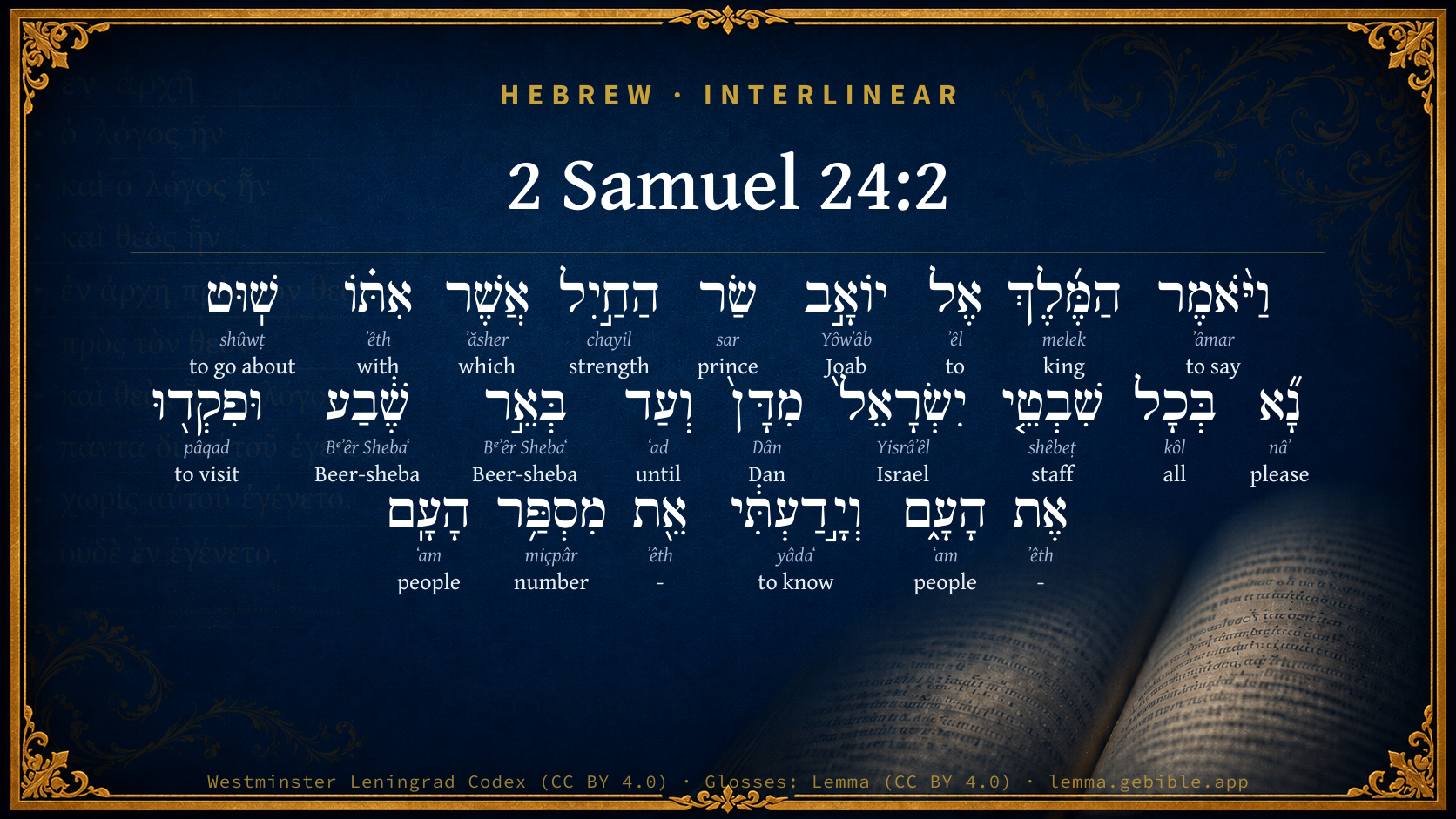
  1. וַיֹּ֨אמֶר ʼâmar H559 “and · to say” Conjunction + Verb, Qal, Sequential Imperfect, 3rd Person, Masculine, Singular
  2. הַמֶּ֜לֶךְ melek H4428 “the · king” Particle, Definite Article + Noun, Common, Masculine, Singular, Absolute
  3. אֶל ʼêl H413 “to” Preposition
  4. יוֹאָ֣ב Yôwʼâb H3097 “Joab” Noun, Proper
  5. שַׂר sar H8269 “prince of” Noun, Common, Masculine, Singular, Construct
  6. הַחַ֣יִל chayil H2428 “the · strength” Particle, Definite Article + Noun, Common, Masculine, Singular, Absolute
  7. אֲשֶׁר ʼăsher H834 “which” Particle, Relative
  8. אִתּ֗וֹ ʼêth H854 “with · him” Preposition + Suffix, Personal, 3rd Person, Masculine, Singular
  9. נָ֞א nâʼ H4994 “please” Particle, Exhortation
  10. בְּכָל kôl H3605 “in/at · all of” Preposition + Noun, Common, Masculine, Singular, Construct
  11. שִׁבְטֵ֤י shêbeṭ H7626 “staffs of” Noun, Common, Masculine, Plural, Construct
  12. יִשְׂרָאֵל֙ Yisrâʼêl H3478 “Israel” Noun, Proper
  13. מִדָּן֙ Dân H1835 “from · Dan” Preposition + Noun, Proper
  14. וְעַד ʻad H5704 “and · until” Conjunction + Preposition
  15. בְּאֵ֣ר Bᵉʼêr Shebaʻ H884 “Beer-sheba” Noun, Proper
  16. שֶׁ֔בַע Bᵉʼêr Shebaʻ H884 “Beer-sheba” Adjective, Cardinal number, Feminine, Singular, Absolute
  17. וּפִקְד֖וּ pâqad H6485 “and · visit” Conjunction + Verb, Qal, Imperative, 2nd Person, Masculine, Plural
  18. אֶת ʼêth H853 “-” Particle, Direct Object
  19. הָעָ֑ם ʻam H5971 “the · people” Particle, Definite Article + Noun, Common, Masculine, Singular, Absolute
  20. וְיָ֣דַעְתִּ֔י yâdaʻ H3045 “and · to know” Conjunction + Verb, Qal, Sequential Perfect, 1st Person, Common, Singular
  21. אֵ֖ת ʼêth H853 “-” Particle, Direct Object
  22. מִסְפַּ֥ר miçpâr H4557 “number of” Noun, Common, Masculine, Singular, Construct
  23. הָעָֽם ʻam H5971 “the · people” Particle, Definite Article + Noun, Common, Masculine, Singular, Absolute

About this verse

These counts appear in no published source. They are computed here, from the morphology-tagged text and Lemma’s own curated glosses. What Lemma adds →

24
words
21
distinct lemmas
Historical
section

Notable vocabulary

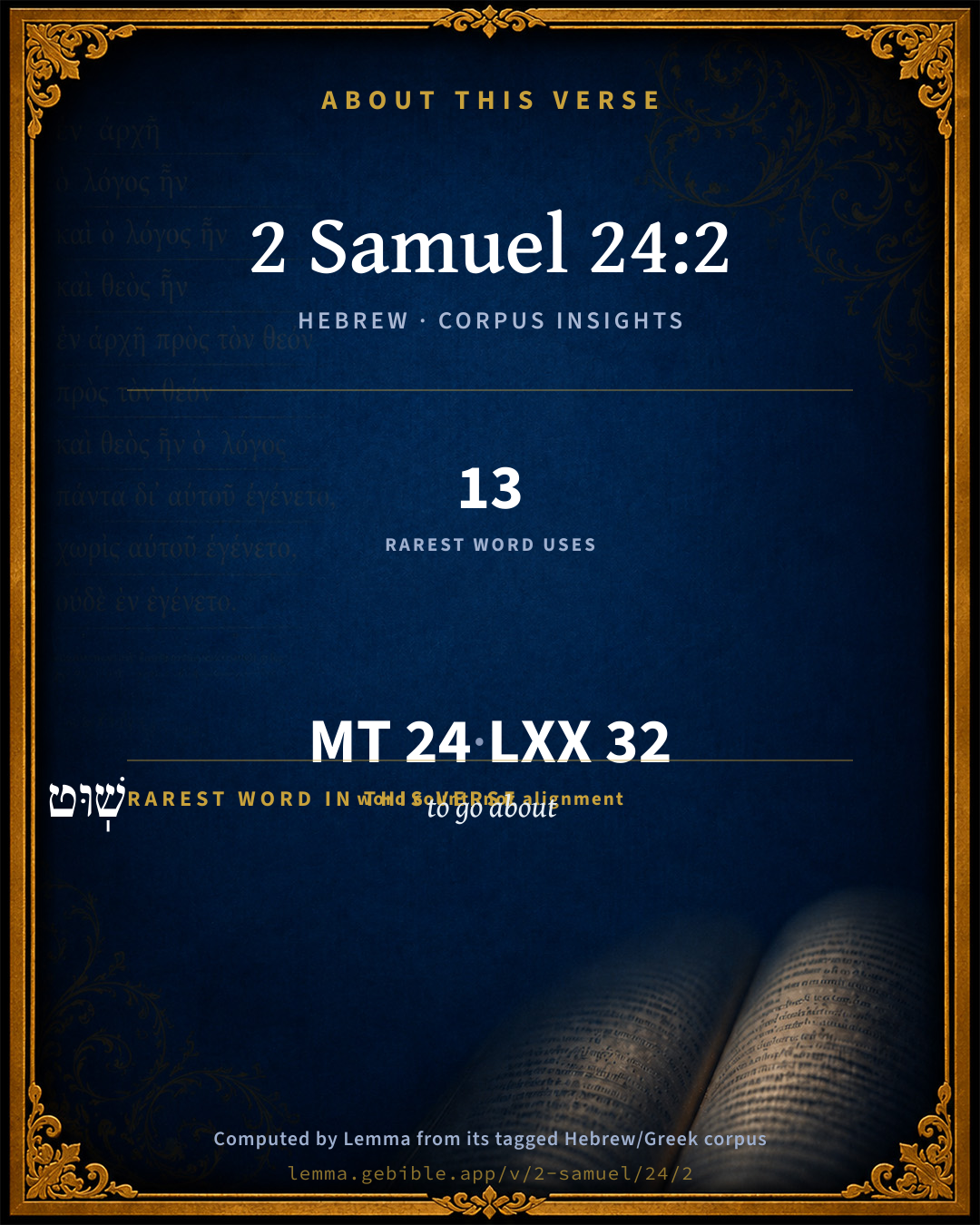
The rarest word here is שֽׁוּט to go about H7751 — appearing just 13 times in the whole Hebrew Bible.

Shared distinctive vocabulary

שֽׁוּט to go about H7751 occurs in 13 verses of the Hebrew Bible. Also found in:

Grammatical profile

  • 4 verbs
  • 12 nouns
  • 1 adjective
  • 3 prepositions
  • 4 particles

Verb forms

  • וַיֹּ֨אמֶר Qal · Sequential Imperfect
  • שֽׁוּט Qal · Imperative
  • וּפִקְד֖וּ Qal · Imperative
  • וְיָ֣דַעְתִּ֔י Qal · Sequential Perfect

Repetition

Words recur within this verse — often emphatic in Hebrew:

  • בְּאֵ֣ר Beer-sheba H884 ×2
  • הָעָ֑ם people H5971 ×2

Hebrew & Septuagint length

In English translation the verse runs 44 words from the Hebrew and 42 from the Septuagint (LXX English) — closely comparable.

A rough comparison of the two English renderings, which tokenize alike — not a word-level alignment.

Word counts can differ between the Hebrew and the Greek without any difference in meaning — e.g. the Hebrew direct-object marker אֵת has no separate Greek word, and Greek often adds the article ὁ.

In the original languages it is 24 Hebrew tokens and 32 Greek tokens — but the two are counted differently (Hebrew bundles its prefixes and suffixes into one token; the Greek is in lemma form), so that isn’t a like-for-like length.

Cross-references

14

Topical passages linked to 2 Samuel 24:2 in the Treasury of Scripture Knowledge — connected by theme and wording, ordered by reader-vote popularity; previews shown in the World English Bible.

  • 2 Samuel 3:10 to transfer the kingdom from the house of Saul, and to set up the throne of David over Israel and over Judah, from Dan even to Beersheba.
  • Judges 20:1 Then all the children of Israel went out, and the congregation was assembled as one man, from Dan even to Beersheba, with the land of Gilead, to Yahweh at Mizpah.
  • 2 Samuel 20:23 Now Joab was over all the host of Israel; and Benaiah the son of Jehoiada was over the Cherethites and over the Pelethites;
  • 2 Samuel 8:16 Joab the son of Zeruiah was over the host; and Jehoshaphat the son of Ahilud was recorder;
  • 2 Samuel 17:11 But I counsel that all Israel be gathered together to you, from Dan even to Beersheba, as the sand that is by the sea for multitude; and that you go to battle in your own person.
  • 2 Samuel 23:37 Zelek the Ammonite, Naharai the Beerothite, armor bearers to Joab the son of Zeruiah,
  • 1 Chronicles 21:2 David said to Joab and to the princes of the people, Go, number Israel from Beersheba even to Dan; and bring me word, that I may know the sum of them.
  • 2 Chronicles 32:25–26 But Hezekiah didn't render again according to the benefit done to him; for his heart was lifted up: therefore there was wrath on him, and on Judah and Jerusalem.
  • 2 Chronicles 32:31 However in [the business of] the ambassadors of the princes of Babylon, who sent to him to inquire of the wonder that was done in the land, God left him, to try him, that he might know all that was in his heart.
  • Proverbs 29:23 A man's pride brings him low, But one of lowly spirit gains honor.
  • Jeremiah 17:5 Thus says Yahweh: Cursed is the man who trusts in man, and makes flesh his arm, and whose heart departs from Yahweh.
  • 2 Corinthians 12:7 By reason of the exceeding greatness of the revelations, that I should not be exalted excessively, there was given to me a thorn in the flesh, a messenger of Satan to buffet me, that I should not be exalted excessively.
  • Deuteronomy 8:13–14 and when your herds and your flocks multiply, and your silver and your gold is multiplied, and all that you have is multiplied;
  • 2 Samuel 2:13 Joab the son of Zeruiah, and the servants of David, went out, and met them by the pool of Gibeon; and they sat down, the one on the one side of the pool, and the other on the other side of the pool.

Cross-references courtesy of OpenBible.info (CC BY 4.0).

Hebrew and Greek witnesses Masoretic Hebrew ↔ Greek Septuagint

The same verse in the two great witnesses to the Old Testament, shown verse-for-verse.

These are two independent witnesses, not word-aligned to each other, and the Septuagint is shown in lemma (dictionary) form.

Hebrew 2 Samuel 24:2 Masoretic · Westminster Leningrad Codex

וַיֹּ֨אמֶר הַמֶּ֜לֶךְ אֶל יוֹאָ֣ב שַׂר הַחַ֣יִל אֲשֶׁר אִתּ֗וֹ שֽׁוּט נָ֞א בְּכָל שִׁבְטֵ֤י יִשְׂרָאֵל֙ מִדָּן֙ וְעַד בְּאֵ֣ר שֶׁ֔בַע וּפִקְד֖וּ אֶת הָעָ֑ם וְיָ֣דַעְתִּ֔י אֵ֖ת מִסְפַּ֥ר הָעָֽם

The king said to Joab the captain of the host, who was with him, Go now back and forth through all the tribes of Israel, from Dan even to Beersheba, and number you the people, that I may know the sum of the people.

World English Bible · Public Domain

Greek LXX 2 Samuel 24:2 Septuagint · lemma form

καί εἶπον ὁ βασιλεύς πρός ιωαβ ἄρχων ὁ ἰσχύς ὁ μετά αὐτός διαἔρχομαι δή πᾶς φυλή ἰσραήλ ἀπό δαν καί ἕως βηρσαβεε καί ἐπισκέπτομαι ὁ λαός καί γιγνώσκω ὁ ἀριθμός ὁ λαός

And the king said to Joab commander of the host, who was with him, Go now through all the tribes of Israel and Juda, from Dan even to Bersabee, and number the people, and I will know the number of the people.

LXX2012 (modern English Septuagint) · Public Domain

Hebrew: Westminster Leningrad Codex (CC BY 4.0). Greek: Septuagint (public domain); English from LXX2012 (modern English Septuagint) (Public Domain). How the Septuagint differs from the Hebrew →

Targum (Aramaic paraphrase)

1

The Targum is the ancient Jewish Aramaic paraphrase of the Hebrew Scriptures — an interpretive translation, not the Hebrew text itself. Onkelos (literal) and Pseudo-Jonathan (expansive) render the Torah, and Jonathan the Prophets. Coverage is partial: where no permissively-licensed English translation exists for a verse, only the Aramaic is shown. This is verse-level text, not a word-by-word alignment to the Hebrew.

  1. Targum Jonathan Prophets (Joshua–Malachi)
    וַאֲמַר מַלְכָּא לְיוֹאָב רַב חֵילָא דְעִמֵיהּ הֲלֵיךְ כְּעַן בְּכָל שִׁבְטָא דְיִשְׂרָאֵל מִדָן וְעַד בְּאֵר שֶׁבַע וּמְנֵי יַת עַמָא וְאִידַע יַת חֻשְׁבַּן עַמָא:

    (no public-domain English translation for this verse)

    Targum Jonathan — Aramaic: “Mikraot Gedolot” (public domain). English: “Sefaria Community Translation” (CC0 1.0 (public-domain dedication)); “London "Chaldee Paraphrase," 1871” (public domain). Text via Sefaria.

Commentary

Notes on 2 Samuel 24:2 from classic Christian and Jewish commentators (each source and its license shown beneath its notes). The classic Christian expositions comment on the surrounding passage and are grouped to its opening verse, so a note may address several verses; the Jewish commentaries on the Tanakh (Rashi and others) are per-verse, so they appear only where the commentator wrote on this verse.

Lemma curates 59 commentaries, every one of them public domain or Creative Commons licensed, each selected and text-cleaned for this edition rather than reprinted as found. About our sources →

The Cambridge Bible for Schools and Colleges

gen. ed. J. J. S. Perowne

2. For the king said] And the king said: yielding to the temptation to which he was subjected by permission of God through the instrumentality of Satan.

the host] The word for host in 2Sa_24:2; 2Sa_24:4 is different from that generally used of the Israelite army, and perhaps indicates that this chapter was derived from a different source.

number ye] It is stated in 1Ch_21:2 that the commission was given to “Joab and to the captains (or princes) of the people.” Their cooperation is here implied by the use of the plural, and by 2Sa_24:4. They were associated with Joab in the work, just as the princes of the tribes were associated with Moses and Aaron in taking the census (Num_1:4 ff.), and this indicates that the census had some military object in view.

The Cambridge Bible for Schools and Colleges (gen. ed. J. J. S. Perowne; Cambridge University Press, 1878–1918) — public domain. Text from a community e-Sword module.

Trapp's Complete Commentary

John Trapp

2Sa 24:2 For the king said to Joab the captain of the host, which [was] with him, Go now through all the tribes of Israel, from Dan even to Beersheba, and number ye the people, that I may know the number of the people.

Ver. 2. That I may know the number of the people.] As I have lately taken notice and made a catalogue of my worthies, and the forces under their command. This Augustus Caesar might do for his pleasure, and carry it away without punishment. {Luk 2:1} Not so David. God will take that from others that he will not bear with in his own. {Amo 3:2} The Philistines might cart the ark, but David smarted for so doing.

John Trapp, A Commentary or Exposition upon All the Books of the Old and New Testament (1647–1656) — public domain. Text from a community e-Sword module.

Joseph Benson's Commentary

2Sa 24:2. From Dan even to Beer-sheba — From one end of the country to the other. For Dan was the utmost bound of it in the north, and Beer-sheba in the south. That I may know the number of the people — This expression shows David’s sin in this matter, that he numbered them, not by direction from God, but out of mere curiosity, and pride, and vain-glory; accompanied with a confidence in the numbers of his people. All which sins were so manifest, that not only God saw them, but even Joab and the captains of the host.

Joseph Benson's Commentary on the Old and New Testaments (1811–1818) — public domain. Text from a community e-Sword module.

Tyndale Open Study Notes

Tyndale Open Resources

24:2 Dan and Beersheba were the traditional northern and southern boundaries of Israel. This phrase meant the entire land of Israel.

Tyndale Open Study Notes — © Tyndale Open Resources, licensed CC BY-SA 4.0. Text via the HelloAO Bible API.

Geneva Bible (1599)

Geneva Bible translators

Because he did this to try his power, and so to trust therein, it offended God, else it was lawful to number the people, Exod. 30:12; Num. 1:2.

Geneva Bible (1599) marginal notes — public domain. Text via Bolls.life.

John Gill's Exposition

For the king said to Joab the captain of the host, which was with him,.... Or who was with him, even Joab, who was now at court, and was a counsellor of David, as well as his general; or which army was with Joab, a standing army he had the command of:

go now through all the tribes of Israel, from Dan even to Beersheba; from the northern part of the land of Israel to the southern part of it, and this course was accordingly steered, Sa2 24:6,

and number ye the people, that I may know the number of the people; so that this appears to be done not through any urgent necessity, but merely out of curiosity, and to gratify the pride of his heart, and please himself with the thought of ruling such a numerous people, and brag of their numbers to other nations, and place his confidence therein; and no wonder it was displeasing to the Lord.

John Gill's Exposition of the Whole Bible (1746–1763) — public domain (CC PDM 1.0). Text via the HelloAO Bible API.

Albert Barnes' Notes on the Bible

1Ch 21:2, supplies some missing words. This passage should run, as at 2Sa 24:4, “And the king said to Joab and to the princes of the host who were with him,” etc. (compare 1Ch 27:22). They were employed “with Joab” as his assistants in the numbering, exactly as in the previous numbering Num 1:4 when a prince was appointed from each tribe to be “with” Moses and Aaron.

Albert Barnes' Notes on the Bible (1834–1885) — public domain. Text from a community e-Sword/MySword module.

Haydock's Catholic Bible Commentary

Them. He was led by curiosity. (Menochius)

George Leo Haydock (1774–1849), Haydock's Catholic Family Bible and Commentary, 1859 edition — public domain. Excludes Psalms (Douay-Rheims chapter numbering differs from Protestant) and Deuterocanonical books (Catholic canon only).

Matthew Poole's English Annotations

Which expression points at David’s sin in this matter, that he numbered them, not by direction from God, nor for any important business of the church or kingdom; but out of mere curiosity, and pride, and vain-glory; accompanied either with a secret distrust of God’s promise; or rather, with a carnal confidence in the numbers of his people; all which were great sins, and were so manifest, that not only God saw them, and all the degrees and aggravations of them, in David; but even Joab and the captains of the host were very sensible of them, 2Sa 24:3,4.

Matthew Poole's English Annotations on the Holy Bible (1683–1685) — public domain. Text from a community e-Sword/MySword module.

The Pulpit Commentary

For the king said; Hebrew, and the king said. David"s command was not the cause of Jehovah"s auger, but the result of his having himself given way to ambition; and, as he yielded to the temptation, it so far became an act of Satan, in that it led to sin; but in its final result it led to good, in that the chastisement cured the people of their thirst for war. And as Satan can act only so far as the Divine will permits, the temptation was most truly the doing of Jehovah (but see note on. (1Sa_26:19) Captain of the host, which was with him. There is a good deal of difficulty about this passage, as the word for "host" is not that elsewhere used, and the last phrase is somewhat meaningless. In 1Ch_21:2 we find "David said to Joab and to the rulers of the people." Without the concurrence of these rulers, who were the princes of the tribes, the census could not have been taken. But as the ancient versions confirm the reading of the Hebrew here, no change of the text is admissible. Number ye. This is distinctly the war word, for which see note on 2Sa_18:1. It proves that the census was taken for military reasons. Even this in itself was not wrong, (Num_26:2) but it is indicative of David"s purpose. When, moreover, Moses numbered the people, the census was taken by the priests, (Num_1:3 Num_26:1, Num_26:2) and from the payment of the half shekel to the sanctuary, it appears that it was to some extent a religious ceremony. All this David neglects, and the employment of Joab goes far to prove that what David wanted was an examination of the military resources of his kingdom.

Ver. 2 (THE KING"S PALACE.) (1Ch_21:2)

Self-elation.

This chapter contains the spiritual history of a great soul in its "fall and rising again," its sin and recovery its

(1) self-elation,

(2) self-will (vers. 3, 4),

(3) self-deception (during many months),

(4) self-conviction (by self-examination, ver. 10),

(5) self-abasement,

(6) self-surrender (ver. 14),

(7) self-devotion for the people (ver. 17), and self-dedication to God (vers. 24, 25). Of self-elation, pride, presumption, vain glory (the sin of David), it may be said that it is

I A COMMON EFFECT OF EXTRAORDINARY PROSPERITY, temporal or spiritual. Pride; war, famine, or pestilence; suffering and humiliation; peace and industry; prosperity pride again; such is the melancholy circle of human affairs. (Exo_8:14) "If we knew how to enjoy our blessings in the fear of God, they would be continued unto us; but it is the sin of man that he extracts, even from the mercies of God, the poison which destroys his comforts; he grows fat upon the bounties of Heaven, spurns its laws, and awakens its vengeance" (R. Watson).

II AN UNGRATEFUL PERVERSION OF DIVINE BENEFITS. "The grave sin of proud exaltation, which David and the people of Israel here had in common, presupposed the elevation to victory and power that God had bestowed by his gracious mind; and its consequence was the judgment that revealed God"s anger against the perversion of his favours into plans of self-aggrandizement" (Erdmann). What should produce thankfulness and humility too often results in unthankfulness and vain glory. (2Ki_20:13)

III A SPECIAL TEMPTATION OF THE EVIL ONE. (1Ti_3:6) "And Satan an adversary stood up," etc.. (1Ch_21:1) "We see that God and Satan both had their hand in the work; God by permission, Satan by suggestion; God as a Judge, Satan as an enemy; God as in a just punishment for sin, Satan as in an act of sin; God in a wise ordination of it to good, Satan in a malicious intent to confusion" (Hall).

IV A GRIEVOUS EXHIBITION OF SPIRITUAL BLINDNESS; inconsideration of dependence, self-ignorance, self-deception, and foolish infatuation. (Jer_49:16) "David, when strongly tempted to this gratification of his vanity, was not at all sensible of the evil of such an act; while Joab was. Joab, though a man of blood, and apparently hardened in iniquity, could see through David"s vain and arrogant feelings, while David himself, whose mind was under ordinary circumstances eminently sensitive and pious, could not discover the impiety of his proceeding, but persevered in evil for several months. Such is the infatuation of sin!" (Lindsay).

V A PECULIAR PROVOCATIVE OF DIVINE WRATH 1 Samuel; (Pro_16:5) most odious of all things in the sight of God, because most directly opposed to him. "Pride is the beginning of sin" (Ecc_10:13). "And what is pride but the craving for undue exaltation? And this is undue exaltation when the soul abandons him to whom it ought to cleave as its end, and becomes a kind of end to itself. This happens when it becomes its own satisfaction. And it does so when it falls away from that unchangeable good which ought to satisfy it more than itself" (Augustine, "The City of God" 14:13).

VI A PERNICIOUS INFLUENCE IN RELATION TO OTHER PEOPLE; inciting in them a similar spirit, and bringing untold miseries upon them. What oppression, strife, and other deadly fruits grow out of this "root of bitterness"! (Exo_14:5)

VII A RUINOUS TENDENCY IN RELATION TO MAN HIMSELF. (Dan_4:28; Pro_16:18) "Pride wishes to dethrone God. Pride takes occasion from virtue itself. Pride was particularly odious in David, who was exalted from so lowly a state. His pride was accompanied by falsehood; for he had protested his humility in the psalms which he made for all the people to sing. David was a just man; but this was a reason why God should punish him more severely. For it is certain that the sins of the children of God are more deserving of condemnation than the sins of reprobates and slaves of the devil. These only offend their master, but those do outrage to their Father; these are only rebel subjects, but those are unnatural children and barbarians; these only abuse the gifts of nature, but those profane miserably the gifts of grace. And how much more abominable is Judas than Pilate! Be not surprised, then, that when David, who was complete in a thousand graces, committed the crime of felony against him, the Eternal could not suffer such an indignity without punishing him severely" (Du Bose, in Vinet"s "Histoire de la Predication"). D.

The Pulpit Commentary (1880–1919), ed. H.D.M. Spence-Jones & Joseph S. Exell — public domain. Text from a community e-Sword module.

Lesson kit

Teaching starters — assembled from the data on this page, not authored interpretation. Every prompt links to the verse data it draws on. Edit before teaching.

2 Samuel, in the Historical, opens this verse with 24 words (21 distinct Hebrew lemmas). Its most distinctive word is shûwṭ (“to go about”). A historical commentator’s framing appears above. Read the whole chapter for the surrounding context.

Discussion questions

  1. What does “to go about” (shûwṭ) contribute to the verse as a whole?
  2. How does Numbers 11:8, which shares the word «to go about», read alongside this verse?
  3. What does the repetition of “Beer-sheba” (2× in this one verse) do in this verse?
  4. These translations render this verse differently; the difference is in the English rendering, not the original. What questions does that raise?
  5. «וַיֹּ֨אמֶר» is a Qal Sequential Imperfect verb. How does that grammatical form shape the action described?
  6. Compare how The Cambridge Bible for Schools and Colleges and Trapp's Complete Commentary read this verse. Where do they agree or differ?

Things to notice

Reading settings

Reading text

Shown beneath each verse's original-language words.

Old Testament
Old Testament edition

Read the OT as the Masoretic Hebrew (MT) or the Greek Septuagint (LXX).

English shown for the Greek Septuagint (in the Hebrew ↔ Greek comparison).

Comparing translations? Open the Compare panel on any verse page to stack up to four side by side.