
1 Chronicles 26:30

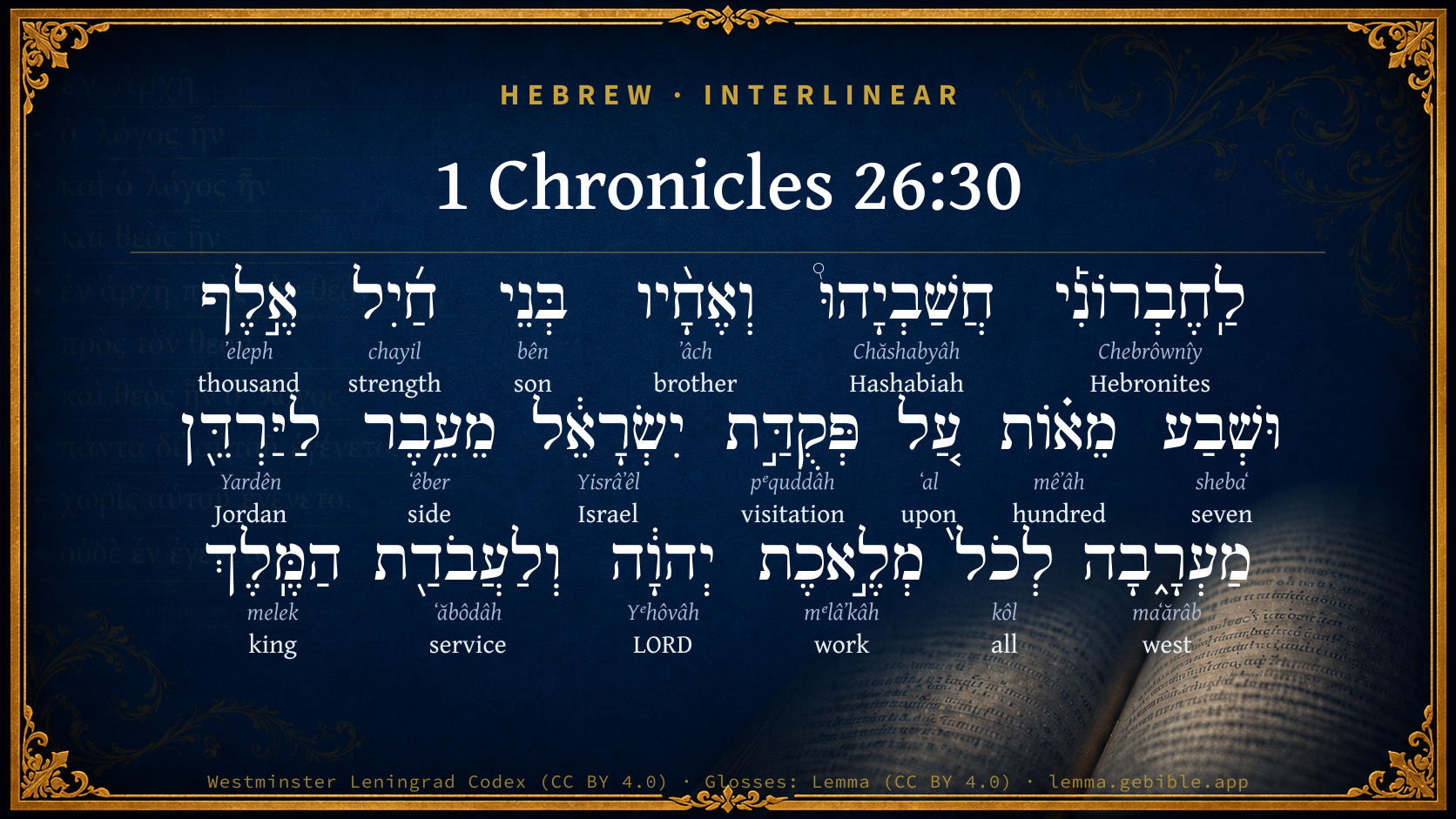
Hebrew (Westminster Leningrad Codex) 1 Chronicles 26:30 appears in the Hebrew Old Testament. The text above is from the Westminster Leningrad Codex. Each word links to its Strong’s number, a concise gloss, and parsing drawn from the Open Scriptures Hebrew Bible morphology. Click any word for its full Brown-Driver-Briggs (BDB) entry.
Download image
Cite this verse

1 Chronicles 26:30 (World English Bible). Public Domain. Lemma interlinear Bible study tool, https://lemma.gebible.app/v/1-chronicles/26/30.

Show BibTeX & RIS
BibTeX
RIS
English Translation
Of the Hebronites, Hashabiah and his brothers, men of valor, one thousand seven hundred, had the oversight of Israel beyond the Jordan westward, for all the business of Yahweh, and for the service of the king.
World English Bible · Public Domain
Download a study sheet

One document with this verse’s original text, its word-by-word gloss line, the meaning frame, cross-references with their text, attributed commentary, and full source and license credits — printable, and it pastes into notes with its structure intact.

This verse Autodidact and up

Study sheet (.html) Plain text (.txt)

A passage Seminary Student

Up to 50 verses in one chapter. A passage sheet keeps up to 6 commentary sources and 12 cross-references per verse, in the order this page ranks them, and says so on the sheet whenever that leaves anything out. Ask for a single verse and you get the Autodidact verse sheet above.

Everything on this page stays free to read, with no account — the sheet is a download of what is already on screen, not access to it.

Want to remove ads? Support Godless Engineer
Compare translations 3

The same verse in 3 English versions, stacked beneath the original-language interlinear above. Click any original word for its lexicon entry.

Each is an independent rendering of the whole verse — the interlinear is not word-aligned to these translations.

Highlighted words mark where these versions differ — a whole-verse word diff, not a word-by-word alignment.

  • World English Bible Public Domain
    Of the Hebronites, Hashabiah and his brothers, men of valor, one thousand seven hundred, had the oversight of Israel beyond the Jordan westward, for all the business of Yahweh, and for the service of the king.
  • King James Version Public Domain
    And of the Hebronites, Hashabiah and his brethren, men of valor, a thousand and seven hundred, were officers among them of Israel on this side Jordan westward in all the business of the LORD, and in the service of the king.
  • unfoldingWord Literal Text CC BY-SA 4.0
    Of the Hebronite, Hashabiah and his brothers, sons of valor, 1,700, upon the oversight of Israel from across the Jordan from the west, for all of the work of Yahweh and for the service of the king.

unfoldingWord Literal Text — © unfoldingWord, licensed CC BY-SA 4.0. Word-aligned USFM3 via Door43 (git.door43.org/unfoldingWord/en_ult).

Versions to compare (up to 4)

3 of 4 selected

Show all 18 translations

Every available English version of this verse, each an independent rendering of the whole verse.

  • World English Bible Public Domain
    Of the Hebronites, Hashabiah and his brothers, men of valor, one thousand seven hundred, had the oversight of Israel beyond the Jordan westward, for all the business of Yahweh, and for the service of the king.
  • Berean Standard Bible Public Domain
    From the Hebronites, Hashabiah and his relatives, 1,700 capable men, had charge of the affairs of Israel west of the Jordan for all the work of the LORD and for the service of the king.
  • Majority Standard Bible Public Domain
    From the Hebronites, Hashabiah and his relatives, 1,700 capable men, had charge of the affairs of Israel west of the Jordan for all the work of the LORD and for the service of the king.
  • King James Version Public Domain
    And of the Hebronites, Hashabiah and his brethren, men of valor, a thousand and seven hundred, were officers among them of Israel on this side Jordan westward in all the business of the LORD, and in the service of the king.
  • American Standard Version (1901) Public Domain
    Of the Hebronites, Hashabiah and his brethren, men of valor, a thousand and seven hundred, had the oversight of Israel beyond the Jordan westward, for all the business of Jehovah, and for the service of the king.
  • Revised Version (1885) Public Domain
    Of the Hebronites, Hashabiah and his brethren, men of valour, a thousand and seven hundred, had the oversight of Israel beyond Jordan westward; for all the business of the LORD, and for the service of the king.
  • Geneva Bible (1599) Public Domain
    Of the Hebronites, Ashabiah and his brethren, men of actiuitie, a thousande, and seuen hundreth were officers for Israel beyonde Iorden Westward, in all the busines of the Lord, and for the seruice of the King.
  • Douay-Rheims (1899) Public Domain
    And of the Hebronites Hasabias, and his brethren most able men, a thousand seven hundred had the charge over Israel beyond the Jordan westward, in all the works of the Lord, and for the service of the king.
  • Young's Literal Translation Public Domain
    Of the Hebronite, Hashabiah and his brethren, sons of valour, a thousand and seven hundred, `are' over the inspection of Israel, beyond the Jordan westward, for all the work of Jehovah, and for the service of the king.
  • Literal Standard Version CC BY-SA 4.0
    Of the Hebronite, Hashabiah and his brothers, one thousand and seven hundred sons of valor, [are] over the inspection of Israel, beyond the Jordan westward, for all the work of YHWH, and for the service of the king.
  • Unlocked Literal Bible CC BY-SA 4.0
    Of Hebron's descendants, Hashabiah and his brothers, 1,700 capable men, were in charge of Yahweh's work and the king's work. They were on the west side of the Jordan.
  • unfoldingWord Literal Text CC BY-SA 4.0
    Of the Hebronite, Hashabiah and his brothers, sons of valor, 1,700, upon the oversight of Israel from across the Jordan from the west, for all of the work of Yahweh and for the service of the king.
  • Darby Bible Public Domain
    Of the Hebronites, Hashabiah and his brethren, men of valour, a thousand and seven hundred, for the administration of Israel on this side Jordan westward, for all the business of Jehovah, and for the service of the king.
  • World Messianic Bible Public Domain
    Of the Hebronites, Hashabiah and his brothers, one thousand seven hundred men of valor, had the oversight of Israel beyond the Jordan westward, for all the business of the LORD and for the service of the king.
  • Webster's Bible Public Domain
    And of the Hebronites, Hashabiah and his brethren, men of valor, a thousand and seven hundred, were officers among them of Israel on this side of Jordan westward in all the business of the LORD, and in the service of the king.
  • Free Bible Version CC BY-SA 4.0
    From the Hebronites: Hashabiah and his relatives, 1,700 capable men, were put in charge of Israel west of the Jordan, responsible for everything involving the Lord's work and the king's service.
  • Bible in Basic English Public Domain
    Of the Hebronites, Hashabiah and his brothers, seventeen hundred able men, were overseers of Israel on the other side of the Jordan, to the west, being responsible for all the work of the Lord's house and for the work done by the king's servants.
  • JPS Tanakh (1917) Public Domain
    Of the Hebronites, Hashabiah and his brethren, men of valour, a thousand and seven hundred, had the oversight of Israel beyond the Jordan westward; for all the business of the LORD, and for the service of the king.

Literal Standard Version (2020), Covenant Press — licensed CC BY-SA 4.0. Text via the HelloAO Bible API (eBible.org). Unlocked Literal Bible (unfoldingWord) — licensed CC BY-SA 4.0. Text via the HelloAO Bible API (eBible.org). unfoldingWord Literal Text — © unfoldingWord, licensed CC BY-SA 4.0. Word-aligned USFM3 via Door43 (git.door43.org/unfoldingWord/en_ult). Free Bible Version, Dr. Jonathan Gallagher — licensed CC BY-SA 4.0. Text via the HelloAO Bible API (eBible.org).

Word by word

More ways to search: Search by grammar → Find every occurrence → Compare this word →

Practice this passage: Drill this verse → Learn its vocabulary →

לַֽחֶבְרוֹנִ֡י
Chebrôwnîy
H2276
“to/for the · Hebronites”
Preposition, Determined + Noun, Gentilic, Masculine, Singular, Absolute
Part of Speech
Preposition + Noun
Type
Gentilic
Gender
Masculine
Number
Singular
State
Absolute
Full BDB Definition

Origin: patronymically from H2275

TWOT: None

Hebronites = see Hebron - the inhabitants of the city of Hebron - the descendants of Hebron, the grandson of Levi
  1. חֲשַׁבְיָהוּ֩ Chăshabyâh H2811 “Hashabiah” Noun, Proper
  2. וְאֶחָ֨יו ʼâch H251 “and · brothers · his” Conjunction + Noun, Common, Masculine, Plural, Construct + Suffix, Personal, 3rd Person, Masculine, Singular
  3. בְּנֵי bên H1121 “sons of” Noun, Common, Masculine, Plural, Construct
  4. חַ֜יִל chayil H2428 “strength” Noun, Common, Masculine, Singular, Absolute
  5. אֶ֣לֶף ʼeleph H505 “thousand” Adjective, Cardinal number, Both, Singular, Absolute
  6. וּשְׁבַע shebaʻ H7651 “and · seven” Conjunction + Adjective, Cardinal number, Feminine, Singular, Absolute
  7. מֵא֗וֹת mêʼâh H3967 “hundred” Adjective, Cardinal number, Both, Plural, Absolute
  8. עַ֚ל ʻal H5921 “upon” Preposition
  9. פְּקֻדַּ֣ת pᵉquddâh H6486 “visitation of” Noun, Common, Feminine, Singular, Construct
  10. יִשְׂרָאֵ֔ל Yisrâʼêl H3478 “Israel” Noun, Proper
  11. מֵעֵ֥בֶר ʻêber H5676 “from · side” Preposition + Noun, Common, Masculine, Singular, Absolute
  12. לַיַּרְדֵּ֖ן Yardên H3383 “to/for the · Jordan” Preposition, Determined + Noun, Proper
  13. מַעְרָ֑בָה maʻărâb H4628 “west · toward” Noun, Common, Masculine, Singular, Absolute + Suffix, Demonstrative
  14. לְכֹל֙ kôl H3605 “to/for · all of” Preposition + Noun, Common, Masculine, Singular, Construct
  15. מְלֶ֣אכֶת mᵉlâʼkâh H4399 “work of” Noun, Common, Feminine, Singular, Construct
  16. יְהוָ֔ה Yᵉhôvâh H3068 “LORD” Noun, Proper
  17. וְלַעֲבֹדַ֖ת ʻăbôdâh H5656 “and · to/for · service of” Conjunction + Preposition + Noun, Common, Feminine, Singular, Construct
  18. הַמֶּֽלֶךְ melek H4428 “the · king” Particle, Definite Article + Noun, Common, Masculine, Singular, Absolute

About this verse

These counts appear in no published source. They are computed here, from the morphology-tagged text and Lemma’s own curated glosses. What Lemma adds →

19
words
19
distinct lemmas
Historical
section

Notable vocabulary

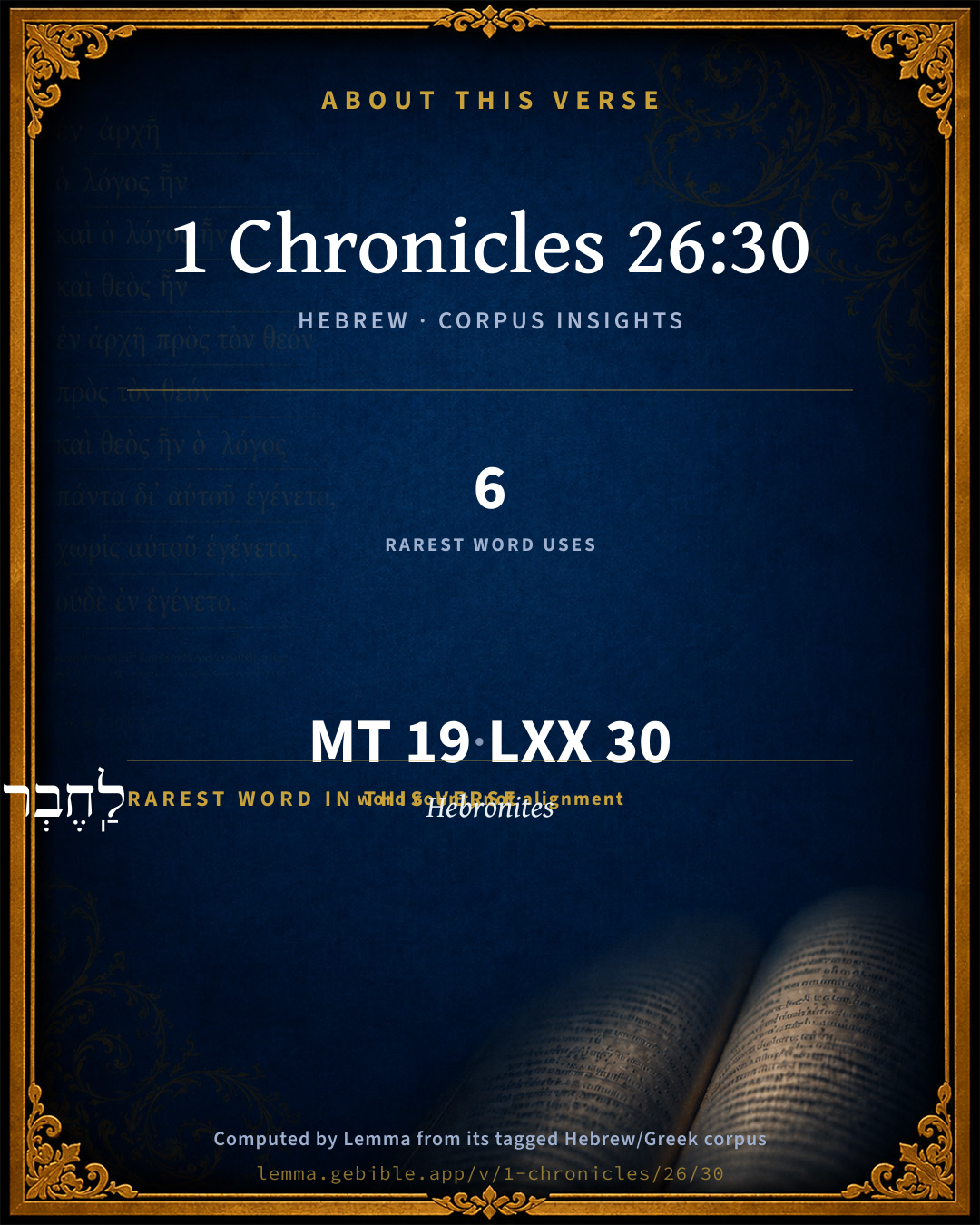
The rarest word here is לַֽחֶבְרוֹנִ֡י Hebronites H2276 — appearing just 6 times in the whole Hebrew Bible.

Shared distinctive vocabulary

לַֽחֶבְרוֹנִ֡י Hebronites H2276 occurs in 5 verses of the Hebrew Bible. Also found in:

Grammatical profile

  • 15 nouns
  • 3 adjectives
  • 1 preposition

Hebrew & Septuagint length

In English translation the verse runs 36 words from the Hebrew and 35 from the Septuagint (LXX English) — closely comparable.

A rough comparison of the two English renderings, which tokenize alike — not a word-level alignment.

Word counts can differ between the Hebrew and the Greek without any difference in meaning — e.g. the Hebrew direct-object marker אֵת has no separate Greek word, and Greek often adds the article ὁ.

In the original languages it is 19 Hebrew tokens and 30 Greek tokens — but the two are counted differently (Hebrew bundles its prefixes and suffixes into one token; the Greek is in lemma form), so that isn’t a like-for-like length.

Cross-references

3

Topical passages linked to 1 Chronicles 26:30 in the Treasury of Scripture Knowledge — connected by theme and wording, ordered by reader-vote popularity; previews shown in the World English Bible.

  • 1 Chronicles 27:17 of Levi, Hashabiah the son of Kemuel: of Aaron, Zadok:
  • 1 Chronicles 23:12 The sons of Kohath: Amram, Izhar, Hebron, and Uzziel, four.
  • 1 Chronicles 23:19 The sons of Hebron: Jeriah the chief, Amariah the second, Jahaziel the third, and Jekameam the fourth.

Cross-references courtesy of OpenBible.info (CC BY 4.0).

Hebrew and Greek witnesses Masoretic Hebrew ↔ Greek Septuagint

The same verse in the two great witnesses to the Old Testament, shown verse-for-verse.

These are two independent witnesses, not word-aligned to each other, and the Septuagint is shown in lemma (dictionary) form.

Hebrew 1 Chronicles 26:30 Masoretic · Westminster Leningrad Codex

לַֽחֶבְרוֹנִ֡י חֲשַׁבְיָהוּ֩ וְאֶחָ֨יו בְּנֵי חַ֜יִל אֶ֣לֶף וּשְׁבַע מֵא֗וֹת עַ֚ל פְּקֻדַּ֣ת יִשְׂרָאֵ֔ל מֵעֵ֥בֶר לַיַּרְדֵּ֖ן מַעְרָ֑בָה לְכֹל֙ מְלֶ֣אכֶת יְהוָ֔ה וְלַעֲבֹדַ֖ת הַמֶּֽלֶךְ

Of the Hebronites, Hashabiah and his brothers, men of valor, one thousand seven hundred, had the oversight of Israel beyond the Jordan westward, for all the business of Yahweh, and for the service of the king.

World English Bible · Public Domain

Greek LXX 1 Chronicles 26:30 Septuagint · lemma form

ὁ χεβρωνι ασαβιας καί ὁ ἀδελφός αὐτός υἱός δυνατός χίλιοι καί ἑπτακόσιοι ἐπί ὁ ἐπίσκεψις ὁ ἰσραήλ πέραν ὁ ἰορδάνης πρός δυσμή εἰς πᾶς λειτουργία κύριος καί ἐργασία ὁ βασιλεύς

For the Chebronites, Asabias and his brethren, a thousand and seven hundred mighty men, were over the charge of Israel beyond Jordan westward, for all the service of the Lord and work of the king.

LXX2012 (modern English Septuagint) · Public Domain

On this verse, Ellicott's Commentary for English Readers discusses the Septuagint’s reading. Read the note in Commentary ↓

Hebrew: Westminster Leningrad Codex (CC BY 4.0). Greek: Septuagint (public domain); English from LXX2012 (modern English Septuagint) (Public Domain). How the Septuagint differs from the Hebrew →

Commentary

Notes on 1 Chronicles 26:30 from classic Christian and Jewish commentators (each source and its license shown beneath its notes). The classic Christian expositions comment on the surrounding passage and are grouped to its opening verse, so a note may address several verses; the Jewish commentaries on the Tanakh (Rashi and others) are per-verse, so they appear only where the commentator wrote on this verse.

Lemma curates 59 commentaries, every one of them public domain or Creative Commons licensed, each selected and text-cleaned for this edition rather than reprinted as found. About our sources →

Trapp's Complete Commentary

John Trapp

1Ch 26:30 [And] of the Hebronites, Hashabiah and his brethren, men of valour, a thousand and seven hundred, [were] officers among them of Israel on this side Jordan westward in all the business of the LORD, and in the service of the king.

Ver. 30. And in the service of the king.] Putting in execution his decrees for the observing of God’s laws.

John Trapp, A Commentary or Exposition upon All the Books of the Old and New Testament (1647–1656) — public domain. Text from a community e-Sword module.

Joseph Benson's Commentary

1Ch 26:30. In all business of the Lord — In all things which concerned the house or worship of God; to take care that such moneys as were given toward building the temple, or toward the sacrifices and other holy ministrations, should be gathered and received, and faithfully sent up to Jerusalem; and to see the execution of all the laws of God among the people. In the service of the king, &c. — They served the king in the execution of his decrees, by which the several rights of the king and people were established. And as the king was the principal person intrusted with the execution of God’s laws, so these Levites chiefly were his eyes, by which he saw his people’s transgressions, and his hands, by which he inflicted due censures upon them for their miscarriages.

Joseph Benson's Commentary on the Old and New Testaments (1811–1818) — public domain. Text from a community e-Sword module.

Geneva Bible (1599)

Geneva Bible translators

That is, for the king’s house.

Geneva Bible (1599) marginal notes — public domain. Text via Bolls.life.

Adam Clarke's Commentary

Verse 30. In all the business of the Lord] Every thing that concerned ecclesiastical matters.

In the service of the king.] Every thing that concerned civil affairs: see also 1Ch 26:32.

Thus courts of ecclesiastical and civil judicature were established in the land; and due care taken to preserve and insure the peace of the Church, and the safety of the state; without which the public welfare could neither be secured nor promoted. Whatever affects religion in any country, must affect the state or government of that country: true religion alone can dispose men to civil obedience. Therefore, it is the interest of every state to protect and encourage religion. It would certainly be ruinous to true religion, to make the state dependent on the Church; nor should the Church be dependent on the state. Let them mutually support each other; and let the state rule by the laws, and the Church live by the Bible.

Adam Clarke's Commentary on the Bible (1810–1826) — public domain. Text from a community e-Sword/MySword module.

Ellicott's Commentary for English Readers

(30) And of the Hebronites, Hashabiah.—Rather, As to the Hebronites, Hashabiah, and his kinsmen, sons of valour (1Ch_26:7), a thousand and seven hundred, were charged with (Heb., over) the supervision of Israel on yonder side of the Jordan, westward, for all the work of Iahweh and for the service of the king.

Officers.—Pĕquddah (oversight, superintendence). Vulg., praeërant Israeli: LXX., ἐπὶ τῆς ἐπισκέψεως τοῦ Ισραηλ. (See 1Ch_23:11; 1Ch_24:19 for another meaning of the word.)

Hashabiah.—A Kohathite of this name is not mentioned elsewhere.

On this side Jordan.—Rather, on the other side (‘çber): the western side of the river is so called in Jos_5:1; Jos_22:7. The use of this expression here seems to imply that the source upon which the chronicle is here dependent, was written in some locality east of the Jordan, perhaps at Babylon.

A Bible Commentary for English Readers, edited by Charles John Ellicott (1878–1897) — public domain. Text from a community e-Sword module.

The Cambridge Bible for Schools and Colleges

gen. ed. J. J. S. Perowne

30. the Hebronites] Cp. 1Ch_23:12.

were officers among them of Israel] R.V. had the oversight of Israel.

on this side Jordan westward] R.V. beyond Jordan westward; cp. Jos_22:7, R.V. Western Palestine is meant.

The Cambridge Bible for Schools and Colleges (gen. ed. J. J. S. Perowne; Cambridge University Press, 1878–1918) — public domain. Text from a community e-Sword module.

Albert Barnes' Notes on the Bible

The “business of the Lord” in the provinces would consist especially in the collection of the tithes, the redemption-money, and the free-will offerings of the people. It may perhaps have included some religious teaching. Compare 2Ch 17:7-9.

Albert Barnes' Notes on the Bible (1834–1885) — public domain. Text from a community e-Sword/MySword module.

Haydock's Catholic Bible Commentary

Beyond. Hebrew meheber means, "at the passage, or on either side." Protestants, "on this side Jordan, westward." This would seem to designate the countries nearer Jerusalem. (Haydock) --- But westward may also be understood with reference to Ruben, &c., so as to mean the parts along the river. --- King. To decide both ecclesiastical and civil causes. (Calmet) --- They also inspected the preparations for the temple, and gathered the king’s tribute. (Grotius)

George Leo Haydock (1774–1849), Haydock's Catholic Family Bible and Commentary, 1859 edition — public domain. Excludes Psalms (Douay-Rheims chapter numbering differs from Protestant) and Deuterocanonical books (Catholic canon only).

Matthew Poole's English Annotations

On this side Jordan westward; in those parts of the land of Canaan which border upon Jordan, or are not very remote from it.

In all the business of the Lord, i.e. in all things which did or should concern the house or worship of God; partly to take care that such monies as were either imposed by a tax, or freely given by the people, towards the building or repairing of the temple, or towards the sacrifices and other holy ministrations, should be gathered and received, and faithfully sent up to Jerusalem to be employed in that work; partly to see to the execution of all the laws of God among the people, and to restrain or punish wilful offenders against it.

In the service of the king; not that all the king’s businesses were managed by them; for it is apparent, both from the nature of the thing, and from Scripture, that the king’s military affairs were managed by his captains, and his political or civil affairs were managed by the princes, and judges, and officers of other tribes; but because they served the king in the execution of his decrees, made pursuantly to the laws of God, by which the several rights of king and people were established, and all things both in church and commonwealth were to be ordered. Now as the king was the principal person intrusted with the execution of God’s laws, so these Levites chiefly were his eyes by which he saw his people’s transgressions, and his hands by which he inflicted due and deserved censures upon them for their miscarriages. And the doing of this was very much for the service of the king, whose throne was established and secured by such righteous administrations. Besides, they were to take care by their counsel and authority to keep the people in obedience to their king; which the Levites were most obliged and best obliged to do.

Matthew Poole's English Annotations on the Holy Bible (1683–1685) — public domain. Text from a community e-Sword/MySword module.

The Pulpit Commentary

Were officers among them of Israel. The simpler translation would be, were for the superintending of Israel (compare the verb in ver. 32). On this side Jordan westward; literally, across Jordan westward, the point of view being from the Persian side. So Ezr_4:16 Ezr_6:6 Ezr_8:36; Neh_2:7; but also, Jos_5:1 Jos_22:7, when the point of viewwas that of those who had still to cross the Jordan to the west. The expression, in all the business of the Lord, is probably no mere reminiscence of the temple or semi-sacred business (such as the gathering of the tithes, etc.) but rather the recognition of the fact that all that pertained to the right discharge of the civil duties of an Israelite"s life lay within that description.

The Pulpit Commentary (1880–1919), ed. H.D.M. Spence-Jones & Joseph S. Exell — public domain. Text from a community e-Sword module.

John Wesley's Explanatory Notes

Of the Lord - In all things which concerned the house or worship of God; to take care that such monies as were given towards building the temple, or towards the sacrifices and other holy ministrations should be gathered and received, and faithfully sent up to Jerusalem; and to see to the execution of all the laws of God among the people. Service of, &c. - They served the king in the execution of his decrees, by which the several rights of the king and people were established. And as the king was the principal person intrusted with the execution of God's laws, so these Levites chiefly were his eyes by which he saw his people's transgressions, and his hands by which he inflicted due censures upon them for their miscarriages.

John Wesley, Explanatory Notes Upon the Whole Bible (1754–1765) — public domain. Text via the GEBible commentary corpus.

Rashi

Rabbi Shlomo Yitzchaki (Rashi)

Of the Hebronites: Hashabiah... to all the work of the Lord They are the officers over those who did the work of the Lord in trans-Jordan.

and to the service of the king They were also appointed over the dwellers of the king’s heritage and the king’s treasuries, and so [we find] further (v. 32): “for every matter of God and matter of the king.”

Rashi on the Tanakh — English translations: “The Judaica Press complete Tanach with Rashi, translated by A. J. Rosenberg” (CC BY 4.0); “Pentateuch with Rashi's commentary by M. Rosenbaum and A.M. Silbermann, 1929-1934” (public domain); “The Metsudah Tanach series, Lakewood, N.J” (CC BY 4.0); and “The Book of Joshua, Metsudah Publications, 1997” (CC BY 4.0). Text via Sefaria.

Lesson kit

Teaching starters — assembled from the data on this page, not authored interpretation. Every prompt links to the verse data it draws on. Edit before teaching.

1 Chronicles, in the Historical, opens this verse with 19 words (19 distinct Hebrew lemmas). Its most distinctive word is Chebrôwnîy (“Hebronites”). A historical commentator’s framing appears above. Read the whole chapter for the surrounding context.

Discussion questions

  1. How does “Hebronites” (Chebrôwnîy) shape what this verse is saying?
  2. Numbers 3:27 shares the word «Hebronites» with this verse. How do the two illuminate each other?
  3. The translations on this page render this verse differently — a whole-verse word diff, not a word-by-word alignment. What might account for the different wordings?
  4. Reading how Trapp's Complete Commentary and Joseph Benson's Commentary read this verse, where do the two commentators agree and where do they part?

Things to notice

Reading settings

Reading text

Shown beneath each verse's original-language words.

Old Testament
Old Testament edition

Read the OT as the Masoretic Hebrew (MT) or the Greek Septuagint (LXX).

English shown for the Greek Septuagint (in the Hebrew ↔ Greek comparison).

Comparing translations? Open the Compare panel on any verse page to stack up to four side by side.