1 Samuel 14:48

Hebrew (Westminster Leningrad Codex) 1 Samuel 14:48 appears in the Hebrew Old Testament. The text above is from the Westminster Leningrad Codex. Each word links to its Strong’s number, a concise gloss, and parsing drawn from the Open Scriptures Hebrew Bible morphology. Click any word for its full Brown-Driver-Briggs (BDB) entry.
Download image
Cite this verse

1 Samuel 14:48 (World English Bible). Public Domain. Lemma interlinear Bible study tool, https://lemma.gebible.app/v/1-samuel/14/48.

Show BibTeX & RIS
BibTeX
RIS
English Translation
He did valiantly, and struck the Amalekites, and delivered Israel out of the hands of those who despoiled them.
World English Bible · Public Domain
Download a study sheet

One document with this verse’s original text, its word-by-word gloss line, the meaning frame, cross-references with their text, attributed commentary, and full source and license credits — printable, and it pastes into notes with its structure intact.

This verse Autodidact and up

Study sheet (.html) Plain text (.txt)

A passage Seminary Student

Up to 50 verses in one chapter. A passage sheet keeps up to 6 commentary sources and 12 cross-references per verse, in the order this page ranks them, and says so on the sheet whenever that leaves anything out. Ask for a single verse and you get the Autodidact verse sheet above.

Everything on this page stays free to read, with no account — the sheet is a download of what is already on screen, not access to it.

Want to remove ads? Support Godless Engineer
Compare translations 3

The same verse in 3 English versions, stacked beneath the original-language interlinear above. Click any original word for its lexicon entry.

Each is an independent rendering of the whole verse — the interlinear is not word-aligned to these translations.

Highlighted words mark where these versions differ — a whole-verse word diff, not a word-by-word alignment.

  • World English Bible Public Domain
    He did valiantly, and struck the Amalekites, and delivered Israel out of the hands of those who despoiled them.
  • King James Version Public Domain
    And he gathered an host, and smote the Amalekites, and delivered Israel out of the hands of them that spoiled them.
  • unfoldingWord Literal Text CC BY-SA 4.0
    And he did valor, and he struck Amalek. And he delivered Israel from the hand of its plunderers.

unfoldingWord Literal Text — © unfoldingWord, licensed CC BY-SA 4.0. Word-aligned USFM3 via Door43 (git.door43.org/unfoldingWord/en_ult).

Versions to compare (up to 4)

3 of 4 selected

Show all 18 translations

Every available English version of this verse, each an independent rendering of the whole verse.

  • World English Bible Public Domain
    He did valiantly, and struck the Amalekites, and delivered Israel out of the hands of those who despoiled them.
  • Berean Standard Bible Public Domain
    He fought valiantly and defeated the Amalekites, delivering Israel from the hands of its plunderers.
  • Majority Standard Bible Public Domain
    He fought valiantly and defeated the Amalekites, delivering Israel from the hands of its plunderers.
  • King James Version Public Domain
    And he gathered an host, and smote the Amalekites, and delivered Israel out of the hands of them that spoiled them.
  • American Standard Version (1901) Public Domain
    And he did valiantly, and smote the Amalekites, and delivered Israel out of the hands of them that despoiled them.
  • Revised Version (1885) Public Domain
    And he did valiantly, and smote the Amalekites, and delivered Israel out of the hands of them that spoiled them.
  • Geneva Bible (1599) Public Domain
    He gathered also an hoste and smote Amalek, and deliuered Israel out of the handes of them that spoyled them.
  • Douay-Rheims (1899) Public Domain
    And gathering together an army, he defeated Amalec, and delivered Israel from the hand of them that spoiled them.
  • Young's Literal Translation Public Domain
    And he maketh a force, and smiteth Amalek, and delivereth Israel out of the hand of its spoiler.
  • Literal Standard Version CC BY-SA 4.0
    And he makes a force, and strikes Amalek, and delivers Israel out of the hand of its spoiler.
  • Unlocked Literal Bible CC BY-SA 4.0
    He acted with great courage and defeated the Amalekites. He rescued Israel out of the hands of those who plundered them.
  • unfoldingWord Literal Text CC BY-SA 4.0
    And he did valor, and he struck Amalek. And he delivered Israel from the hand of its plunderers.
  • Darby Bible Public Domain
    And he did valiantly, and smote the Amalekites, and delivered Israel out of the hands of their spoilers.
  • World Messianic Bible Public Domain
    He did valiantly and struck the Amalekites, and delivered Israel out of the hands of those who plundered them.
  • Webster's Bible Public Domain
    And he gathered a host, and smote the Amalekites, and delivered Israel from the hands of them that spoiled them.
  • Free Bible Version CC BY-SA 4.0
    He fought bravely, conquering the Amalekites, saving Israel from those who plundered them.
  • Bible in Basic English Public Domain
    And he did great things, and overcame the Amalekites, and made Israel safe from the hands of their attackers.
  • JPS Tanakh (1917) Public Domain
    And he did valiantly, and smote the Amalekites, and delivered Israel out of the hands of them that spoiled them.

Literal Standard Version (2020), Covenant Press — licensed CC BY-SA 4.0. Text via the HelloAO Bible API (eBible.org). Unlocked Literal Bible (unfoldingWord) — licensed CC BY-SA 4.0. Text via the HelloAO Bible API (eBible.org). unfoldingWord Literal Text — © unfoldingWord, licensed CC BY-SA 4.0. Word-aligned USFM3 via Door43 (git.door43.org/unfoldingWord/en_ult). Free Bible Version, Dr. Jonathan Gallagher — licensed CC BY-SA 4.0. Text via the HelloAO Bible API (eBible.org).

Word by word

More ways to search: Search by grammar → Find every occurrence → Compare this word →

Practice this passage: Drill this verse → Learn its vocabulary →

שֹׁסֵֽהוּ
shâçâh
H8154
“plundering · him”
Verb, Qal, Participle Active, Masculine, Singular, Construct + Suffix, Personal, 3rd Person, Masculine, Singular
Part of Speech
Verb
Stem
Qal
Form
Participle Active
Gender
Masculine
Number
Singular
State
Construct
Full BDB Definition

Origin: a primitive root

TWOT: 2425

to spoil, plunder, take spoil - (Qal) - to plunder - plunderers (participle) - (Poel) to plunder
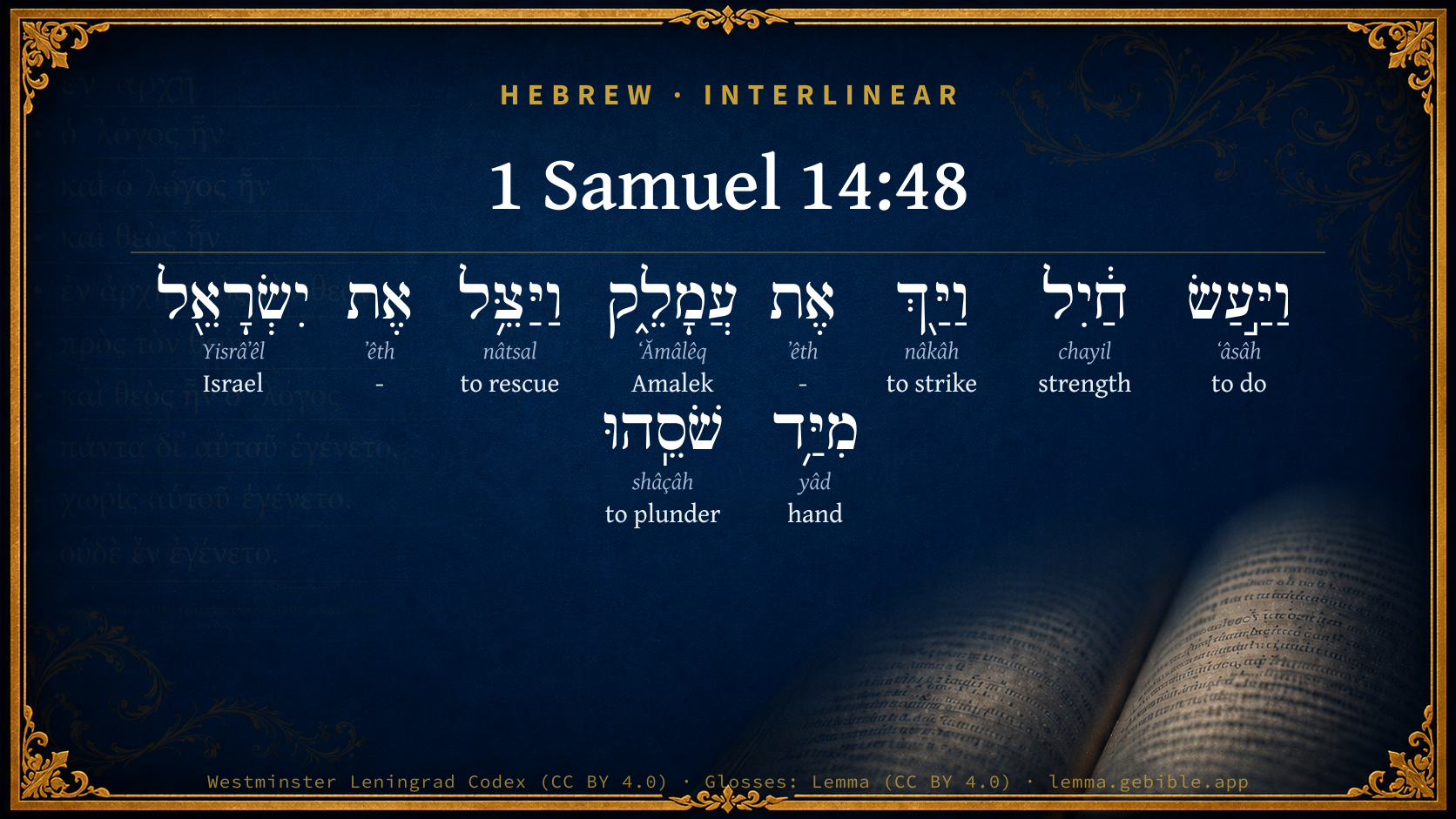
  1. וַיַּ֣עַשׂ ʻâsâh H6213 “and · to do” Conjunction + Verb, Qal, Sequential Imperfect, 3rd Person, Masculine, Singular
  2. חַ֔יִל chayil H2428 “strength” Noun, Common, Masculine, Singular, Absolute
  3. וַיַּ֖ךְ nâkâh H5221 “and · to strike” Conjunction + Verb, Hiphil, Sequential Imperfect, 3rd Person, Masculine, Singular
  4. אֶת ʼêth H853 “-” Particle, Direct Object
  5. עֲמָלֵ֑ק ʻĂmâlêq H6002 “Amalek” Noun, Proper
  6. וַיַּצֵּ֥ל nâtsal H5337 “and · to rescue” Conjunction + Verb, Hiphil, Sequential Imperfect, 3rd Person, Masculine, Singular
  7. אֶת ʼêth H853 “-” Particle, Direct Object
  8. יִשְׂרָאֵ֖ל Yisrâʼêl H3478 “Israel” Noun, Proper
  9. מִיַּ֥ד yâd H3027 “from · hand of” Preposition + Noun, Common, Both, Singular, Construct

About this verse

These counts appear in no published source. They are computed here, from the morphology-tagged text and Lemma’s own curated glosses. What Lemma adds →

10
words
9
distinct lemmas
Historical
section

Notable vocabulary

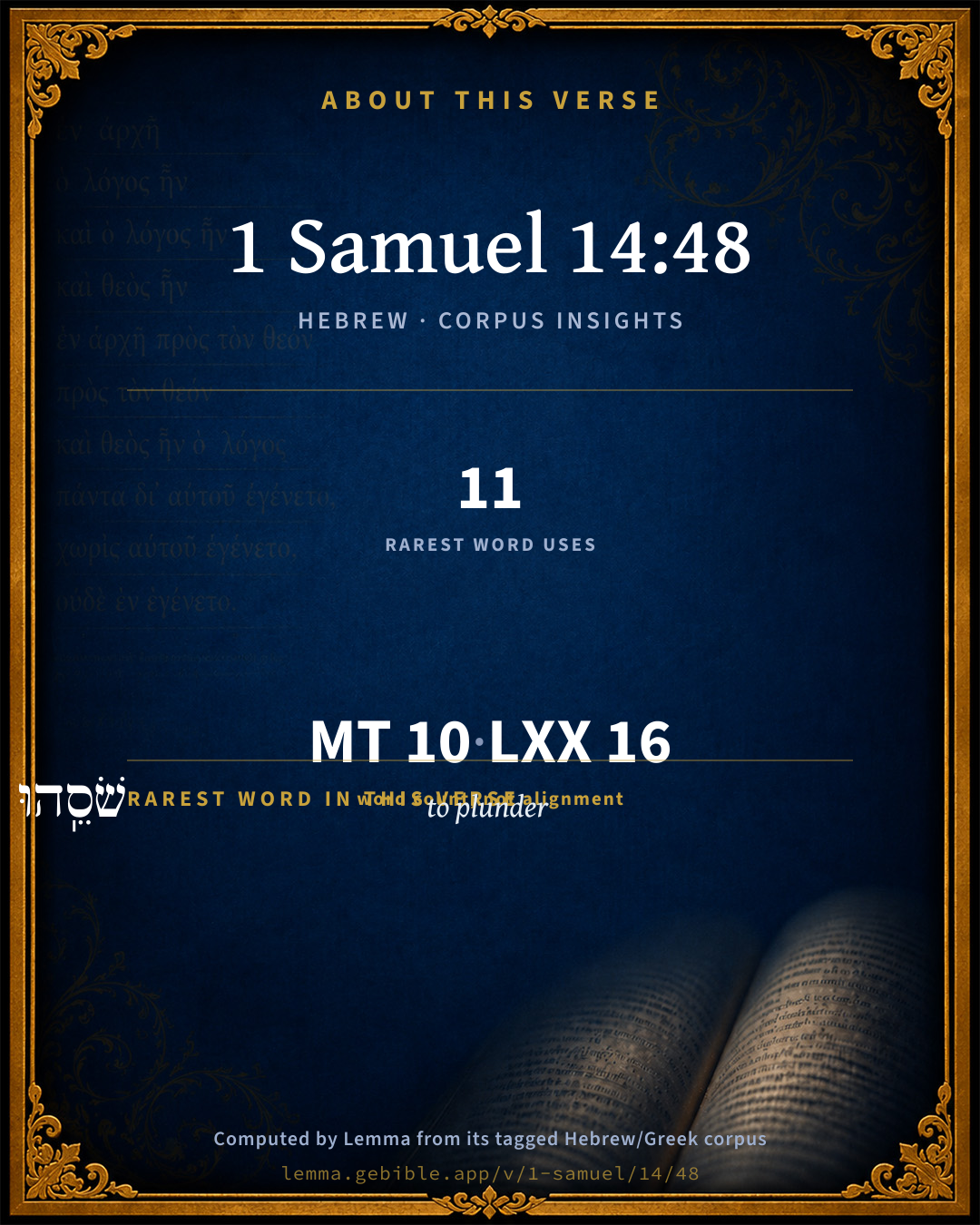
The rarest word here is שֹׁסֵֽהוּ to plunder H8154 — appearing just 11 times in the whole Hebrew Bible.

Shared distinctive vocabulary

שֹׁסֵֽהוּ to plunder H8154 occurs in 11 verses of the Hebrew Bible. Also found in:

Grammatical profile

  • 4 verbs
  • 4 nouns
  • 2 particles

Verb forms

  • וַיַּ֣עַשׂ Qal · Sequential Imperfect
  • וַיַּ֖ךְ Hiphil · Sequential Imperfect
  • וַיַּצֵּ֥ל Hiphil · Sequential Imperfect
  • שֹׁסֵֽהוּ Qal · Participle Active

Hebrew & Septuagint length

In English translation the verse runs 19 words from the Hebrew and 20 from the Septuagint (LXX English) — closely comparable.

A rough comparison of the two English renderings, which tokenize alike — not a word-level alignment.

Word counts can differ between the Hebrew and the Greek without any difference in meaning — e.g. the Hebrew direct-object marker אֵת has no separate Greek word, and Greek often adds the article ὁ.

In the original languages it is 10 Hebrew tokens and 16 Greek tokens — but the two are counted differently (Hebrew bundles its prefixes and suffixes into one token; the Greek is in lemma form), so that isn’t a like-for-like length.

Cross-references

3

Topical passages linked to 1 Samuel 14:48 in the Treasury of Scripture Knowledge — connected by theme and wording, ordered by reader-vote popularity; previews shown in the World English Bible.

  • Exodus 17:14 Yahweh said to Moses, "Write this for a memorial in a book, and rehearse it in the ears of Joshua: that I will utterly blot out the memory of Amalek from under the sky."
  • Deuteronomy 25:19 Therefore it shall be, when Yahweh your God has given you rest from all your enemies round about, in the land which Yahweh your God gives you for an inheritance to possess it, that you shall blot out the memory of Amalek from under the sky; you shall not forget.
  • 1 Samuel 15:3–7 Now go and strike Amalek, and utterly destroy all that they have, and don't spare them; but kill both man and woman, infant and suckling, ox and sheep, camel and donkey.

Cross-references courtesy of OpenBible.info (CC BY 4.0).

Hebrew and Greek witnesses Masoretic Hebrew ↔ Greek Septuagint

The same verse in the two great witnesses to the Old Testament, shown verse-for-verse.

These are two independent witnesses, not word-aligned to each other, and the Septuagint is shown in lemma (dictionary) form.

Hebrew 1 Samuel 14:48 Masoretic · Westminster Leningrad Codex

וַיַּ֣עַשׂ חַ֔יִל וַיַּ֖ךְ אֶת עֲמָלֵ֑ק וַיַּצֵּ֥ל אֶת יִשְׂרָאֵ֖ל מִיַּ֥ד שֹׁסֵֽהוּ

He did valiantly, and struck the Amalekites, and delivered Israel out of the hands of those who despoiled them.

World English Bible · Public Domain

Greek LXX 1 Samuel 14:48 Septuagint · lemma form

καί ποιέω δύναμις καί πατάσσω ὁ αμαληκ καί ἐκαἱρέω ὁ ἰσραήλ ἐκ χείρ ὁ καταπατέω αὐτός

And he wrought valiantly, and struck Amalec, and rescued Israel out of the hand of them that trampled on him.

LXX2012 (modern English Septuagint) · Public Domain

Hebrew: Westminster Leningrad Codex (CC BY 4.0). Greek: Septuagint (public domain); English from LXX2012 (modern English Septuagint) (Public Domain). How the Septuagint differs from the Hebrew →

Targum (Aramaic paraphrase)

1

The Targum is the ancient Jewish Aramaic paraphrase of the Hebrew Scriptures — an interpretive translation, not the Hebrew text itself. Onkelos (literal) and Pseudo-Jonathan (expansive) render the Torah, and Jonathan the Prophets. Coverage is partial: where no permissively-licensed English translation exists for a verse, only the Aramaic is shown. This is verse-level text, not a word-by-word alignment to the Hebrew.

  1. Targum Jonathan Prophets (Joshua–Malachi)
    וּכְנַשׁ מַשִׁרְיָן וּמְחָא יַת דְבֵית עֲמָלֵק וְשֵׁיזֵיב יַת יִשְׂרָאֵל מִיַד בָּזְזֵיהוֹן:

    (no public-domain English translation for this verse)

    Targum Jonathan — Aramaic: “Mikraot Gedolot” (public domain). English: “Sefaria Community Translation” (CC0 1.0 (public-domain dedication)); “London "Chaldee Paraphrase," 1871” (public domain). Text via Sefaria.

Commentary

Notes on 1 Samuel 14:48 from classic Christian and Jewish commentators (each source and its license shown beneath its notes). The classic Christian expositions comment on the surrounding passage and are grouped to its opening verse, so a note may address several verses; the Jewish commentaries on the Tanakh (Rashi and others) are per-verse, so they appear only where the commentator wrote on this verse.

Lemma curates 59 commentaries, every one of them public domain or Creative Commons licensed, each selected and text-cleaned for this edition rather than reprinted as found. About our sources →

Trapp's Complete Commentary

John Trapp

1Sa 14:48 And he gathered an host, and smote the Amalekites, and delivered Israel out of the hands of them that spoiled them.

Ver. 48. And he gathered a host,] See on 1Sa 14:47.

And delivered Israel out of the hands.] God may make use of wicked men as instruments to defend his people: "the earth helped the woman"; {Rev 12:16} yet the vials of God’s wrath were poured out "upon the earth." {Rev 16:1}

John Trapp, A Commentary or Exposition upon All the Books of the Old and New Testament (1647–1656) — public domain. Text from a community e-Sword module.

Tyndale Open Study Notes

Tyndale Open Resources

14:48 conquered the Amalekites: See 15:1-35. The Amalekites, a nomadic group in the south, periodically raided and pillaged Israel (see Exod 17:8-16; Num 14:45; Judg 3:13; 6:3, 33; 7:12; 10:12).

Tyndale Open Study Notes — © Tyndale Open Resources, licensed CC BY-SA 4.0. Text via the HelloAO Bible API.

Geneva Bible (1599)

Geneva Bible translators

As the Lord had commanded, Deut. 25:17.

Geneva Bible (1599) marginal notes — public domain. Text via Bolls.life.

Adam Clarke's Commentary

Verse 48. Smote the Amalekites.] This war is mentioned in the following chapter.

Adam Clarke's Commentary on the Bible (1810–1826) — public domain. Text from a community e-Sword/MySword module.

Ellicott's Commentary for English Readers

(48) Smote the Amalekites.—Out of the many wars the king waged, this war with Amalek is singled out, for in the new development of Hebrew power by which Saul’s reign was marked this campaign or series of campaigns was especially prominent. This war is related with some detail in the next chapter, but it is there introduced on account of other considerations. The English translators in their rendering, “he gathered an host,” have followed the Syriac and Vulg.; the marginal translation, “he wrought mightily,” is the more accurate.

A Bible Commentary for English Readers, edited by Charles John Ellicott (1878–1897) — public domain. Text from a community e-Sword module.

The Cambridge Bible for Schools and Colleges

gen. ed. J. J. S. Perowne

48. gathered a host] Better, did valiantly, as in Num_24:18; Psa_40:12.

smote the Amalekites] As recorded at length in ch. 15.

The Cambridge Bible for Schools and Colleges (gen. ed. J. J. S. Perowne; Cambridge University Press, 1878–1918) — public domain. Text from a community e-Sword module.

John Gill's Exposition

And he gathered an host,.... A large army; for after the battle with the Ammonites he disbanded his army, and sent them home, retaining only 3000 men, and these deserted him to six hundred, which were all the men he had with him, when he fought last with the Philistines; but now, finding he had enemies on every side of him, he gathered a numerous host to defend his country against them, and particularly to attack the people next mentioned:

and he smote the Amalekites; a people that Israel, by the law of God, were bound to destroy, and blot out their name; a particular account of his expedition against them is given in the following chapter:

and delivered Israel out of the hands of them that spoiled them; the nations before mentioned, Moabites, Ammonites, Edomites, Syrians, and Philistines.

John Gill's Exposition of the Whole Bible (1746–1763) — public domain (CC PDM 1.0). Text via the HelloAO Bible API.

Haydock's Catholic Bible Commentary

Amalec. The particulars of this war will be given [in] chap. xv., as it explains the cause of Saul’s rejection, and David’s advancement to the throne. (Salien)

George Leo Haydock (1774–1849), Haydock's Catholic Family Bible and Commentary, 1859 edition — public domain. Excludes Psalms (Douay-Rheims chapter numbering differs from Protestant) and Deuterocanonical books (Catholic canon only).

Matthew Poole's English Annotations

Smote the Amalekites; which is here mentioned only in the general, but is particularly described in the next chapter.

Matthew Poole's English Annotations on the Holy Bible (1683–1685) — public domain. Text from a community e-Sword/MySword module.

Whedon's Commentary on the Bible

Daniel D. Whedon

48. He gathered a host — Rather, he waxed mighty. He acquired mighty influence and power by his many successful battles.

Smote the Amalekites — As we read in the next chapter. But as we have detailed descriptions of the wars with Amalek, and Ammon, and the Philistines, how are we to account for the fact that the wars with Moab, Edom, and Zobah are only mentioned with a passing notice? We answer, The sacred writers seek to show us the divine as well as the human side in the history of the chosen people, and therefore they select those facts which serve this purpose best. Saul’s battles with Moab, Edom, and Zobah probably furnished no marked displays of Divine interposition, and for this reason our author paused not to describe them fully.

Daniel D. Whedon (gen. ed.), Commentary on the Old and New Testaments (1874–1909) — public domain. Text from a community e-Sword module.

The Pulpit Commentary

He gathered a host. So the Syriac and Vulgate, but the margin is probably the true meaning, "He wrought mightily," or valiantly.

The Pulpit Commentary (1880–1919), ed. H.D.M. Spence-Jones & Joseph S. Exell — public domain. Text from a community e-Sword module.

Rashi

Rabbi Shlomo Yitzchaki (Rashi)

He raised an army. And he gathered an army.

Rashi on the Tanakh — English translations: “The Judaica Press complete Tanach with Rashi, translated by A. J. Rosenberg” (CC BY 4.0); “Pentateuch with Rashi's commentary by M. Rosenbaum and A.M. Silbermann, 1929-1934” (public domain); “The Metsudah Tanach series, Lakewood, N.J” (CC BY 4.0); and “The Book of Joshua, Metsudah Publications, 1997” (CC BY 4.0). Text via Sefaria.

Lesson kit

Teaching starters — assembled from the data on this page, not authored interpretation. Every prompt links to the verse data it draws on. Edit before teaching.

1 Samuel, in the Historical, opens this verse with 10 words (9 distinct Hebrew lemmas). Its most distinctive word is shâçâh (“to plunder”). A historical commentator’s framing appears above. Read the whole chapter for the surrounding context.

Discussion questions

  1. How does “to plunder” (shâçâh) shape what this verse is saying?
  2. How does Judges 2:14, which shares the word «to plunder», read alongside this verse?
  3. The translations on this page render this verse differently — a whole-verse word diff, not a word-by-word alignment. What might account for the different wordings?
  4. «וַיַּ֣עַשׂ» is a Qal Sequential Imperfect verb. How does that grammatical form shape the action described?
  5. Compare how Trapp's Complete Commentary and Tyndale Open Study Notes read this verse. Where do they agree or differ?

Things to notice

Reading settings

Reading text

Shown beneath each verse's original-language words.

Old Testament
Old Testament edition

Read the OT as the Masoretic Hebrew (MT) or the Greek Septuagint (LXX).

English shown for the Greek Septuagint (in the Hebrew ↔ Greek comparison).

Comparing translations? Open the Compare panel on any verse page to stack up to four side by side.