
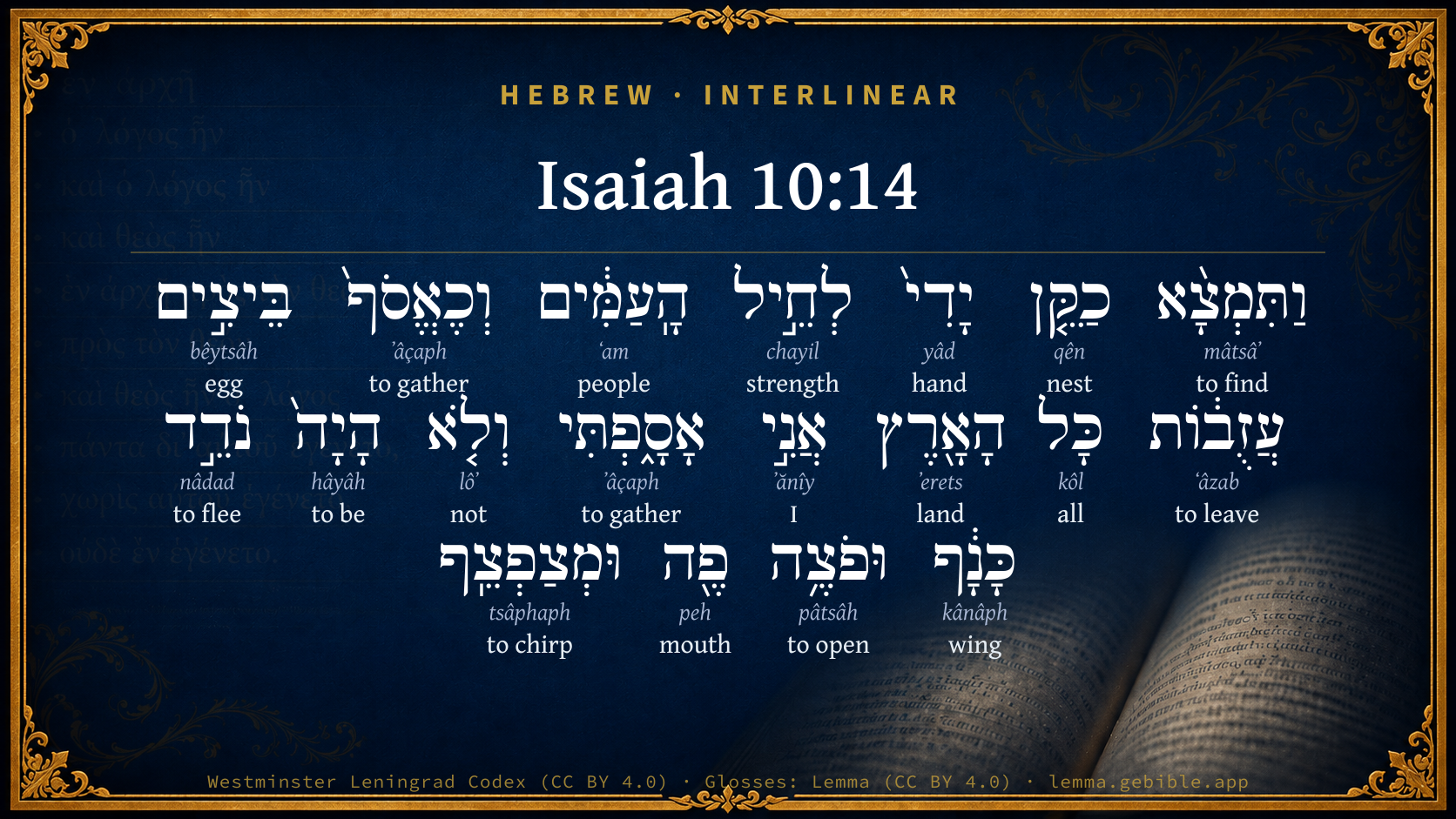
Isaiah 10:14

Hebrew (Westminster Leningrad Codex) Isaiah 10:14 appears in the Hebrew Old Testament. The text above is from the Westminster Leningrad Codex. Each word links to its Strong’s number, a concise gloss, and parsing drawn from the Open Scriptures Hebrew Bible morphology. Click any word for its full Brown-Driver-Briggs (BDB) entry.
Download image
Cite this verse

Isaiah 10:14 (World English Bible). Public Domain. Lemma interlinear Bible study tool, https://lemma.gebible.app/v/isaiah/10/14.

Show BibTeX & RIS
BibTeX
RIS
English Translation
and my hand has found as a nest the riches of the peoples; and as one gathers eggs that are forsaken, have I gathered all the earth: and there was none that moved the wing, or that opened the mouth, or chirped.
World English Bible · Public Domain
Download a study sheet

One document with this verse’s original text, its word-by-word gloss line, the meaning frame, cross-references with their text, attributed commentary, and full source and license credits — printable, and it pastes into notes with its structure intact.

This verse Autodidact and up

Study sheet (.html) Plain text (.txt)

A passage Seminary Student

Up to 50 verses in one chapter. A passage sheet keeps up to 6 commentary sources and 12 cross-references per verse, in the order this page ranks them, and says so on the sheet whenever that leaves anything out. Ask for a single verse and you get the Autodidact verse sheet above.

Everything on this page stays free to read, with no account — the sheet is a download of what is already on screen, not access to it.

Want to remove ads? Support Godless Engineer
Compare translations 3

The same verse in 3 English versions, stacked beneath the original-language interlinear above. Click any original word for its lexicon entry.

Each is an independent rendering of the whole verse — the interlinear is not word-aligned to these translations.

Highlighted words mark where these versions differ — a whole-verse word diff, not a word-by-word alignment.

  • World English Bible Public Domain
    and my hand has found as a nest the riches of the peoples; and as one gathers eggs that are forsaken, have I gathered all the earth: and there was none that moved the wing, or that opened the mouth, or chirped.
  • King James Version Public Domain
    And my hand hath found as a nest the riches of the people: and as one gathereth eggs that are left, have I gathered all the earth; and there was none that moved the wing, or opened the mouth, or peeped.
  • unfoldingWord Literal Text CC BY-SA 4.0
    And my hand has found, as a nest, the wealth of the peoples, and as one gathers abandoned eggs, I, I have gathered all of the earth, and none was fluttering a wing or opening a mouth or chirping.”

unfoldingWord Literal Text — © unfoldingWord, licensed CC BY-SA 4.0. Word-aligned USFM3 via Door43 (git.door43.org/unfoldingWord/en_ult).

Versions to compare (up to 4)

3 of 4 selected

Show all 18 translations

Every available English version of this verse, each an independent rendering of the whole verse.

  • World English Bible Public Domain
    and my hand has found as a nest the riches of the peoples; and as one gathers eggs that are forsaken, have I gathered all the earth: and there was none that moved the wing, or that opened the mouth, or chirped.
  • Berean Standard Bible Public Domain
    My hand reached as into a nest to seize the wealth of the nations. Like one gathering abandoned eggs, I gathered all the earth. No wing fluttered, no beak opened or chirped.’”
  • Majority Standard Bible Public Domain
    My hand reached as into a nest to seize the wealth of the nations. Like one gathering abandoned eggs, I gathered all the earth. No wing fluttered, no beak opened or chirped.’”
  • King James Version Public Domain
    And my hand hath found as a nest the riches of the people: and as one gathereth eggs that are left, have I gathered all the earth; and there was none that moved the wing, or opened the mouth, or peeped.
  • American Standard Version (1901) Public Domain
    and my hand hath found as a nest the riches of the peoples; and as one gathereth eggs that are forsaken, have I gathered all the earth: and there was none that moved the wing, or that opened the mouth, or chirped.
  • Revised Version (1885) Public Domain
    and my hand hath found as a nest the riches of the peoples; and as one gathereth eggs that are forsaken, have I gathered all the earth: and there was none that moved the wing, or that opened the mouth, or chirped.
  • Geneva Bible (1599) Public Domain
    And mine hand hath found as a nest the riches of the people, and as one gathereth egges that are left, so haue I gathered all the earth: and there was none to mooue the wing or to open the mouth, or to whisper.
  • Douay-Rheims (1899) Public Domain
    And my hand hath found the strength of the people as a nest; and as eggs are gathered, that are left, so have I gathered all the earth: and there was none that moved the wing, or opened the mouth, or made the least noise.
  • Young's Literal Translation Public Domain
    And my hand as to a nest Getteth to the wealth of the peoples, And as a gathering of forsaken eggs All the earth I -- I have gathered, And there hath not been one moving wing, Or opening mouth, or whispering.'
  • Literal Standard Version CC BY-SA 4.0
    And my hand gets to the wealth of the peoples as to a nest, || And as a gathering of forsaken eggs || I have gathered all the earth, || And there has not been one moving wing, || Or opening mouth, or whispering.”
  • Unlocked Literal Bible CC BY-SA 4.0
    My hand has seized, as from a nest, the wealth of nations, and as one gathers abandoned eggs, I gathered all the earth. None fluttered their wings or opened their mouth or chirped.”
  • unfoldingWord Literal Text CC BY-SA 4.0
    And my hand has found, as a nest, the wealth of the peoples, and as one gathers abandoned eggs, I, I have gathered all of the earth, and none was fluttering a wing or opening a mouth or chirping.”
  • Darby Bible Public Domain
    and my hand hath found as a nest the riches of the peoples, and as one gathereth forsaken eggs, have I gathered all the earth; and there was none that moved the wing, or opened the mouth, or chirped.
  • World Messianic Bible Public Domain
    My hand has found the riches of the peoples like a nest, and like one gathers eggs that are abandoned, I have gathered all the earth. There was no one who moved their wing, or that opened their mouth, or chirped.”
  • Webster's Bible Public Domain
    And my hand hath found as a nest the riches of the people: and as one gathereth eggs that are left, have I gathered all the earth; and there was none that moved the wing, or opened the mouth, or peeped.
  • Free Bible Version CC BY-SA 4.0
    Like robbing a bird's nest, I took the wealth of the nations. Like collecting abandoned eggs, I collected the whole earth. There wasn't a fluttering wing or an open beak, not even a chirp!”
  • Bible in Basic English Public Domain
    And I have put my hands on the wealth of the peoples, as on the place where a bird has put her eggs; and as a man may take the eggs from which a bird has gone, so I have taken all the earth for myself: and not a wing was moved, and not a mouth gave out a sound.
  • JPS Tanakh (1917) Public Domain
    And my hand hath found as a nest the riches of the peoples; and as one gathereth eggs that are forsaken, have I gathered all the earth; and there was none that moved the wing, or that opened the mouth, or chirped.

Literal Standard Version (2020), Covenant Press — licensed CC BY-SA 4.0. Text via the HelloAO Bible API (eBible.org). Unlocked Literal Bible (unfoldingWord) — licensed CC BY-SA 4.0. Text via the HelloAO Bible API (eBible.org). unfoldingWord Literal Text — © unfoldingWord, licensed CC BY-SA 4.0. Word-aligned USFM3 via Door43 (git.door43.org/unfoldingWord/en_ult). Free Bible Version, Dr. Jonathan Gallagher — licensed CC BY-SA 4.0. Text via the HelloAO Bible API (eBible.org).

Word by word

More ways to search: Search by grammar → Find every occurrence → Compare this word →

Practice this passage: Drill this verse → Learn its vocabulary →

וּמְצַפְצֵֽף
tsâphaph
H6850
“and · chirping”
Conjunction + Verb, Pilpel, Participle Active, Masculine, Singular, Absolute
Part of Speech
Conjunction + Verb
Stem
Pilpel
Form
Participle Active
Gender
Masculine
Number
Singular
State
Absolute
Full BDB Definition

Origin: a primitive root

TWOT: 1957

(Pilpel) to chirp, peep - of birds - of ghosts
  1. וַתִּמְצָ֨א mâtsâʼ H4672 “and · to find” Conjunction + Verb, Qal, Sequential Imperfect, 3rd Person, Feminine, Singular
  2. כַקֵּ֤ן qên H7064 “like/as the · nest” Preposition, Determined + Noun, Common, Masculine, Singular, Absolute
  3. יָדִי֙ yâd H3027 “hand · my” Noun, Common, Both, Singular, Construct + Suffix, Personal, 1st Person, Common, Singular
  4. לְחֵ֣יל chayil H2428 “to/for · strength of” Preposition + Noun, Common, Masculine, Singular, Construct
  5. הָֽעַמִּ֔ים ʻam H5971 “the · peoples” Particle, Definite Article + Noun, Common, Masculine, Plural, Absolute
  6. וְכֶאֱסֹף֙ ʼâçaph H622 “and · like/as · to gather” Conjunction + Preposition + Verb, Qal, Infinitive Construct
  7. בֵּיצִ֣ים bêytsâh H1000 “eggs” Noun, Common, Feminine, Plural, Absolute
  8. עֲזֻב֔וֹת ʻâzab H5800 “left” Verb, Qal, Participle Passive, Feminine, Plural, Absolute
  9. כָּל kôl H3605 “all of” Noun, Common, Masculine, Singular, Construct
  10. הָאָ֖רֶץ ʼerets H776 “the · land” Particle, Definite Article + Noun, Common, Both, Singular, Absolute
  11. אֲנִ֣י ʼănîy H589 “I” Pronoun, Personal, 1st Person, Common, Singular
  12. אָסָ֑פְתִּי ʼâçaph H622 “to gather” Verb, Qal, Perfect, 1st Person, Common, Singular
  13. וְלֹ֤א lôʼ H3808 “and · not” Conjunction + Particle, Negative
  14. הָיָה֙ hâyâh H1961 “to be” Verb, Qal, Perfect, 3rd Person, Masculine, Singular
  15. נֹדֵ֣ד nâdad H5074 “fleeing” Verb, Qal, Participle Active, Masculine, Singular, Absolute
  16. כָּנָ֔ף kânâph H3671 “wing” Noun, Common, Feminine, Singular, Absolute
  17. וּפֹצֶ֥ה pâtsâh H6475 “and · opening” Conjunction + Verb, Qal, Participle Active, Masculine, Singular, Absolute
  18. פֶ֖ה peh H6310 “mouth” Noun, Common, Masculine, Singular, Absolute

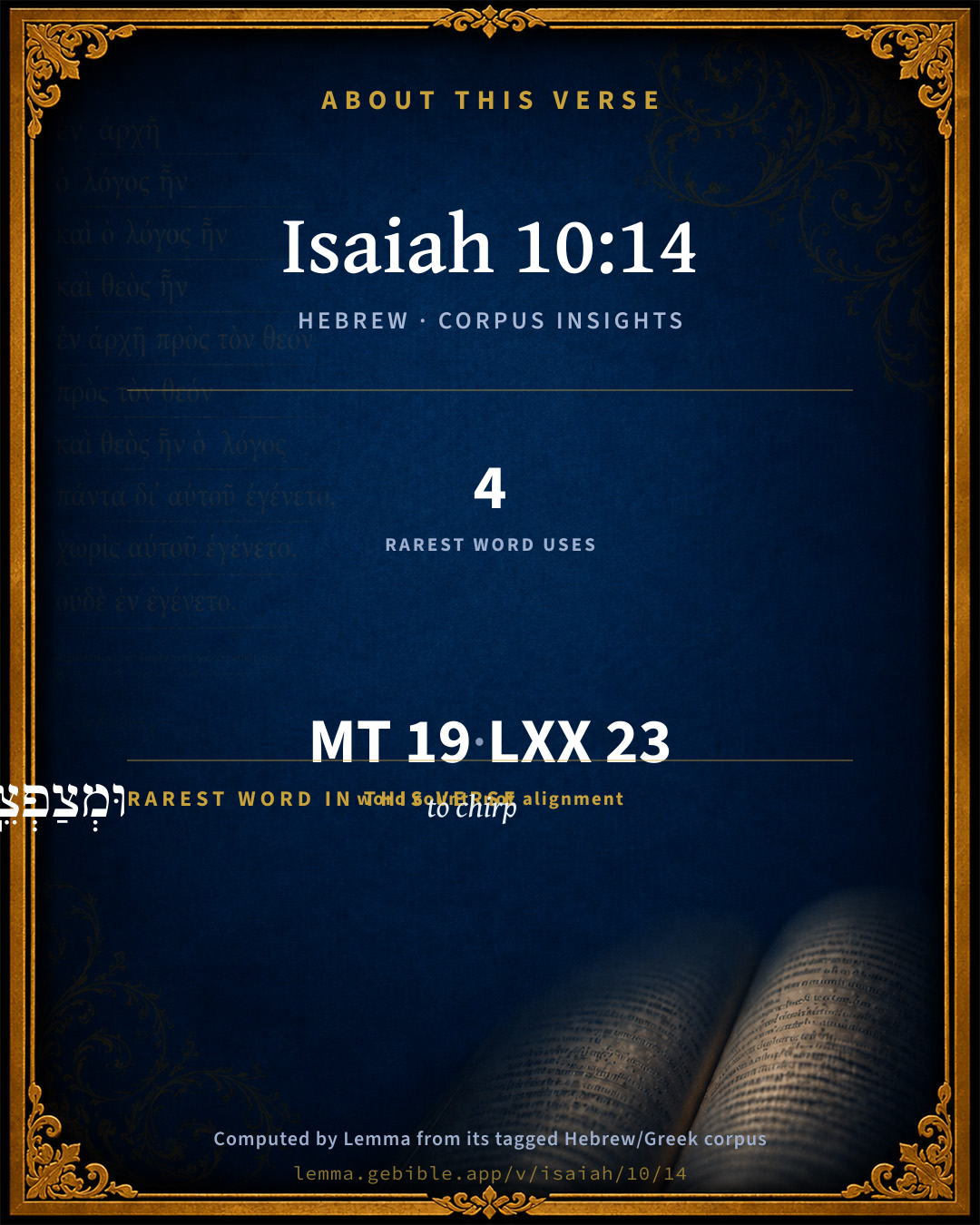
About this verse

These counts appear in no published source. They are computed here, from the morphology-tagged text and Lemma’s own curated glosses. What Lemma adds →

19
words
18
distinct lemmas
Prophets
section

Notable vocabulary

The rarest word here is וּמְצַפְצֵֽף to chirp H6850 — appearing just 4 times in the whole Hebrew Bible.

Shared distinctive vocabulary

וּמְצַפְצֵֽף to chirp H6850 occurs in 4 verses of the Hebrew Bible. Also found in:

Grammatical profile

  • 8 verbs
  • 9 nouns
  • 1 pronoun
  • 1 particle

Verb forms

  • וַתִּמְצָ֨א Qal · Sequential Imperfect
  • וְכֶאֱסֹף֙ Qal · Infinitive Construct
  • עֲזֻב֔וֹת Qal · Participle Passive
  • אָסָ֑פְתִּי Qal · Perfect
  • הָיָה֙ Qal · Perfect
  • נֹדֵ֣ד Qal · Participle Active
  • וּפֹצֶ֥ה Qal · Participle Active
  • וּמְצַפְצֵֽף Pilpel · Participle Active

Repetition

A word recurs within this verse — often emphatic in Hebrew:

  • וְכֶאֱסֹף֙ to gather H622 ×2

Hebrew & Septuagint length

In English translation the verse runs 42 words from the Hebrew and 43 from the Septuagint (LXX English) — closely comparable.

A rough comparison of the two English renderings, which tokenize alike — not a word-level alignment.

Word counts can differ between the Hebrew and the Greek without any difference in meaning — e.g. the Hebrew direct-object marker אֵת has no separate Greek word, and Greek often adds the article ὁ.

In the original languages it is 19 Hebrew tokens and 23 Greek tokens — but the two are counted differently (Hebrew bundles its prefixes and suffixes into one token; the Greek is in lemma form), so that isn’t a like-for-like length.

Cross-references

9

Topical passages linked to Isaiah 10:14 in the Treasury of Scripture Knowledge — connected by theme and wording, ordered by reader-vote popularity; previews shown in the World English Bible.

  • Job 31:25 If I have rejoiced because my wealth was great, And because my hand had gotten much;
  • Proverbs 18:12 Before destruction the heart of man is proud, But before honor is humility.
  • Proverbs 21:6–7 Getting treasures by a lying tongue Is a fleeting vapor for those who seek death.
  • Isaiah 5:8 Woe to those who join house to house, Who lay field to field, until there is no room, And you are made to dwell alone in the midst of the land!
  • Jeremiah 49:16 As for your terror, the pride of your heart has deceived you, O you who dwell in the clefts of the rock, who hold the height of the hill: though you should make your nest as high as the eagle, I will bring you down from there, says Yahweh.
  • Hosea 12:7–8 A merchant has dishonest scales in his hand. He loves to defraud.
  • Obadiah 1:4 Though you mount on high as the eagle, and though your nest is set among the stars, I will bring you down from there, says Yahweh.
  • Nahum 2:9–3:1 Take the spoil of silver. Take the spoil of gold, for there is no end of the store, the glory of all goodly furniture.
  • Habakkuk 2:5–11 Yes, moreover, wine is treacherous. A haughty man who doesn't stay at home, who enlarges his desire as Sheol, and he is like death, and can't be satisfied, but gathers to himself all nations, and heaps to himself all peoples.

Cross-references courtesy of OpenBible.info (CC BY 4.0).

Hebrew and Greek witnesses Masoretic Hebrew ↔ Greek Septuagint

The same verse in the two great witnesses to the Old Testament, shown verse-for-verse.

These are two independent witnesses, not word-aligned to each other, and the Septuagint is shown in lemma (dictionary) form.

Hebrew Isaiah 10:14 Masoretic · Westminster Leningrad Codex

וַתִּמְצָ֨א כַקֵּ֤ן יָדִי֙ לְחֵ֣יל הָֽעַמִּ֔ים וְכֶאֱסֹף֙ בֵּיצִ֣ים עֲזֻב֔וֹת כָּל הָאָ֖רֶץ אֲנִ֣י אָסָ֑פְתִּי וְלֹ֤א הָיָה֙ נֹדֵ֣ד כָּנָ֔ף וּפֹצֶ֥ה פֶ֖ה וּמְצַפְצֵֽף

and my hand has found as a nest the riches of the peoples; and as one gathers eggs that are forsaken, have I gathered all the earth: and there was none that moved the wing, or that opened the mouth, or chirped.

World English Bible · Public Domain

Greek LXX Isaiah 10:14 Septuagint · lemma form

καί ὁ οἰκέω ὅλος καταλαμβάνω ὁ χείρ ὡς νοσσιά καί ὡς καταλείπω ᾠόν αἴρω καί οὐ εἰμί ὅς διαφεύγω ἐγώ ἤ ἀντιεἶπον ἐγώ

And I will shake the inhabited cities: and I will take with my hand all the world as a nest: and I will even take them as eggs that have been left; and there is none that shall escape me, or contradict me.

LXX2012 (modern English Septuagint) · Public Domain

On this verse, John Gill's Exposition discusses the Septuagint’s reading. Read the note in Commentary ↓

Hebrew: Westminster Leningrad Codex (CC BY 4.0). Greek: Septuagint (public domain); English from LXX2012 (modern English Septuagint) (Public Domain). How the Septuagint differs from the Hebrew →

Targum (Aramaic paraphrase)

1

The Targum is the ancient Jewish Aramaic paraphrase of the Hebrew Scriptures — an interpretive translation, not the Hebrew text itself. Onkelos (literal) and Pseudo-Jonathan (expansive) render the Torah, and Jonathan the Prophets. Coverage is partial: where no permissively-licensed English translation exists for a verse, only the Aramaic is shown. This is verse-level text, not a word-by-word alignment to the Hebrew.

  1. Targum Jonathan Prophets (Joshua–Malachi)
    וְאַשְׁכָּחֵית כְּקִנָה יְדֵי נִכְסֵי עַמְמַיָא וּכְמַכְנַשׁ בֵּיעִין שְׁבִיקִין כָּל דַיְרֵי אַרְעָא אֲנָא כְנֵישִׁית וְלָא הֲוָה נָטֵיל מִכָּא וְשָׁדֵי כָּא וּפְתַח פּוּמָא וּמְמַלֵיל מִלָא:

    And my hand hath found as a nest the riches of the people: and as one gathereth eggs that are left, I have gathered all the inhabitants of the earth; and there was none that moved from thence and flew thither, that opened his mouth and spoke a word.

    Targum Jonathan — Aramaic: “Mikraot Gedolot” (public domain). English: “Sefaria Community Translation” (CC0 1.0 (public-domain dedication)); “London "Chaldee Paraphrase," 1871” (public domain). Text via Sefaria.

Commentary

Notes on Isaiah 10:14 from classic Christian and Jewish commentators (each source and its license shown beneath its notes). The classic Christian expositions comment on the surrounding passage and are grouped to its opening verse, so a note may address several verses; the Jewish commentaries on the Tanakh (Rashi and others) are per-verse, so they appear only where the commentator wrote on this verse.

Lemma curates 59 commentaries, every one of them public domain or Creative Commons licensed, each selected and text-cleaned for this edition rather than reprinted as found. About our sources →

Trapp's Complete Commentary

John Trapp

Isa 10:14 And my hand hath found as a nest the riches of the people: and as one gathereth eggs [that are] left, have I gathered all the earth; and there was none that moved the wing, or opened the mouth, or peeped.

Ver. 14. And my hand had found.] See Isa 10:10.

As a nest.] Or, As in a nest, where a man need but only put in his hand and take out the birds or eggs, and hath none to withstand him. Thrasonica Allegoria.

The riches of the people.] Whereon they sat abrood, as it were, but I have unnested and despoiled them. They meanwhile, as silly doves, saved themselves by flight, not fight; or else, sitting in their dove cots, saw their nests destroyed, young ones taken away and killed before their eyes, never offering to rescue or revenge.

John Trapp, A Commentary or Exposition upon All the Books of the Old and New Testament (1647–1656) — public domain. Text from a community e-Sword module.

The Biblical Illustrator

Joseph S. Exell

Isa_10:14

And my hand hath found as a nest the riches of the people

A proud boast of utter subjugation

The Assyrian conqueror has gathered all the earth as one gathers the eggs from which he has first driven off the terrified hen bird.

But she would hover round her rifled nest and its plunderer with a trepidating flight and piercing cry, than which no movements and sounds in the brute creation express more anguish; while these spoiled nations dare not show even such instinctive signs of a broken heart, but know a depth beyond that depth--there was none that moved the wing, or opened the mouth, or chirped. (Sir E. Strachey, Bart.)

Easy conquest

I have taken by my might the riches of the people, with as great ease as a countryman takes young birds out of a nest; yea, as one taketh and gathereth eggs which the bird hath forsaken--which is easier than to take birds. (W. Day, M. A.)

Unholy brag

Strange that ever men, who were made to do good, should take a pride and take a pleasure in doing wrong or doing mischief to all about them without control, and should reckon that their glory which is their shame. (M. Henry.)

The Biblical Illustrator, edited by Joseph S. Exell (c. 1880s–1900s) — public domain. Text from a community e-Sword module.

Jamieson, Fausset & Brown

Robert Jamieson, A. R. Fausset & David Brown

nest--implying the ease with which he carried off all before him.

left--by the parent bird.

none . . . moved . . . wing--image from an angry bird resisting the robbery of its "nest."

peeped--chirped even low (Isa 8:19). No resistance was offered me, of deed, or even word.

Jamieson, Fausset & Brown — Commentary Critical and Explanatory on the Whole Bible (1871) — public domain (CC PDM 1.0). Text via the HelloAO Bible API.

Ellicott's Commentary for English Readers

(14) My hand hath found as a nest.—The inscription of Sargon presents an almost verbal parallelism (Records of the Past, vii. 28). In other documents the king looks on himself as a colossal fowler, and the kingdoms are but as birds’-nests for him to spoil, and the nests are left empty.

There was none that . . . peeped—i.e., chirped. See Note on Isa_8:19. Not a fledgling was left in the nests which the royal fowler had despoiled.

A Bible Commentary for English Readers, edited by Charles John Ellicott (1878–1897) — public domain. Text from a community e-Sword module.

The Cambridge Bible for Schools and Colleges

gen. ed. J. J. S. Perowne

14. The magnificent simile represents the ease with which the Assyrians had rifled the countries of their treasures, and the panic terror which their approach everywhere produced.

or peeped] R.V. chirped; the same word as in Isa_8:19.

The Cambridge Bible for Schools and Colleges (gen. ed. J. J. S. Perowne; Cambridge University Press, 1878–1918) — public domain. Text from a community e-Sword module.

John Gill's Exposition

Shall the axe boast itself against him that heweth therewith?.... Hitherto are the words of the Assyrian monarch; and here begin the words of the prophet, rebuking him for his pride, and deriding his vain boasting, in attributing that to himself, to his wisdom and power, who was but an instrument, which belonged to God, the sole Governor and wise orderer of all things; which was all one as if an axe should ascribe the cutting down of trees to itself, and insist on it that the man that cut with it had no share in the action, nor was it to be ascribed to him; than which nothing is more absurd. The sense is, that the king of Assyria, in taking cities, and conquering kingdoms, and adding them to his own, was only an instrument in the hand of God, like an axe in the hand of one that hews down trees; and therefore it was vain and ridiculous to take that to himself which belonged to the Lord, on whom he depended as an instrument, as to motion, operation, and effect; from whom he had all power to act, all fitness for it, and efficacy in it, as the axe has from the person that makes and uses it, or any other instrument, as follows:

or shall the saw magnify itself against him that shaketh it? or draws it to and fro; which is the sense of the Targum, Septuagint, and Vulgate Latin versions, and others; and which further exposes the vanity and arrogance of the Assyrian monarch, who had no more concern in the spoiling of nations, and destruction of kingdoms, than the saw has in cutting of timber that is hewn; which has its form, its sharp teeth, not of itself, but from the maker; and when thus made, and fit for use, cannot draw itself to and fro, and cut trees in pieces, which are felled by the axe, but must be moved by another; and to insult the mover of it, as if it was not his act, but its own, is not more absurd than what this haughty prince was guilty of, in boasting of his power, wisdom, and prudence, in the above mentioned things:

as if the rod should shake itself against them that lift it up (m); for such was the king of Assyria, he was no other than the rod of the Lord's anger, Isa 10:5 and which he lifted up, and with it chastised his people; wherefore for him to behave haughtily against the Lord, and arrogate that to himself which was the Lord's doing, was as if a rod should shake itself against him that lifts it up; or, "as if a rod should shake those that lift it up": as if there were more power in the rod than in them that take it up and strike with it; yea, that even the rod moves them, and not they the rod, which is wretchedly absurd:

or, as if the staff should lift up itself, as if it were no wood (n); but something more than wood, an animate creature, a rational agent, whereas it is nothing else but wood; or "as if a staff should lift up" itself against that which is "not wood", like itself, but is a man, that can move himself and that too; or "as if a staff should lift up" that which is "not wood"; attempt to bear, carry, move, and direct that which is not material like itself, but is a Spirit, infinite, eternal, even the almighty God. De Dieu thinks that is not a verb, but a noun of the plural number, of "a mountain": and renders it, "as if a rod should shake those that lift it up: and as if a staff were mountains, and not wood". The Targum is,

"when a rod is lifted up to smite, it is not the rod that smites, but he that smites with it.''

The sense is, that the Assyrian monarch was only a rod and staff in the hand of the Lord, and only moved and acted as used by him; whereas, according to his vain boast, he was the sole agent, and all was done by his own power and prudence; and was so far from being moved and directed by the power and providence of God, that he was the director of him; which is infinitely more absurd than the things instanced in.

(m) Ben Melech observes, that this is to be understood of the blessed God; and the word being in the plural number, it is the same way, of speaking as in Josh. xxiv. 19. "the Holy Gods is he".

(n) Gussetius thinks this clause contains an ironical answer to the above questions, "shall the axe boast itself?" &c.; "shall the saw magnify itself?" &c.; they should, "as the rod should shake itself" &c.; just in like manner as that does, and so by lifting up itself, ceases to be wood; and which being sarcastically spoken, carries in it a strong negative, that the axe and saw should not glory, or magnify themselves, and no more should the king of Assyria. Vid. Comment. Ebr. p. 360.

John Gill's Exposition of the Whole Bible (1746–1763) — public domain (CC PDM 1.0). Text via the HelloAO Bible API.

Albert Barnes' Notes on the Bible

And my hand hath found, as a nest - By a beautiful and striking figure here, the Assyrian monarch is represented as describing the ease with which he had subdued kingdoms, and rifled them of their treasures. No resistance had been offered. He had taken them with as little opposition as a rustic takes possession of a nest, with its eggs or young, when the parent bird is away.

Eggs that are left - That is, eggs that are left of the parent bird; when the bird from fright, or any other cause, has gone, and when no resistance is offered.

Have I gathered all the earth - That is, I have subdued and plundered it. This shows the height of his self-confidence and his arrogant assumptions.

That moved the wing - Keeping up the figure of the nest. There was none that offered resistance; as an angry bird does when her nest is about to be robbed.

Or opened the mouth - To make a noise in alarm. The dread of him produced perfect silence and submission.

Or peeped - Or that chirped - the noise made by young birds; the note at Isa 8:19. The idea is, that such was the dread of his name and power that there was universal silence. None dared to resist the terror of his arms.

Albert Barnes' Notes on the Bible (1834–1885) — public domain. Text from a community e-Sword/MySword module.

Haydock's Catholic Bible Commentary

Nest. Some put these words in the mouth of God. (Tertullian) (Abdias 4.) --- But they shew the insolence of Sennacherib.

George Leo Haydock (1774–1849), Haydock's Catholic Family Bible and Commentary, 1859 edition — public domain. Excludes Psalms (Douay-Rheims chapter numbering differs from Protestant) and Deuterocanonical books (Catholic canon only).

Matthew Poole's English Annotations

Hath found as a nest; as one findeth young birds in a nest, the nest being put for the birds in it, as Deu 32:11. No less easily do I both find and take them.

Eggs that are left; which the dam hath left in her nest. This is more easy than the former; for the young birds might possibly make some faint resistance, or flutter away; but the eggs could do neither.

All the earth; all the riches of the earth or world. An hyperbole not unusual in the mouths of such persons, upon such occasions.

That moved the wing, or opened the mouth, or peeped; as birds do, which, when they see and cannot hinder the robbing of their nests, express their grief and anger by hovering about them, and by mournful cries.

Matthew Poole's English Annotations on the Holy Bible (1683–1685) — public domain. Text from a community e-Sword/MySword module.

Whedon's Commentary on the Bible

Daniel D. Whedon

14. The same self-glorifying goes on.

My hand hath found — Has only to reach out and seize.

As a nest — As easy as an undefended bird’s nest.

Riches of — The wealth of the peoples whom I attack, so powerless are they to resist.

Eggs that are left — Abandoned by the parent bird.

That moved the wing — “None fluttered the wing, or opened the beak, or peeped.” The figure is carried here to eggs hatched, and young birds, which also had abandoned the nest. The word chirped or peeped is the same as in Isa_8:19, where it means the low cry of false soothsayers, here it is the cry of young birds whom the spoiler’s hand snatches away. In Isa_38:14, the same word means (Authorized Version) the cry or chatter of a swallow or a crane. The boaster means, that such everywhere is the dread of his name there is universal silence. None dare to resist his terrible assaults.

Daniel D. Whedon (gen. ed.), Commentary on the Old and New Testaments (1874–1909) — public domain. Text from a community e-Sword module.

The Pulpit Commentary

My hand hath found as a nest the riches of the people; rather, of the peoples. The Assyrians are fond of comparing their enemies to birds ("Records of the Past," vol. 7. pp. 36, 62, etc.); but the exact metaphor here used does not, I believe, occur in the inscriptions. The nations" treasures are like eggs found in deserted nests, which the hunter gathers without any, even the slightest, risk. All the earth. Oriental hyperbole. Assyrian monarchs often say that they "have subdued all the races of men," or "carried the glory of their name to the ends of the earth," or "overthrown the armies of the whole world in battle." Peeped; rather, chirped. (see note on Isa_8:19) None of the inhabitants offered even such feeble resistance as a bird makes when its nest is robbed.

The Pulpit Commentary (1880–1919), ed. H.D.M. Spence-Jones & Joseph S. Exell — public domain. Text from a community e-Sword module.

John Wesley's Explanatory Notes

Eggs - Which the dam left in her nest. Gathered - All the riches of the earth. An hyperbole not unusual in the mouths of such persons. Peeped - As birds do, which, when they see the robbing of their nest, express their grief and anger, by hovering about them, and by mournful cries.

John Wesley, Explanatory Notes Upon the Whole Bible (1754–1765) — public domain. Text via the GEBible commentary corpus.

J. A. Alexander on Isaiah

Joseph Addison Alexander

The rapidity and ease of the Assyrian conquests are expressed by a natural and beautiful comparison. In seizing on the riches of the nations, the conqueror had encountered no more difficulty than if he had been merely taking eggs from a forsaken nest, without even the impotent resistance which the bird, if present, might have offered, by its cries and by the flapping of its wings. “My hand has found (i.e., reached and seized) the strength (or more specifically, the pecuniary strength, the wealth) of the nations, and like the gathering of (or as one gathers) eggs forsaken, so have I gathered all the earth (i.e., all its inhabitants and their possessions), and there was none that moved a wing, or opened a mouth, or chirped.” The word peeped used in the English version is not only obsolete but liable to be confounded with another of the same form.

Joseph Addison Alexander, The Prophecies of Isaiah (1846–1847; New York: Scribner, 1870–1878) — public domain. Text from a community e-Sword module.

unfoldingWord translationNotes

Door43 World Missions Community

General Information:

Yahweh is still quoting the king of Assyria. (See: Isaiah 10:13)

My hand has seized

The hand is a metonym for either the king's power or his army. AT: "In my power I have seized" or "My army has seized" (See: Metonymy)

My hand has seized, as from a nest, the wealth of nations

The king of Assyria compares taking the treasures from the nations to a person taking eggs out of a bird's nest. This emphasizes how easy it was for him and his army to conquer these other kingdoms. AT: "My army has stolen the wealth from the nations just as easily as a man takes eggs from a nest" (See: Simile)

as one gathers abandoned eggs, I gathered all the earth

The king of Assyria speaks of taking over nations as if he was gathering eggs. AT: "just as a person takes eggs from a nest when the bird is not there to protect them, my army has taken the treasures of every nation" (See: Simile)

None fluttered their wings or opened their mouth or chirped

This compares the nations to a bird who sits quietly while her eggs are taken. This emphasizes that the nations did nothing while the army of Assyria took all of their possessions. AT: "And like a bird that does not make a sound or flap her wings when someone steals her eggs, the nations did nothing as we took their treasure" (See: Simile)

translationWords

hand

nation

unfoldingWord translationNotes — © Distant Shores Media and the Door43 World Missions Community, licensed CC BY-SA 4.0. Source: git.door43.org/Door43/en_tn.

Rashi

Rabbi Shlomo Yitzchaki (Rashi)

like a nest like nests of ownerless birds.

and as one gathers abandoned eggs And as one gathers abandoned eggs which their mother abandoned, and no one protests against him by covering them.

and no one moved a wing, or opened his mouth or chirped This entire expression is apropos to birds; since he compared those exiles to a bird’s nest and to abandoned eggs, he used this expression, saying that neither the father nor the mother chirped about them.

Rashi on the Tanakh — English translations: “The Judaica Press complete Tanach with Rashi, translated by A. J. Rosenberg” (CC BY 4.0); “Pentateuch with Rashi's commentary by M. Rosenbaum and A.M. Silbermann, 1929-1934” (public domain); “The Metsudah Tanach series, Lakewood, N.J” (CC BY 4.0); and “The Book of Joshua, Metsudah Publications, 1997” (CC BY 4.0). Text via Sefaria.

Ibn Ezra

Rabbi Abraham ibn Ezra

לחיל The riches. Comp. החיל the wealth (Deut. 8:17).

נודד Moving. A transitive verb, governing the accusative. כנף Wing. This figure is used because the nations have just been compared with eggs, and birds come from eggs.

Ibn Ezra on the Tanakh — English translations: “Sefaria Community Translation” (CC0 1.0 (public-domain dedication)); “Yalkut, Sifsei Chachomim Chumash, Metsudah Publications, 2009” (CC BY 4.0); and “Commentary of Ibn Ezra on Isaiah - trans. by M. Friedlander, 1873” (public domain). Text via Sefaria.

Lesson kit

Teaching starters — assembled from the data on this page, not authored interpretation. Every prompt links to the verse data it draws on. Edit before teaching.

Isaiah, in the Prophets, opens this verse with 19 words (18 distinct Hebrew lemmas). Its most distinctive word is tsâphaph (“to chirp”). A historical commentator’s framing appears above. Read the whole chapter for the surrounding context.

Discussion questions

  1. How does “to chirp” (tsâphaph) shape what this verse is saying?
  2. How does Isaiah 8:19, which shares the word «to chirp», read alongside this verse?
  3. What does the repetition of “to gather” (2× in this one verse) do in this verse?
  4. These translations render this verse differently. What is at stake in choosing one wording over another?
  5. «וַתִּמְצָ֨א» is a Qal Sequential Imperfect verb. How does that grammatical form shape the action described?
  6. Compare how Trapp's Complete Commentary and The Biblical Illustrator read this verse. Where do they agree or differ?

Things to notice

Reading settings

Reading text

Shown beneath each verse's original-language words.

Old Testament
Old Testament edition

Read the OT as the Masoretic Hebrew (MT) or the Greek Septuagint (LXX).

English shown for the Greek Septuagint (in the Hebrew ↔ Greek comparison).

Comparing translations? Open the Compare panel on any verse page to stack up to four side by side.