
Daniel 11:25

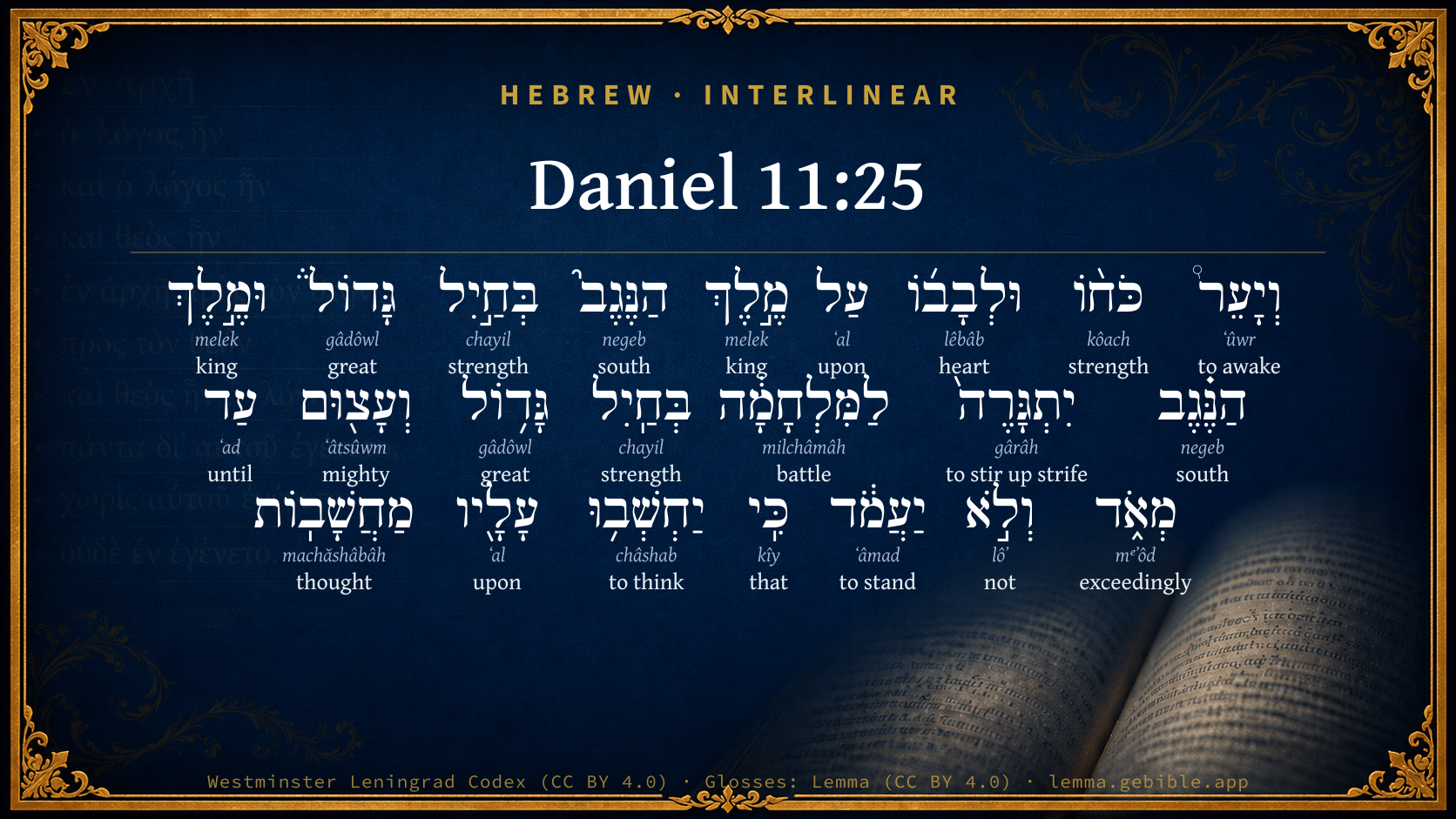
Hebrew (Westminster Leningrad Codex) Daniel 11:25 appears in the Hebrew Old Testament. The text above is from the Westminster Leningrad Codex. Each word links to its Strong’s number, a concise gloss, and parsing drawn from the Open Scriptures Hebrew Bible morphology. Click any word for its full Brown-Driver-Briggs (BDB) entry.
Download image
Cite this verse

Daniel 11:25 (World English Bible). Public Domain. Lemma interlinear Bible study tool, https://lemma.gebible.app/v/daniel/11/25.

Show BibTeX & RIS
BibTeX
RIS
English Translation
He shall stir up his power and his courage against the king of the south with a great army; and the king of the south shall war in battle with an exceeding great and mighty army; but he shall not stand; for they shall devise devices against him.
World English Bible · Public Domain
Download a study sheet

One document with this verse’s original text, its word-by-word gloss line, the meaning frame, cross-references with their text, attributed commentary, and full source and license credits — printable, and it pastes into notes with its structure intact.

This verse Autodidact and up

Study sheet (.html) Plain text (.txt)

A passage Seminary Student

Up to 50 verses in one chapter. A passage sheet keeps up to 6 commentary sources and 12 cross-references per verse, in the order this page ranks them, and says so on the sheet whenever that leaves anything out. Ask for a single verse and you get the Autodidact verse sheet above.

Everything on this page stays free to read, with no account — the sheet is a download of what is already on screen, not access to it.

Want to remove ads? Support Godless Engineer
Compare translations 3

The same verse in 3 English versions, stacked beneath the original-language interlinear above. Click any original word for its lexicon entry.

Each is an independent rendering of the whole verse — the interlinear is not word-aligned to these translations.

Highlighted words mark where these versions differ — a whole-verse word diff, not a word-by-word alignment.

  • World English Bible Public Domain
    He shall stir up his power and his courage against the king of the south with a great army; and the king of the south shall war in battle with an exceeding great and mighty army; but he shall not stand; for they shall devise devices against him.
  • King James Version Public Domain
    And he shall stir up his power and his courage against the king of the south with a great army; and the king of the south shall be stirred up to battle with a very great and mighty army; but he shall not stand: for they shall forecast devices against him.
  • unfoldingWord Literal Text CC BY-SA 4.0
    He will stir up his power and his heart against the king of the South with a great army. The king of the South will wage war with an exceedingly great and mighty army, but he will not stand, because plots will be devised against him.

unfoldingWord Literal Text — © unfoldingWord, licensed CC BY-SA 4.0. Word-aligned USFM3 via Door43 (git.door43.org/unfoldingWord/en_ult).

Versions to compare (up to 4)

3 of 4 selected

Show all 18 translations

Every available English version of this verse, each an independent rendering of the whole verse.

  • World English Bible Public Domain
    He shall stir up his power and his courage against the king of the south with a great army; and the king of the south shall war in battle with an exceeding great and mighty army; but he shall not stand; for they shall devise devices against him.
  • Berean Standard Bible Public Domain
    And with a large army he will stir up his power and his courage against the king of the South, who will mobilize a very large and powerful army but will not withstand the plots devised against him.
  • Majority Standard Bible Public Domain
    And with a large army he will stir up his power and his courage against the king of the South, who will mobilize a very large and powerful army but will not withstand the plots devised against him.
  • King James Version Public Domain
    And he shall stir up his power and his courage against the king of the south with a great army; and the king of the south shall be stirred up to battle with a very great and mighty army; but he shall not stand: for they shall forecast devices against him.
  • American Standard Version (1901) Public Domain
    And he shall stir up his power and his courage against the king of the south with a great army; and the king of the south shall war in battle with an exceeding great and mighty army; but he shall not stand; for they shall devise devices against him.
  • Revised Version (1885) Public Domain
    And he shall stir up his power and his courage against the king of the south with a great army; and the king of the south shall war in battle with an exceeding great and mighty army: but he shall not stand, for they shall devise devices against him.
  • Geneva Bible (1599) Public Domain
    Also he shall stirre vp his power and his courage against the King of the South with a great armie, and the King of the South shall be stirred vp to battell with a very great and mightie armie: but he shall not stand: for they shall forecast and practise against him.
  • Douay-Rheims (1899) Public Domain
    And his strength and his heart shall be stirred up against the king of the south with a great army: and the king of the south shall be stirred up to battle with many and very strong succours: and they shall not stand, for they shall form designs against him.
  • Young's Literal Translation Public Domain
    `And he stirreth up his power and his heart against the king of the south with a great force, and the king of the south stirreth himself up to battle with a very great and mighty force, and standeth not, for they devise devices against him,
  • Literal Standard Version CC BY-SA 4.0
    And he stirs up his power and his heart against the king of the south with a great force, and the king of the south stirs himself up to battle with a very great and mighty force, and does not stand, for they devise plans against him,
  • Unlocked Literal Bible CC BY-SA 4.0
    He will wake up his power and his heart against the king of the South with a great army. The king of the South will wage war with a large, very powerful army, but he will not stand because others will make plots against him.
  • unfoldingWord Literal Text CC BY-SA 4.0
    He will stir up his power and his heart against the king of the South with a great army. The king of the South will wage war with an exceedingly great and mighty army, but he will not stand, because plots will be devised against him.
  • Darby Bible Public Domain
    And he shall stir up his power and his courage against the king of the south with a great army; and the king of the south shall engage in battle with an exceeding great and mighty army; but he shall not stand, for they shall plan devices against him.
  • World Messianic Bible Public Domain
    “He will stir up his power and his courage against the king of the south with a great army; and the king of the south will wage war in battle with an exceedingly great and mighty army, but he won’t stand; for they will devise plans against him.
  • Webster's Bible Public Domain
    And he shall stir up his power and his courage against the king of the south with a great army; and the king of the south shall be stirred up to battle with a very great and mighty army; but he shall not stand: for they shall forecast devices against him.
  • Free Bible Version CC BY-SA 4.0
    Then he will draw on his strength and courage to gather a large army against the king of the south. The king of the south will prepare for war, fighting back with a large and powerful army, but he will not be successful because of plots made against him.
  • Bible in Basic English Public Domain
    And he will put in motion his power and his strength against the king of the south with a great army; and the king of the south will go to war with a very great and strong army: but he will be forced to give way, because of their designs against him;
  • JPS Tanakh (1917) Public Domain
    And he shall stir up his power and his courage against the king of the south with a great army; and the king of the south shall stir himself up to battle with a very great and mighty army; but he shall not stand, for they shall devise devices against him.

Literal Standard Version (2020), Covenant Press — licensed CC BY-SA 4.0. Text via the HelloAO Bible API (eBible.org). Unlocked Literal Bible (unfoldingWord) — licensed CC BY-SA 4.0. Text via the HelloAO Bible API (eBible.org). unfoldingWord Literal Text — © unfoldingWord, licensed CC BY-SA 4.0. Word-aligned USFM3 via Door43 (git.door43.org/unfoldingWord/en_ult). Free Bible Version, Dr. Jonathan Gallagher — licensed CC BY-SA 4.0. Text via the HelloAO Bible API (eBible.org).

Word by word

More ways to search: Search by grammar → Find every occurrence → Compare this word →

Practice this passage: Drill this verse → Learn its vocabulary →

יִתְגָּרֶה֙
gârâh
H1624
“to stir up strife”
Verb, Hithpael, Imperfect, 3rd Person, Masculine, Singular
Part of Speech
Verb
Stem
Hithpael
Form
Imperfect
Person
3rd Person
Gender
Masculine
Number
Singular
Full BDB Definition

Origin: a primitive root

TWOT: 378

to cause strife, stir up, contend, meddle, strive, be stirred up - (Piel) to stir up strife, excite strife - (Hithpael) - to excite oneself against, engage in strife - to excite oneself (against foe), wage war
  1. וְיָעֵר֩ ʻûwr H5782 “and · to awake” Conjunction + Verb, Hiphil, Jussive, 3rd Person, Masculine, Singular
  2. כֹּח֨וֹ kôach H3581 “strength · his” Noun, Common, Masculine, Singular, Construct + Suffix, Personal, 3rd Person, Masculine, Singular
  3. וּלְבָב֜וֹ lêbâb H3824 “and · heart · his” Conjunction + Noun, Common, Masculine, Singular, Construct + Suffix, Personal, 3rd Person, Masculine, Singular
  4. עַל ʻal H5921 “upon” Preposition
  5. מֶ֣לֶךְ melek H4428 “king of” Noun, Common, Masculine, Singular, Construct
  6. הַנֶּגֶב֮ negeb H5045 “the · south” Particle, Definite Article + Noun, Common, Masculine, Singular, Absolute
  7. בְּחַ֣יִל chayil H2428 “in/at · strength” Preposition + Noun, Common, Masculine, Singular, Absolute
  8. גָּדוֹל֒ gâdôwl H1419 “great” Adjective, Adjective, Masculine, Singular, Absolute
  9. וּמֶ֣לֶךְ melek H4428 “and · king of” Conjunction + Noun, Common, Masculine, Singular, Construct
  10. הַנֶּ֗גֶב negeb H5045 “the · south” Particle, Definite Article + Noun, Common, Masculine, Singular, Absolute
  11. לַמִּלְחָמָ֔ה milchâmâh H4421 “to/for the · battle” Preposition, Determined + Noun, Common, Feminine, Singular, Absolute
  12. בְּחַֽיִל chayil H2428 “in/at · strength” Preposition + Noun, Common, Masculine, Singular, Absolute
  13. גָּד֥וֹל gâdôwl H1419 “great” Adjective, Adjective, Masculine, Singular, Absolute
  14. וְעָצ֖וּם ʻâtsûwm H6099 “and · mighty” Conjunction + Adjective, Adjective, Masculine, Singular, Absolute
  15. עַד ʻad H5704 “until” Preposition
  16. מְאֹ֑ד mᵉʼôd H3966 “exceedingly” Adverb
  17. וְלֹ֣א lôʼ H3808 “and · not” Conjunction + Particle, Negative
  18. יַעֲמֹ֔ד ʻâmad H5975 “to stand” Verb, Qal, Imperfect, 3rd Person, Masculine, Singular
  19. כִּֽי kîy H3588 “that” Conjunction
  20. יַחְשְׁב֥וּ châshab H2803 “to think” Verb, Qal, Imperfect, 3rd Person, Masculine, Plural
  21. עָלָ֖יו ʻal H5921 “upon · him” Preposition + Suffix, Personal, 3rd Person, Masculine, Singular
  22. מַחֲשָׁבֽוֹת machăshâbâh H4284 “thoughts” Noun, Common, Feminine, Plural, Absolute

About this verse

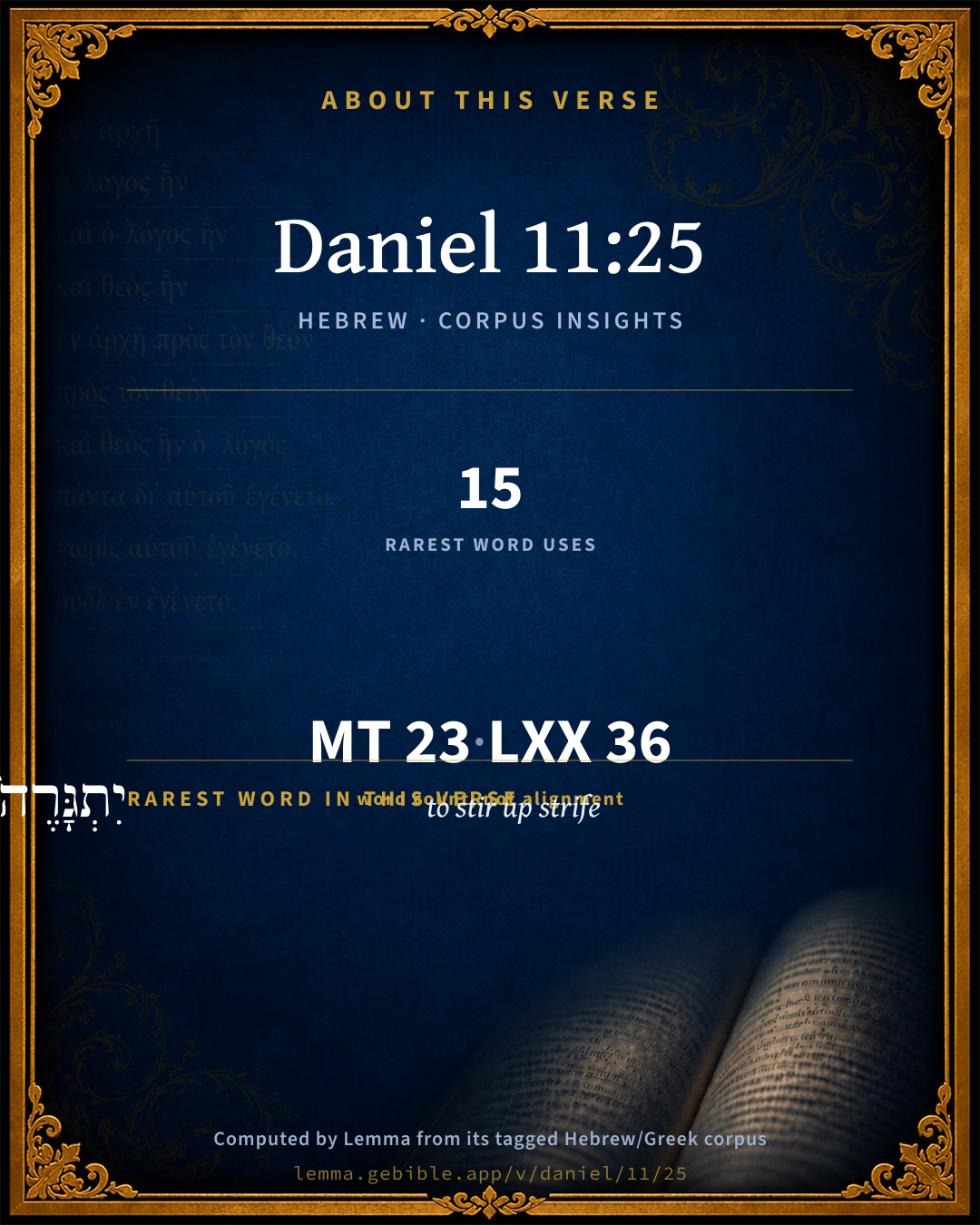
These counts appear in no published source. They are computed here, from the morphology-tagged text and Lemma’s own curated glosses. What Lemma adds →

23
words
18
distinct lemmas
Prophets
section

Notable vocabulary

The rarest word here is יִתְגָּרֶה֙ to stir up strife H1624 — appearing just 15 times in the whole Hebrew Bible.

Shared distinctive vocabulary

יִתְגָּרֶה֙ to stir up strife H1624 occurs in 13 verses of the Hebrew Bible. Also found in:

Grammatical profile

  • 4 verbs
  • 10 nouns
  • 3 adjectives
  • 3 prepositions
  • 1 conjunction
  • 1 adverb
  • 1 particle

Verb forms

  • וְיָעֵר֩ Hiphil · Jussive
  • יִתְגָּרֶה֙ Hithpael · Imperfect
  • יַעֲמֹ֔ד Qal · Imperfect
  • יַחְשְׁב֥וּ Qal · Imperfect

Repetition

Words recur within this verse — often emphatic in Hebrew:

  • עַל upon H5921 ×2
  • מֶ֣לֶךְ king H4428 ×2
  • הַנֶּגֶב֮ south H5045 ×2
  • בְּחַ֣יִל strength H2428 ×2
  • גָּדוֹל֒ great H1419 ×2

Hebrew & Septuagint length

In English translation the verse runs 48 words from the Hebrew and 50 from the Septuagint (LXX English) — closely comparable.

A rough comparison of the two English renderings, which tokenize alike — not a word-level alignment.

Word counts can differ between the Hebrew and the Greek without any difference in meaning — e.g. the Hebrew direct-object marker אֵת has no separate Greek word, and Greek often adds the article ὁ.

In the original languages it is 23 Hebrew tokens and 36 Greek tokens — but the two are counted differently (Hebrew bundles its prefixes and suffixes into one token; the Greek is in lemma form), so that isn’t a like-for-like length.

Cross-references

4

Topical passages linked to Daniel 11:25 in the Treasury of Scripture Knowledge — connected by theme and wording, ordered by reader-vote popularity; previews shown in the World English Bible.

  • Proverbs 28:25 One who is greedy stirs up strife; But one who trusts in Yahweh will prosper.
  • Proverbs 15:18 A wrathful man stirs up contention, But one who is slow to anger appeases strife.
  • Daniel 11:2 Now will I show you the truth. Behold, there shall stand up yet three kings in Persia; and the fourth shall be far richer than they all: and when he has grown strong through his riches, he shall stir up all against the realm of Greece.
  • Daniel 11:10 His sons shall war, and shall assemble a multitude of great forces, which shall come on, and overflow, and pass through; and they shall return and war, even to his fortress.

Cross-references courtesy of OpenBible.info (CC BY 4.0).

Hebrew and Greek witnesses Masoretic Hebrew ↔ Greek Septuagint

The same verse in the two great witnesses to the Old Testament, shown verse-for-verse.

These are two independent witnesses, not word-aligned to each other, and the Septuagint is shown in lemma (dictionary) form.

Hebrew Daniel 11:25 Masoretic · Westminster Leningrad Codex

וְיָעֵר֩ כֹּח֨וֹ וּלְבָב֜וֹ עַל מֶ֣לֶךְ הַנֶּגֶב֮ בְּחַ֣יִל גָּדוֹל֒ וּמֶ֣לֶךְ הַנֶּ֗גֶב יִתְגָּרֶה֙ לַמִּלְחָמָ֔ה בְּחַֽיִל גָּד֥וֹל וְעָצ֖וּם עַד מְאֹ֑ד וְלֹ֣א יַעֲמֹ֔ד כִּֽי יַחְשְׁב֥וּ עָלָ֖יו מַחֲשָׁבֽוֹת

He shall stir up his power and his courage against the king of the south with a great army; and the king of the south shall war in battle with an exceeding great and mighty army; but he shall not stand; for they shall devise devices against him.

World English Bible · Public Domain

Greek LXX Daniel 11:25 Septuagint · lemma form

καί ἐγείρω ὁ ἰσχύς αὐτός καί ὁ καρδία αὐτός ἐπί ὁ βασιλεύς αἴγυπτος ἐν ὄχλος πολύς καί ὁ βασιλεύς αἴγυπτος ἐρεθίζω εἰς πόλεμος ἐν ὄχλος ἰσχυρός σφόδρα λίαν καί οὐ ἵστημι ὅτι διανοέομαι ἐπί αὐτός διάνοια

And his strength and his heart shall be stirred up against the king of the south with a great force; and the king of the south shall engage in war with a great and very strong force; but his forces shall not stand, for they shall devise plans against him:

LXX2012 (modern English Septuagint) · Public Domain

On this verse, The Pulpit Commentary discusses the Septuagint’s reading. Read the note in Commentary ↓

Hebrew: Westminster Leningrad Codex (CC BY 4.0). Greek: Septuagint (public domain); English from LXX2012 (modern English Septuagint) (Public Domain). How the Septuagint differs from the Hebrew →

Commentary

Notes on Daniel 11:25 from classic Christian and Jewish commentators (each source and its license shown beneath its notes). The classic Christian expositions comment on the surrounding passage and are grouped to its opening verse, so a note may address several verses; the Jewish commentaries on the Tanakh (Rashi and others) are per-verse, so they appear only where the commentator wrote on this verse.

Lemma curates 59 commentaries, every one of them public domain or Creative Commons licensed, each selected and text-cleaned for this edition rather than reprinted as found. About our sources →

Trapp's Complete Commentary

John Trapp

Dan 11:25 And he shall stir up his power and his courage against the king of the south with a great army; and the king of the south shall be stirred up to battle with a very great and mighty army; but he shall not stand: for they shall forecast devices against him.

Ver. 25. And he shall stir up his power and his courage.] Antiochus shall, himself being stirred up by the devil, that restless spirit, who continually maketh ado in the world. Fuit etiam Antiochus ingenio inquieto, versatili, turbido, vago et vario: unde multa machinatus est, pauca ad felicem exitum perduxit. Howbeit, in this second expedition against Egypt, he prospered.

John Trapp, A Commentary or Exposition upon All the Books of the Old and New Testament (1647–1656) — public domain. Text from a community e-Sword module.

Joseph Benson's Commentary

Dan 11:25-26. For he shall stir up his power, &c., against the king of the south — By the king of the south is meant the king of Egypt, namely, Ptolemy Philometor, who demanded the surrender of Cœlosyria to him, as by right belonging to him, through virtue of the marriage articles between Ptolemy Epiphanes and Cleopatra; but Antiochus, instead of complying with his demand, invaded Egypt with a vast force both by sea and land. And the king of the south shall be stirred up, &c. — That is, the generals of Ptolemy were stirred up to war with very many and exceeding strong forces; and yet could not resist the fraudulent counsels of Antiochus. The two armies engaged between Pelusium and mount Cassius, and Antiochus obtained the victory. The next campaign he had greater success, routed the Egyptians, took Pelusium, ascended as far as Memphis, and made himself master of all Egypt except Alexandria. These transactions are recorded Maccabees Dan 1:16-19. The misfortunes of Ptolemy are, by the prophet, ascribed to the treachery and baseness of his own ministers and subjects, Dan 11:26: and it is certain that Eulæus was a very wicked minister, and bred up the young king in luxury and effeminacy, contrary to his inclination. Ptolemy Macron, too, who was governor of Cyprus, revolted from him, and delivered up that important island to Antiochus. Nay, even the Alexandrians, seeing the distress of Philometor, renounced their allegiance; and taking his younger brother Euergetes, or Physcon, proclaimed him king instead of his elder brother.

Joseph Benson's Commentary on the Old and New Testaments (1811–1818) — public domain. Text from a community e-Sword module.

Keil & Delitzsch

C. F. Keil & F. Delitzsch

These verses describe the victorious war of the king who had come to power against the king of the south, the war of Antiochus Epiphanes against king Ptolemy Philometor, which is described in 1 Macc. 1:16-19, with manifest reference to this prophecy. ויער (he shall stir up) is potentialis in the sense of divine decree: "he shall stir up his power and his heart." כּח is not warlike power, which is mentioned in בּחיל־גּדול (Dan 11:25), but the power which consists in the bringing of a great army under his command; לבב, the mental energy for the carrying out of his plans. For יעמד לא, cf. Dan 8:4. The subject is the last-named king of the south, who, notwithstanding his very great and powerful army, shall not stand in battle, but shall give way, because devices are contrived against him. The subject to יחשׁבוּ is not the enemy, the king of the north, with his army, but, according to Dan 11:26, his table-companions.

Dan 11:26

Here it is more definitely stated why he cannot stand. פתבּגו אכּלי, who eat his food (פּתבּג, see under Dan 1:5), i.e., his table-companions (cf. Psa 41:10[9]), persons about him. ישׁבּרוּהוּ, shall break him, i.e., cast him to the ground. His army shall therefore overflow, but shall execute nothing, only many shall fall down slain. The first member of the verse points to treachery, whereby the battle was lost and the war was fruitless. Hitzig incorrectly interprets ישׁטוף rushes away, i.e., is disorganized and takes to flight. But שׁטף cannot have this meaning.

Dan 11:27

Here then is described how the two kings seek through feigned friendship to destroy one another. The two kings are of course the two kings of the north and the south previously named. Of a third, namely, of two kings of Egypt, Philometor and Physkon, Daniel knows nothing. The third, Physkon, is introduced from history; and hence Hitzig, v. Lengerke, and others understand by the "two kings," the two kings Antiochus and Philometor confederated against the king of the south, but Kliefoth, on the contrary, thinks of Antiochus and Physkon, the latter of whom he regards as the king of the south, Dan 11:25. All this is arbitrary. Jerome has already rejected the historical evidence for this, and remarks: verum ex eo, quia scriptura nunc dicit: duos fuisse reges, quorum cor fuerit fraudulentum ... hoc secundum historiam demonstrari non potest. למרע לבבם Hitzig translates: "their heart belongs to wickedness," contrary to the context. ל denotes also here only the direction: "their heart goes toward wicked deeds," is directed thereto. מרע (from רעע), formed after מצר (cf. Ewald, 160a), the evil-doing, consists in this, that the one seeks to overthrow and destroy the other under the cloak of feigned friendship; for they eat as friends at one table, and "speak lies" - the one tells lies to the other, professing friendship. But their design shall not succeed. All interpretations of these words which are determined by historical facta are arbitrary. The history of Antiochus Epiphanes furnishes no illustrations for this. In the sense of the prophecy תצלח לא has only this meaning: the design of the king of the north to destroy the king of the south, and to make himself master both of the north and the south, shall not succeed, and the king of the south will not fulfil what he promises to his deceitful adversary. For yet the end shall be at the time appointed. These words state the reason why the מרע shall not succeed. Hitzig incorrectly translates: "but the end holds onwards to the appointed time;" for כּי cannot in this connection be rendered by but, and ל cannot express the idea of holding to anything. ל denotes here, as generally, the direction toward the end, as Dan 11:35, and Dan 8:17, Dan 8:19. The end goes yet on to the time appointed by God. That this מועד (appointment of time) does not lie in the present, but in the future, is denoted by עוד, although we do not, with Hvernick, interpret עוד by "for the end lies yet further out," nor, with v. Lengerke and Maurer, may we supply the verb "withdraws itself, is reserved." עוד stands before קץ because on it the emphasis lies. קץ is, however, not the end of the war between Antiochus and Egypt (v. Leng., Maur., Hitzig), but cannot be otherwise taken than קץ עת, Dan 11:35, Dan 11:40, and Dan 12:4. But in the latter passage קץ עת is the time of the resurrection of the dead, thus the end of the present course of the world, with which all the oppression of the people of God ceases. Accordingly קץ in the verse before us, as in Dan 11:35, Dan 11:40, is the time in which the conduct of the kings previously described, in their rising up and in their hostility against the people of God, reaches its end (Dan 11:45); and with the overthrow of these enemies the period of oppression also comes to an end. This end comes only למועד, at the time which God has determined for the purifying of His people (Dan 11:35). So long may the kings of the north and the south prosecute their aims; so long shall they strive for the possession of the kingdom without succeeding in their plans. למועד has here and in Dan 11:35 the definite article, because in both verses the language refers not to any definite time, but to the time determined by God for the consummation of His kingdom. The placing of the article in this word in the verse before us is not, with Kliefoth, to be explained from a reference to Dan 8:17, Dan 8:19. The two revelations are separated from each other by too long a space of time for this one to refer back to that earlier one by the mere use of the article, although both treat of the same subject. The למועד occurs besides in Dan 11:29, where it is natural to suppose that it has the same meaning as here; but the contents of the verse oppose such a conclusion. Dan 11:29 treats, it is true, of a renewed warlike expedition against the south, which, however, brings neither the final deciding of the war with the south (cf. Dan 11:40), nor yet the end of the oppression of the people of God; המועד is thus only the time determined for the second aggression against the south, not the time of the end.

Keil & Delitzsch — Biblical Commentary on the Old Testament (1861–1891) — public domain (CC PDM 1.0). Text via the HelloAO Bible API. (Old Testament only.)

Tyndale Open Study Notes

Tyndale Open Resources

11:25-27 The king of the south was Ptolemy VI Philometor (181–146 BC). Antiochus IV attacked Egypt twice between 170 and 168 BC (1 Maccabees 1:17-19).

Tyndale Open Study Notes — © Tyndale Open Resources, licensed CC BY-SA 4.0. Text via the HelloAO Bible API.

Geneva Bible (1599)

Geneva Bible translators

He shall be overcome with treason.

Geneva Bible (1599) marginal notes — public domain. Text via Bolls.life.

Jamieson, Fausset & Brown

Robert Jamieson, A. R. Fausset & David Brown

A fuller detail of what was summarily stated (Dan 11:22-24). This is the first of Antiochus' three (Dan 11:29) open invasions of Egypt.

against the king of the south--against Ptolemy Philometer. Subsequently, Ptolemy Physcon (the Gross), or Euergetes II, was made king by the Egyptians, as Ptolemy Philometer was in Antiochus hands.

great army--as distinguished from the "small people" (Dan 11:23) with which he first came. This was his first open expedition; he was emboldened by success to it. Antiochus "entered Egypt with an overwhelming multitude, with chariots, elephants, and cavalry" (1 Maccabees 1:17).

stirred up--by the necessity, though naturally indolent.

not stand--Philometer was defeated.

they shall forecast, &c.--His own nobles shall frame treacherous "devices" against him (see Dan 11:26). Euloeus and Lenoeus maladministered his affairs. Antiochus, when checked at last at Alexandria, left Ptolemy Philometer at Memphis as king, pretending that his whole object was to support Philometer's claims against the usurper Physcon.

Jamieson, Fausset & Brown — Commentary Critical and Explanatory on the Whole Bible (1871) — public domain (CC PDM 1.0). Text via the HelloAO Bible API.

Adam Clarke's Commentary

Verse 25. He shall stir up his power] Antiochus marched against Ptolemy, the king of the south, (Egypt,) with a great army; and the Egyptian generals had raised a mighty force.

Stirred up to battle] The two armies met between Pelusium and Mount Casius; but he (the king of the south) could not stand-the Egyptian army was defeated. The next campaign he had greater success; he routed the Egyptian army, took Memphis, and made himself master of all Egypt, except Alexandria, see 1Macc 1:16-19. And all these advantages he gained by forecasting devices; probably by corrupting his ministers and captains. Ptolemy Macron gave up Cyprus to Antiochus; and the Alexandrians were led to renounce their allegiance to Potlemy Philometer, and took Euergetes, or Physcon his younger brother, and made him king in his stead. All this was doubtless by the corruptions of Antiochus. See below.

Adam Clarke's Commentary on the Bible (1810–1826) — public domain. Text from a community e-Sword/MySword module.

John Calvin's Commentaries

The angel here announces how Antiochus Epiphanes after prevailing by fraud, should become bolder in his daring. He should venture to levy a hostile army and invade Egypt openly, without any further dissimulation. He therefore says, at length he shall rouse his strength and his courage He had previously crept along through hiding-places and fastnesses, and had not roused either his strength or his courage when remaining quiet at home; meanwhile he obtained the possession of various towns by treachery and other artifices. This was only creeping on by burrowing underground. But he now openly declares war, and brings his forces into the field of battle, and thus stirs up his strength and his courage As I have already said, his new method of warfare is here described as unusual with him, as his audacity, doubtless, gradually increased through that series of success which he had enjoyed, and by which he had become more powerful than his nephew, through the practice of deceit. He afterwards adds, with a great army. He had mentioned a small band, he now places opposite to it a large army; for it required a long space of time to collect extensive pecuniary resources for carrying on the war, and also for enlarging and extending his own boundaries. He was thus able to enroll fresh levies, while his prosperity induced many to become his auxiliaries. As he found himself in every way superior to his nephew, he collected a great army. The king of the south also shall be irritated; that is, he shall not dare to harass his own uncle Antiochus, but shall be forced to open warfare. He shall come, then, with a great army, very great, strong, and powerful, says he, but he shall not stand, because they shall devise devices against him; meaning, he shall be conquered by treachery. Here the angel signifies that Ptolemy should have sufficient courage to resist, had he not been betrayed by his adherents. We shall more clearly perceive this in the next verse to-morrow.

John Calvin's Commentaries (1540-1563) — public domain. Text from the Calvin Translation Society English edition (1840s-50s) via the Christian Classics Ethereal Library (ccel.org). Calvin's coverage is partial (roughly two-thirds of the Bible); uncommented books and verses are honest gaps, never fabricated. The 19th-century editor's footnotes and remarks are omitted so the notes are faithfully Calvin's own voice.

Ellicott's Commentary for English Readers

(25) The south.—Here, for the first time in the second portion of the prophecy, mention is made of the southern king. It is highly probable that the deceit mentioned in the last three verses had this king and his provinces for its object. This and the next two verses are supposed to describe the war of Antiochus with Ptolemy Philometor (see 1Ma_1:16-19), or his war with Physcon, on which see Livy. xliv. 19.

His power and his courage—i.e., his military skill as well as his personal energy.

But he shall not stand.—Comp. Dan_8:4. The subject is the king of the south, who finds the devices of his opponent are more than a match for him. The “devices are explained in the next two verses.

A Bible Commentary for English Readers, edited by Charles John Ellicott (1878–1897) — public domain. Text from a community e-Sword module.

The Cambridge Bible for Schools and Colleges

gen. ed. J. J. S. Perowne

25. courage] lit. heart: cf. Jos_2:11; Amo_2:16; Psa_76:5.

the king of the south] Ptolemy Philometor.

shall be stirred up] shall stir himself up (Dan_11:10).

a great army … a very great and mighty army] We have no independent evidence as to the relative size of the armies of Antiochus and Philometor. There is however no reason to suppose that the author would not represent correctly what had taken place only two or three years before he wrote.

but he shall not stand, for they shall devise devices against him] In spite of his superior army, Philometor could not maintain the contest, owing to the treachery of his adherents. We cannot say more particularly what is referred to: it is possible that the fortress of Pelusium, and Philometor himself, both fell into Antiochus’ hands by treachery.

25–28. Antiochus’ first Egyptian expedition (b.c. 170).

The Cambridge Bible for Schools and Colleges (gen. ed. J. J. S. Perowne; Cambridge University Press, 1878–1918) — public domain. Text from a community e-Sword module.

John Gill's Exposition

And he shall stir up his power and his courage against the king of the south with a great army,.... That is, Antiochus shall arouse himself, and exert his courage, and gather a large and powerful army, and set out with them to fight with Ptolemy Philometor, king of Egypt; this is his second expedition into Egypt, as is observed in the Apocrypha:

"About the same time Antiochus prepared his second voyage into Egypt:'' (2 Maccabees 5:1)

before he went into Egypt more privately, with a few men, under a pretence of friendship; but now more openly as an enemy, with a large army; so it is said in the Apocrypha:

"17 Wherefore he entered into Egypt with a great multitude, with chariots, and elephants, and horsemen, and a great navy, 18 And made war against Ptolemee king of Egypt: but Ptolemee was afraid of him, and fled; and many were wounded to death.'' (1 Maccabees 1)

and he entered into Egypt with a great multitude, with chariots, and with elephants, and with horses, and with a great fleet; which account exactly agrees with this prophecy, and serves to illustrate it:

and the king of the south shall be stirred up to battle with a very great and mighty army; this is Ptolemy Philometor, king of Egypt, who, hearing of the preparations of Antiochus, and of his design to enter his kingdom, gathered a large army together to give him battle:

but he shall not stand; the king of Egypt could not stand against Antiochus; the two armies met between Mount Casius and Pelusium, where they came, to a battle, and Antiochus got the victory: upon his second victory over the forces of Ptolemy, he took Pelusium, and led his army into the very heart of the kingdom, and had it in his power to have cut off all the Egyptians, to a man; he made himself master of Memphis, and all the rest of Egypt, except Alexandria, which held out against him (w):

for they shall forecast devices against him; Antiochus, and those that assisted him with their counsels, formed schemes against Ptolemy, which succeeded: the loss of the battle was not owing to want of the necessary preparations for it; or to an insufficient number of men; or to a defect of military skill and courage; but to the treachery of his own courtiers and commanders, particularly Eulaeus and Lennaeeus to whom the blame was laid, and to the desertion of Ptolemy Macron; which is more clearly expressed in the following verse.

(w) See the Universal History, vol. 9. p. 280, 281.

John Gill's Exposition of the Whole Bible (1746–1763) — public domain (CC PDM 1.0). Text via the HelloAO Bible API.

Albert Barnes' Notes on the Bible

And he shall stir up his power and his courage against the king of the south with a great army - This must refer to a subsequent invasion of Egypt by Antiochus. In the course of his reign he four times invaded that conntry with various degrees of success. In the first, he took Pelusium, and having placed a garrison there, retired into winter-quarters to Tyre. In the second, above referred to, he took Memphis and laid siege to Alexandria. The third invasion here referred to was after he had taken Jerusalem, and was caused by the fact that, as Ptolemy Philometor for was in the hands of Antiochus, the Egyptians had raised Ptolemy Physcon (the Gross) to the throne. This prince assumed the name of Euergetes II. The pretended object of Antiochus in this invasion (168 b.c.) was to support the claims of Ptolemy Philometor against the usurpation of his brother, but his real purpose was to subject the whole country to his own power. He defeated the Alexandrians by sea near Pelusium, and then drew up his land forces before the city of Alexandria. Ptolemy Physcon sent an embassy to Rome to solicit the protection of the Senate, and at the same time entered into negotiations of peace with Antiochus. The proposals were rejected; but when Antiochus perceived that the conquest of Alexandria would be difficult, he retired to Memphis, and pre tended to deliver up the kingdom to Ptolemy Philometor, and having left a strong garrison at Pelusium, he returned to Antioch. This invasion is thus de scribed by the author of the book of Maccabees (1 Macc. 1:17); “Wherefore he entered Egypt with a great multitude, with chariots, and elephants, and horsemen, and a great navy.” - Porphyry, as quoted by Scaliger; Polybius, Legat, Sections 81, 82, 84; Livy, xliv. 19; xlv. 11; Justin, xxxiv. 2; Prideaux, Con. iii. 232-235.

And the king of the south - Ptolemy Physcon, king of Egypt.

Shall be stirred up to battle with a very great and mighty army - To oppose Antiochus.

But he shall not stand - He shall not be able to resist him. His navy was defeated; Antiochus still held possession of Memphis, and laid siege to Alexandria.

For they shall forecast devices against him - Hebrew, “shall think thoughts” (see the notes at Dan 11:24); that is, they shall form plans against him to defeat him. The reference here is to the invading forces, that they would form sagacious plans for the overthrow of the king of Egypt.

Albert Barnes' Notes on the Bible (1834–1885) — public domain. Text from a community e-Sword/MySword module.

Haydock's Catholic Bible Commentary

The king. Ptolemeus Philometor. (Challoner) --- Epiphanes came under the pretext of restoring Philometor, and gained a victory over Evergetes; but returned in Syria, that the two brothers might weaken each other, (Calmet) while the Syrians formed designs against both. (Haydock)

George Leo Haydock (1774–1849), Haydock's Catholic Family Bible and Commentary, 1859 edition — public domain. Excludes Psalms (Douay-Rheims chapter numbering differs from Protestant) and Deuterocanonical books (Catholic canon only).

Matthew Poole's English Annotations

Antiochus Epiphanes, being imboldened by his former successes, shall wage war against Ptolemy king of Egypt, with all his might, and with open force.

And the king of the south shall be stirred up to battle; being exasperated against Antiochus.

But he shall not stand: for they shall forecast devices against him: he might have prospered, if he had not been betrayed by Eulaius, Leneeus, and the rest of his nobles, being corrupted by Antiochus.

Matthew Poole's English Annotations on the Holy Bible (1683–1685) — public domain. Text from a community e-Sword/MySword module.

Whedon's Commentary on the Bible

Daniel D. Whedon

25, 26. These verses probably describe the campaign of Antiochus Epiphanes (170 B.C.) against Ptolemy Philometer of Egypt, the king of the south. (See note Dan_11:5.) The young Ptolemy gathered an immense army to withstand the Syrian invasion, but owing to the treachery of his own people, who “devised devices” against him, he was defeated. Probably the chief traitors here thought of are Eulaeus and Lenaeus, two courtiers upon whom the king lavished every favor and who virtually controlled the state policy after the death of Cleopatra, the queen mother. Antiochus marched on into Egypt as its conqueror as far as Memphis, and even captured Ptolemy himself. It seems to be intimated here that those who were closest to the Egyptian sovereign and who ate the “dainties” of the royal table, were responsible for this disaster. (See above.)

His army shall overflow — Rather, by a slight change in the text, read, with Dr. Terry, “his army shall be overwhelmed.”

Daniel D. Whedon (gen. ed.), Commentary on the Old and New Testaments (1874–1909) — public domain. Text from a community e-Sword module.

The Pulpit Commentary

And he shall stir up his power and his courage against the king of the south with a great army; and the king of the south shall be stirred up to battle with a very great and mighty army; but he shall not stand: for they shall forecast devices against him. The versions present no point of remark, save that, instead of "king of the south," the Septuagint has, as usual, "the King of Egypt." This is supposed to be a compendious account of the second of the wars waged by Epipbanes against Egypt; but it suits the first better. At this time the Romans had declared war against Perseus, King of Macedon, and Antiochus, finding that they did not conquer Macedon easily, regarded the opportunity a suitable one for assailing Egypt and wresting from Ptolemy Philometor Coele-Syria, which his father had given as dower with Cleopatra, his daughter. The state of Egypt presented an aspect eminently hopeful to an assailant. The court of Egypt was full of intrigue and treachery; the centre of intrigue was the brother of the king, Ptolemy, nicknamed Physeon. The king, Ptolemy, was young; his generals, however, took up the challenge, and set on the field a large army; but the army was defeated, and Antiochus advanced as far as Memphis. Ptolemy was taken prisoner by his uncle, and Physeon his brother ascended the throne. The defeat of Philometor was supposed to be largely due to treachery.

The Pulpit Commentary (1880–1919), ed. H.D.M. Spence-Jones & Joseph S. Exell — public domain. Text from a community e-Sword module.

John Wesley's Explanatory Notes

But he shall not stand - He might have prospered, if he had not been betrayed by Eulaius, Benaeus, and the rest of his nobles, corrupted by Antiochus.

John Wesley, Explanatory Notes Upon the Whole Bible (1754–1765) — public domain. Text via the GEBible commentary corpus.

Scofield Reference Notes

C. I. Scofield

south

Egypt.

The Scofield Reference Bible (1917 edition), notes by C. I. Scofield — public domain. Text from a community e-Sword module.

unfoldingWord translationNotes

Door43 World Missions Community

General Information:

The angel continues speaking to Daniel.

He will wake up his power and his heart

Power and heart (that is, courage) are spoken of as if they were people whom someone could wake up in order to make them act. AT: "He will make himself powerful and will become courageous" (See: Personification)

heart

Here this represents courage. (See: Metaphor)

with a great army

"with a great army that he will assemble"

will wage war

"will fight against him"

he will not stand

Not standing represents being defeated. AT: "the king of the South will be defeated" or "his army will be defeated" (See: Metaphor)

those who eat his fine food

This refers to the king's advisers. It was usual for a king's most trusted advisers to eat meals with him. AT: "the king's best advisers" (See: Metonymy)

His army will be swept away like a flood

Here the severe defeat of an army is spoken of as a flood of water that completely sweeps it away. AT: "The enemy will completely defeat his army" or "His enemy will completely destroy his army as a flood destroys everything in its path" (See: Metaphor)

many of them will fall killed

Here "fall" is an idiom that refers to dying in battle, so "fall" and "killed" mean basically the same thing. AT: "many of his soldiers will die in battle" (See: Idiom and Doublet)

with their hearts set on evil against each other

Here "heart" represents a person's desires. Desires are spoken of here as if they were an object that someone could set or place in a certain position. AT: "each determined to do evil to the other" (See: Metaphor)

will sit at the same table

Sitting at the same table represents the act of talking to each other. (See: Metonymy)

but it will be of no use

"but their talking will not help them"

For the end will come at the time that has been fixed

This tells why their meetings will not be successful. AT: "The result of their actions will only come at the time that God has fixed" (See: Active or Passive)

translationWords

power

king

flood

heart

evil

unfoldingWord translationNotes — © Distant Shores Media and the Door43 World Missions Community, licensed CC BY-SA 4.0. Source: git.door43.org/Door43/en_tn.

Rashi

Rabbi Shlomo Yitzchaki (Rashi)

and he will not stand the king of the south.

because they will devise plans against him They will plot against him to fell him through the bribery that they will bribe his officers to betray him, as he concludes: “and those who eat his food will break him.”

Rashi on the Tanakh — English translations: “The Judaica Press complete Tanach with Rashi, translated by A. J. Rosenberg” (CC BY 4.0); “Pentateuch with Rashi's commentary by M. Rosenbaum and A.M. Silbermann, 1929-1934” (public domain); “The Metsudah Tanach series, Lakewood, N.J” (CC BY 4.0); and “The Book of Joshua, Metsudah Publications, 1997” (CC BY 4.0). Text via Sefaria.

Lesson kit

Teaching starters — assembled from the data on this page, not authored interpretation. Every prompt links to the verse data it draws on. Edit before teaching.

Daniel, in the Prophets, opens this verse with 23 words (18 distinct Hebrew lemmas). Its most distinctive word is gârâh (“to stir up strife”). A historical commentator’s framing appears above. Read the whole chapter for the surrounding context.

Discussion questions

  1. How does “to stir up strife” (gârâh) shape what this verse is saying?
  2. Deuteronomy 2:5 shares the word «to stir up strife» with this verse. How do the two illuminate each other?
  3. “upon” occurs 2× in this one verse. What is the effect of the repetition?
  4. These translations render this verse differently; the difference is in the English rendering, not the original. What questions does that raise?
  5. The verb «וְיָעֵר֩» is Hiphil Jussive. How does its form color the action?
  6. Reading how Trapp's Complete Commentary and Joseph Benson's Commentary read this verse, where do the two commentators agree and where do they part?

Things to notice

Reading settings

Reading text

Shown beneath each verse's original-language words.

Old Testament
Old Testament edition

Read the OT as the Masoretic Hebrew (MT) or the Greek Septuagint (LXX).

English shown for the Greek Septuagint (in the Hebrew ↔ Greek comparison).

Comparing translations? Open the Compare panel on any verse page to stack up to four side by side.