
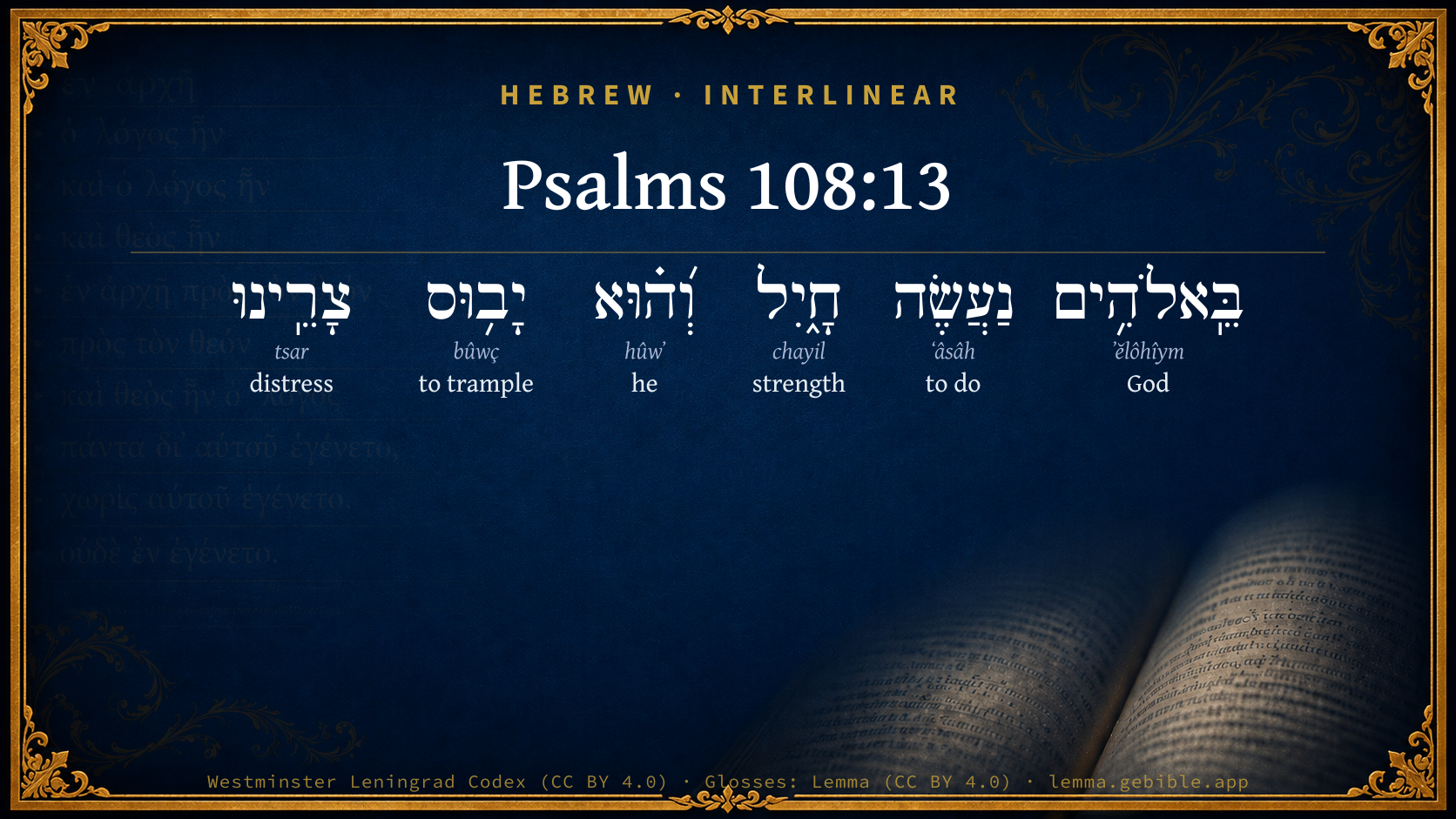
Psalms 108:13

Hebrew (Westminster Leningrad Codex) Psalms 108:13 appears in the Hebrew Old Testament. The text above is from the Westminster Leningrad Codex. Each word links to its Strong’s number, a concise gloss, and parsing drawn from the Open Scriptures Hebrew Bible morphology. Click any word for its full Brown-Driver-Briggs (BDB) entry.
Download image
Cite this verse

Psalms 108:13 (World English Bible). Public Domain. Lemma interlinear Bible study tool, https://lemma.gebible.app/v/psalms/108/13.

Show BibTeX & RIS
BibTeX
RIS
English Translation
Through God, we will do valiantly. For it is he who will tread down our enemies.
World English Bible · Public Domain
Download a study sheet

One document with this verse’s original text, its word-by-word gloss line, the meaning frame, cross-references with their text, attributed commentary, and full source and license credits — printable, and it pastes into notes with its structure intact.

This verse Autodidact and up

Study sheet (.html) Plain text (.txt)

A passage Seminary Student

Up to 50 verses in one chapter. A passage sheet keeps up to 6 commentary sources and 12 cross-references per verse, in the order this page ranks them, and says so on the sheet whenever that leaves anything out. Ask for a single verse and you get the Autodidact verse sheet above.

Everything on this page stays free to read, with no account — the sheet is a download of what is already on screen, not access to it.

Want to remove ads? Support Godless Engineer
Compare translations 3

The same verse in 3 English versions, stacked beneath the original-language interlinear above. Click any original word for its lexicon entry.

Each is an independent rendering of the whole verse — the interlinear is not word-aligned to these translations.

Highlighted words mark where these versions differ — a whole-verse word diff, not a word-by-word alignment.

  • World English Bible Public Domain
    Through God, we will do valiantly. For it is he who will tread down our enemies.
  • King James Version Public Domain
    Through God we shall do valiantly: for he it is that shall tread down our enemies.
  • unfoldingWord Literal Text CC BY-SA 4.0
    With God we will accomplish valor; and he, he will trample our adversaries.

unfoldingWord Literal Text — © unfoldingWord, licensed CC BY-SA 4.0. Word-aligned USFM3 via Door43 (git.door43.org/unfoldingWord/en_ult).

Versions to compare (up to 4)

3 of 4 selected

Show all 18 translations

Every available English version of this verse, each an independent rendering of the whole verse.

  • World English Bible Public Domain
    Through God, we will do valiantly. For it is he who will tread down our enemies.
  • Berean Standard Bible Public Domain
    With God we will perform with valor, and He will trample our enemies.
  • Majority Standard Bible Public Domain
    With God we will perform with valor, and He will trample our enemies.
  • King James Version Public Domain
    Through God we shall do valiantly: for he it is that shall tread down our enemies.
  • American Standard Version (1901) Public Domain
    Through God we shall do valiantly: For he it is that will tread down our adversaries. Psalm 109 For the Chief Musicion. A Psalm of David.
  • Revised Version (1885) Public Domain
    Through God we shall do valiantly: for he it is that shall tread down our adversaries.
  • Geneva Bible (1599) Public Domain
    Through God we shall doe valiantly: for he shall treade downe our enemies.
  • Douay-Rheims (1899) Public Domain
    O grant us help from trouble: for vain is the help of man.
  • Young's Literal Translation Public Domain
    In God we do mightily, And He doth tread down our adversaries!
  • Literal Standard Version CC BY-SA 4.0
    We do mightily in God, || And He treads down our adversaries!
  • Unlocked Literal Bible CC BY-SA 4.0
    We will triumph with God's help; he will trample down our enemies.
  • unfoldingWord Literal Text CC BY-SA 4.0
    With God we will accomplish valor; and he, he will trample our adversaries.
  • Darby Bible Public Domain
    Through God we shall do valiantly; and he it is that will tread down our adversaries.
  • World Messianic Bible Public Domain
    Through God, we will do valiantly, for it is he who will tread down our enemies.
  • Webster's Bible Public Domain
    \\108:12\\Give us help from trouble: for vain is the help of man.
  • Free Bible Version CC BY-SA 4.0
    Our strength is in God, and he will crush our enemies.
  • Bible in Basic English Public Domain
    With God we will do great things; for by him will our haters be crushed underfoot.
  • JPS Tanakh (1917) Public Domain
    (108-14) Through God we shall do valiantly; for He it is that will tread down our adversaries.

Literal Standard Version (2020), Covenant Press — licensed CC BY-SA 4.0. Text via the HelloAO Bible API (eBible.org). Unlocked Literal Bible (unfoldingWord) — licensed CC BY-SA 4.0. Text via the HelloAO Bible API (eBible.org). unfoldingWord Literal Text — © unfoldingWord, licensed CC BY-SA 4.0. Word-aligned USFM3 via Door43 (git.door43.org/unfoldingWord/en_ult). Free Bible Version, Dr. Jonathan Gallagher — licensed CC BY-SA 4.0. Text via the HelloAO Bible API (eBible.org).

Word by word

More ways to search: Search by grammar → Find every occurrence → Compare this word →

Practice this passage: Drill this verse → Learn its vocabulary →

About this verse

These counts appear in no published source. They are computed here, from the morphology-tagged text and Lemma’s own curated glosses. What Lemma adds →

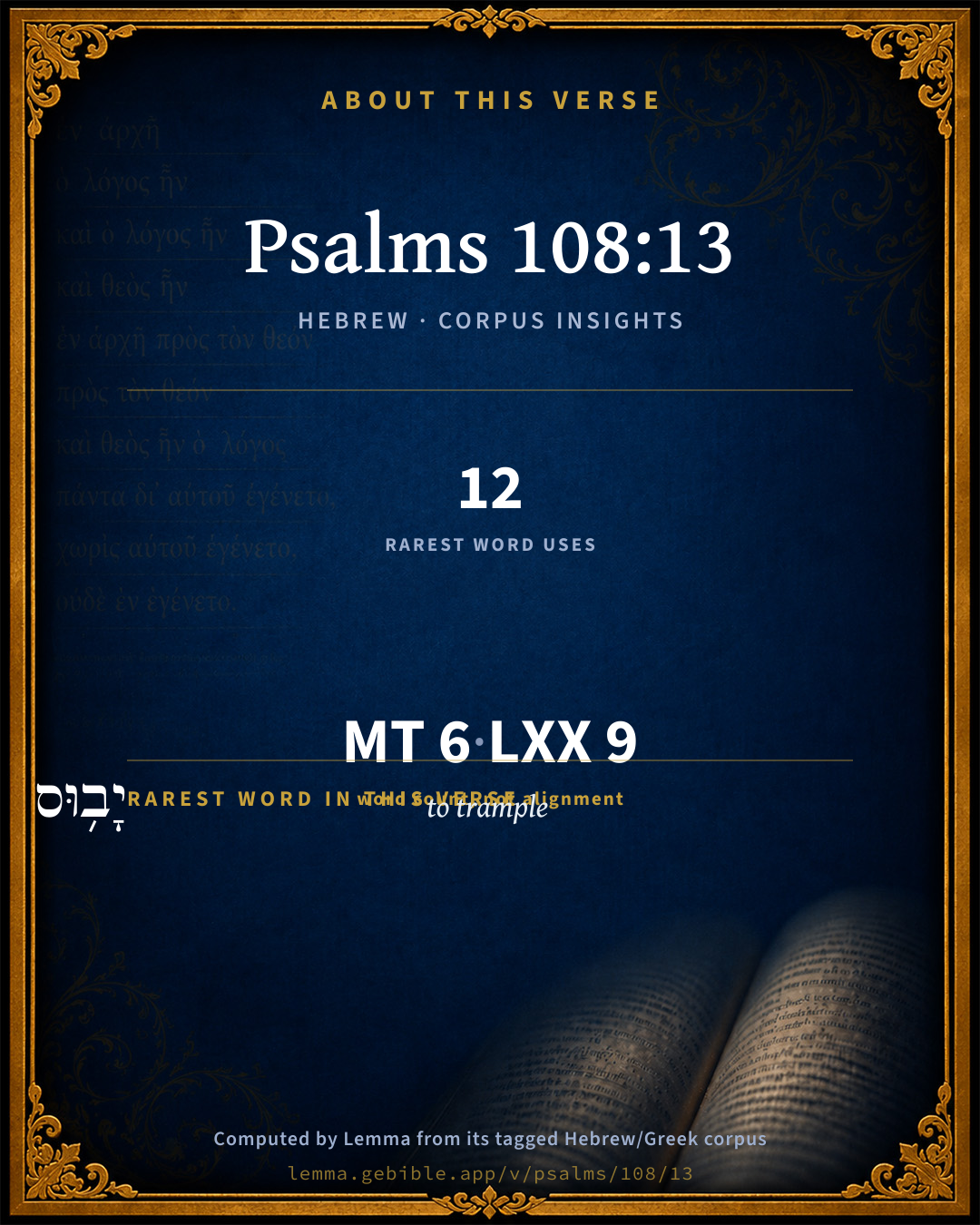
6
words
6
distinct lemmas
Wisdom
section

Notable vocabulary

The rarest word here is יָב֥וּס to trample H947 — appearing just 12 times in the whole Hebrew Bible.

Shared distinctive vocabulary

יָב֥וּס to trample H947 occurs in 12 verses of the Hebrew Bible. Also found in:

Grammatical profile

  • 2 verbs
  • 3 nouns
  • 1 pronoun

Verb forms

  • נַעֲשֶׂה Qal · Imperfect
  • יָב֥וּס Qal · Imperfect

Hebrew & Septuagint length

In English translation the verse runs 16 words from the Hebrew and 14 from the Septuagint (LXX English) — closely comparable.

A rough comparison of the two English renderings, which tokenize alike — not a word-level alignment.

Word counts can differ between the Hebrew and the Greek without any difference in meaning — e.g. the Hebrew direct-object marker אֵת has no separate Greek word, and Greek often adds the article ὁ.

In the original languages it is 6 Hebrew tokens and 9 Greek tokens — but the two are counted differently (Hebrew bundles its prefixes and suffixes into one token; the Greek is in lemma form), so that isn’t a like-for-like length.

Cross-references

13

Topical passages linked to Psalms 108:13 in the Treasury of Scripture Knowledge — connected by theme and wording, ordered by reader-vote popularity; previews shown in the World English Bible.

  • Psalms 118:6–13 Yahweh is on my side. I will not be afraid. What can man do to me?
  • Psalms 60:12 Through God we shall do valiantly, For it is he who will tread down our adversaries.
  • Romans 16:20 And the God of peace will quickly crush Satan under your feet. The grace of our Lord Jesus Christ be with you.
  • Psalms 18:29–34 For by you, I advance through a troop. By my God, I leap over a wall.
  • Isaiah 63:3 I have trodden the winepress alone; and of the peoples there was no man with me: yes, I trod them in my anger, and trampled them in my wrath; and their lifeblood is sprinkled on my garments, and I have stained all my clothing.
  • 2 Corinthians 2:14 Now thanks be to God, who always leads us in triumph in Christ, and reveals through us the sweet aroma of his knowledge in every place.
  • Psalms 18:42 Then I beat them small as the dust before the wind. I cast them out as the mire of the streets.
  • Judges 15:8 He struck them hip and thigh with a great slaughter: and he went down and lived in the cleft of the rock of Etam.
  • 2 Chronicles 20:12 Our God, will you not judge them? for we have no might against this great company that comes against us; neither know we what to do: but out eyes are on you.
  • Psalms 144:1 Blessed be Yahweh, my rock, Who teaches my hands to war, And my fingers to battle:
  • Isaiah 25:10 For in this mountain will the hand of Yahweh rest; and Moab shall be trodden down in his place, even as straw is trodden down in the water of the dung-hill.
  • 1 Corinthians 15:10 But by the grace of God I am what I am. His grace which was bestowed on me was not futile, but I worked more than all of them; yet not I, but the grace of God which was with me.
  • Ephesians 6:10–18 Finally, be strong in the Lord, and in the strength of his might.

Cross-references courtesy of OpenBible.info (CC BY 4.0).

Hebrew and Greek witnesses Masoretic Hebrew ↔ Greek Septuagint

The same verse in the two great witnesses to the Old Testament, shown verse-for-verse.

You’re reading Greek Psalm 107 (Hebrew Psalm 108). The Septuagint counts the superscription, so verse numbers can differ from the Hebrew — chapter-level alignment, not verse-by-verse. Numbering follows Rahlfs.

These are two independent witnesses, not word-aligned to each other, and the Septuagint is shown in lemma (dictionary) form.

Hebrew Psalms 108:13 Masoretic · Westminster Leningrad Codex

בֵּֽאלֹהִ֥ים נַעֲשֶׂה חָ֑יִל וְ֝ה֗וּא יָב֥וּס צָרֵֽינוּ

Through God, we will do valiantly. For it is he who will tread down our enemies.

World English Bible · Public Domain

Greek LXX Greek Psalm 107:13 Septuagint · lemma form

δίδωμι ἐγώ βοήθεια ἐκ θλῖψις καί μάταιος σωτηρία ἄνθρωπος

Through God we shall do valiantly; and he will bring to nothing our enemies.

LXX2012 (modern English Septuagint) · Public Domain

Hebrew: Westminster Leningrad Codex (CC BY 4.0). Greek: Septuagint (public domain); English from LXX2012 (modern English Septuagint) (Public Domain). How the Septuagint differs from the Hebrew →

Commentary

Notes on Psalms 108:13 from classic Christian and Jewish commentators (each source and its license shown beneath its notes). The classic Christian expositions comment on the surrounding passage and are grouped to its opening verse, so a note may address several verses; the Jewish commentaries on the Tanakh (Rashi and others) are per-verse, so they appear only where the commentator wrote on this verse.

Lemma curates 59 commentaries, every one of them public domain or Creative Commons licensed, each selected and text-cleaned for this edition rather than reprinted as found. About our sources →

The Biblical Illustrator

Joseph S. Exell

Psa_108:13

Through God we shall do valiantly.

Assurance of the Churchs victory

1. Whatsoever may be the variety of the exercises of faith, victory and triumph shall close the war, and crown the wrestler.

2. Albeit the means be nothing but vanity without God, yet they must be used, for they are something when they are used by us, and put in Gods hand.

3. What the Lord doth by the believer as His servant, or by any other instrument, God must have the glory of it.

4. The faith of the Churchs victory over her enemies is grounded upon Gods engaging in the war for the Church, and against our enemies. (D. Dickson.)

Faiths impossible feats

We need the courage of those ancient soldiers who were wont to regard difficulties only as whetstones upon which to sharpen their swords. I like Alexanders balk--when they said there were so many thousands, so many millions, perhaps, of Persians. Very well, said he, it is good reaping where the corn is thick. One butcher is not afraid of a thousand sheep. I like even the talk of the old Gascon who said, when they asked him, Can you and your troops get into that fortress? it is impregnable. Can the sun enter in? said he. Yes. Well, where the sun can go we will enter. Whatever is possible, or whatever is impossible, Christians can do at Gods command, for God is with us. (C. H. Spurgeon.)

.

Psa_109:1-31

The Biblical Illustrator, edited by Joseph S. Exell (c. 1880s–1900s) — public domain. Text from a community e-Sword module.

J. A. Alexander on Psalms

Joseph Addison Alexander

14. (Psa 108:13) In God we will make (i.e. gain or gather) strength, and he will tread down (or trample on) our adversaries (persecutors or oppressors). See above, on Psa 60:12, between which and the verse before us there is not the slightest difference.

Joseph Addison Alexander, The Psalms Translated and Explained (1850) — public domain. Text from a community e-Sword module.

Adam Clarke's Commentary

Verse 13. Through God we shall do valiantly] From him we derive our courage, from him our strength, and by him our success.

[For the ANALYSIS, see the Psa 57:1-11 (note) and Psa 60:1-12 (note). Also see introduction to Psa 108:1-13 (note)].

Adam Clarke's Commentary on the Bible (1810–1826) — public domain. Text from a community e-Sword/MySword module.

The Cambridge Bible for Schools and Colleges

gen. ed. J. J. S. Perowne

13. Through God] Cp. Psa_56:4.

we shall do valiantly] Cp. Num_24:18; Psa_118:15-16.

shall tread down our enemies] Cp. Psa_44:5; Psa_18:42, note. R.V. adversaries, cp. Psa_108:11.

The Cambridge Bible for Schools and Colleges (gen. ed. J. J. S. Perowne; Cambridge University Press, 1878–1918) — public domain. Text from a community e-Sword module.

Albert Barnes' Notes on the Bible

Through God we shall do ... - This also is taken from Psa 60:12, without change.

Thus the psalm, though made up of parts of two separate psalms, is complete and continuous in itself. There is no break or discrepancy in the current of thought, but the unity is as perfect as though it had been an original composition. It is to be remarked, also, that though in the original psalms the parts which are used here have a different connection, and are separately complete there, yet as employed here, they seem to be exactly suited to the new use which is made of the language; and though the original “reasons” for the use of the language do not appear here, yet there is a sufficient reason for that language apparent in the psalm as rearranged. To an Israelite, also, there might be a new interest in the use of the language in the fact that words with which he was familiar, as employed for other purposes, “could” be thus combined, and made applicable to a new occasion in the national history.

Albert Barnes' Notes on the Bible (1834–1885) — public domain. Text from a community e-Sword/MySword module.

The Treasury of David

Charles H. Spurgeon

Ver. 13. God's help shall inspire us to help ourselves. Faith is neither a coward nor a sluggard: she knows that God is with her, and therefore she does valiantly; she knows that he will tread down her enemies, and therefore she arises to tread them down in his name. Where praise and prayer have preceded the battle, we may expect to see heroic deeds and decisive victories.

Through God is our secret support; from that source we draw all our courage, wisdom, and strength.

We shall do valiantly. This is the public outflow from that secret source: our inward and spiritual faith proves itself by outward and valorous deeds.

He shall tread down our enemies. They shall fall before him, and as they lie prostrate he shall march over them, and all the hosts of his people with him. This is a prophecy. It was fulfilled to David, but it remains true to the Son of David and all who are on his side. The Church shall yet arouse herself to praise her God with all her heart, and then with songs and hosannas she will advance to the great battle; her foes shall be overthrown and utterly crushed by the power of her God, and the Lord's glory shall be above all the earth. Send it in our time, we beseech thee, O Lord.

Ver. 13. How, when, and why a believer should do valiantly.

Charles H. Spurgeon's The Treasury of David (1869–1885) — public domain. Psalms only. Text from a community e-Sword/MySword module.

The Pulpit Commentary

Through God we shall do valiantly, etc. Also completely identical with Psa_60:12.

The Pulpit Commentary (1880–1919), ed. H.D.M. Spence-Jones & Joseph S. Exell — public domain. Text from a community e-Sword module.

Lesson kit

Teaching starters — assembled from the data on this page, not authored interpretation. Every prompt links to the verse data it draws on. Edit before teaching.

Psalms, in the Wisdom, opens this verse with 6 words (6 distinct Hebrew lemmas). Its most distinctive word is bûwç (“to trample”). A historical commentator’s framing appears above. Read the whole chapter for the surrounding context.

Discussion questions

  1. What does “to trample” (bûwç) contribute to the verse as a whole?
  2. How does Psalms 44:5, which shares the word «to trample», read alongside this verse?
  3. The translations on this page render this verse differently — a whole-verse word diff, not a word-by-word alignment. What might account for the different wordings?
  4. «נַעֲשֶׂה» is a Qal Imperfect verb. How does that grammatical form shape the action described?
  5. Compare how The Biblical Illustrator and J. A. Alexander on Psalms read this verse. Where do they agree or differ?

Things to notice

Reading settings

Reading text

Shown beneath each verse's original-language words.

Old Testament
Old Testament edition

Read the OT as the Masoretic Hebrew (MT) or the Greek Septuagint (LXX).

English shown for the Greek Septuagint (in the Hebrew ↔ Greek comparison).

Comparing translations? Open the Compare panel on any verse page to stack up to four side by side.