2 Chronicles 26:17

Hebrew (Westminster Leningrad Codex) 2 Chronicles 26:17 appears in the Hebrew Old Testament. The text above is from the Westminster Leningrad Codex. Each word links to its Strong’s number, a concise gloss, and parsing drawn from the Open Scriptures Hebrew Bible morphology. Click any word for its full Brown-Driver-Briggs (BDB) entry.
Download image
Cite this verse

2 Chronicles 26:17 (World English Bible). Public Domain. Lemma interlinear Bible study tool, https://lemma.gebible.app/v/2-chronicles/26/17.

Show BibTeX & RIS
BibTeX
RIS
English Translation
Azariah the priest went in after him, and with him eighty priests of Yahweh, who were valiant men:
World English Bible · Public Domain
Download a study sheet

One document with this verse’s original text, its word-by-word gloss line, the meaning frame, cross-references with their text, attributed commentary, and full source and license credits — printable, and it pastes into notes with its structure intact.

This verse Autodidact and up

Study sheet (.html) Plain text (.txt)

A passage Seminary Student

Up to 50 verses in one chapter. A passage sheet keeps up to 6 commentary sources and 12 cross-references per verse, in the order this page ranks them, and says so on the sheet whenever that leaves anything out. Ask for a single verse and you get the Autodidact verse sheet above.

Everything on this page stays free to read, with no account — the sheet is a download of what is already on screen, not access to it.

Want to remove ads? Support Godless Engineer
Compare translations 3

The same verse in 3 English versions, stacked beneath the original-language interlinear above. Click any original word for its lexicon entry.

Each is an independent rendering of the whole verse — the interlinear is not word-aligned to these translations.

Highlighted words mark where these versions differ — a whole-verse word diff, not a word-by-word alignment.

  • World English Bible Public Domain
    Azariah the priest went in after him, and with him eighty priests of Yahweh, who were valiant men:
  • King James Version Public Domain
    And Azariah the priest went in after him, and with him fourscore priests of the LORD, that were valiant men:
  • unfoldingWord Literal Text CC BY-SA 4.0
    And Azariah, the priest, went in after him, and with him the priests of Yahweh, 80 sons of strength.

unfoldingWord Literal Text — © unfoldingWord, licensed CC BY-SA 4.0. Word-aligned USFM3 via Door43 (git.door43.org/unfoldingWord/en_ult).

Versions to compare (up to 4)

3 of 4 selected

Show all 18 translations

Every available English version of this verse, each an independent rendering of the whole verse.

  • World English Bible Public Domain
    Azariah the priest went in after him, and with him eighty priests of Yahweh, who were valiant men:
  • Berean Standard Bible Public Domain
    Then Azariah the priest, along with eighty brave priests of the LORD, went in after him.
  • Majority Standard Bible Public Domain
    Then Azariah the priest, along with eighty brave priests of the LORD, went in after him.
  • King James Version Public Domain
    And Azariah the priest went in after him, and with him fourscore priests of the LORD, that were valiant men:
  • American Standard Version (1901) Public Domain
    And Azariah the priest went in after him, and with him fourscore priests of Jehovah, that were valiant men:
  • Revised Version (1885) Public Domain
    And Azariah the priest went in after him, and with him fourscore priests of the LORD, that were valiant men:
  • Geneva Bible (1599) Public Domain
    And Azariah the Priest went in after him, and with him foure score Priests of the Lord, valiant men.
  • Douay-Rheims (1899) Public Domain
    And immediately Azarias the priest going in after him, and with him fourscore priests of the Lord, most valiant men,
  • Young's Literal Translation Public Domain
    And Azariah the priest goeth in after him, and with him priests of Jehovah eighty, sons of valour,
  • Literal Standard Version CC BY-SA 4.0
    And Azariah the priest goes in after him, and with him eighty priests of YHWH, sons of valor,
  • Unlocked Literal Bible CC BY-SA 4.0
    Azariah, the priest, went in after him, and with him eighty priests of Yahweh, who were brave men.
  • unfoldingWord Literal Text CC BY-SA 4.0
    And Azariah, the priest, went in after him, and with him the priests of Yahweh, 80 sons of strength.
  • Darby Bible Public Domain
    And Azariah the priest went in after him, and with him priests of Jehovah, eighty valiant men;
  • World Messianic Bible Public Domain
    Azariah the priest went in after him, and with him eighty priests of the LORD, who were valiant men.
  • Webster's Bible Public Domain
    And Azariah the priest went in after him, and with him eighty priests of the LORD, that were valiant men:
  • Free Bible Version CC BY-SA 4.0
    Azariah the priest went in after him, with eighty brave priests of the Lord.
  • Bible in Basic English Public Domain
    And Azariah the priest went in after him, with eighty of the Lord's priests, who were strong men;
  • JPS Tanakh (1917) Public Domain
    And Azariah the priest went in after him, and with him fourscore priests of the LORD, that were valiant men;

Literal Standard Version (2020), Covenant Press — licensed CC BY-SA 4.0. Text via the HelloAO Bible API (eBible.org). Unlocked Literal Bible (unfoldingWord) — licensed CC BY-SA 4.0. Text via the HelloAO Bible API (eBible.org). unfoldingWord Literal Text — © unfoldingWord, licensed CC BY-SA 4.0. Word-aligned USFM3 via Door43 (git.door43.org/unfoldingWord/en_ult). Free Bible Version, Dr. Jonathan Gallagher — licensed CC BY-SA 4.0. Text via the HelloAO Bible API (eBible.org).

Word by word

More ways to search: Search by grammar → Find every occurrence → Compare this word →

Practice this passage: Drill this verse → Learn its vocabulary →

שְׁמוֹנִ֖ים
shᵉmônîym
H8084
“eighty”
Adjective, Cardinal number, Both, Plural, Absolute
Part of Speech
Adjective
Type
Cardinal number
Gender
Both
Number
Plural
State
Absolute
Full BDB Definition

Origin: mult from H8083

TWOT: 2411b

eighty, fourscore - eighty (as cardinal number) - eightieth (as ordinal number) - in combination with other numbers
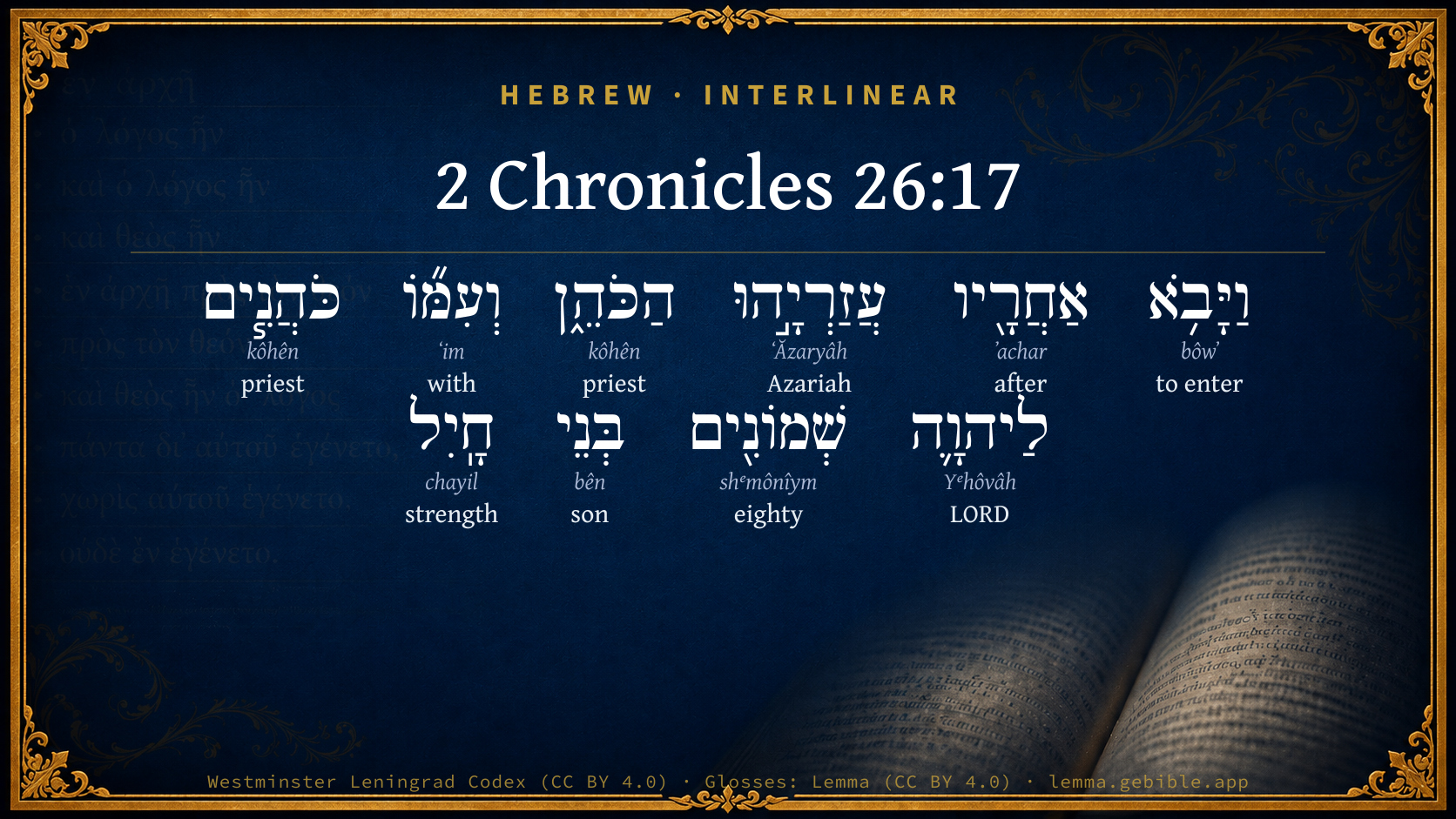
  1. וַיָּבֹ֥א bôwʼ H935 “and · to enter” Conjunction + Verb, Qal, Sequential Imperfect, 3rd Person, Masculine, Singular
  2. אַחֲרָ֖יו ʼachar H310 “after · him” Preposition + Suffix, Personal, 3rd Person, Masculine, Singular
  3. עֲזַרְיָ֣הוּ ʻĂzaryâh H5838 “Azariah” Noun, Proper
  4. הַכֹּהֵ֑ן kôhên H3548 “the · priest” Particle, Definite Article + Noun, Common, Masculine, Singular, Absolute
  5. וְעִמּ֞וֹ ʻim H5973 “and · with · him” Conjunction + Preposition + Suffix, Personal, 3rd Person, Masculine, Singular
  6. כֹּהֲנִ֧ים kôhên H3548 “priests” Noun, Common, Masculine, Plural, Absolute
  7. לַיהוָ֛ה Yᵉhôvâh H3068 “to/for · LORD” Preposition + Noun, Proper
  8. בְּנֵי bên H1121 “sons of” Noun, Common, Masculine, Plural, Construct
  9. חָֽיִל chayil H2428 “strength” Noun, Common, Masculine, Singular, Absolute

About this verse

These counts appear in no published source. They are computed here, from the morphology-tagged text and Lemma’s own curated glosses. What Lemma adds →

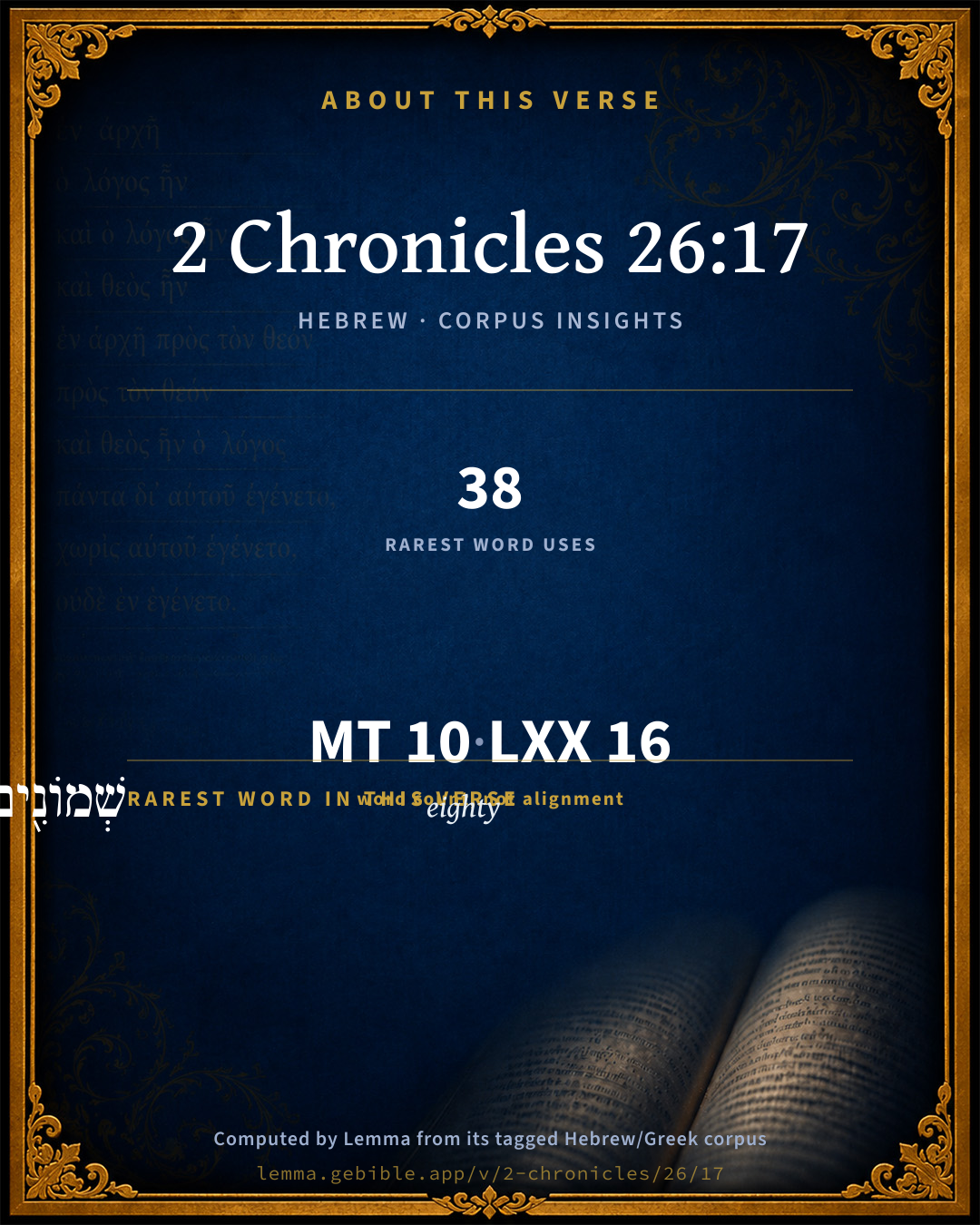
10
words
9
distinct lemmas
Historical
section

Shared distinctive vocabulary

שְׁמוֹנִ֖ים eighty H8084 occurs in 37 verses of the Hebrew Bible. Also found in:

Grammatical profile

  • 1 verb
  • 6 nouns
  • 1 adjective
  • 2 prepositions

Verb forms

  • וַיָּבֹ֥א Qal · Sequential Imperfect

Repetition

A word recurs within this verse — often emphatic in Hebrew:

  • הַכֹּהֵ֑ן priest H3548 ×2

Hebrew & Septuagint length

In English translation the verse runs 18 words from the Hebrew and 19 from the Septuagint (LXX English) — closely comparable.

A rough comparison of the two English renderings, which tokenize alike — not a word-level alignment.

Word counts can differ between the Hebrew and the Greek without any difference in meaning — e.g. the Hebrew direct-object marker אֵת has no separate Greek word, and Greek often adds the article ὁ.

In the original languages it is 10 Hebrew tokens and 16 Greek tokens — but the two are counted differently (Hebrew bundles its prefixes and suffixes into one token; the Greek is in lemma form), so that isn’t a like-for-like length.

Cross-references

3

Topical passages linked to 2 Chronicles 26:17 in the Treasury of Scripture Knowledge — connected by theme and wording, ordered by reader-vote popularity; previews shown in the World English Bible.

  • 1 Chronicles 6:10 and Johanan became the father of Azariah, (he it is who executed the priest's office in the house that Solomon built in Jerusalem),
  • 1 Chronicles 12:28 and Zadok, a young man mighty of valor, and of his father's house twenty-two captains.
  • 1 Chronicles 26:6 Also to Shemaiah his son were sons born, who ruled over the house of their father; for they were mighty men of valor.

Cross-references courtesy of OpenBible.info (CC BY 4.0).

Hebrew and Greek witnesses Masoretic Hebrew ↔ Greek Septuagint

The same verse in the two great witnesses to the Old Testament, shown verse-for-verse.

These are two independent witnesses, not word-aligned to each other, and the Septuagint is shown in lemma (dictionary) form.

Hebrew 2 Chronicles 26:17 Masoretic · Westminster Leningrad Codex

וַיָּבֹ֥א אַחֲרָ֖יו עֲזַרְיָ֣הוּ הַכֹּהֵ֑ן וְעִמּ֞וֹ כֹּהֲנִ֧ים לַיהוָ֛ה שְׁמוֹנִ֖ים בְּנֵי חָֽיִל

Azariah the priest went in after him, and with him eighty priests of Yahweh, who were valiant men:

World English Bible · Public Domain

Greek LXX 2 Chronicles 26:17 Septuagint · lemma form

καί εἰςἔρχομαι ὀπίσω αὐτός αζαριας ὁ ἱερεύς καί μετά αὐτός ἱερεύς ὁ κύριος ὀγδοήκοντα υἱός δυνατός

And there went in after him Azarias the priest, and with him eighty priests of the Lord, mighty men.

LXX2012 (modern English Septuagint) · Public Domain

Hebrew: Westminster Leningrad Codex (CC BY 4.0). Greek: Septuagint (public domain); English from LXX2012 (modern English Septuagint) (Public Domain). How the Septuagint differs from the Hebrew →

Commentary

Notes on 2 Chronicles 26:17 from classic Christian and Jewish commentators (each source and its license shown beneath its notes). The classic Christian expositions comment on the surrounding passage and are grouped to its opening verse, so a note may address several verses; the Jewish commentaries on the Tanakh (Rashi and others) are per-verse, so they appear only where the commentator wrote on this verse.

Lemma curates 59 commentaries, every one of them public domain or Creative Commons licensed, each selected and text-cleaned for this edition rather than reprinted as found. About our sources →

Trapp's Complete Commentary

John Trapp

2Ch 26:17 And Azariah the priest went in after him, and with him fourscore priests of the LORD, [that were] valiant men:

Ver. 17. That were valiant men.] Men of great strength and good mettle. Levites did great exploits when put upon it, as Exo 32:26, &c. "They out of Zebulun, that handled the pen of the writer" - scribes and scholars - also bore arms in some cases. {Jdg 5:14}

John Trapp, A Commentary or Exposition upon All the Books of the Old and New Testament (1647–1656) — public domain. Text from a community e-Sword module.

The Biblical Illustrator

Joseph S. Exell

2Ch_26:17-18

It appertaineth not unto thee, Uzziah, to burn incense unto the Lord.

We must abide within our limitation

The great temptation of some natures is to try to do the very things for which they are least qualified. There is a marvellous irony in human genius in this matter. It would seem to be an inscrutable mystery that men will persist in attempting to do the thing which they cannot do, and which they were obviously never meant to do. Whenever a man is out of place he is guilty of wasting strength. A man can only work well within his own limit. No man should strain himself at his labour, be he poet, or musician, or divine, be he prophet or merchantman; he should keep easily within the circle he was appointed to occupy, for all stretching is weakening, all effort that is above the line of nature tends to destruction, both to the worker and of the influence which he ought to exert. Know your own place, and keep it. (J. Parker, D. D.)

The folly of self-will

God has sacred places, God has allotted specific duties to men; every man will be wise in proportion as he sees his own calling, and makes his calling and election sure. Reward lies along that line. Leave your native heath, take your life into your own hands, say you will create a sphere for yourself and do as you please, and you shall be stung with disappointments as with a cloud of insects. Say you will insist upon having your own way in the world, and every rock you strike will but injure the hand that smites it. But live and move and have your being in God. Say, Lord, not my will, but Thine be done; make me door-keeper, or lamp-lighter, or hewer of wood or drawer of water, or a Zechariah having learning in Thy visions and power of reading all the apocalypse of Thy providence: what Thou wilt, as Thou wilt, as long as Thou wilt: Thy will is heaven. It is towards this end that all Christian education must tend. (J. Parker, D. D.)

Uzziahs pride punished

I. His reign as king. This was pre-eminently successful. The Arab hordes on his south-east borders were subdued, and the Ammonites were reduced to tribute. He was no less vigorous in defensive than offensive operations. He paid as great attention to the arts of peace as of war. He was the special patron of agriculture; he dug wells, built towers in the wilderness for the protection of the flocks, and cultivated rich vineyards.

II. Uzziahs sin. Uzziah was ambitious; he was not willing that any in his realm should enjoy prerogatives denied to him.

III. Uzziahs punishment. Henceforth the most menial subject would not exchange places with the leprous king. As lessons taught by this narrative we learn--

1. Prosperity is dangerous. The record of Uzziah does not stand alone. Prosperity seldom draws men to God. Gratitude does not increase in proportion as Gods favours multiply. A mans piety is not usually increased by his becoming rich. It is seldom men are more religious in health than in sickness. Before I was afflicted I went astray; but now have I kept Thy Word.

2. God is to be approached reverently. Uzziah seems to have thought that by being a king, successful and famous, he had earned the right to enter the holy place and offer sacred incense. It is often expected that God will accept worship if the display of wealth mingle with it largely. Does not the ability to offer such choice incense gain for one the right to lift the sacred veil and stand where God hath said His Priests only should enter, and the stranger that cometh nigh shall be put to death? Uzziah thought that God would not exclude a favoured king from that sacred presence. Men often think that it is possible to find some incense wafted from a worldly censer which shall ascend as fragrance to the unseen holy. But what had Uzziahs kingdom to do toward fitting him to perform a priestly act? Mans approach to God is through Christ. In the Old Testament dispensation, not even a symbol of His person or work could be accepted or admitted into the holy place, other than that which God had appointed.

3. Sin, though in high places, must be rebuked. It seemed a bold act for the priests to say to Judahs king, Go out of the sanctuary, for thou hast trespassed. They were the humble ministers of religion, and he the proud and pampered king of a victorious people. He had transcended his limit, and must be rebuked, though he be a king. Such invasions of religion are not rare. The world is always ready to take religious duties into her own hands, to tell how God is to be worshipped, what doctrines are to be preached, what duties prescribed, what faults are to be rebuked, and what allowed. She enters with a regal tread, and speaks with imperious voice. What shall be done? Does and will the Church stand firm in her antagonism to wrong and sin, though they stand in kingly pride to offer polluted incense on her sacred altars?

4. Men may be blinded to sin, till they see its consequences. It is not probable that Uzziah realised his guilt till the leprosy rose up in his forehead. Then he hasted to go out of the sanctuary. Perhaps he feared other and severer judgments would follow. Had God stayed His retributive hand, and the king been suffered, with no leprous spots, to leave the altar as proud and ambitious as he entered, his guilt would have been as great. The smitten forehead, like a detective, laid the offender under arrest, and thus exposed him; but it did not create or increase his sin. Many, guilty of the most grievous wrongs, think themselves respectable, and claim the confidence of others, till some providence uncovers their evil deeds. It is a mistake to suppose that all the criminals are in prison. A bad men is as bad on one side of iron bars as on the other. (Monday Club Sermons.)

The Biblical Illustrator, edited by Joseph S. Exell (c. 1880s–1900s) — public domain. Text from a community e-Sword module.

Ellicott's Commentary for English Readers

(17) Azariah the priest—i.e., the high priest, whose duty it would be to resist such an encroachment on sacerdotal functions. His name does not occur in the list (1Ch_4:27-41).

Valiant men.—Sons of valour (1Ch_5:18), so called because they had the moral courage to oppose the king.

A Bible Commentary for English Readers, edited by Charles John Ellicott (1878–1897) — public domain. Text from a community e-Sword module.

The Cambridge Bible for Schools and Colleges

gen. ed. J. J. S. Perowne

17. Azariah the priest] i.e. the high-priest (2Ch_26:20). He cannot be identified certainly with any priest in the list given 1Ch_6:4-15 (5:30–41, Heb.).

The Cambridge Bible for Schools and Colleges (gen. ed. J. J. S. Perowne; Cambridge University Press, 1878–1918) — public domain. Text from a community e-Sword module.

John Gill's Exposition

Then Uzziah was wroth,.... With the priests, and, as Josephus (b) says, threatened to kill them:

and had a censer in his hand to burn incense; ready to do it, and resolved upon it:

and while he was wroth with the priests; and expressing his indignation, and do what he would do to them, if they continued to oppose him:

the leprosy even rose up in his forehead before the priests in the house of the Lord, from beside the incense altar; which seems not only to describe the position of the priests, being beside the altar of incense, to keep the king from it, when the leprosy was seen by them in his forehead, but the quarter from whence the stroke invisibly came. Josephus (c) says, there was earthquake at the same time, and a mountain was rent.

(b) Antiqu. l. 9. c. 10. sect. 4. (c) lbid.

John Gill's Exposition of the Whole Bible (1746–1763) — public domain (CC PDM 1.0). Text via the HelloAO Bible API.

Haydock's Catholic Bible Commentary

Azarias. The prophet, who had hitherto kept the king (H.) within bounds, was now no more, v. 5. T.

George Leo Haydock (1774–1849), Haydock's Catholic Family Bible and Commentary, 1859 edition — public domain. Excludes Psalms (Douay-Rheims chapter numbering differs from Protestant) and Deuterocanonical books (Catholic canon only).

The Pulpit Commentary

Azariah the priest. Ver. 20 states what was otherwise to be supposed, that he was the chief priest (varh;). We fail to identify his name with any in the typical list of 1Ch_6:4-15, where the Azariah of ver. 11 is too early, and the Azariah of ver. 13 too late, for our present Azariah. With him four score priests. This passage suggests to us an idea of how many deeply interesting details are wanting, which would fill in the interstices of Old Testament history. Probably the intention of the king, ambitious to simulate the self-assumed religious ways of neighbouring Gentile kings, was no secret; and possibly the king may have given time for the chief priest to collect his auxiliaries, through some ostentatious display on his own part, in the very performance of his desecration. The number and the character of these helping priests (lyjAyneB) give the idea that they had their work to do, and purposed doing it promptly, or that they would over-awe, and obviate the use of actual force, by their imposing number.

The Pulpit Commentary (1880–1919), ed. H.D.M. Spence-Jones & Joseph S. Exell — public domain. Text from a community e-Sword module.

Lesson kit

Teaching starters — assembled from the data on this page, not authored interpretation. Every prompt links to the verse data it draws on. Edit before teaching.

2 Chronicles, in the Historical, opens this verse with 10 words (9 distinct Hebrew lemmas). Its most distinctive word is shᵉmônîym (“eighty”). A historical commentator’s framing appears above. Read the whole chapter for the surrounding context.

Discussion questions

  1. The word shᵉmônîym carries the sense “eighty.” How does it shape the verse?
  2. Genesis 5:25 shares the word «eighty» with this verse. How do the two illuminate each other?
  3. “priest” occurs 2× in this one verse. What is the effect of the repetition?
  4. The translations on this page render this verse differently — a whole-verse word diff, not a word-by-word alignment. What might account for the different wordings?
  5. The verb «וַיָּבֹ֥א» is Qal Sequential Imperfect. How does its form color the action?
  6. Reading how Trapp's Complete Commentary and The Biblical Illustrator read this verse, where do the two commentators agree and where do they part?

Things to notice

Reading settings

Reading text

Shown beneath each verse's original-language words.

Old Testament
Old Testament edition

Read the OT as the Masoretic Hebrew (MT) or the Greek Septuagint (LXX).

English shown for the Greek Septuagint (in the Hebrew ↔ Greek comparison).

Comparing translations? Open the Compare panel on any verse page to stack up to four side by side.