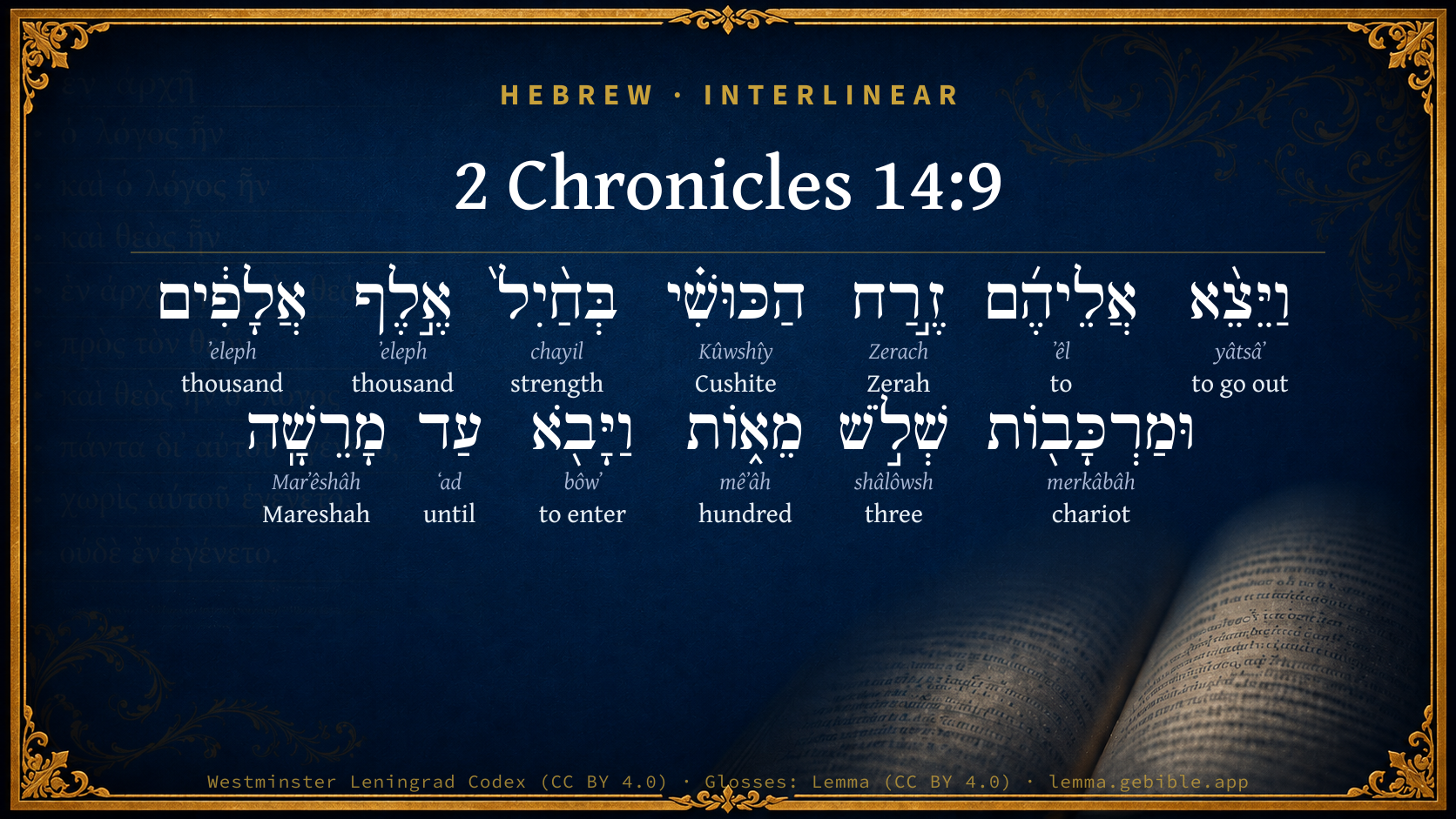
2 Chronicles 14:9

Hebrew (Westminster Leningrad Codex) 2 Chronicles 14:9 appears in the Hebrew Old Testament. The text above is from the Westminster Leningrad Codex. Each word links to its Strong’s number, a concise gloss, and parsing drawn from the Open Scriptures Hebrew Bible morphology. Click any word for its full Brown-Driver-Briggs (BDB) entry.
Download image
Cite this verse

2 Chronicles 14:9 (World English Bible). Public Domain. Lemma interlinear Bible study tool, https://lemma.gebible.app/v/2-chronicles/14/9.

Show BibTeX & RIS
BibTeX
RIS
English Translation
There came out against them Zerah the Ethiopian with an army of a million troops, and three hundred chariots; and he came to Mareshah.
World English Bible · Public Domain
Download a study sheet

One document with this verse’s original text, its word-by-word gloss line, the meaning frame, cross-references with their text, attributed commentary, and full source and license credits — printable, and it pastes into notes with its structure intact.

This verse Autodidact and up

Study sheet (.html) Plain text (.txt)

A passage Seminary Student

Up to 50 verses in one chapter. A passage sheet keeps up to 6 commentary sources and 12 cross-references per verse, in the order this page ranks them, and says so on the sheet whenever that leaves anything out. Ask for a single verse and you get the Autodidact verse sheet above.

Everything on this page stays free to read, with no account — the sheet is a download of what is already on screen, not access to it.

Want to remove ads? Support Godless Engineer
Compare translations 3

The same verse in 3 English versions, stacked beneath the original-language interlinear above. Click any original word for its lexicon entry.

Each is an independent rendering of the whole verse — the interlinear is not word-aligned to these translations.

Highlighted words mark where these versions differ — a whole-verse word diff, not a word-by-word alignment.

  • World English Bible Public Domain
    There came out against them Zerah the Ethiopian with an army of a million troops, and three hundred chariots; and he came to Mareshah.
  • King James Version Public Domain
    And there came out against them Zerah the Ethiopian with an host of a thousand thousand, and three hundred chariots; and came unto Mareshah.
  • unfoldingWord Literal Text CC BY-SA 4.0
    And Zerah the Cushite came out against them with an army of 1,000 thousands and 300 chariots; and he came to Mareshah.

unfoldingWord Literal Text — © unfoldingWord, licensed CC BY-SA 4.0. Word-aligned USFM3 via Door43 (git.door43.org/unfoldingWord/en_ult).

Versions to compare (up to 4)

3 of 4 selected

Show all 18 translations

Every available English version of this verse, each an independent rendering of the whole verse.

  • World English Bible Public Domain
    There came out against them Zerah the Ethiopian with an army of a million troops, and three hundred chariots; and he came to Mareshah.
  • Berean Standard Bible Public Domain
    Then Zerah the Cushite came against them with an army of 1,000,000 men and 300 chariots, and they advanced as far as Mareshah.
  • Majority Standard Bible Public Domain
    Then Zerah the Cushite came against them with an army of 1,000,000 men and 300 chariots, and they advanced as far as Mareshah.
  • King James Version Public Domain
    And there came out against them Zerah the Ethiopian with an host of a thousand thousand, and three hundred chariots; and came unto Mareshah.
  • American Standard Version (1901) Public Domain
    And there came out against them Zerah the Ethiopian with an army of a thousand thousand, and three hundred chariots; and he came unto Mareshah.
  • Revised Version (1885) Public Domain
    And there came out against them Zerah the Ethiopian with an army of a thousand thousand, and three hundred chariots; and he came unto Mareshah.
  • Geneva Bible (1599) Public Domain
    And there came out against them Zerah of Ethiopia with an hoste of ten hundreth thousande, and three hundreth charets, and came vnto Mareshah.
  • Douay-Rheims (1899) Public Domain
    And Zara the Ethiopian came out against them with his army of ten hundred thousand men, and with three hundred chariots: and he came as far as Maresa.
  • Young's Literal Translation Public Domain
    And come out unto them doth Zerah the Cushite with a force of a thousand thousand, and chariots three hundred, and he cometh in unto Mareshah,
  • Literal Standard Version CC BY-SA 4.0
    And Zerah the Cushite comes out to them with a force of one million [men] and three hundred chariots, and he comes to Mareshah,
  • Unlocked Literal Bible CC BY-SA 4.0
    Zerah the Cushite came against them with an army of one million soldiers and three hundred chariots; he came to Mareshah.
  • unfoldingWord Literal Text CC BY-SA 4.0
    And Zerah the Cushite came out against them with an army of 1,000 thousands and 300 chariots; and he came to Mareshah.
  • Darby Bible Public Domain
    And Zerah the Ethiopian came out against him with a host of a thousand thousand, and three hundred chariots, and he came to Mareshah.
  • World Messianic Bible Public Domain
    Zerah the Ethiopian came out against them with an army of a million troops and three hundred chariots, and he came to Mareshah.
  • Webster's Bible Public Domain
    And there came out against them Zerah the Cushite, with a host of a thousand thousand, and three hundred chariots; and came to Mareshah.
  • Free Bible Version CC BY-SA 4.0
    Zerah the Ethiopian attacked them with an army of a thousand times a thousand men and three hundred chariots, advancing as far as Mareshah.
  • Bible in Basic English Public Domain
    And Zerah the Ethiopian, with an army of a million, and three hundred war-carriages, came out against them to Mareshah.
  • JPS Tanakh (1917) Public Domain
    (14-8) And there came out against them Zerah the Ethiopian with an army of a thousand thousand, and three hundred chariots; and he came unto Mareshah.

Literal Standard Version (2020), Covenant Press — licensed CC BY-SA 4.0. Text via the HelloAO Bible API (eBible.org). Unlocked Literal Bible (unfoldingWord) — licensed CC BY-SA 4.0. Text via the HelloAO Bible API (eBible.org). unfoldingWord Literal Text — © unfoldingWord, licensed CC BY-SA 4.0. Word-aligned USFM3 via Door43 (git.door43.org/unfoldingWord/en_ult). Free Bible Version, Dr. Jonathan Gallagher — licensed CC BY-SA 4.0. Text via the HelloAO Bible API (eBible.org).

Word by word

More ways to search: Search by grammar → Find every occurrence → Compare this word →

Practice this passage: Drill this verse → Learn its vocabulary →

מָרֵשָֽׁה
Marʼêshâh
H4762
“Mareshah”
Noun, Proper
Part of Speech
Noun
Type
Proper
Full BDB Definition

Origin: formed like H4761

TWOT: None

Mareshah = "crest of a hill" - one of the cities in the lowlands of Judah
  1. וַיֵּצֵ֨א yâtsâʼ H3318 “and · to go out” Conjunction + Verb, Qal, Sequential Imperfect, 3rd Person, Masculine, Singular
  2. אֲלֵיהֶ֜ם ʼêl H413 “to · them” Preposition + Suffix, Personal, 3rd Person, Masculine, Plural
  3. זֶ֣רַח Zerach H2226 “Zerah” Noun, Proper
  4. הַכּוּשִׁ֗י Kûwshîy H3569 “the · Cushite” Particle, Definite Article + Noun, Gentilic, Masculine, Singular, Absolute
  5. בְּחַ֨יִל֙ chayil H2428 “in/at · strength” Preposition + Noun, Common, Masculine, Singular, Absolute
  6. אֶ֣לֶף ʼeleph H505 “thousand” Adjective, Cardinal number, Both, Singular, Absolute
  7. אֲלָפִ֔ים ʼeleph H505 “thousand” Adjective, Cardinal number, Both, Plural, Absolute
  8. וּמַרְכָּב֖וֹת merkâbâh H4818 “and · chariots” Conjunction + Noun, Common, Feminine, Plural, Absolute
  9. שְׁלֹ֣שׁ shâlôwsh H7969 “three” Adjective, Cardinal number, Feminine, Singular, Absolute
  10. מֵא֑וֹת mêʼâh H3967 “hundred” Adjective, Cardinal number, Both, Plural, Absolute
  11. וַיָּבֹ֖א bôwʼ H935 “and · to enter” Conjunction + Verb, Qal, Sequential Imperfect, 3rd Person, Masculine, Singular
  12. עַד ʻad H5704 “until” Preposition

About this verse

These counts appear in no published source. They are computed here, from the morphology-tagged text and Lemma’s own curated glosses. What Lemma adds →

13
words
12
distinct lemmas
Historical
section

Notable vocabulary

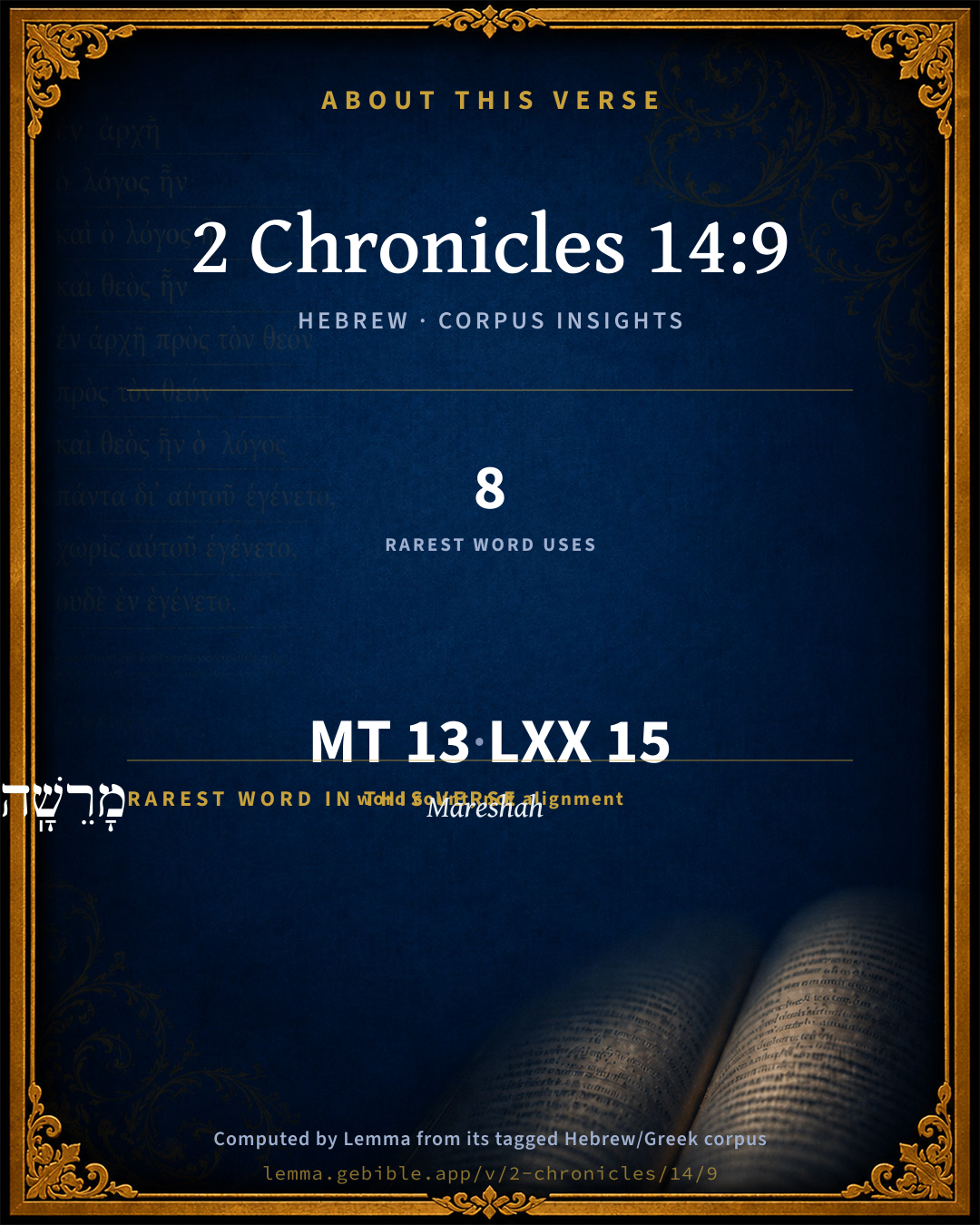
The rarest word here is מָרֵשָֽׁה Mareshah H4762 — appearing just 8 times in the whole Hebrew Bible.

Shared distinctive vocabulary

מָרֵשָֽׁה Mareshah H4762 occurs in 8 verses of the Hebrew Bible. Also found in:

Grammatical profile

  • 2 verbs
  • 5 nouns
  • 4 adjectives
  • 2 prepositions

Verb forms

  • וַיֵּצֵ֨א Qal · Sequential Imperfect
  • וַיָּבֹ֖א Qal · Sequential Imperfect

Repetition

A word recurs within this verse — often emphatic in Hebrew:

  • אֶ֣לֶף thousand H505 ×2

Hebrew & Septuagint length

In English translation the verse runs 24 words from the Hebrew and 22 from the Septuagint (LXX English) — closely comparable.

A rough comparison of the two English renderings, which tokenize alike — not a word-level alignment.

Word counts can differ between the Hebrew and the Greek without any difference in meaning — e.g. the Hebrew direct-object marker אֵת has no separate Greek word, and Greek often adds the article ὁ.

In the original languages it is 13 Hebrew tokens and 15 Greek tokens — but the two are counted differently (Hebrew bundles its prefixes and suffixes into one token; the Greek is in lemma form), so that isn’t a like-for-like length.

Cross-references

9

Topical passages linked to 2 Chronicles 14:9 in the Treasury of Scripture Knowledge — connected by theme and wording, ordered by reader-vote popularity; previews shown in the World English Bible.

  • 2 Chronicles 16:8 Weren't the Ethiopians and the Lubim a huge host, with chariots and horsemen exceeding many? yet, because you did rely on Yahweh, he delivered them into your hand.
  • Joshua 15:44 and Keilah, and Achzib, and Mareshah; nine cities with their villages.
  • 2 Chronicles 11:8 and Gath, and Mareshah, and Ziph,
  • 2 Chronicles 12:2–3 It happened in the fifth year of king Rehoboam, that Shishak king of Egypt came up against Jerusalem, because they had trespassed against Yahweh,
  • 2 Kings 19:9 When he heard say of Tirhakah king of Ethiopia, Behold, he is come out to fight against you, he sent messengers again to Hezekiah, saying,
  • Isaiah 8:9–10 Make an uproar, O you peoples, and be broken in pieces! And give ear, all you of far countries: gird yourselves, and be broken in pieces! Gird yourselves, and be broken in pieces!
  • Ezekiel 30:5 Ethiopia, and Put, and Lud, and all the mixed people, and Cub, and the children of the land that is in league, shall fall with them by the sword.
  • Micah 1:15 I will yet bring to you, inhabitant of Mareshah, He who is the glory of Israel will come to Adullam.
  • Revelation 16:14 for they are spirits of demons, performing signs; which go forth to the kings of the whole inhabited earth, to gather them together for the war of that great day of God, the Almighty.

Cross-references courtesy of OpenBible.info (CC BY 4.0).

Hebrew and Greek witnesses Masoretic Hebrew ↔ Greek Septuagint

The same verse in the two great witnesses to the Old Testament, shown verse-for-verse.

These are two independent witnesses, not word-aligned to each other, and the Septuagint is shown in lemma (dictionary) form.

Hebrew 2 Chronicles 14:9 Masoretic · Westminster Leningrad Codex

וַיֵּצֵ֨א אֲלֵיהֶ֜ם זֶ֣רַח הַכּוּשִׁ֗י בְּחַ֨יִל֙ אֶ֣לֶף אֲלָפִ֔ים וּמַרְכָּב֖וֹת שְׁלֹ֣שׁ מֵא֑וֹת וַיָּבֹ֖א עַד מָרֵשָֽׁה

There came out against them Zerah the Ethiopian with an army of a million troops, and three hundred chariots; and he came to Mareshah.

World English Bible · Public Domain

Greek LXX 2 Chronicles 14:9 Septuagint · lemma form

καί ἐκἔρχομαι ασα εἰς συνάντησις αὐτός καί παρατάσσω πόλεμος ἐν ὁ φάραγξ κατά βορέας μαρισα

And Zare the Ethiopian went out against them, with a force of a million, and three hundred chariots; and came to Maresa.

LXX2012 (modern English Septuagint) · Public Domain

On this verse, The Cambridge Bible for Schools and Colleges discusses the Septuagint’s reading. Read the note in Commentary ↓

Hebrew: Westminster Leningrad Codex (CC BY 4.0). Greek: Septuagint (public domain); English from LXX2012 (modern English Septuagint) (Public Domain). How the Septuagint differs from the Hebrew →

Commentary

Notes on 2 Chronicles 14:9 from classic Christian and Jewish commentators (each source and its license shown beneath its notes). The classic Christian expositions comment on the surrounding passage and are grouped to its opening verse, so a note may address several verses; the Jewish commentaries on the Tanakh (Rashi and others) are per-verse, so they appear only where the commentator wrote on this verse.

Lemma curates 59 commentaries, every one of them public domain or Creative Commons licensed, each selected and text-cleaned for this edition rather than reprinted as found. About our sources →

Matthew Henry's Commentary

Here is, I. Disturbance given to the peace of Asa's kingdom by a formidable army of Ethiopians that invaded them, Ch2 14:9, Ch2 14:10. Though still they sought God, yet this fear came upon them, that their faith in God might be tried, and that God might have an opportunity of doing great things for them. It was a vast number that the Ethiopians brought against him: 1,000,000 men; and now he found the benefit of having an army ready raised against such a time of need. That provision which we thought needless may soon appear to be of great advantage.

II. The application Asa made to God on occasion of the threatening cloud which now hung over his head, Ch2 14:11. He that sought God in the day of his peace and prosperity could with holy boldness cry to God in the day of his trouble, and call him his God. His prayer is short, but has much in it. 1. He gives to God the glory of his infinite power and sovereignty: It is nothing with thee to help and save by many or few, by those that are mighty or by those that have no power. See Sa1 14:6. God works in his own strength, not in the strength of instruments (Psa 21:13), nay, it is his glory to help the weakest and to perfect strength out of the mouth of babes and sucklings. "We do not say, Lord, take our part, for we have a good army for thee to work by; but, take our part, for without thee we have no power." 2. He takes hold of their covenant-relation to God as theirs. O Lord, our God! and again, "Thou art our God, whom we have chosen and cleave to as ours, and who hast promised to be ours." 3. He pleads their dependence upon God, and the eye they had to him in this expedition. he was well prepared for it, yet trusted not to his preparations; but, "Lord, we rest on thee, and in thy name we go against this multitude, by warrant from thee, aiming at thy glory, and trusting to thy strength." 4. He interests God in their cause: "Let not man" (mortal man, so the word is) "prevail against thee. If he prevail against us, it will be said that he prevails against thee, because thou art our God, and we rest on thee and go forth in thy name, which thou hast encouraged us to do. The enemy is a mortal man; make it to appear what an unequal match he is for an immortal God. Lord, maintain thy own honour; hallowed by thy name."

III. The glorious victory God gave him over his enemies. 1. God defeated the enemy, and put their forces into disorder (Ch2 14:12): The Lord smote the Ethiopians, smote them with terror, and an unaccountable consternation, so that they fled, and knew neither why nor whither. 2. Asa and his soldiers took the advantage God gave them against the enemy. (1.) They destroyed them. They fell before the Lord (for who can stand before him?) and before his host, either an invisible host of angels that were employed to destroy them or the host of Israel, called God's host because owned by him. (2.) They took the plunder of their camp, carried away very much spoil from the slain and from the baggage. (3.) They smote the cities that were in league with them, to which they fled for shelter, and carried off the spoil of them (Ch2 14:14); and they were not able to make any resistance, for the fear of the Lord came upon them, that is, a fear which God struck them with to such a degree that they had no heart to withstand the conquerors. (4.) They fetched away the cattle out of the enemy's country, in vast numbers, Ch2 14:15. Thus the wealth of the sinner is laid up for the just.

Matthew Henry's Commentary on the Whole Bible (1708–1710) — public domain (CC PDM 1.0). Text via the HelloAO Bible API.

Jamieson, Fausset & Brown

Robert Jamieson, A. R. Fausset & David Brown

HE OVERCOMES ZERAH, AND SPOILS THE ETHIOPIANS. (Ch2 14:9-15)

there came out against them Zerah the Ethiopian--This could not have been from Ethiopia south of the cataracts of the Nile, for in the reign of Osorkon I, successor of Shishak, no foreign army would have been allowed a free passage through Egypt. Zerah must, therefore, have been chief of the Cushites, or Ethiopians of Arabia, as they were evidently a nomad horde who had a settlement of tents and cattle in the neighborhood of Gerar.

a thousand thousand, and three hundred chariots--"Twenty camels employed to carry couriers upon them might have procured that number of men to meet in a short time. As Zerah was the aggressor, he had time to choose when he would summon these men and attack the enemy. Every one of these Cushite shepherds, carrying with them their own provisions of flour and water, as is their invariable custom, might have fought with Asa without eating a loaf of Zerah's bread or drinking a pint of his water" [BRUCE, Travels].

Jamieson, Fausset & Brown — Commentary Critical and Explanatory on the Whole Bible (1871) — public domain (CC PDM 1.0). Text via the HelloAO Bible API.

Trapp's Complete Commentary

John Trapp

2Ch 14:9 And there came out against them Zerah the Ethiopian with an host of a thousand thousand, and three hundred chariots; and came unto Mareshah.

Ver. 9. And there came out against them.] Called in, likely, by the ten tribes, in revenge of the late overthrow given them by Abijah.

Zerah the Ethiopian.] Who is thought to have reigned over Egypt also.

With a host of a thousand thousand.] A larger host than that of Xerxes. Josephus saith it consisted of nine hundred thousand foot, and one hundred thousand horse.

And three hundred chariots,] sc., Falcatis et aeratis, armed with scythes, and other instruments of death.

And came unto Mareshah.] The country of the prophet Micah, the Morasthite, in the tribe of Judah. Here, then, was Hannibal ad portas.

John Trapp, A Commentary or Exposition upon All the Books of the Old and New Testament (1647–1656) — public domain. Text from a community e-Sword module.

Joseph Benson's Commentary

2Ch 14:9. There came out against them Zerah the Ethiopian — Or, the Arabian, as the Hebrew word Cush is frequently used, and must necessarily be understood, 2Ch 21:16, and 2Ki 19:9. The Arabians were much nearer to Asa than the Ethiopians, who could not have come to attack him but through Egypt, which probably the king of Egypt would not have permitted them to do. And came unto Mareshah — A city upon and within the borders of Judah, Jos 15:44. Though Asa and his people still sought the Lord, yet he suffered this immense force of a thousand thousand men, to come against them, that their faith in him might be tried, and that he might have an opportunity of doing great things for them.

Joseph Benson's Commentary on the Old and New Testaments (1811–1818) — public domain. Text from a community e-Sword module.

Whedon's Commentary on the Bible

Daniel D. Whedon

WAR WITH ZERAH THE ETHIOPIAN, 2Ch_14:9-15.

9. Zerah the Ethiopian belonged, probably, to the same dynasty as Shishak, (see note on 1Ki_11:40; 1Ki_14:25,) for the composition of his army of “the Ethiopians and the Lubims,” (2Ch_16:8,) the same nations as composed the army of Shishak, (2Ch_12:3,) proves him to have been an Egyptian, not, as some have thought, an Asiatic or Arabian king. He was known as the Ethiopian, doubtless, because he was such by birth, being, as Rawlinson says, the son-in-law, not the son, of his predecessor on the throne of Egypt. Hence he is most probably to be identified with Usarken II., (written also Osarchon,) the third king of the twenty-second dynasty, and the second after Shishak. His object in invading Judah was doubtless to recover to Egypt the cities which Asa had been fortifying, (2Ch_14:6, note,) for Asa’s procedure had been virtually a rebellion against Egypt.

A thousand thousand — An enormous army, but not larger than other Oriental monarchs have been known to bring into the field.

Came unto Mareshah — This was one of the cities which Rehoboam had fortified, (2Ch_11:8,) and which Shishak had probably captured. It lay, according to Robinson, (see note on Jos_15:44,) on a hill a mile and a half south of Eleutheropolis, a spot admirably adapted for a fortress. Here the hill country of Judah borders on the great Philistine plain, and the vast Egyptian army might easily have advanced along the coast, and across the plain as far as Mareshah, without meeting much opposition.

Daniel D. Whedon (gen. ed.), Commentary on the Old and New Testaments (1874–1909) — public domain. Text from a community e-Sword module.

Geneva Bible (1599)

Geneva Bible translators

Which was a city in Judah, Josh. 15:44, where Michaiah the Prophet was born.

The king of Ethiopia, or Egypt.

Geneva Bible (1599) marginal notes — public domain. Text via Bolls.life.

Adam Clarke's Commentary

Verse 9. Zerah the Ethiopian] Probably of that Ethiopia which lay on the south of Egypt, near to Libya, and therefore the Libyans are joined with them, 2Ch 16:8.

A thousand thousand] If this people had come from any great distance, they could not have had forage for such an immense army.

Adam Clarke's Commentary on the Bible (1810–1826) — public domain. Text from a community e-Sword/MySword module.

Ellicott's Commentary for English Readers

(9) Against them.—Against the army described in last verse. Literally, unto them (Gen_4:8; Jdg_12:3).

Zerah the Ethiopian.—Heb., ha-Kûshî. (See Note on 1Ch_1:8 [Cush].) Zerah is identified with Osorchon II., hieroglyphic Uasarken, who succeeded Shishak as king of Egypt. The name of this king is curiously like that of Sargon, the great Assyrian conqueror of the eighth century. (See Note on 2Ch_12:2.) The object of the expedition appears to have been to bring Judah again under the yoke of Egypt. Shishak had made Rehoboam tributary (2Ch_12:8), after reducing his fortresses and plundering Jerusalem. But now Asa had restored the defences of his country, and apparently reorganised the fighting material; steps indicating a desire for national independence.

A thousand thousand.—This very large and symmetrical number would probably be best represented in English by an indefinite expression, like “myriads.” It is otherwise out of all proportion to the three hundred chariots, which last seems a correct datum. Syriac and Arabic say “20,000 chariots.”

Mareshah.—One of the fortresses of Rehoboam (2Ch_11:8). It lay in the lowland of Judah, about twenty-six miles south-west of Jerusalem.

A Bible Commentary for English Readers, edited by Charles John Ellicott (1878–1897) — public domain. Text from a community e-Sword module.

The Cambridge Bible for Schools and Colleges

gen. ed. J. J. S. Perowne

9. against them] We should expect either against him (i.e. Asa) or against Judah. Perhaps this account has been torn out from some older document without regard to the context, so that the reference of them is lost. Cp. notes on 2Ch_14:12-14.

Zerah the Ethiopian] Rather, Zerah the Cushite (“man of Cush”). Gush (Gen_10:7) was the ancestor of certain Arabian tribes (including Saba), and Arabians and Cushites (“Ethiopians” A.V., also R.V.) are mentioned as neighbours (2Ch_21:16). It is therefore not improbable that the leader of the inroad was an Arabian (Sabean) and not an Ethiopian. Zerah perhaps represents Dhirrîh (Zirrîh), a title (meaning “the magnificent”) of several of the oldest princes of Saba.

a thousand thousand] This was an inroad of the “children of the East” who were formidable from sheer weight of numbers. We may gather from 2Ch_16:8 that the original invaders, starting from South Arabia, were joined by other hordes as they drew near the border of Judah. The number a thousand thousand is probably meant to signify that the host was too great to number; it is not to be taken literally.

three hundred chariots] The chariots, though comparatively few, are mentioned, (1) because Asa himself had none at all, (2) perhaps also because they represent an Egyptian contingent. This suggestion receives support from 2Ch_16:8, where the Lubim (cp. 2Ch_12:3) are associated with the Cushites in the invasion. The cowardly foreign policy of Egypt may have led her on this occasion to defend her own borders from the barbarian hordes, by encouraging them to invade her neighbour’s territories.

The reading three hundred is supported by the LXX. and is probably right. The reading of the Pesh., “thirty thousand,” and the wording of 2Ch_16:8, “with very many chariots and horsemen,” seem like a retouching of the narrative to make the number of the chariots and horsemen correspond with the number of the whole host.

Mareshah] See note on 2Ch_11:8.

9–15 (no parallel in Kings). The Battle of Mareshah

For a discussion of the historical probabilities of this account see Introduction, § 8.

The Cambridge Bible for Schools and Colleges (gen. ed. J. J. S. Perowne; Cambridge University Press, 1878–1918) — public domain. Text from a community e-Sword module.

John Gill's Exposition

Then Asa went out against him,.... Notwithstanding he brought so great an army with him:

and they set the battle in array in the valley of Zephathah at Mareshah; where the Ethiopians were; he did not stay till they got further into his country, but marched against them when on the frontiers of it, and chose the valley to pitch in, as being more to the advantage of his smaller army; see Jdg 1:17.

John Gill's Exposition of the Whole Bible (1746–1763) — public domain (CC PDM 1.0). Text via the HelloAO Bible API.

Albert Barnes' Notes on the Bible

Zerah the Ethiopian is probably Usarken (Osorkon) II, the third king of Egypt after Shishak, according to the Egyptian monuments. Osorkon II may have been by birth an Ethiopian, for he was the son-in-law, not the son, of the preceding monarch, and reigned in right of his wife. The object of the expedition would be to bring Judaea once more under the Egyptian yoke.

An host of a thousand thousand - This is the largest collected army of which we hear in Scripture; but it does not exceed the known numbers of other Oriental armies in ancient times. Darius Codomannus brought into the field at Arbela a force of 1,040, 000; Xerxes crossed into Greece with certainly above a million of combatants.

Albert Barnes' Notes on the Bible (1834–1885) — public domain. Text from a community e-Sword/MySword module.

Haydock's Catholic Bible Commentary

Ethiopian. Some think Zara was a successor of Sesac; and the Rabbins say, that he "restored the spoils which the latter had taken." (Seder. xvi.) --- He at least, made the Jews some compensation for that loss. Perhaps he had been present in the expedition of Sesac, and was now animated with the same ambition. (Tirinus) --- It would be difficult for a foreign king to traverse Egypt with so large an army, (Calmet) unless he had conquered or intimidated the king of the country. (Haydock) --- Hence some believe that the Ethiopia here in question, was a part of Arabia. (Calmet) (Torniel.) --- But it is more probable that it lay south of Egypt, as the troops of Zara are joined with the Lybians, chap. xvi. 8. (Salien, the year of the world 3094.) (Tirinus) --- A king of Arabia would hardly have had so many subjects. (Calmet) --- Three. Some would read thirteen, as Anai takes notice of the great number of chariots, chap. xvi. 8. (Junius) (Malvenda) (Calmet) --- But surely the number here specified is sufficient. The minds of men are very different. In the former chapter we find them complaining of the too great numbers! (Haydock)

George Leo Haydock (1774–1849), Haydock's Catholic Family Bible and Commentary, 1859 edition — public domain. Excludes Psalms (Douay-Rheims chapter numbering differs from Protestant) and Deuterocanonical books (Catholic canon only).

Matthew Poole's English Annotations

The Ethiopian; or, the Arabian, as the Hebrew word Cush is commonly used, as hath been noted before; these being much nearer to Asa than the Ethiopians, who also could not have come to Asa but through Egypt, which probably the king of Egypt would not permit him to do.

Mareshah; a city upon and within the borders of Judah, Jos 15:44.

Matthew Poole's English Annotations on the Holy Bible (1683–1685) — public domain. Text from a community e-Sword/MySword module.

The Pulpit Commentary

Vers. 9-15. The remaining seven verses of this chapter are occupied with the account of the invasion of Zerah the Ethiopian, and the successful defence and reprisals of Asa.

Zerah the Ethiopian; Hebrew, yviWKhjrz, the "Ethiopian," Greek and Septuagint rendering for "Cushite." In its vaguest dimensions Ethiopia, or Cush, designated Africa south of Egypt, but more concisely it meant the lands we now call Nubia, Sennaar, Kordefan, and part of Abyssinia. And these, roughly speaking, were bounded north, south, east, and west respectively by Egypt and Syene, Abyssinia, Red Sea, and Libyan Desert. When, however, Ethiopia proper is spoken of, the name probably designates the kingdom of Meroe; (Seba, (Gen_10:7; 1Ch_1:9) and the Assyrian inscriptions make the Cushite name of the deified Nimrod one with Meroe), which was so closely associated at different times with Egypt, that sometimes an Egypt king swayed it (as e.g. some eighteen hundred years before Shishak, Sesostris fourth king of the twelfth dynasty), and sometimes vice versa (as e.g. the three Ethiopian kings of the twenty-fifth dynasty Shabak (Sabakhou), Sethos (Sebechos), and Tarkos (Tirhakah), whose reigning dates as between Ethiopia and Egypt are not yet certified). The name thus confined covers an irregular circular bulk of country between "the modern Khartoum, where the Astapus joins the true Nile, and the influx of the Astaboras, into their united stream." From the language of Diodorus (1:23), harmonized conjecturally with Strabo (18:821), the region may be counted as 375 miles in circumference and 125 miles in the diameter of the erratic circle, its extreme south point being variously stated, distant from Syene, 873 miles (Pliny, 6:29. or, according to Mannert"s book ("Geogr. d. Alt.," 10:183), 600 miles by the assertion of Artemidorns, or 625 by that of Eratosthenes. Thence the "Cushite" extended probably to the Euphrates and the Tigris, and through Arabia, Babylonia, and Persia. Some, however, think that the Cushite now intended was the Ethiopian of Arabia, who had settlement near Gerar (Dr. Jamieson, in "Comm.") as a nomadic horde. Dr. Jamieson quotes Bruce"s "Travels" to support this view, which seems a most improbable, not to say impossible, one nevertheless. The question as to the people intended will perhaps best be found in the solution of the question for whom the name of their king stands (see following note). Zerah. Hebrew as above. It is noteworthy that the four previous occurrences of this name Gen_36:13 and 1Ch_1:37, son of Reuel, grandson of Esau; Gen_38:30 and 1Ch_2:6, son of Judah and Tumor; 1Ch_4:24, son of Simeon; 1Ch_5:6, 1Ch_5:26, Hebrew text, son of Iddo, a Gershonite Levite show it as the name of an Israelite, or descendant of Shem. Our present Zerah is a Cushite, or descendant of Ham. The Septuagint forms of the name are Zare) Zara Zarev, or Zarae Zaarai, or (Alexandrian) jAkariav. Although Professor Dr. Murphy says ("Handbook: Chronicles," p. 116) that "it is plain that Zerah was a sovereign of Kush, who in the reign of Takeloth, about B.C. 944, invaded Egypt and penetrated into Asia," the balance of probability, both from the names themselves and the synchronisms of history, corroborated by the composition of Zerah"s army (Cushim and Lubim, (2Ch_16:8) and some other tributary considerations, is that our Zerah was Usarken II, the fourth king of the twenty-second dynasty (or possibly Usarken I, the second king of the dynasty). The invasion of the text was probably in Asa"s fourteenth year, his reign thus far being dated B.C. 953940 (or B.C. 933 920 if Manasseh"s be taken at only thirty-five instead of fifty-five years). The alleged army of this Zerah was an Egyptian army, largely made of mercenaries (compare the description of Shishak"s army, ch. 12:3). The present defeat of Zerah would go far to explain the known decline of the Egyptian power at just this date, i.e. some twenty-five to thirty years after Shishak. At the same time, it must be admitted that it is not possible to identify with certainty Zerah with either Usarken. Whether he is an unknown Arabian Cushite, or an unknown African Cushite of Ethiopia above Egypt, or one of the Usarkens, has yet to be pronounced. Mareshah. (see our note, 2Ch_11:8) It lay the "second mile" (Eusebius and Jerome) south of Eleutheropolis and between Hebron (RAPC 1Ma 5:36 2Ma 12:35) and Ashdod (Josephus, "Ant.," 12:8. The mention of the valley of Zephathah in the following verse will half identify its exact position. It is probable that Dr. Robinson ("Bibl. Res.," 2:67) and Toblev in his interesting, Dritto Wand." (pp. 129, 142), have reliably fixed the site one Roman mile south-west of the modern Beit-Jibrin. Mareshah is again mentioned in 2Ch_20:37 and Mic_1:15, as quoted already, in references interesting to be consulted. A thousand thousand. Whether this number be correct or not, it may be noted that it is the largest alleged number of an army given in the Old Testament.

Vers. 9-15.

The human trust and prayer that herald Divine victory.

Though God gives nothing for that vanishing point our merit, yet he constantly of old gave, now constantly gives, in connection with our own right-doings and fight-praying, in order that his freest gifts may establish a healthy reaction on our experience and on our practical conduct. In the prayer, the appeal, the trust, the simple, practical account of Ass, according to the narrative contained within the compass of the above verses, we have vividly portrayed

I THE SOVEREIGN MASTER OF AND OVER ALL DIFFICULTIES. What comfort we forfeit, what source of courage we fling away, when we permit to lie as though the mere commonplace of faith, the truth that God is the Equal of all our confronting difficulties, let them be what they may equal to them at all times, in all places, under all circumstances andconditions! How much is written in the canon of confidence, the charter of our liberty of speech" at the throne of the heavenly grace, (1Jn_5:14, 1Jn_5:15) where we read, "If we ask anything according to his will, he heareth us: and if we know that he hear us, whatsoever we ask, we know that we have the petitions that we desired of him"! As much as is thus written, so much do we lose, when we fail to live in the strength thereof. Asa did now live so.

II THE EXAMPLE OF AN UNCONDITIONED, UNLIMITED, AND UNINTERFERING COMMITTING OF THE ENTIRE CONTROL OF A PRESSING CASE OF HUMAN DIFFICULTY INTO GOD"S HAND, WHILE MAN REMAINS SIMPLY OBEDIENT TO THE DUTY OF ACTIVE WORK. Sometimes we are called upon to stand by and stand still, and see, as it were, at one view, whether more or less sustained in its duration, "the salvation of the Lord;" but more frequently, as in the example of the present narrative, we are reminded of the advisableness and duty of putting our own hand and all our own strength into the work, which still depends supremely on the "saving strength" of God and his Anointed.

III ONE EARNEST ENTREATY THAT HE WILL BE GRACIOUSLY PLEASED TO ASSUME THE SOVEREIGN MASTERY OF THE DIFFICULTY" OF THE SITUATION, AND TAKE THE CONTROL OFFERED TO HIM, IN LOVING FAITH AND TRUST. God waits for this on the part of his creatures our heavenly Father on the part of his children. He loves to be asked, and desires that we should seek and knock. And it is, indeed, a most inspiring thought, as well as a thought warranted of inspiration, that our prayer, faith, trust, avail so often as the very signal of Divine action.

IV THE COMPLETENESS OF THE TRIUMPH, WHICH THENCE RESULTS, OBSERVABLE. A faith that can scarcely be described as anything better than a lame faith; a trust that is suspicious and doubtful all the while; a prayer that has no earnestness nor force of anticipation inherent in it, are poor preparation for conflict, and no augury of decisive and trenchant triumph. They, at all events, in so sense deserve, as certainly they cannot merit nor earn, the shout of victory when the day"s sun is ready to go down. Such a shout follows on decision of mind, glowing love, and trust of heart, and a tone in prayer, divinely warranted, that might itself be mistaken for a summons.

Vers. 9-15.

An alarming invasion.

I THE INVADER AND HIS ARMY. (Ver. 9.)

1. The invader. Zerah, the Ethiopian (or Cushite), commonly identified with Osorkhon (Usarkon) I king of Egypt, the second sovereign of the twenty-second or Bubastio dynasty (Rossellini, Wilkinson, Champollion, Lepsius, Rawlinson, Ebers); but, inasmuch as no Ethiopian appears among the monumental kings of this dynasty, a claim to be regarded as the Zerah of Scripture has been advanced in behalf of Azerch-amen, an Ethiopian conqueror of Egypt (Schrader, Brugseh), who, in the reign of Osorkhon, overran the entire dominion of the Pharaohs, and, though unable at that time to retain his hold, nevertheless paved the way for the subsequent conquest of the country by Pianchi, of the twenty-fifth or Ethiopian dynasty. If, however, the former identification be provisionally accepted, Zerah"s designation as "the Cushite" may be explained by supposing that his mother was an Ethiopian (Rawlinson), or that he bore the title "king"s son of Cush" as crown prince of Egypt and viceroy of the south or Ethiopia (Ebers).

1. His army 1, 000, 000 men 900, 000 infantry, with 100, 000 cavalry (Josephus, "Ant.," 8:12. 1), and 300 chariots. This immense host of Ethiopians and Libyans, (2Ch_16:8) only 100, 000 fewer than all the fighting men of Israel, and. more than twice as many as the warriors of Judah in the time of David, (1Ch_21:5) so far outnumbers the army of Shishak, (2Ch_12:3) that it has been set down to popular exaggeration in making a rough estimate (Keil), or to legendary

2. embellishment (Ebers), suggested by the vast armies of the Persians, with which the Chronicler was familiar (Ewald). The largest army o! invasion of which history speaks was probably that of Xerxes, which, when numbered on the Doriscan plain, amounted to nearly two millions and a half of fighting men, military and naval (Herod., 7:60, etc.; Smith"s " History of Greece," p. 189). Recent calculations show that "the total strength of the German army on a war footing is now rather over three millions and a half of men" (Scottish Leader, January 1, 1889).

3. His comp. At Mareshah, or Marissa, one of Rehoboam"s garrison cities, between Hebron and Ashded. (2Ch_11:8, which see)

II THE MONARCH AND THE PEOPLE OF JUDAH. (Vers. 10, 11.)

1. A display of splendid courage. "Asa went out against him." On either hypothesis as to Zerah"s person, it was an exhibition of noble daring on the part of the King of Judah to confront him, much more to stand up against a million of highly disciplined troops, with only little more than half that number of spearmen and archers (ver. 8). As an instance of heroic fortitude, it was worthy to be placed alongside of the most brilliant feats of valour recorded in either sacred or profane history, as e.g. the pursuit of the victorious kings by Abraham, (Gen_14:14-16) the discomfiture of the Midianitee by Gideon with 300 men, (Jud_1:7:21) the invasion of the Philistines" garrison at Miehmash by Jonathan and his armour-bearer, (1Sa_14:13-16) the combat of David with Goliath, (1Sa_17:49, 1Sa_17:50) the defeat of the Persians under Darius at Marathon by Miltiades, with a small body of Athenians and Plataeans (s.c. 490), and under Xerxes at Thermopylae, by Leonidas and 300 Spartans (s.c. 480), the victory of Bruce with 80, 000 Scotch over Edward II with 100, 000 English (A.D. 1314), of the Black Prince over an army seven times as large as his own at Poictiers (A.D. 1356), of Clive with 3000 men over 50, 000 led by the Nabob of Moorshedabad at Plassey (A.D.). 1757).

1. An example of commendable prudence. Asa selected, as the spot on which to join issue with the enemy, the valley of Zephathah, near Mareshah, probably because there the advantage to be derived from superior numbers would less operate. He also disposed his troops in such a fashion as to enable them most efficiently to resist the onset of the foe. In so doing, he only discovered his sagacity and sense both as a general and a man. He knew that, while it was hopeless to expect victory without God"s help, it was folly to cry for Divine assistance while neglecting to put his

2. battalions in order. So in ordinary matters and in matters of religion. Prayer cannot supersede the use of common means.

3. A pattern of lofty faith. Having marshalled his forced, Asa prayed prayed upon the battle-field, as Moses did on the Red Sea shore when pursued by the Philistines, (Exo_14:10) as Jehoshaphat did when invaded by the Ammonites and Moabites, (2Ch_20:18) as Cromwell and his Ironsides, Gustavus Adolphus and his Swedes, Colonel Gardiner and his Scotch dragoons, and other God-fearing generals with their regiments have been accustomed to do before entering into engagements with their enemies. Asa"s prayer was remarkable for two things.

(1) For the brevity and directness of its petitions. Necessitated in his case by the situation, these qualities are excellent in all petitioners. (Mat_6:7) Asa asked the help of Jehovah against his foes, as David before him had often done, (Psa_59:4 Psa_71:12 Psa_35:2) and as Christians may still do, (Heb_4:16) especially against such foes as are spiritual and threaten the destruction of their souls (Psa_71:12; Isa_49:8; Hos_13:9; Mar_9:22, 24; Act_26:22)

(2) For the excellence and strength of its arguments. invites those who address him in prayer to fill their mouths with arguments, (Job_23:4) to bring forth their strong reasons, (Isa_41:21) and to plead with him. (Isa_43:26) Asa urged:

(a) Jehovah"s covenant relation to him and his people. Jehovah was God and their (ver. 11) a good argument for a Christian suppliant.

(b) The multitude of the foe arranged against them. David derived a plea from the number of his adversaries, (Psa_25:19, Psa_56:2) and so may David"s brethren. (Eph_6:18) Compare the English king"s prayer at Agincourt, "O God, of battles," etc. ("Henry V," Ac 4. sc. 1).

(c) The fact that the war was Jehovah s even more than theirs. (2Ch_20:15) They were going out against Zerah in his Name, as in his Name David had advanced to meet Goliath. (1Sa_17:45) In this Name all Christian warfare should be carried on (Psa_20:5; Act_4:30 Act_16:18; Col_3:17) when it is, a claim is thereby established upon God to uphold the honour of his Name (Psa_71:9; Joh_12:28)

(d) The circumstance that he alone was able to assist them in the tremendous crisis that had come upon them. "There is none beside thee to help, between the mighty and him that hath no strength" (Revised Version); or, "There is no difference with thee to help, whether the mighty or him that hath no strength" (margin); or, "It is nothing with thee to help, whether with many, or with them that have no power" (Authorized Version). Whichever reading be adopted though the first is the best the sentiment was that Jehovah alone could assist in so unequal a combat, and that he could do so if he would, since it was not necessary for him to be "on the side of the strongest battalions" (Napoleon). He could win battles, as Jonathan long before observed, whether by many or by few. (1Sa_14:6) Much more is God the only Refuge to which the Christian can turn on carrying on the unequal contest to which he is called against the principalities and powers of darkness; and to his power nothing is impossible (2Ch_20:6; Mat_19:26; Mar_14:36; Eph_3:20; 1Pe_1:5)

(e) The dishonour Jehovah himself would sustain through their defeat. The invasion of Zerah was practically a campaign against Jehovah. To suffer them to be overthrown would be (seemingly at least) permitting himself to be overcome by a weak mortal. Happily, God condescends to allow this in matters of grace, as in the case of Jacob (Gen_32:29; Hos_12:4) but not in ordinary affairs when the interest of his kingdom would be thereby injured (Rom_8:28; Eph_1:11) Asa"s argument was good. Compare the boldness of Moses in pleading with God in behalf of Israel. (Num_14:16)

(3) The fact that they were deliberately trusting in God. "Help us, O Lord our God, for we rest on thee." God has pledged himself never to disappoint those who trust in him (Psa_34:22 Psa_37:40; Isa_45:17)

III JEHOVAH AND THE COMBATANTS. (Vers. 12-15.)

1. The Ethiopians were routed.

(1) They were defeated on the field of battle. Jehovah "smote" them before Asa and Judah (ver. 12).

(2) They were put to flight by the archers and spearmen that opposed them. The Ethiopians "fled.

(3) They were pursued as far as Gerar, a chief city of the Philistines, now identified as the Khirbet-el-Gerar, in the Wady Jorf-el-Gerar, three leagues south-east of Gaza (Rowland).

(4) They were massacred by the victorious monarch and his exulting warriors. They were "destroyed before the Lord and before his host," for the understanding of which there is no need to call in the help of a battalion of angels, as in Gen_32:2. Asa"s army was Jehovah"s host, because Jehovah was with it and in it; and the blood of Asa"s enemies was poured out before Jehovah, because the battle had been undertaken in his Name and the victory achieved through his power.

(5) They were so completely crushed that they could not recover themselves. They disappeared from Palestine, and ceased from troubling Judah. Such will be the end of the enemies of the Church of God (1Sa_2:9; 2Th_1:9)

2. The men of Judah were victorious.

(1) The monarch"s prayer was answered. So did God hear the prayer of Moses when he cried for help against the Egyptians, (Exo_14:15) and that of the Israelites when they appealed for assistance against their, (Jud_1:10:11) and that of the Reubenites when they entreated succour against the Hagarites, (1Ch_5:20) and that of Hezekiah when he appealed to the Lord God of Israel against Sennacherib. (1Ki_19:15, etc.) So God hears the prayer of the Church"s King, (Joh_11:41, Joh_11:42) and of the soldiers of the cross (Psa_65:2; 1Jn_4:6)

(2) The soldiers" courage was rewarded. They inflicted a decisive blow upon the enemy; they smote all the cities round about Gerar, these having probably espoused the cause of the enemy; they carried away much spoil, not only of ammunitions of war and provisions which had been.laid up in those cities, but also of cattle and sheep and camels, which they had found in abundance, and which, in all likelihood, had belonged to the enemy. So did Christ, the Captain of salvation, achieve a brilliant triumph over the principalities and powers of darkness, despoiling them of victory, and making a show of them openly; (Col_2:15) and so will Christ"s followers be made more than conquerors over the same foes, (Rom_8:7) and carry off from the fields of conflict where they meet their enemies much spiritual treasure. (Rom_8:28)

LESSONS.

1. The sinfulness of wars of aggression, and the lawfulness of wars ofdefence.

2. The duty of combining working with praying, as well as praying withworking.

3. The impossibility of achieving victory either without or against God, orof suffering defeat with God upon one"s side. W.

The Pulpit Commentary (1880–1919), ed. H.D.M. Spence-Jones & Joseph S. Exell — public domain. Text from a community e-Sword module.

John Wesley's Explanatory Notes

Ethiopian - Or, the Arabian, as the Hebrew word Cush is commonly used: these being much nearer to Asa than the Ethiopians.

John Wesley, Explanatory Notes Upon the Whole Bible (1754–1765) — public domain. Text via the GEBible commentary corpus.

Kretzmann's Popular Commentary

Paul E. Kretzmann

The Defeat of the Ethiopians

v. 9. And there came out against them Zerah the Ethiopian, either a Cushite king of Arabia or a mighty Ethiopian king, who, as history relates, invaded the southwest of Egypt and of Asia, with an host of a thousand thousand and three hundred chariots, an immense army, filled with the lust of conquest; and came unto Mareshah, a fortified town in the lowlands of Judah.

v. 10. Then Asa went out against him, and they set the battle in array in the Valley of Zephathah, between Hebron and Ashdod, at Mareshah.

v. 11. And Asa cried unto the Lord, his God, and said, Lord, it is nothing with Thee to help, whether with many, or with them that have no power, he had the firm confidence that the almighty power of God was independent of the armed forces of man, no matter what their number was. Help us, O Lord, our God; for we rest on Thee, and in Thy name we go against this multitude, which outnumbered his whole army almost two to one. O Lord, Thou art our God; let not man prevail against Thee, mere mortal man, in this case, being represented by the horde which threatened to overwhelm the army of Judah.

v. 12. So the Lord, in answer to Asa’s prayer, smote the Ethiopians before Asa and before Judah; and the Ethiopians fled.

v. 13. And Asa and the people that were with him pursued them unto Gerar, the ancient Philistine city southeast of Gaza; and the Ethiopians were overthrown that they could not recover themselves, they fell beyond the hope of rallying their forces; for they were destroyed before the Lord, broken like a piece of glass or fragile pottery. and before His host, for so Asa’s army is called as the instrument of the divine justice and wrath against the enemy, and they, the soldiers of Judah, carried away very much spoil.

v. 14. And they smote all the cities round about Gerar, the Philistines, as usual, probably having made common cause with the Cushites; for the fear of the Lord came upon them, the inhabitants of this entire region. And they spoiled all the cities; for there was exceeding much spoil in them.

v. 15. They smote also the tents of cattle, the herds of the nomad tribes in the northwestern part of Paran, bordering upon the Philistine country, and carried away sheep and camels in abundance, and returned to Jerusalem. Those who trust in the Lord with all their heart shall never be ashamed, for His blessing and protection is always near them.

Paul E. Kretzmann, Popular Commentary of the Bible (1921–1924) — public domain. Text from a community e-Sword module.

unfoldingWord translationNotes

Door43 World Missions Community

Zerah

This is the name of a man. (See: How to Translate Names)

one million soldiers and three hundred chariots

"1,000,000 soldiers and 300 chariots" (See: Numbers)

Mareshah ... the Valley of Zephathah

These are the names of places. (See: How to Translate Names)

Asa went out to meet him

Here "Asa" represents both the king and the army that he led into battle. It is implicit that he went out to meet him in battle. AT: "Asa led his army out to meet him in battle" (See: Metonymy and Assumed Knowledge and Implicit Information)

in your name

Here "name" represents Yahweh's authority. AT: "on your behalf" or "by your authority" (See: Metonymy)

do not let man defeat you

Since the army of Judah is fighting in Yahweh's name, Asa speaks of Zerah defeating Judah as if Zerah were to defeat Yahweh himself. AT: "do not let man defeat your people" (See: Assumed Knowledge and Implicit Information)

translationWords

Ethiopia

chariot

name

unfoldingWord translationNotes — © Distant Shores Media and the Door43 World Missions Community, licensed CC BY-SA 4.0. Source: git.door43.org/Door43/en_tn.

Lesson kit

Teaching starters — assembled from the data on this page, not authored interpretation. Every prompt links to the verse data it draws on. Edit before teaching.

2 Chronicles, in the Historical, opens this verse with 13 words (12 distinct Hebrew lemmas). Its most distinctive word is Marʼêshâh (“Mareshah”). A historical commentator’s framing appears above. Read the whole chapter for the surrounding context.

Discussion questions

  1. How does “Mareshah” (Marʼêshâh) shape what this verse is saying?
  2. Joshua 15:44 shares the word «Mareshah» with this verse. How do the two illuminate each other?
  3. “thousand” occurs 2× in this one verse. What is the effect of the repetition?
  4. These translations render this verse differently; the difference is in the English rendering, not the original. What questions does that raise?
  5. The verb «וַיֵּצֵ֨א» is Qal Sequential Imperfect. How does its form color the action?
  6. Reading how Matthew Henry's Commentary and Jamieson, Fausset & Brown read this verse, where do the two commentators agree and where do they part?

Things to notice

Reading settings

Reading text

Shown beneath each verse's original-language words.

Old Testament
Old Testament edition

Read the OT as the Masoretic Hebrew (MT) or the Greek Septuagint (LXX).

English shown for the Greek Septuagint (in the Hebrew ↔ Greek comparison).

Comparing translations? Open the Compare panel on any verse page to stack up to four side by side.