
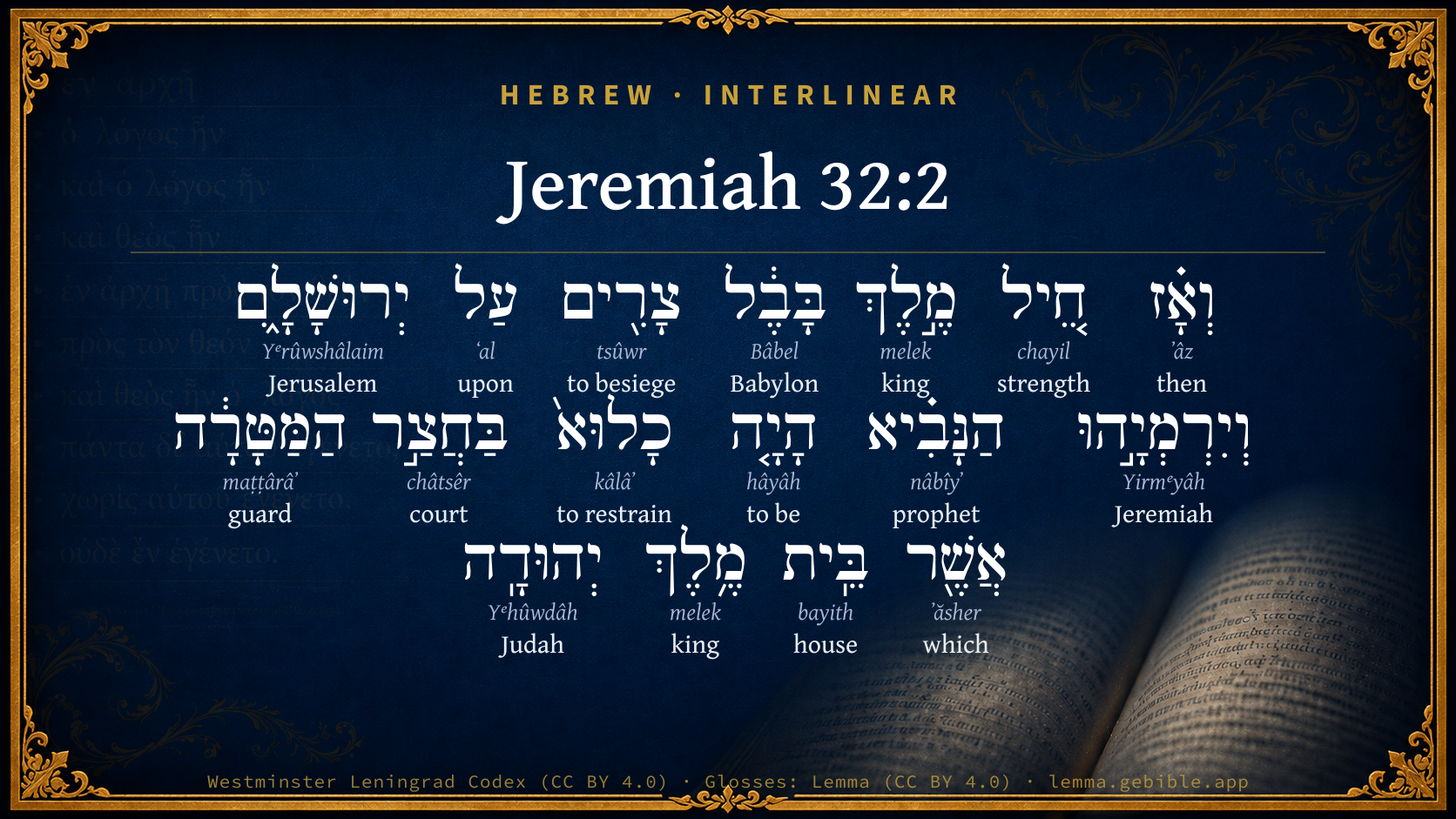
Jeremiah 32:2

Hebrew (Westminster Leningrad Codex) Jeremiah 32:2 appears in the Hebrew Old Testament. The text above is from the Westminster Leningrad Codex. Each word links to its Strong’s number, a concise gloss, and parsing drawn from the Open Scriptures Hebrew Bible morphology. Click any word for its full Brown-Driver-Briggs (BDB) entry.
Download image
Cite this verse

Jeremiah 32:2 (World English Bible). Public Domain. Lemma interlinear Bible study tool, https://lemma.gebible.app/v/jeremiah/32/2.

Show BibTeX & RIS
BibTeX
RIS
English Translation
Now at that time the king of Babylon's army was besieging Jerusalem; and Jeremiah the prophet was shut up in the court of the guard, which was in the king of Judah's house.
World English Bible · Public Domain
Download a study sheet

One document with this verse’s original text, its word-by-word gloss line, the meaning frame, cross-references with their text, attributed commentary, and full source and license credits — printable, and it pastes into notes with its structure intact.

This verse Autodidact and up

Study sheet (.html) Plain text (.txt)

A passage Seminary Student

Up to 50 verses in one chapter. A passage sheet keeps up to 6 commentary sources and 12 cross-references per verse, in the order this page ranks them, and says so on the sheet whenever that leaves anything out. Ask for a single verse and you get the Autodidact verse sheet above.

Everything on this page stays free to read, with no account — the sheet is a download of what is already on screen, not access to it.

Want to remove ads? Support Godless Engineer
Compare translations 3

The same verse in 3 English versions, stacked beneath the original-language interlinear above. Click any original word for its lexicon entry.

Each is an independent rendering of the whole verse — the interlinear is not word-aligned to these translations.

Highlighted words mark where these versions differ — a whole-verse word diff, not a word-by-word alignment.

  • World English Bible Public Domain
    Now at that time the king of Babylon's army was besieging Jerusalem; and Jeremiah the prophet was shut up in the court of the guard, which was in the king of Judah's house.
  • King James Version Public Domain
    For then the king of Babylon's army besieged Jerusalem: and Jeremiah the prophet was shut up in the court of the prison, which was in the king of Judah's house.
  • unfoldingWord Literal Text CC BY-SA 4.0
    At that time, the army of the king of Babylon was besieging Jerusalem, and Jeremiah the prophet was imprisoned in the courtyard of the guard at the house of the king of Judah.

unfoldingWord Literal Text — © unfoldingWord, licensed CC BY-SA 4.0. Word-aligned USFM3 via Door43 (git.door43.org/unfoldingWord/en_ult).

Versions to compare (up to 4)

3 of 4 selected

Show all 18 translations

Every available English version of this verse, each an independent rendering of the whole verse.

  • World English Bible Public Domain
    Now at that time the king of Babylon's army was besieging Jerusalem; and Jeremiah the prophet was shut up in the court of the guard, which was in the king of Judah's house.
  • Berean Standard Bible Public Domain
    At that time the army of the king of Babylon was besieging Jerusalem, and Jeremiah the prophet was imprisoned in the courtyard of the guard, which was in the palace of the king of Judah.
  • Majority Standard Bible Public Domain
    At that time the army of the king of Babylon was besieging Jerusalem, and Jeremiah the prophet was imprisoned in the courtyard of the guard, which was in the palace of the king of Judah.
  • King James Version Public Domain
    For then the king of Babylon's army besieged Jerusalem: and Jeremiah the prophet was shut up in the court of the prison, which was in the king of Judah's house.
  • American Standard Version (1901) Public Domain
    Now at that time the king of Babylon's army was besieging Jerusalem; and Jeremiah the prophet was shut up in the court of the guard, which was in the king of Judah's house.
  • Revised Version (1885) Public Domain
    Now at that time the king of Babylon’s army besieged Jerusalem: and Jeremiah the prophet was shut up in the court of the guard, which was in the king of Judah’s house.
  • Geneva Bible (1599) Public Domain
    For then the King of Babels hoste besieged Ierusalem: And Ieremiah the Prophet was shutte vp in the court of the prison, which was in the King of Iudahs house.
  • Douay-Rheims (1899) Public Domain
    At that time the army of the king o Babylon besieged Jerusalem: and Jeremias the prophet was shut up in the court of the prison, which was in the house of the king of Juda.
  • Young's Literal Translation Public Domain
    And then the forces of the king of Babylon are laying siege against Jerusalem, and Jeremiah the prophet hath been shut up in the court of the prison that `is' in the house of the king of Judah,
  • Literal Standard Version CC BY-SA 4.0
    And then the forces of the king of Babylon are laying siege against Jerusalem, and Jeremiah the prophet has been shut up in the court of the prison that [is] in the house of the king of Judah,
  • Unlocked Literal Bible CC BY-SA 4.0
    At that time, the army of the king of Babylon was besieging Jerusalem, and Jeremiah the prophet was imprisoned in the courtyard of the guard at the house of the king of Judah.
  • unfoldingWord Literal Text CC BY-SA 4.0
    At that time, the army of the king of Babylon was besieging Jerusalem, and Jeremiah the prophet was imprisoned in the courtyard of the guard at the house of the king of Judah.
  • Darby Bible Public Domain
    And the king of Babylon's army was then besieging Jerusalem; and the prophet Jeremiah was shut up in the court of the guard, which was in the king of Judah's house.
  • World Messianic Bible Public Domain
    Now at that time the king of Babylon’s army was besieging Jerusalem. Jeremiah the prophet was shut up in the court of the guard, which was in the king of Judah’s house.
  • Webster's Bible Public Domain
    For then the king of Babylon's army besieged Jerusalem: and Jeremiah the prophet was confined in the court of the prison, which was in the king of Judah's house.
  • Free Bible Version CC BY-SA 4.0
    This was when the army of the king of Babylon was besieging Jerusalem. Jeremiah the prophet was imprisoned in the guard's courtyard, part of the king of Judah's palace.
  • Bible in Basic English Public Domain
    Now at that time the king of Babylon's army was round Jerusalem, shutting it in: and Jeremiah the prophet was shut up in the place of the armed watchmen, in the house of the king of Judah.
  • JPS Tanakh (1917) Public Domain
    Now at that time the king of Babylon's army was besieging Jerusalem; and Jeremiah the prophet was shut up in the court of the guard, which was in the king of Judah's house.

Literal Standard Version (2020), Covenant Press — licensed CC BY-SA 4.0. Text via the HelloAO Bible API (eBible.org). Unlocked Literal Bible (unfoldingWord) — licensed CC BY-SA 4.0. Text via the HelloAO Bible API (eBible.org). unfoldingWord Literal Text — © unfoldingWord, licensed CC BY-SA 4.0. Word-aligned USFM3 via Door43 (git.door43.org/unfoldingWord/en_ult). Free Bible Version, Dr. Jonathan Gallagher — licensed CC BY-SA 4.0. Text via the HelloAO Bible API (eBible.org).

Word by word

More ways to search: Search by grammar → Find every occurrence → Compare this word →

Practice this passage: Drill this verse → Learn its vocabulary →

הַמַּטָּרָ֔ה
maṭṭârâʼ
H4307
“the · guard”
Particle, Definite Article + Noun, Common, Feminine, Singular, Absolute
Part of Speech
Particle + Noun
Type
Common
Gender
Feminine
Number
Singular
State
Absolute
Full BDB Definition

Origin: from H5201

TWOT: 1356a

guard, ward, prison, mark, target - guard, ward, prison - target, mark (figuratively of chastisement)
  1. וְאָ֗ז ʼâz H227 “and · then” Conjunction + Adverb
  2. חֵ֚יל chayil H2428 “strength of” Noun, Common, Masculine, Singular, Construct
  3. מֶ֣לֶךְ melek H4428 “king of” Noun, Common, Masculine, Singular, Construct
  4. בָּבֶ֔ל Bâbel H894 “Babylon” Noun, Proper
  5. צָרִ֖ים tsûwr H6696 “besieging” Verb, Qal, Participle Active, Masculine, Plural, Absolute
  6. עַל ʻal H5921 “upon” Preposition
  7. יְרוּשָׁלִָ֑ם Yᵉrûwshâlaim H3389 “Jerusalem” Noun, Proper
  8. וְיִרְמְיָ֣הוּ Yirmᵉyâh H3414 “and · Jeremiah” Conjunction + Noun, Proper
  9. הַנָּבִ֗יא nâbîyʼ H5030 “the · prophet” Particle, Definite Article + Noun, Common, Masculine, Singular, Absolute
  10. הָיָ֤ה hâyâh H1961 “to be” Verb, Qal, Perfect, 3rd Person, Masculine, Singular
  11. כָלוּא֙ kâlâʼ H3607 “restrained” Verb, Qal, Participle Passive, Masculine, Singular, Absolute
  12. בַּחֲצַ֣ר châtsêr H2691 “in/at · court of” Preposition + Noun, Common, Both, Singular, Construct
  13. אֲשֶׁ֖ר ʼăsher H834 “which” Particle, Relative
  14. בֵּֽית bayith H1004 “house of” Noun, Common, Masculine, Singular, Construct
  15. מֶ֥לֶךְ melek H4428 “king of” Noun, Common, Masculine, Singular, Construct
  16. יְהוּדָֽה Yᵉhûwdâh H3063 “Judah” Noun, Proper

About this verse

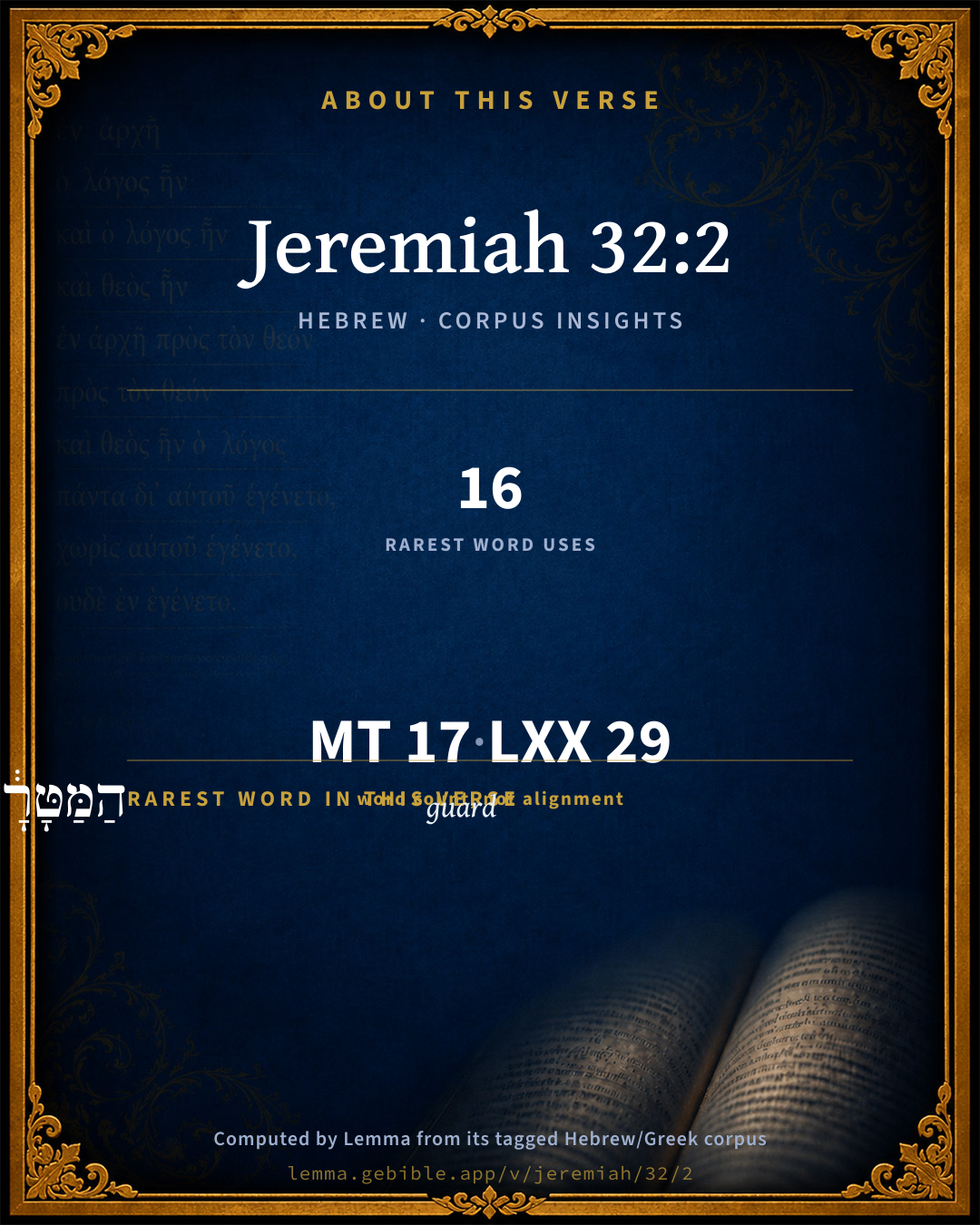
These counts appear in no published source. They are computed here, from the morphology-tagged text and Lemma’s own curated glosses. What Lemma adds →

17
words
16
distinct lemmas
Prophets
section

Notable vocabulary

The rarest word here is הַמַּטָּרָ֔ה guard H4307 — appearing just 16 times in the whole Hebrew Bible.

Shared distinctive vocabulary

הַמַּטָּרָ֔ה guard H4307 occurs in 15 verses of the Hebrew Bible. Also found in:

Grammatical profile

  • 3 verbs
  • 11 nouns
  • 1 preposition
  • 1 adverb
  • 1 particle

Verb forms

  • צָרִ֖ים Qal · Participle Active
  • הָיָ֤ה Qal · Perfect
  • כָלוּא֙ Qal · Participle Passive

Repetition

A word recurs within this verse — often emphatic in Hebrew:

  • מֶ֣לֶךְ king H4428 ×2

Hebrew & Septuagint length

In the original languages it is 17 Hebrew tokens and 29 Greek tokens — but the two are counted differently (Hebrew bundles its prefixes and suffixes into one token; the Greek is in lemma form), so that isn’t a like-for-like length.

Cross-references

9

Topical passages linked to Jeremiah 32:2 in the Treasury of Scripture Knowledge — connected by theme and wording, ordered by reader-vote popularity; previews shown in the World English Bible.

  • Jeremiah 37:21 Then Zedekiah the king commanded, and they committed Jeremiah into the court of the guard; and they gave him daily a loaf of bread out of the bakers' street, until all the bread in the city was spent. Thus Jeremiah remained in the court of the guard.
  • Nehemiah 3:25 Palal the son of Uzai [repaired] over against the turning [of the wall], and the tower that stands out from the upper house of the king, which is by the court of the guard. After him Pedaiah the son of Parosh [repaired].
  • Jeremiah 33:1 Moreover the word of Yahweh came to Jeremiah the second time, while he was yet shut up in the court of the guard, saying,
  • Jeremiah 38:6 Then took they Jeremiah, and cast him into the dungeon of Malchijah the king's son, that was in the court of the guard: and they let down Jeremiah with cords. In the dungeon there was no water, but mire; and Jeremiah sank in the mire.
  • Jeremiah 32:8 So Hanamel my uncle's son came to me in the court of the guard according to the word of Yahweh, and said to me, Please buy my field that is in Anathoth, which is in the land of Benjamin; for the right of inheritance is yours, and the redemption is yours; buy it for yourself. Then I knew that this was the word of Yahweh.
  • Jeremiah 36:5 Jeremiah commanded Baruch, saying, I am shut up; I can't go into the house of Yahweh:
  • Jeremiah 39:13–15 So Nebuzaradan the captain of the guard sent, and Nebushazban, Rabsaris, and Nergal Sharezer, Rabmag, and all the chief officers of the king of Babylon;
  • Matthew 5:12 Rejoice, and be exceedingly glad, for great is your reward in heaven. For that is how they persecuted the prophets who were before you.
  • Jeremiah 32:3 For Zedekiah king of Judah had shut him up, saying, Why do you prophesy, and say, Thus says Yahweh, Behold, I will give this city into the hand of the king of Babylon, and he shall take it;

Cross-references courtesy of OpenBible.info (CC BY 4.0).

Hebrew and Greek witnesses Masoretic Hebrew ↔ Greek Septuagint

The same verse in the two great witnesses to the Old Testament, shown verse-for-verse.

These are two independent witnesses, not word-aligned to each other, and the Septuagint is shown in lemma (dictionary) form.

Hebrew Jeremiah 32:2 Masoretic · Westminster Leningrad Codex

וְאָ֗ז חֵ֚יל מֶ֣לֶךְ בָּבֶ֔ל צָרִ֖ים עַל יְרוּשָׁלִָ֑ם וְיִרְמְיָ֣הוּ הַנָּבִ֗יא הָיָ֤ה כָלוּא֙ בַּחֲצַ֣ר הַמַּטָּרָ֔ה אֲשֶׁ֖ר בֵּֽית מֶ֥לֶךְ יְהוּדָֽה

Now at that time the king of Babylon's army was besieging Jerusalem; and Jeremiah the prophet was shut up in the court of the guard, which was in the king of Judah's house.

World English Bible · Public Domain

Greek LXX Structure differs

In the Septuagint, Jeremiah is about an eighth shorter than the Hebrew and arranges its material differently — the Oracles Against the Nations (Hebrew chapters 46–51) appear in the middle of the Greek book, after 25:13. Because the chapter and verse boundaries do not line up, a verse-for-verse comparison with the Hebrew is not shown.

A verse-for-verse comparison isn’t shown here because the chapters and verses don’t line up. Switch to the LXX edition with the MT / LXX toggle above to read the Greek directly.

Hebrew: Westminster Leningrad Codex (CC BY 4.0). Greek: Septuagint (public domain); English from a public-domain English Septuagint. How the Septuagint differs from the Hebrew →

Targum (Aramaic paraphrase)

1

The Targum is the ancient Jewish Aramaic paraphrase of the Hebrew Scriptures — an interpretive translation, not the Hebrew text itself. Onkelos (literal) and Pseudo-Jonathan (expansive) render the Torah, and Jonathan the Prophets. Coverage is partial: where no permissively-licensed English translation exists for a verse, only the Aramaic is shown. This is verse-level text, not a word-by-word alignment to the Hebrew.

  1. Targum Jonathan Prophets (Joshua–Malachi)
    בְּכֵן מַשִׁרְיַת מַלְכָּא דְבָבֶל צַיָרִין עַל יְרוּשְׁלֵם וְיִרְמְיָה נְבִיָא הֲוָה כָלֵי בְּדָרַת בֵּית אֲסִירַיָא דִי בְּבֵית מְלַךְ שִׁבְטָא דְבֵית יְהוּדָה:

    (no public-domain English translation for this verse)

    Targum Jonathan — Aramaic: “Mikraot Gedolot” (public domain). English: “Sefaria Community Translation” (CC0 1.0 (public-domain dedication)); “London "Chaldee Paraphrase," 1871” (public domain). Text via Sefaria.

Commentary

Notes on Jeremiah 32:2 from classic Christian and Jewish commentators (each source and its license shown beneath its notes). The classic Christian expositions comment on the surrounding passage and are grouped to its opening verse, so a note may address several verses; the Jewish commentaries on the Tanakh (Rashi and others) are per-verse, so they appear only where the commentator wrote on this verse.

Lemma curates 59 commentaries, every one of them public domain or Creative Commons licensed, each selected and text-cleaned for this edition rather than reprinted as found. About our sources →

Trapp's Complete Commentary

John Trapp

Jer 32:2 For then the king of Babylon’s army besieged Jerusalem: and Jeremiah the prophet was shut up in the court of the prison, which [was] in the king of Judah’s house.

Ver. 2. And Jeremiah the prophet was shut up in the court of the prison.] Where he had some liberty more than at some other times. {Jer 37:16; Jer 37:20-21} So had Paul at Rome, {Act 28:16; Act 28:30} Bradford in the counter, &c.; this was a mercy, and so they esteemed it. Good people were suffered to come about them; and they made use of that opportunity to do what good they could.

John Trapp, A Commentary or Exposition upon All the Books of the Old and New Testament (1647–1656) — public domain. Text from a community e-Sword module.

Tyndale Open Study Notes

Tyndale Open Resources

32:2 Jerusalem had been under siege since January 588 BC (2 Kgs 25:1). • Jeremiah favored surrender to the Babylonians, but the thought angered many who believed that they could successfully defy the foreign army. To protect Jeremiah, Zedekiah imprisoned him in the courtyard of the guard (Jer 37:21).

Tyndale Open Study Notes — © Tyndale Open Resources, licensed CC BY-SA 4.0. Text via the HelloAO Bible API.

Jamieson, Fausset & Brown

Robert Jamieson, A. R. Fausset & David Brown

in . . . court of . . . prison--that is, in the open space occupied by the guard, from which he was not allowed to depart, but where any of his friends might visit him (Jer 32:12; Jer 38:13, Jer 38:28). Marvellous obstinacy, that at the time when they were experiencing the truth of Jeremiah's words in the pressure of the siege, they should still keep the prophet in confinement [CALVIN]. The circumstances narrated (Jer 32:3-5) occurred at the beginning of the siege, when Jeremiah foretold the capture of the city (Jer 32:1; Jer 34:1-7; Jer 39:1). He was at that time put into free custody in the court of the prison. At the raising of the siege by Pharaoh-hophra, Jeremiah was on the point of repairing to Benjamin, when he was cast into "the dungeon," but obtained leave to be removed again to the court of the prison (Jer 37:12-21). When there he urged the Jews, on the second advance of the Chaldeans to the siege, to save themselves by submission to Nebuchadnezzar (Jer 38:2-3); in consequence of this the king, at the instigation of the princes, had him cast into a miry dungeon (Jer 38:4-6); again he was removed to the prison court at the intercession of a courtier (Jer 32:7-13), where he remained till the capture of the city (Jer 32:28), when he was liberated (Jer 39:11, &c.; Jer 40:1, &c.).

Jamieson, Fausset & Brown — Commentary Critical and Explanatory on the Whole Bible (1871) — public domain (CC PDM 1.0). Text via the HelloAO Bible API.

Adam Clarke's Commentary

Verse 2. Then the king of Babylon's army besieged Jerusalem] The siege had commenced the year before, and continued a year after, ending in the fifth month of the following year; consequently, the siege must have lasted about eighteen months and twenty-seven days. See 2Kg 25:18.

Adam Clarke's Commentary on the Bible (1810–1826) — public domain. Text from a community e-Sword/MySword module.

John Calvin's Commentaries

He points out then the circumstances of that time, and not without reason, when he says, that he was then shut up in prison, and also mentions the year, even the tenth of Zedekiah and the eighteenth of king Nebuchadnezar. It was about the end of the ninth year that the army of Nebuchadnezar came up to Jerusalem; the city was besieged for two months in that year. The tenth year followed, in which this vision was given to the Prophet. The siege continued for a year and a half; but there was some interruption; for the Egyptians came to its aid. Thus for a short time, while the Chaldeans went to meet them, it had some liberty. But the Egyptians, as we shall hereafter see, were forced to retire in disgrace, and afterwards suffered punishment for their audacity and rashness. It was then about the middle of the siege that God, as we shall see, foretold to the Prophet the future return of the people. But though God shewed a regard for the miserable exiles, he yet at the same time confirmed what he had previously said of his future vengeance; for the people could not be restored before they had been driven into exile. It was indeed a dreadful instance of hardness and obduracy, that having been so often scourged they received no benefit. They had experienced the heavy judgment of God under Jehoiakim, and also under Jeconiah; but the memory of these calamities had soon vanished, and they lived as securely as though they had never heard a word from the mouth of Jeremiah: and he was not the only one who had threatened them, but there were before him Isaiah and others, and at the same time with him was Ezekiel, who had been exiled into Chaldea. Then from the number of years we conclude how great must have been the obstinacy of the people.

At the same time we must observe how seasonable was this prophecy for alleviating the minds of the godly, as they were not far from extreme calamity; for it was in the eleventh year of Zedekiah and in the fourth month that the city was taken and demolished, the people driven into exile, and the Temple burnt. Then there were not more than six or seven months, perhaps, to the time of their utter ruin; there is indeed no mention made here of the month in which the Prophet received the vision, but the tenth year is only mentioned. Now, the city was taken at the beginning of the eleventh year, as we have stated. Hence then comes more fully to light the extreme perverseness of the people; for while the enemy surrounded the city, they held Jeremiah captive. He had already foretold many years past what experience then taught them to be true. For forty years he had not ceased to cry out and to strive by warning, exhorting, and threatening them to lead them to repentance. As then nothing new happened to them, and as they found by the evils which came on them that Jeremiah had been a true and faithful servant of God, what was their object in shutting him up in prison? was not this to carry on war with God? for what had they to do with Jeremiah? He had not evidently acted a private part, nor had he only dreamt of what he had so often foretold them. Then they did not fight with a mortal man, but like the giants they dared to raise up their horns against God himself.

For the same reason also, he calls himself a Prophet This indeed he often did, but there is no doubt but that the indignity offered to him is pointed out, that even at the time when the Chaldeans surrounded the city with their army, Jeremiah the Prophet was shut up in the court of the prison. He might have only said, that Jeremiah was shut up, but for honor’s sake he assumed the title of a Prophet, that hence might appear more evidently the baseness of the people’s contumacy, that though they perceived that God was angry with them, they yet ceased not from their presumption; for they then held the Prophet in prison as though they were fighting with God himself. We know that fools, according to the old proverb, being chastised, become wise. If then the Jews had a particle or a spark of wisdom, they might have been so subdued by evils and calamities as to cast aside their haughtiness and obstinacy. But we see that they were untameable, and through a mad fury persisted in their wickedness; for though besieged by their enemies, they yet attempted to hold God as it were captive in the person of his servant.

As to the court of the prison, I doubt not but it was a milder sort of imprisonment, for we shall hereafter see that the Prophet prayed that he might not be thence thrown into the dark prison where he had been. He sought it as no common favor to remain in some prison; and he was as yet exposed to the mockeries of all. However this may have been, we see that the people had then become nothing better, though they had already been chastised and scourged by God.

We ought at the same timeto bear in mind what I have already said, that though the ungodly sought in all ways wholly to extinguish the word of God, they yet did not attain what they wished; for God broke through all hinderances, and continued the course of his word notwithstanding all their attempts. And this ought to be carefully noticed, for we see at this day all sorts of contrivances made by the wicked to impede the course of celestial truth. Let then this history be remembered, that though Jeremiah was a captive, yet his word was free and his tongue at liberty, as Paul also boasts, that though he was bound with chains, yet God’s word was not bound. (2 Timothy 2:9)

John Calvin's Commentaries (1540-1563) — public domain. Text from the Calvin Translation Society English edition (1840s-50s) via the Christian Classics Ethereal Library (ccel.org). Calvin's coverage is partial (roughly two-thirds of the Bible); uncommented books and verses are honest gaps, never fabricated. The 19th-century editor's footnotes and remarks are omitted so the notes are faithfully Calvin's own voice.

The Cambridge Bible for Schools and Colleges

gen. ed. J. J. S. Perowne

2. the court of the guard] not meaning the place where a guard, or body of men, were posted but “a part of the court surrounding the Palace railed off to guard prisoners in, whom it was not desired to throw into the common dungeon” (Dr. ad loc.; see also his note p. 367). Cp. Neh_3:25; Neh_12:39.

The Cambridge Bible for Schools and Colleges (gen. ed. J. J. S. Perowne; Cambridge University Press, 1878–1918) — public domain. Text from a community e-Sword module.

John Gill's Exposition

For then the king of Babylon's army besieged Jerusalem,.... And had done so for some time; for the siege began in the ninth year of Zedekiah's reign, on the tenth day of the tenth month, Jer 52:4;

and Jeremiah the prophet was shut up in the court of the prison, which was in the king of Judah's house; which showed great stupidity and hardness of heart in the king, and his courtiers, and in the people, to imprison a prophet of the Lord, when surrounded by an enemy's army, and that according to the prediction of the prophet; by which it appeared that he was a true prophet; and they might reasonably expect that the rest of his predictions, which related to the taking of their city, and carrying them captive, would be fulfilled. It is true, indeed, he was in a better prison than before, more honourable, being within the limits of the king's house; and, besides, was not closely confined, but allowed to walk in the court of the prison; and so had a free air to breathe in, and more company to converse with, and could exercise himself by walking about; perhaps he was placed here to keep him from prophesying to the people to their discouragement, and the more to awe him, as he was under the eye of the king and his ministry. Of this prison and its court mention is made in Neh 3:25; it seems to have been for state prisoners.

John Gill's Exposition of the Whole Bible (1746–1763) — public domain (CC PDM 1.0). Text via the HelloAO Bible API.

Albert Barnes' Notes on the Bible

The prison - Or, the guard, a part of the king’s palace, probably where the royal guard had its quarters.

Albert Barnes' Notes on the Bible (1834–1885) — public domain. Text from a community e-Sword/MySword module.

Haydock's Catholic Bible Commentary

Court, at large, so that people might come to him freely. He was not chained or in prison, as [in] chap. xxxvii. 15., and xxxviii. 6, 13. (Calmet)

George Leo Haydock (1774–1849), Haydock's Catholic Family Bible and Commentary, 1859 edition — public domain. Excludes Psalms (Douay-Rheims chapter numbering differs from Protestant) and Deuterocanonical books (Catholic canon only).

Matthew Poole's English Annotations

The king of Babylon (as appears from 2Ki 25:1; Jer 39:1) besieged Jerusalem in the tenth month of the ninth year of Zedekiah, so as he had besieged it some time before the revelation of this prophecy came to Jeremiah. Jeremiah was at that time a prisoner, in a prison within the king’s house. The king could keep him from revealing God’s will to the people, but he could not keep God from revealing himself to him. Prisons hinder us from communion with men, but often contribute to God’s people freer and sweeter communion with him. In the mean time the desperate hardness of this prince and these people’s hearts appear, in that the fear of an enemy besieging them could not awe them from such outrageous acts of persecution.

Matthew Poole's English Annotations on the Holy Bible (1683–1685) — public domain. Text from a community e-Sword/MySword module.

Whedon's Commentary on the Bible

Daniel D. Whedon

2. Jeremiah the prophet was shut up — He had been arrested in an attempt to flee from Jerusalem, (Jer_37:13,) and was kept in custody until the end of the siege. He seems, however, to have enjoyed considerable liberty, being kept, not in the “dungeon,” (Jer_38:13,) but in the “court of the prison,” (Jer_37:21,) where his friends were permitted access to him. So far from contradicting the thirty-seventh chapter as to the cause of Jeremiah’s imprisonment, this account is fully confirmatory, differing indeed in form and in fulness, but harmonizing perfectly in spirit and substance.

Daniel D. Whedon (gen. ed.), Commentary on the Old and New Testaments (1874–1909) — public domain. Text from a community e-Sword module.

The Pulpit Commentary

In the court of the prison; or, the court of the guard, which adjoined the royal palace. (Neh_3:25)

The Pulpit Commentary (1880–1919), ed. H.D.M. Spence-Jones & Joseph S. Exell — public domain. Text from a community e-Sword module.

Rashi

Rabbi Shlomo Yitzchaki (Rashi)

was besieging an expression of a siege (מָצוֹר).

in the prison yard an expression of “the prison” (בֵּית הַמִֹּשְמָר).

Rashi on the Tanakh — English translations: “The Judaica Press complete Tanach with Rashi, translated by A. J. Rosenberg” (CC BY 4.0); “Pentateuch with Rashi's commentary by M. Rosenbaum and A.M. Silbermann, 1929-1934” (public domain); “The Metsudah Tanach series, Lakewood, N.J” (CC BY 4.0); and “The Book of Joshua, Metsudah Publications, 1997” (CC BY 4.0). Text via Sefaria.

Lesson kit

Teaching starters — assembled from the data on this page, not authored interpretation. Every prompt links to the verse data it draws on. Edit before teaching.

Jeremiah, in the Prophets, opens this verse with 17 words (16 distinct Hebrew lemmas). Its most distinctive word is maṭṭârâʼ (“guard”). A historical commentator’s framing appears above. Read the whole chapter for the surrounding context.

Discussion questions

  1. How does “guard” (maṭṭârâʼ) shape what this verse is saying?
  2. 1 Samuel 20:20 shares the word «guard» with this verse. How do the two illuminate each other?
  3. “king” occurs 2× in this one verse. What is the effect of the repetition?
  4. These translations render this verse differently. What is at stake in choosing one wording over another?
  5. The verb «צָרִ֖ים» is Qal Participle Active. How does its form color the action?
  6. Reading how Trapp's Complete Commentary and Tyndale Open Study Notes read this verse, where do the two commentators agree and where do they part?

Things to notice

Reading settings

Reading text

Shown beneath each verse's original-language words.

Old Testament
Old Testament edition

Read the OT as the Masoretic Hebrew (MT) or the Greek Septuagint (LXX).

English shown for the Greek Septuagint (in the Hebrew ↔ Greek comparison).

Comparing translations? Open the Compare panel on any verse page to stack up to four side by side.