
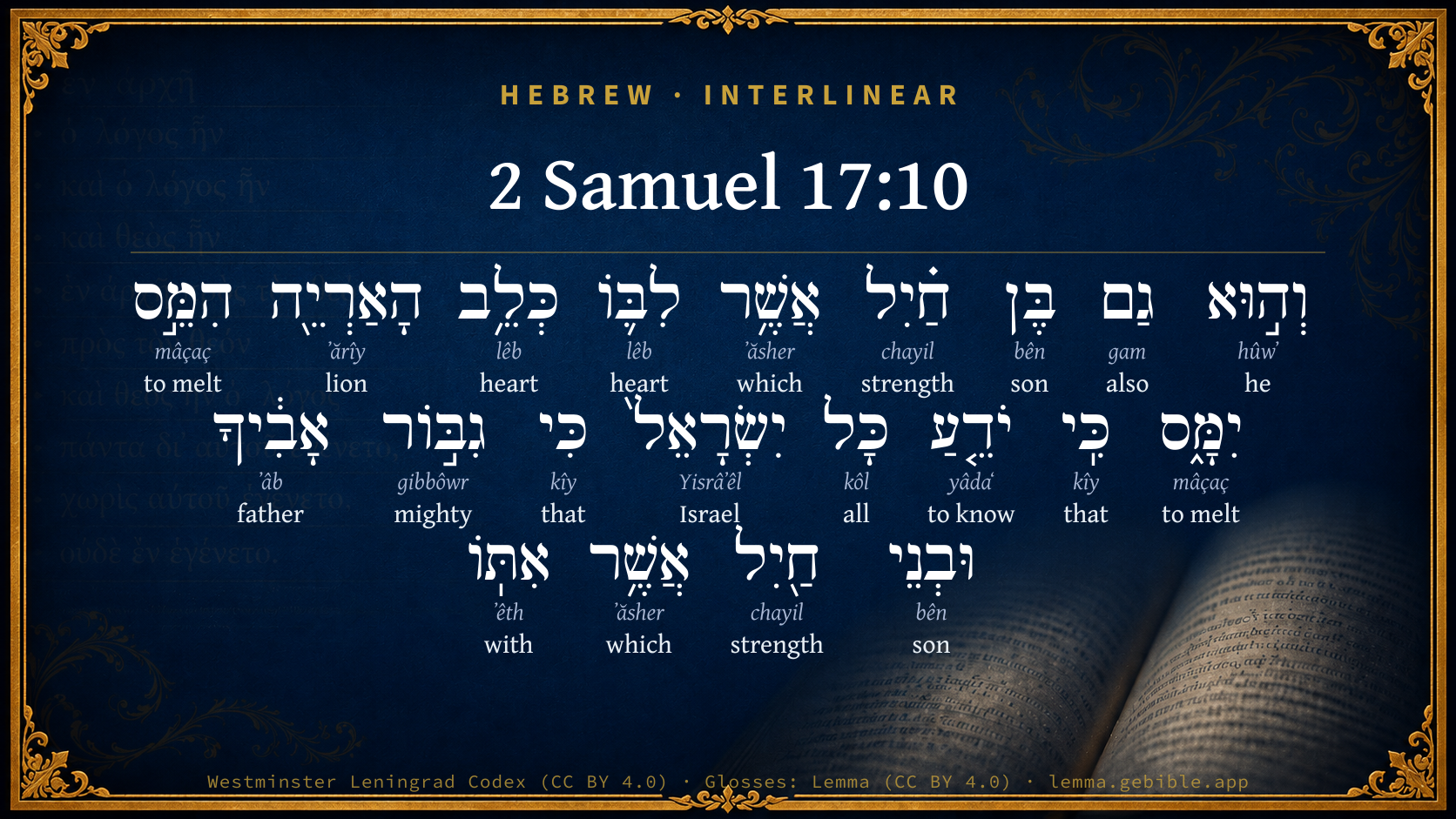
2 Samuel 17:10

Hebrew (Westminster Leningrad Codex) 2 Samuel 17:10 appears in the Hebrew Old Testament. The text above is from the Westminster Leningrad Codex. Each word links to its Strong’s number, a concise gloss, and parsing drawn from the Open Scriptures Hebrew Bible morphology. Click any word for its full Brown-Driver-Briggs (BDB) entry.
Download image
Cite this verse

2 Samuel 17:10 (World English Bible). Public Domain. Lemma interlinear Bible study tool, https://lemma.gebible.app/v/2-samuel/17/10.

Show BibTeX & RIS
BibTeX
RIS
English Translation
Even he who is valiant, whose heart is as the heart of a lion, will utterly melt; for all Israel knows that your father is a mighty man, and those who are with him are valiant men.
World English Bible · Public Domain
Download a study sheet

One document with this verse’s original text, its word-by-word gloss line, the meaning frame, cross-references with their text, attributed commentary, and full source and license credits — printable, and it pastes into notes with its structure intact.

This verse Autodidact and up

Study sheet (.html) Plain text (.txt)

A passage Seminary Student

Up to 50 verses in one chapter. A passage sheet keeps up to 6 commentary sources and 12 cross-references per verse, in the order this page ranks them, and says so on the sheet whenever that leaves anything out. Ask for a single verse and you get the Autodidact verse sheet above.

Everything on this page stays free to read, with no account — the sheet is a download of what is already on screen, not access to it.

Want to remove ads? Support Godless Engineer
Compare translations 3

The same verse in 3 English versions, stacked beneath the original-language interlinear above. Click any original word for its lexicon entry.

Each is an independent rendering of the whole verse — the interlinear is not word-aligned to these translations.

Highlighted words mark where these versions differ — a whole-verse word diff, not a word-by-word alignment.

  • World English Bible Public Domain
    Even he who is valiant, whose heart is as the heart of a lion, will utterly melt; for all Israel knows that your father is a mighty man, and those who are with him are valiant men.
  • King James Version Public Domain
    And he also that is valiant, whose heart is as the heart of a lion, shall utterly melt: for all Israel knoweth that thy father is a mighty man, and they which be with him are valiant men.
  • unfoldingWord Literal Text CC BY-SA 4.0
    And even he, a son of valor whose heart like the heart of a lion, melting, he will melt, because all of Israel knows that your father a warrior and who with him sons of valor.

unfoldingWord Literal Text — © unfoldingWord, licensed CC BY-SA 4.0. Word-aligned USFM3 via Door43 (git.door43.org/unfoldingWord/en_ult).

Versions to compare (up to 4)

3 of 4 selected

Show all 18 translations

Every available English version of this verse, each an independent rendering of the whole verse.

  • World English Bible Public Domain
    Even he who is valiant, whose heart is as the heart of a lion, will utterly melt; for all Israel knows that your father is a mighty man, and those who are with him are valiant men.
  • Berean Standard Bible Public Domain
    Then even the most valiant soldier with the heart of a lion will melt with fear, because all Israel knows that your father is a mighty man who has valiant men with him.
  • Majority Standard Bible Public Domain
    Then even the most valiant soldier with the heart of a lion will melt with fear, because all Israel knows that your father is a mighty man who has valiant men with him.
  • King James Version Public Domain
    And he also that is valiant, whose heart is as the heart of a lion, shall utterly melt: for all Israel knoweth that thy father is a mighty man, and they which be with him are valiant men.
  • American Standard Version (1901) Public Domain
    And even he that is valiant, whose heart is as the heart of a lion, will utterly melt; for all Israel knoweth that thy father is a mighty man, and they that are with him are valiant men.
  • Revised Version (1885) Public Domain
    And even he that is valiant, whose heart is as the heart of a lion, shall utterly melt: for all Israel knoweth that thy father is a mighty man, and they which be with him are valiant men.
  • Geneva Bible (1599) Public Domain
    Then he also that is valiant whose heart is as the heart of a lion, shall shrinke and faint: for all Israel knoweth, that thy father is valiant, and they which be with him, stout men.
  • Douay-Rheims (1899) Public Domain
    And the most valiant man whose heart is as the heart of a lion, shall melt for fear: for all the people of Israel know thy father to be a valiant man, and that all who are with him are valiant.
  • Young's Literal Translation Public Domain
    and he also, the son of valour, whose heart `is' as the heart of the lion, doth utterly melt, for all Israel doth know that thy father is a hero, and sons of valour `are' those with him.
  • Literal Standard Version CC BY-SA 4.0
    and he also, the son of valor, whose heart [is] as the heart of the lion, utterly melts, for all Israel knows that your father is a hero, and those with him [are] sons of valor.
  • Unlocked Literal Bible CC BY-SA 4.0
    Then even the bravest soldiers, whose hearts are like the heart of a lion, will be afraid because all Israel knows that your father is a mighty man, and that the men who are with him are very strong.
  • unfoldingWord Literal Text CC BY-SA 4.0
    And even he, a son of valor whose heart like the heart of a lion, melting, he will melt, because all of Israel knows that your father a warrior and who with him sons of valor.
  • Darby Bible Public Domain
    and even the valiant man whose heart is as the heart of a lion shall utterly melt; for all Israel knows that thy father is a mighty man, and they that are with him are valiant men.
  • World Messianic Bible Public Domain
    Even he who is valiant, whose heart is as the heart of a lion, will utterly melt; for all Israel knows that your father is a mighty man, and those who are with him are valiant men.
  • Webster's Bible Public Domain
    And he also that is valiant, whose heart is as the heart of a lion, will utterly melt: for all Israel knoweth that thy father is a mighty man, and they who are with him are valiant men.
  • Free Bible Version CC BY-SA 4.0
    Then even the bravest soldier who has the heart of a lion will be scared to death, because everyone in Israel knows that your father is a powerful man who has brave men with him.
  • Bible in Basic English Public Domain
    Then even the strongest, whose heart is like the heart of a lion, will become like water; for all Israel is conscious that your father is a man of war, and those who are with him are strong and without fear.
  • JPS Tanakh (1917) Public Domain
    then even he that is valiant, whose heart is as the heart of a lion, will utterly melt; for all Israel knoweth that thy father is a mighty man, and they that are with him are valiant men.

Literal Standard Version (2020), Covenant Press — licensed CC BY-SA 4.0. Text via the HelloAO Bible API (eBible.org). Unlocked Literal Bible (unfoldingWord) — licensed CC BY-SA 4.0. Text via the HelloAO Bible API (eBible.org). unfoldingWord Literal Text — © unfoldingWord, licensed CC BY-SA 4.0. Word-aligned USFM3 via Door43 (git.door43.org/unfoldingWord/en_ult). Free Bible Version, Dr. Jonathan Gallagher — licensed CC BY-SA 4.0. Text via the HelloAO Bible API (eBible.org).

Word by word

More ways to search: Search by grammar → Find every occurrence → Compare this word →

Practice this passage: Drill this verse → Learn its vocabulary →

הִמֵּ֣ס
mâçaç
H4549
“to melt”
Verb, Niphal, Infinitive Absolute
Part of Speech
Verb
Stem
Niphal
Form
Infinitive Absolute
Full BDB Definition

Origin: a primitive root

TWOT: 1223

to dissolve, melt - (Qal) to waste away - (Niphal) - to melt, vanish, drop off, melt away - to faint, grow fearful (figuratively) - wasted, worthless (participle) - (Hiphil) to cause to melt
  1. וְה֣וּא hûwʼ H1931 “and · he” Conjunction + Pronoun, Personal, 3rd Person, Masculine, Singular
  2. גַם gam H1571 “also” Adverb
  3. בֶּן bên H1121 “son of” Noun, Common, Masculine, Singular, Construct
  4. חַ֗יִל chayil H2428 “strength” Noun, Common, Masculine, Singular, Absolute
  5. אֲשֶׁ֥ר ʼăsher H834 “which” Particle, Relative
  6. לִבּ֛וֹ lêb H3820 “heart · his” Noun, Common, Masculine, Singular, Construct + Suffix, Personal, 3rd Person, Masculine, Singular
  7. כְּלֵ֥ב lêb H3820 “like/as · heart of” Preposition + Noun, Common, Masculine, Singular, Construct
  8. הָאַרְיֵ֖ה ʼărîy H738 “the · lion” Particle, Definite Article + Noun, Common, Masculine, Singular, Absolute
  9. יִמָּ֑ס mâçaç H4549 “to melt” Verb, Niphal, Imperfect, 3rd Person, Masculine, Singular
  10. כִּֽי kîy H3588 “that” Conjunction
  11. יֹדֵ֤עַ yâdaʻ H3045 “knowing” Verb, Qal, Participle Active, Masculine, Singular, Absolute
  12. כָּל kôl H3605 “all of” Noun, Common, Masculine, Singular, Construct
  13. יִשְׂרָאֵל֙ Yisrâʼêl H3478 “Israel” Noun, Proper
  14. כִּי kîy H3588 “that” Conjunction
  15. גִבּ֣וֹר gibbôwr H1368 “mighty” Adjective, Adjective, Masculine, Singular, Absolute
  16. אָבִ֔יךָ ʼâb H1 “father · your” Noun, Common, Masculine, Singular, Construct + Suffix, Personal, 2nd Person, Masculine, Singular
  17. וּבְנֵי bên H1121 “and · sons of” Conjunction + Noun, Common, Masculine, Plural, Construct
  18. חַ֖יִל chayil H2428 “strength” Noun, Common, Masculine, Singular, Absolute
  19. אֲשֶׁ֥ר ʼăsher H834 “which” Particle, Relative
  20. אִתּֽוֹ ʼêth H854 “with · him” Preposition + Suffix, Personal, 3rd Person, Masculine, Singular

About this verse

These counts appear in no published source. They are computed here, from the morphology-tagged text and Lemma’s own curated glosses. What Lemma adds →

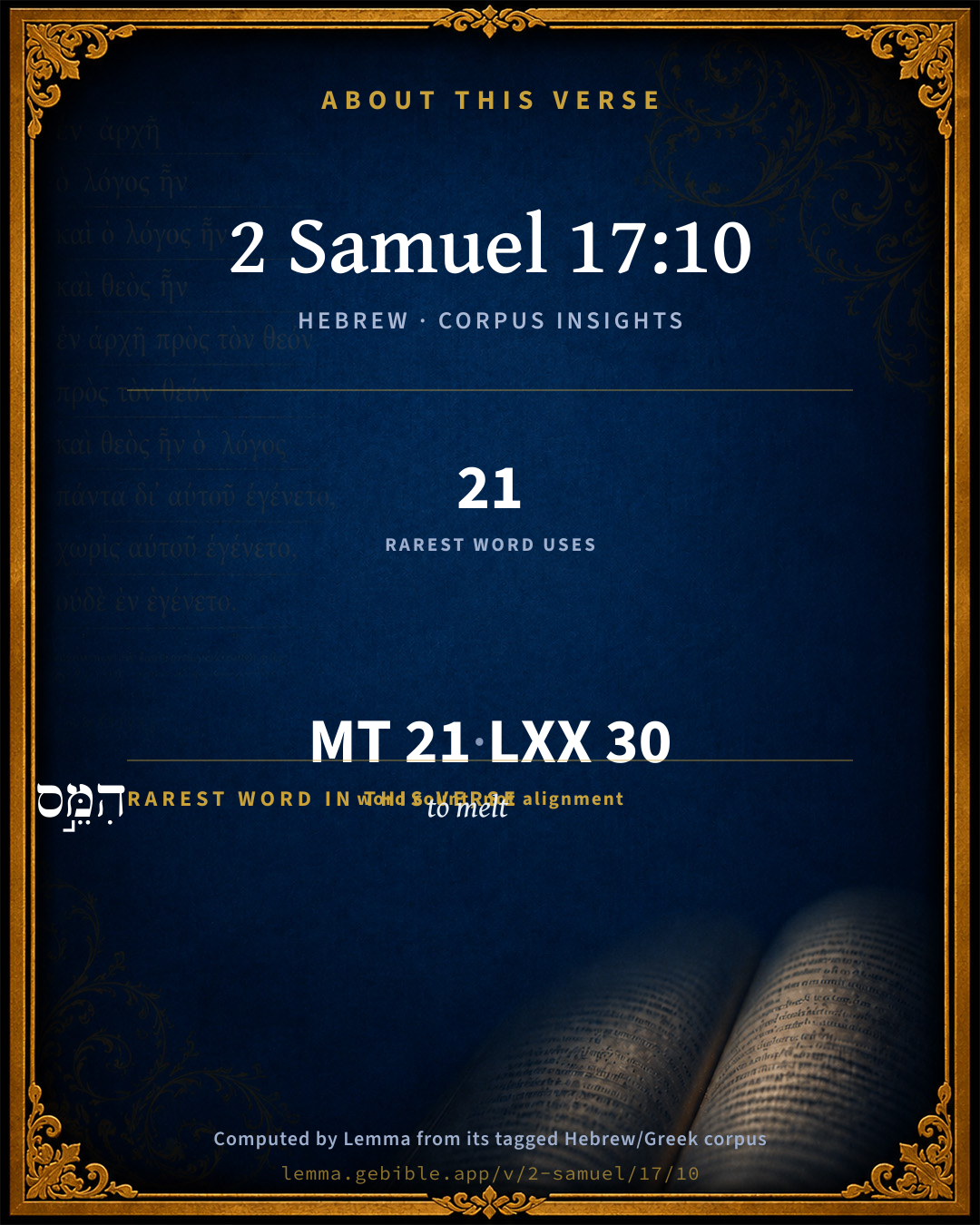
21
words
15
distinct lemmas
Historical
section

Notable vocabulary

The rarest word here is הִמֵּ֣ס to melt H4549 — appearing just 21 times in the whole Hebrew Bible.

Shared distinctive vocabulary

הִמֵּ֣ס to melt H4549 occurs in 20 verses of the Hebrew Bible. Also found in:

Grammatical profile

  • 3 verbs
  • 10 nouns
  • 1 adjective
  • 1 pronoun
  • 1 preposition
  • 2 conjunctions
  • 1 adverb
  • 2 particles

Verb forms

  • הִמֵּ֣ס Niphal · Infinitive Absolute
  • יִמָּ֑ס Niphal · Imperfect
  • יֹדֵ֤עַ Qal · Participle Active

Repetition

Words recur within this verse — often emphatic in Hebrew:

  • בֶּן son H1121 ×2
  • חַ֗יִל strength H2428 ×2
  • לִבּ֛וֹ heart H3820 ×2
  • הִמֵּ֣ס to melt H4549 ×2
  • אֲשֶׁ֥ר which H834 ×2
  • כִּֽי that H3588 ×2

Hebrew & Septuagint length

In English translation the verse runs 37 words from the Hebrew and 37 from the Septuagint (LXX English) — the same length.

A rough comparison of the two English renderings, which tokenize alike — not a word-level alignment.

Word counts can differ between the Hebrew and the Greek without any difference in meaning — e.g. the Hebrew direct-object marker אֵת has no separate Greek word, and Greek often adds the article ὁ.

In the original languages it is 21 Hebrew tokens and 30 Greek tokens — but the two are counted differently (Hebrew bundles its prefixes and suffixes into one token; the Greek is in lemma form), so that isn’t a like-for-like length.

Cross-references

13

Topical passages linked to 2 Samuel 17:10 in the Treasury of Scripture Knowledge — connected by theme and wording, ordered by reader-vote popularity; previews shown in the World English Bible.

  • Joshua 2:9–11 and she said to the men, I know that Yahweh has given you the land, and that the fear of you is fallen on us, and that all the inhabitants of the land melt away before you.
  • Genesis 49:9 Judah is a lion's cub. From the prey, my son, you have gone up. He stooped down, he crouched as a lion, As a lioness. Who will rouse him up?
  • Exodus 15:15 Then the chiefs of Edom were dismayed. Trembling takes hold of the mighty men of Moab. All the inhabitants of Canaan are melted away.
  • Numbers 24:8–9 God brings him forth out of Egypt; He has as it were the strength of the wild-ox: He shall eat up the nations his adversaries, Shall break their bones in pieces, Smite [them] through with his arrows.
  • Deuteronomy 1:28 Where are we going up? our brothers have made our heart to melt, saying, The people are greater and taller than we; the cities are great and fortified up to the sky; and moreover we have seen the sons of the Anakim there.
  • 1 Samuel 18:17 Saul said to David, Behold, my elder daughter Merab, her will I give you as wife: only be valiant for me, and fight Yahweh's battles. For Saul said, Don't let my hand be on him, but let the hand of the Philistines be on him.
  • 2 Samuel 1:23 Saul and Jonathan were lovely and pleasant in their lives, In their death they were not divided: They were swifter than eagles, They were stronger than lions.
  • 2 Samuel 23:20 Benaiah the son of Jehoiada, the son of a valiant man of Kabzeel, who had done mighty deeds, he killed the two [sons of] Ariel of Moab: he went down also and killed a lion in the midst of a pit in time of snow.
  • Proverbs 28:1 The wicked flee when no one pursues; But the righteous are as bold as a lion.
  • Song of Solomon 3:7 Behold, it is Solomon's carriage! Sixty mighty men are around it, Of the mighty men of Israel.
  • Isaiah 13:7 Therefore shall all hands be feeble, and every heart of man shall melt:
  • Isaiah 19:1 The burden of Egypt. Behold, Yahweh rides on a swift cloud, and comes to Egypt: and the idols of Egypt shall tremble at his presence; and the heart of Egypt shall melt in the midst of it.
  • Hebrews 11:34 quenched the power of fire, escaped the edge of the sword, from weakness were made strong, grew mighty in war, and turned to flight armies of aliens.

Cross-references courtesy of OpenBible.info (CC BY 4.0).

Hebrew and Greek witnesses Masoretic Hebrew ↔ Greek Septuagint

The same verse in the two great witnesses to the Old Testament, shown verse-for-verse.

These are two independent witnesses, not word-aligned to each other, and the Septuagint is shown in lemma (dictionary) form.

Hebrew 2 Samuel 17:10 Masoretic · Westminster Leningrad Codex

וְה֣וּא גַם בֶּן חַ֗יִל אֲשֶׁ֥ר לִבּ֛וֹ כְּלֵ֥ב הָאַרְיֵ֖ה הִמֵּ֣ס יִמָּ֑ס כִּֽי יֹדֵ֤עַ כָּל יִשְׂרָאֵל֙ כִּי גִבּ֣וֹר אָבִ֔יךָ וּבְנֵי חַ֖יִל אֲשֶׁ֥ר אִתּֽוֹ

Even he who is valiant, whose heart is as the heart of a lion, will utterly melt; for all Israel knows that your father is a mighty man, and those who are with him are valiant men.

World English Bible · Public Domain

Greek LXX 2 Samuel 17:10 Septuagint · lemma form

καί γέ αὐτός υἱός δύναμις ὅς ὁ καρδία καθώς ὁ καρδία ὁ λέων τήκω τήκω ὅτι οἶδα πᾶς ἰσραήλ ὅτι δυνατός ὁ πατήρ σύ καί υἱός δύναμις ὁ μετά αὐτός

Then even he that is strong, whose heart is as the heart of a lion, —it shall utterly melt: for all Israel knows that your father is mighty, and they that are with him are mighty men.

LXX2012 (modern English Septuagint) · Public Domain

Hebrew: Westminster Leningrad Codex (CC BY 4.0). Greek: Septuagint (public domain); English from LXX2012 (modern English Septuagint) (Public Domain). How the Septuagint differs from the Hebrew →

Targum (Aramaic paraphrase)

1

The Targum is the ancient Jewish Aramaic paraphrase of the Hebrew Scriptures — an interpretive translation, not the Hebrew text itself. Onkelos (literal) and Pseudo-Jonathan (expansive) render the Torah, and Jonathan the Prophets. Coverage is partial: where no permissively-licensed English translation exists for a verse, only the Aramaic is shown. This is verse-level text, not a word-by-word alignment to the Hebrew.

  1. Targum Jonathan Prophets (Joshua–Malachi)
    וְהוּא אַף גְבַר גִבַּר דְלִיבֵּיהּ כְּלִבָּא דְאַרְיָא מִמַס יִמְסֵי אֲרֵי יְדַע כָּל יִשְׂרָאֵל אֲרֵי גִיבַּר אֲבוּךְ וְגַבְרִין גִבָּרִין דִי עִמֵיהּ:

    (no public-domain English translation for this verse)

    Targum Jonathan — Aramaic: “Mikraot Gedolot” (public domain). English: “Sefaria Community Translation” (CC0 1.0 (public-domain dedication)); “London "Chaldee Paraphrase," 1871” (public domain). Text via Sefaria.

Commentary

Notes on 2 Samuel 17:10 from classic Christian and Jewish commentators (each source and its license shown beneath its notes). The classic Christian expositions comment on the surrounding passage and are grouped to its opening verse, so a note may address several verses; the Jewish commentaries on the Tanakh (Rashi and others) are per-verse, so they appear only where the commentator wrote on this verse.

Lemma curates 59 commentaries, every one of them public domain or Creative Commons licensed, each selected and text-cleaned for this edition rather than reprinted as found. About our sources →

Trapp's Complete Commentary

John Trapp

2Sa 17:10 And he also [that is] valiant, whose heart [is] as the heart of a lion, shall utterly melt: for all Israel knoweth that thy father [is] a mighty man, and [they] which [be] with him [are] valiant men.

Ver. 10. Whose heart is as the heart of a lion, shall utterly melt.] Falling asunder in his bosom like drops of water. See Jos 2:11. Those seeming lions shall become as harts and stags, that have great horns and strength, but do nothing with them, quia deest animus, through want of courage.

That thy father is a mighty man, &c.] This he repeateth as his chief argument, for he knew that he spake to a carpet knight.

John Trapp, A Commentary or Exposition upon All the Books of the Old and New Testament (1647–1656) — public domain. Text from a community e-Sword module.

Geneva Bible (1599)

Geneva Bible translators

Hebrew, melt.

Geneva Bible (1599) marginal notes — public domain. Text via Bolls.life.

John Gill's Exposition

Therefore I counsel,.... My advice is as follows:

that all Israel be generally gathered unto thee, from Dan even to Beersheba, as the sand that is by the sea for multitude: not all the inhabitants of the land, but such as are fit to bear arms, or that were soldiers, employed in military affairs, in keeping garrisons, guarding the coasts, &c. even the militia of the nation, from the extreme boundary of it on the north to the extreme boundary of it on the south; in such a direction lay Dan and Beersheba. This is opposed to the counsel of Ahithophel, which was only to select twelve thousand men, and send them against David at once; and this is designed chiefly to gain time, since such a collection could not be made soon, and so David would have more time to get farther off, and to prepare the better for his defence; and this advice might be the more agreeable to Absalom, as it promised a greater certainty of success through numbers, and might feed the vanity and ambition of that prince to have such a large army under him, as well as suggested that all Israel were on his side, and at his command, and might easily be gathered to him:

and that thou go to battle in thine own person; this was another part of his advice opposed to the counsel of Ahithophel, who proposed to have the command of the twelve thousand men himself, and to leave Absalom at Jerusalem; now Hushai suggests that it would be more to his interest and his honour to take command of the army himself, and go in person into the field of battle; since this would serve to animate his soldiers, when they saw their prince at the head of them, and he would have the glory of the victory, which he might insinuate hereby Ahithophel sought to deprive him of: it is in the Hebrew text, that "thy face" or "faces go to battle" (m), where he might be seen in person, and have the oversight and direction of things himself; the Targum is,"and thou shalt go at the head of us all;''and this advice Hushai was directed to give, and which was taken, that Absalom might fall in battle.

(m) "facies tuae euntes", Montanus, "facies tua vadat", Pagninus.

John Gill's Exposition of the Whole Bible (1746–1763) — public domain (CC PDM 1.0). Text via the HelloAO Bible API.

Haydock's Catholic Bible Commentary

Man. Hebrew, "the son of valour himself." Achitophel, or any other. (Menochius)

George Leo Haydock (1774–1849), Haydock's Catholic Family Bible and Commentary, 1859 edition — public domain. Excludes Psalms (Douay-Rheims chapter numbering differs from Protestant) and Deuterocanonical books (Catholic canon only).

Matthew Poole's English Annotations

The known fame of the prodigious valour of David and his followers will easily gain credit to that report, and strike the stoutest of our men with dread, even Ahithophel himself, if he should go with them.

Matthew Poole's English Annotations on the Holy Bible (1683–1685) — public domain. Text from a community e-Sword/MySword module.

Keil & Delitzsch

C. F. Keil & F. Delitzsch

"And even if he (the hearer, Sa2 17:9) be a brave man, who has a lion's heart (lion-like courage), he will be thrown into despair; for all Israel knows that thy father is a hero, and brave men (are those) who are with him."

Keil & Delitzsch — Biblical Commentary on the Old Testament (1861–1891) — public domain (CC PDM 1.0). Text via the HelloAO Bible API. (Old Testament only.)

Rashi

Rabbi Shlomo Yitzchaki (Rashi)

Even if he is a soldier. That person who hears [about the disaster] even if he is a soldier and his heart is like that of a lion his heart will surely melt in fear and trepidation. And he will no longer join you because he will say, "He [Avsholom] has already started to fall and he is being punished for [what he did to] his father and he will not succeed.

Rashi on the Tanakh — English translations: “The Judaica Press complete Tanach with Rashi, translated by A. J. Rosenberg” (CC BY 4.0); “Pentateuch with Rashi's commentary by M. Rosenbaum and A.M. Silbermann, 1929-1934” (public domain); “The Metsudah Tanach series, Lakewood, N.J” (CC BY 4.0); and “The Book of Joshua, Metsudah Publications, 1997” (CC BY 4.0). Text via Sefaria.

Lesson kit

Teaching starters — assembled from the data on this page, not authored interpretation. Every prompt links to the verse data it draws on. Edit before teaching.

2 Samuel, in the Historical, opens this verse with 21 words (15 distinct Hebrew lemmas). Its most distinctive word is mâçaç (“to melt”). A historical commentator’s framing appears above. Read the whole chapter for the surrounding context.

Discussion questions

  1. How does “to melt” (mâçaç) shape what this verse is saying?
  2. Exodus 16:21 shares the word «to melt» with this verse. How do the two illuminate each other?
  3. “son” occurs 2× in this one verse. What is the effect of the repetition?
  4. These translations render this verse differently; the difference is in the English rendering, not the original. What questions does that raise?
  5. The verb «הִמֵּ֣ס» is Niphal Infinitive Absolute. How does its form color the action?
  6. Reading how Trapp's Complete Commentary and Geneva Bible (1599) read this verse, where do the two commentators agree and where do they part?

Things to notice

Reading settings

Reading text

Shown beneath each verse's original-language words.

Old Testament
Old Testament edition

Read the OT as the Masoretic Hebrew (MT) or the Greek Septuagint (LXX).

English shown for the Greek Septuagint (in the Hebrew ↔ Greek comparison).

Comparing translations? Open the Compare panel on any verse page to stack up to four side by side.