
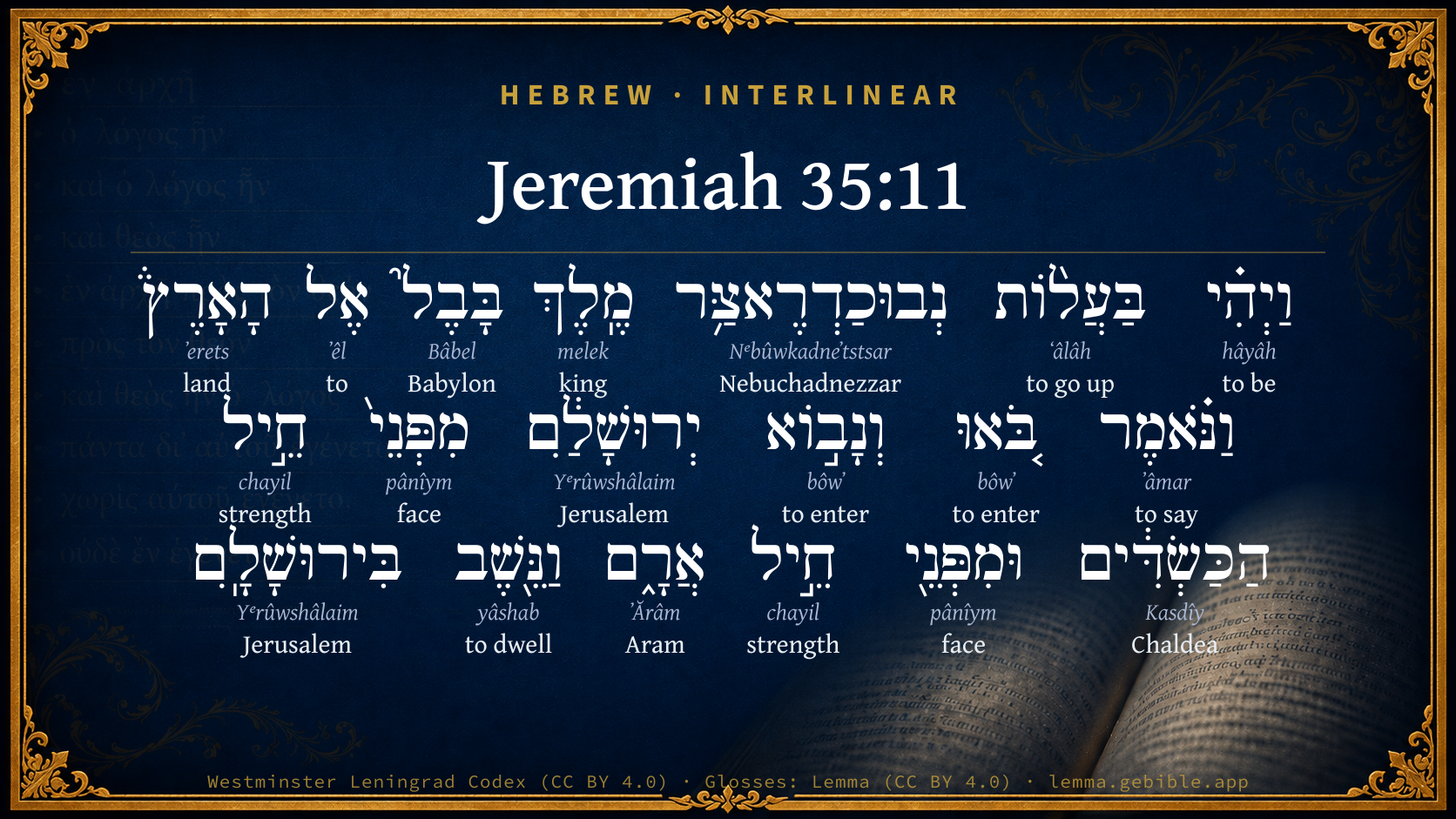
Jeremiah 35:11

Hebrew (Westminster Leningrad Codex) Jeremiah 35:11 appears in the Hebrew Old Testament. The text above is from the Westminster Leningrad Codex. Each word links to its Strong’s number, a concise gloss, and parsing drawn from the Open Scriptures Hebrew Bible morphology. Click any word for its full Brown-Driver-Briggs (BDB) entry.
Download image
Cite this verse

Jeremiah 35:11 (World English Bible). Public Domain. Lemma interlinear Bible study tool, https://lemma.gebible.app/v/jeremiah/35/11.

Show BibTeX & RIS
BibTeX
RIS
English Translation
But it happened, when Nebuchadrezzar king of Babylon came up into the land, that we said, Come, and let us go to Jerusalem for fear of the army of the Chaldeans, and for fear of the army of the Syrians; so we dwell at Jerusalem.
World English Bible · Public Domain
Download a study sheet

One document with this verse’s original text, its word-by-word gloss line, the meaning frame, cross-references with their text, attributed commentary, and full source and license credits — printable, and it pastes into notes with its structure intact.

This verse Autodidact and up

Study sheet (.html) Plain text (.txt)

A passage Seminary Student

Up to 50 verses in one chapter. A passage sheet keeps up to 6 commentary sources and 12 cross-references per verse, in the order this page ranks them, and says so on the sheet whenever that leaves anything out. Ask for a single verse and you get the Autodidact verse sheet above.

Everything on this page stays free to read, with no account — the sheet is a download of what is already on screen, not access to it.

Want to remove ads? Support Godless Engineer
Compare translations 3

The same verse in 3 English versions, stacked beneath the original-language interlinear above. Click any original word for its lexicon entry.

Each is an independent rendering of the whole verse — the interlinear is not word-aligned to these translations.

Highlighted words mark where these versions differ — a whole-verse word diff, not a word-by-word alignment.

  • World English Bible Public Domain
    But it happened, when Nebuchadrezzar king of Babylon came up into the land, that we said, Come, and let us go to Jerusalem for fear of the army of the Chaldeans, and for fear of the army of the Syrians; so we dwell at Jerusalem.
  • King James Version Public Domain
    But it came to pass, when Nebuchadrezzar king of Babylon came up into the land, that we said, Come, and let us go to Jerusalem for fear of the army of the Chaldeans, and for fear of the army of the Syrians: so we dwell at Jerusalem.
  • unfoldingWord Literal Text CC BY-SA 4.0
    But when Nebuchadnezzar king of Babylon attacked the land, we said, ‘Come, we must go to Jerusalem to escape from the Chaldean and Aramean armies.’ So we are living in Jerusalem.”

unfoldingWord Literal Text — © unfoldingWord, licensed CC BY-SA 4.0. Word-aligned USFM3 via Door43 (git.door43.org/unfoldingWord/en_ult).

Versions to compare (up to 4)

3 of 4 selected

Show all 18 translations

Every available English version of this verse, each an independent rendering of the whole verse.

  • World English Bible Public Domain
    But it happened, when Nebuchadrezzar king of Babylon came up into the land, that we said, Come, and let us go to Jerusalem for fear of the army of the Chaldeans, and for fear of the army of the Syrians; so we dwell at Jerusalem.
  • Berean Standard Bible Public Domain
    So when Nebuchadnezzar king of Babylon marched into the land, we said: ‘Come, let us go into Jerusalem to escape the armies of the Chaldeans and the Arameans.’ So we have remained in Jerusalem.”
  • Majority Standard Bible Public Domain
    So when Nebuchadnezzar king of Babylon marched into the land, we said: ‘Come, let us go into Jerusalem to escape the armies of the Chaldeans and the Arameans.’ So we have remained in Jerusalem.”
  • King James Version Public Domain
    But it came to pass, when Nebuchadrezzar king of Babylon came up into the land, that we said, Come, and let us go to Jerusalem for fear of the army of the Chaldeans, and for fear of the army of the Syrians: so we dwell at Jerusalem.
  • American Standard Version (1901) Public Domain
    But it came to pass, when Nebuchadrezzar king of Babylon came up into the land, that we said, Come, and let us go to Jerusalem for fear of the army of the Chaldeans, and for fear of the army of the Syrians; so we dwell at Jerusalem.
  • Revised Version (1885) Public Domain
    But it came to pass, when Nebuchadrezzar king of Babylon came up into the land, that we said, Come, and let us go to Jerusalem for fear of the army of the Chaldeans, and for fear of the army of the Syrians; so we dwell at Jerusalem.
  • Geneva Bible (1599) Public Domain
    But when Nebuchad-nezzar King of Babel came vp into the land, we said, Come, and let vs go to Ierusalem, from the hoste of the Caldeans, and from the host of Aram: so we dwel at Ierusalem.
  • Douay-Rheims (1899) Public Domain
    But when Nabuchodonosor king of Babylon came up to our land, we said: Come, let us go into Jerusalem from the face of the army of the Chaldeans, and from the face of the army of Syria: and we have remained in Jerusalem.
  • Young's Literal Translation Public Domain
    and it cometh to pass, in the coming up of Nebuchadrezzar king of Babylon unto the land, that we say, Come, and we enter Jerusalem, because of the force of the Chaldeans, and because of the force of Aram -- and we dwell in Jerusalem.'
  • Literal Standard Version CC BY-SA 4.0
    and it comes to pass, in the coming up of Nebuchadnezzar king of Babylon to the land, that we say, Come, and we enter Jerusalem, because of the force of the Chaldeans, and because of the force of Aram—and we dwell in Jerusalem.”
  • Unlocked Literal Bible CC BY-SA 4.0
    But when Nebuchadnezzar king of Babylon attacked the land, we said, 'Come, we must go to Jerusalem to escape from the Chaldean and Aramean armies.' So we are living in Jerusalem.”
  • unfoldingWord Literal Text CC BY-SA 4.0
    But when Nebuchadnezzar king of Babylon attacked the land, we said, ‘Come, we must go to Jerusalem to escape from the Chaldean and Aramean armies.’ So we are living in Jerusalem.”
  • Darby Bible Public Domain
    And it came to pass when Nebuchadrezzar king of Babylon came up into the land, that we said, Come and let us go into Jerusalem because of the army of the Chaldeans, and because of the army of Syria; and we dwell at Jerusalem.
  • World Messianic Bible Public Domain
    But when Nebuchadnezzar king of Babylon came up into the land, we said, ‘Come! Let’s go to Jerusalem for fear of the army of the Kasdim, and for fear of the army of the Syrians; so we will dwell at Jerusalem.’”
  • Webster's Bible Public Domain
    But it came to pass, when Nebuchadrezzar king of Babylon came up into the land, that we said, Come, and let us go to Jerusalem for fear of the army of the Chaldeans, and for fear of the army of the Syrians: so we dwell at Jerusalem.
  • Free Bible Version CC BY-SA 4.0
    So when Nebuchadnezzar king of Babylon invaded the country we decided, ‘Come on, let's go into Jerusalem to be safe from the armies of the Chaldeans, Babylonians, and Arameans.’ That's why we've stayed in Jerusalem.”
  • Bible in Basic English Public Domain
    But when Nebuchadrezzar, king of Babylon, came up into the land, we said, Come, let us go to Jerusalem, away from the army of the Chaldaeans and from the army of the Aramaeans: and so we are living in Jerusalem.
  • JPS Tanakh (1917) Public Domain
    But it came to pass, when Nebuchadrezzar king of Babylon came up against the land, that we said: Come, and let us go to Jerusalem for fear of the army of the Chaldeans, and for fear of the army of the Arameans; so we dwell at Jerusalem.'

Literal Standard Version (2020), Covenant Press — licensed CC BY-SA 4.0. Text via the HelloAO Bible API (eBible.org). Unlocked Literal Bible (unfoldingWord) — licensed CC BY-SA 4.0. Text via the HelloAO Bible API (eBible.org). unfoldingWord Literal Text — © unfoldingWord, licensed CC BY-SA 4.0. Word-aligned USFM3 via Door43 (git.door43.org/unfoldingWord/en_ult). Free Bible Version, Dr. Jonathan Gallagher — licensed CC BY-SA 4.0. Text via the HelloAO Bible API (eBible.org).

Word by word

More ways to search: Search by grammar → Find every occurrence → Compare this word →

Practice this passage: Drill this verse → Learn its vocabulary →

נְבוּכַדְרֶאצַּ֥ר
Nᵉbûwkadneʼtstsar
H5019
“Nebuchadnezzar”
Noun, Proper
Part of Speech
Noun
Type
Proper
Full BDB Definition

Origin: of foreign derivation

TWOT: None

Nebuchadnezzar or Nebuchadrezzar = "may Nebo protect the crown" - the great king of Babylon who captured Jerusalem and carried Judah captive
  1. וַיְהִ֗י hâyâh H1961 “and · to be” Conjunction + Verb, Qal, Sequential Imperfect, 3rd Person, Masculine, Singular
  2. בַּעֲל֨וֹת ʻâlâh H5927 “in/at · to go up” Preposition + Verb, Qal, Infinitive Construct
  3. מֶֽלֶךְ melek H4428 “king of” Noun, Common, Masculine, Singular, Construct
  4. בָּבֶל֮ Bâbel H894 “Babylon” Noun, Proper
  5. אֶל ʼêl H413 “to” Preposition
  6. הָאָרֶץ֒ ʼerets H776 “the · land” Particle, Definite Article + Noun, Common, Both, Singular, Absolute
  7. וַנֹּ֗אמֶר ʼâmar H559 “and · to say” Conjunction + Verb, Qal, Sequential Imperfect, 1st Person, Common, Plural
  8. בֹּ֚אוּ bôwʼ H935 “enter” Verb, Qal, Imperative, 2nd Person, Masculine, Plural
  9. וְנָב֣וֹא bôwʼ H935 “and · to enter” Conjunction + Verb, Qal, Imperfect, 1st Person, Common, Plural
  10. יְרוּשָׁלִַ֔ם Yᵉrûwshâlaim H3389 “Jerusalem” Noun, Proper
  11. מִפְּנֵי֙ pânîym H6440 “from · face(s) of” Preposition + Noun, Common, Both, Plural, Construct
  12. חֵ֣יל chayil H2428 “strength of” Noun, Common, Masculine, Singular, Construct
  13. הַכַּשְׂדִּ֔ים Kasdîy H3778 “the · Chaldea” Particle, Definite Article + Noun, Proper
  14. וּמִפְּנֵ֖י pânîym H6440 “and · from · face(s) of” Conjunction + Preposition + Noun, Common, Both, Plural, Construct
  15. חֵ֣יל chayil H2428 “strength of” Noun, Common, Masculine, Singular, Construct
  16. אֲרָ֑ם ʼĂrâm H758 “Aram” Noun, Proper
  17. וַנֵּ֖שֶׁב yâshab H3427 “and · to dwell” Conjunction + Verb, Qal, Sequential Imperfect, 1st Person, Common, Plural
  18. בִּירוּשָׁלִָֽם Yᵉrûwshâlaim H3389 “in/at · Jerusalem” Preposition + Noun, Proper

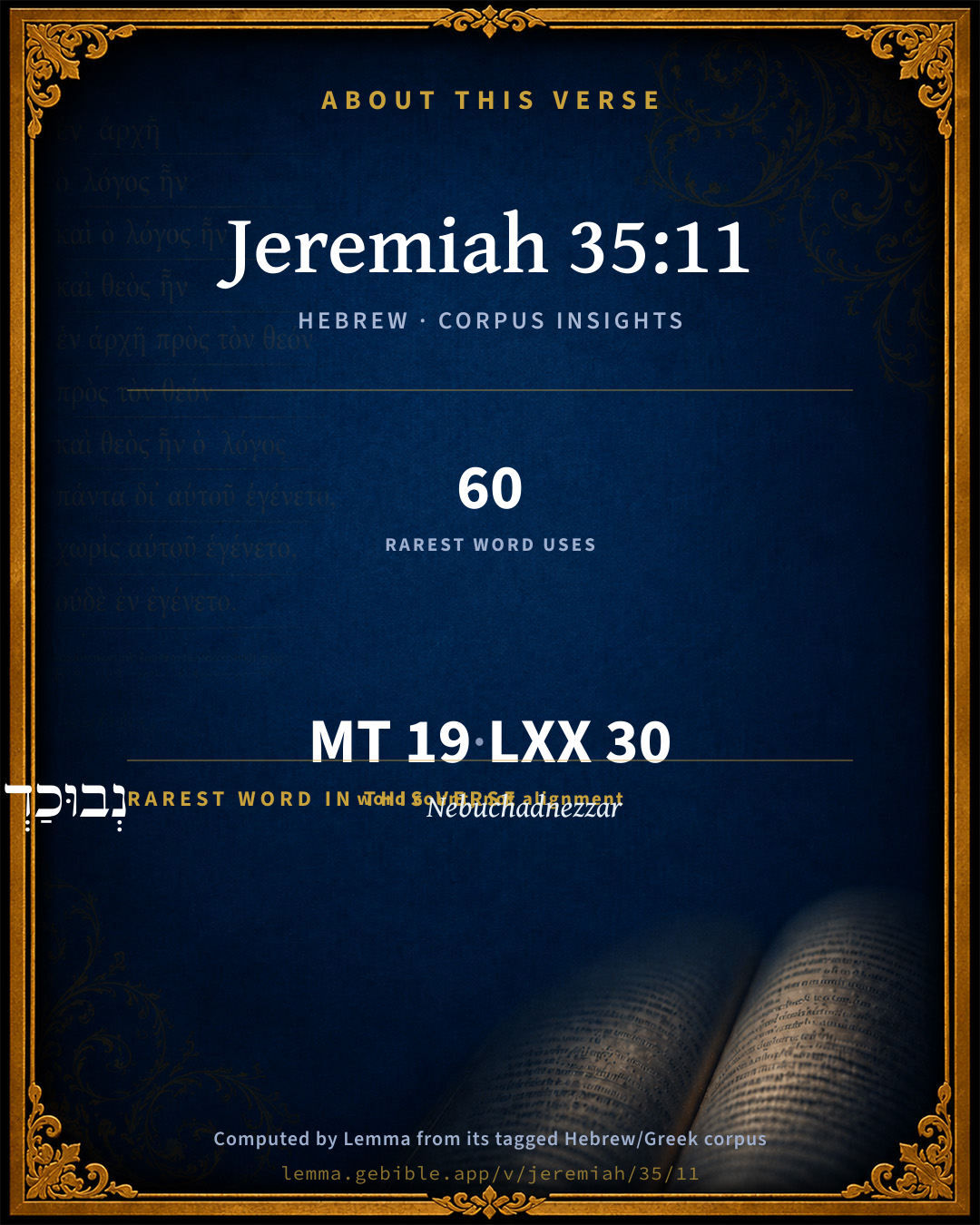
About this verse

These counts appear in no published source. They are computed here, from the morphology-tagged text and Lemma’s own curated glosses. What Lemma adds →

19
words
15
distinct lemmas
Prophets
section

Shared distinctive vocabulary

נְבוּכַדְרֶאצַּ֥ר Nebuchadnezzar H5019 occurs in 58 verses of the Hebrew Bible. Also found in:

Grammatical profile

  • 6 verbs
  • 12 nouns
  • 1 preposition

Verb forms

  • וַיְהִ֗י Qal · Sequential Imperfect
  • בַּעֲל֨וֹת Qal · Infinitive Construct
  • וַנֹּ֗אמֶר Qal · Sequential Imperfect
  • בֹּ֚אוּ Qal · Imperative
  • וְנָב֣וֹא Qal · Imperfect
  • וַנֵּ֖שֶׁב Qal · Sequential Imperfect

Repetition

Words recur within this verse — often emphatic in Hebrew:

  • בֹּ֚אוּ to enter H935 ×2
  • יְרוּשָׁלִַ֔ם Jerusalem H3389 ×2
  • מִפְּנֵי֙ face H6440 ×2
  • חֵ֣יל strength H2428 ×2

Hebrew & Septuagint length

In the original languages it is 19 Hebrew tokens and 30 Greek tokens — but the two are counted differently (Hebrew bundles its prefixes and suffixes into one token; the Greek is in lemma form), so that isn’t a like-for-like length.

Cross-references

6

Topical passages linked to Jeremiah 35:11 in the Treasury of Scripture Knowledge — connected by theme and wording, ordered by reader-vote popularity; previews shown in the World English Bible.

  • Jeremiah 8:14 Why do we sit still? assemble yourselves, and let us enter into the fortified cities, and let us be silent there; for Yahweh our God has put us to silence, and given us water of gall to drink, because we have sinned against Yahweh.
  • 2 Kings 24:1–2 In his days Nebuchadnezzar king of Babylon came up, and Jehoiakim became his servant three years: then he turned and rebelled against him.
  • Jeremiah 4:5–7 Declare you in Judah, and publish in Jerusalem; and say, Blow you the trumpet in the land: cry aloud and say, Assemble yourselves, and let us go into the fortified cities.
  • Daniel 1:1–2 In the third year of the reign of Jehoiakim king of Judah came Nebuchadnezzar king of Babylon to Jerusalem, and besieged it.
  • Mark 13:14 But when you see the abomination of desolation, spoken of by Daniel the prophet, standing where it ought not (let the reader understand), then let those who are in Judea flee to the mountains,
  • Luke 21:20–21 "But when you see Jerusalem surrounded by armies, then know that its desolation is at hand.

Cross-references courtesy of OpenBible.info (CC BY 4.0).

Hebrew and Greek witnesses Masoretic Hebrew ↔ Greek Septuagint

The same verse in the two great witnesses to the Old Testament, shown verse-for-verse.

These are two independent witnesses, not word-aligned to each other, and the Septuagint is shown in lemma (dictionary) form.

Hebrew Jeremiah 35:11 Masoretic · Westminster Leningrad Codex

וַיְהִ֗י בַּעֲל֨וֹת נְבוּכַדְרֶאצַּ֥ר מֶֽלֶךְ בָּבֶל֮ אֶל הָאָרֶץ֒ וַנֹּ֗אמֶר בֹּ֚אוּ וְנָב֣וֹא יְרוּשָׁלִַ֔ם מִפְּנֵי֙ חֵ֣יל הַכַּשְׂדִּ֔ים וּמִפְּנֵ֖י חֵ֣יל אֲרָ֑ם וַנֵּ֖שֶׁב בִּירוּשָׁלִָֽם

But it happened, when Nebuchadrezzar king of Babylon came up into the land, that we said, Come, and let us go to Jerusalem for fear of the army of the Chaldeans, and for fear of the army of the Syrians; so we dwell at Jerusalem.

World English Bible · Public Domain

Greek LXX Structure differs

In the Septuagint, Jeremiah is about an eighth shorter than the Hebrew and arranges its material differently — the Oracles Against the Nations (Hebrew chapters 46–51) appear in the middle of the Greek book, after 25:13. Because the chapter and verse boundaries do not line up, a verse-for-verse comparison with the Hebrew is not shown.

A verse-for-verse comparison isn’t shown here because the chapters and verses don’t line up. Switch to the LXX edition with the MT / LXX toggle above to read the Greek directly.

On this verse, Albert Barnes' Notes on the Bible discusses the Septuagint’s reading. Read the note in Commentary ↓

Hebrew: Westminster Leningrad Codex (CC BY 4.0). Greek: Septuagint (public domain); English from a public-domain English Septuagint. How the Septuagint differs from the Hebrew →

Targum (Aramaic paraphrase)

1

The Targum is the ancient Jewish Aramaic paraphrase of the Hebrew Scriptures — an interpretive translation, not the Hebrew text itself. Onkelos (literal) and Pseudo-Jonathan (expansive) render the Torah, and Jonathan the Prophets. Coverage is partial: where no permissively-licensed English translation exists for a verse, only the Aramaic is shown. This is verse-level text, not a word-by-word alignment to the Hebrew.

  1. Targum Jonathan Prophets (Joshua–Malachi)
    וַהֲוָה כַּד סָלֵיק נְבוּכַדְרֶאצַר מַלְכָּא דְבָבֶל עַל אַרְעָא וַאֲמַרְנָא אֲתוֹ וְנֵיעוּל לִירוּשְׁלֵם מִן קֳדָם מַשִׁרְיַת כַּסְדָאֵי וּמִן קֳדָם מַשִׁרְיַת אֲרָם וִיתֵיבְנָא בִּירוּשְׁלֵם:

    (no public-domain English translation for this verse)

    Targum Jonathan — Aramaic: “Mikraot Gedolot” (public domain). English: “Sefaria Community Translation” (CC0 1.0 (public-domain dedication)); “London "Chaldee Paraphrase," 1871” (public domain). Text via Sefaria.

Commentary

Notes on Jeremiah 35:11 from classic Christian and Jewish commentators (each source and its license shown beneath its notes). The classic Christian expositions comment on the surrounding passage and are grouped to its opening verse, so a note may address several verses; the Jewish commentaries on the Tanakh (Rashi and others) are per-verse, so they appear only where the commentator wrote on this verse.

Lemma curates 59 commentaries, every one of them public domain or Creative Commons licensed, each selected and text-cleaned for this edition rather than reprinted as found. About our sources →

Trapp's Complete Commentary

John Trapp

Jer 35:11 But it came to pass, when Nebuchadrezzar king of Babylon came up into the land, that we said, Come, and let us go to Jerusalem for fear of the army of the Chaldeans, and for fear of the army of the Syrians: so we dwell at Jerusalem.

Ver. 11. Come, and let us go to Jerusalem.] So then it was lawful for them to dispense with those their observances, in that inevitable necessity; like as also they might have drunk wine rather than have perished. But what can be reasonably pleaded for that man of sin, who taketh upon him to dispense with God’s holy law, and de iniustitia facere iustitiam, ex nihilo aliquid, ex virtute vitium, {a} to make righteousness of unrighteousness, vice of virtue, something of nothing?

So we dwell at Jerusalem.] But better they had kept out, and held to their old course; for so they might have escaped some way.

{a} Bellarm., De Pontif. Rom, lib. iv.

John Trapp, A Commentary or Exposition upon All the Books of the Old and New Testament (1647–1656) — public domain. Text from a community e-Sword module.

Geneva Bible (1599)

Geneva Bible translators

Which declareth that they were not so bound to their vow, that it could not be broken for any necessity: for where they were commanded to dwell in tents, they dwell now at Jerusalem for fear of the wars.

Geneva Bible (1599) marginal notes — public domain. Text via Bolls.life.

Jamieson, Fausset & Brown

Robert Jamieson, A. R. Fausset & David Brown

Chaldeans . . . Syrians--when Jehoiakim revolted from Nebuchadnezzar (Kg2 24:1-2). Necessity sets aside all other laws. This is the Rechabites' excuse for their seeming disobedience to Jonadab in temporarily settling in a city. Herein was seen the prescient wisdom of Jonadab's commands; they could at a moment's notice migrate, having no land possessions to tie them.

Jamieson, Fausset & Brown — Commentary Critical and Explanatory on the Whole Bible (1871) — public domain (CC PDM 1.0). Text via the HelloAO Bible API.

Adam Clarke's Commentary

Verse 11. But - when Nebuchadnezzar - came up] If at present we appear to be acting contrary in any respect to our institutions, in being found in the city, necessity alone has induced us to take this temporary step. We have sought the shelter of the city for the preservation of our lives; so now we dwell at Jerusalem.

Adam Clarke's Commentary on the Bible (1810–1826) — public domain. Text from a community e-Sword/MySword module.

John Calvin's Commentaries

It hence appears that it proved advantageous to the Rechabites to observe what their father had commanded them: for had they been fixed to their possessions, they must have been driven into exile with the rest when the kingdom of Israel was destroyed; what happened to the ten tribes nmst have happened to the Rechabites. But as they had nothing as their own, they were freer to move elsewhere; nor had they the trial of leaving possessions, for they had none. We know that many are so tied to their own houses, fields, vineyards, and meadows, that they would rather be killed a hundred times than to be torn away from them. Then Jenadab consulted well the benefit of his posterity, when he ordered them to dwell in tents; for thus they could collect together in one day all that they had, according to the known saying of Bias. Hence poverty was a great advantage to them: their austerity of life was also a benefit to them; they could without difficulty dwell at Jerusalem, for they had no need of many luxuries. Had they been accustomed to wine and to other delicacies, they might have discussed the point, whether it would have been better for them at once to die than to suffer want in a besieged city. Moreover, as they had lived frugally and had also been accustomed to an austere life, no anxiety prevented them to come with confidence to Jerusalem; for they thought that they could gain a sparing and sordid subsistence by their own labor.

It hence then appears what Jenadab had in view, when he forbade his posterity the use of wine as well as the possession of fields and vineyards; for he could then foresee what dreadful revolutions were at hand. It was therefore his purpose thus to train up his posterity, that when difficulties came they might not succumb under the burden, but patiently bear want or any other inconvenience, which to others would be intolerable, whenever their former delicacies came to mind. We they said, Come, and let us enter into Jerusalem from the face of both armies. When therefore the Israelites were detained by their fields and domestic possessions, the Rechabites went to Jerusalem, and thus were freed from danger. It now follows, —

John Calvin's Commentaries (1540-1563) — public domain. Text from the Calvin Translation Society English edition (1840s-50s) via the Christian Classics Ethereal Library (ccel.org). Calvin's coverage is partial (roughly two-thirds of the Bible); uncommented books and verses are honest gaps, never fabricated. The 19th-century editor's footnotes and remarks are omitted so the notes are faithfully Calvin's own voice.

Ellicott's Commentary for English Readers

(11) When Nebuchadrezzar king of Babylon came up into the land . . .—The statement has the character of an apologetic explanation. They had been driven, as the peasants of Judaea had been (Jer_4:6; Jer_8:14), to take refuge from the invading armies, probably in the invasion of Nebuchadnezzar in the eighth year of Jehoiakim (2Ki_24:1-2), bringing their flocks and their herds, as far as they could, with them, but this was only a temporary casualty, and they intended, when the danger was over, to return to their former mode of life. The Syrians are joined with the Chaldees in the invasion, as in 2Ki_24:2.

A Bible Commentary for English Readers, edited by Charles John Ellicott (1878–1897) — public domain. Text from a community e-Sword module.

The Cambridge Bible for Schools and Colleges

gen. ed. J. J. S. Perowne

11. Syrians] allies of the Chaldaeans at this period. See 2Ki_24:2.

The Cambridge Bible for Schools and Colleges (gen. ed. J. J. S. Perowne; Cambridge University Press, 1878–1918) — public domain. Text from a community e-Sword module.

John Gill's Exposition

But it came to pass, when Nebuchadrezzar king of Babylon came up into the land,.... Into the land of Judea to invade it, which was in the reign of Jehoiakim, in the fourth year of it, after he had served him three years, and rebelled against him; See Gill on Jer 35:1;

that we said, come, and let us go to Jerusalem; they said one to another, let us not stay here to be destroyed by a foreign enemy; but let us go to Jerusalem, a fortified city, where we may be safe:

for fear of the army of the Chaldeans, and for fear of the army of the Syrians; for Nebuchadnezzar's army in this expedition consisted of Chaldeans and Syrians, and of other nations, Kg2 24:2;

so we dwell at Jerusalem; for the present. It seems as though this was quickly after Nebuchadnezzar's incursion, and when he was but just departed; so that their fears had not wholly subsided; and they, as yet, had not returned to their tents, and former manner of living: hence it appears that the Rechabites did not look upon this command of their father as equal to a divine precept, which must be always obeyed; but that in case of necessity it might be dispensed with, and especially when in danger of life, and when human prudence required it; and in which case the lawgiver himself would have dispensed with it, had he been on the spot.

John Gill's Exposition of the Whole Bible (1746–1763) — public domain (CC PDM 1.0). Text via the HelloAO Bible API.

Albert Barnes' Notes on the Bible

The Syrians - The Septuagint substitutes Assyrians for Syrians, but marauding bands of the Aramaeans are probably meant.

Albert Barnes' Notes on the Bible (1834–1885) — public domain. Text from a community e-Sword/MySword module.

Haydock's Catholic Bible Commentary

Syria. 4 Kings xxiv. 2. The mention of these shews that this was the second siege, when Joakim was slain, and many led into captivity, (chap. lii. 28.) with these Rechabites. (Calmet) --- They lived under tents, but in case of necessity entered the city, ver. 10. If they observe works of supererogation, all must surely keep God’s law. (Worthington)

George Leo Haydock (1774–1849), Haydock's Catholic Family Bible and Commentary, 1859 edition — public domain. Excludes Psalms (Douay-Rheims chapter numbering differs from Protestant) and Deuterocanonical books (Catholic canon only).

Matthew Poole's English Annotations

When the Chaldean army came into the land, they saw there would be no quiet abode for them any where but in some fortified place. The Syrians joined with the Chaldeans in this war, as we read, 2Ki 24:2. This they tell the prophet was the reason why they, who never used to dwell in cities nor fixed houses, came to dwell at Jerusalem, to prevent being destroyed by the foragers for these armies.

Matthew Poole's English Annotations on the Holy Bible (1683–1685) — public domain. Text from a community e-Sword/MySword module.

Whedon's Commentary on the Bible

Daniel D. Whedon

11. Army of the Syrians — In the earlier times the Syrians were their great danger; and even now the greater army of the Chaldeans included the lesser of the Syrians.

Daniel D. Whedon (gen. ed.), Commentary on the Old and New Testaments (1874–1909) — public domain. Text from a community e-Sword module.

The Pulpit Commentary

And for fear of the army of the Syrians. We are expressly told in 2Ki_24:2 that, after the rebellion of Jehoiakim, "bands of Syrians" made incursions into Judah.

Vers. 11-17. Filal obedience.

The filial obedience of the Rechabites is here adduced as a rebuke to the people of Israel for their disobedience to their Father in heaven.

I WE OWE A DUTY OF FILIAL OBEDIENCE TO GOD. Obligation corresponds to privilege; peculiar relationship involves peculiar duties. If God is our Father, we owe special obedience to God on account of our relationship with him. The doctrine of the fatherhood of God is no excuse for the relaxation of the fidelity which we felt to be obligatory so long as he was regarded only as our supreme Ruler. Instead of making us more careless, this doctrine should increase the assiduity of our devotion. Strict religionists who dread the moral effects of the modern broad enunciation of this great truth, and lax self-indulgent people who fancy it will allow them to defy the Law of God at pleasure, both fall into a grievous mistake. The father has rights over his children possessed by no one else, and they owe obedience to him as to no other person. This was recognized and carried out much further in the ancient world than it is among us.

1. It is based on nature; the child naturally belongs to the parent.

2. It is increased by experience. For years the child is wholly dependent on his parents. Helpless, and needing constant attention, he finds in them sustenance, protection, and happiness. Parental anxiety, labour, and sacrifice should bind the children by ties of deepest gratitude. Repayment is impossible, nor is it expected; but the least that can be done is to offer, obedience.

3. It is recognized by law. The old Roman law gave the father absolute power over the life of his child. Modem law, though it interferes more with the relations of the family, sanctions wide parental fights. Now, if God is our Father, similar obligations bind us to filial obedience to him over and above the obligation we may feel to his Law, his holiness, and his supremacy. (Mal_1:6)

II THE NEGLECT OF FILIAL OBEDIENCE TO GOD IS REBUKED BY THE NEGLECT OF FILIAL OBEDIENCE TO MEN. The Rechabites were a rebuke to the Israelites. Yet the Israelites had less excuse for disobeying their heavenly Father than the Rechabites would have had for neglecting the ordinances of their ancestor. Matthew Henry clearly indicates the points of contrast somewhat as follows. I give his thoughts with abridgment:

1. The Rechabites were obedient to one who was but a man; but the Jews were disobedient to an infinite and eternal God.

2. Jonadab was long since dead, and could neither take cognizance of their disobedience nor give correction for it; but God lives forever to see how his laws are observed, and to punish disobedience.

3. The Rechabites were never put in mind of their obligations to their father; but God often sent his prophets to his people, "rising early and speaking," etc.

4. Jonadab never did that for his seed which God had done for his people; he left them a charge, out left them no estate to bear the charge; but God had given his people a good land, etc.

5. God did not tie up his people to so much hardship as Jonadab required of his descendants; and yet Jonadab"s orders were obeyed, and God"s were not.

The Pulpit Commentary (1880–1919), ed. H.D.M. Spence-Jones & Joseph S. Exell — public domain. Text from a community e-Sword module.

Rashi

Rabbi Shlomo Yitzchaki (Rashi)

And it came to pass when Nebuchadrezzar...came up Perforce we came to the city. Therefore, we are now dwelling in houses.

Rashi on the Tanakh — English translations: “The Judaica Press complete Tanach with Rashi, translated by A. J. Rosenberg” (CC BY 4.0); “Pentateuch with Rashi's commentary by M. Rosenbaum and A.M. Silbermann, 1929-1934” (public domain); “The Metsudah Tanach series, Lakewood, N.J” (CC BY 4.0); and “The Book of Joshua, Metsudah Publications, 1997” (CC BY 4.0). Text via Sefaria.

Lesson kit

Teaching starters — assembled from the data on this page, not authored interpretation. Every prompt links to the verse data it draws on. Edit before teaching.

Jeremiah, in the Prophets, opens this verse with 19 words (15 distinct Hebrew lemmas). Its most distinctive word is Nᵉbûwkadneʼtstsar (“Nebuchadnezzar”). A historical commentator’s framing appears above. Read the whole chapter for the surrounding context.

Discussion questions

  1. How does “Nebuchadnezzar” (Nᵉbûwkadneʼtstsar) shape what this verse is saying?
  2. How does 2 Kings 24:1, which shares the word «Nebuchadnezzar», read alongside this verse?
  3. What does the repetition of “to enter” (2× in this one verse) do in this verse?
  4. These translations render this verse differently. What is at stake in choosing one wording over another?
  5. «וַיְהִ֗י» is a Qal Sequential Imperfect verb. How does that grammatical form shape the action described?
  6. Compare how Trapp's Complete Commentary and Geneva Bible (1599) read this verse. Where do they agree or differ?

Things to notice

Reading settings

Reading text

Shown beneath each verse's original-language words.

Old Testament
Old Testament edition

Read the OT as the Masoretic Hebrew (MT) or the Greek Septuagint (LXX).

English shown for the Greek Septuagint (in the Hebrew ↔ Greek comparison).

Comparing translations? Open the Compare panel on any verse page to stack up to four side by side.