
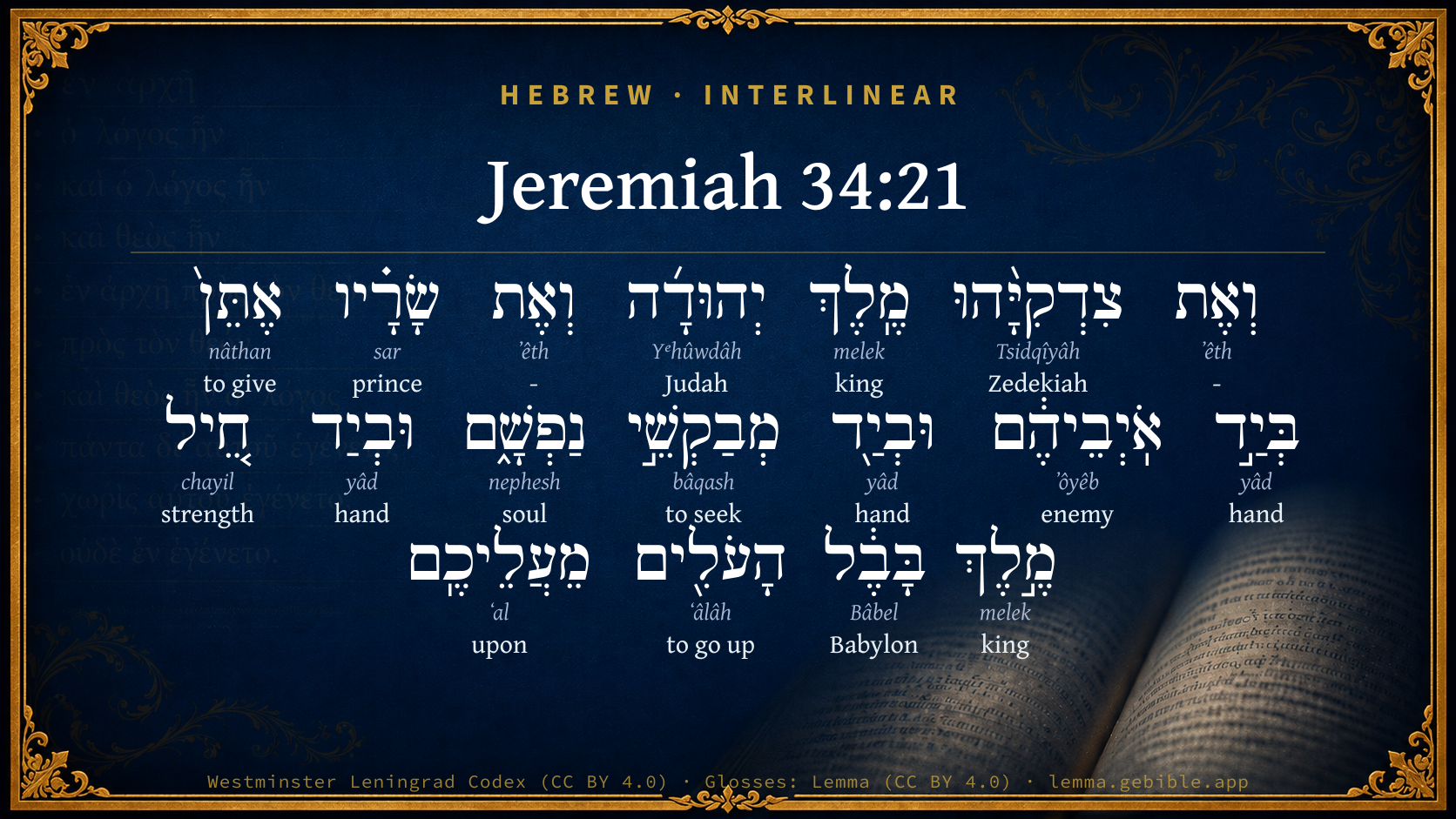
Jeremiah 34:21

Hebrew (Westminster Leningrad Codex) Jeremiah 34:21 appears in the Hebrew Old Testament. The text above is from the Westminster Leningrad Codex. Each word links to its Strong’s number, a concise gloss, and parsing drawn from the Open Scriptures Hebrew Bible morphology. Click any word for its full Brown-Driver-Briggs (BDB) entry.
Download image
Cite this verse

Jeremiah 34:21 (World English Bible). Public Domain. Lemma interlinear Bible study tool, https://lemma.gebible.app/v/jeremiah/34/21.

Show BibTeX & RIS
BibTeX
RIS
English Translation
Zedekiah king of Judah and his princes will I give into the hand of their enemies, and into the hand of those who seek their life, and into the hand of the king of Babylon's army, who have gone away from you.
World English Bible · Public Domain
Download a study sheet

One document with this verse’s original text, its word-by-word gloss line, the meaning frame, cross-references with their text, attributed commentary, and full source and license credits — printable, and it pastes into notes with its structure intact.

This verse Autodidact and up

Study sheet (.html) Plain text (.txt)

A passage Seminary Student

Up to 50 verses in one chapter. A passage sheet keeps up to 6 commentary sources and 12 cross-references per verse, in the order this page ranks them, and says so on the sheet whenever that leaves anything out. Ask for a single verse and you get the Autodidact verse sheet above.

Everything on this page stays free to read, with no account — the sheet is a download of what is already on screen, not access to it.

Want to remove ads? Support Godless Engineer
Compare translations 3

The same verse in 3 English versions, stacked beneath the original-language interlinear above. Click any original word for its lexicon entry.

Each is an independent rendering of the whole verse — the interlinear is not word-aligned to these translations.

Highlighted words mark where these versions differ — a whole-verse word diff, not a word-by-word alignment.

  • World English Bible Public Domain
    Zedekiah king of Judah and his princes will I give into the hand of their enemies, and into the hand of those who seek their life, and into the hand of the king of Babylon's army, who have gone away from you.
  • King James Version Public Domain
    And Zedekiah king of Judah and his princes will I give into the hand of their enemies, and into the hand of them that seek their life, and into the hand of the king of Babylon's army, which are gone up from you.
  • unfoldingWord Literal Text CC BY-SA 4.0
    So I will give Zedekiah king of Judah and his leaders into the hand of their enemies and into the hand of those who are seeking their life, and into the hand of the army of the king of Babylon that has risen up against you.

unfoldingWord Literal Text — © unfoldingWord, licensed CC BY-SA 4.0. Word-aligned USFM3 via Door43 (git.door43.org/unfoldingWord/en_ult).

Versions to compare (up to 4)

3 of 4 selected

Show all 18 translations

Every available English version of this verse, each an independent rendering of the whole verse.

  • World English Bible Public Domain
    Zedekiah king of Judah and his princes will I give into the hand of their enemies, and into the hand of those who seek their life, and into the hand of the king of Babylon's army, who have gone away from you.
  • Berean Standard Bible Public Domain
    And I will deliver Zedekiah king of Judah and his officials into the hands of their enemies who seek their lives, to the army of the king of Babylon that had withdrawn from you.
  • Majority Standard Bible Public Domain
    And I will deliver Zedekiah king of Judah and his officials into the hands of their enemies who seek their lives, to the army of the king of Babylon that had withdrawn from you.
  • King James Version Public Domain
    And Zedekiah king of Judah and his princes will I give into the hand of their enemies, and into the hand of them that seek their life, and into the hand of the king of Babylon's army, which are gone up from you.
  • American Standard Version (1901) Public Domain
    And Zedekiah king of Judah and his princes will I give into the hand of their enemies, and into the hand of them that seek their life, and into the hand of the king of Babylon's army, that are gone away from you.
  • Revised Version (1885) Public Domain
    And Zedekiah king of Judah and his princes will I give into the hand of their enemies, and into the hand of them that seek their life, and into the hand of the king of Babylon’s army, which are gone up from you.
  • Geneva Bible (1599) Public Domain
    And Zedekiah King of Iudah, and his princes will I giue into the hand of their enemies, and into the hande of them that seeke their life, and into the hande of the King of Babels hoste, which are gone vp from you.
  • Douay-Rheims (1899) Public Domain
    And Sedecias the king of Juda, and his princes, I will give into the hands of their enemies, and into the hands of them that seek their lives, and into the hands of the armies of the king of Babylon, which are gone from you.
  • Young's Literal Translation Public Domain
    `And Zedekiah king of Judah, and his heads, I give into the hand of their enemies, and into the hand of those seeking their soul, and into the hand of the forces of the king of Babylon, that are going up from off you.
  • Literal Standard Version CC BY-SA 4.0
    And I give Zedekiah king of Judah and his heads into the hand of their enemies, and into the hand of those seeking their soul, and into the hand of the forces of the king of Babylon that are going up from off you.
  • Unlocked Literal Bible CC BY-SA 4.0
    So I will give Zedekiah king of Judah and his leaders into the hand of their enemies and into the hand of those who are seeking their life, and into the hand of the army of the king of Babylon that has risen up against you.
  • unfoldingWord Literal Text CC BY-SA 4.0
    So I will give Zedekiah king of Judah and his leaders into the hand of their enemies and into the hand of those who are seeking their life, and into the hand of the army of the king of Babylon that has risen up against you.
  • Darby Bible Public Domain
    And Zedekiah king of Judah and his princes will I give into the hand of their enemies, and into the hand of them that seek their life, and into the hand of the king of Babylon's army, which are gone up from you.
  • World Messianic Bible Public Domain
    “I will give Zedekiah king of Judah and his princes into the hands of their enemies, into the hands of those who seek their life and into the hands of the king of Babylon’s army, who has gone away from you.
  • Webster's Bible Public Domain
    And Zedekiah king of Judah and his princes I will give into the hand of their enemies, and into the hand of them that seek their life, and into the hand of the king of Babylon's army, which are gone up from you.
  • Free Bible Version CC BY-SA 4.0
    I will hand over Zedekiah king of Judah and his officials to their enemies who are trying to kill them, to the army of the king of Babylon which has paused its attack on you.
  • Bible in Basic English Public Domain
    And Zedekiah, king of Judah, and his rulers I will give into the hands of their haters and into the hands of those who have designs against their lives, and into the hands of the king of Babylon's army which has gone away from you.
  • JPS Tanakh (1917) Public Domain
    And Zedekiah king of Judah and his princes will I give into the hand of their enemies, and into the hand of them that seek their life, and into the hand of the king of Babylon's army, that are gone up from you.

Literal Standard Version (2020), Covenant Press — licensed CC BY-SA 4.0. Text via the HelloAO Bible API (eBible.org). Unlocked Literal Bible (unfoldingWord) — licensed CC BY-SA 4.0. Text via the HelloAO Bible API (eBible.org). unfoldingWord Literal Text — © unfoldingWord, licensed CC BY-SA 4.0. Word-aligned USFM3 via Door43 (git.door43.org/unfoldingWord/en_ult). Free Bible Version, Dr. Jonathan Gallagher — licensed CC BY-SA 4.0. Text via the HelloAO Bible API (eBible.org).

Word by word

More ways to search: Search by grammar → Find every occurrence → Compare this word →

Practice this passage: Drill this verse → Learn its vocabulary →

צִדְקִיָּ֨הוּ
Tsidqîyâh
H6667
“Zedekiah”
Noun, Proper
Part of Speech
Noun
Type
Proper
Full BDB Definition

Origin: from H6664 and H3050

TWOT: None

Zedekiah = "Jehovah is righteous" - the last king of Judah renamed from 'Mattaniah' by Nebuchadnezzar; son of Josiah by wife Hamutal; placed on the throne by Nebuchadnezzar when he carried his nephew Jehoiakim in captivity - false prophet at the court of king Ahab of the northern kingdom of Israel - son of Maaseiah, a false prophet in Babylon - son of Hananiah, one of the princes of Judah in the time of Jeremiah - a priest who sealed the covenant with Nehemiah - son of king Jehoiakim of Judah
  1. וְאֶת ʼêth H853 “and · -” Conjunction + Particle, Direct Object
  2. מֶֽלֶךְ melek H4428 “king of” Noun, Common, Masculine, Singular, Construct
  3. יְהוּדָ֜ה Yᵉhûwdâh H3063 “Judah” Noun, Proper
  4. וְאֶת ʼêth H853 “and · -” Conjunction + Particle, Direct Object
  5. שָׂרָ֗יו sar H8269 “princes · his” Noun, Common, Masculine, Plural, Construct + Suffix, Personal, 3rd Person, Masculine, Singular
  6. אֶתֵּן֙ nâthan H5414 “to give” Verb, Qal, Imperfect, 1st Person, Common, Singular
  7. בְּיַ֣ד yâd H3027 “in/at · hand of” Preposition + Noun, Common, Both, Singular, Construct
  8. אֹֽיְבֵיהֶ֔ם ʼôyêb H341 “enemy · them” Verb, Qal, Participle Active, Masculine, Plural, Construct + Suffix, Personal, 3rd Person, Masculine, Plural
  9. וּבְיַ֖ד yâd H3027 “and · in/at · hand of” Conjunction + Preposition + Noun, Common, Both, Singular, Construct
  10. מְבַקְשֵׁ֣י bâqash H1245 “seeking” Verb, Piel, Participle Active, Masculine, Plural, Construct
  11. נַפְשָׁ֑ם nephesh H5315 “soul · their” Noun, Common, Both, Singular, Construct + Suffix, Personal, 3rd Person, Masculine, Plural
  12. וּבְיַד yâd H3027 “and · in/at · hand of” Conjunction + Preposition + Noun, Common, Both, Singular, Construct
  13. חֵ֚יל chayil H2428 “strength of” Noun, Common, Masculine, Singular, Construct
  14. מֶ֣לֶךְ melek H4428 “king of” Noun, Common, Masculine, Singular, Construct
  15. בָּבֶ֔ל Bâbel H894 “Babylon” Noun, Proper
  16. הָעֹלִ֖ים ʻâlâh H5927 “the · going up” Particle, Definite Article + Verb, Qal, Participle Active, Masculine, Plural, Absolute
  17. מֵעֲלֵיכֶֽם ʻal H5921 “from · upon · you” Preposition + Preposition + Suffix, Personal, 2nd Person, Masculine, Plural

About this verse

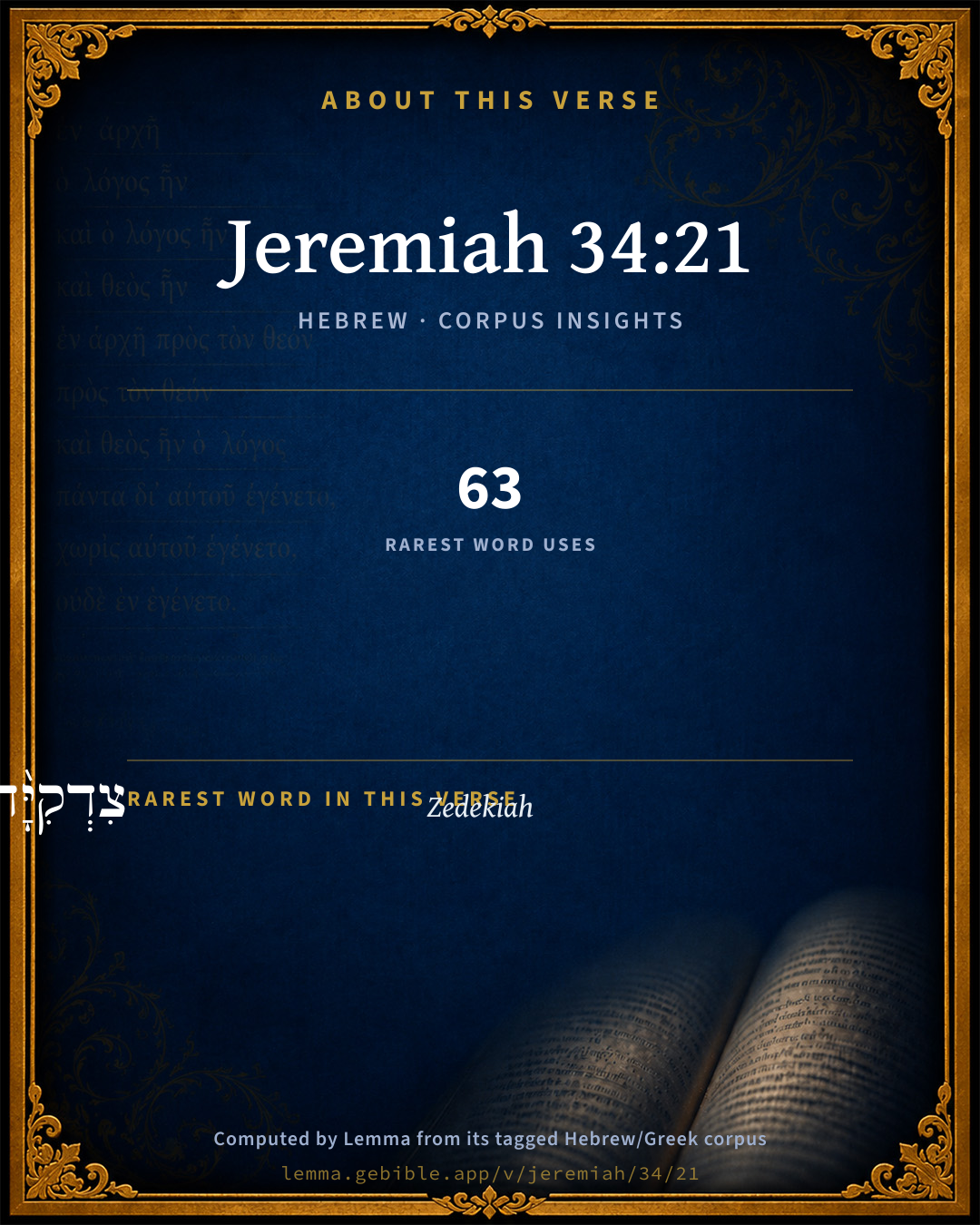
These counts appear in no published source. They are computed here, from the morphology-tagged text and Lemma’s own curated glosses. What Lemma adds →

18
words
14
distinct lemmas
Prophets
section

Grammatical profile

  • 4 verbs
  • 11 nouns
  • 1 preposition
  • 2 particles

Verb forms

  • אֶתֵּן֙ Qal · Imperfect
  • אֹֽיְבֵיהֶ֔ם Qal · Participle Active
  • מְבַקְשֵׁ֣י Piel · Participle Active
  • הָעֹלִ֖ים Qal · Participle Active

Repetition

Words recur within this verse — often emphatic in Hebrew:

  • בְּיַ֣ד hand H3027 ×3
  • מֶֽלֶךְ king H4428 ×2

Cross-references

9

Topical passages linked to Jeremiah 34:21 in the Treasury of Scripture Knowledge — connected by theme and wording, ordered by reader-vote popularity; previews shown in the World English Bible.

  • Jeremiah 39:6 Then the king of Babylon killed the sons of Zedekiah in Riblah before his eyes: also the king of Babylon killed all the nobles of Judah.
  • Jeremiah 52:24–27 The captain of the guard took Seraiah the chief priest, and Zephaniah the second priest, and the three keepers of the threshold:
  • 2 Kings 25:18–21 The captain of the guard took Seraiah the chief priest, and Zephaniah the second priest, and the three keepers of the threshold:
  • Jeremiah 37:5–11 Pharaoh's army was come forth out of Egypt; and when the Chaldeans who were besieging Jerusalem heard news of them, they broke up from Jerusalem.
  • Jeremiah 52:10 The king of Babylon killed the sons of Zedekiah before his eyes: he killed also all the princes of Judah in Riblah.
  • Ezekiel 17:16 As I live, says the Lord Yahweh, surely in the place where the king dwells who made him king, whose oath he despised, and whose covenant he broke, even with him in the midst of Babylon he shall die.
  • Jeremiah 32:4 and Zedekiah king of Judah shall not escape out of the hand of the Chaldeans, but shall surely be delivered into the hand of the king of Babylon, and shall speak with him mouth to mouth, and his eyes shall see his eyes;
  • Jeremiah 34:3–5 and you shall not escape out of his hand, but shall surely be taken, and delivered into his hand; and your eyes shall see the eyes of the king of Babylon, and he shall speak with you mouth to mouth, and you shall go to Babylon.
  • Lamentations 4:20 The breath of our nostrils, the anointed of Yahweh, was taken in their pits; Of whom we said, Under his shadow we shall live among the nations.

Cross-references courtesy of OpenBible.info (CC BY 4.0).

Hebrew and Greek witnesses Masoretic Hebrew ↔ Greek Septuagint

The same verse in the two great witnesses to the Old Testament, shown verse-for-verse.

These are two independent witnesses, not word-aligned to each other, and the Septuagint is shown in lemma (dictionary) form.

Hebrew Jeremiah 34:21 Masoretic · Westminster Leningrad Codex

וְאֶת צִדְקִיָּ֨הוּ מֶֽלֶךְ יְהוּדָ֜ה וְאֶת שָׂרָ֗יו אֶתֵּן֙ בְּיַ֣ד אֹֽיְבֵיהֶ֔ם וּבְיַ֖ד מְבַקְשֵׁ֣י נַפְשָׁ֑ם וּבְיַד חֵ֚יל מֶ֣לֶךְ בָּבֶ֔ל הָעֹלִ֖ים מֵעֲלֵיכֶֽם

Zedekiah king of Judah and his princes will I give into the hand of their enemies, and into the hand of those who seek their life, and into the hand of the king of Babylon's army, who have gone away from you.

World English Bible · Public Domain

Greek LXX Structure differs

In the Septuagint, Jeremiah is about an eighth shorter than the Hebrew and arranges its material differently — the Oracles Against the Nations (Hebrew chapters 46–51) appear in the middle of the Greek book, after 25:13. Because the chapter and verse boundaries do not line up, a verse-for-verse comparison with the Hebrew is not shown.

A verse-for-verse comparison isn’t shown here because the chapters and verses don’t line up. Switch to the LXX edition with the MT / LXX toggle above to read the Greek directly.

Hebrew: Westminster Leningrad Codex (CC BY 4.0). Greek: Septuagint (public domain); English from a public-domain English Septuagint. How the Septuagint differs from the Hebrew →

Targum (Aramaic paraphrase)

1

The Targum is the ancient Jewish Aramaic paraphrase of the Hebrew Scriptures — an interpretive translation, not the Hebrew text itself. Onkelos (literal) and Pseudo-Jonathan (expansive) render the Torah, and Jonathan the Prophets. Coverage is partial: where no permissively-licensed English translation exists for a verse, only the Aramaic is shown. This is verse-level text, not a word-by-word alignment to the Hebrew.

  1. Targum Jonathan Prophets (Joshua–Malachi)
    וְיַת צִדְקִיָה מְלַךְ שִׁבְטָא דְבֵית יְהוּדָה וְיַת רַבְרְבוֹהִי אֶמְסַר בְּיַד בַּעֲלֵי דְבָבֵיהוֹן וּבְיַד דְבָעַן לְמִקְטַלְהוֹן וּבְיַד מַשִׁירְיַת מַלְכָּא דְבָבֶל דְאִסְתַּלְקָא מִנְכוֹן:

    (no public-domain English translation for this verse)

    Targum Jonathan — Aramaic: “Mikraot Gedolot” (public domain). English: “Sefaria Community Translation” (CC0 1.0 (public-domain dedication)); “London "Chaldee Paraphrase," 1871” (public domain). Text via Sefaria.

Commentary

Notes on Jeremiah 34:21 from classic Christian and Jewish commentators (each source and its license shown beneath its notes). The classic Christian expositions comment on the surrounding passage and are grouped to its opening verse, so a note may address several verses; the Jewish commentaries on the Tanakh (Rashi and others) are per-verse, so they appear only where the commentator wrote on this verse.

Lemma curates 59 commentaries, every one of them public domain or Creative Commons licensed, each selected and text-cleaned for this edition rather than reprinted as found. About our sources →

Trapp's Complete Commentary

John Trapp

Jer 34:21 And Zedekiah king of Judah and his princes will I give into the hand of their enemies, and into the hand of them that seek their life, and into the hand of the king of Babylon’s army, which are gone up from you.

Ver. 21. Which are gone up from you.] But will be upon you again ere long; they are but gone back to fetch beer, as it were. You have deceived your servants with a vain hope of liberty, and so you do now yourselves. See Jer 37:8; Jer 37:21.

John Trapp, A Commentary or Exposition upon All the Books of the Old and New Testament (1647–1656) — public domain. Text from a community e-Sword module.

Tyndale Open Study Notes

Tyndale Open Resources

34:21-22 Pharaoh Hophra had a treaty with Zedekiah to help him if he were attacked (Isa 30:1-3; 31:1-3). The Babylonians left Jerusalem to fight against Pharaoh Hophra (Jer 37:5-7), but their departure was temporary.

Tyndale Open Study Notes — © Tyndale Open Resources, licensed CC BY-SA 4.0. Text via the HelloAO Bible API.

Geneva Bible (1599)

Geneva Bible translators

To fight against the Egyptians, as Jer. 37:11.

Geneva Bible (1599) marginal notes — public domain. Text via Bolls.life.

Jamieson, Fausset & Brown

Robert Jamieson, A. R. Fausset & David Brown

gone up--that is, raised the siege in order to meet Pharaoh-hophra (Jer 37:7-10). The departure of the Chaldeans was a kind of manumission of the Jews; but as their manumission of their bond-servants was recalled, so God revoked His manumission of them from the Chaldeans.

Jamieson, Fausset & Brown — Commentary Critical and Explanatory on the Whole Bible (1871) — public domain (CC PDM 1.0). Text via the HelloAO Bible API.

Adam Clarke's Commentary

Verse 21. The king of Babylon's army, which are gone up from you.] Nebuchadnezzar, hearing that there was an Egyptian army coming to the relief of Jerusalem, raised the siege, went out, and met and defeated the Egyptians. It was in the interim this prophecy was delivered.

Adam Clarke's Commentary on the Bible (1810–1826) — public domain. Text from a community e-Sword/MySword module.

John Calvin's Commentaries

He repeats almost the same words, but yet he comes closer to the subject, for he names the enemies of whom he had spoken indefinitely before. He had indeed said that they would be cruel, and would seek their death, and would not be otherwise satisfied. He repeats again the same for the sake of confirmation; but he afterwards adds, that these enemies would be the soldiers of the king of Babylon, even the Chaldeans. He then shews, as by the finger, to the Jews, their calamity, lest they should, as usual, indulge themselves with the hope of security. He does not then declare generally, that they would be punished, and that enemies would come cruelly to destroy them; but he points out the army of the king of Babylon, and says that the Chaldeans would come, being armed by God and fighting under his banner, and would take the city, and destroy the whole kingdom.

But as the Chaldeans had departed, the confidence and the security of the Jews had increased, for they thought that they were now freed from danger. The cause of this departure was, that the Egyptians had gathered an army to help the Jews, or rather to provide by anticipation, for their own safety. There was an alliance, we know, at that time between the Jews and the Egyptians; and the object of both was to fortify themselves against the king of Babylon. The Egyptians had no great care for the Jews, but another reason influenced them; for it was well known, that as soon as the Chaldeans finished the Jewish war, they would make an attack on Egypt. Now they thought that it would be an advantage to them to engage with the Babylonian army in connection with the Jews; for they would have had to fight alone, had Nebuchadnezzar gained the victory; nay, the Jews themselves would have been compelled to assist in subduing Egypt. Hence the Egyptians, having well weighed these things, gathered a large army. The Babylonians, having heard the report, went forth to meet them. Thus the siege of the city was left. The Jews exulted as though they had escaped all danger. Hence the Prophet derides their folly in thinking that they would now be in peace and quietness, because the Chaldeans had gone up from them, because they left for a time the city, and went up towards Egypt. Though then, he says, (the particle is to be taken adversatively) they have ascended from you, yet God will deliver you into into their hand.

We now see that Jeremiah spared neither the king nor the princes; and thus we ought to notice the power of the Holy Spirit, which prevailed in the hearts of the Prophets, for they boldly addressed, not only the common people, but also kings and princes. As then we find the Prophet denouncing, with so much courage, the judgment of God on the king and the chief men, let us know, that none are fit to bear rule in the Church, except they be endued with so much firmness as not to fear any, and not to be disheartened by the power of any, so as not to reprove boldly the highest as well as the lowest. It follows —

John Calvin's Commentaries (1540-1563) — public domain. Text from the Calvin Translation Society English edition (1840s-50s) via the Christian Classics Ethereal Library (ccel.org). Calvin's coverage is partial (roughly two-thirds of the Bible); uncommented books and verses are honest gaps, never fabricated. The 19th-century editor's footnotes and remarks are omitted so the notes are faithfully Calvin's own voice.

Ellicott's Commentary for English Readers

(21) The king of Babylon’s army, which are gone up from you . . .—The words are important, as showing, as before stated, that the siege had actually been raised, and that the nobles of Judah were flattering themselves that the danger which had led them to a simulated, or, at best, transient repentance, had passed away altogether. They were reckoning once again on the help that they trusted was to come from Egypt (Jer_37:7) They are warned, however, in the next verse that the Babylonian army shall return, as executing the judgment of Jehovah, and that then there will be no escape for them.

A Bible Commentary for English Readers, edited by Charles John Ellicott (1878–1897) — public domain. Text from a community e-Sword module.

John Gill's Exposition

And Zedekiah king of Judah, and his princes,.... These were either the princes of the blood, the sons of Zedekiah, and his nobles and courtiers, as distinct from the princes in Jer 34:19; these shall not be spared, neither the king, nor his sons, nor those of the privy council: but those

will I give I to the hands of their enemies, and into the hand of them that seek their life; as in Jer 34:20;

and into the hand of the king of Babylon's army; or, "even into the hand" (b) &c. and so this is an explanation of the former, and shows who their enemies were, and those that sought their life. The accomplishment of this may be seen in Jer 52:9;

which are gone up from you; departed from Jerusalem, as the Chaldean army did upon hearing that Pharaoh king of Egypt was marching with his army to raise the siege of Jerusalem; upon which they left it, and went forth to meet him; and this encouraged the wicked Jews to break their covenant, and reduce their servants to bondage again, they had let go free; see Jer 37:5.

(b) "in manum, inquam, exercitus", Junius & Tremellius, Piscator.

John Gill's Exposition of the Whole Bible (1746–1763) — public domain (CC PDM 1.0). Text via the HelloAO Bible API.

Haydock's Catholic Bible Commentary

From you, to attack Egypt. Afterwards the various detachments came and took Jerusalem. (Calmet)

George Leo Haydock (1774–1849), Haydock's Catholic Family Bible and Commentary, 1859 edition — public domain. Excludes Psalms (Douay-Rheims chapter numbering differs from Protestant) and Deuterocanonical books (Catholic canon only).

Matthew Poole's English Annotations

Here is nothing in this verse but what was said before, save only in the last clause, where mention is made of the king of Babylon’s army, which was gone up from them, the occasion of which we shall meet with Jer 37:5, because there was an army came out of Egypt to assist the Jews.

Matthew Poole's English Annotations on the Holy Bible (1683–1685) — public domain. Text from a community e-Sword/MySword module.

The Pulpit Commentary

And Zedekiah... and his princes. Graf infers from the separate mention of the king and his princes that these had themselves been unfaithful to the covenant. But the threat in this verse seems merely intended to enforce the preceding one by specializing the most prominent sufferers. Parallel passage: Jer_21:7. Which are gone up from you. (see Jer_37:5)

The Pulpit Commentary (1880–1919), ed. H.D.M. Spence-Jones & Joseph S. Exell — public domain. Text from a community e-Sword module.

Rashi

Rabbi Shlomo Yitzchaki (Rashi)

who have gone up away from you because of the army of Pharaoh that came out of Egypt, as is explained in this Book (37:5).

Rashi on the Tanakh — English translations: “The Judaica Press complete Tanach with Rashi, translated by A. J. Rosenberg” (CC BY 4.0); “Pentateuch with Rashi's commentary by M. Rosenbaum and A.M. Silbermann, 1929-1934” (public domain); “The Metsudah Tanach series, Lakewood, N.J” (CC BY 4.0); and “The Book of Joshua, Metsudah Publications, 1997” (CC BY 4.0). Text via Sefaria.

Lesson kit

Teaching starters — assembled from the data on this page, not authored interpretation. Every prompt links to the verse data it draws on. Edit before teaching.

Jeremiah, in the Prophets, opens this verse with 18 words (14 distinct Hebrew lemmas). Its most distinctive word is Tsidqîyâh (“Zedekiah”). A historical commentator’s framing appears above. Read the whole chapter for the surrounding context.

Discussion questions

  1. What does “Zedekiah” (Tsidqîyâh) contribute to the verse as a whole?
  2. How does Jeremiah 39:6, which shares this passage’s theme, read alongside this verse?
  3. What does the repetition of “hand” (3× in this one verse) do in this verse?
  4. The translations on this page render this verse differently — a whole-verse word diff, not a word-by-word alignment. What might account for the different wordings?
  5. «אֶתֵּן֙» is a Qal Imperfect verb. How does that grammatical form shape the action described?
  6. Compare how Trapp's Complete Commentary and Tyndale Open Study Notes read this verse. Where do they agree or differ?

Things to notice

Reading settings

Reading text

Shown beneath each verse's original-language words.

Old Testament
Old Testament edition

Read the OT as the Masoretic Hebrew (MT) or the Greek Septuagint (LXX).

English shown for the Greek Septuagint (in the Hebrew ↔ Greek comparison).

Comparing translations? Open the Compare panel on any verse page to stack up to four side by side.