
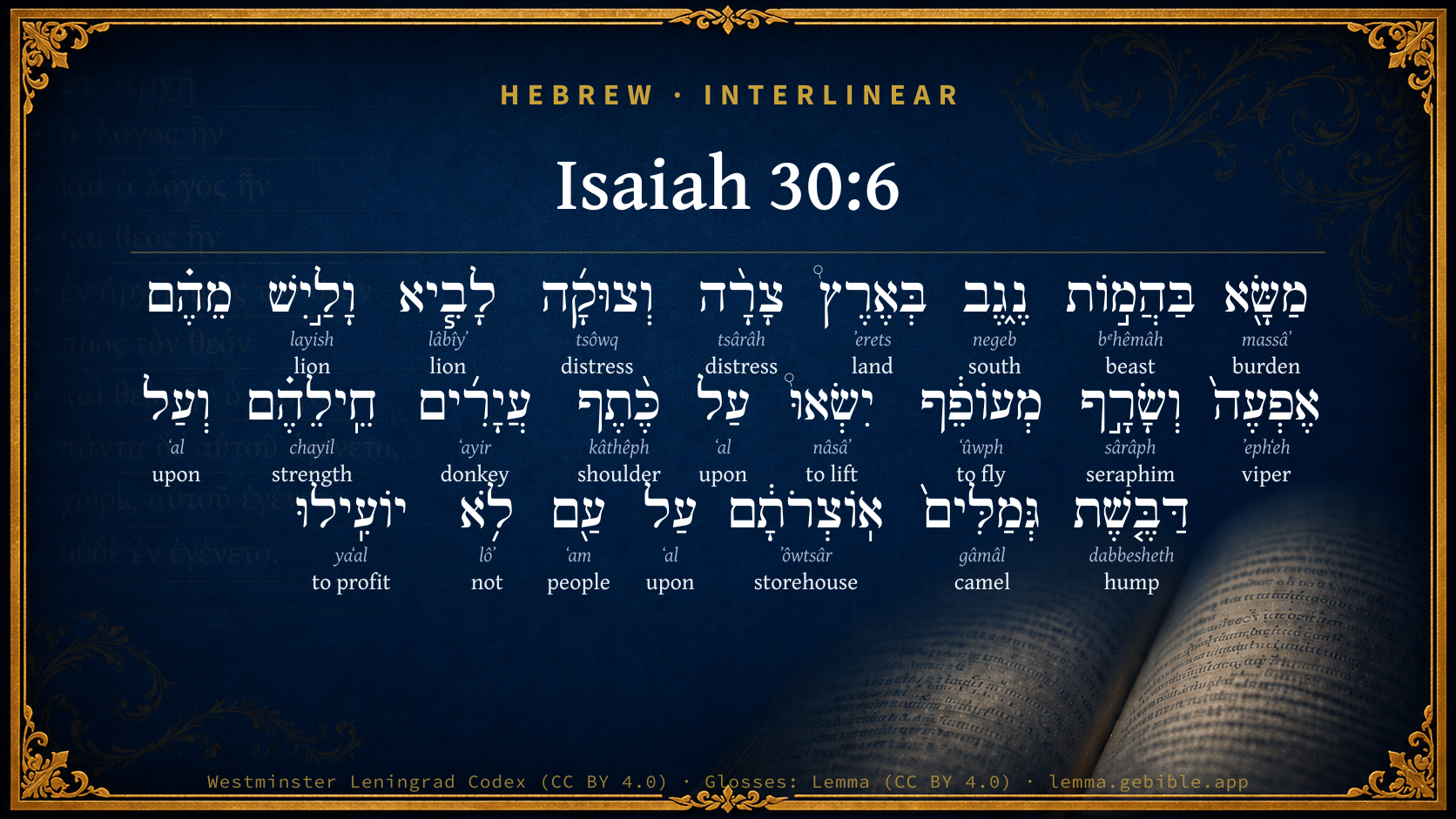
Isaiah 30:6

Hebrew (Westminster Leningrad Codex) Isaiah 30:6 appears in the Hebrew Old Testament. The text above is from the Westminster Leningrad Codex. Each word links to its Strong’s number, a concise gloss, and parsing drawn from the Open Scriptures Hebrew Bible morphology. Click any word for its full Brown-Driver-Briggs (BDB) entry.
Download image
Cite this verse

Isaiah 30:6 (World English Bible). Public Domain. Lemma interlinear Bible study tool, https://lemma.gebible.app/v/isaiah/30/6.

Show BibTeX & RIS
BibTeX
RIS
English Translation
The burden of the animals of the South. Through the land of trouble and anguish, from whence come the lioness and the lion, the viper and fiery flying serpent, they carry their riches on the shoulders of young donkeys, and their treasures on the humps of camels, to a people that shall not profit [them].
World English Bible · Public Domain
Highlights
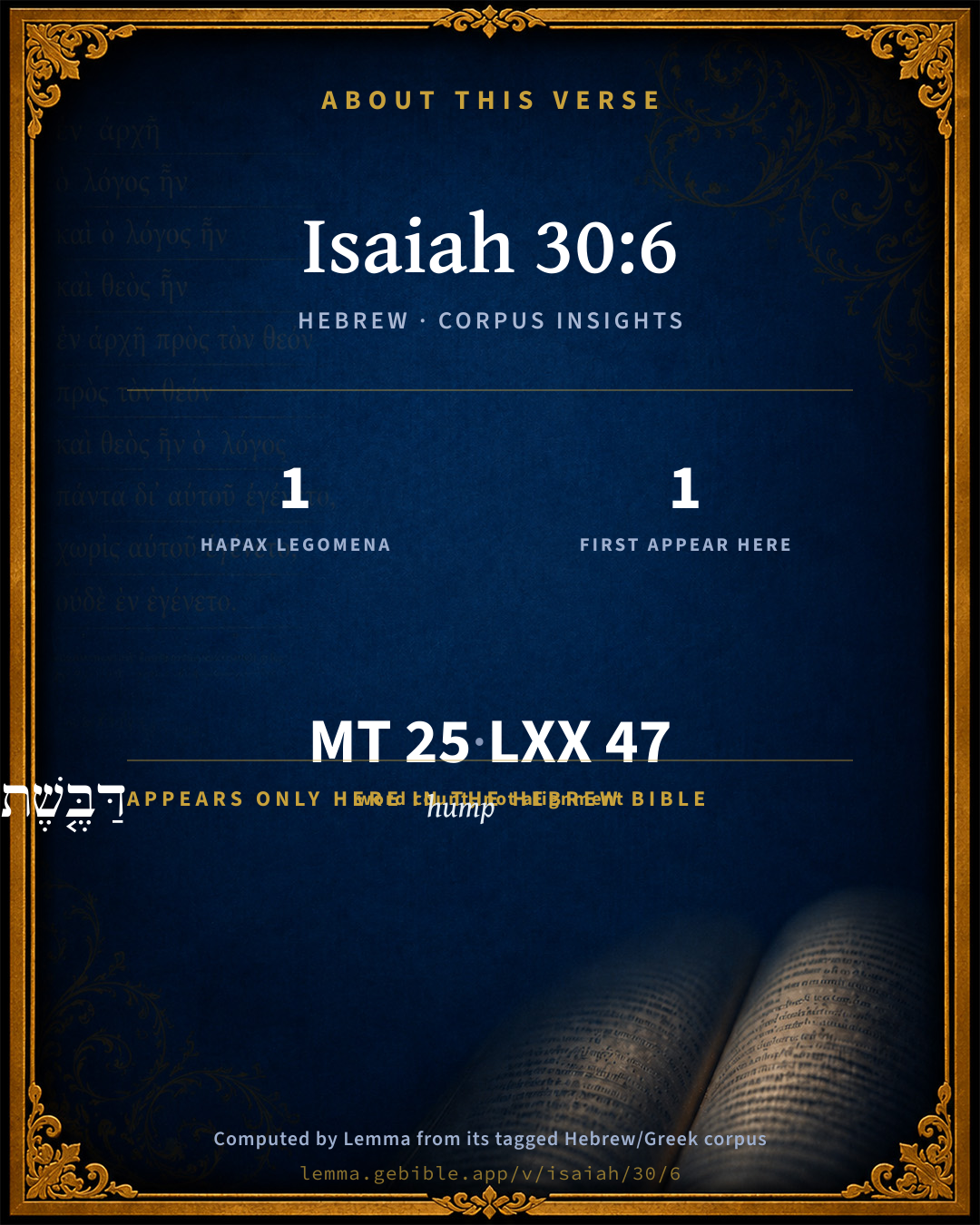
  • 1 hapax legomenon — only here in the Hebrew Bible
  • 1 first appearance in the Hebrew Bible
Full analysis ↓
Download a study sheet

One document with this verse’s original text, its word-by-word gloss line, the meaning frame, cross-references with their text, attributed commentary, and full source and license credits — printable, and it pastes into notes with its structure intact.

This verse Autodidact and up

Study sheet (.html) Plain text (.txt)

A passage Seminary Student

Up to 50 verses in one chapter. A passage sheet keeps up to 6 commentary sources and 12 cross-references per verse, in the order this page ranks them, and says so on the sheet whenever that leaves anything out. Ask for a single verse and you get the Autodidact verse sheet above.

Everything on this page stays free to read, with no account — the sheet is a download of what is already on screen, not access to it.

Want to remove ads? Support Godless Engineer
Compare translations 3

The same verse in 3 English versions, stacked beneath the original-language interlinear above. Click any original word for its lexicon entry.

Each is an independent rendering of the whole verse — the interlinear is not word-aligned to these translations.

Highlighted words mark where these versions differ — a whole-verse word diff, not a word-by-word alignment.

  • World English Bible Public Domain
    The burden of the animals of the South. Through the land of trouble and anguish, from whence come the lioness and the lion, the viper and fiery flying serpent, they carry their riches on the shoulders of young donkeys, and their treasures on the humps of camels, to a people that shall not profit [them].
  • King James Version Public Domain
    The burden of the beasts of the south: into the land of trouble and anguish, from whence come the young and old lion, the viper and fiery flying serpent, they will carry their riches upon the shoulders of young asses, and their treasures upon the bunches of camels, to a people that shall not profit them.
  • unfoldingWord Literal Text CC BY-SA 4.0
    The burden of the beasts of the Negev. Through a land of trouble and distress, from them the lioness and the lion, the viper and the flying serpent, they carry their riches on the shoulder of donkeys and their treasures, on the hump of camels to a people do not benefit.

unfoldingWord Literal Text — © unfoldingWord, licensed CC BY-SA 4.0. Word-aligned USFM3 via Door43 (git.door43.org/unfoldingWord/en_ult).

Versions to compare (up to 4)

3 of 4 selected

Show all 18 translations

Every available English version of this verse, each an independent rendering of the whole verse.

  • World English Bible Public Domain
    The burden of the animals of the South. Through the land of trouble and anguish, from whence come the lioness and the lion, the viper and fiery flying serpent, they carry their riches on the shoulders of young donkeys, and their treasures on the humps of camels, to a people that shall not profit [them].
  • Berean Standard Bible Public Domain
    This is the burden against the beasts of the Negev: Through a land of hardship and distress, of lioness and lion, of viper and flying serpent, they carry their wealth on the backs of donkeys and their treasures on the humps of camels, to a people of no profit to them.
  • Majority Standard Bible Public Domain
    This is the burden against the beasts of the Negev: Through a land of hardship and distress, of lioness and lion, of viper and flying serpent, they carry their wealth on the backs of donkeys and their treasures on the humps of camels, to a people of no profit to them.
  • King James Version Public Domain
    The burden of the beasts of the south: into the land of trouble and anguish, from whence come the young and old lion, the viper and fiery flying serpent, they will carry their riches upon the shoulders of young asses, and their treasures upon the bunches of camels, to a people that shall not profit them.
  • American Standard Version (1901) Public Domain
    The burden of the beasts of the South. Through the land of trouble and anguish, from whence come the lioness and the lion, the viper and fiery flying serpent, they carry their riches upon the shoulders of young asses, and their treasures upon the humps of camels, to a people that shall not profit `them'.
  • Revised Version (1885) Public Domain
    The burden of the beasts of the South. Through the land of trouble and anguish, from whence come the lioness and the lion, the viper and fiery flying serpent, they carry their riches upon the shoulders of young asses, and their treasures upon the bunches of camels, to a people that shall not profit them.
  • Geneva Bible (1599) Public Domain
    The burden of the beasts of the South, in a land of trouble and anguish, from whence shall come the yong and olde lyon, the viper and fierie flying serpent against them that shall beare their riches vpon the shoulders of the coltes, and their treasures vpon the bounches of the camels, to a people that cannot profite.
  • Douay-Rheims (1899) Public Domain
    The burden of the beasts of the south. In a land of trouble and distress, from whence come the lioness, and the lion, the viper and the flying basilisk, they carry their riches upon the shoulders of beasts, and their treasures upon the bunches of camels to a people that shall not be able to profit them.
  • Young's Literal Translation Public Domain
    The burden of the beasts of the south. Into a land of adversity and distress, Of young lion and of old lion, Whence `are' viper and flying saraph, They carry on the shoulder of asses their wealth, And on the hump of camels their treasures, Unto a people not profitable.
  • Literal Standard Version CC BY-SA 4.0
    The burden of the beasts of the south. Into a land of adversity and distress, || Of young lion and of old lion, || From where [are] viper and flying, burning serpent, || They carry their wealth on the shoulder of donkeys, || And their treasures on the hump of camels, || To a people not profitable.
  • Unlocked Literal Bible CC BY-SA 4.0
    A declaration about the beasts of the Negev: Through the land of trouble and danger, of the lioness and the lion, the viper and fiery flying serpent, they carry their riches on the backs of donkeys, and their treasures on the camels' humps, to a people who cannot help them.
  • unfoldingWord Literal Text CC BY-SA 4.0
    The burden of the beasts of the Negev. Through a land of trouble and distress, from them the lioness and the lion, the viper and the flying serpent, they carry their riches on the shoulder of donkeys and their treasures, on the hump of camels to a people do not benefit.
  • Darby Bible Public Domain
    -- The burden of the beasts of the south: Through a land of trouble and anguish, whence come the lioness and lion, the viper and fiery flying serpent, they carry their riches upon the shoulders of asses, and their treasures upon the bunches of camels, to the people that shall not profit [them].
  • World Messianic Bible Public Domain
    The burden of the animals of the South. Through the land of trouble and anguish, of the lioness and the lion, the viper and fiery flying serpent, they carry their riches on the shoulders of young donkeys, and their treasures on the humps of camels, to an unprofitable people.
  • Webster's Bible Public Domain
    The burden of the beasts of the south: into the land of trouble and anguish, from whence come the young and the old lion, the viper and flying serpent, they will carry their riches upon the shoulders of young asses, and their treasures upon the bunches of camels, to a people that shall not profit them.
  • Free Bible Version CC BY-SA 4.0
    A message about the animals of the Negev. The messengers travel through a harsh and hostile land where lions and lionesses live, vipers and vicious snakes too. Their donkeys are burdened down with valuable gifts, their camels are loaded with treasure, to give to a worthless people that can't help.
  • Bible in Basic English Public Domain
    The word about the Beasts of the South. Through the land of trouble and grief, the land of the she-lion and the voice of the lion, of the snake and the burning winged snake, they take their wealth on the backs of young asses, and their stores on camels, to a people in whom is no profit.
  • JPS Tanakh (1917) Public Domain
    The burden of the beasts of the South. Through the land of trouble and anguish, from whence come the lioness and the lion, the viper and flying serpent, they carry their riches upon the shoulders of young asses, and their treasures upon the humps of camels, to a people that shall not profit them.

Literal Standard Version (2020), Covenant Press — licensed CC BY-SA 4.0. Text via the HelloAO Bible API (eBible.org). Unlocked Literal Bible (unfoldingWord) — licensed CC BY-SA 4.0. Text via the HelloAO Bible API (eBible.org). unfoldingWord Literal Text — © unfoldingWord, licensed CC BY-SA 4.0. Word-aligned USFM3 via Door43 (git.door43.org/unfoldingWord/en_ult). Free Bible Version, Dr. Jonathan Gallagher — licensed CC BY-SA 4.0. Text via the HelloAO Bible API (eBible.org).

Word by word

More ways to search: Search by grammar → Find every occurrence → Compare this word →

Practice this passage: Drill this verse → Learn its vocabulary →

דַּבֶּ֤שֶׁת
dabbesheth
H1707
“hump of”
Noun, Common, Feminine, Singular, Construct
Part of Speech
Noun
Type
Common
Gender
Feminine
Number
Singular
State
Construct
Full BDB Definition

Origin: intensive from the same as H1706

TWOT: 400b

hump (of camel)
  1. מַשָּׂ֖א massâʼ H4853 “burden of” Noun, Common, Masculine, Singular, Construct
  2. בַּהֲמ֣וֹת bᵉhêmâh H929 “beasts of” Noun, Common, Feminine, Plural, Construct
  3. נֶ֑גֶב negeb H5045 “south” Noun, Common, Masculine, Singular, Absolute
  4. בְּאֶרֶץ֩ ʼerets H776 “in/at · land of” Preposition + Noun, Common, Both, Singular, Construct
  5. צָרָ֨ה tsârâh H6869 “distress” Noun, Common, Feminine, Singular, Absolute
  6. וְצוּקָ֜ה tsôwq H6695 “and · distress” Conjunction + Noun, Common, Feminine, Singular, Absolute
  7. לָבִ֧יא lâbîyʼ H3833 “lion” Noun, Common, Both, Singular, Absolute
  8. וָלַ֣יִשׁ layish H3918 “and · lion” Conjunction + Noun, Common, Masculine, Singular, Absolute
  9. אֶפְעֶה֙ ʼephʻeh H660 “viper” Noun, Common, Masculine, Singular, Absolute
  10. וְשָׂרָ֣ף sârâph H8314 “and · seraphim” Conjunction + Noun, Common, Masculine, Singular, Absolute
  11. מְעוֹפֵ֔ף ʻûwph H5774 “flying” Verb, Polel, Participle Active, Masculine, Singular, Absolute
  12. יִשְׂאוּ֩ nâsâʼ H5375 “to lift” Verb, Qal, Imperfect, 3rd Person, Masculine, Plural
  13. עַל ʻal H5921 “upon” Preposition
  14. כֶּ֨תֶף kâthêph H3802 “shoulder of” Noun, Common, Feminine, Singular, Construct
  15. עֲיָרִ֜ים ʻayir H5895 “donkeys” Noun, Common, Masculine, Plural, Absolute
  16. חֵֽילֵהֶ֗ם chayil H2428 “forces · their” Noun, Common, Masculine, Plural, Construct + Suffix, Personal, 3rd Person, Masculine, Plural
  17. וְעַל ʻal H5921 “and · upon” Conjunction + Preposition
  18. גְּמַלִּים֙ gâmâl H1581 “camels” Noun, Common, Masculine, Plural, Absolute
  19. אֽוֹצְרֹתָ֔ם ʼôwtsâr H214 “storehouses · their” Noun, Common, Masculine, Plural, Construct + Suffix, Personal, 3rd Person, Masculine, Plural
  20. עַל ʻal H5921 “upon” Preposition
  21. עַ֖ם ʻam H5971 “people” Noun, Common, Masculine, Singular, Absolute
  22. לֹ֥א lôʼ H3808 “not” Particle, Negative
  23. יוֹעִֽילוּ yaʻal H3276 “to profit” Verb, Hiphil, Imperfect, 3rd Person, Masculine, Plural

About this verse

These counts appear in no published source. They are computed here, from the morphology-tagged text and Lemma’s own curated glosses. What Lemma adds →

25
words
22
distinct lemmas
Prophets
section

Notable vocabulary

1 hapax legomenon — a word that appears only here in the entire Hebrew Bible:

  • דַּבֶּ֤שֶׁת hump H1707

First appearance in Scripture

This word makes its first canonical appearance in the Hebrew Bible here:

  • דַּבֶּ֤שֶׁת hump H1707

Shared distinctive vocabulary

וָלַ֣יִשׁ lion H3918 occurs in 3 verses of the Hebrew Bible. Also found in:

Grammatical profile

  • 3 verbs
  • 17 nouns
  • 4 prepositions
  • 1 particle

Verb forms

  • מְעוֹפֵ֔ף Polel · Participle Active
  • יִשְׂאוּ֩ Qal · Imperfect
  • יוֹעִֽילוּ Hiphil · Imperfect

Repetition

A word recurs within this verse — often emphatic in Hebrew:

Hebrew & Septuagint length

In English translation the verse runs 55 words from the Hebrew and 49 from the Septuagint (LXX English) — closely comparable.

A rough comparison of the two English renderings, which tokenize alike — not a word-level alignment.

Word counts can differ between the Hebrew and the Greek without any difference in meaning — e.g. the Hebrew direct-object marker אֵת has no separate Greek word, and Greek often adds the article ὁ.

In the original languages it is 25 Hebrew tokens and 47 Greek tokens — but the two are counted differently (Hebrew bundles its prefixes and suffixes into one token; the Greek is in lemma form), so that isn’t a like-for-like length.

Cross-references

20

Topical passages linked to Isaiah 30:6 in the Treasury of Scripture Knowledge — connected by theme and wording, ordered by reader-vote popularity; previews shown in the World English Bible.

  • Deuteronomy 8:15 who led you through the great and terrible wilderness, [in which were] fiery serpents and scorpions, and thirsty ground where was no water; who brought you forth water out of the rock of flint;
  • Isaiah 46:1–2 Bel bows down, Nebo stoops; their idols are on the animals, and on the cattle: the things that you carried about are made a load, a burden to the weary [animal].
  • Deuteronomy 4:20 But Yahweh has taken you, and brought you forth out of the iron furnace, out of Egypt, to be to him a people of inheritance, as at this day.
  • Jeremiah 11:4 which I commanded your fathers in the day that I brought them forth out of the land of Egypt, out of the iron furnace, saying, Obey my voice, and do them, according to all which I command you: so shall you be my people, and I will be your God;
  • 1 Kings 10:2 She came to Jerusalem with a very great train, with camels that bore spices, and very much gold, and precious stones; and when she was come to Solomon, she talked with him of all that was in her heart.
  • Hosea 8:9–10 For they have gone up to Assyria, Like a wild donkey wandering alone. Ephraim has hired lovers for himself.
  • Exodus 1:14 and they made their lives bitter with hard service, in mortar and in brick, and in all manner of service in the field, all their service, in which they ruthlessly made them serve.
  • Exodus 5:10–21 The taskmasters of the people went out, and their officers, and they spoke to the people, saying, This is what Pharaoh says: "I will not give you straw.
  • Numbers 21:6–7 Yahweh sent fiery serpents among the people, and they bit the people; and much people of Israel died.
  • Deuteronomy 17:16 Only he shall not multiply horses to himself, nor cause the people to return to Egypt, to the end that he may multiply horses; because Yahweh has said to you, You shall henceforth return no more that way.
  • 2 Chronicles 9:1 When the queen of Sheba heard of the fame of Solomon, she came to prove Solomon with hard questions at Jerusalem, with a very great train, and camels that bore spices, and gold in abundance, and precious stones: and when she was come to Solomon, she talked with him of all that was in her heart.
  • 2 Chronicles 16:2 Then Asa brought out silver and gold out of the treasures of the house of Yahweh and of the king's house, and sent to Ben Hadad king of Syria, who lived at Damascus, saying,
  • 2 Chronicles 28:20–23 Tilgath Pilneser king of Assyria came to him, and distressed him, but didn't strengthen him.
  • Isaiah 8:22 and they shall look to the earth, and see, distress and darkness, the gloom of anguish; and into thick darkness [they shall be] driven away.
  • Isaiah 15:7 Therefore the abundance they have gotten, and that which they have laid up, shall they carry away over the brook of the willows.
  • Isaiah 19:4 I will give over the Egyptians into the hand of a cruel lord; and a fierce king shall rule over them, says the Lord, Yahweh of Hosts.
  • Isaiah 57:9 You went to the king with oil, and did increase your perfumes, and did send your ambassadors far off, and did debase yourself even to Sheol.
  • Jeremiah 2:6 Neither said they, Where is Yahweh who brought us up out of the land of Egypt, who led us through the wilderness, through a land of deserts and of pits, through a land of drought and of the shadow of death, through a land that none passed through, and where no man lived?
  • Hosea 12:1 Ephraim feeds on wind, And chases the east wind. He continually multiplies lies and desolation. They make a covenant with Assyria, And oil is carried into Egypt.
  • Matthew 12:42 The queen of the south will rise up in the judgment with this generation, and will condemn it, for she came from the ends of the earth to hear the wisdom of Solomon; and behold, someone greater than Solomon is here.

Cross-references courtesy of OpenBible.info (CC BY 4.0).

Hebrew and Greek witnesses Masoretic Hebrew ↔ Greek Septuagint

The same verse in the two great witnesses to the Old Testament, shown verse-for-verse.

These are two independent witnesses, not word-aligned to each other, and the Septuagint is shown in lemma (dictionary) form.

Hebrew Isaiah 30:6 Masoretic · Westminster Leningrad Codex

מַשָּׂ֖א בַּהֲמ֣וֹת נֶ֑גֶב בְּאֶרֶץ֩ צָרָ֨ה וְצוּקָ֜ה לָבִ֧יא וָלַ֣יִשׁ מֵהֶ֗ם אֶפְעֶה֙ וְשָׂרָ֣ף מְעוֹפֵ֔ף יִשְׂאוּ֩ עַל כֶּ֨תֶף עֲיָרִ֜ים חֵֽילֵהֶ֗ם וְעַל דַּבֶּ֤שֶׁת גְּמַלִּים֙ אֽוֹצְרֹתָ֔ם עַל עַ֖ם לֹ֥א יוֹעִֽילוּ

The burden of the animals of the South. Through the land of trouble and anguish, from whence come the lioness and the lion, the viper and fiery flying serpent, they carry their riches on the shoulders of young donkeys, and their treasures on the humps of camels, to a people that shall not profit [them].

World English Bible · Public Domain

Greek LXX Isaiah 30:6 Septuagint · lemma form

ὁ ὅρασις ὁ τετράπους ὁ ἐν ὁ ἔρημος ἐν ὁ θλῖψις καί ὁ στενοχωρία λέων καί σκύμνος λέων ἐκεῖθεν καί ἀσπίς καί ἔκγονος ἀσπίς πέτομαι ὅς φέρω ἐπί ὄνος καί κάμηλος ὁ πλοῦτος αὐτός πρός ἔθνος ὅς οὐ ὠφελέω αὐτός εἰς βοήθεια ἀλλά εἰς αἰσχύνη καί ὄνειδος

THE VISION OF THE QUADRUPEDS IN THE DESERT. In affliction and distress, where are the lion and lion's whelp, thence come also asps, and the young of flying asps, there shall they be who bore their wealth on asses and camels to a nation which shall not profit them.

LXX2012 (modern English Septuagint) · Public Domain

On this verse, Keil & Delitzsch discusses the Septuagint’s reading. Read the note in Commentary ↓

Hebrew: Westminster Leningrad Codex (CC BY 4.0). Greek: Septuagint (public domain); English from LXX2012 (modern English Septuagint) (Public Domain). How the Septuagint differs from the Hebrew →

Targum (Aramaic paraphrase)

1

The Targum is the ancient Jewish Aramaic paraphrase of the Hebrew Scriptures — an interpretive translation, not the Hebrew text itself. Onkelos (literal) and Pseudo-Jonathan (expansive) render the Torah, and Jonathan the Prophets. Coverage is partial: where no permissively-licensed English translation exists for a verse, only the Aramaic is shown. This is verse-level text, not a word-by-word alignment to the Hebrew.

  1. Targum Jonathan Prophets (Joshua–Malachi)
    מַטְלִין עַל בְּעִירְהוֹן בְּאוֹרַח דָרוֹמָא בַּאֲרַע עָקָא וְעִיוּק אֲתַר דְאַרְיָא בַר אַוְיְוָן וְחֵיוָן הוּרְמָנִין מַפְרְחִין נָטְלִין עַל כְּתַף עִילִין נִכְסֵיהוֹן וְעַל חִטוּרִיאַת גַמְלִין מָא דִבְאָצְרֵיהוֹן מוֹבְלִין לְעַם לָא יַהֲנוֹן לְהוֹן:

    They carry upon their beasts of burden on the way southward, into a land of oppression and distress, a place of the lion, and the whelps of the lionesses, and serpents, and of the flying basilisks—they carry upon the shoulders of their young cattle their treasures, and they bring upon the bunches of camels whatever is in their treasuries unto a people, that shall not profit them.

    Targum Jonathan — Aramaic: “Mikraot Gedolot” (public domain). English: “Sefaria Community Translation” (CC0 1.0 (public-domain dedication)); “London "Chaldee Paraphrase," 1871” (public domain). Text via Sefaria.

Commentary

Notes on Isaiah 30:6 from classic Christian and Jewish commentators (each source and its license shown beneath its notes). The classic Christian expositions comment on the surrounding passage and are grouped to its opening verse, so a note may address several verses; the Jewish commentaries on the Tanakh (Rashi and others) are per-verse, so they appear only where the commentator wrote on this verse.

Lemma curates 59 commentaries, every one of them public domain or Creative Commons licensed, each selected and text-cleaned for this edition rather than reprinted as found. About our sources →

The Cambridge Bible for Schools and Colleges

gen. ed. J. J. S. Perowne

6. trouble and anguish] Better perhaps distress and hardship, cf. Deu_8:15; Jer_2:6.

the young and old lion] R.V. the lioness and the lion. Hebrew (like Arabic) possesses a superfluity of synonyms for the lion.

fiery flying serpent] winged Saraph. See on Isa_6:2, Isa_14:29; cf. Num_21:6. These are some of the terrors braved by the Jewish envoys in the prosecution of their foolhardy enterprise.

they will carry (R.V. they carry) their riches, &c.] The ambassadors take with them a whole caravan of presents to the Egyptian courts.

6, 7. These verses are marked as an independent oracle by a heading in the enigmatic style of those in ch. 21, 22. Some commentators regard the title as an editorial note which has crept into the text from the margin; but the substance of the oracle, which is a parallel to, rather than a continuation of, Isa_30:1-5, favours the supposition that it was originally distinct. From the analogy of Isa_21:1; Isa_21:13, Isa_22:1, we should expect the superscription to be suggested by some striking phrase in the body of the prophecy. There is, however, nothing in the text as it stands to suggest “beasts of the south.” “The south” means the Negeb, the desert region to the south of Judah, traversed by the Jewish ambassadors on their way to Egypt. The “beasts” might be either the beasts of burden painfully making their way through it (Isa_30:6) or the wild animals by which it is haunted (Isa_30:6). That the expression refers to the hippopotamus (Job_40:15) as a symbol of Egypt is a hazardous speculation. The text is probably corrupt, and Duhm’s suggestion that the title reproduces some lost words at the beginning of the oracle is probably on the right track, although his proposed reconstruction may not command assent.

The Cambridge Bible for Schools and Colleges (gen. ed. J. J. S. Perowne; Cambridge University Press, 1878–1918) — public domain. Text from a community e-Sword module.

Trapp's Complete Commentary

John Trapp

Isa 30:6 The burden of the beasts of the south: into the land of trouble and anguish, from whence [come] the young and old lion, the viper and fiery flying serpent, they will carry their riches upon the shoulders of young asses, and their treasures upon the bunches of camels, to a people [that] shall not profit [them].

Ver. 6. The burden,] i.e., The gifts and presents wherewith the Hebrews’ beasts were laden to carry southward, to hire help from Egypt. A man’s gift maketh room for him. {Pro 18:11} Philip was wont to say, that he doubted not of taking any town or tower, if he could but thrust into it an ass laden with gold. But these Jewish ambassadors lost both their labour and their treasures, carried upon the shoulders of many young asses, and upon the bunches of camels, to a very great quantity. See what a present was sent to a poor prophet, even of every good thing of Damascus forty camels’ burden, {2Ki 8:9} and guess by that what a deal of wealth went now to Egypt to procure help.

Into the land of trouble and anguish.] That great and terrible wilderness of Arabia, wherein were "fiery serpents and scorpions," {Deu 8:15} and other fell creatures not a few. Through that "waste howling desert" {Deu 32:10} that lay between Judea and Egypt, travelled these beasts with their burdens; but all was labour in vain, and cost cast away, because God was not of the counsel.

John Trapp, A Commentary or Exposition upon All the Books of the Old and New Testament (1647–1656) — public domain. Text from a community e-Sword module.

Joseph Benson's Commentary

Isa 30:6-7. The burden of the beasts of the south — The burden of riches or treasures, carried upon beasts travelling southward. In these verses the prophet has before his eyes “the ambassadors of the Jews, or, as some think, also of Hosea, and the Ephraimites, (see 2Ki 17:4,) bearing their splendid and sumptuous presents on asses and camels into Egypt; and perceiving that they would reap no advantage from this proud and sumptuous embassy, and that the whole would be fruitless, or rather would raise the indignation of the Assyrians, he cannot refrain, but exhibits, to the life, the whole scheme of this imprudence, folly, and incredulity, as it was immediately presented to his prophetic sight, with its shameful and sorrowful event.” Into the land of trouble and anguish — Into Egypt and Ethiopia, for both were joined together in this matter, (see chap. 20.,) whose land seems to be called a land of trouble, &c., prophetically, because they should distress and not help those that applied to and trusted in them, as was said of the Assyrians in the like case, 2Ch 28:20. Bishop Lowth, who supposes that the deserts are here meant, which the Israelites passed through when they came out of Egypt, renders it, by, or through a land of distress, &c. But it seems more likely, as it certainly was more important, that the land to which, than that through which, they went, should be spoken of. Besides, the direct road from Judea to Egypt was not through such a country as is here described. From whence come the young and old lion, &c. — This may be understood literally, for “Egypt, at this time, joined to Ethiopia, was, of all countries, most fertile of every fierce and wild creature, which the nature of man abhors, both terrestrial and aquatic.” See Boch. Hieroz., p. 2:1. 3. c. 13. The words, however, may have a higher and mystical meaning, and by these wild and savage creatures may be designed the craft and cruelty of the Egyptians and Ethiopians, and the danger and injury the Jews, or Israelites, would bring upon themselves by a confederacy with them. Therefore have I cried concerning this — This counsel, or practice; their strength is to sit still — It is safer and better for them to stay quietly at home, seeking to God for help, than to go or send to Egypt for it.

Joseph Benson's Commentary on the Old and New Testaments (1811–1818) — public domain. Text from a community e-Sword module.

Keil & Delitzsch

C. F. Keil & F. Delitzsch

The prophet's address is hardly commenced, however, when a heading is introduced of the very same kind as we have already met with several times in the cycle of prophecies against the heathen nations. Gesenius, Hitzig, Umbreit, and Knobel, rid themselves of it by pronouncing it a gloss founded upon a misunderstanding. But nothing is more genuine in the whole book of Isaiah than the words massâ' bahămōth negebh . The heading is emblematical, like the four headings in chapters 21, 22. And the massâ' embraces Isa 30:6, Isa 30:7. Then follows the command to write it on a table by itself. The heading is an integral part of the smaller whole. Isaiah breaks off his address to communicate an oracle relating to the Egyptian treaty, which Jehovah has specially commanded him to hand down to posterity. The same interruption would take place if we expunged the heading; for in any case it was Isa 30:6, Isa 30:7 that he was to write upon a table. This is not an address to the people, but the preliminary text, the application of which is determined afterwards. The prophet communicates in the form of a citation what has been revealed to him by God, and then states what God has commanded him to do with it. We therefore enclose Isa 30:6, Isa 30:7 in inverted commas as a quotation, and render the short passage, which is written in the tone of chapter 21, as follows: "Oracle concerning the water-oxen of the south: Through a land of distress and confinement, whence the lioness and lion, adders and flying dragons; they carry their possessions on the shoulders of asses' foals, and their treasures on the humps of camels, to a nation that profits nothing. And Egypt, worthlessly and hollowly will they help; therefore I call this Egypt, Great-mouth that sits still." The "water-ox of the south" is the Nile-horse; and this is the emblem of Egypt, the land of the south (in Daniel and Zechariah Babylonia is "the land of the north"). Bahămōth is the construct of behēmōth (Job 40), which is a Hebraized from of an Egyptian word, p-ehe-mau (though the word itself has not yet been met with), i.e., the ox of the water, or possibly p-ehe-mau-t (with the feminine article at the close, though in hesmut, another name for a female animal, mut = t. mau signifies "the mother:" see at Job 40:15). The animal referred to is the hippopotamus, which is called bomarino in Italian, Arab. the Nile-horse or water-pig. The emblem of Egypt in other passages of the Old Testament is tannin, the water-snake, or leviathan, the crocodile. In Psa 78:31 this is called chayyath qâneh, "the beast of the reed," though Hengstenberg supposes that the Nile-horse is intended there. This cannot be maintained, however; but in the passage before us this emblem is chosen, just because the fat, swine-like, fleshy colossus, whose belly nearly touches the ground as it walks, is a fitting image of Egypt, a land so boastful and so eager to make itself thick and broad, and yet so slow to exert itself in the interest of others, and so unwilling to move from the spot. This is also implied in the name rahabh-hēm-shâb. Rahab is a name applied to Egypt in other passages also (Isa 51:9; Psa 87:4; Psa 89:11), and that in the senses attested by the lxx at Job 26:12 (cf., Isa 9:13), viz., κῆτος, a sea-monster, monstrum marinum. Here the name has the meaning common in other passages, viz., violence, domineering pride, boasting (ἀλαζονεία, as one translator renders it). הם is a term of comparison, as in Gen 14:2-3, etc.; the plural refers to the people called rahabh. Hence the meaning is either, "The bragging people, they are sit-still;" or, "Boast-house, they are idlers." To this deceitful land the ambassadors of Judah were going with rich resources (chăyâlı̄m, opes) on the shoulder of asses' foals, and on the hump (dabbesheth, from dâbhash, according to Luzzatto related to gâbhash, to be hilly) of camels, without shrinking from the difficulties and dangers of the road through the desert, where lions and snakes spring out now here and now there (מהם, neuter, as in Zep 2:7, comp. Isa 38:16; see also Deu 8:15; Num 21:6). Through this very desert, through which God had led their fathers when He redeemed them out of the bondage of Egypt, they were now marching to purchase the friendship of Egypt, though really, whatever might be the pretext which they offered, it was only to deceive themselves; for the vainglorious land would never keep the promises that it made.

Keil & Delitzsch — Biblical Commentary on the Old Testament (1861–1891) — public domain (CC PDM 1.0). Text via the HelloAO Bible API. (Old Testament only.)

Lange's Commentary on the Holy Scriptures

2. THE PROPHET AS HE OUGHT TO BE, AND AS HE OUGHT NOT TO BE

Isa_30:6-14

6          The burden of the beasts of the south:

4Into the land of trouble and anguish,

From whence come 5the young and old lion,

The viper and fiery flying serpent,

They will carry their riches upon the shoulders of young asses,

And their treasures upon the bunches of camels,

To a people that shall not profit them.

7     For the Egyptians shall help in vain, and to no purpose;

Therefore 6have I cried 7concerning this, Their strength is to sit still.

8     Now go, write it before them in a table,

And note it in a book,

That it may be for 8the time to come for ever and ever:

9     That this is a rebellious people,

Lying children, children that will not hear the law of the Lord:

10     Which say to the Seers, See not;

And to the prophets, Prophesy not unto us right things,

Speak unto us smooth things, prophesy deceits:

11     Get you out of the way, turn aside out of the path,

Cause the Holy One of Israel to cease from before us.

12     Wherefore thus saith the Holy One of Israel,

Because ye despise this word,

And trust in 9oppression and perverseness,

And stay thereon:

13     Therefore this iniquity shall be to you as a breach ready to fall,

Swelling out in a high wall,

Whose breaking cometh suddenly at an instant.

14     And he shall break it as the breaking of 10the potters’ vessel,

That is broken in pieces; he shall not spare;

So that there shall not be found in the bursting of it a sherd

To take fire from the hearth,

Or to take water withal out of the pit.

TEXTUAL AND GRAMMATICAL

Isa_30:11, The form מִנֵּי is found only here. The Masoretic note under the text is to be read “Two Nuns with Tseri.” מִנֵּי is formed after the analogy of the forms אַחֲרֵי ,עֲלֵי, etc., and has the same meaning as the more common מִנִּי (Isa_46:3).

EXEGETICAL AND CRITICAL

1. In order to set forth right vividly the certainty of his prophecy, Isaiah tells the people that he has been commanded to mark his utterance concerning the Egyptian help as a particular massa, to which he now gives an emblematic title similar to what we find in chapters 21, 22. The purport of this massa is this: The Jewish ambassadors drag rich treasures laboriously through the perilous wilderness to Egypt, in order to purchase the assistance of the Egyptians which will prove to be empty vapor; wherefore Jehovah Himself gives Egypt the name “Boaster, sitting still” (Isa_30:6-7). This massa is to be preserved till the remotest future, as a witness for the truth of what was said by the Prophet (Isa_30:8). In this way it must be made possible to establish objectively the truth of the prophetic testimony, as all sense for the truth is wanting in the people of Israel, for they are a lying race, that will not hear the law of Jehovah (Isa_30:9). They show this by actually demanding of the prophets that they should not tell them the truth, but only what is agreeable, even when it is pure falsehood (verse 10); and, further, by requiring that they (the prophets) should depart from the right way, and remove from their (the people’s) eyes the Holy One of Israel (Isa_30:11). Because then they despise the word of the Lord, and rely only on violence at home and a perverse foreign policy (Isa_30:12), this their sin shall be to them as a rent wall which bulges out and threatens every moment to fall (Isa_30:13). And it will also fall, and its remains will through the violence of the fall become reduced to small pieces such as the sherds of a pot, none of which is large enough for one to carry in it fire from the hearth or water from the pit (Isa_30:14).

2. The burden——and ever.

Isa_30:6-8. Very unjustly is the spuriousness of the inscription משׂא בהמות נגב maintained. In Isa_30:8 the Prophet is commanded to record it, i.e., the preceding brief, sharply marked saying in a particular tablet to serve as documentary evidence in the future. I understand this saying to be verses 6 and 7. For they are essentially of the same import as verses 1–5. But they reproduce this import in a quite peculiar, emblematic, mystical form. They bear, we might say, a decidedly prophetical character. Their purport is designedly set forth in this peculiar form for the purpose of being specially recorded. If now this brief saying is manifestly designed to have an independent existence, why should it not also have its own name, its particular inscription? The Prophet has recorded from 13–23. a series of prophecies against foreign nations, to each of which he gives the title מַשָּׂא. He has, in particular, in chapter 21 brought together some rather short utterances under the title משׂא with an emblematical addition (Isa_21:1; Isa_21:11; Isa_21:13). Might he not designedly insert here in the text such a brief emblematic משּׂא, as he was led to do so by the peculiar circumstances attending its origin? As he states, Isa_30:8, he received, after having orally delivered the words, the command also to make a particular record of them in writing. As now this recording formed an interlude to his oral teaching, and as he committed to writing all his oral teaching, why should he not record this interlude also? It could not possibly be passed over. Nor could he place it as an independent משׂא among the rest, for it would have been unintelligible in that connection. It is a rash conclusion to declare that the very expression משׂא is an evidence that the inscription did not proceed from Isaiah, because he never used the word. It is only in such prophecies as immediately refer to the theocracy that Isaiah does not use the word. It is with him a standing designation of prophecies concerning foreign nations. On this very account the word is here entirely appropriate. This only may be admitted, that when Isaiah orally delivered the prophecy contained in Isa_30:6-7, he did not then employ the words משׂא בה׳ נ׳. Possibly they may have been put as an inscription only to the writing mentioned in Isa_30:8. The purport of the massa is denoted by the words בהמות נגב. I believe that these words are ambiguous, and are purposely used in their ambiguity. The emblematic inscriptions Isa_21:1; Isa_21:11; Isa_21:13; Isa_22:1 are ambiguous. נגב is the south generally (Jos_15:4; Jos_18:15; Jos_18:19, et saepe), but also specially the south of Judah (comp. on Isa_21:1). It is clear that the word cannot be taken here in the latter sense. For although the ambassadors on the way to Egypt crossed the south of Judah, they went also far beyond it. They made a journey into the south, into southern lands in general, and to these Egypt, the end of their journey, belongs. The בחמות נגב are therefore beasts which belong to the south generally. As then the Prophet above all means to warn against Egypt, must not also an Egyptian beast belong to these בְּהֵּמוֹת נגב? In fact בהמות recalls to mind the בְּהֵּמוֹתJob_40:15, the hippopotamus, in Egyptian probably p-ehe-mou, from which there is formed in Hebrew בְּהֵמוֹת resembling the plural of בְּהֵמָה (Comp. Lepsius in Herz.R.-Enc, I., p. 141), which could the more easily happen, since the Egyptian word signifies bos aquae, as the animal is called among the Arabians gamûs el-bahr, the river buffalo, and among the Italians bomarino. Comp. Herod. II. 71. But the Prophet does not think of the behemoth only. He has certainly also in his eye the beasts going to the south, bearing the treasures of Judah. Yea, I believe that the editors of Drechsler’sIsaiah (II. p. 65, note) are perfectly right, when they say that we are to regard also as a subject of the oracle “the Magnates of Judah sent to Egypt, who more devoid of knowledge than ox and ass, belong to the beasts of burden.” This kind of irony corresponds to the manner of Isaiah, and suits the context well. For not the innocent beasts, but those fools and untrustworthy Egypt must be regarded as the objects of the divine massa. [The beasts of the south are simply the asses and camels that bear the treasures to Egypt—D. M.]. בארץ צ׳ וצ׳ is to be connected with לביא .ישׂאן to מעופף is parenthetical. The expressions צָדָה (angustiae) and צוּקָה (coarctatio) occur also in the verse, Isa_8:22; yet they are found combined as here only in Pro_1:27.—לביא comp. on Isa_5:29. לַיִשׁ is found combined with לביא only here, and occurs besides only in two other places: Job 4:22; Pro_30:30. מֵהֶם refers to ארץ, there being substituted for this term in the singular the idea of the many separate localities from which such beasts may come. We, who are more accustomed to mark the place where, than the place whence anything appears (comp. e.g.מֵעַל and מִתַּחַת לָרָקִיעַGen_1:7), can fitly render “wherein are lioness and lion.” אֶפְעֶהvipera, regulus, besides here Isa_59:5; Job_20:16. שׂרף מעופף comp. on Isa_14:29. Observe the irony: through so dangerous a country the grandees of Judah drag their treasures, in order to purchase a help which will leave them in the lurch. עירים (Kethibh עֲוָרִים) comp. Isa_30:24; Gen_32:16; Jdg_10:4; Jdg_12:14. The plural of חַיִל occurs besides only in the signification “forces, bands of warriors,” and is mostly preceded by גִבֹּרֵי or שָׂרֵי (1Ch_7:5; 1Ch_7:7; 1Ch_7:11; 1Ch_7:40; Jer_40:7; Jer_40:13; Jer_41:11, et saepe). Only in Ecc_10:10 does the word stand in the general signification “vires.” דַּבֶּשֶׁת hump, bunch, is ἄπ. λεγ. But Egypt will help vapor and emptiness (הבל וריק only here) i.e., the result of its assistance will be nothing but empty vapor, הבל וריק are therefore not to be taken as adverbs (which they can indeed be, comp. Psa_73:13; Job_21:34; Job_35:16, et saepe), but as accusatives of the object depending on an idea of making, effecting latent in עזר (comp. Isa_19:21; Exo_10:26; Job_6:4; Zec_7:5). The Lord gives Egypt also a characteristic name, as it were, to serve as a warning that no one may rely on this deceitful help to his own detriment. He names Egypt רהב הם שׁבת. Here, first of all, it appears to me that the Prophet chose this expression with reference to a place in Job. We read, Job_9:13, in a context which treats of the might and majesty of the supreme God: “Eloah turns not His anger, under Him bow themselves עֹזְרֵי רַהַב.” Whatever the author of the book of Job may have understood by these עזרי רהב, at all events in view of Isaiah’s unquestionable acquaintance with the book of Job, and of his frequent references to it, it is certainly not to be regarded as accidental that he applies to Egypt the two words עזר and רהב which stand together in that remarkable passage in Job which we own to be for us very obscure—רהב (from רָהַבtumultuari, strepere3:5; Pro_6:3; Psa_138:3; Son_6:5) is ferocia, superbia, and is used poetically to designate a huge aquatic animal (Job_26:12; Isa_51:9) which is conceived of as symbol of Egypt; hence רַהַב occurs simply as symbolical name of Egypt: Psa_87:4; Psa_89:11. רהב is then also here a designation of Egypt in the sense of ferocia, superbia, haughtiness, boasting. The words הם שׁבת are a closer specification, involving at the same time an antithesis. We best fill up the ellipsis by supplying אֲשֶׁר before הֵם, as hereby the abruptness of the construction is avoided. Cases such as עֵמֶם הַשִּׂדּים הוּא יָם הֵמֶּלַח ,בֶּלע הִיא־צֹעַרGen_14:2-3 are not analogous; as in them an unknown name is explained by one that is known. But in our passage a new essential antithetic element is to be added to the first name; the whole name is to be marked as consisting of two parts in contrast to one another: Boasting that is at the same time sitting still. This thought is best expressed in German [and English] by the total omission of the pronoun, Boasting—sitting still.

[“Those who approve of our common rendering, Their strength is to sit still, consider the words as designed to teach that the true strength and security of the Jews consisted in the exercise of quiet and patient confidence in God, assured that He would deliver them in His own way. To justify such rendering, however, the first two words must be joined, רָהְבִהֶם. But against this construction there lie two objections. First, the pronominal suffix could not with propriety be referred to any antecedent but Egypt at the beginning of the verse. Secondly, the noun רַהַב never occurs with the acceptation strength, but always signifies pride, insolence, rage.” Henderson. If we only keep in mind, as a Hebrew would do, the significance of the name Rahab as meaning arrogance, we shall hardly find a happier translation of this expression than that given by Lowth,Rahab the Inactive.—D. M.]. The same explanation is to be given of the plural הֵם as of מֵהֻם in Isa_30:6. Drechsler is disposed, after the example of Cocceius and Vitringa, to derive שֶבֶת from שָׁבַתdesinere. But. not to mention that such a derivative שֶׁבֶת does not occur (for in Gen_21:19; Pro_20:3שֶׁבֶת is certainly the infin. of יָשַׁב), the notion of ceasing, of doing nothing more is here quite unsuitable. The context requires the idea of inability to do anything, not withstanding great noise with words and gestures. The Prophet, after having hitherto delivered his prophecy orally, received the command also to write it down immediately. And this should be done אִתָּםi.e., before their (the people’s) eyes (Isa_59:12; Job_12:3 et saepe). For it was to be established that the Prophet had predicted the fruitlessness of the effort to obtain aid from Egypt, in order that, when this should be demonstrated by fact, the omniscience of Jehovah, and the trustworthiness of His servant as a Prophet, might appear indubitable. It appears to me that בּוֹא intimates that the Prophet could not do the writing on the spot where he was speaking, but must repair to a place where he would find the materials necessary for writing. לוּחַ and סֵפֶר differ only rhetorically in the parallelism. For, in fact, the word was to be not twice, but only once, written down. It is not necessary to read לְעֵד for לָעַד Observe the climax in the three specifications of time.

3. That this is a——of the pit.

Isa_30:9-14. The writing down which was commanded would not be needful, if there were alive in the people a mind for the truth and for what was really conducive to their welfare. But as they now refuse to hear the warning voice of truth, so they would also hereafter deny that they had been warned, if it could not be proved to them, as we say, on black and white. The Prophet, therefore, gives a reason for what he had said, Isa_30:6-8, by the words כי עם מרי וגו׳ Isa_30:9 sqq. The expression עַם מְרִי is found only here in Isaiah. He had, perhaps, Numb. 17:25 [E. V. Num_17:10] in view, where the command is given that the rod of Aaron should be kept כֶּחָשׁ ·לְאיֹת לִבְנֵי־מֶרִֽי is found only here. So corrupt are the people that they actually dare to attempt to prescribe to the Prophets what they ought, and what they ought not to prophesy, as if the true Prophet could see anything else than what Jehovah shows him (comp. the demand made upon the Prophet Micaiah, the son of Imlah, and his answer to it, 1Ki_22:13-14, also the answer of Balaam Num_22:38, sqq.). The distinction between וֹאִים and חֹזִים has merely a rhetorical significance; for there is no real difference between them (comp. Isa_29:10 and 1Sa_9:9). וֹאֶה occurs in this signification in Isaiah only here. These people would have best liked entirely to forbid the Prophets of Jehovah to see anything as Prophets. But where this failed, they tried to induce them at least to accommodate their visions to the wishes of the public. They said to them: see not right things (the truth Isa_26:10; Isa_59:14) for us (dat. commodi), speak unto us what is agreeable (properly smooth, going smoothly on, Psa_12:3-4, only here in Isaiah), and see deceptions (מהתלותἄπ. λεγ., comp. הֲתֻלִּיםJob_17:3 and Hiph. הֵתֵלGen_31:7; Jdg_16:10 et saepe). Yea, they proceed quite consistently still further; they call upon the Prophets to turn aside altogether from the right way, that is, to forsake the Lord Himself, and to remove Him, the Holy One of Israel (on Isa_29:19) entirely from the face of the people. They thus require that the Prophets should not only apostatize to idolatry, but even take up an offensive attitude against the Lord.הִשְׁבִּית (Isa_13:11; Isa_16:10; Isa_21:2) is used of the abolition of idolatrous institutions, e.g., 2Ki_23:5. This wicked conduct cannot remain unpunished. Because they thus contemptuously reject (מאם with בְּ comp. Isa_7:15 sq.; Isa_33:15; comp. Amo_2:4) the warning word of the Lord, which Isaiah announced to them respecting their Egyptian policy, and hope for their deliverance by exacting by violence the money needed to purchase the aid of Egypt (Isa_30:6, comp. 2Ki_15:20), and by sinful reliance on the help of the heathen (נָלוֹז part. Niph., perversum, pravum, only here in Isaiah, besides only in the Proverbs of Solomon Pro_2:14; Pro_3:32;Pro_14:2 comp. Pro_3:21; Pro_4:21), this godless procedure of theirs shall be to them the precursor of certain destruction. As the breach in a wall and its bulging out is the sure precursor of its fall, (comp. Psa_62:4), so this Egyptian alliance shall be a symptom, not of the deliverance, but of the ruin of Judah. פֶּרֶץ (besides only Isa_58:2) is manifestly not simply the mere rent, but that which is rent or burst in pieces. A פּרץ נפל is a part of a wall that has burst asunder, which is falling, i.e., about to fall. It is also נִבְעֶה (tumescens, בָּעָה to swell up, boil up, Isa_64:1, to desire eagerly Isa_21:12; except in Isaiah the word occurs only Oba_1:6) in a high wall, the higher the wall, the more dangerous the breach. פתאם לפתע comp. Isa_29:5. The suffix in שִׁבְרָהּ refers to חוֹמָה. When we read in the next verse וּשְׁבָרָהּ, Jehovah is evidently the subject, and the object is the wall, by which Judah is to be understood—a rapid transition from the image to the thing signified, which is here the less surprising as another image is immediately employed in what follows. That the subject of שְׁבָרָהּ must be a person, clearly appears from the nature of the figure, as it is more closely defined by the following words כתות לא יחמל. For it is not a potter’s vessel that breaks of itself that is spoken of, but. One which is intentionally (לא יחמל) broken in pieces (כתות is therefore the nearer specification of שֵׁבֶר: the transition from the infinitive to the finite verb in לא יחמל occurs frequently, and is here rendered necessary especially by the negation). מְכִתָּהcontusio, then as the abstract for the concrete, that which is broken in pieces, the fragments, חָתָהcapere, to fetch, besides here only Psa_52:7; Pro_4:27; Pro_17:10; Pro_25:22. יָקוּד (the verb יָקַד in Isaiah only Isa_10:16; Isa_65:5 and here), is that which is kindled, burning, the glowing fire. חָשַׂף is properly nudare, retegere. But while we take off the surface, we, as it were, uncover the fluid. עֵרָה, nudavit, is likewise used of pouring out, because the bottom of the vessel is thereby uncovered—(Gen_24:20; 2Ch_24:11; Isa_53:12). חָשַׂף occurs further in Isa_20:4; Isa_47:2; Isa_52:10. גֶּבֶא is a cavity, a deep place in the earth, only here in Isaiah (comp. Eze_47:11). That the Prophet alludes here to the exile is evident. But the passage did not receive its complete fulfilment till the second, or Roman exile.

Footnotes:

[4]through a land of trouble.

[5]lioness and lion.

[6]I call it; Boaster that sits still.

[7]Or, to her.

[8]Heb. the latter day.

[9]Or, fraud.

[10]Heb. the bottle of potters.

Lange's Commentary on the Holy Scriptures (Critical, Doctrinal, and Homiletical), ed. John Peter Lange, English translation edited by Philip Schaff (1864–1880) — public domain. Text from a community e-Sword module.

Tyndale Open Study Notes

Tyndale Open Resources

30:6-7 This taunt was against those who were busy trying to please the Egyptians in order to get Egypt’s military support.

30:6 Caravans moved from Judah through the Negev and the Sinai Peninsula to Egypt to avoid the main coast road that was under Assyrian control. It was a dangerous region, filled with lions and poisonous snakes. People would risk their lives to make a worthless alliance. • Being weighed down with riches might refer to money being sent to Egypt to buy that nation’s help.

Tyndale Open Study Notes — © Tyndale Open Resources, licensed CC BY-SA 4.0. Text via the HelloAO Bible API.

Geneva Bible (1599)

Geneva Bible translators

That is, a heavy sentence or prophecy against the beasts that carried their treasures into Egypt, by the wilderness, which was south from Judah, signifying that if the beasts should not be spared, the men should be punished much more grievously.

Geneva Bible (1599) marginal notes — public domain. Text via Bolls.life.

Jamieson, Fausset & Brown

Robert Jamieson, A. R. Fausset & David Brown

burden--the prophecy as to, &c. [MAURER]; so the Septuagint, the fresh inscription here marks emphatically the prediction that follows. Or, rather, Isaiah sees in vision, the ambassador's beasts burdened with rich presents travelling southwards (namely, to Egypt, Dan 11:5-6), and exclaims, Oh, the burden of treasure on the beasts! &c. (Hos 8:9; Hos 12:1).

land of trouble--the desert between Palestine and Egypt, destitute of water and abounding in dangerous animals (Deu 8:15; Jer 2:6).

flying serpent-- (Isa 14:29), a species which springs like a dart from trees, on its prey.

will carry--rather, present, "carry," namely, as presents to Egypt (Kg1 15:19).

young asses--rather, "full-grown asses" [MAURER].

Jamieson, Fausset & Brown — Commentary Critical and Explanatory on the Whole Bible (1871) — public domain (CC PDM 1.0). Text via the HelloAO Bible API.

Adam Clarke's Commentary

Verse 6. The burden] משא massa seems here to be taken in its proper sense; the load, not the oracle. The same subject is continued; and there seems to be no place here for a new title to a distinct prophecy.

Does not burden of the beasts of the South in this place relate to the presents sent by Hoshea king of Israel to the South - to Egypt, which lay south of Judea, to engage the Egyptians to succour him against the king of Assyria?

Into the land of trouble and anguish - "Through a land of distress and difficulty"] The same deserts are here spoken of which the Israelites passed through when they came out of Egypt, which Moses describes, De 8:15, as "that great and terrible wilderness wherein were fiery serpents, and scorpions, and drought; where there was no water." And which was designed to be a kind of barrier between them and Egypt, of which the Lord had said, "Ye shall henceforth return no more that way," De 17:16.

Shall not profit them] A MS. adds in the margin the word למו lamo, them, which seems to have been lost out of the text: it is authorized by the Septuagint and Vulgate.

Adam Clarke's Commentary on the Bible (1810–1826) — public domain. Text from a community e-Sword/MySword module.

Ellicott's Commentary for English Readers

(6) The burden of the beasts of the south.—It has been conjectured that this, which reads like the heading of a new section, was first placed in the margin by a transcriber, as suggested by the mention of the lions, the vipers, the camels, and the asses, and then found its way into the text (Cheyne). There seems no reason, however, why the prophet should not have prefixed it as with the sarcasm of an indignant irony. “You ask for an oracle,” he seems to say, and you shall have one; but its very heading will imply condemnation and derision; “and then he continues his picture of the journey of the embassy. They pass through the Negeb, the south country, arid and waste, haunted only by lions, and vipers, and fiery (i.e., venomous) serpents, and they had their asses and camels with them, laden with the treasures with which they hoped to purchase the Egyptian alliance.

A Bible Commentary for English Readers, edited by Charles John Ellicott (1878–1897) — public domain. Text from a community e-Sword module.

John Gill's Exposition

The burden of the beasts of the south,.... Some think this begins a new prophecy, and this the name and inscription of it. The Septuagint version is,

"the vision of the four footed beasts in the wilderness;''

and Kimchi's note is,

"this prophecy, which he prophesied, that the beasts of the south should go out, meaning the beasts of the wilderness, and devour those that went to seek help from Egypt;''

but it respects the same thing as before, as appears by what follows; namely, the messengers going down to Egypt, which lay south of Judea, as Jarchi and Kimchi, Ben Melech and Abarbinel, observe, with beasts carrying riches thither, either for safety, or to obtain help from them:

into a land of trouble and anguish; as it had been to their fathers formerly, and would be no otherwise to them now, notwithstanding their high raised expectations of assistance from them; there may be an allusion to its name Mizraim:

from whence come the young and old lion, the viper, and fiery flying serpent; creatures with which Egypt abounded, as historians relate, and where some of them, at least, were worshipped, and where also men dwelt comparable to these creatures, as for craft and cruelty; though some understand this not of the country of Egypt, into which they went, but of the desert of Arabia, which lay between Judea and Egypt, through which they went; which was a land of trouble and anguish, for want of water, and because of these noxious creatures, of which it was full; see Deu 8:15,

they will carry their riches upon the shoulders of young asses; which were much used in Judea to carry burdens on, and which were laid chiefly on their shoulders; and this denotes the great quantity of riches that would be, and were carried into Egypt, either by the ambassadors, as presents to the Egyptians, to gain their friendship and assistance; or else by some of the principal inhabitants of Jerusalem and Judea, who, upon hearing of the invasion by Sennacherib, gathered up their riches, and fled to Egypt with them for safety, making use of young asses and camels, as follow:

and their treasures upon the bunches of camels; much used in travelling through the deserts of Arabia, and which have some one, some two humps on their backs, whereby they are better fitted to carry burdens. The word is of the singular number, and only used in this place; and has the signification of honey, as the camels hump is so called, as Jarchi from the Talmud (h) says, because, when hurt, it is healed by anointing it with honey; and upon these they carried their money and jewels they had treasured up:

to a people that shall not profit them; the Egyptians, who were of no service to the Jews, to free them from the invasion of the Assyrians.

(h) Bava Metzia, fol. 38. 1. Sabbat. fol. 154. 2.

John Gill's Exposition of the Whole Bible (1746–1763) — public domain (CC PDM 1.0). Text via the HelloAO Bible API.

Albert Barnes' Notes on the Bible

The burden of the beasts of the south - The word ‘south’ here refers doubtless to the country to the south of Judea; and particularly to Egypt. Thus it is used in Dan 11:5-6. The phrase ‘beasts of the south,’ here refers to the animals that were traveling to Egypt. Isaiah, in vision, sees the caravan heavily laden with treasures pursuing a southern direction on its way to Egypt. The word ‘burden’ is used in two senses, to denote that which is borne, a heavy burden; or an oracle, a solemn prophetic message (see the notes at Isa 15:1; Isa 17:1; Isa 19:1). Many understand the word here in the latter sense, and regard this as the title of a prophetic message similar to those in Isa 15:1; Isa 17:1; Isa 19:1. But the word is doubtless used here in its ordinary signification, to denote the load which is borne on animals, and here especially the treasures which were borne down to Egypt, for the purpose of securing their friendly alliance. The prophet sees the caravan, or the beasts of the ambassadors heavily laden with rich treasures, traveling southward toward Egypt, and cries out, ‘O the heavy burden, the load of treasures going to the south!’

Into the land of trouble and anguish - Egypt; so called either because it was the land where the Hebrews had formerly suffered so severe oppressions; or because it was a land where the subjects were now grievously oppressed, and borne down with cruel laws; or because it was yet to be a land of trouble, from which the Jews could expect no aid. The general idea is, that Egypt was not a land of liberty and happiness, but a country where cruelty, oppression, and woe abounded. One source of trouble, as emblematic of all, the prophet immediately mentions when he designates that it abounded with venomous reptiles.

The viper - (אפעה 'eph‛eh). Septuagint, Ἀσπίδες Aspides ‘asps’ (see Isa 59:5). This is a well-known species of serpent. It is probably the same as the El-Effah of the Arabs which is thus described by Mr. Jackson: ‘It is remarkable for its quick and penetrating poison; it is about two feet long and as thick as a man’s arm, beautifully spotted with yellow and brown, and sprinkled over with blackish specks, similar to the horn-nosed snake. They have a wide mouth, by which they inhale a great quantity of air, and when inflated therewith they eject it with such force as to be heard at a considerable distance.’ It is well known that Egypt produced venomous reptiles in abundance. Cleopatra destroyed herself with the bite of an asp which she had concealed for that purpose.

And fiery flying serpent - (מעופף שׂרף s'ârâph me‛ôpēp). Septuagint, Ἔκγονα ἀσπίδων περομένων Ekgona aspidōn petomenōn. This is the flying serpent so often referred to in the Scriptures. See a description of it in the notes at Isa 14:29. It is known to have abounded in the Arabian deserts, and was doubtless found also in Egypt as being in the same latitude, and infested with similar reptiles. Niebuhr thus describes a species of serpent which answers to this account. ‘There is at Bakra a sort of serpents which they call Heie Sursurie, or Heie Thiare. They commonly keep upon the date trees; and as it would be laborious for them to come down from a very high tree in order to ascend another, they twist themselves by the tail to a branch of the former, which, making a spring, by the motion they give it, throw themselves to the second. Hence, it is that the modern Arabs call them the flying serpents - Heie Thiare. Lord Anson, as quoted by Niebuhr, also speaks of them as follows: ‘The Spaniards informed us that there was often found in the woods a most mischievous serpent, called the flying snake, which, they said, darted itself from the boughs of trees on either man or beast that came within its reach, and whose sting they took to be inevitable death.’ There was a species of serpent which the Greeks called Αξοντίας Acontias, and the Roman Jaculus, from their swift darting motion, and perhaps the same species is here referred to which Lucan calls Jaculique volucres. That these venomous reptiles abounded in Egypt is expressly testified by profane writers. Thus Ammianus says (xxii. 15), that ‘Egypt nourishes innumerable serpents, basilisks, and twoheaded serpents (amphisbaenas), and the seytalus (a serpent of a glistening color), and the acontias (Latin, Jaculus), and adders, and vipers, and many others.’

They will carry their riches - Presents, designed to induce the Egyptians to enter into the alliance. That it was a common custom to make presents when one king sent an embassy to another, whether the design was to show friendship or civility, or to form an alliance, is well known in regard to all the nations of the East. The custom prevails at the present day, and is often referred to in Scripture (see 1Ki 15:19; 2Ki 16:8; 2Ki 18:14-15).

Albert Barnes' Notes on the Bible (1834–1885) — public domain. Text from a community e-Sword/MySword module.

Haydock's Catholic Bible Commentary

Burden. This title seems unnecessary, and may be added by some Jew, (chap. xxi. 13.) though the Chaldean and others explain it, "They carry on their beasts, presents to the south," to the nations of Arabia and Egypt, infested with lions, &c. The rest of the prophecy is against the Jews, who cannot well be styled beasts of the south. (Calmet) --- Basilisk. The ibis devours many serpents on their flight from Arabia and Egypt. (Herodotus ii. 5.; Solin. xxxii.)

George Leo Haydock (1774–1849), Haydock's Catholic Family Bible and Commentary, 1859 edition — public domain. Excludes Psalms (Douay-Rheims chapter numbering differs from Protestant) and Deuterocanonical books (Catholic canon only).

Matthew Poole's English Annotations

The burden; either

1. The prophecy; which if oft called the burden; or rather

2. The burden of riches or treasures, as it is explained in the latter part of the verse.

Of the beasts of the south; which is carried upon asses or camels, as it follows, into Egypt, which lay southward from Judea.

Into the land of trouble and anguish; into Egypt and Ethiopia or Cush; for both are joined together in this matter, Isa 20, whole land seems to be called a land of trouble and anguish prophetically, because they should distress them, and not help them; as was said of the Assyrians in the like case, 2Ch 28:20, some render it, by or through the land, &c., and understand it of the vast wilderness which lay between Judea and Egypt. But it was more proper and important to speak of the land to which these man and beasts went, than of that through which they were to pass; which it was needless so particularly to describe. Nor was the direct road from Judea to Egypt such a place as is here described.

The young and old lion; which may be understood properly, because these and the following creatures did abound, and were very fierce and mischievous, in Egypt and Ethiopia; but withal, seems to design the craft and cruelty of that people, and the danger of their confederacy with them, and the harm which they should have from them.

Fiery flying serpent: that there were flying serpents in those parts, is affirmed, not only in Scripture, bout also by Herodotus, Cicero, and Ammianus, and divers other authors. They; the Jews, designed by the same pronoun,

they, Isa 30 5,

will carry their riches; either,

1. To secure them; or rather,

2. To procure their assistance. Upon the shoulders of young asses; much used there for carrying burdens, as is evident from Gen 32:15; 45:23, &c.

Upon the bunches; upon the backs, which were strengthened with bunches, by a synecdoche.

Matthew Poole's English Annotations on the Holy Bible (1683–1685) — public domain. Text from a community e-Sword/MySword module.

Whedon's Commentary on the Bible

Daniel D. Whedon

6, 7. Burden of the beasts of the south — Animals carrying southward to Egypt treasures to buy an alliance.

Land of trouble and anguish — Egypt, so called either because it was such once to the children of Israel, or because it was such to its present subjects, or because of present confusion to the Jews from rejecting their application. In every conceivable sense Egypt was a “trouble.”

The south — By this term is here meant the interjacent land on the way to Egypt. What a bootless errand, to carry presents over this stretch of desert land to Egypt! Has Israel forgotten her desert horrors? Is she again desirous to go among lions, adders, and leaping serpents, to seek for help and protection? Egypt will not help.

Egypt is רהב, (rahab,) a “braggart, sitting still,” (Gesenius,) boasting in promises, but doing nothing. Beginning with warnings at folly so great, the prophet ends with ridicule.

Daniel D. Whedon (gen. ed.), Commentary on the Old and New Testaments (1874–1909) — public domain. Text from a community e-Sword module.

The Pulpit Commentary

Burden of the beasts of the south. Delitzsch thinks that the Egyptians are intended by the "beasts of the south the expression pointing primarily to the hippopotamus, which was an apt emblem of the slow-moving Egyptians. But most commentators regard the "beasts" of this clause as equivalent to the young asses and camels" mentioned towards the end of the verse. (On the sense of the word "burden," see the introductory paragraph to Isa 13) Into the lane of trouble and anguish; rather, through a laud. It is not Egypt that is spoken of, but the desert between Judaea and Egypt. The reminiscences of this desert were such that the Israelites always exaggerated its terrors and dangers. (see Deu_8:15 Jer_2:6) From whence come the young and old lion; rather, the lioness and the lion. (see "Speaker"s Commentary" Gen_49:9; vol. 1. p. 227) Lions can never have been numerous in the tract in question; but they may have haunted portions of it, when it was better watered than at present. The viper and fiery flying serpent. Snakes of various kinds have always been abundant in the desert between Judaea and Egypt. (Num_21:6; Strab., 16. p. 759; Schubert," Travels," sol. it. p. 406; Burckhardt, "Travels," p. 499, etc.) Seine of them were believed anciently to have wings (Herod., 2:75; 3:107); but the fact is doubted. Isaiah is not concerned with natural history, but with definitely marking out the locality through which the ambassadors would march. For this purpose it was best to describe it in terms drawn from the popular belief. Their riches... their treasures. Ambassadors who came to request military aid, as a matter of course carried rich presents with them. Young asses... camels. The ordinary beasts of burden employed in the passage of the desert. (Gen_37:25 Gen_42:26; Herod., 3:9, etc.)

The Pulpit Commentary (1880–1919), ed. H.D.M. Spence-Jones & Joseph S. Exell — public domain. Text from a community e-Sword module.

John Wesley's Explanatory Notes

The burden - The treasures, which were carried upon asses or camels, into Egypt, which lay southward from Judea. The land of trouble - Egypt, so called prophetically. From whence - This may be understood properly, but withal, seems to design the craft and cruelty of that people. They - The Jews. Their riches - To procure their assistance. Bunches - Upon the backs.

John Wesley, Explanatory Notes Upon the Whole Bible (1754–1765) — public domain. Text via the GEBible commentary corpus.

J. A. Alexander on Isaiah

Joseph Addison Alexander

“The burden of the beasts of the south, in a land of souring and distress, whence (are) the adder and the fiery flying serpent; they are carrying (or about to carry) on the shoulder of young asses their wealth, and on the hump of camels their treasures to a people (or for the sake of a people) who cannot profit.” The Prophet sees the ambassadors of Israel carrying costly presents through the waste howling wilderness, for the purpose of securing the Egyptian alliance. Some apply the description to the emigration of the Jews into Egypt in the days of Jeremiah. This may be alluded to, but cannot be the exclusive subject of the passage. The most natural construction of the first clause is to take it as an exclamation (oh the burden of the beasts! what a burden to the beasts!) or as an absolute nominative (as to the burden of the beasts). The beasts meant are the asses and the camels of the following clause, called beasts of the south because traveling in that direction. The land meant is the interjacent desert described by Moses in similar terms. (Dent 1:19; 8:15). ‘Land of suffering’ denotes a land of danger and privation, such as the great Arabian desert is to travelers. The lions and vipers of this verse belong to the poetical description of the desert.

Joseph Addison Alexander, The Prophecies of Isaiah (1846–1847; New York: Scribner, 1870–1878) — public domain. Text from a community e-Sword module.

Scofield Reference Notes

C. I. Scofield

burden

(See Scofield "Isa 13:1")

The Scofield Reference Bible (1917 edition), notes by C. I. Scofield — public domain. Text from a community e-Sword module.

unfoldingWord translationNotes

Door43 World Missions Community

General Information:

This continues God's declaration concerning the people of Judah.

A declaration

"This is what Yahweh declares"

of the lioness and the lion, the viper and fiery flying serpent

This refers to these types of animals in general. AT: "where lionesses and lions dwell, and where there are vipers and serpents" (See: Generic Noun Phrases)

fiery flying serpent

Here the word "fiery" probably refers to the serpent's poisonous bite and the word "flying" refers to its quick movements. See how you translated this in Isaiah 14:29.

they carry their riches

"the people of Judah carry their riches"

I have called her Rahab, who sits still

There were popular stories about a sea monster named Rahab. The name Rahab means "strength" or "arrogance." AT: "I call Egypt a loud boaster who does nothing" (See: How to Translate Names)

translationWords

declare

Negev

lions

serpent

donkey

camel

people group

Egypt

unfoldingWord translationNotes — © Distant Shores Media and the Door43 World Missions Community, licensed CC BY-SA 4.0. Source: git.door43.org/Door43/en_tn.

Rashi

Rabbi Shlomo Yitzchaki (Rashi)

The burden of the beasts of the southland The burdens on their beasts on the way to the southland (Jonathan), for Egypt is in the south of Eretz Israel, and this is the insult and the derision that they would insult them: See these people, whose burdens of money are laden on their beasts to transport bribes to Egypt for nothing, and they imperil themselves in the deserts, in a land of trouble and anguish, etc.

viper It is a species of deadly snakes, and there are only two of them in the world, a male and a female, which reproduce after seventy years, (i.e. its gestation period is seventy years) (Bechoroth 8a). The flying serpent, too, is a species of snake, not that it has wings with which to fly, but it jumps and springs long distances and throws a flame from its mouth.

their wealth (חֵילֵיהֶם) their money.

the humps (דַּבֶּשֶׁת) hidroba in O.F. A camel has this in the place the burden is laden, and since it always becomes sore, and they smear honey there to heal it, it is called דַּבֶּשֶׁת, (from דְּבַשׁ, honey,) as we say in Baba Mezia 38b: Honey that lost its sweetness is fit for the sores of the camels.

Rashi on the Tanakh — English translations: “The Judaica Press complete Tanach with Rashi, translated by A. J. Rosenberg” (CC BY 4.0); “Pentateuch with Rashi's commentary by M. Rosenbaum and A.M. Silbermann, 1929-1934” (public domain); “The Metsudah Tanach series, Lakewood, N.J” (CC BY 4.0); and “The Book of Joshua, Metsudah Publications, 1997” (CC BY 4.0). Text via Sefaria.

Ibn Ezra

Rabbi Abraham ibn Ezra

The burden of the beasts of the south. This refers to those that went down to Egypt. South. Egypt, which is in the south of Palestine. The prophet says that, on their way, those messengers would meet wild beasts, as bears, tigers, etc.; this is expressed in the words a lion, a leopard, amongst them an asp, etc.

בארץ צרה In a narrow land, whence they will not be able to escape. They will carry, etc. Those messengers will carry their property on the back of the mules, in order to bring it to Egypt into safety. חיליהם Their property. Comp. החיל the property (Deut. 8:17).

דבשת Bunches. Hap. leg.—The beasts of the south will do them much damage.

Ibn Ezra on the Tanakh — English translations: “Sefaria Community Translation” (CC0 1.0 (public-domain dedication)); “Yalkut, Sifsei Chachomim Chumash, Metsudah Publications, 2009” (CC BY 4.0); and “Commentary of Ibn Ezra on Isaiah - trans. by M. Friedlander, 1873” (public domain). Text via Sefaria.

Lesson kit

Teaching starters — assembled from the data on this page, not authored interpretation. Every prompt links to the verse data it draws on. Edit before teaching.

Isaiah, in the Prophets, opens this verse with 25 words (22 distinct Hebrew lemmas). Its most distinctive word is dabbesheth (“hump”). A historical commentator’s framing appears above. Read the whole chapter for the surrounding context.

Discussion questions

  1. How does “hump” (dabbesheth) shape what this verse is saying?
  2. This verse holds 1 word here found nowhere else in the Hebrew Bible. What might the rare word draw attention to?
  3. The word “hump” first appears here in Scripture. What is being introduced at this debut?
  4. Job 4:11 shares the word «lion» with this verse. How do the two illuminate each other?
  5. “upon” occurs 3× in this one verse. What is the effect of the repetition?
  6. These translations render this verse differently; the difference is in the English rendering, not the original. What questions does that raise?
  7. The verb «מְעוֹפֵ֔ף» is Polel Participle Active. How does its form color the action?
  8. Reading how The Cambridge Bible for Schools and Colleges and Trapp's Complete Commentary read this verse, where do the two commentators agree and where do they part?

Things to notice

  • 1 word in this verse appears nowhere else in the Hebrew Bible.
  • 1 word makes its first canonical appearance in Scripture here.
  • This verse counts 25 Hebrew ↔ 47 Greek words.
  • These translations choose different wording for 27 words in this verse.
  • “upon” occurs 3× in this single verse.

Reading settings

Reading text

Shown beneath each verse's original-language words.

Old Testament
Old Testament edition

Read the OT as the Masoretic Hebrew (MT) or the Greek Septuagint (LXX).

English shown for the Greek Septuagint (in the Hebrew ↔ Greek comparison).

Comparing translations? Open the Compare panel on any verse page to stack up to four side by side.