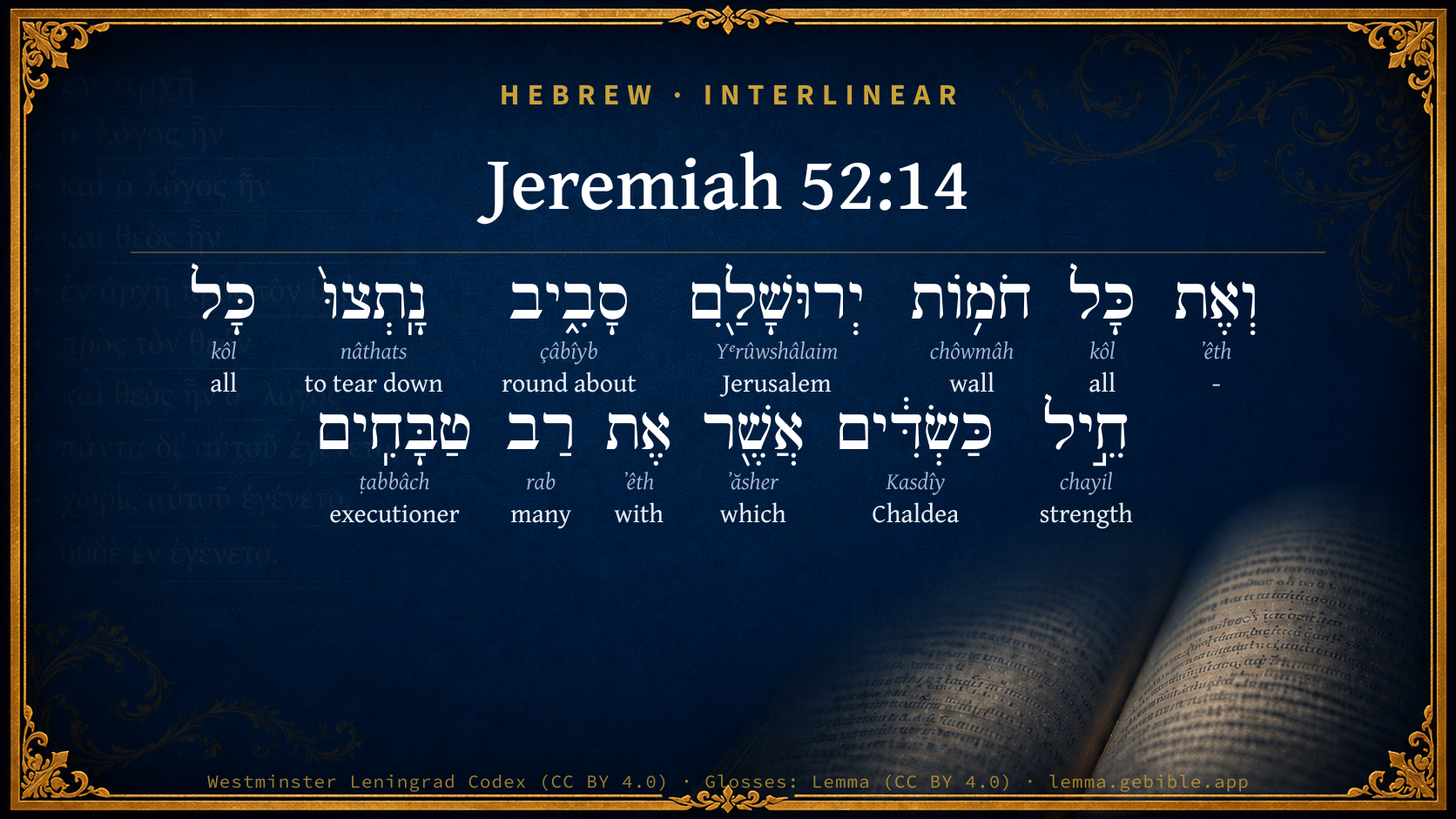
Jeremiah 52:14

Hebrew (Westminster Leningrad Codex) Jeremiah 52:14 appears in the Hebrew Old Testament. The text above is from the Westminster Leningrad Codex. Each word links to its Strong’s number, a concise gloss, and parsing drawn from the Open Scriptures Hebrew Bible morphology. Click any word for its full Brown-Driver-Briggs (BDB) entry.
Download image
Cite this verse

Jeremiah 52:14 (World English Bible). Public Domain. Lemma interlinear Bible study tool, https://lemma.gebible.app/v/jeremiah/52/14.

Show BibTeX & RIS
BibTeX
RIS
English Translation
All the army of the Chaldeans, who were with the captain of the guard, broke down all the walls of Jerusalem round about.
World English Bible · Public Domain
Download a study sheet

One document with this verse’s original text, its word-by-word gloss line, the meaning frame, cross-references with their text, attributed commentary, and full source and license credits — printable, and it pastes into notes with its structure intact.

This verse Autodidact and up

Study sheet (.html) Plain text (.txt)

A passage Seminary Student

Up to 50 verses in one chapter. A passage sheet keeps up to 6 commentary sources and 12 cross-references per verse, in the order this page ranks them, and says so on the sheet whenever that leaves anything out. Ask for a single verse and you get the Autodidact verse sheet above.

Everything on this page stays free to read, with no account — the sheet is a download of what is already on screen, not access to it.

Want to remove ads? Support Godless Engineer
Compare translations 3

The same verse in 3 English versions, stacked beneath the original-language interlinear above. Click any original word for its lexicon entry.

Each is an independent rendering of the whole verse — the interlinear is not word-aligned to these translations.

Highlighted words mark where these versions differ — a whole-verse word diff, not a word-by-word alignment.

  • World English Bible Public Domain
    All the army of the Chaldeans, who were with the captain of the guard, broke down all the walls of Jerusalem round about.
  • King James Version Public Domain
    And all the army of the Chaldeans, that were with the captain of the guard, brake down all the walls of Jerusalem round about.
  • unfoldingWord Literal Text CC BY-SA 4.0
    As for the walls around Jerusalem, all the army of the Babylonians who were with the commander of the bodyguards destroyed them.

unfoldingWord Literal Text — © unfoldingWord, licensed CC BY-SA 4.0. Word-aligned USFM3 via Door43 (git.door43.org/unfoldingWord/en_ult).

Versions to compare (up to 4)

3 of 4 selected

Show all 18 translations

Every available English version of this verse, each an independent rendering of the whole verse.

  • World English Bible Public Domain
    All the army of the Chaldeans, who were with the captain of the guard, broke down all the walls of Jerusalem round about.
  • Berean Standard Bible Public Domain
    And the whole army of the Chaldeans under the captain of the guard broke down all the walls around Jerusalem.
  • Majority Standard Bible Public Domain
    And the whole army of the Chaldeans under the captain of the guard broke down all the walls around Jerusalem.
  • King James Version Public Domain
    And all the army of the Chaldeans, that were with the captain of the guard, brake down all the walls of Jerusalem round about.
  • American Standard Version (1901) Public Domain
    And all the army of the Chaldeans, that were with the captain of the guard, brake down all the walls of Jerusalem round about.
  • Revised Version (1885) Public Domain
    And all the army of the Chaldeans, that were with the captain of the guard, brake down all the walls of Jerusalem round about.
  • Geneva Bible (1599) Public Domain
    And al the armie of the Caldeans that were with the chiefe steward, brake downe all ye walles of Ierusalem round about.
  • Douay-Rheims (1899) Public Domain
    And all the army of the Chaldeans that were with the general broke down all the wall of Jerusalem round about.
  • Young's Literal Translation Public Domain
    and all the walls of Jerusalem round about broken down have all the forces of the Chaldeans that `are' with the chief of the executioners.
  • Literal Standard Version CC BY-SA 4.0
    and all the forces of the Chaldeans that [are] with the chief of the executioners have broken down all the walls of Jerusalem.
  • Unlocked Literal Bible CC BY-SA 4.0
    As for the walls around Jerusalem, all the army of the Babylonians who were with the commander of the bodyguards destroyed them.
  • unfoldingWord Literal Text CC BY-SA 4.0
    As for the walls around Jerusalem, all the army of the Babylonians who were with the commander of the bodyguards destroyed them.
  • Darby Bible Public Domain
    And all the army of the Chaldeans, that were with the captain of the body-guard, broke down all the walls of Jerusalem round about.
  • World Messianic Bible Public Domain
    All the army of the Kasdim, who were with the captain of the guard, broke down all the walls of Jerusalem all around.
  • Webster's Bible Public Domain
    And all the army of the Chaldeans, that were with the captain of the guard, broke down all the walls of Jerusalem on every side.
  • Free Bible Version CC BY-SA 4.0
    The whole Babylonian army under the commander of the guard knocked down all the walls around Jerusalem.
  • Bible in Basic English Public Domain
    And the walls round Jerusalem were broken down by the Chaldaean army which was with the captain.
  • JPS Tanakh (1917) Public Domain
    And all the army of the Chaldeans, that were with the captain of the guard, broke down all the walls of Jerusalem round about.

Literal Standard Version (2020), Covenant Press — licensed CC BY-SA 4.0. Text via the HelloAO Bible API (eBible.org). Unlocked Literal Bible (unfoldingWord) — licensed CC BY-SA 4.0. Text via the HelloAO Bible API (eBible.org). unfoldingWord Literal Text — © unfoldingWord, licensed CC BY-SA 4.0. Word-aligned USFM3 via Door43 (git.door43.org/unfoldingWord/en_ult). Free Bible Version, Dr. Jonathan Gallagher — licensed CC BY-SA 4.0. Text via the HelloAO Bible API (eBible.org).

Word by word

More ways to search: Search by grammar → Find every occurrence → Compare this word →

Practice this passage: Drill this verse → Learn its vocabulary →

טַבָּחִֽים
ṭabbâch
H2876
“executioners”
Noun, Common, Masculine, Plural, Absolute
Part of Speech
Noun
Type
Common
Gender
Masculine
Number
Plural
State
Absolute
Full BDB Definition

Origin: from H2873

TWOT: 786c

executioner, cook, bodyguard, guardsman - cook (who also killed the animal for food) - guardsmen, bodyguard
  1. וְאֶת ʼêth H853 “and · -” Conjunction + Particle, Direct Object
  2. כָּל kôl H3605 “all of” Noun, Common, Masculine, Singular, Construct
  3. חֹמ֥וֹת chôwmâh H2346 “walls of” Noun, Common, Feminine, Plural, Construct
  4. יְרוּשָׁלִַ֖ם Yᵉrûwshâlaim H3389 “Jerusalem” Noun, Proper
  5. סָבִ֑יב çâbîyb H5439 “round about” Noun, Common, Both, Singular, Absolute
  6. נָֽתְצוּ֙ nâthats H5422 “to tear down” Verb, Qal, Perfect, 3rd Person, Common, Plural
  7. כָּל kôl H3605 “all of” Noun, Common, Masculine, Singular, Construct
  8. חֵ֣יל chayil H2428 “strength of” Noun, Common, Masculine, Singular, Construct
  9. כַּשְׂדִּ֔ים Kasdîy H3778 “Chaldea” Noun, Proper
  10. אֲשֶׁ֖ר ʼăsher H834 “which” Particle, Relative
  11. אֶת ʼêth H854 “with” Preposition
  12. רַב rab H7227 “many of” Noun, Common, Masculine, Singular, Construct

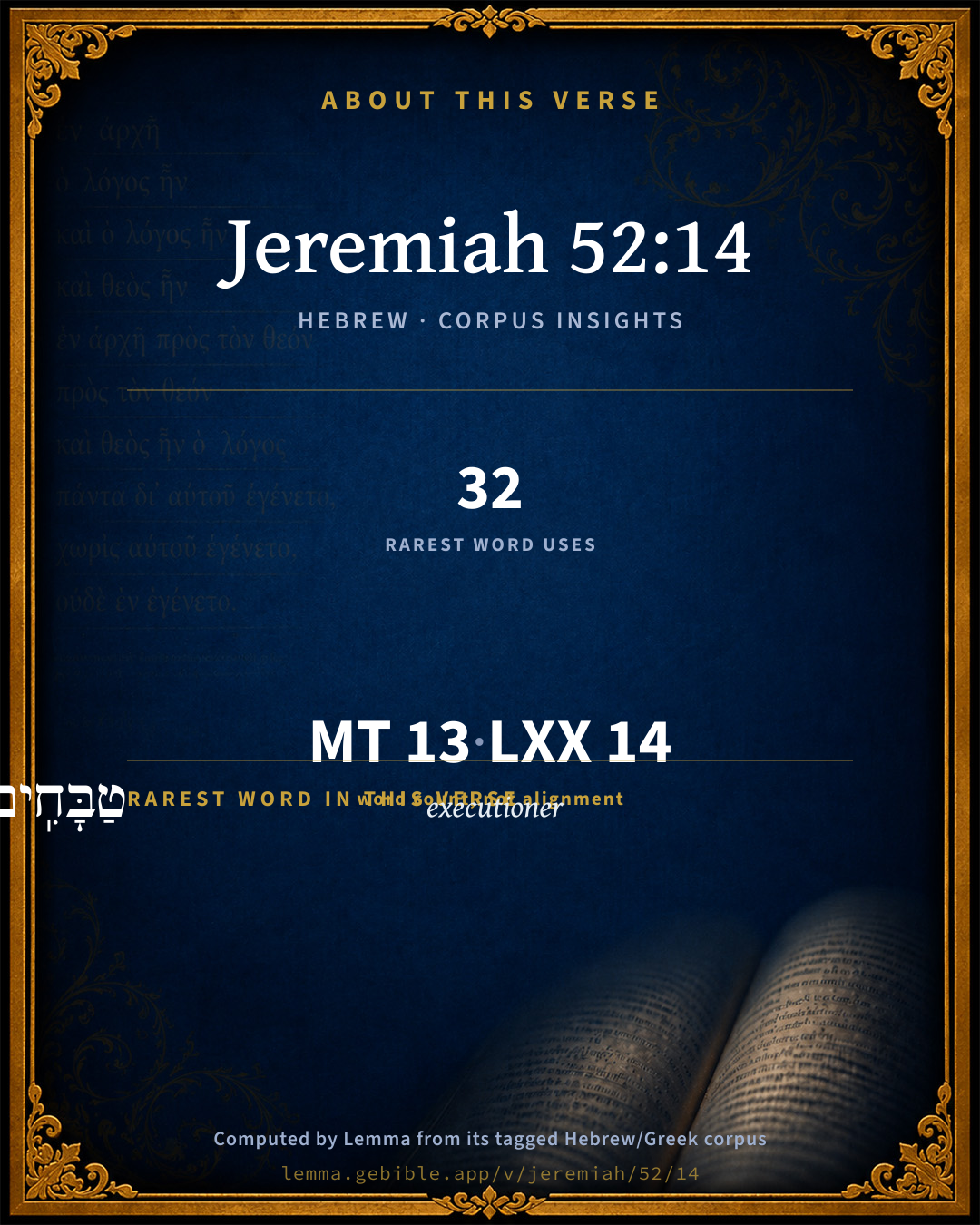
About this verse

These counts appear in no published source. They are computed here, from the morphology-tagged text and Lemma’s own curated glosses. What Lemma adds →

13
words
12
distinct lemmas
Prophets
section

Shared distinctive vocabulary

טַבָּחִֽים executioner H2876 occurs in 32 verses of the Hebrew Bible. Also found in:

Grammatical profile

  • 1 verb
  • 9 nouns
  • 1 preposition
  • 2 particles

Verb forms

  • נָֽתְצוּ֙ Qal · Perfect

Repetition

A word recurs within this verse — often emphatic in Hebrew:

Hebrew & Septuagint length

In the original languages it is 13 Hebrew tokens and 14 Greek tokens — but the two are counted differently (Hebrew bundles its prefixes and suffixes into one token; the Greek is in lemma form), so that isn’t a like-for-like length.

Cross-references

2

Topical passages linked to Jeremiah 52:14 in the Treasury of Scripture Knowledge — connected by theme and wording, ordered by reader-vote popularity; previews shown in the World English Bible.

  • Nehemiah 1:3 They said to me, The remnant who are left of the captivity there in the province are in great affliction and reproach: the wall of Jerusalem also is broken down, and the gates of it are burned with fire.
  • 2 Kings 25:10 All the army of the Chaldeans, who were [with] the captain of the guard, broke down the walls of Jerusalem round about.

Cross-references courtesy of OpenBible.info (CC BY 4.0).

Hebrew and Greek witnesses Masoretic Hebrew ↔ Greek Septuagint

The same verse in the two great witnesses to the Old Testament, shown verse-for-verse.

These are two independent witnesses, not word-aligned to each other, and the Septuagint is shown in lemma (dictionary) form.

Hebrew Jeremiah 52:14 Masoretic · Westminster Leningrad Codex

וְאֶת כָּל חֹמ֥וֹת יְרוּשָׁלִַ֖ם סָבִ֑יב נָֽתְצוּ֙ כָּל חֵ֣יל כַּשְׂדִּ֔ים אֲשֶׁ֖ר אֶת רַב טַבָּחִֽים

All the army of the Chaldeans, who were with the captain of the guard, broke down all the walls of Jerusalem round about.

World English Bible · Public Domain

Greek LXX Structure differs

In the Septuagint, Jeremiah is about an eighth shorter than the Hebrew and arranges its material differently — the Oracles Against the Nations (Hebrew chapters 46–51) appear in the middle of the Greek book, after 25:13. Because the chapter and verse boundaries do not line up, a verse-for-verse comparison with the Hebrew is not shown.

A verse-for-verse comparison isn’t shown here because the chapters and verses don’t line up. Switch to the LXX edition with the MT / LXX toggle above to read the Greek directly.

Hebrew: Westminster Leningrad Codex (CC BY 4.0). Greek: Septuagint (public domain); English from a public-domain English Septuagint. How the Septuagint differs from the Hebrew →

Targum (Aramaic paraphrase)

1

The Targum is the ancient Jewish Aramaic paraphrase of the Hebrew Scriptures — an interpretive translation, not the Hebrew text itself. Onkelos (literal) and Pseudo-Jonathan (expansive) render the Torah, and Jonathan the Prophets. Coverage is partial: where no permissively-licensed English translation exists for a verse, only the Aramaic is shown. This is verse-level text, not a word-by-word alignment to the Hebrew.

  1. Targum Jonathan Prophets (Joshua–Malachi)
    וְיַת כָּל שׁוּרֵי יְרוּשְׁלֵם סְחוֹר סְחוֹר תְּרָעוּ כָּל מַשִׁרְיַת כַּסְדָאֵי דְעִם רַב קָטוֹלַיָא:

    (no public-domain English translation for this verse)

    Targum Jonathan — Aramaic: “Mikraot Gedolot” (public domain). English: “Sefaria Community Translation” (CC0 1.0 (public-domain dedication)); “London "Chaldee Paraphrase," 1871” (public domain). Text via Sefaria.

Commentary

Notes on Jeremiah 52:14 from classic Christian and Jewish commentators (each source and its license shown beneath its notes). The classic Christian expositions comment on the surrounding passage and are grouped to its opening verse, so a note may address several verses; the Jewish commentaries on the Tanakh (Rashi and others) are per-verse, so they appear only where the commentator wrote on this verse.

Lemma curates 59 commentaries, every one of them public domain or Creative Commons licensed, each selected and text-cleaned for this edition rather than reprinted as found. About our sources →

John Gill's Exposition

Then Nebuzaradan the captain of the guard carried away captive certain of the poor of the people,.... That is, of the city, as distinct from the poor of the land of Judea he left, afterwards observed:

and the residue of the people that remained in the city; that died not by the sword or famine, and fled not with Zedekiah: or "even the residue of the people"; and so are the same with the poor people in the former clause; though Kimchi explains it thus,

"some of the poor of the people he carried captive, and some of them he left:''

and those that fell away, that fell to the king of Babylon; that fell off from the Jews, and surrendered to the king of Babylon during the siege; or that voluntarily came in, and put themselves into the hands of the captain of the guard:

and the rest of the multitude; of the people, both in city and country.

John Gill's Exposition of the Whole Bible (1746–1763) — public domain (CC PDM 1.0). Text via the HelloAO Bible API.

Lesson kit

Teaching starters — assembled from the data on this page, not authored interpretation. Every prompt links to the verse data it draws on. Edit before teaching.

Jeremiah, in the Prophets, opens this verse with 13 words (12 distinct Hebrew lemmas). Its most distinctive word is ṭabbâch (“executioner”). A historical commentator’s framing appears above. Read the whole chapter for the surrounding context.

Discussion questions

  1. What does “executioner” (ṭabbâch) contribute to the verse as a whole?
  2. How does Genesis 37:36, which shares the word «executioner», read alongside this verse?
  3. What does the repetition of “all” (2× in this one verse) do in this verse?
  4. These translations render this verse differently; the difference is in the English rendering, not the original. What questions does that raise?
  5. «נָֽתְצוּ֙» is a Qal Perfect verb. How does that grammatical form shape the action described?

Things to notice

Reading settings

Reading text

Shown beneath each verse's original-language words.

Old Testament
Old Testament edition

Read the OT as the Masoretic Hebrew (MT) or the Greek Septuagint (LXX).

English shown for the Greek Septuagint (in the Hebrew ↔ Greek comparison).

Comparing translations? Open the Compare panel on any verse page to stack up to four side by side.