
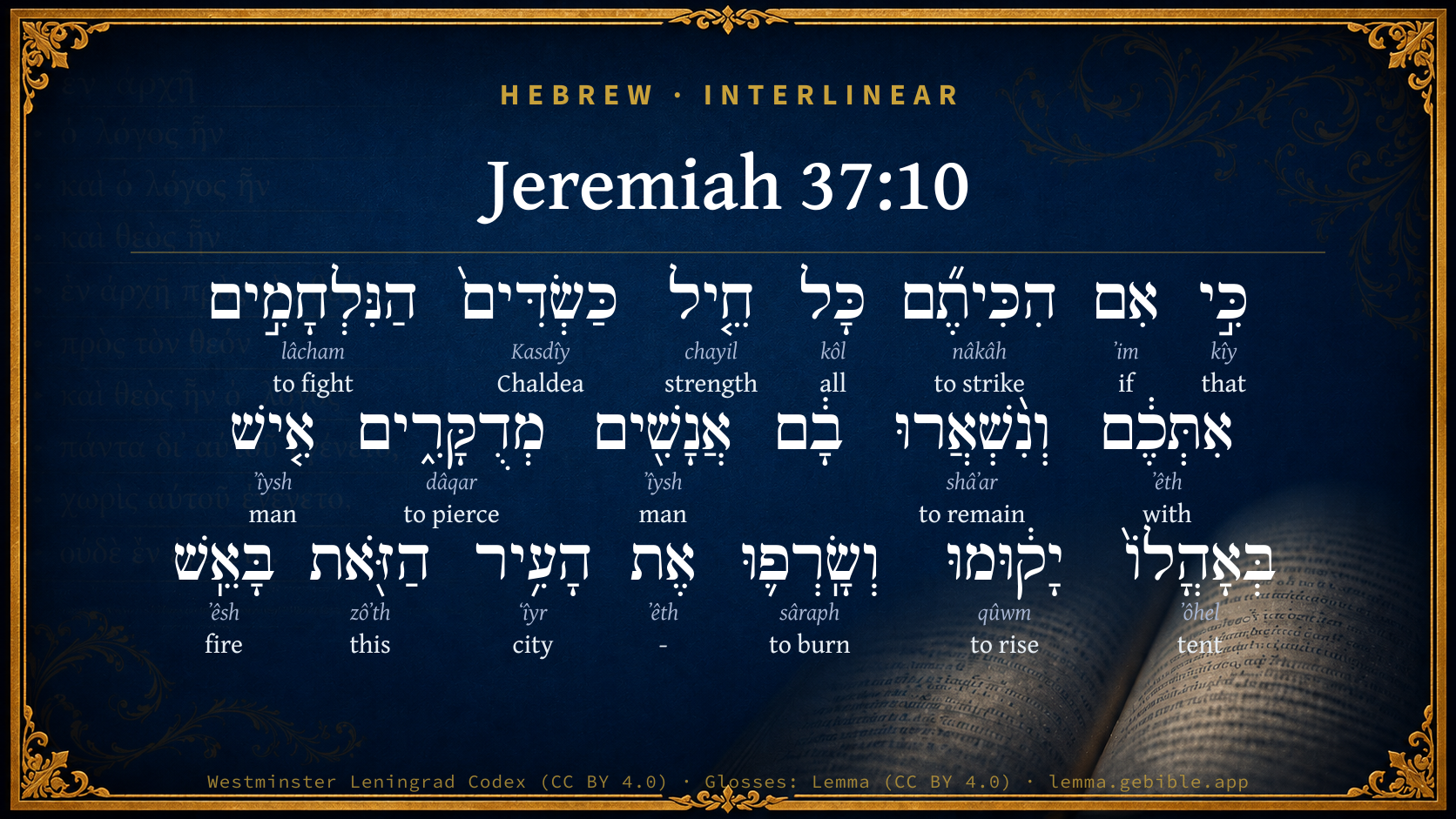
Jeremiah 37:10

Hebrew (Westminster Leningrad Codex) Jeremiah 37:10 appears in the Hebrew Old Testament. The text above is from the Westminster Leningrad Codex. Each word links to its Strong’s number, a concise gloss, and parsing drawn from the Open Scriptures Hebrew Bible morphology. Click any word for its full Brown-Driver-Briggs (BDB) entry.
Download image
Cite this verse

Jeremiah 37:10 (World English Bible). Public Domain. Lemma interlinear Bible study tool, https://lemma.gebible.app/v/jeremiah/37/10.

Show BibTeX & RIS
BibTeX
RIS
English Translation
For though you had struck the whole army of the Chaldeans who fight against you, and there remained but wounded men among them, yes would they rise up every man in his tent, and burn this city with fire.
World English Bible · Public Domain
Download a study sheet

One document with this verse’s original text, its word-by-word gloss line, the meaning frame, cross-references with their text, attributed commentary, and full source and license credits — printable, and it pastes into notes with its structure intact.

This verse Autodidact and up

Study sheet (.html) Plain text (.txt)

A passage Seminary Student

Up to 50 verses in one chapter. A passage sheet keeps up to 6 commentary sources and 12 cross-references per verse, in the order this page ranks them, and says so on the sheet whenever that leaves anything out. Ask for a single verse and you get the Autodidact verse sheet above.

Everything on this page stays free to read, with no account — the sheet is a download of what is already on screen, not access to it.

Want to remove ads? Support Godless Engineer
Compare translations 3

The same verse in 3 English versions, stacked beneath the original-language interlinear above. Click any original word for its lexicon entry.

Each is an independent rendering of the whole verse — the interlinear is not word-aligned to these translations.

Highlighted words mark where these versions differ — a whole-verse word diff, not a word-by-word alignment.

  • World English Bible Public Domain
    For though you had struck the whole army of the Chaldeans who fight against you, and there remained but wounded men among them, yes would they rise up every man in his tent, and burn this city with fire.
  • King James Version Public Domain
    For though ye had smitten the whole army of the Chaldeans that fight against you, and there remained but wounded men among them, yet should they rise up every man in his tent, and burn this city with fire.
  • unfoldingWord Literal Text CC BY-SA 4.0
    Even if you had defeated the entire Chaldean army that is fighting you so that only wounded men were left in their tents, they would get up and burn this city.”

unfoldingWord Literal Text — © unfoldingWord, licensed CC BY-SA 4.0. Word-aligned USFM3 via Door43 (git.door43.org/unfoldingWord/en_ult).

Versions to compare (up to 4)

3 of 4 selected

Show all 18 translations

Every available English version of this verse, each an independent rendering of the whole verse.

  • World English Bible Public Domain
    For though you had struck the whole army of the Chaldeans who fight against you, and there remained but wounded men among them, yes would they rise up every man in his tent, and burn this city with fire.
  • Berean Standard Bible Public Domain
    Indeed, if you were to strike down the entire army of the Chaldeans that is fighting against you, and only wounded men remained in their tents, they would still get up and burn this city down.”
  • Majority Standard Bible Public Domain
    Indeed, if you were to strike down the entire army of the Chaldeans that is fighting against you, and only wounded men remained in their tents, they would still get up and burn this city down.”
  • King James Version Public Domain
    For though ye had smitten the whole army of the Chaldeans that fight against you, and there remained but wounded men among them, yet should they rise up every man in his tent, and burn this city with fire.
  • American Standard Version (1901) Public Domain
    For though ye had smitten the whole army of the Chaldeans that fight against you, and there remained but wounded men among them, yea would they rise up every man in his tent, and burn this city with fire.
  • Revised Version (1885) Public Domain
    For though ye had smitten the whole army of the Chaldeans that fight against you, and there remained but wounded men among them, yet should they rise up every man in his tent, and burn this city with fire.
  • Geneva Bible (1599) Public Domain
    For though ye had smitten the whole hoste of the Caldeans that fight against you, and there remained but wounded men among them, yet should euery man rise vp in his tent, and burne this citie with fire.
  • Douay-Rheims (1899) Public Domain
    Now when the army of the Chaldeans was gone away from Jerusalem, because of Pharao's army,
  • Young's Literal Translation Public Domain
    for though ye had smitten all the force of the Chaldeans who are fighting with you, and there were left of them wounded men -- each in his tent -- they rise, and have burnt this city with fire.'
  • Literal Standard Version CC BY-SA 4.0
    for though you had struck all the force of the Chaldeans who are fighting with you, and there were left of them wounded men—they rise, each in his tent, and have burned this city with fire.”
  • Unlocked Literal Bible CC BY-SA 4.0
    Even if you had defeated the entire Chaldean army that is fighting you so that only wounded men were left in their tents, they would get up and burn this city.”
  • unfoldingWord Literal Text CC BY-SA 4.0
    Even if you had defeated the entire Chaldean army that is fighting you so that only wounded men were left in their tents, they would get up and burn this city.”
  • Darby Bible Public Domain
    For though ye had smitten the whole army of the Chaldeans that fight against you, and there remained [but] wounded men among them, [yet] should they rise up every man in his tent, and burn this city with fire.
  • World Messianic Bible Public Domain
    For though you had struck the whole army of the Kasdim who fight against you, and only wounded men remained among them, they would each rise up in his tent and burn this city with fire.’”
  • Webster's Bible Public Domain
    For though ye had smitten the whole army of the Chaldeans that fight against you, and there remained but wounded men among them, yet would they rise up every man in his tent, and burn this city with fire.
  • Free Bible Version CC BY-SA 4.0
    In fact, even if you were able to kill the whole Babylonian army attacking you, leaving only wounded men in their tents, they would still get up and burn this city down.
  • Bible in Basic English Public Domain
    For even if you had overcome all the army of the Chaldaeans fighting against you, and there were only wounded men among them, still they would get up, every man in his tent, and put this town on fire.
  • JPS Tanakh (1917) Public Domain
    For though ye had smitten the whole army of the Chaldeans that fight against you, and there remained but wounded men among them, yet would they rise up every man in his tent, and burn this city with fire.'

Literal Standard Version (2020), Covenant Press — licensed CC BY-SA 4.0. Text via the HelloAO Bible API (eBible.org). Unlocked Literal Bible (unfoldingWord) — licensed CC BY-SA 4.0. Text via the HelloAO Bible API (eBible.org). unfoldingWord Literal Text — © unfoldingWord, licensed CC BY-SA 4.0. Word-aligned USFM3 via Door43 (git.door43.org/unfoldingWord/en_ult). Free Bible Version, Dr. Jonathan Gallagher — licensed CC BY-SA 4.0. Text via the HelloAO Bible API (eBible.org).

Word by word

More ways to search: Search by grammar → Find every occurrence → Compare this word →

Practice this passage: Drill this verse → Learn its vocabulary →

מְדֻקָּרִ֑ים
dâqar
H1856
“pierced”
Verb, Pual, Participle Passive, Masculine, Plural, Absolute
Part of Speech
Verb
Stem
Pual
Form
Participle Passive
Gender
Masculine
Number
Plural
State
Absolute
Full BDB Definition

Origin: a primitive root

TWOT: 449

to pierce, thrust through, pierce through - (Qal) to pierce, run through - (Niphal) to be pierced through - (Pual) pierced, riddled (participle)
  1. כִּ֣י kîy H3588 “that” Conjunction
  2. אִם ʼim H518 “if” Conjunction
  3. הִכִּיתֶ֞ם nâkâh H5221 “to strike” Verb, Hiphil, Perfect, 2nd Person, Masculine, Plural
  4. כָּל kôl H3605 “all of” Noun, Common, Masculine, Singular, Construct
  5. חֵ֤יל chayil H2428 “strength of” Noun, Common, Masculine, Singular, Construct
  6. כַּשְׂדִּים֙ Kasdîy H3778 “Chaldea” Noun, Proper
  7. הַנִּלְחָמִ֣ים lâcham H3898 “the · fighting” Particle, Definite Article + Verb, Niphal, Participle Active, Masculine, Plural, Absolute
  8. אִתְּכֶ֔ם ʼêth H854 “with · you” Preposition + Suffix, Personal, 2nd Person, Masculine, Plural
  9. וְנִ֨שְׁאֲרוּ shâʼar H7604 “and · to remain” Conjunction + Verb, Niphal, Perfect, 3rd Person, Common, Plural
  10. אֲנָשִׁ֖ים ʼîysh H376 “men” Noun, Common, Masculine, Plural, Absolute
  11. אִ֤ישׁ ʼîysh H376 “man” Noun, Common, Masculine, Singular, Absolute
  12. בְּאָהֳלוֹ֙ ʼôhel H168 “in/at · tent · his” Preposition + Noun, Common, Masculine, Singular, Construct + Suffix, Personal, 3rd Person, Masculine, Singular
  13. יָק֔וּמוּ qûwm H6965 “to rise” Verb, Qal, Imperfect, 3rd Person, Masculine, Plural
  14. וְשָֽׂרְפ֛וּ sâraph H8313 “and · to burn” Conjunction + Verb, Qal, Sequential Perfect, 3rd Person, Common, Plural
  15. אֶת ʼêth H853 “-” Particle, Direct Object
  16. הָעִ֥יר ʻîyr H5892 “the · city” Particle, Definite Article + Noun, Common, Feminine, Singular, Absolute
  17. הַזֹּ֖את zôʼth H2063 “the · this” Particle, Definite Article + Pronoun, Demonstrative, Feminine, Singular
  18. בָּאֵֽשׁ ʼêsh H784 “in/at the · fire” Preposition, Determined + Noun, Common, Both, Singular, Absolute

About this verse

These counts appear in no published source. They are computed here, from the morphology-tagged text and Lemma’s own curated glosses. What Lemma adds →

20
words
18
distinct lemmas
Prophets
section

Notable vocabulary

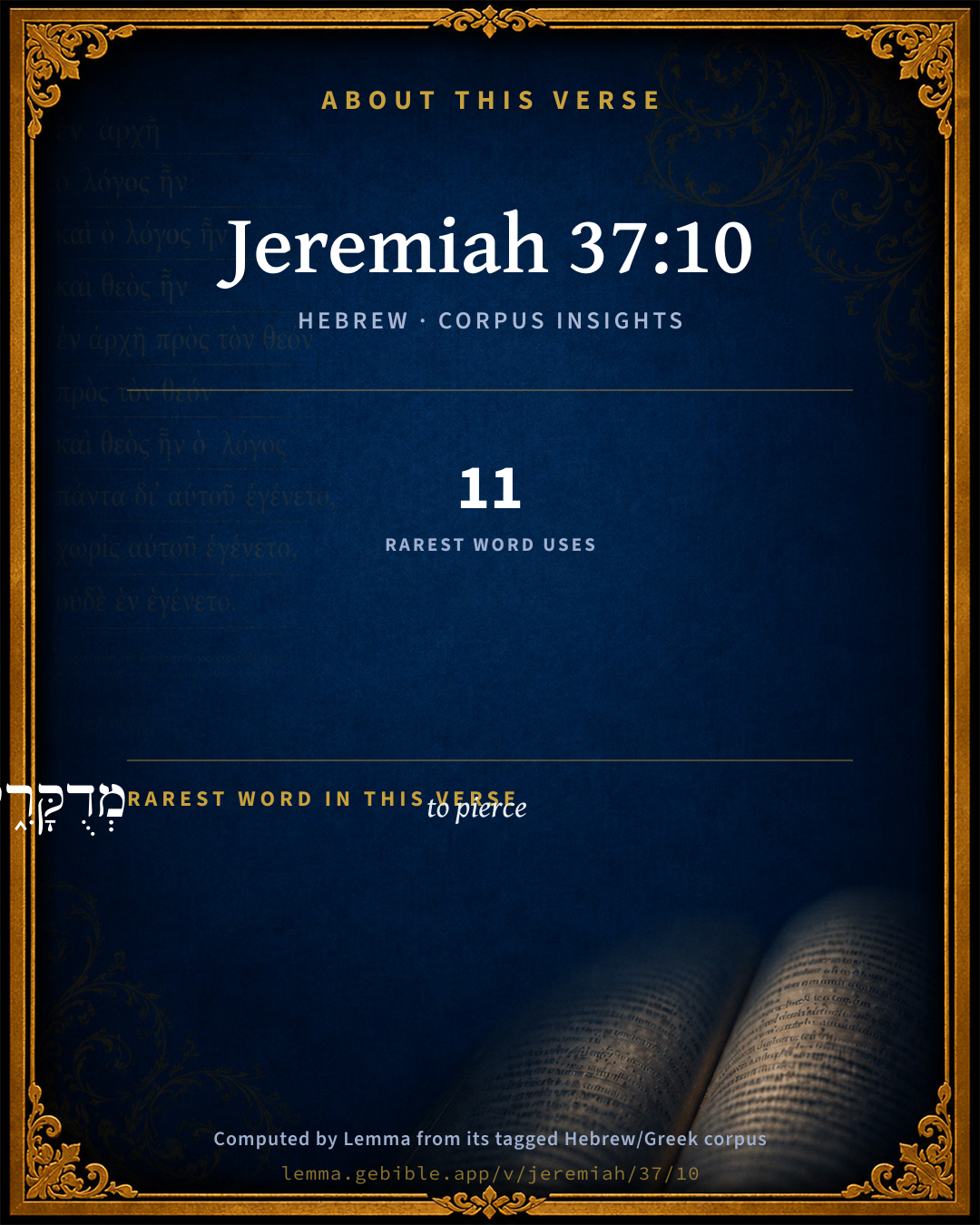
The rarest word here is מְדֻקָּרִ֑ים to pierce H1856 — appearing just 11 times in the whole Hebrew Bible.

Shared distinctive vocabulary

מְדֻקָּרִ֑ים to pierce H1856 occurs in 10 verses of the Hebrew Bible. Also found in:

Grammatical profile

  • 6 verbs
  • 8 nouns
  • 1 pronoun
  • 2 prepositions
  • 2 conjunctions
  • 1 particle

Verb forms

  • הִכִּיתֶ֞ם Hiphil · Perfect
  • הַנִּלְחָמִ֣ים Niphal · Participle Active
  • וְנִ֨שְׁאֲרוּ Niphal · Perfect
  • מְדֻקָּרִ֑ים Pual · Participle Passive
  • יָק֔וּמוּ Qal · Imperfect
  • וְשָֽׂרְפ֛וּ Qal · Sequential Perfect

Repetition

A word recurs within this verse — often emphatic in Hebrew:

  • אֲנָשִׁ֖ים man H376 ×2

Cross-references

11

Topical passages linked to Jeremiah 37:10 in the Treasury of Scripture Knowledge — connected by theme and wording, ordered by reader-vote popularity; previews shown in the World English Bible.

  • Leviticus 26:36–38 "'As for those of you who are left, I will send a faintness into their hearts in the lands of their enemies: and the sound of a driven leaf will put them to flight; and they shall flee, as one flees from the sword; and they will fall when no one pursues.
  • Isaiah 30:17 One thousand [shall flee] at the threat of one; at the threat of five shall you flee: until you be left as a beacon on the top of a mountain, and as an ensign on a hill.
  • Jeremiah 50:45 Therefore hear the counsel of Yahweh, that he has taken against Babylon; and his purposes, that he has purposed against the land of the Chaldeans: Surely they shall drag them away, [even] the little ones of the flock; surely he shall make their habitation desolate over them.
  • Joel 2:11 Yahweh thunders his voice before his army; For his forces are very great; For he is strong who obeys his command; For the day of Yahweh is great and very awesome, And who can endure it?
  • Isaiah 10:4 They shall only bow down under the prisoners, and shall fall under the slain. For all this his anger is not turned away, but his hand is stretched out still.
  • Isaiah 13:15 Everyone who is found shall be thrust through; and everyone who is taken shall fall by the sword.
  • Isaiah 14:19 But you are cast forth away from your tomb like an abominable branch, clothed with the slain, who are thrust through with the sword, who go down to the stones of the pit; as a dead body trodden under foot.
  • Jeremiah 21:4–7 Thus says Yahweh, the God of Israel, Behold, I will turn back the weapons of war that are in your hands, with which you fight against the king of Babylon, and against the Chaldeans who besiege you, without the walls; and I will gather them into the midst of this city.
  • Jeremiah 37:8 The Chaldeans shall come again, and fight against this city; and they shall take it, and burn it with fire.
  • Jeremiah 49:20 Therefore hear the counsel of Yahweh, that he has taken against Edom; and his purposes, that he has purposed against the inhabitants of Teman: Surely they shall drag them away, [even] the little ones of the flock; surely he shall make their habitation desolate over them.
  • Jeremiah 51:4 They shall fall down slain in the land of the Chaldeans, and thrust through in her streets.

Cross-references courtesy of OpenBible.info (CC BY 4.0).

Hebrew and Greek witnesses Masoretic Hebrew ↔ Greek Septuagint

The same verse in the two great witnesses to the Old Testament, shown verse-for-verse.

These are two independent witnesses, not word-aligned to each other, and the Septuagint is shown in lemma (dictionary) form.

Hebrew Jeremiah 37:10 Masoretic · Westminster Leningrad Codex

כִּ֣י אִם הִכִּיתֶ֞ם כָּל חֵ֤יל כַּשְׂדִּים֙ הַנִּלְחָמִ֣ים אִתְּכֶ֔ם וְנִ֨שְׁאֲרוּ בָ֔ם אֲנָשִׁ֖ים מְדֻקָּרִ֑ים אִ֤ישׁ בְּאָהֳלוֹ֙ יָק֔וּמוּ וְשָֽׂרְפ֛וּ אֶת הָעִ֥יר הַזֹּ֖את בָּאֵֽשׁ

For though you had struck the whole army of the Chaldeans who fight against you, and there remained but wounded men among them, yes would they rise up every man in his tent, and burn this city with fire.

World English Bible · Public Domain

Greek LXX Structure differs

In the Septuagint, Jeremiah is about an eighth shorter than the Hebrew and arranges its material differently — the Oracles Against the Nations (Hebrew chapters 46–51) appear in the middle of the Greek book, after 25:13. Because the chapter and verse boundaries do not line up, a verse-for-verse comparison with the Hebrew is not shown.

A verse-for-verse comparison isn’t shown here because the chapters and verses don’t line up. Switch to the LXX edition with the MT / LXX toggle above to read the Greek directly.

On this verse, The Cambridge Bible for Schools and Colleges discusses the Septuagint’s reading. Read the note in Commentary ↓

Hebrew: Westminster Leningrad Codex (CC BY 4.0). Greek: Septuagint (public domain); English from a public-domain English Septuagint. How the Septuagint differs from the Hebrew →

Targum (Aramaic paraphrase)

1

The Targum is the ancient Jewish Aramaic paraphrase of the Hebrew Scriptures — an interpretive translation, not the Hebrew text itself. Onkelos (literal) and Pseudo-Jonathan (expansive) render the Torah, and Jonathan the Prophets. Coverage is partial: where no permissively-licensed English translation exists for a verse, only the Aramaic is shown. This is verse-level text, not a word-by-word alignment to the Hebrew.

  1. Targum Jonathan Prophets (Joshua–Malachi)
    אֲרֵי אִם תִּקְטְלוּן כָּל מַשִׁרְיַת כַּסְדָאֵי דִמְגִיחִין קְרָבָא עִמְכוֹן וְיִשְׁתַּאֲרוּן בְּהוֹן גַבְרִין מְטָעֲנִין גְבַר בְּמַשְׁכְּנֵיהּ יְקוּמוּן וְיוֹקְדוֹן יַת קַרְתָּא הָדָא בְּנוּרָא:

    (no public-domain English translation for this verse)

    Targum Jonathan — Aramaic: “Mikraot Gedolot” (public domain). English: “Sefaria Community Translation” (CC0 1.0 (public-domain dedication)); “London "Chaldee Paraphrase," 1871” (public domain). Text via Sefaria.

Commentary

Notes on Jeremiah 37:10 from classic Christian and Jewish commentators (each source and its license shown beneath its notes). The classic Christian expositions comment on the surrounding passage and are grouped to its opening verse, so a note may address several verses; the Jewish commentaries on the Tanakh (Rashi and others) are per-verse, so they appear only where the commentator wrote on this verse.

Lemma curates 59 commentaries, every one of them public domain or Creative Commons licensed, each selected and text-cleaned for this edition rather than reprinted as found. About our sources →

Trapp's Complete Commentary

John Trapp

Jer 37:10 For though ye had smitten the whole army of the Chaldeans that fight against you, and there remained [but] wounded men among them, [yet] should they rise up every man in his tent, and burn this city with fire.

Ver. 10. For though ye had smitten.] Pro auxesi adiecit hyperbolen; he useth a hyperbolic supposition for illustration.

And there remained but wounded men among them.] God cannot be without a staff to beat a rebel. Virum malum vel mus mordet, saith the proverb; A mouse will bite a bad man. Milez Cobelitz, a Christian soldier, sore wounded and all bloody, seeing Amurath, the great Turk, viewing the dead bodies after a victory, rose up out of a heap of slain men, and making toward the conqueror, as if he would have craved his life of him, suddenly stabbed him in the bottom of his belly with a short dagger which he had under his coat, and so slew him. {a}

Yet should they rise every man in his tent.] It is God who strengtheneth or weakeneth the arm of either party. {Eze 30:24} Those that fight against spiritual wickedness in their own strength are sure to be foiled; and although the unclean spirit may seem to be cast out, yet he will return to his old house, and bring seven worse with him. {Mat 12:43-45}

{a} Turkish History, 200.

John Trapp, A Commentary or Exposition upon All the Books of the Old and New Testament (1647–1656) — public domain. Text from a community e-Sword module.

Jamieson, Fausset & Brown

Robert Jamieson, A. R. Fausset & David Brown

yet . . . they--Even a few wounded men would suffice for your destruction.

Jamieson, Fausset & Brown — Commentary Critical and Explanatory on the Whole Bible (1871) — public domain (CC PDM 1.0). Text via the HelloAO Bible API.

Adam Clarke's Commentary

Verse 10. For though ye had smitten the whole army] Strong words; but they show how fully God was determined to give up this city to fire and sword, and how fully he had instructed his prophet on this point.

Adam Clarke's Commentary on the Bible (1810–1826) — public domain. Text from a community e-Sword/MySword module.

John Calvin's Commentaries

The Prophet shews how foolishly and absurdly the Jews acted, in casting their eyes on fortunate events, and thus forming their opinions. He therefore exhorts them to cease to rely on such a confidence as would deceive them; for he says, that though they gained many battles, and the war turned on their side, yet they could not escape final ruin, for they had to do with God. It was hence the same thing, as though he had said, that they were not to judge by their state at that time, as to what it would be, because God was at war with them; and therefore if God had resolved to destroy them, though there were no enemy, yet he could by one breath slay them all. And for the same reason he concludes that he could employ the Chaldeans, Though few in number remained, and even wounded, yet riley would rise up from their tents, and set the buildings of Jerusalem on fire. This city, therefore, shall be burnt; ask not by whom or when: God will in this work employ the Chaldeans, for he hath so determined.

We may hence conclude, that the Jews had been for a time victorious, at least had successfully repelled their enemies in their attacks on the city; for the Prophet would not have said this, had he not seen that the Jews entertained hope of deliverance on account of some success they had in the war. He therefore says, that all this was of no importance, for their city was to perish by fire. But the principle which I have mentioned must be borne in mind, for Jeremiah took it as granted that the destruction of the city Jerusalem was not to be effected by the forces of the King Nebuchadnezzar, neither by the power or number of his army, nor by the valor of his soldiers, but by the judgment of God. Since it is so, he says, though few remained, and they wounded, even lying as half dead, yet they will rise up every one from his tent, that is, not together, nor in a regular order, nor under a banner, as soldiers are wont to do, but each one, though no comrade were near, though scattered here and there, would yet rise up from his tent. He intimates, in short, that though the contest were only with shadows, they yet could not escape that extreme vengeance which God had threatened. Hence he says, they shall rise up every one from his tent, and burn this city

Now he says not that the Chaldeans would take possession of the city, he speaks not of the assault, but only of the burning, he hence intimates, that though the Chaldeans might have in themselves no power to hurt them, yet it was sufficient that they were armed by God, for the purpose of setting fire to the houses, like women and children, who often burn whole cities and villages; for in this case there is no need of valor or of any great skill. So then God declares, that though the Chaldeans might not be prepared to fight, yet they were strong enough, yea, even though they were lying down and half-dead after having been wounded. This is the meaning.

John Calvin's Commentaries (1540-1563) — public domain. Text from the Calvin Translation Society English edition (1840s-50s) via the Christian Classics Ethereal Library (ccel.org). Calvin's coverage is partial (roughly two-thirds of the Bible); uncommented books and verses are honest gaps, never fabricated. The 19th-century editor's footnotes and remarks are omitted so the notes are faithfully Calvin's own voice.

The Cambridge Bible for Schools and Colleges

gen. ed. J. J. S. Perowne

10. wounded] mg. Heb. thrust through. Cp. Lam_4:9 with note.

every man in his tent] Co. suggests that these words should be connected with “wounded men,” meaning “If there be but one survivor in each tent out of its several occupants.” The LXX, however, read in his place, i.e. where he lies on the field of battle.

The Cambridge Bible for Schools and Colleges (gen. ed. J. J. S. Perowne; Cambridge University Press, 1878–1918) — public domain. Text from a community e-Sword module.

John Gill's Exposition

For though ye had smitten the whole army of the Chaldeans that fight against you,.... Supposing the whole army of the Chaldeans had been vanquished and slain by the Egyptians, the confederates of the Jews; or should they be slain by them in a second siege of them, excepting a few next mentioned:

and there remained but wounded men among them; and supposing that those of them that were left, that were not slain, were everyone of them wounded men, and so disabled for fighting, as might be thought:

yet should they rise up every man in his tent; where he was smitten, and lay wounded; or where he was carried to be cured of his wounds; such should rise up like persons from the dead almost, and fight with such strength and spirit, that they should soon take the city, though in such a condition:

and burn this city with fire; this being a thing determined by the Lord, and nothing should hinder it; for it matters not what the instruments are; though ever so impotent and disabled, they shall do the work allotted to them. Wherefore all the hopes of the Jews, founded upon the departure of the Chaldean army, were vain ones.

John Gill's Exposition of the Whole Bible (1746–1763) — public domain (CC PDM 1.0). Text via the HelloAO Bible API.

Matthew Poole's English Annotations

The substance of the answer returned by the prophet to the king is this: That whereas they pleased themselves with fancies that the Babylonian army now withdrawn to meet with the army of the Egyptians would return no more to the siege, it was a dream; he assures them from God they should return, besiege the city, and take it, and burn it; and therefore they did but deceive themselves to think otherwise; though they were gone, yet it was but for a very short time. He further assures them that the potency or impotency of the Chaldeans was inconsiderable; for if their whole army were made up of wounded men, or if they could prevail so far as to wound all their soldiers, or thrust them through, (as the word is translated, Jer 51:4) yet they should do the work. When God is resolved upon an effect, the instruments are very little to be regarded. It is not the arm of flesh, but the power of God, which is in that case alone to be considered.

Matthew Poole's English Annotations on the Holy Bible (1683–1685) — public domain. Text from a community e-Sword/MySword module.

The Pulpit Commentary

Even if the Jews had defeated the whole Chaldean army, and there remained but a group of sorely wounded men, these in their weakness would be enabled to carry out God"s sure purpose. But wounded men hardly brings out the force of the Hebrew; the word rendered "men" is emphatic, and expresses paucity of numbers, and that rendered "wounded" is, literally, pierced through.

The irresistible will of God.

I THE FACT. The Jews were ready to believe that Egypt was a match for Babylon, and to hope that through the conflict of these two powers they might regain their liberty. Even if they were justified in thinking so from a calculation of the material resources of these great empires, Jeremiah reminded them that there were other considerations to be taken into account before the result could be predicted. It was the will of God that Babylon should conquer Jerusalem. Therefore, if the Chaldean army were reduced to a disorganized group of wounded men, Jerusalem would still succumb. The Jews had found that, while they were faithful to God, they were strong against hordes of enemies. They were to learn that when they had put themselves against God, the position was reversed, and the weakest foe could overthrow them. So it was true against them, as it had been on their side, that "a little one should chase a thousand." It has been the mistake of kings and of peoples to leave out of their calculations the chief factor of their history to forget that God is ever working out his will through their cross purposes. Do we not make the same mistake in our private lives? If God is almighty, it follows beyond question that he must accomplish what he purposes, though to us there seems no means of doing so, and though he neither reveals the means nor in most cases the end, working them out "deep in unfathomable mines." Still, we know some things concerning God"s will and the way he works it out; e.g. he always wills what is just and good; material events are largely beyond our control and under the influence of providence; moral influences count for much in history, and these are directly affected by the spiritual relations of God with the minds of men.

II THE RELATION OF THIS FACT TO FATALISM AND TO NECESSARIAITISM.

The relation of it to fatalism. It must be distinguished from materialistic fatalism, which denies all will in nature; from pagan fatalism, which sets the decrees of the fates above the power of the gods; from Mohammedan fatalism, which ascribes every event to the will of God, but regards that will as the unfettered choice of an irresponsible despot. The irresistible power in providence as revealed in the Bible is a will, a Divine will, a holy will, that always works out purposes of justice, purity, and love. The relation of this fact to necessarianism. If God"s will is irresistible what room is there for our will? Must not that be necessarily bound by his will? This question arises from confusing two phases of the will of God. The phrase, "will of God," represents two things

a. what God purposes to do himself, and

b. what he desires us to do.

The first governs his actions, the second inspires his Law. Now, it is the first that is irresistible; the second is plainly resistible. All sin is nothing but man"s rebellion against God"s will, i.e. God"s will in the second sense what he wishes us to do. This is really no contradiction to what we know of the first will of God what he purposes to do himself because in his almighty will of action he chooses to give us free will containing the power of resisting his Law. Still, God"s will to act must harmonize with his wilt in his Law for our conduct. If we resist the second will, we shall find ourselves in conflict with the first, against which all resistance is futile. Therefore true wisdom will lead us to do God"s will where we are free in relation to it, that we may find ourselves in agreement with God"s will where opposition means only failure and ruin.

God"s purpose independent of means.

The declaration of the certainty of the judgments upon Judah is absolute. They are not to be avoided by any human effort or apparent success. The soldiers of Chaldea, although they were to be wounded ("thrust through" equivalent to "dead"?), would still avail for the work they had to do, and would be raised again to do it.

I THE LESSON. A twofold one, viz.:

1. The inevitableness of the Divine will, whether it be to destroy or to save.

2. God"s independence of human means. He can save by "many or by few." He is declared able "of these stones to raise up children unto Abraham." It pleased him by "the foolishness of preaching" to save many, etc.

(1) The sinner in rebellion against God, however great his outward success and however feeble the opposition to him, has reason to fear. It is an easy thing for his Maker to crush him. It will not require a great instrumentality. Herod was eaten of worms.

(2) The Christian worker should rejoice and be encouraged. Every true word or work will have its effect. He must succeed, however insignificant his company or his means.

II THE TYPE. The ghostly army that was to "burn the city with fire" represents the mighty power of God to create his agents, and symbolizes the death and resurrection of Christ. It is the dead Christ who is raised again to fulfil the will of God in judgment and salvation. M.

The Pulpit Commentary (1880–1919), ed. H.D.M. Spence-Jones & Joseph S. Exell — public domain. Text from a community e-Sword module.

John Wesley's Explanatory Notes

And burn it - When God is resolved upon an effect, the instruments are little to be regarded. It is not the arm of flesh, but the power of God which is in that case to be considered.

John Wesley, Explanatory Notes Upon the Whole Bible (1754–1765) — public domain. Text via the GEBible commentary corpus.

Lesson kit

Teaching starters — assembled from the data on this page, not authored interpretation. Every prompt links to the verse data it draws on. Edit before teaching.

Jeremiah, in the Prophets, opens this verse with 20 words (18 distinct Hebrew lemmas). Its most distinctive word is dâqar (“to pierce”). A historical commentator’s framing appears above. Read the whole chapter for the surrounding context.

Discussion questions

  1. How does “to pierce” (dâqar) shape what this verse is saying?
  2. Numbers 25:8 shares the word «to pierce» with this verse. How do the two illuminate each other?
  3. “man” occurs 2× in this one verse. What is the effect of the repetition?
  4. The translations on this page render this verse differently — a whole-verse word diff, not a word-by-word alignment. What might account for the different wordings?
  5. The verb «הִכִּיתֶ֞ם» is Hiphil Perfect. How does its form color the action?
  6. Reading how Trapp's Complete Commentary and Jamieson, Fausset & Brown read this verse, where do the two commentators agree and where do they part?

Things to notice

Reading settings

Reading text

Shown beneath each verse's original-language words.

Old Testament
Old Testament edition

Read the OT as the Masoretic Hebrew (MT) or the Greek Septuagint (LXX).

English shown for the Greek Septuagint (in the Hebrew ↔ Greek comparison).

Comparing translations? Open the Compare panel on any verse page to stack up to four side by side.