
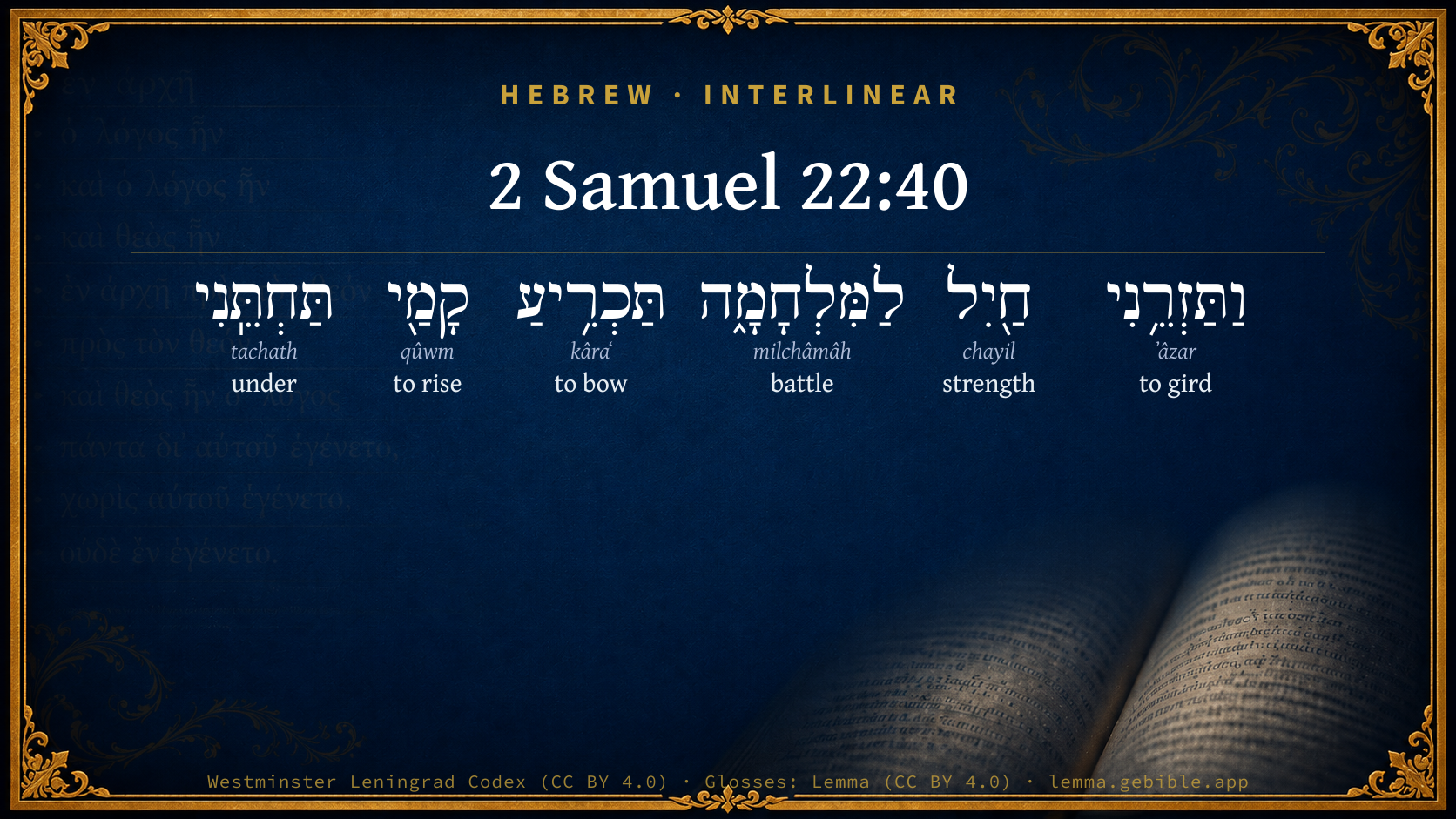
2 Samuel 22:40

Hebrew (Westminster Leningrad Codex) 2 Samuel 22:40 appears in the Hebrew Old Testament. The text above is from the Westminster Leningrad Codex. Each word links to its Strong’s number, a concise gloss, and parsing drawn from the Open Scriptures Hebrew Bible morphology. Click any word for its full Brown-Driver-Briggs (BDB) entry.
Download image
Cite this verse

2 Samuel 22:40 (World English Bible). Public Domain. Lemma interlinear Bible study tool, https://lemma.gebible.app/v/2-samuel/22/40.

Show BibTeX & RIS
BibTeX
RIS
English Translation
For you have girded me with strength to the battle; You have subdued under me those who rose up against me.
World English Bible · Public Domain
Download a study sheet

One document with this verse’s original text, its word-by-word gloss line, the meaning frame, cross-references with their text, attributed commentary, and full source and license credits — printable, and it pastes into notes with its structure intact.

This verse Autodidact and up

Study sheet (.html) Plain text (.txt)

A passage Seminary Student

Up to 50 verses in one chapter. A passage sheet keeps up to 6 commentary sources and 12 cross-references per verse, in the order this page ranks them, and says so on the sheet whenever that leaves anything out. Ask for a single verse and you get the Autodidact verse sheet above.

Everything on this page stays free to read, with no account — the sheet is a download of what is already on screen, not access to it.

Want to remove ads? Support Godless Engineer
Compare translations 3

The same verse in 3 English versions, stacked beneath the original-language interlinear above. Click any original word for its lexicon entry.

Each is an independent rendering of the whole verse — the interlinear is not word-aligned to these translations.

Highlighted words mark where these versions differ — a whole-verse word diff, not a word-by-word alignment.

  • World English Bible Public Domain
    For you have girded me with strength to the battle; You have subdued under me those who rose up against me.
  • King James Version Public Domain
    For thou hast girded me with strength to battle: them that rose up against me hast thou subdued under me.
  • unfoldingWord Literal Text CC BY-SA 4.0
    And you gird me valor for war; you make the ones rising up under me bow down.

unfoldingWord Literal Text — © unfoldingWord, licensed CC BY-SA 4.0. Word-aligned USFM3 via Door43 (git.door43.org/unfoldingWord/en_ult).

Versions to compare (up to 4)

3 of 4 selected

Show all 18 translations

Every available English version of this verse, each an independent rendering of the whole verse.

  • World English Bible Public Domain
    For you have girded me with strength to the battle; You have subdued under me those who rose up against me.
  • Berean Standard Bible Public Domain
    You have armed me with strength for battle; You have subdued my foes beneath me.
  • Majority Standard Bible Public Domain
    You have armed me with strength for battle; You have subdued my foes beneath me.
  • King James Version Public Domain
    For thou hast girded me with strength to battle: them that rose up against me hast thou subdued under me.
  • American Standard Version (1901) Public Domain
    For thou hast girded me with strength unto the battle; Thou hast subdued under me those that rose up against me.
  • Revised Version (1885) Public Domain
    For thou hast girded me with strength unto the battle: thou hast subdued under me those that rose up against me.
  • Geneva Bible (1599) Public Domain
    For thou hast girded me with power to battell, and them that arose against me, hast thou subdued vnder me.
  • Douay-Rheims (1899) Public Domain
    Thou hast girded me with strength to battle: thou hast made them that resisted me to bow under me.
  • Young's Literal Translation Public Domain
    And Thou girdest me `with' strength for battle, Thou causest my withstanders to bow under me.
  • Literal Standard Version CC BY-SA 4.0
    And You gird me [with] strength for battle, || You cause my withstanders to bow under me.
  • Unlocked Literal Bible CC BY-SA 4.0
    You put strength on me like a belt for battle; you put under me those who rise up against me.
  • unfoldingWord Literal Text CC BY-SA 4.0
    And you gird me valor for war; you make the ones rising up under me bow down.
  • Darby Bible Public Domain
    And thou girdedst me with strength to battle: Thou didst subdue under me those that rose up against me.
  • World Messianic Bible Public Domain
    For you have armed me with strength for the battle. You have subdued under me those who rose up against me.
  • Webster's Bible Public Domain
    For thou hast girded me with strength to battle: them that rose up against me hast thou subdued under me.
  • Free Bible Version CC BY-SA 4.0
    You made me strong for the battle; you made those who rose up against me kneel low before me.
  • Bible in Basic English Public Domain
    For I have been armed by you with strength for the fight: you have made low under me those who came out against me.
  • JPS Tanakh (1917) Public Domain
    For Thou hast girded me with strength unto the battle; Thou hast subdued under me those that rose up against me.

Literal Standard Version (2020), Covenant Press — licensed CC BY-SA 4.0. Text via the HelloAO Bible API (eBible.org). Unlocked Literal Bible (unfoldingWord) — licensed CC BY-SA 4.0. Text via the HelloAO Bible API (eBible.org). unfoldingWord Literal Text — © unfoldingWord, licensed CC BY-SA 4.0. Word-aligned USFM3 via Door43 (git.door43.org/unfoldingWord/en_ult). Free Bible Version, Dr. Jonathan Gallagher — licensed CC BY-SA 4.0. Text via the HelloAO Bible API (eBible.org).

Word by word

More ways to search: Search by grammar → Find every occurrence → Compare this word →

Practice this passage: Drill this verse → Learn its vocabulary →

וַתַּזְרֵ֥נִי
ʼâzar
H247
“and · to gird · me”
Conjunction + Verb, Piel, Sequential Imperfect, 2nd Person, Masculine, Singular + Suffix, Personal, 1st Person, Common, Singular
Part of Speech
Conjunction + Verb
Stem
Piel
Form
Sequential Imperfect
Person
2nd Person
Gender
Masculine
Number
Singular
Full BDB Definition

Origin: a primitive root

TWOT: 59

gird, encompass, equip, clothe - (Qal) to gird, gird on (metaphorical of strength) - (Niphal) be girded - (Piel) hold close, clasp - (Hithpael) gird oneself (for war)
  1. חַ֖יִל chayil H2428 “strength” Noun, Common, Masculine, Singular, Absolute
  2. לַמִּלְחָמָ֑ה milchâmâh H4421 “to/for the · battle” Preposition, Determined + Noun, Common, Feminine, Singular, Absolute
  3. תַּכְרִ֥יעַ kâraʻ H3766 “to bow” Verb, Hiphil, Imperfect, 2nd Person, Masculine, Singular
  4. קָמַ֖י qûwm H6965 “rising · me” Verb, Qal, Participle Active, Masculine, Plural, Construct + Suffix, Personal, 1st Person, Common, Singular
  5. תַּחְתֵּֽנִי tachath H8478 “under · me” Preposition + Suffix, Personal, 1st Person, Common, Singular

About this verse

These counts appear in no published source. They are computed here, from the morphology-tagged text and Lemma’s own curated glosses. What Lemma adds →

6
words
6
distinct lemmas
Historical
section

Notable vocabulary

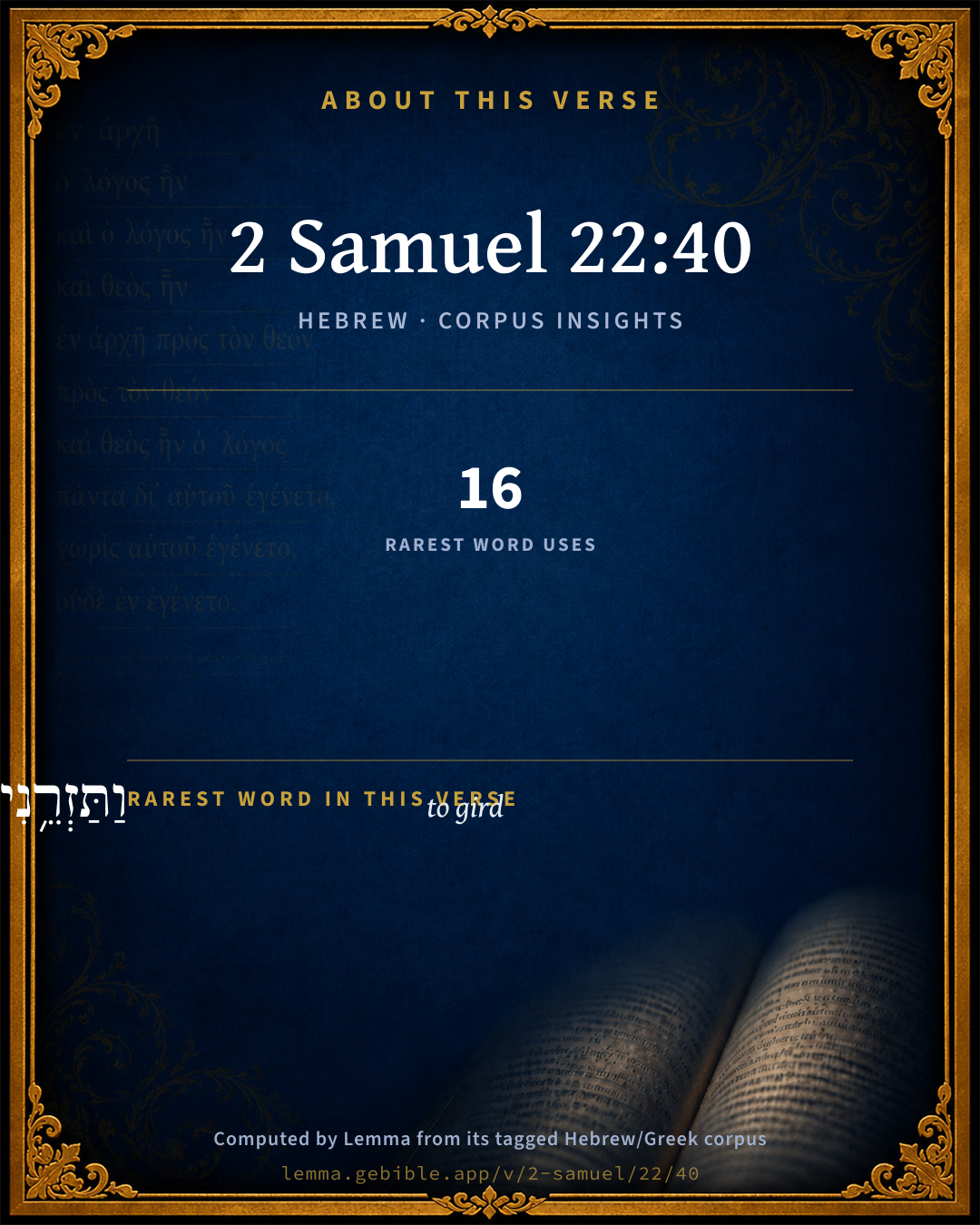
The rarest word here is וַתַּזְרֵ֥נִי to gird H247 — appearing just 16 times in the whole Hebrew Bible.

Shared distinctive vocabulary

וַתַּזְרֵ֥נִי to gird H247 occurs in 15 verses of the Hebrew Bible. Also found in:

Grammatical profile

  • 3 verbs
  • 2 nouns
  • 1 preposition

Verb forms

  • וַתַּזְרֵ֥נִי Piel · Sequential Imperfect
  • תַּכְרִ֥יעַ Hiphil · Imperfect
  • קָמַ֖י Qal · Participle Active

Hebrew & Septuagint length

In English translation the verse runs 21 words from the Hebrew and 24 from the Septuagint (LXX English) — closely comparable.

A rough comparison of the two English renderings, which tokenize alike — not a word-level alignment.

Word counts can differ between the Hebrew and the Greek without any difference in meaning — e.g. the Hebrew direct-object marker אֵת has no separate Greek word, and Greek often adds the article ὁ.

Cross-references

10

Topical passages linked to 2 Samuel 22:40 in the Treasury of Scripture Knowledge — connected by theme and wording, ordered by reader-vote popularity; previews shown in the World English Bible.

  • Psalms 44:5 Through you, will we push down our adversaries. Through your name, will we tread them under who rise up against us.
  • Psalms 18:32 The God who arms me with strength, and makes my way perfect?
  • Psalms 18:39 For you have girded me with strength to the battle. You have subdued under me those who rose up against me.
  • Isaiah 60:14 The sons of those who afflicted you shall come bending to you; and all those who despised you shall bow themselves down at the soles of your feet; and they shall call you The city of Yahweh, The Zion of the Holy One of Israel.
  • Colossians 1:11 strengthened with all power, according to the might of his glory, for all endurance and perseverance with joy;
  • 1 Samuel 17:49–51 David put his hand in his bag, and took there a stone, and slang it, and struck the Philistine in his forehead; and the stone sank into his forehead, and he fell on his face to the earth.
  • 1 Samuel 23:5 David and his men went to Keilah, and fought with the Philistines, and brought away their cattle, and killed them with a great slaughter. So David saved the inhabitants of Keilah.
  • Psalms 144:2 My loving kindness, my fortress, My high tower, my deliverer, My shield, and he in whom I take refuge; Who subdues my people under me.
  • Isaiah 45:5 I am Yahweh, and there is none else; besides me there is no God. I will gird you, though you have not known me;
  • Revelation 5:9 They sang a new song, saying, "You are worthy to take the book, And to open its seals: For you were killed, And bought us for God with your blood, Out of every tribe, language, people, and nation,

Cross-references courtesy of OpenBible.info (CC BY 4.0).

Hebrew and Greek witnesses Masoretic Hebrew ↔ Greek Septuagint

The same verse in the two great witnesses to the Old Testament, shown verse-for-verse.

These are two independent witnesses, not word-aligned to each other, and the Septuagint is shown in lemma (dictionary) form.

Hebrew 2 Samuel 22:40 Masoretic · Westminster Leningrad Codex

וַתַּזְרֵ֥נִי חַ֖יִל לַמִּלְחָמָ֑ה תַּכְרִ֥יעַ קָמַ֖י תַּחְתֵּֽנִי

For you have girded me with strength to the battle; You have subdued under me those who rose up against me.

World English Bible · Public Domain

Greek LXX 2 Samuel 22:40 Septuagint · lemma form

καί ἐνἰσχύω ἐγώ δύναμις εἰς πόλεμος κάμπτω ὁ ἐπι ἀναἵστημι ἐγώ ὑποκάτω ἐγώ

And you shall strengthen me with power for the war; you shall cause them that rise up against me to bow down under me.

LXX2012 (modern English Septuagint) · Public Domain

Hebrew: Westminster Leningrad Codex (CC BY 4.0). Greek: Septuagint (public domain); English from LXX2012 (modern English Septuagint) (Public Domain). How the Septuagint differs from the Hebrew →

Targum (Aramaic paraphrase)

1

The Targum is the ancient Jewish Aramaic paraphrase of the Hebrew Scriptures — an interpretive translation, not the Hebrew text itself. Onkelos (literal) and Pseudo-Jonathan (expansive) render the Torah, and Jonathan the Prophets. Coverage is partial: where no permissively-licensed English translation exists for a verse, only the Aramaic is shown. This is verse-level text, not a word-by-word alignment to the Hebrew.

  1. Targum Jonathan Prophets (Joshua–Malachi)
    וּסְעַדְתַּנִי בְחֵילָא לְמֶעְבַּד קְרָבָא תְּבַרְתָּא עַמְמַיָא דְקַיְמִין לְאַבְאָשָׁא לִי תְּחוֹתָי:

    (no public-domain English translation for this verse)

    Targum Jonathan — Aramaic: “Mikraot Gedolot” (public domain). English: “Sefaria Community Translation” (CC0 1.0 (public-domain dedication)); “London "Chaldee Paraphrase," 1871” (public domain). Text via Sefaria.

Commentary

Notes on 2 Samuel 22:40 from classic Christian and Jewish commentators (each source and its license shown beneath its notes). The classic Christian expositions comment on the surrounding passage and are grouped to its opening verse, so a note may address several verses; the Jewish commentaries on the Tanakh (Rashi and others) are per-verse, so they appear only where the commentator wrote on this verse.

Lemma curates 59 commentaries, every one of them public domain or Creative Commons licensed, each selected and text-cleaned for this edition rather than reprinted as found. About our sources →

MacLaren's Expositions of Holy Scripture

Alexander MacLaren

2 Samuel

DAVID’S HYMN OF VICTORY

2Sa 22:40 f11 - 2Sa 22:51.

The Davidic authorship of this great hymn has been admitted even by critics who are in general too slow to recognise it. One of these says that ‘there is no Israelite king to whom the expressions in the psalm apply so closely as to David.’ The favourite alternative theory that the speaker is the personified nation is hard to accept. The voice of individual trust and of personal experience sounds clear in the glowing words. Two editions of the hymn are preserved for us,-in Psa 18:1 - Psa 18:50 and 2Sa 22:1 - 2Sa 22:51. Slight variations exist in the two copies, which may probably be merely accidental. Nothing important depends on them. The text begins with the closing words of a description of God’s arming the singer for his victories, and goes on to paint the tumult of battle and the rout of the foe {2Sa 22:40 f11 - 2Sa 22:43}; then follows triumphant expectation of future wider victories {2Sa 22:44 - 2Sa 22:46}; and that leads up to the closing burst of grateful praise {2Sa 22:47 - 2Sa 22:51}.

I. We are not to forget that what is described in 2Sa 22:40 f11 - 2Sa 22:43 is a literal fight, with real swords against very real enemies. We may draw lessons of encouragement from it for our conflict with spiritual wickednesses, but we must not lose sight of the bloody combat with flesh and blood which the singer had waged. He felt that God had braced his armour on him, had given him the impenetrable ‘shield’ which he wore on his arm, and had strengthened his arms to bend the ‘bow of steel.’ We see him in swift pursuit, pressing hard on the flying foe, crushing them with his fierce charge, trampling them under foot. ‘I did beat them small as the dust of the earth.’ His blows fell like those of a great pestle, pulverising some substance in a mortar. ‘I did stamp them as the mire of the streets,’-a vivid picture of trampling down the prostrate wretches, for which Psa 18:1 - Psa 18:50 gives the less picturesque variant, ‘did cast them out.’ In their despair the fugitives shriek aloud for God’s help, and the Psalmist has a stern joy in knowing their cries to be unheard.

Now, such delight in an enemy’s despair and destruction, such gratification at the vanity of his prayers, are far away from being Christian sentiments, and the gulf is not wholly bridged by the consideration that David felt himself to be God’s Anointed, and enmity to him to be, consequently, treason against God. His feelings were most natural and entirely consistent with the stage of revelation in which he lived. They were capable of being purified into that triumph in the victory of good and the ruin of evil without which there is no vigorous sympathy with Christ’s conflict. They kindle, by their splendid energy and condensed rapidity, an answering glow even in readers so far away from the scene as we are. But still they do belong to a lower level of feeling, and result from a less full revelation than belongs to Christianity. The light of battle which blazes in them is not the fire which Jesus longed to kindle on earth.

But we may well take a pattern from the stern soldier’s recognition that all his victory was due to God alone. The strength that he put forth was God’s gift. It was God who subdued the insurgents, not David. The panic which made the foe take to flight was infused into them by God. No name but Jehovah’s was to be carved on the trophy reared on the battlefield. The human victor was but the instrument of the divine Conqueror. Such lowly reference of all our power and success to Him will save us from overweening self-adulation, and is the surest way to retain the power which He gives, and which is lost most surely when we take the credit of it to ourselves.

II. The enemies thus far have been from among his own subjects, but in 2Sa 22:44 - 2Sa 22:46 a transition is made to victory over ‘strangers’; that is, foreign nations. The triumph over ‘the strivings of my people’ heartens the singer to expect that he will be’ head of the nations.’ The other version of the hymn {Psa 18:1 - Psa 18:50} reads simply ‘the people.’

The picture of hasty surrender ‘as soon as they hear of me’ is graphic. His very name conquers. ‘The strangers shall submit themselves unto me’ is literally ‘shall lie,’ or yield feigned obedience. They ‘fade away’ as if withered by the hot wind of the desert. ‘They shall come limping’ {as the word here used signifies}, as if wounded in the fight, for which Psa 18:1 - Psa 18:50 reads ‘trembling.’

Now this vision of extended conquests, based as it is on past smaller victories, carries valuable lessons. David here lays hold of the great promises to his house of a wide dominion, and expects the beginnings of their fulfilment to himself. And he did extend his conquests beyond the territory of Israel. But we may take the hope as an instance in a particular direction of what should be the issue of all experience of God’s mercies. ‘To-morrow shall be as this day, and much more abundant.’ Smaller victories will be followed by greater. Our reception of God’s favouring help should widen our anticipations. Our gratitude to Him should be ‘a lively sense of favours to come.’ Progressive victory should be the experience of every believer.

We may see, too, dimly apparent through the large hope of the Psalmist-King, the prophecy of the worldwide victories of his Son, in whom the great promises of a dominion ‘from sea to sea, and from the river unto the ends of the earth,’ are fulfilled.

III. 2Sa 22:46 - 2Sa 22:51 make a noble close to a noble hymn, in which the singer’s strong wing never flags, nor the rush of thought and feeling ever slackens. In it, even more absolutely than in the rest of the psalm, his victory is all ascribed to Jehovah. He alone acts, David simply receives. To have learned by experience that’ He lives,’ and is ‘my Rock,’ and to gather all the feelings excited by the retrospect of a long life into ‘Blessed be my Rock,’ is to have reaped and garnered the richest harvest which earth can yield. So at last sings the man whose early years had been full of struggles and privations. A morning of tempest has cleared into sunny evening calm, as it will with us all if the tempest blows us into our true shelter.

This psalm begins with a rapturous heaping together of the precious names of God, as the singer has had them revealed to him by experience. Foremost among these stands that one, ‘my Rock,’ which is caught up again in this closing burst of thanksgiving. That great Rock towers unchangeable above fleeting things. The river runs past its base, the woods nestling at its feet bud, and shed their pride of foliage, but it stands the same. David had many a time hid in ‘the clefts of the rocks’ in his years of wandering, and the figure is eloquent on his lips.

These closing strains gather together once more the main points of the previous verses, his deliverance from domestic foes, and his conquests over external enemies. These are wholly God’s work. True thankfulness delights to repeat its acknowledgments. God does not weary of giving, we should not weary of praising the Giver and His gifts. We renew our enjoyment of our long-past mercies by reiterating our thankfulness for them. They do not die as long as gratitude keeps their remembrance green.

But the Psalmist’s experience impels him to a vow {2Sa 22:50}. He will give thanks to God among the nations. God’s mercies bind, and, if rightly felt, will joyfully impel, the receiver to spread His name as far as his voice can reach. Love is sometimes silent, but gratitude must speak. The most unmusical voice is tuned to melody by God’s great blessings received and appreciated, and they need never want a theme who can tell what the Lord has done for their souls. ‘Then shall. . . the tongue of the dumb sing.’ A dumb Christian is a monstrosity. We are ‘the secretaries of His praise,’ and have been saved ourselves that we may declare His goodness.

2Sa 22:51 has been supposed by some to be a liturgical addition, on the ground that, if David were the author, he would not be likely to name himself thus. But there does not seem to be anything unnatural in his mentioning himself by name in such a connection, and the reference to his dynasty, based as it is on Nathan’s promise, is most fitting. The last thought about his mercies which the humble gratitude of the Psalmist utters is that they were not given to him for any good in himself, nor to be selfishly enjoyed, but that they were bestowed on him because of the place that he filled in the divine purposes, and belonged to ‘his seed’ as truly as to himself. So lowly had his prosperity made him. So truly had he sunk himself in his office, and in the great things that God meant to do through him and his house. We know better than David did what these were, and how the promise on which he rested his hopes of the duration of his house is fulfilled in his Son, whose kingdom is an everlasting kingdom, and who bears God’s name to all the nations.

Alexander MacLaren, Expositions of Holy Scripture (1904–1910) — public domain. Text from a community e-Sword module.

Geneva Bible (1599)

Geneva Bible translators

He acknowledgeth that God was the author of his victories, who gave him strength.

Geneva Bible (1599) marginal notes — public domain. Text via Bolls.life.

unfoldingWord translationNotes

Door43 World Missions Community

General Information:

David continues his song to Yahweh.

You put strength on me like a belt for battle

Here the strength that Yahweh gives is compared to a belt for battle that allowed David to do mighty things. (See: Simile)

you put under me those who rise up against me

"you helped me defeat those who fought against me"

the back of my enemies' necks

Possible meanings are 1) David seeing the backs of the enemy as they run away or 2) David putting his foot on the back of his enemy's neck after he defeats him.

I annihilated

"I completely destroyed"

translationWords

strength

unfoldingWord translationNotes — © Distant Shores Media and the Door43 World Missions Community, licensed CC BY-SA 4.0. Source: git.door43.org/Door43/en_tn.

Lesson kit

Teaching starters — assembled from the data on this page, not authored interpretation. Every prompt links to the verse data it draws on. Edit before teaching.

2 Samuel, in the Historical, opens this verse with 6 words (6 distinct Hebrew lemmas). Its most distinctive word is ʼâzar (“to gird”). A historical commentator’s framing appears above. Read the whole chapter for the surrounding context.

Discussion questions

  1. The word ʼâzar carries the sense “to gird.” How does it shape the verse?
  2. How does 1 Samuel 2:4, which shares the word «to gird», read alongside this verse?
  3. These translations render this verse differently. What is at stake in choosing one wording over another?
  4. «וַתַּזְרֵ֥נִי» is a Piel Sequential Imperfect verb. How does that grammatical form shape the action described?
  5. Compare how MacLaren's Expositions of Holy Scripture and Geneva Bible (1599) read this verse. Where do they agree or differ?

Things to notice

Reading settings

Reading text

Shown beneath each verse's original-language words.

Old Testament
Old Testament edition

Read the OT as the Masoretic Hebrew (MT) or the Greek Septuagint (LXX).

English shown for the Greek Septuagint (in the Hebrew ↔ Greek comparison).

Comparing translations? Open the Compare panel on any verse page to stack up to four side by side.