
Deuteronomy 8:17

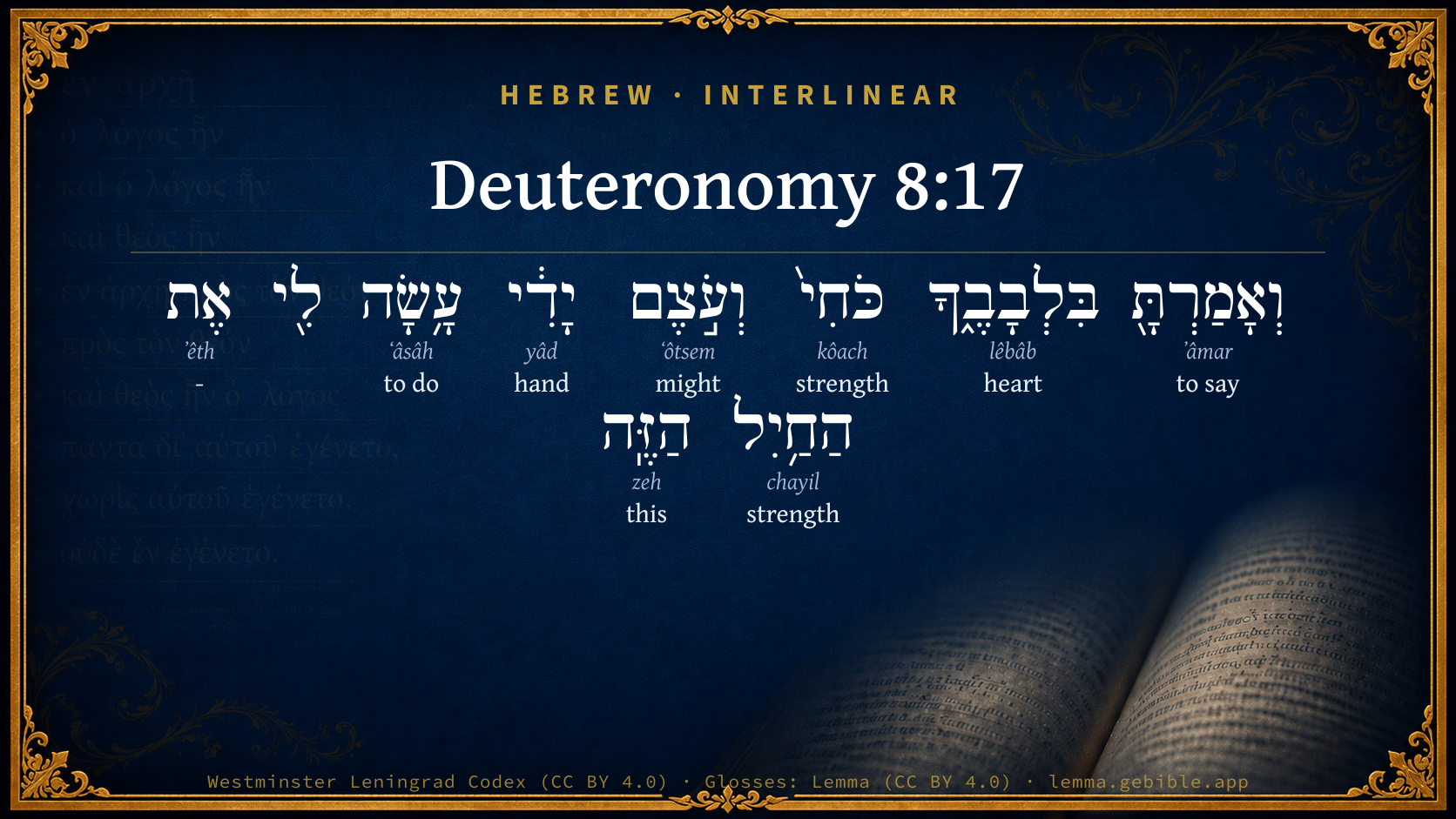
Hebrew (Westminster Leningrad Codex) Deuteronomy 8:17 appears in the Hebrew Old Testament. The text above is from the Westminster Leningrad Codex. Each word links to its Strong’s number, a concise gloss, and parsing drawn from the Open Scriptures Hebrew Bible morphology. Click any word for its full Brown-Driver-Briggs (BDB) entry.
Download image
Cite this verse

Deuteronomy 8:17 (World English Bible). Public Domain. Lemma interlinear Bible study tool, https://lemma.gebible.app/v/deuteronomy/8/17.

Show BibTeX & RIS
BibTeX
RIS
English Translation
and [lest] you say in your heart, My power and the might of my hand has gotten me this wealth.
World English Bible · Public Domain
Highlights
  • 1 first appearance in the Hebrew Bible
Full analysis ↓
Download a study sheet

One document with this verse’s original text, its word-by-word gloss line, the meaning frame, cross-references with their text, attributed commentary, and full source and license credits — printable, and it pastes into notes with its structure intact.

This verse Autodidact and up

Study sheet (.html) Plain text (.txt)

A passage Seminary Student

Up to 50 verses in one chapter. A passage sheet keeps up to 6 commentary sources and 12 cross-references per verse, in the order this page ranks them, and says so on the sheet whenever that leaves anything out. Ask for a single verse and you get the Autodidact verse sheet above.

Everything on this page stays free to read, with no account — the sheet is a download of what is already on screen, not access to it.

Want to remove ads? Support Godless Engineer
Compare translations 3

The same verse in 3 English versions, stacked beneath the original-language interlinear above. Click any original word for its lexicon entry.

Each is an independent rendering of the whole verse — the interlinear is not word-aligned to these translations.

Highlighted words mark where these versions differ — a whole-verse word diff, not a word-by-word alignment.

  • World English Bible Public Domain
    and [lest] you say in your heart, My power and the might of my hand has gotten me this wealth.
  • King James Version Public Domain
    And thou say in thine heart, My power and the might of mine hand hath gotten me this wealth.
  • unfoldingWord Literal Text CC BY-SA 4.0
    And you will say in your heart, ‘My power and the might of my hand made for me this wealth.’

unfoldingWord Literal Text — © unfoldingWord, licensed CC BY-SA 4.0. Word-aligned USFM3 via Door43 (git.door43.org/unfoldingWord/en_ult).

Versions to compare (up to 4)

3 of 4 selected

Show all 18 translations

Every available English version of this verse, each an independent rendering of the whole verse.

  • World English Bible Public Domain
    and [lest] you say in your heart, My power and the might of my hand has gotten me this wealth.
  • Berean Standard Bible Public Domain
    You might say in your heart, “The power and strength of my hands have made this wealth for me.”
  • Majority Standard Bible Public Domain
    You might say in your heart, “The power and strength of my hands have made this wealth for me.”
  • King James Version Public Domain
    And thou say in thine heart, My power and the might of mine hand hath gotten me this wealth.
  • American Standard Version (1901) Public Domain
    and `lest' thou say in thy heart, My power and the might of my hand hath gotten me this wealth.
  • Revised Version (1885) Public Domain
    and thou say in thine heart, My power and the might of mine hand hath gotten me this wealth.
  • Geneva Bible (1599) Public Domain
    Beware least thou say in thine heart, My power, and the strength of mine owne hand hath prepared me this abundance.
  • Douay-Rheims (1899) Public Domain
    Lest thou shouldst say in thy heart: My own might, and the strength of my own hand have achieved all these things for me.
  • Young's Literal Translation Public Domain
    and thou hast said in thy heart, My power, and the might of my hand, hath made for me this wealth:
  • Literal Standard Version CC BY-SA 4.0
    and you have said in your heart, My power and the might of my hand have made this wealth for me.
  • Unlocked Literal Bible CC BY-SA 4.0
    but you may say in your heart, 'My power and the might of my hand acquired all this wealth.'
  • unfoldingWord Literal Text CC BY-SA 4.0
    And you will say in your heart, ‘My power and the might of my hand made for me this wealth.’
  • Darby Bible Public Domain
    -- and thou say in thy heart, My power and the might of my hand has procured me this wealth.
  • World Messianic Bible Public Domain
    and lest you say in your heart, “My power and the might of my hand has gotten me this wealth.”
  • Webster's Bible Public Domain
    And thou shalt say in thy heart, My power and the might of my hand hath gotten me this wealth.
  • Free Bible Version CC BY-SA 4.0
    You might think to yourselves, “I became rich through all my hard work.”
  • Bible in Basic English Public Domain
    Say not then, in your hearts, My power and the strength of my hands have got me this wealth.
  • JPS Tanakh (1917) Public Domain
    and thou say in thy heart: 'My power and the might of my hand hath gotten me this wealth.'

Literal Standard Version (2020), Covenant Press — licensed CC BY-SA 4.0. Text via the HelloAO Bible API (eBible.org). Unlocked Literal Bible (unfoldingWord) — licensed CC BY-SA 4.0. Text via the HelloAO Bible API (eBible.org). unfoldingWord Literal Text — © unfoldingWord, licensed CC BY-SA 4.0. Word-aligned USFM3 via Door43 (git.door43.org/unfoldingWord/en_ult). Free Bible Version, Dr. Jonathan Gallagher — licensed CC BY-SA 4.0. Text via the HelloAO Bible API (eBible.org).

Word by word

More ways to search: Search by grammar → Find every occurrence → Compare this word →

Practice this passage: Drill this verse → Learn its vocabulary →

וְעֹ֣צֶם
ʻôtsem
H6108
“and · might of”
Conjunction + Noun, Common, Masculine, Singular, Construct
Part of Speech
Conjunction + Noun
Type
Common
Gender
Masculine
Number
Singular
State
Construct
Full BDB Definition

Origin: from H6105

TWOT: 1673a

power, bones, might - might - bones
  1. וְאָמַרְתָּ֖ ʼâmar H559 “and · to say” Conjunction + Verb, Qal, Sequential Perfect, 2nd Person, Masculine, Singular
  2. בִּלְבָבֶ֑ךָ lêbâb H3824 “in/at · heart · your” Preposition + Noun, Common, Masculine, Singular, Construct + Suffix, Personal, 2nd Person, Masculine, Singular
  3. כֹּחִי֙ kôach H3581 “strength · my” Noun, Common, Masculine, Singular, Construct + Suffix, Personal, 1st Person, Common, Singular
  4. יָדִ֔י yâd H3027 “hand · my” Noun, Common, Both, Singular, Construct + Suffix, Personal, 1st Person, Common, Singular
  5. עָ֥שָׂה ʻâsâh H6213 “to do” Verb, Qal, Perfect, 3rd Person, Masculine, Singular
  6. אֶת ʼêth H853 “-” Particle, Direct Object
  7. הַחַ֥יִל chayil H2428 “the · strength” Particle, Definite Article + Noun, Common, Masculine, Singular, Absolute
  8. הַזֶּֽה zeh H2088 “the · this” Particle, Definite Article + Pronoun, Demonstrative, Masculine, Singular

About this verse

These counts appear in no published source. They are computed here, from the morphology-tagged text and Lemma’s own curated glosses. What Lemma adds →

10
words
9
distinct lemmas
Pentateuch
section

Notable vocabulary

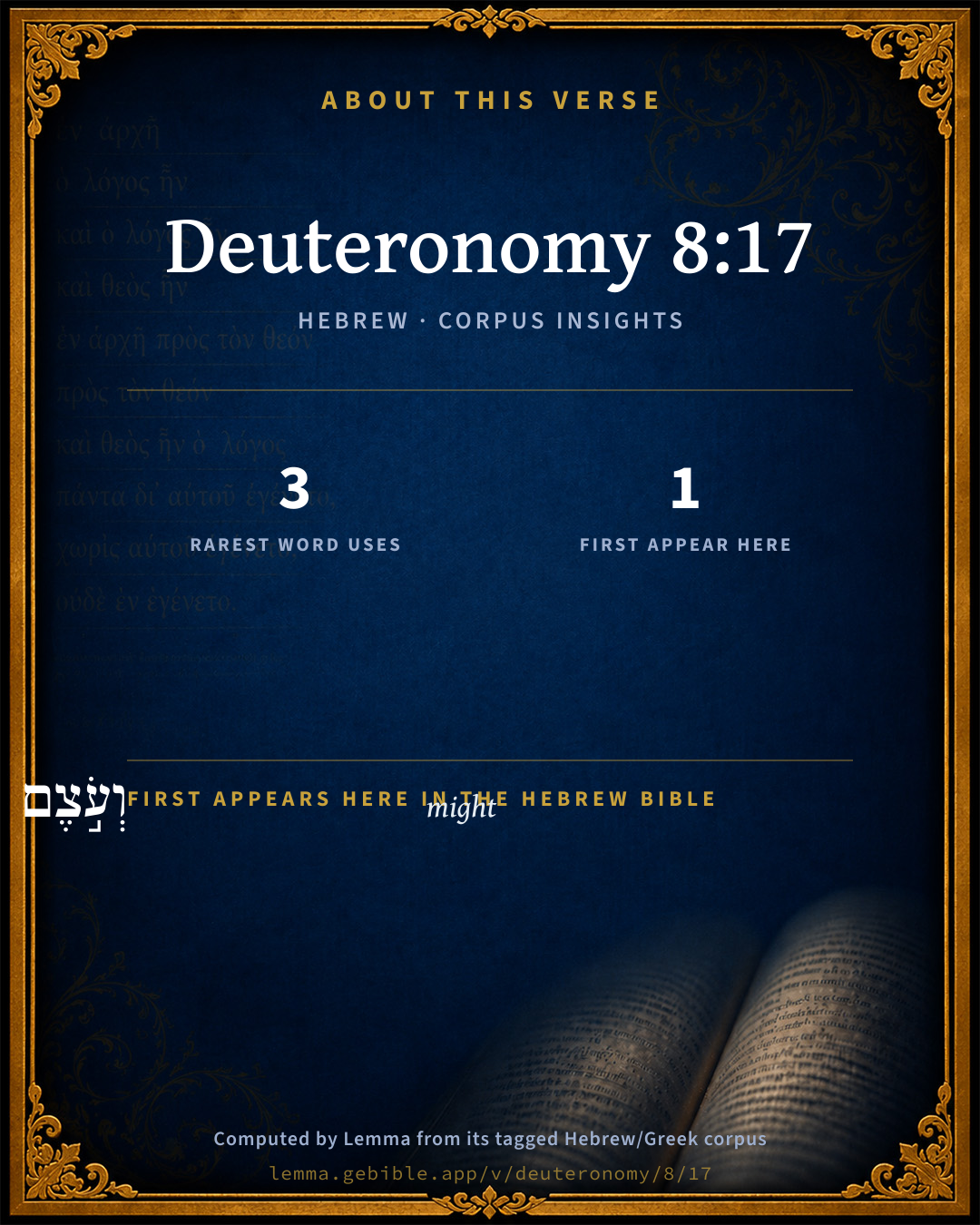
The rarest word here is וְעֹ֣צֶם might H6108 — appearing just 3 times in the whole Hebrew Bible.

First appearance in Scripture

This word makes its first canonical appearance in the Hebrew Bible here:

  • וְעֹ֣צֶם might H6108

Shared distinctive vocabulary

וְעֹ֣צֶם might H6108 occurs in 3 verses of the Hebrew Bible. Also found in:

Grammatical profile

  • 2 verbs
  • 5 nouns
  • 1 pronoun
  • 1 preposition
  • 1 particle

Verb forms

  • וְאָמַרְתָּ֖ Qal · Sequential Perfect
  • עָ֥שָׂה Qal · Perfect

Hebrew & Septuagint length

In English translation the verse runs 20 words from the Hebrew and 22 from the Septuagint (LXX English) — closely comparable.

A rough comparison of the two English renderings, which tokenize alike — not a word-level alignment.

Word counts can differ between the Hebrew and the Greek without any difference in meaning — e.g. the Hebrew direct-object marker אֵת has no separate Greek word, and Greek often adds the article ὁ.

Cross-references

7

Topical passages linked to Deuteronomy 8:17 in the Treasury of Scripture Knowledge — connected by theme and wording, ordered by reader-vote popularity; previews shown in the World English Bible.

  • Deuteronomy 9:4 Don't speak in your heart, after that Yahweh your God has thrust them out from before you, saying, For my righteousness Yahweh has brought me in to possess this land; whereas for the wickedness of these nations Yahweh does drive them out from before you.
  • 1 Corinthians 4:7 For who makes you different? And what do you have that you didn't receive? But if you did receive it, why do you boast as if you had not received it?
  • Daniel 4:30 The king spoke and said, Is not this great Babylon, which I have built for the royal dwelling-place, by the might of my power and for the glory of my majesty?
  • Isaiah 10:8–14 For he says, Aren't my princes all of them kings?
  • Deuteronomy 7:17 If you shall say in your heart, These nations are more than I; how can I dispossess them?
  • Hosea 12:8 Ephraim said, "Surely I have become rich, I have found myself wealth. In all my wealth they won't find in me any iniquity that is sin."
  • Habakkuk 1:16 Therefore he sacrifices to his net, and burns incense to his dragnet, because by them his life is luxurious, and his food is good.

Cross-references courtesy of OpenBible.info (CC BY 4.0).

Hebrew and Greek witnesses Masoretic Hebrew ↔ Greek Septuagint

The same verse in the two great witnesses to the Old Testament, shown verse-for-verse.

These are two independent witnesses, not word-aligned to each other, and the Septuagint is shown in lemma (dictionary) form.

Hebrew Deuteronomy 8:17 Masoretic · Westminster Leningrad Codex

וְאָמַרְתָּ֖ בִּלְבָבֶ֑ךָ כֹּחִי֙ וְעֹ֣צֶם יָדִ֔י עָ֥שָׂה לִ֖י אֶת הַחַ֥יִל הַזֶּֽה

and [lest] you say in your heart, My power and the might of my hand has gotten me this wealth.

World English Bible · Public Domain

Greek LXX Deuteronomy 8:17 Septuagint · lemma form

μή εἶπον ἐν ὁ καρδία σύ ὁ ἰσχύς ἐγώ καί ὁ κράτος ὁ χείρ ἐγώ ποιέω ἐγώ ὁ δύναμις ὁ μέγας οὗτος

Lest you should say in your heart, My strength, and the power of my hand have wrought for me this great wealth.

LXX2012 (modern English Septuagint) · Public Domain

Hebrew: Westminster Leningrad Codex (CC BY 4.0). Greek: Septuagint (public domain); English from LXX2012 (modern English Septuagint) (Public Domain). How the Septuagint differs from the Hebrew →

Targum (Aramaic paraphrase)

2

The Targum is the ancient Jewish Aramaic paraphrase of the Hebrew Scriptures — an interpretive translation, not the Hebrew text itself. Onkelos (literal) and Pseudo-Jonathan (expansive) render the Torah, and Jonathan the Prophets. Coverage is partial: where no permissively-licensed English translation exists for a verse, only the Aramaic is shown. This is verse-level text, not a word-by-word alignment to the Hebrew.

  1. Targum Onkelos Torah (Genesis–Deuteronomy)
    וְתֵימַר בְּלִבָּךְ חֵילִי וּתְקֵף יְדִי קְנוֹ לִי יָת נִכְסַיָא הָאִלֵין

    (no public-domain English translation for this verse)

    Targum Onkelos — Aramaic: “Onkelos Genesis” (public domain); “Onkelos Exodus” (public domain); “Onkelos Leviticus” (public domain); “Onkelos Numbers” (public domain); “Onkelos Deuteronomy” (public domain). English: “Sefaria Community Translation” (CC0 1.0 (public-domain dedication)); “J.W. Etheridge. The Targums of Onkelos and Jonathan Ben Uzziel on the Pentateuch. London: Longmans, Green, 1862” (public domain). Text via Sefaria.

  2. Targum Pseudo-Jonathan Torah (Genesis–Deuteronomy)
    הֲווֹ זְהִירִין דְּלָא תֵימְרוּן בְּלִבְּכוֹן חֵילָן וּתְקוֹף יְדָן קָנוּ לָן יַת נִכְסַיָא הָאִילֵין

    Beware that you say not in your heart, Our strength and the might of our hands have obtained us all these riches;

    Targum Pseudo-Jonathan — Aramaic: “Targum Jonathan on Genesis” (public domain); “Targum Jonathan on Exodus” (public domain); “Targum Jonathan on Leviticus” (public domain); “Targum Jonathan on Numbers” (public domain); “Targum Jonathan on Deuteronomy” (public domain). English: “The Targum of Jonathan ben Uzziel, trans. J. W. Etheridge, London, 1862” (public domain). Text via Sefaria.

Commentary

Notes on Deuteronomy 8:17 from classic Christian and Jewish commentators (each source and its license shown beneath its notes). The classic Christian expositions comment on the surrounding passage and are grouped to its opening verse, so a note may address several verses; the Jewish commentaries on the Tanakh (Rashi and others) are per-verse, so they appear only where the commentator wrote on this verse.

Lemma curates 59 commentaries, every one of them public domain or Creative Commons licensed, each selected and text-cleaned for this edition rather than reprinted as found. About our sources →

Trapp's Complete Commentary

John Trapp

Deu 8:17 And thou say in thine heart, My power and the might of [mine] hand hath gotten me this wealth.

Ver. 17. My power.] As that great dragon of Egypt, lying at ease in the swollen waters of his Nile, saith, "My river is mine own, and I have made it for myself." {Eze 29:3 Hab 1:16}

John Trapp, A Commentary or Exposition upon All the Books of the Old and New Testament (1647–1656) — public domain. Text from a community e-Sword module.

The Cambridge Bible for Schools and Colleges

gen. ed. J. J. S. Perowne

17. thou say in thine heart] That is not only as if convinced; but, whether or not thou sayest this expressly with thy lips, thou feelest and practically behavest as if thine own power and might had gotten thee this wealth.

The Cambridge Bible for Schools and Colleges (gen. ed. J. J. S. Perowne; Cambridge University Press, 1878–1918) — public domain. Text from a community e-Sword module.

John Gill's Exposition

But thou shalt remember the Lord thy God,.... That he was the author of their beings, the God of their lives and mercies; what great and good things he had done for them in Egypt, and in the wilderness; and particularly in putting them into the possession of such a fruitful country, abounding with all that heart could wish for:

for it is he that giveth thee power to get wealth; for though men may have seeming opportunities for getting wealth, may have capacities for the management of business for the acquisition of it, and may not be wanting in diligence and industry, yet may not attain it; it is the blessing of God that makes rich, and to that it should be imputed whenever it is enjoyed; see Psa 127:2.

that he may establish his covenant which he sware unto thy fathers,

as it is this day; that he would give the land of Canaan to their seed, and make them a rich and flourishing people, as they would be and were when possessed of the land, which is supposed throughout this discourse.

John Gill's Exposition of the Whole Bible (1746–1763) — public domain (CC PDM 1.0). Text via the HelloAO Bible API.

Haydock's Catholic Bible Commentary

For me. Hebrew, "hath procured me this wealth," or strength, ver. 18.

George Leo Haydock (1774–1849), Haydock's Catholic Family Bible and Commentary, 1859 edition — public domain. Excludes Psalms (Douay-Rheims chapter numbering differs from Protestant) and Deuterocanonical books (Catholic canon only).

The Pulpit Commentary

Vers. 17, 18. The blessing in store for them was God"s free gift to them; and when they came to enjoy it they were not to allow themselves to say in their heart, i.e. to think or imagine, that the prosperous condition in which they were placed was the result of their own exertions; they were to ascribe all to God"s gracious bounty, for from him had come the power by which prosperity had been gained, and this he had given, not on account of any merit in them, but that he might fulfill his covenant engagements to their fathers. Get wealth lyij hc to make strength, to gather substance, (Gen_12:5) to procure wealth (Rth_4:11, margin; Eze_28:4) As it is this day. "As was quite evident then, when the establishment of the covenant had already commenced, and Israel had come through the desert to the border of Canaan" (see Deu_4:20) (Keil).

Vers. 17, 18. Danger of self-glorification.

The enjoyment of God"s mercies, which should be so provocative of thankfulness, may become a snare, if we are not careful to guard against their misuse. Several of the dangers to which prosperity makes us liable are dealt with in the Homily referred to above. Here, there is one specially named, which is perhaps the most common of all, viz. that of attributing success in life to one"s own skill, or wisdom, or might: "And thou say in thine heart, My power and the might of mine hand hath gotten me this wealth". (see Eze_28:4, 5 29:3; Psa_12:3; Jud_1:7:2) So strong is the tendency to accredit ourselves with any gains which may be ours, in a vain, self-glorifying spirit, that we cannot be too anxious to guard against it, by exposing the sin and evil of it.

I IT IS UNTRUE. However much care we may have taken to ensure success, whether we gain our end or no, has been dependent at every moment on a conjunction of circumstances, which we were as powerless to bring about or to avoid, as to create the tides or arrest the moon. And even the ability to take care, and to put forth effort, has been a gift. We are violating the first rudiments of most certain truth, when we take the credit of success in life to ourselves.

II IT IS DISLOYAL. For it is God who gives us the power to get wealth. We owe all we have to his bounty, and even the very breath we draw, to his unceasing care. The laws on which we have relied to bring prosperity have been of God"s creation. And for a creature to plume himself on the gifts of the Creator, who can adequately set forth such injustice to high Heaven?

III IT IS UNGRATEFUL. For, as if it were not enough that the Most High should have all our faults to bear with unceasingly is it not marvelously ungrateful that creatures who would have long ago been cut down except for the long-suffering of God, should pride themselves on the abilities which have been in such forbearance continued to them?

IV IT IS MOST MISCHIEVOUS IN ITS EFFECTS. For it nurses pride, instead of fostering thankfulness. It genders selfishness, it freezes benevolence, and will surely breed a covetous, tyrannous, haughty disposition, if not fought against and overcome.

V IT IS OFFENSIVE IN GOD"S SIGHT, (Pro_6:16, Pro_6:17; Jam_4:6; 1Pe_5:5) God sets himself in array against pride of heart. How can it be otherwise? "What communion hath light with darkness?" God will dwell with the contrite and humble spirit, but "the proud he knoweth afar off.

VI IT IS THE REVERSE OF THAT WHICH GODS DESIGNS. (Ver. 16.) For the varied experiences of life are an appeal of God to men as moral beings, "to humble them and prove them;" and if, in spite of all, any take the credit to themselves of their own prosperity, God"s own intent in their life-history is being reversed.

VII IT WILL SOONER OR LATER BRING HUMILIATION AND SUFFERING, (Pro_29:23) Again and again does our Savior also lay down this principle, that pride exposes to much shame. (Luk_14:11 Luk_18:14) It is not for us to say, in any individual case, in what form the debasement or disappointment will come. But come it will. It may be in one or more of the following ways:

1. By the removal of the wealth which was gained, and a sudden plunge from prosperity to adversity. It is sad when men have to part with all before they will learn that God gave all!

2. By depriving men of any further power to attend to worldly concerns, they may have to see their utter helplessness without God.

3. By a searching dealing with the spirit in the furnace of tribulation, God may graciously burn up the pride, and purge away corruption. But the process is a terrific one, even here. It is being saved, "yet so as by fire." Still, it is better to be saved, even thus, cost what it may. (1Co_3:18) It is only when God succeeds in "humbling" us, that he can do us good "at the latter end.

4. If, after all warnings, teachings, and strivings, God"s voice is still unheard, and pride still rears itself up against him, he will reckon the proud one as "the chaff which the wind driveth away." And oh, how will this self-elation shrivel up then! (see Isa_2:10-22) God will not give his glory to another (1Sa_2:30; Mal_4:1) What reversals of position will that day witness! That which the world reckoned as "great wealth" will come to naught, and the "wealthy" one will be bankrupt for eternity; while those who in lowliness of spirit have received thankfully the least of God"s gifts, shall have him as their "exceeding great Reward." To such he will say, "Friend, come up higher!"

The Pulpit Commentary (1880–1919), ed. H.D.M. Spence-Jones & Joseph S. Exell — public domain. Text from a community e-Sword module.

Lesson kit

Teaching starters — assembled from the data on this page, not authored interpretation. Every prompt links to the verse data it draws on. Edit before teaching.

Deuteronomy, in the Pentateuch, opens this verse with 10 words (9 distinct Hebrew lemmas). Its most distinctive word is ʻôtsem (“might”). A historical commentator’s framing appears above. Read the whole chapter for the surrounding context.

Discussion questions

  1. How does “might” (ʻôtsem) shape what this verse is saying?
  2. This is the first place “might” appears in Scripture (first appears here). What does its debut here establish?
  3. How does Job 30:21, which shares the word «might», read alongside this verse?
  4. The translations on this page render this verse differently — a whole-verse word diff, not a word-by-word alignment. What might account for the different wordings?
  5. «וְאָמַרְתָּ֖» is a Qal Sequential Perfect verb. How does that grammatical form shape the action described?
  6. Compare how Trapp's Complete Commentary and The Cambridge Bible for Schools and Colleges read this verse. Where do they agree or differ?

Things to notice

  • 1 word makes its first canonical appearance in Scripture here.
  • These translations choose different wording for 7 words in this verse.
  • 9 distinct Hebrew lemmas span 10 words in this verse.

Reading settings

Reading text

Shown beneath each verse's original-language words.

Old Testament
Old Testament edition

Read the OT as the Masoretic Hebrew (MT) or the Greek Septuagint (LXX).

English shown for the Greek Septuagint (in the Hebrew ↔ Greek comparison).

Comparing translations? Open the Compare panel on any verse page to stack up to four side by side.