Jeremiah 40:13

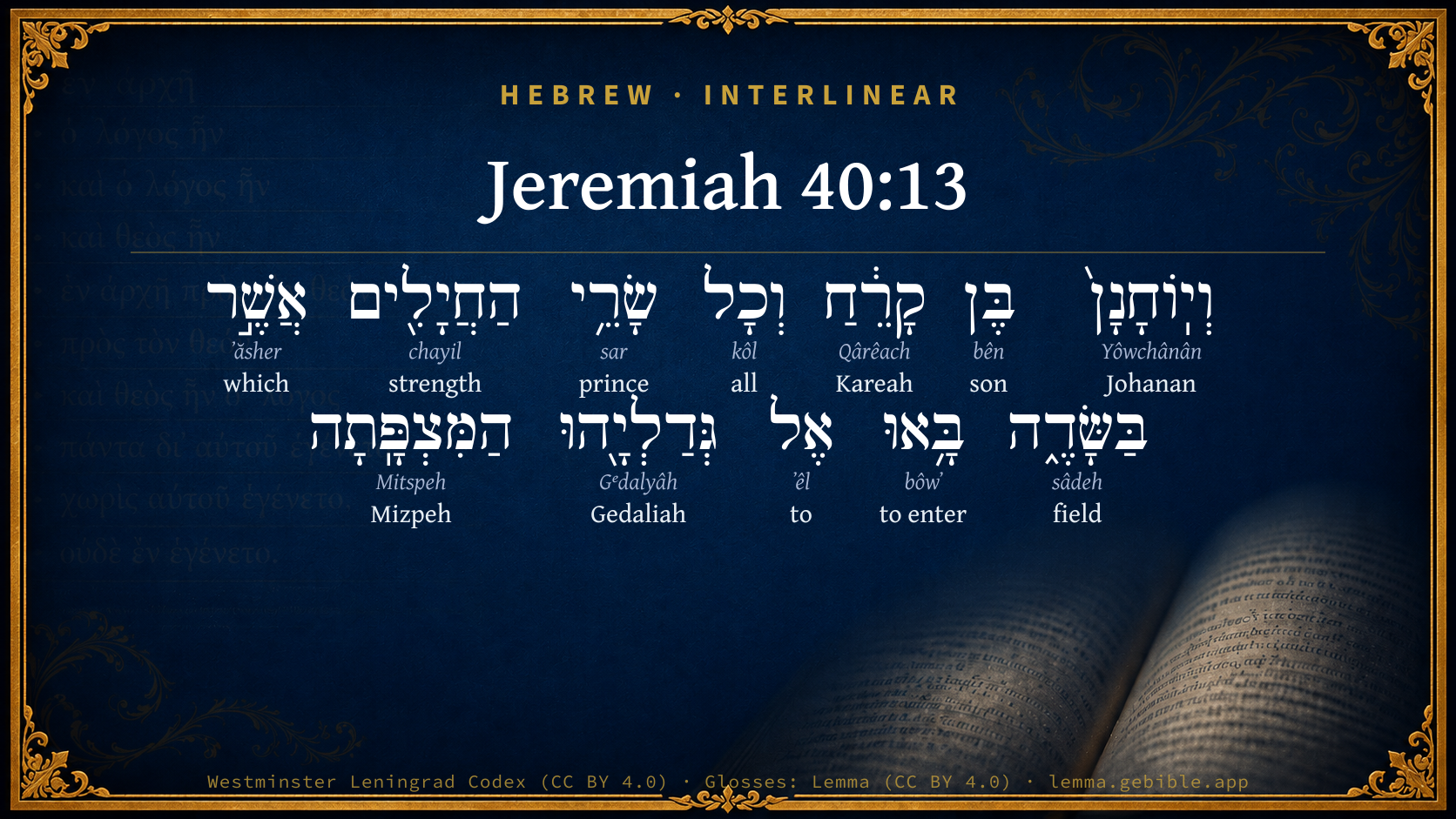
Hebrew (Westminster Leningrad Codex) Jeremiah 40:13 appears in the Hebrew Old Testament. The text above is from the Westminster Leningrad Codex. Each word links to its Strong’s number, a concise gloss, and parsing drawn from the Open Scriptures Hebrew Bible morphology. Click any word for its full Brown-Driver-Briggs (BDB) entry.
Download image
Cite this verse

Jeremiah 40:13 (World English Bible). Public Domain. Lemma interlinear Bible study tool, https://lemma.gebible.app/v/jeremiah/40/13.

Show BibTeX & RIS
BibTeX
RIS
English Translation
Moreover Johanan the son of Kareah, and all the captains of the forces who were in the fields, came to Gedaliah to Mizpah,
World English Bible · Public Domain
Download a study sheet

One document with this verse’s original text, its word-by-word gloss line, the meaning frame, cross-references with their text, attributed commentary, and full source and license credits — printable, and it pastes into notes with its structure intact.

This verse Autodidact and up

Study sheet (.html) Plain text (.txt)

A passage Seminary Student

Up to 50 verses in one chapter. A passage sheet keeps up to 6 commentary sources and 12 cross-references per verse, in the order this page ranks them, and says so on the sheet whenever that leaves anything out. Ask for a single verse and you get the Autodidact verse sheet above.

Everything on this page stays free to read, with no account — the sheet is a download of what is already on screen, not access to it.

Want to remove ads? Support Godless Engineer
Compare translations 3

The same verse in 3 English versions, stacked beneath the original-language interlinear above. Click any original word for its lexicon entry.

Each is an independent rendering of the whole verse — the interlinear is not word-aligned to these translations.

Highlighted words mark where these versions differ — a whole-verse word diff, not a word-by-word alignment.

  • World English Bible Public Domain
    Moreover Johanan the son of Kareah, and all the captains of the forces who were in the fields, came to Gedaliah to Mizpah,
  • King James Version Public Domain
    Moreover Johanan the son of Kareah, and all the captains of the forces that were in the fields, came to Gedaliah to Mizpah,
  • unfoldingWord Literal Text CC BY-SA 4.0
    Johanan son of Kareah and all the army commanders in the countryside came to Gedaliah at Mizpah.

unfoldingWord Literal Text — © unfoldingWord, licensed CC BY-SA 4.0. Word-aligned USFM3 via Door43 (git.door43.org/unfoldingWord/en_ult).

Versions to compare (up to 4)

3 of 4 selected

Show all 18 translations

Every available English version of this verse, each an independent rendering of the whole verse.

  • World English Bible Public Domain
    Moreover Johanan the son of Kareah, and all the captains of the forces who were in the fields, came to Gedaliah to Mizpah,
  • Berean Standard Bible Public Domain
    Meanwhile, Johanan son of Kareah and all the commanders of the armies in the field came to Gedaliah at Mizpah
  • Majority Standard Bible Public Domain
    Meanwhile, Johanan son of Kareah and all the commanders of the armies in the field came to Gedaliah at Mizpah
  • King James Version Public Domain
    Moreover Johanan the son of Kareah, and all the captains of the forces that were in the fields, came to Gedaliah to Mizpah,
  • American Standard Version (1901) Public Domain
    Moreover Johanan the son of Kareah, and all the captains of the forces that were in the fields, came to Gedaliah to Mizpah,
  • Revised Version (1885) Public Domain
    Moreover Johanan the son of Kareah, and all the captains of the forces that were in the fields, came to Gedaliah to Mizpah,
  • Geneva Bible (1599) Public Domain
    Moreouer Iohanan the sonne of Kareah, and all the captaines of the hoste, that were in the fieldes, came to Gedaliah to Mizpah,
  • Douay-Rheims (1899) Public Domain
    Then Johanan the son of Caree, and all the captains of the army, that had been scattered about in the countries, came to Godolias to Masphath.
  • Young's Literal Translation Public Domain
    And Johanan son of Kareah, and all the heads of the forces that `are' in the field, have come in unto Gedaliah to Mizpah,
  • Literal Standard Version CC BY-SA 4.0
    And Johanan son of Kareah, and all the heads of the forces that [are] in the field, have come to Gedaliah at Mizpah,
  • Unlocked Literal Bible CC BY-SA 4.0
    Johanan son of Kareah and all the army commanders in the countryside came to Gedaliah at Mizpah.
  • unfoldingWord Literal Text CC BY-SA 4.0
    Johanan son of Kareah and all the army commanders in the countryside came to Gedaliah at Mizpah.
  • Darby Bible Public Domain
    And Johanan the son of Kareah, and all the captains of the forces that were in the fields, came to Gedaliah unto Mizpah,
  • World Messianic Bible Public Domain
    Moreover Yochanan the son of Kareah, and all the captains of the forces who were in the fields, came to Gedaliah to Mizpah,
  • Webster's Bible Public Domain
    Moreover Johanan the son of Kareah, and all the captains of the forces, that were in the fields, came to Gedaliah to Mizpah,
  • Free Bible Version CC BY-SA 4.0
    Johanan son of Kareah and all the commanders of the men in the field came to Gedaliah at Mizpah
  • Bible in Basic English Public Domain
    Now Johanan, the son of Kareah, and all the captains of the forces which were in the field, came to Gedaliah in Mizpah,
  • JPS Tanakh (1917) Public Domain
    Moreover Johanan the son of Kareah, and all the captains of the forces that were in the fields, came to Gedaliah to Mizpah,

Literal Standard Version (2020), Covenant Press — licensed CC BY-SA 4.0. Text via the HelloAO Bible API (eBible.org). Unlocked Literal Bible (unfoldingWord) — licensed CC BY-SA 4.0. Text via the HelloAO Bible API (eBible.org). unfoldingWord Literal Text — © unfoldingWord, licensed CC BY-SA 4.0. Word-aligned USFM3 via Door43 (git.door43.org/unfoldingWord/en_ult). Free Bible Version, Dr. Jonathan Gallagher — licensed CC BY-SA 4.0. Text via the HelloAO Bible API (eBible.org).

Word by word

More ways to search: Search by grammar → Find every occurrence → Compare this word →

Practice this passage: Drill this verse → Learn its vocabulary →

הַמִּצְפָּֽתָה
Mitspeh
H4708
“the · Mizpeh · toward”
Particle, Definite Article + Noun, Proper + Suffix, Demonstrative
Part of Speech
Particle + Noun
Type
Proper
Full BDB Definition

Origin: the same as H4707

TWOT: None

Mizpeh = "watchtower" - a city in the district of the Shephelah or lowlands of Judah - a place in Moab on the east of the Jordan - a place in Gilead - a place near Mount Hermon - a place in Benjamin; also 'Mizpah'
  1. וְיֽוֹחָנָן֙ Yôwchânân H3110 “and · Johanan” Conjunction + Noun, Proper
  2. בֶּן bên H1121 “son of” Noun, Common, Masculine, Singular, Construct
  3. קָרֵ֔חַ Qârêach H7143 “Kareah” Noun, Proper
  4. וְכָל kôl H3605 “and · all of” Conjunction + Noun, Common, Masculine, Singular, Construct
  5. שָׂרֵ֥י sar H8269 “princes of” Noun, Common, Masculine, Plural, Construct
  6. הַחֲיָלִ֖ים chayil H2428 “the · forces” Particle, Definite Article + Noun, Common, Masculine, Plural, Absolute
  7. אֲשֶׁ֣ר ʼăsher H834 “which” Particle, Relative
  8. בַּשָּׂדֶ֑ה sâdeh H7704 “in/at the · field” Preposition, Determined + Noun, Common, Masculine, Singular, Absolute
  9. בָּ֥אוּ bôwʼ H935 “to enter” Verb, Qal, Perfect, 3rd Person, Common, Plural
  10. אֶל ʼêl H413 “to” Preposition
  11. גְּדַלְיָ֖הוּ Gᵉdalyâh H1436 “Gedaliah” Noun, Proper

About this verse

These counts appear in no published source. They are computed here, from the morphology-tagged text and Lemma’s own curated glosses. What Lemma adds →

12
words
12
distinct lemmas
Prophets
section

Notable vocabulary

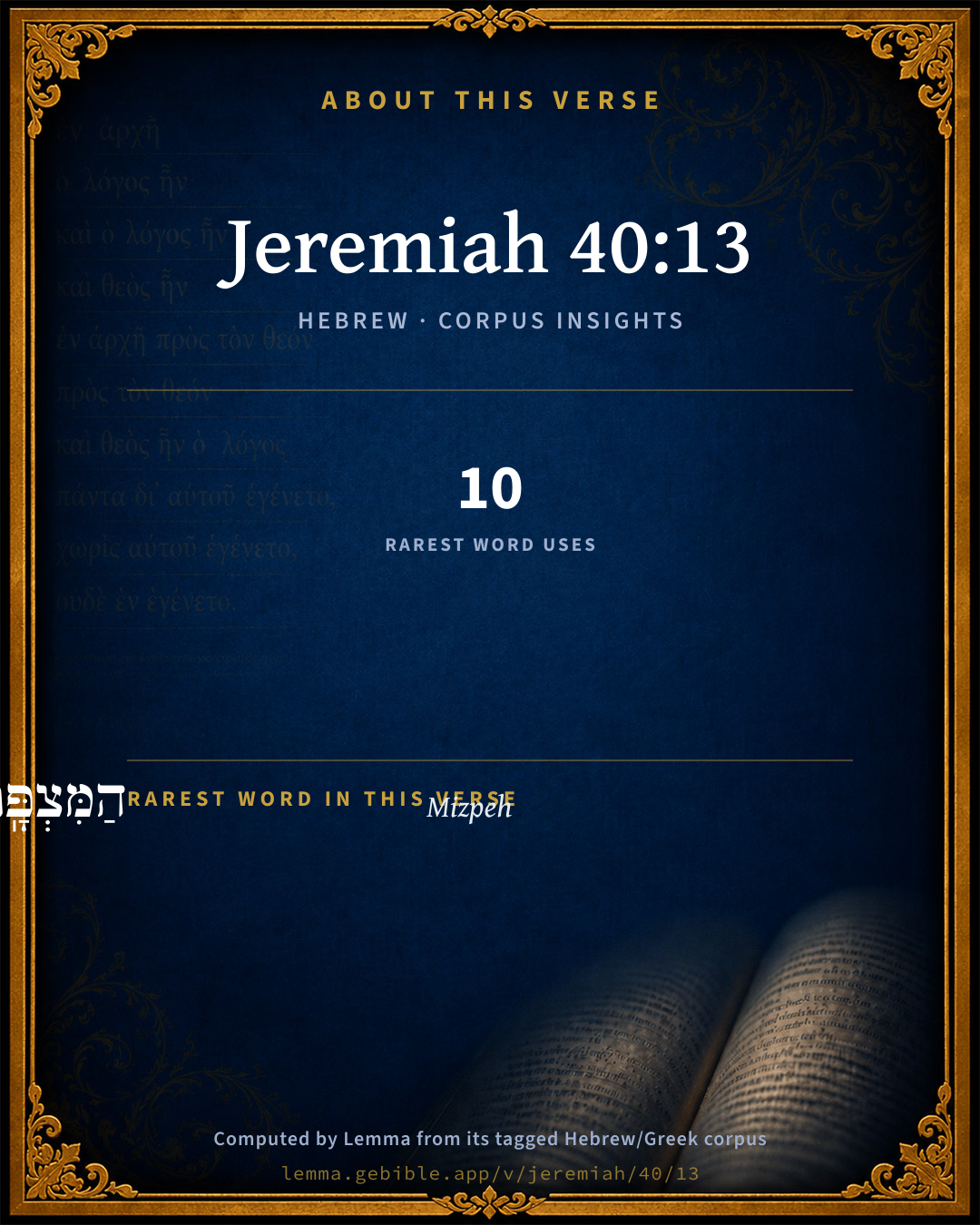
The rarest word here is הַמִּצְפָּֽתָה Mizpeh H4708 — appearing just 10 times in the whole Hebrew Bible.

Shared distinctive vocabulary

הַמִּצְפָּֽתָה Mizpeh H4708 occurs in 9 verses of the Hebrew Bible. Also found in:

Grammatical profile

  • 1 verb
  • 9 nouns
  • 1 preposition
  • 1 particle

Verb forms

  • בָּ֥אוּ Qal · Perfect

Cross-references

2

Topical passages linked to Jeremiah 40:13 in the Treasury of Scripture Knowledge — connected by theme and wording, ordered by reader-vote popularity; previews shown in the World English Bible.

  • Jeremiah 40:8 then they came to Gedaliah to Mizpah, [to wit], Ishmael the son of Nethaniah, and Johanan and Jonathan the sons of Kareah, and Seraiah the son of Tanhumeth, and the sons of Ephai the Netophathite, and Jezaniah the son of the Maacathite, they and their men.
  • Jeremiah 42:1 Then all the captains of the forces, and Johanan the son of Kareah, and Jezaniah the son of Hoshaiah, and all the people from the least even to the greatest, came near,

Cross-references courtesy of OpenBible.info (CC BY 4.0).

Hebrew and Greek witnesses Masoretic Hebrew ↔ Greek Septuagint

The same verse in the two great witnesses to the Old Testament, shown verse-for-verse.

These are two independent witnesses, not word-aligned to each other, and the Septuagint is shown in lemma (dictionary) form.

Hebrew Jeremiah 40:13 Masoretic · Westminster Leningrad Codex

וְיֽוֹחָנָן֙ בֶּן קָרֵ֔חַ וְכָל שָׂרֵ֥י הַחֲיָלִ֖ים אֲשֶׁ֣ר בַּשָּׂדֶ֑ה בָּ֥אוּ אֶל גְּדַלְיָ֖הוּ הַמִּצְפָּֽתָה

Moreover Johanan the son of Kareah, and all the captains of the forces who were in the fields, came to Gedaliah to Mizpah,

World English Bible · Public Domain

Greek LXX Structure differs

In the Septuagint, Jeremiah is about an eighth shorter than the Hebrew and arranges its material differently — the Oracles Against the Nations (Hebrew chapters 46–51) appear in the middle of the Greek book, after 25:13. Because the chapter and verse boundaries do not line up, a verse-for-verse comparison with the Hebrew is not shown.

A verse-for-verse comparison isn’t shown here because the chapters and verses don’t line up. Switch to the LXX edition with the MT / LXX toggle above to read the Greek directly.

Hebrew: Westminster Leningrad Codex (CC BY 4.0). Greek: Septuagint (public domain); English from a public-domain English Septuagint. How the Septuagint differs from the Hebrew →

Targum (Aramaic paraphrase)

1

The Targum is the ancient Jewish Aramaic paraphrase of the Hebrew Scriptures — an interpretive translation, not the Hebrew text itself. Onkelos (literal) and Pseudo-Jonathan (expansive) render the Torah, and Jonathan the Prophets. Coverage is partial: where no permissively-licensed English translation exists for a verse, only the Aramaic is shown. This is verse-level text, not a word-by-word alignment to the Hebrew.

  1. Targum Jonathan Prophets (Joshua–Malachi)
    וְיוֹחָנָן בַּר קָרֵחַ וְכָל רַבָּנֵי חֵילְוָתָא דִי בְּחַקְלָא אֲתוֹ לְוַת גְדַלְיָהוּ לְמִצְפְּיָא:

    (no public-domain English translation for this verse)

    Targum Jonathan — Aramaic: “Mikraot Gedolot” (public domain). English: “Sefaria Community Translation” (CC0 1.0 (public-domain dedication)); “London "Chaldee Paraphrase," 1871” (public domain). Text via Sefaria.

Commentary

Notes on Jeremiah 40:13 from classic Christian and Jewish commentators (each source and its license shown beneath its notes). The classic Christian expositions comment on the surrounding passage and are grouped to its opening verse, so a note may address several verses; the Jewish commentaries on the Tanakh (Rashi and others) are per-verse, so they appear only where the commentator wrote on this verse.

Lemma curates 59 commentaries, every one of them public domain or Creative Commons licensed, each selected and text-cleaned for this edition rather than reprinted as found. About our sources →

Trapp's Complete Commentary

John Trapp

Jer 40:13 Moreover Johanan the son of Kareah, and all the captains of the forces that [were] in the fields, came to Gedaliah to Mizpah,

Ver. 13. Moreover Johanan came to Gedaliah to Mizpah.] Ishmael perhaps had solicited them to take part with him.

John Trapp, A Commentary or Exposition upon All the Books of the Old and New Testament (1647–1656) — public domain. Text from a community e-Sword module.

Joseph Benson's Commentary

Jer 40:13-16. Johanan the son of Kareah came to Gedaliah, &c. — They had been with him before, Jer 40:8-9, but now they come to discover to him a conspiracy formed against his life. And said, Dost thou certainly know, &c. — Or, rather, Dost thou not know, &c., (which is evidently the sense intended,) that the king of the Ammonites hath sent Ishmael to slay thee? — The king of the Ammonites had concerted this matter with Ishmael, with a design to make the Jews, who still remained in their own country, his vassals: see Jer 41:10. But Gedaliah believed them not — Not being credulous, or of a suspicious temper. Then Johanan spake to Gedaliah secretly — Finding that Gedaliah took little notice of what he had spoken to him in the presence of the other captains, he goes to him secretly, and offers him his service to prevent the stroke designed against him, suggesting to him, that if he did not value his own life, yet he ought to consider in what a destitute condition the people would be, in case he should be cut off: they were at present but a small remnant, and if that calamity should happen, even this remnant would also perish. But Gedaliah said, Thou shalt not do this thing, for thou speakest falsely of Ishmael — Gedaliah shows in this instance more of that charity that thinks no evil, than of that prudence and discretion which became a chief magistrate. He ought to have been particularly on his guard against one, concerning whose mischievous designs he had received such information; but, alas! he placed too great confidence in the fidelity of those about him, and this proved ruinous, both to himself and to the poor people whom he was appointed to govern and protect.

Joseph Benson's Commentary on the Old and New Testaments (1811–1818) — public domain. Text from a community e-Sword module.

Whedon's Commentary on the Bible

Daniel D. Whedon

THE CONSPIRACY AGAINST GEDALIAH REPORTED, Jer_40:13-16.

13. In the fields — In the country as contrasted with the town or city.

Daniel D. Whedon (gen. ed.), Commentary on the Old and New Testaments (1874–1909) — public domain. Text from a community e-Sword module.

Jamieson, Fausset & Brown

Robert Jamieson, A. R. Fausset & David Brown

in the fields--not in the city, but scattered in the country (Jer 40:7).

Jamieson, Fausset & Brown — Commentary Critical and Explanatory on the Whole Bible (1871) — public domain (CC PDM 1.0). Text via the HelloAO Bible API.

John Calvin's Commentaries

A sad history is here given, from which we may conclude, that God’s wrath against the people had not been appeased by the destruction of the city and the burning of the Temple. It was some token of mercy, when Gedaliah was set over the remnant of the people and the poor, who had been allowed to dwell in the land. But now Gedaliah is slain, and a miserable scattering must have ensued. The wrath also of the king of Babylon was kindled, because the Chaldeans, who had been given as guards, were at the same time killed. It was then God’s purpose to execute his judgment also on these remnants.

But the Prophet shews how it was that Gedaliah was killed, even because Ishmael had been hired and advised by the king of Ammon. he says, however, that he had been warned by the sons of Kareah, of whom mention has been made, but that he had no faith in them. And hence the Prophet begins by saying, that John the son of Kareah and the other leaders came to him. He had, as we have seen, received them before, and had sworn to them that he would be their defender, so that no one would hurt them; he had undertaken to face all danger, and offered his head as a pledge that the Chaldeans would not attempt anything against them. They came then to him, because with safety was connected public benefit, he had, then, bound them to himself by no common benefit, and it was for their good that he should be safe and secure, who was in favor with the king of Babylon.

John Calvin's Commentaries (1540-1563) — public domain. Text from the Calvin Translation Society English edition (1840s-50s) via the Christian Classics Ethereal Library (ccel.org). Calvin's coverage is partial (roughly two-thirds of the Bible); uncommented books and verses are honest gaps, never fabricated. The 19th-century editor's footnotes and remarks are omitted so the notes are faithfully Calvin's own voice.

The Cambridge Bible for Schools and Colleges

gen. ed. J. J. S. Perowne

13. Moreover … came] The grammatical construction in the Heb. suggests that we should render, Now … had come.

fields] See note on Jer_40:7.

13–16. See introd. summary to section.

The Cambridge Bible for Schools and Colleges (gen. ed. J. J. S. Perowne; Cambridge University Press, 1878–1918) — public domain. Text from a community e-Sword module.

John Gill's Exposition

Moreover, Johanan the son of Kareah,.... Who seems to be the principal captain next to Ishmael, against whom an information is brought, and so not present; this captain is here only mentioned by name, and before next to Ishmael:

and all the captains of the forces that were in the fields; or that had been in the fields, and probably might be there again; see Jer 40:7; that is, the rest of them, besides Johanan mentioned, and Ishmael the conspirator: these

came to Gedaliah to Mizpah; they had been with him before, and being satisfied by him of the safety they would be in, in the service of the Chaldeans, under him, either returned to the fields from whence they came, or went to those cities and villages he directed them to; but, like honest and faithful men, knowing there was a conspiracy against his life, came in a body to inform him of it, for the greater certainty of it; as judging he would be more ready to give heed unto it, than if only a single person had informed him of it, as well as to show their affection and loyalty to him.

John Gill's Exposition of the Whole Bible (1746–1763) — public domain (CC PDM 1.0). Text via the HelloAO Bible API.

Haydock's Catholic Bible Commentary

Came, having discovered the design of Ismahel, whose ambition prompted him to murder the governor, that he might reign: as he was of the royal family, chap. xli. 1. (Calmet)

George Leo Haydock (1774–1849), Haydock's Catholic Family Bible and Commentary, 1859 edition — public domain. Excludes Psalms (Douay-Rheims chapter numbering differs from Protestant) and Deuterocanonical books (Catholic canon only).

Matthew Poole's English Annotations

They had been with him before, Jer 40:8,9, but now they come to discover a conspiracy against his life.

Matthew Poole's English Annotations on the Holy Bible (1683–1685) — public domain. Text from a community e-Sword/MySword module.

The Pulpit Commentary

Vers. 13-16. Gedaliah receives a warning of a plot against his life.

Jer_41:11. Misplaced charity.

"Charity" says St. Paul," thinketh no evil." But without question, there are times when it ought to think evil, and not to think so is evil. For else charity will be misplaced, thrown away, productive of hurt and harm and not of good. Now

I THERE HAVE BEEN AND ARE MANY INSTANCES OF SUCH MISPLACED CHARITY.

1. The miserable way by which Gedallah came by his death, as told in the above section, is an illustration. He ought to have been on his guard. He was warned. He would not believe, but blamed severely the friend who warned him. And all because of his overconfidence in Ishmael, who murdered him.

2. And there have been many other such instances. Perhaps the king who said, concerning the wicked husbandmen, "They will reverence my son." And Paul, who, though warned again and again, would go to Jerusalem. He thought that the loving gifts he bore from the Gentile Churches to the mother Church in Jerusalem would soften their hard hearts. But it was not so. The elder son though he was quite wrong thought that his father"s treatment of his prodigal younger brother was as unwise as it was kind. We have known those who would never let themselves speak anything but good of others, and the result was that they often misled those who trusted to their over lenient judgments. How often, after the most atrocious crimes, there will be found some who would try to prevent the criminal receiving the due reward of his deeds! What is it but charity in the wrong place?

3. But most of all are we guilty of this toward ourselves. We so little like to think harshly of ourselves, and hence we make all manner of excuse for our faults. We tamper with temptation; we spare ourselves when we ought to be most stern.

II AND MUCH SORROW AND TROUBLE ARISE THEREFROM. Cf. above history; the massacres that followed; the ruin of the nation. Never did a seeming virtue work such ill. Charity to the evil is cruelty to the good. Choosing Barabbas means crucifying Christ. It discourages all virtue. Wherefore should I strive after excellence it the worthless are to be dealt with even as I? This was the elder son"s complaint. (Lu 15) And there seemed to be a good deal in it; hence the father took care to point out to him how much preferable was his own lot: "Son, thou art ever with me," etc. Thy lot is ever so much the best, as the lot of him who never leaves the father"s house is far better than that of him who comes back after a wretched leaving of it for the far country. But most of all the evil results are seen in our misplaced charity to ourselves. Temptation tampered with triumphs, and we who would not be stern with ourselves perish. Hiding from ourselves the truth as to our real condition, we never g to him who alone can make us what we need to be, and so souls are lost.

III HOW EXCELLENT THE EXAMPLE AND TEACHING OF OUR LORD ON THIS SUBJECT. Full of charity as he was, tender and gentle as a mother to the weak and sinful, to the poor outcasts who came to him, yet he was never guilty of any spurious charity. He did not, nor does he, warm vipers in his bosom who should sting him at the last. Cf. John 2 at end, "Jesus did not commit himself unto them." "But so the Gospel goes on; the word is unfortunately rendered "and" in our Authorized Version "there was a man of the Pharisees," etc. (Joh_3:1)

1. It means that our Lord did commit himself to this man as we see he did since he was very different from those whom our Lord could not and would not trust. His treatment of Judas was no exception to his rule. He knew him from the beginning. Nor is his treatment of ourselves, poor, sad recompense as we make him. He has taken us in hand, and he will not put us out of his hand until he has wrought in us all that he designs, he exemplified his own word about being, whilst harmless as doves, wise as serpents also. He says, (Mat_7:1) "Judge not." But almost the next verse bids us not cast pearls before swine! The intent is that, whilst we should not be censorious, we are not to be blind fools, who will imagine in their false charity that pearls will be appreciated by pigs. Charity is to think evil when evil is palpably there.

IV WHAT LEADS TO THIS ERROR. Cf. the history.

1. Perhaps Gedaliah"s conscious integrity; his freedom from all intent of evil.

2. Or over elation at the loyalty and trust that were being displayed on all sides.

3. The accused man had himself (ver. 8) come to Gedaliah.

4. Or dislike to Johanan and his proposals.

5. Or reliance on his own capacity of taking all due care. And when we are wrongly charitable to what is evil, our motives are akin to these. We intend no evil; that which is said to be evil has wrought no harm in others. We intend to be on our guard and deem ourselves to be quite able to take care of ourselves. We dislike the safeguards proposed. We do not believe in the peril against which we are warned. We are disposed to think well of and to like the evil.

V OUR SAFEGUARDS.

1. Seek the knowledge of man.

2. Seek the Spirit of Christ. C.

The Pulpit Commentary (1880–1919), ed. H.D.M. Spence-Jones & Joseph S. Exell — public domain. Text from a community e-Sword module.

John Wesley's Explanatory Notes

Moreover - They had been with him before, but now they come to discover a conspiracy against his life.

John Wesley, Explanatory Notes Upon the Whole Bible (1754–1765) — public domain. Text via the GEBible commentary corpus.

Keil & Delitzsch

C. F. Keil & F. Delitzsch

Gedaliah is forewarned of Ishmael's intention to murder him. - After the return of those who had taken refuge in Moab, etc., Johanan the son of Kareah, together with the rest of the captains who were scattered here and there through the country, came to Gedaliah at Mizpah, to say to him: "Dost thou know indeed that Baalis the king of the Ammonites hath sent Ishmael the son of Nethaniah to take thy life?" The words "that were in the country" are neither a gloss, nor a thoughtless repetition by some scribe from Jer 40:7 (as Hitzig and Graf suppose), but they are repeated for the purpose of distinguishing plainly between the captains with their men from the Jews who had returned out of Moab, Ammon, and Edom. הכּות, "to strike the soul, life" = to kill; cf. Gen 37:21; Deu 19:6. What induced the king of Ammon to think of assassination - whether it was personal hostility towards Gedaliah, or the hope of destroying the only remaining support of the Jews, and thereby perhaps putting himself in possession of the country, - cannot be determined. That he employed Ishmael for the accomplishment of his purpose, may have been owing to the fact that this man had a personal envy of Gedaliah; for Ishmael, being sprung from the royal family (Jer 40:1), probably could not endure being subordinate to Gedaliah. - The plot had become known, and Gedaliah was secretly informed of it by Johanan; but the former did not believe the rumour. Johanan then secretly offered to slay Ishmael, taking care that no one should know who did it, and urged compliance in the following terms: "Why should he slay thee, and all the Jews who have gathered themselves round thee be scattered, and the remnant of Judah perish?" Johanan thus called his attention to the evil consequences which would result to the remnant left in the land were he killed; but Gedaliah replied, "Do not this thing, for thou speakest a lie against Ishmael." The Qeri needlessly changes אל־תּעשׂ into אל־תּעשׂה; cf. Jer 39:12.

Keil & Delitzsch — Biblical Commentary on the Old Testament (1861–1891) — public domain (CC PDM 1.0). Text via the HelloAO Bible API. (Old Testament only.)

unfoldingWord translationNotes

Door43 World Missions Community

Johanan ... Kareah

See how you translated these names in Jeremiah 40:8. (See: How to Translate Names)

Gedaliah

See how you translated this man's name in Jeremiah 39:14. (See: How to Translate Names)

Do you realize that Baalis king of the people of Ammon sent Ishmael son of Nethaniah to murder you?

Johanan and the commanders use a rhetorical question to warn Gedaliah. It can be translated as a statement. AT: "You need to understand that Baalis king of the people of Ammon sent Ishmael son of Nethaniah to murder you!" (See: Rhetorical Question)

Baalis

This is the name of a man. (See: How to Translate Names)

Ishmael ... Nethaniah

Translate these names as in Jeremiah 40:8. (See: How to Translate Names)

Ahikim

See how you translated this name in Jeremiah 26:24. (See: How to Translate Names)

translationWords

Jonathan

commander

Mizpah

king

people group

Ammon

send

believe

unfoldingWord translationNotes — © Distant Shores Media and the Door43 World Missions Community, licensed CC BY-SA 4.0. Source: git.door43.org/Door43/en_tn.

Lesson kit

Teaching starters — assembled from the data on this page, not authored interpretation. Every prompt links to the verse data it draws on. Edit before teaching.

Jeremiah, in the Prophets, opens this verse with 12 words (12 distinct Hebrew lemmas). Its most distinctive word is Mitspeh (“Mizpeh”). A historical commentator’s framing appears above. Read the whole chapter for the surrounding context.

Discussion questions

  1. How does “Mizpeh” (Mitspeh) shape what this verse is saying?
  2. How does Joshua 11:8, which shares the word «Mizpeh», read alongside this verse?
  3. These translations render this verse differently. What is at stake in choosing one wording over another?
  4. «בָּ֥אוּ» is a Qal Perfect verb. How does that grammatical form shape the action described?
  5. Compare how Trapp's Complete Commentary and Joseph Benson's Commentary read this verse. Where do they agree or differ?

Things to notice

Reading settings

Reading text

Shown beneath each verse's original-language words.

Old Testament
Old Testament edition

Read the OT as the Masoretic Hebrew (MT) or the Greek Septuagint (LXX).

English shown for the Greek Septuagint (in the Hebrew ↔ Greek comparison).

Comparing translations? Open the Compare panel on any verse page to stack up to four side by side.