
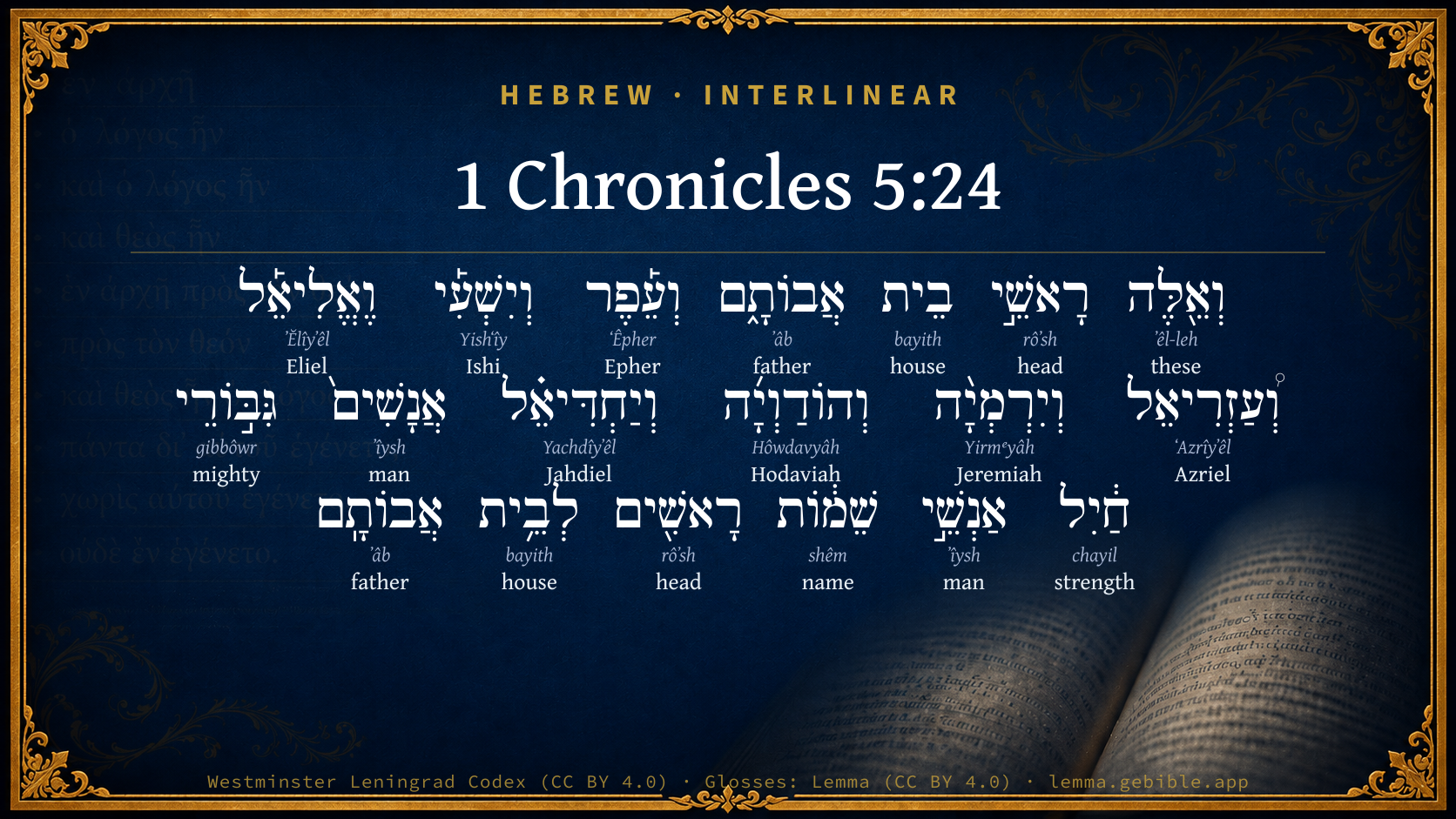
1 Chronicles 5:24

Hebrew (Westminster Leningrad Codex) 1 Chronicles 5:24 appears in the Hebrew Old Testament. The text above is from the Westminster Leningrad Codex. Each word links to its Strong’s number, a concise gloss, and parsing drawn from the Open Scriptures Hebrew Bible morphology. Click any word for its full Brown-Driver-Briggs (BDB) entry.
Download image
Cite this verse

1 Chronicles 5:24 (World English Bible). Public Domain. Lemma interlinear Bible study tool, https://lemma.gebible.app/v/1-chronicles/5/24.

Show BibTeX & RIS
BibTeX
RIS
English Translation
These were the heads of their fathers' houses: even Epher, and Ishi, and Eliel, and Azriel, and Jeremiah, and Hodaviah, and Jahdiel, mighty men of valor, famous men, heads of their fathers' houses.
World English Bible · Public Domain
Highlights
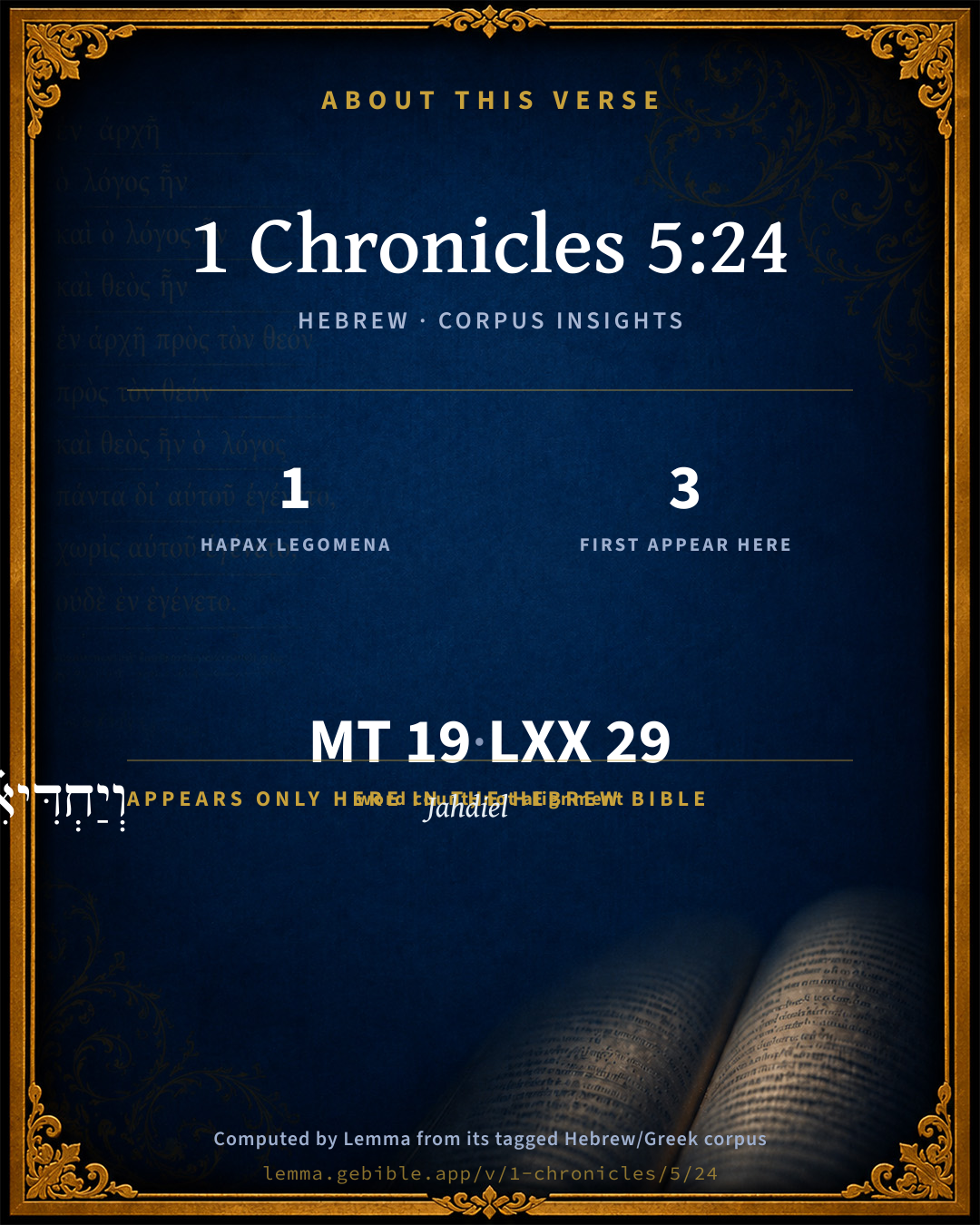
  • 1 hapax legomenon — only here in the Hebrew Bible
  • 3 first appearances in the Hebrew Bible
Full analysis ↓
Download a study sheet

One document with this verse’s original text, its word-by-word gloss line, the meaning frame, cross-references with their text, attributed commentary, and full source and license credits — printable, and it pastes into notes with its structure intact.

This verse Autodidact and up

Study sheet (.html) Plain text (.txt)

A passage Seminary Student

Up to 50 verses in one chapter. A passage sheet keeps up to 6 commentary sources and 12 cross-references per verse, in the order this page ranks them, and says so on the sheet whenever that leaves anything out. Ask for a single verse and you get the Autodidact verse sheet above.

Everything on this page stays free to read, with no account — the sheet is a download of what is already on screen, not access to it.

Want to remove ads? Support Godless Engineer
Compare translations 3

The same verse in 3 English versions, stacked beneath the original-language interlinear above. Click any original word for its lexicon entry.

Each is an independent rendering of the whole verse — the interlinear is not word-aligned to these translations.

Highlighted words mark where these versions differ — a whole-verse word diff, not a word-by-word alignment.

  • World English Bible Public Domain
    These were the heads of their fathers' houses: even Epher, and Ishi, and Eliel, and Azriel, and Jeremiah, and Hodaviah, and Jahdiel, mighty men of valor, famous men, heads of their fathers' houses.
  • King James Version Public Domain
    And these were the heads of the house of their fathers, even Epher, and Ishi, and Eliel, and Azriel, and Jeremiah, and Hodaviah, and Jahdiel, mighty men of valor, famous men, and heads of the house of their fathers.
  • unfoldingWord Literal Text CC BY-SA 4.0
    And these the heads of the house of their fathers, even Epher and Ishi and Eliel and Azriel and Jeremiah and Hodaviah and Jahdiel, men, warriors of strength, men of names, heads of the house of their fathers.

unfoldingWord Literal Text — © unfoldingWord, licensed CC BY-SA 4.0. Word-aligned USFM3 via Door43 (git.door43.org/unfoldingWord/en_ult).

Versions to compare (up to 4)

3 of 4 selected

Show all 18 translations

Every available English version of this verse, each an independent rendering of the whole verse.

  • World English Bible Public Domain
    These were the heads of their fathers' houses: even Epher, and Ishi, and Eliel, and Azriel, and Jeremiah, and Hodaviah, and Jahdiel, mighty men of valor, famous men, heads of their fathers' houses.
  • Berean Standard Bible Public Domain
    These were the heads of their families: Epher, Ishi, Eliel, Azriel, Jeremiah, Hodaviah, and Jahdiel. They were mighty men of valor, famous men, and heads of their families.
  • Majority Standard Bible Public Domain
    These were the heads of their families: Epher, Ishi, Eliel, Azriel, Jeremiah, Hodaviah, and Jahdiel. They were mighty men of valor, famous men, and heads of their families.
  • King James Version Public Domain
    And these were the heads of the house of their fathers, even Epher, and Ishi, and Eliel, and Azriel, and Jeremiah, and Hodaviah, and Jahdiel, mighty men of valor, famous men, and heads of the house of their fathers.
  • American Standard Version (1901) Public Domain
    And these were the heads of their fathers' houses: even Epher, and Ishi, and Eliel, and Azriel, and Jeremiah, and Hodaviah, and Jahdiel, mighty men of valor, famous men, heads of their fathers' houses.
  • Revised Version (1885) Public Domain
    And these were the heads of their fathers’ houses; even Epher, and Ishi, and Eliel, and Azriel, and Jeremiah, and Hodaviah, and Jahdiel, mighty men of valour, famous men, heads of their fathers’ houses.
  • Geneva Bible (1599) Public Domain
    And these were the heads of the housholds of their fathers, euen Epher and Ishi, and Eliel and Azriel, and Ieremiah, and Hodauiah, and Iahdiel, strong men, valiant and famous, heades of the housholdes of their fathers.
  • Douay-Rheims (1899) Public Domain
    And these were the heads of the house of their kindred, Epher, and Jesi, and Eliel, and Esriel, and Jeremia, and Odoia, and Jediel, most valiant and powerful men, and famous chiefs in their families.
  • Young's Literal Translation Public Domain
    And these `are' heads of the house of their fathers, even Epher, and Ishi, and Eliel, and Azriel, and Jeremiah, and Hodaviah, and Jahdiel, men mighty in valour, men of name, heads to the house of their fathers.
  • Literal Standard Version CC BY-SA 4.0
    And these [are] heads of the house of their fathers: even Epher, and Ishi, and Eliel, and Azriel, and Jeremiah, and Hodaviah, and Jahdiel, men mighty in valor, men of renown, heads of the house of their fathers.
  • Unlocked Literal Bible CC BY-SA 4.0
    These were the heads of their fathers' houses: Epher, Ishi, Eliel, Azriel, Jeremiah, Hodaviah, and Jahdiel. They were mighty men, famous men, heads of their fathers' houses.
  • unfoldingWord Literal Text CC BY-SA 4.0
    And these the heads of the house of their fathers, even Epher and Ishi and Eliel and Azriel and Jeremiah and Hodaviah and Jahdiel, men, warriors of strength, men of names, heads of the house of their fathers.
  • Darby Bible Public Domain
    And these were the heads of their fathers' houses: Epher, and Jishi, and Eliel, and Azriel, and Jeremiah, and Hodaviah, and Jahdiel, mighty men of valour, famous men, heads of their fathers' houses.
  • World Messianic Bible Public Domain
    These were the heads of their fathers’ houses: Epher, Ishi, Eliel, Azriel, Jeremiah, Hodaviah, and Jahdiel—mighty men of valor, famous men, heads of their fathers’ houses.
  • Webster's Bible Public Domain
    And these were the heads of the house of their fathers, even Epher, and Ishi, and Eliel, and Azriel, and Jeremiah, and Hodaviah, and Jahdiel, mighty men of valor, famous men, and heads of the house of their fathers.
  • Free Bible Version CC BY-SA 4.0
    These were the family heads: Epher, Ishi, Eliel, Azriel, Jeremiah, Hodaviah, and Jahdiel. They were strong warriors, famous men, heads of their families.
  • Bible in Basic English Public Domain
    And these were the heads of their families: Epher and Ishi and Eliel and Azriel and Jeremiah and Hodaviah and Jahdiel, men of war, of great name, heads of families.
  • JPS Tanakh (1917) Public Domain
    And these were the heads of their fathers' houses: Epher, and Ishi, and Eliel, and Azriel, and Jeremiah, and Hodaviah, and Jahdiel, mighty men of valour, famous men, heads of their fathers' houses.

Literal Standard Version (2020), Covenant Press — licensed CC BY-SA 4.0. Text via the HelloAO Bible API (eBible.org). Unlocked Literal Bible (unfoldingWord) — licensed CC BY-SA 4.0. Text via the HelloAO Bible API (eBible.org). unfoldingWord Literal Text — © unfoldingWord, licensed CC BY-SA 4.0. Word-aligned USFM3 via Door43 (git.door43.org/unfoldingWord/en_ult). Free Bible Version, Dr. Jonathan Gallagher — licensed CC BY-SA 4.0. Text via the HelloAO Bible API (eBible.org).

Word by word

More ways to search: Search by grammar → Find every occurrence → Compare this word →

Practice this passage: Drill this verse → Learn its vocabulary →

וְיַחְדִּיאֵ֗ל
Yachdîyʼêl
H3164
“and · Jahdiel”
Conjunction + Noun, Proper
Part of Speech
Conjunction + Noun
Type
Proper
Full BDB Definition

Origin: from H3162 and H410

TWOT: None

Jahdiel = "my unity is God" - a chief of Manasseh on the east of the Jordan
  1. וְאֵ֖לֶּה ʼêl-leh H428 “and · these” Conjunction + Pronoun, Demonstrative, Common, Plural
  2. רָאשֵׁ֣י rôʼsh H7218 “heads of” Noun, Common, Masculine, Plural, Construct
  3. בֵית bayith H1004 “house of” Noun, Common, Masculine, Singular, Construct
  4. אֲבוֹתָ֑ם ʼâb H1 “fathers · their” Noun, Common, Masculine, Plural, Construct + Suffix, Personal, 3rd Person, Masculine, Plural
  5. וְעֵ֡פֶר ʻÊpher H6081 “and · Epher” Conjunction + Noun, Proper
  6. וְיִשְׁעִ֡י Yishʻîy H3469 “and · Ishi” Conjunction + Noun, Proper
  7. וֶאֱלִיאֵ֡ל ʼĔlîyʼêl H447 “and · Eliel” Conjunction + Noun, Proper
  8. וְ֠עַזְרִיאֵל ʻAzrîyʼêl H5837 “and · Azriel” Conjunction + Noun, Proper
  9. וְיִרְמְיָ֨ה Yirmᵉyâh H3414 “and · Jeremiah” Conjunction + Noun, Proper
  10. וְהוֹדַוְיָ֜ה Hôwdavyâh H1938 “and · Hodaviah” Conjunction + Noun, Proper
  11. אֲנָשִׁים֙ ʼîysh H376 “men” Noun, Common, Masculine, Plural, Absolute
  12. גִּבּ֣וֹרֵי gibbôwr H1368 “mighty of” Adjective, Adjective, Masculine, Plural, Construct
  13. חַ֔יִל chayil H2428 “strength” Noun, Common, Masculine, Singular, Absolute
  14. אַנְשֵׁ֣י ʼîysh H376 “men of” Noun, Common, Masculine, Plural, Construct
  15. שֵׁמ֔וֹת shêm H8034 “names” Noun, Common, Masculine, Plural, Absolute
  16. רָאשִׁ֖ים rôʼsh H7218 “heads” Noun, Common, Masculine, Plural, Absolute
  17. לְבֵ֥ית bayith H1004 “to/for · house of” Preposition + Noun, Common, Masculine, Singular, Construct
  18. אֲבוֹתָֽם ʼâb H1 “fathers · their” Noun, Common, Masculine, Plural, Construct + Suffix, Personal, 3rd Person, Masculine, Plural

About this verse

These counts appear in no published source. They are computed here, from the morphology-tagged text and Lemma’s own curated glosses. What Lemma adds →

19
words
15
distinct lemmas
Historical
section

Notable vocabulary

1 hapax legomenon — a word that appears only here in the entire Hebrew Bible:

  • וְיַחְדִּיאֵ֗ל Jahdiel H3164

First appearance in Scripture

These words make their first canonical appearance in the Hebrew Bible here:

  • וֶאֱלִיאֵ֡ל Eliel H447
  • וְ֠עַזְרִיאֵל Azriel H5837
  • וְיַחְדִּיאֵ֗ל Jahdiel H3164

Shared distinctive vocabulary

וְ֠עַזְרִיאֵל Azriel H5837 occurs in 3 verses of the Hebrew Bible. Also found in:

Grammatical profile

  • 17 nouns
  • 1 adjective
  • 1 pronoun

Repetition

Words recur within this verse — often emphatic in Hebrew:

  • רָאשֵׁ֣י head H7218 ×2
  • בֵית house H1004 ×2
  • אֲבוֹתָ֑ם father H1 ×2
  • אֲנָשִׁים֙ man H376 ×2

Hebrew & Septuagint length

In English translation the verse runs 33 words from the Hebrew and 36 from the Septuagint (LXX English) — closely comparable.

A rough comparison of the two English renderings, which tokenize alike — not a word-level alignment.

Word counts can differ between the Hebrew and the Greek without any difference in meaning — e.g. the Hebrew direct-object marker אֵת has no separate Greek word, and Greek often adds the article ὁ.

In the original languages it is 19 Hebrew tokens and 29 Greek tokens — but the two are counted differently (Hebrew bundles its prefixes and suffixes into one token; the Greek is in lemma form), so that isn’t a like-for-like length.

Cross-references

1

Topical passages linked to 1 Chronicles 5:24 in the Treasury of Scripture Knowledge — connected by theme and wording, ordered by reader-vote popularity; previews shown in the World English Bible.

  • 1 Chronicles 4:38 these mentioned by name were princes in their families: and their fathers' houses increased greatly.

Cross-references courtesy of OpenBible.info (CC BY 4.0).

Hebrew and Greek witnesses Masoretic Hebrew ↔ Greek Septuagint

The same verse in the two great witnesses to the Old Testament, shown verse-for-verse.

These are two independent witnesses, not word-aligned to each other, and the Septuagint is shown in lemma (dictionary) form.

Hebrew 1 Chronicles 5:24 Masoretic · Westminster Leningrad Codex

וְאֵ֖לֶּה רָאשֵׁ֣י בֵית אֲבוֹתָ֑ם וְעֵ֡פֶר וְיִשְׁעִ֡י וֶאֱלִיאֵ֡ל וְ֠עַזְרִיאֵל וְיִרְמְיָ֨ה וְהוֹדַוְיָ֜ה וְיַחְדִּיאֵ֗ל אֲנָשִׁים֙ גִּבּ֣וֹרֵי חַ֔יִל אַנְשֵׁ֣י שֵׁמ֔וֹת רָאשִׁ֖ים לְבֵ֥ית אֲבוֹתָֽם

These were the heads of their fathers' houses: even Epher, and Ishi, and Eliel, and Azriel, and Jeremiah, and Hodaviah, and Jahdiel, mighty men of valor, famous men, heads of their fathers' houses.

World English Bible · Public Domain

Greek LXX 1 Chronicles 5:24 Septuagint · lemma form

καί οὗτος ἀρχηγός οἶκος πατριά αὐτός οφερ καί ισεϊ καί ελιηλ καί εσδριηλ καί ιερμια καί ωδουια καί ιεδιηλ ἀνήρ ἰσχυρός δύναμις ἀνήρ ὀνομαστός ἄρχων ὁ οἶκος πατριά αὐτός

And these were the heads of the houses of their families; Opher, and Sei, and Eliel, and Jeremia, and Oduia, and Jediel, mighty men of valour, men of renown, heads of the houses of their families.

LXX2012 (modern English Septuagint) · Public Domain

Hebrew: Westminster Leningrad Codex (CC BY 4.0). Greek: Septuagint (public domain); English from LXX2012 (modern English Septuagint) (Public Domain). How the Septuagint differs from the Hebrew →

Commentary

Notes on 1 Chronicles 5:24 from classic Christian and Jewish commentators (each source and its license shown beneath its notes). The classic Christian expositions comment on the surrounding passage and are grouped to its opening verse, so a note may address several verses; the Jewish commentaries on the Tanakh (Rashi and others) are per-verse, so they appear only where the commentator wrote on this verse.

Lemma curates 59 commentaries, every one of them public domain or Creative Commons licensed, each selected and text-cleaned for this edition rather than reprinted as found. About our sources →

Ellicott's Commentary for English Readers

(24) And these were the heads . . . (name lost) Epher, and Ishi . . .—Of these seven “valiant warriors, men of renown, heads for their clans” nothing further is recorded. The meagre memorial of their names has at least this value: it proves that abundant materials for the history of Israel once existed, of which our canonical books have preserved authentic fragments.

A Bible Commentary for English Readers, edited by Charles John Ellicott (1878–1897) — public domain. Text from a community e-Sword module.

The Cambridge Bible for Schools and Colleges

gen. ed. J. J. S. Perowne

24. of the house of their fathers] R.V. of their fathers’ houses.

The Cambridge Bible for Schools and Colleges (gen. ed. J. J. S. Perowne; Cambridge University Press, 1878–1918) — public domain. Text from a community e-Sword module.

John Gill's Exposition

And the God of Israel,.... The Targum is,"the word of the God of Israel:"

stirred up the spirit of Pul king of Assyria: in the times of Menahem king of Israel:

and the spirit of Tilgathpilneser; in the times of Pekah king of Israel, to invade the land, and make war in it:

and he carried them away: not the former, but the latter:

even the Reubenites, and the Gadites, and the half tribe of Manasseh; these entirely together, with some other parts of the land, see Kg2 15:29.

and brought them unto Halah, and Habor, and Hara, and to the river Gozan; to the very same places where afterwards Salmaneser carried the ten tribes, or what remained of them, see Kg2 17:6.

unto this day; the times of Ezra, the writer of this book, after the tribe of Judah returned from the captivity of Babylon; but the ten tribes remained where they were carried, and have not returned even to this day.

Next: 1 Chronicles Chapter 6

John Gill's Exposition of the Whole Bible (1746–1763) — public domain (CC PDM 1.0). Text via the HelloAO Bible API.

The Pulpit Commentary

Epher; same root with Ophrah. (Jud_1:6:11, 15) Of theseven heads of this half-tribe here quoted, no individual mention is made elsewhere. 1Ch_12:19-22 confirms their renown for valour.

The Pulpit Commentary (1880–1919), ed. H.D.M. Spence-Jones & Joseph S. Exell — public domain. Text from a community e-Sword module.

Keil & Delitzsch

C. F. Keil & F. Delitzsch

And the God of Israel,.... The Targum is,"the word of the God of Israel:"

stirred up the spirit of Pul king of Assyria: in the times of Menahem king of Israel:

and the spirit of Tilgathpilneser; in the times of Pekah king of Israel, to invade the land, and make war in it:

and he carried them away: not the former, but the latter:

even the Reubenites, and the Gadites, and the half tribe of Manasseh; these entirely together, with some other parts of the land, see Kg2 15:29.

and brought them unto Halah, and Habor, and Hara, and to the river Gozan; to the very same places where afterwards Salmaneser carried the ten tribes, or what remained of them, see Kg2 17:6.

unto this day; the times of Ezra, the writer of this book, after the tribe of Judah returned from the captivity of Babylon; but the ten tribes remained where they were carried, and have not returned even to this day.

Next: 1 Chronicles Chapter 6

Keil & Delitzsch — Biblical Commentary on the Old Testament (1861–1891) — public domain (CC PDM 1.0). Text via the HelloAO Bible API. (Old Testament only.)

Lesson kit

Teaching starters — assembled from the data on this page, not authored interpretation. Every prompt links to the verse data it draws on. Edit before teaching.

1 Chronicles, in the Historical, opens this verse with 19 words (15 distinct Hebrew lemmas). Its most distinctive word is Yachdîyʼêl (“Jahdiel”). A historical commentator’s framing appears above. Read the whole chapter for the surrounding context.

Discussion questions

  1. How does “Jahdiel” (Yachdîyʼêl) shape what this verse is saying?
  2. This verse holds 1 word here found nowhere else in the Hebrew Bible. What might the rare word draw attention to?
  3. 3 words here appear for the first time in Scripture. What is being introduced at this debut?
  4. 1 Chronicles 27:19 shares the word «Azriel» with this verse. How do the two illuminate each other?
  5. “head” occurs 2× in this one verse. What is the effect of the repetition?
  6. These translations render this verse differently; the difference is in the English rendering, not the original. What questions does that raise?
  7. Reading how Ellicott's Commentary for English Readers and The Cambridge Bible for Schools and Colleges read this verse, where do the two commentators agree and where do they part?

Things to notice

  • 1 word in this verse appears nowhere else in the Hebrew Bible.
  • 3 words make their first canonical appearance in Scripture here.
  • This verse counts 19 Hebrew ↔ 29 Greek words.
  • These translations choose different wording for 8 words in this verse.
  • “head” occurs 2× in this single verse.

Reading settings

Reading text

Shown beneath each verse's original-language words.

Old Testament
Old Testament edition

Read the OT as the Masoretic Hebrew (MT) or the Greek Septuagint (LXX).

English shown for the Greek Septuagint (in the Hebrew ↔ Greek comparison).

Comparing translations? Open the Compare panel on any verse page to stack up to four side by side.