
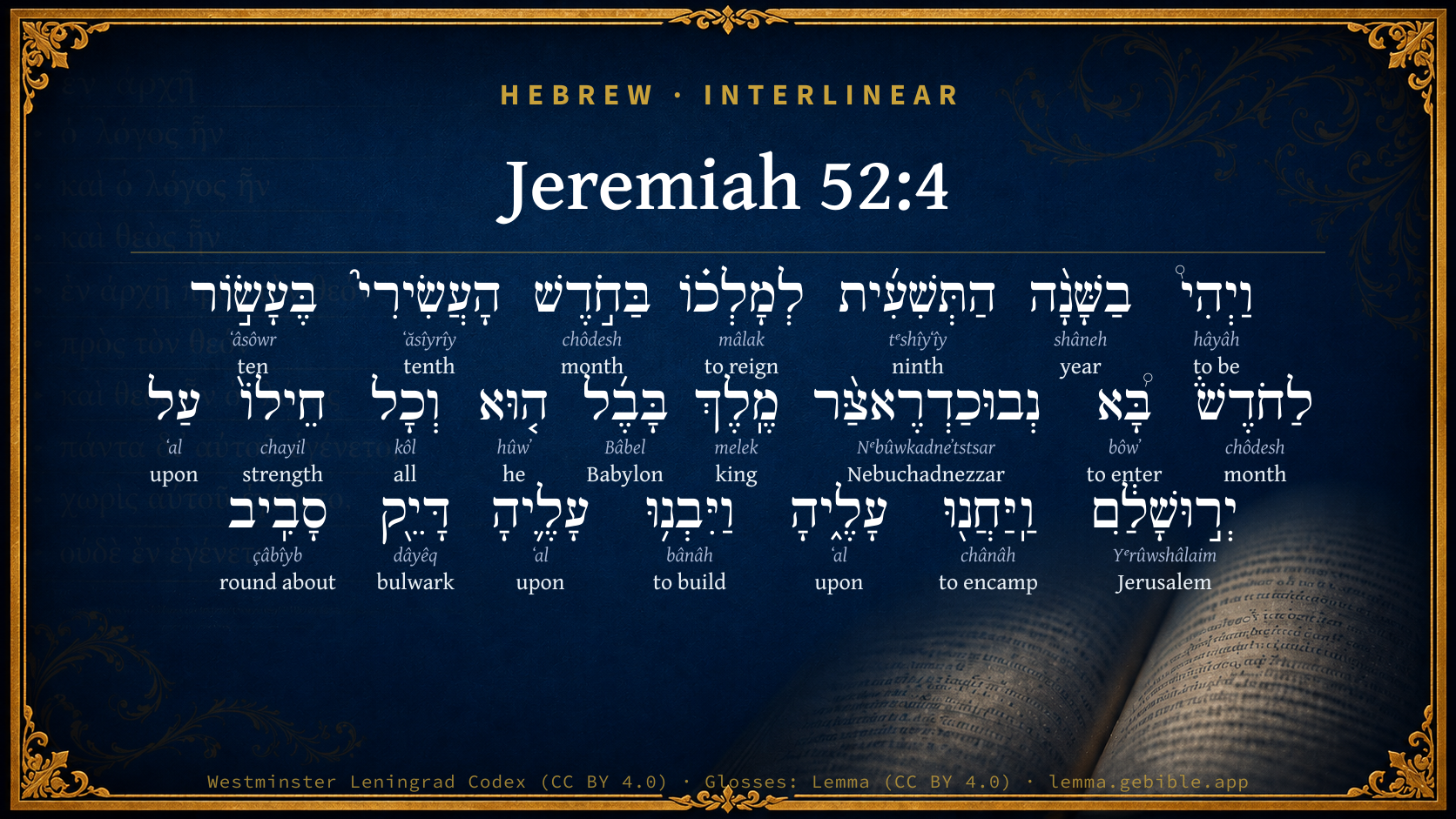
Jeremiah 52:4

Hebrew (Westminster Leningrad Codex) Jeremiah 52:4 appears in the Hebrew Old Testament. The text above is from the Westminster Leningrad Codex. Each word links to its Strong’s number, a concise gloss, and parsing drawn from the Open Scriptures Hebrew Bible morphology. Click any word for its full Brown-Driver-Briggs (BDB) entry.
Download image
Cite this verse

Jeremiah 52:4 (World English Bible). Public Domain. Lemma interlinear Bible study tool, https://lemma.gebible.app/v/jeremiah/52/4.

Show BibTeX & RIS
BibTeX
RIS
English Translation
It happened in the ninth year of his reign, in the tenth month, in the tenth day of the month, that Nebuchadrezzar king of Babylon came, he and all his army, against Jerusalem, and encamped against it; and they built forts against it round about.
World English Bible · Public Domain
Download a study sheet

One document with this verse’s original text, its word-by-word gloss line, the meaning frame, cross-references with their text, attributed commentary, and full source and license credits — printable, and it pastes into notes with its structure intact.

This verse Autodidact and up

Study sheet (.html) Plain text (.txt)

A passage Seminary Student

Up to 50 verses in one chapter. A passage sheet keeps up to 6 commentary sources and 12 cross-references per verse, in the order this page ranks them, and says so on the sheet whenever that leaves anything out. Ask for a single verse and you get the Autodidact verse sheet above.

Everything on this page stays free to read, with no account — the sheet is a download of what is already on screen, not access to it.

Want to remove ads? Support Godless Engineer
Compare translations 3

The same verse in 3 English versions, stacked beneath the original-language interlinear above. Click any original word for its lexicon entry.

Each is an independent rendering of the whole verse — the interlinear is not word-aligned to these translations.

Highlighted words mark where these versions differ — a whole-verse word diff, not a word-by-word alignment.

  • World English Bible Public Domain
    It happened in the ninth year of his reign, in the tenth month, in the tenth day of the month, that Nebuchadrezzar king of Babylon came, he and all his army, against Jerusalem, and encamped against it; and they built forts against it round about.
  • King James Version Public Domain
    And it came to pass in the ninth year of his reign, in the tenth month, in the tenth day of the month, that Nebuchadrezzar king of Babylon came, he and all his army, against Jerusalem, and pitched against it, and built forts against it round about.
  • unfoldingWord Literal Text CC BY-SA 4.0
    It happened that in the ninth year of the reign of King Zedekiah, in the tenth month, and on the tenth day of the month, Nebuchadnezzar, king of Babylon, came with all his army against Jerusalem. They camped opposite it, and they built a siege wall around it.

unfoldingWord Literal Text — © unfoldingWord, licensed CC BY-SA 4.0. Word-aligned USFM3 via Door43 (git.door43.org/unfoldingWord/en_ult).

Versions to compare (up to 4)

3 of 4 selected

Show all 18 translations

Every available English version of this verse, each an independent rendering of the whole verse.

  • World English Bible Public Domain
    It happened in the ninth year of his reign, in the tenth month, in the tenth day of the month, that Nebuchadrezzar king of Babylon came, he and all his army, against Jerusalem, and encamped against it; and they built forts against it round about.
  • Berean Standard Bible Public Domain
    So in the ninth year of Zedekiah’s reign, on the tenth day of the tenth month, Nebuchadnezzar king of Babylon marched against Jerusalem with his entire army. They encamped outside the city and built a siege wall all around it.
  • Majority Standard Bible Public Domain
    So in the ninth year of Zedekiah’s reign, on the tenth day of the tenth month, Nebuchadnezzar king of Babylon marched against Jerusalem with his entire army. They encamped outside the city and built a siege wall all around it.
  • King James Version Public Domain
    And it came to pass in the ninth year of his reign, in the tenth month, in the tenth day of the month, that Nebuchadrezzar king of Babylon came, he and all his army, against Jerusalem, and pitched against it, and built forts against it round about.
  • American Standard Version (1901) Public Domain
    And it came to pass in the ninth year of his reign, in the tenth month, in the tenth day of the month, that Nebuchadrezzar king of Babylon came, he and all his army, against Jerusalem, and encamped against it; and they built forts against it round about.
  • Revised Version (1885) Public Domain
    And it came to pass in the ninth year of his reign, in the tenth month, in the tenth day of the month, that Nebuchadrezzar king of Babylon came, he and all his army, against Jerusalem, and encamped against it; and they built forts against it round about.
  • Geneva Bible (1599) Public Domain
    But in the ninth yeere of his reigne, in the tenth moneth the tenth day of the moneth came Nebuchad-nezzar King of Babel, he and all his hoste against Ierusalem, and pitched against it, and buylt fortes against it round about.
  • Douay-Rheims (1899) Public Domain
    And it came to pass in the ninth year of his reign, in the tenth month, the tenth day of the month, that Nabuchodonosor the king of Babylon came, he and all his army, against Jerusalem, and they besieged it, and built forts against it round about.
  • Young's Literal Translation Public Domain
    And it cometh to pass, in the ninth year of his reign, in the tenth month, in the tenth of the month, come hath Nebuchadrezzar king of Babylon -- he and all his force -- against Jerusalem, and they encamp against it, and build against it a fortification round about;
  • Literal Standard Version CC BY-SA 4.0
    And it comes to pass, in the ninth year of his reign, in the tenth month, on the tenth of the month, Nebuchadnezzar king of Babylon has come—he and all his force—against Jerusalem, and they encamp against it, and build against it a fortification all around;
  • Unlocked Literal Bible CC BY-SA 4.0
    It happened that in the ninth year of the reign of King Zedekiah, in the tenth month, and on the tenth day of the month, Nebuchadnezzar, king of Babylon, came with all his army against Jerusalem. They camped opposite it, and they built a siege wall around it.
  • unfoldingWord Literal Text CC BY-SA 4.0
    It happened that in the ninth year of the reign of King Zedekiah, in the tenth month, and on the tenth day of the month, Nebuchadnezzar, king of Babylon, came with all his army against Jerusalem. They camped opposite it, and they built a siege wall around it.
  • Darby Bible Public Domain
    And it came to pass in the ninth year of his reign, in the tenth month, on the tenth of the month, [that] Nebuchadrezzar king of Babylon came, he and all his army, against Jerusalem; and they encamped against it, and built turrets against it round about.
  • World Messianic Bible Public Domain
    In the ninth year of his reign, in the tenth month, in the tenth day of the month, Nebuchadnezzar king of Babylon came, he and all his army, against Jerusalem, and encamped against it; and they built forts against it round about.
  • Webster's Bible Public Domain
    And it came to pass in the ninth year of his reign, in the tenth month, in the tenth day of the month, that Nebuchadrezzar king of Babylon came, he and all his army, against Jerusalem, and encamped against it, and built forts against it on every side.
  • Free Bible Version CC BY-SA 4.0
    In the ninth year of Zedekiah's reign, on the tenth day of the tenth month, Nebuchadnezzar, king of Babylon, attacked Jerusalem with his entire army. He set up camp around the city and built siege ramps against the walls.
  • Bible in Basic English Public Domain
    And in the ninth year of his rule, on the tenth day of the tenth month, Nebuchadrezzar, king of Babylon, came against Jerusalem with all his army and took up his position before it, building earthworks all round it.
  • JPS Tanakh (1917) Public Domain
    And it came to pass in the ninth year of his reign, in the tenth month, in the tenth day of the month, that Nebuchadrezzar king of Babylon came, he and all his army, against Jerusalem, and encamped against it; and they built forts against it round about.

Literal Standard Version (2020), Covenant Press — licensed CC BY-SA 4.0. Text via the HelloAO Bible API (eBible.org). Unlocked Literal Bible (unfoldingWord) — licensed CC BY-SA 4.0. Text via the HelloAO Bible API (eBible.org). unfoldingWord Literal Text — © unfoldingWord, licensed CC BY-SA 4.0. Word-aligned USFM3 via Door43 (git.door43.org/unfoldingWord/en_ult). Free Bible Version, Dr. Jonathan Gallagher — licensed CC BY-SA 4.0. Text via the HelloAO Bible API (eBible.org).

Word by word

More ways to search: Search by grammar → Find every occurrence → Compare this word →

Practice this passage: Drill this verse → Learn its vocabulary →

דָּיֵ֖ק
dâyêq
H1785
“bulwark”
Noun, Common, Masculine, Singular, Absolute
Part of Speech
Noun
Type
Common
Gender
Masculine
Number
Singular
State
Absolute
Full BDB Definition

Origin: from a root corresponding to H1751

TWOT: 417a

bulwark, siege-wall, sidewall
  1. וַיְהִי֩ hâyâh H1961 “and · to be” Conjunction + Verb, Qal, Sequential Imperfect, 3rd Person, Masculine, Singular
  2. בַשָּׁנָ֨ה shâneh H8141 “in/at the · year” Preposition, Determined + Noun, Common, Feminine, Singular, Absolute
  3. הַתְּשִׁעִ֜ית tᵉshîyʻîy H8671 “the · ninth” Particle, Definite Article + Adjective, Ordinal number, Feminine, Singular, Absolute
  4. לְמָלְכ֗וֹ mâlak H4427 “to reign · him” Preposition + Verb, Qal, Infinitive Construct + Suffix, Personal, 3rd Person, Masculine, Singular
  5. בַּחֹ֣דֶשׁ chôdesh H2320 “in/at the · month” Preposition, Determined + Noun, Common, Masculine, Singular, Absolute
  6. הָעֲשִׂירִי֮ ʻăsîyrîy H6224 “the · tenth” Particle, Definite Article + Adjective, Ordinal number, Masculine, Singular, Absolute
  7. בֶּעָשׂ֣וֹר ʻâsôwr H6218 “in/at the · ten” Preposition, Determined + Noun, Common, Masculine, Singular, Absolute
  8. לַחֹדֶשׁ֒ chôdesh H2320 “to/for the · month” Preposition, Determined + Noun, Common, Masculine, Singular, Absolute
  9. בָּ֠א bôwʼ H935 “to enter” Verb, Qal, Perfect, 3rd Person, Masculine, Singular
  10. נְבוּכַדְרֶאצַּ֨ר Nᵉbûwkadneʼtstsar H5019 “Nebuchadnezzar” Noun, Proper
  11. מֶֽלֶךְ melek H4428 “king of” Noun, Common, Masculine, Singular, Construct
  12. בָּבֶ֜ל Bâbel H894 “Babylon” Noun, Proper
  13. ה֤וּא hûwʼ H1931 “he” Pronoun, Personal, 3rd Person, Masculine, Singular
  14. וְכָל kôl H3605 “and · all of” Conjunction + Noun, Common, Masculine, Singular, Construct
  15. חֵילוֹ֙ chayil H2428 “strength · his” Noun, Common, Masculine, Singular, Construct + Suffix, Personal, 3rd Person, Masculine, Singular
  16. עַל ʻal H5921 “upon” Preposition
  17. יְר֣וּשָׁלִַ֔ם Yᵉrûwshâlaim H3389 “Jerusalem” Noun, Proper
  18. וַֽיַּחֲנ֖וּ chânâh H2583 “and · to encamp” Conjunction + Verb, Qal, Sequential Imperfect, 3rd Person, Masculine, Plural
  19. עָלֶ֑יהָ ʻal H5921 “upon · her” Preposition + Suffix, Personal, 3rd Person, Feminine, Singular
  20. וַיִּבְנ֥וּ bânâh H1129 “and · to build” Conjunction + Verb, Qal, Sequential Imperfect, 3rd Person, Masculine, Plural
  21. עָלֶ֛יהָ ʻal H5921 “upon · her” Preposition + Suffix, Personal, 3rd Person, Feminine, Singular
  22. סָבִֽיב çâbîyb H5439 “round about” Noun, Common, Both, Singular, Absolute

About this verse

These counts appear in no published source. They are computed here, from the morphology-tagged text and Lemma’s own curated glosses. What Lemma adds →

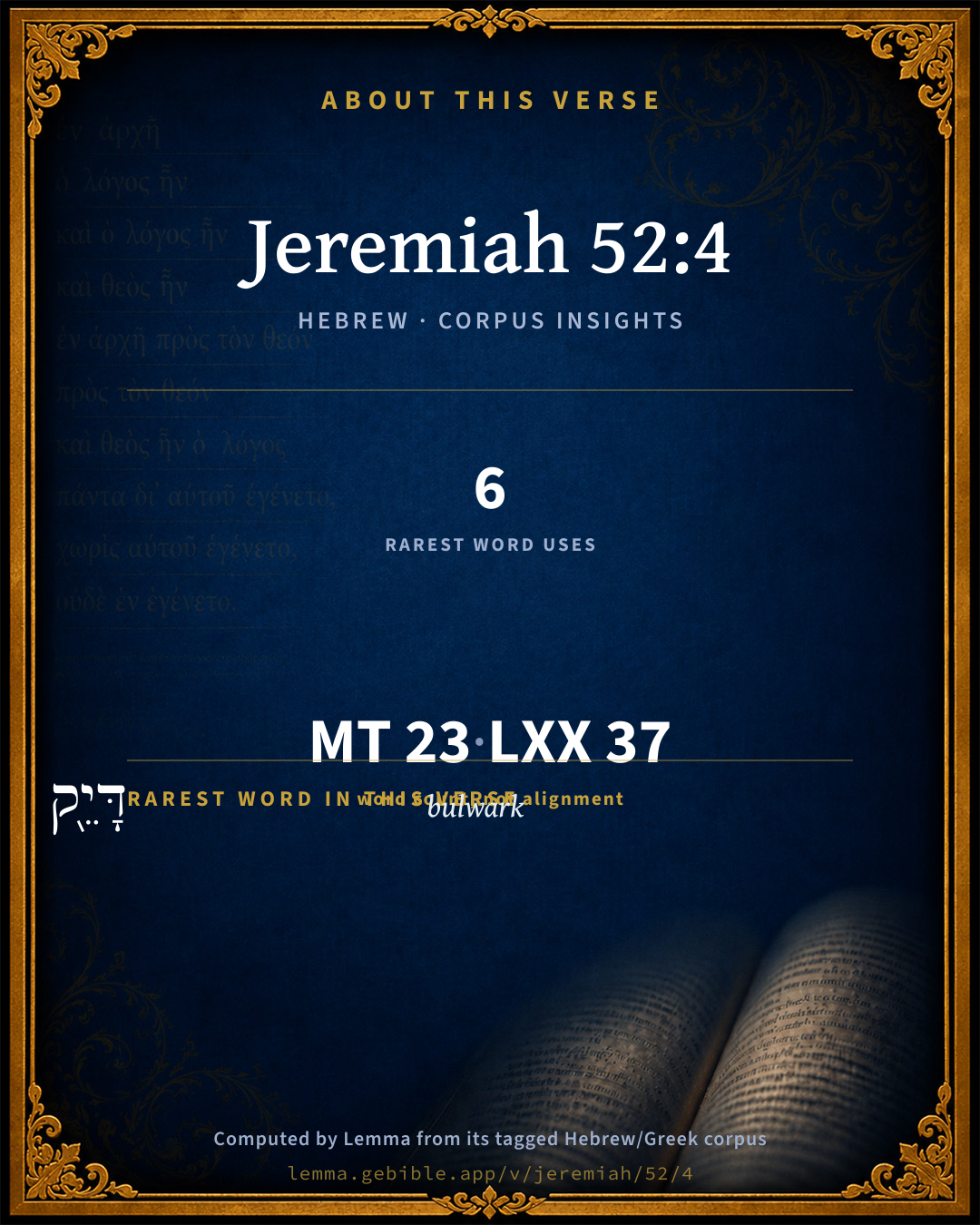
23
words
20
distinct lemmas
Prophets
section

Notable vocabulary

The rarest word here is דָּיֵ֖ק bulwark H1785 — appearing just 6 times in the whole Hebrew Bible.

Shared distinctive vocabulary

דָּיֵ֖ק bulwark H1785 occurs in 6 verses of the Hebrew Bible. Also found in:

Grammatical profile

  • 5 verbs
  • 12 nouns
  • 2 adjectives
  • 1 pronoun
  • 3 prepositions

Verb forms

  • וַיְהִי֩ Qal · Sequential Imperfect
  • לְמָלְכ֗וֹ Qal · Infinitive Construct
  • בָּ֠א Qal · Perfect
  • וַֽיַּחֲנ֖וּ Qal · Sequential Imperfect
  • וַיִּבְנ֥וּ Qal · Sequential Imperfect

Repetition

Words recur within this verse — often emphatic in Hebrew:

  • עַל upon H5921 ×3
  • בַּחֹ֣דֶשׁ month H2320 ×2

Hebrew & Septuagint length

In the original languages it is 23 Hebrew tokens and 37 Greek tokens — but the two are counted differently (Hebrew bundles its prefixes and suffixes into one token; the Greek is in lemma form), so that isn’t a like-for-like length.

Cross-references

15

Topical passages linked to Jeremiah 52:4 in the Treasury of Scripture Knowledge — connected by theme and wording, ordered by reader-vote popularity; previews shown in the World English Bible.

  • Jeremiah 39:1 It happened when Jerusalem was taken, (in the ninth year of Zedekiah king of Judah, in the tenth month, came Nebuchadrezzar king of Babylon and all his army against Jerusalem, and besieged it;
  • Ezekiel 24:1–2 Again, in the ninth year, in the tenth month, in the tenth [day] of the month, the word of Yahweh came to me, saying,
  • Zechariah 8:19 Thus says Yahweh of Hosts: "The fasts of the fourth fifth, seventh, and tenth months shall be for the house of Judah joy and gladness, and cheerful feasts. Therefore love truth and peace."
  • Jeremiah 32:24 Behold, the mounds, they are come to the city to take it; and the city is given into the hand of the Chaldeans who fight against it, because of the sword, and of the famine, and of the pestilence; and what you have spoken has happened; and, behold, you see it.
  • Jeremiah 52:7 Then a breach was made in the city, and all the men of war fled, and went forth out of the city by night by the way of the gate between the two walls, which was by the king's garden; (now the Chaldeans were against the city round about;) and they went toward the Arabah.
  • Leviticus 26:25 I will bring a sword upon you, that will execute the vengeance of the covenant; and you will be gathered together within your cities: and I will send the pestilence among you; and you will be delivered into the hand of the enemy.
  • Deuteronomy 28:52–57 They shall besiege you in all your gates, until your high and fortified walls come down, in which you trusted, throughout all your land; and they shall besiege you in all your gates throughout all your land, which Yahweh your God has given you.
  • 2 Kings 25:1–27 It happened in the ninth year of his reign, in the tenth month, in the tenth day of the month, that Nebuchadnezzar king of Babylon came, he and all his army, against Jerusalem, and encamped against it; and they built forts against it round about.
  • Isaiah 29:3 I will encamp against you round about, and will lay siege against you with posted troops, and I will raise siege works against you.
  • Isaiah 42:24–25 Who gave Jacob for a spoil, and Israel to the robbers? Didn't Yahweh? he against whom we have sinned, and in whose ways they would not walk, neither were they obedient to his law.
  • Jeremiah 6:3–6 Shepherds with their flocks shall come to her; they shall pitch their tents against her round about; they shall feed everyone in his place.
  • Ezekiel 4:1–7 You also, son of man, take a tile, and lay it before you, and portray on it a city, even Jerusalem:
  • Ezekiel 21:22 In his right hand was the divination [for] Jerusalem, to set battering rams, to open the mouth in the slaughter, to lift up the voice with shouting, to set battering rams against the gates, to cast up mounds, to build forts.
  • Luke 19:43 For the days will come on you, when your enemies will throw up a barricade against you, surround you, hem you in on every side,
  • Luke 21:20 "But when you see Jerusalem surrounded by armies, then know that its desolation is at hand.

Cross-references courtesy of OpenBible.info (CC BY 4.0).

Hebrew and Greek witnesses Masoretic Hebrew ↔ Greek Septuagint

The same verse in the two great witnesses to the Old Testament, shown verse-for-verse.

These are two independent witnesses, not word-aligned to each other, and the Septuagint is shown in lemma (dictionary) form.

Hebrew Jeremiah 52:4 Masoretic · Westminster Leningrad Codex

וַיְהִי֩ בַשָּׁנָ֨ה הַתְּשִׁעִ֜ית לְמָלְכ֗וֹ בַּחֹ֣דֶשׁ הָעֲשִׂירִי֮ בֶּעָשׂ֣וֹר לַחֹדֶשׁ֒ בָּ֠א נְבוּכַדְרֶאצַּ֨ר מֶֽלֶךְ בָּבֶ֜ל ה֤וּא וְכָל חֵילוֹ֙ עַל יְר֣וּשָׁלִַ֔ם וַֽיַּחֲנ֖וּ עָלֶ֑יהָ וַיִּבְנ֥וּ עָלֶ֛יהָ דָּיֵ֖ק סָבִֽיב

It happened in the ninth year of his reign, in the tenth month, in the tenth day of the month, that Nebuchadrezzar king of Babylon came, he and all his army, against Jerusalem, and encamped against it; and they built forts against it round about.

World English Bible · Public Domain

Greek LXX Structure differs

In the Septuagint, Jeremiah is about an eighth shorter than the Hebrew and arranges its material differently — the Oracles Against the Nations (Hebrew chapters 46–51) appear in the middle of the Greek book, after 25:13. Because the chapter and verse boundaries do not line up, a verse-for-verse comparison with the Hebrew is not shown.

A verse-for-verse comparison isn’t shown here because the chapters and verses don’t line up. Switch to the LXX edition with the MT / LXX toggle above to read the Greek directly.

Hebrew: Westminster Leningrad Codex (CC BY 4.0). Greek: Septuagint (public domain); English from a public-domain English Septuagint. How the Septuagint differs from the Hebrew →

Targum (Aramaic paraphrase)

1

The Targum is the ancient Jewish Aramaic paraphrase of the Hebrew Scriptures — an interpretive translation, not the Hebrew text itself. Onkelos (literal) and Pseudo-Jonathan (expansive) render the Torah, and Jonathan the Prophets. Coverage is partial: where no permissively-licensed English translation exists for a verse, only the Aramaic is shown. This is verse-level text, not a word-by-word alignment to the Hebrew.

  1. Targum Jonathan Prophets (Joshua–Malachi)
    וַהֲוָה בְשַׁתָּא תְּשִׁיעֵיתָא לְמִמְלְכֵהּ בְּיַרְחָא עֲשִׂירָאָה בְּעַשְׂרָא לְיַרְחָא אֲתָא נְבוּכַדְרֶאצַר מַלְכָּא דְבָבֶל הוּא וְכָל מַשְׁרִיָתֵיהּ עַל יְרוּשְׁלֵם וּשְׁרָא עֲלָהּ וּבְנוֹ עֲלָהּ כַּרְכּוּם סְחוֹר סְחוֹר:

    (no public-domain English translation for this verse)

    Targum Jonathan — Aramaic: “Mikraot Gedolot” (public domain). English: “Sefaria Community Translation” (CC0 1.0 (public-domain dedication)); “London "Chaldee Paraphrase," 1871” (public domain). Text via Sefaria.

Commentary

Notes on Jeremiah 52:4 from classic Christian and Jewish commentators (each source and its license shown beneath its notes). The classic Christian expositions comment on the surrounding passage and are grouped to its opening verse, so a note may address several verses; the Jewish commentaries on the Tanakh (Rashi and others) are per-verse, so they appear only where the commentator wrote on this verse.

Lemma curates 59 commentaries, every one of them public domain or Creative Commons licensed, each selected and text-cleaned for this edition rather than reprinted as found. About our sources →

Jamieson, Fausset & Brown

Robert Jamieson, A. R. Fausset & David Brown

forts--rather, towers of wood [KIMCHI], for watching the movements of the besieged from the height and annoying them with missiles.

Jamieson, Fausset & Brown — Commentary Critical and Explanatory on the Whole Bible (1871) — public domain (CC PDM 1.0). Text via the HelloAO Bible API.

Adam Clarke's Commentary

Verse 4. Ninth year - tenth month] Answering nearly to our January.

Adam Clarke's Commentary on the Bible (1810–1826) — public domain. Text from a community e-Sword/MySword module.

The Cambridge Bible for Schools and Colleges

gen. ed. J. J. S. Perowne

4. in the tenth month] Cp. Zec_8:19 for the memorial fast.

Nebuchadrezzar] the more accurate form of the name. See on ch. Jer_21:2.

forts] some kind of bulwarks, or siege-wall.

The Cambridge Bible for Schools and Colleges (gen. ed. J. J. S. Perowne; Cambridge University Press, 1878–1918) — public domain. Text from a community e-Sword module.

John Gill's Exposition

And it came to pass in the ninth year of his reign,.... Of Zedekiah's reign:

in the tenth month, in the tenth day of the month; the month Tebet, which answers to part of December and part of January; hence the fast of the tenth month, on account of the siege of Jerusalem, Zac 8:19;

that Nebuchadrezzar king of Babylon came, he, and all his army,

against Jerusalem; from whence it appears that he came in person with his army at first to Jerusalem; but, during the siege, or some part of it, retired to Riblah; perhaps upon the news of the king of Egypt's coming to the assistance of the Jews:

and pitched against it; or encamped against it:

and built forts against it round about; wooden towers, as Jarchi and Kimchi explain it; from whence they could shoot their arrows and cast their stones.

John Gill's Exposition of the Whole Bible (1746–1763) — public domain (CC PDM 1.0). Text via the HelloAO Bible API.

Whedon's Commentary on the Bible

Daniel D. Whedon

4. Nebuchadrezzar — A more ancient and correct form than Nebuchadnezzar.

Daniel D. Whedon (gen. ed.), Commentary on the Old and New Testaments (1874–1909) — public domain. Text from a community e-Sword module.

The Pulpit Commentary

Vers. 4-34. The march of doom.

These verses tell of the awful progress of the judgment of God on the doomed city of Jerusalem, her king, and people. To all who imagine that God is too full of love and graciousness to sternly judge and punish men, the contemplation of the events told of here may be painful, but assuredly they will be salutary also. We are shown the Babylonian armies gathering round the city; the long and dreadful siege; the gaunt famine that fastens upon the besieged; the walls broken at last and the inrush of the infuriated foe; the flight, capture, and tragedy of the king; the burning of the city and temple; and the carrying off into exile or slaughter of all but the poorest of the people. Ten weary years are covered by these events, and they were years full of lamentation, affliction, and woe. Now, all this teaches plainly

I THAT THE JUDGMENTS OF GOD ARE SLOW TO BEGIN. He is slow to anger. How long he bore with Judah and Jerusalem ere these tribulations came!

II BUT WHEN BEGUN THEY GO ON. What a procession of one calamity after another it is!

III THEY CANNOT BE ARRESTED OR TURNED ASIDE. All that endurance, courage, and skill could do was done in that memorable siege. Eze_7:6, "An evil, an only evil, behold, it is come," etc.

IV THE DISTRESS AND ANGUISH DEEPEN. (Cf. Eze 7 Eze 8 Eze 11 Lam_2:11, Lam_2:12, 19 4:4, etc.)

V THEY ARE RELENTLESS AND KNOW NO PITY. Prayers and entreaties are in vain. (cf. Pro_1:24-31)

VI THEY CEASE NOT FILL THEIR WORK IS DONE. See this history. The heart of the deceived evil doer protests that God cannot deal so. But he has dealt so with ungodly men, not once nor twice alone; and when he declares that he will again, of what avail is man"s mere protest that he will not? Cf. the whole Book of the Revelation. How loudly, therefore, do facts like these cry out to the sinner, "Flee from the wrath to come"! C.

Vers. 4, 6, 12. Days whose duties are indelible.

Note the particularity of the dates given in each of these verses. Not the year only, but the month; and not the month only, but the day; and sometimes not the day only, but the hour, whether morning or evening, during the light or dark. Now

I THERE ARE SUCH DAYS. In the record of the Flood we have such exactness of date. And in the later history of Jerusalem, the story of its decline and fall under its last kings, we again and again, as in this chapter, meet with such careful giving of exact dates. And in our own experience, looking back over the record of our lives, how vividly some dates stand out! We know the year, the month, the day, and hour, and it seems likely that we shall never forget them nor the events connected with them.

II BUT THESE DAYS ARE NEARLY ALWAYS DAYS OF PAIN AND DISTRESS. It was so in the instances given in these verses. There are anniversaries which we keep, but these are for the most part joyous days, the memory of which we will not willingly let die. But the fact of our keeping them shows that there is probability that such memory would die if we did not carefully keep it up. But the days whose dates are indelible need no anniversaries to remind us of them. We cannot forget them, though, perhaps, we would fain do so. They are burnt in upon our souls so deeply that they are written as on a rock forever. And they are days, not of joy, but of sore distress; as when first the fierce Babylonian forces beleaguered the holy city, and as when after weary months of obstinate defence the awful famine at length broke them down; and as when the proud conqueror in his rage burned down the sanctuary of God. Days of judgment were they, never to be forgotten by Israel any more. And there were many such days. We read of the "fasts" of the different months, many of which commemorated these sad events.

III AND THEIR DATES ARE INDELIBLY WRITTEN IN OUR SOULS.

1. Because of the contrast which they offer to well nigh all other days. If any mark stands out conspicuous like the black marks on a white page, or white on black it proves that the ground upon which such mark stands out so conspicuously is of an entirely opposite colour, a complete contrast. And so the very blackness of these indelible days proves that the days against which they stand out so conspicuously have been of a far other and happier kind. Our very trials, by the vividness with which we remember them, prove the general goodness of our God, because they are such exception to his rule.

2. Because of their intensity. The mark is not merely dark, but deep. The sword pierces through the soul. It is the intensity of the pain that makes it so memorable.

3. Because of the shadow they cast. All our after life may be darkened it often is so by the effect of some awful blow, and the shadow ever starts from and guides our thoughts up to the terrible fact which has caused it.

IV BUT THESE DATES ARE NOT INDELIBLE FOREVER. Cf. our Lord"s illustration: "A woman when she is in travail hath sorrow,... but as soon as she is delivered... she remembereth no more the anguish, for joy." So it is oftentimes even in this world. Life would not be bearable were all sorrows indelible. But they are not. The lapse of time, the pressure of necessary work, the awakening of other interests, and, above all, the bestowment of new joys all tend to scatter the gloom of the soul and to thrust into oblivion memories that could only give pain. And none of them shall follow us into our eternal home. We shall not it does not appear possible forget facts that have occurred, but we shall see them in such new lights and irradiated by such love of God that all the pain that belonged to them will depart and be seen no more. "Help, Lord, that we may come To thy saints" happy home. Where a thousand years As one day appears; Nor go Where one day appears As a thousand years For woe! C.

The Pulpit Commentary (1880–1919), ed. H.D.M. Spence-Jones & Joseph S. Exell — public domain. Text from a community e-Sword module.

Scofield Reference Notes

C. I. Scofield

tenth month

i.e. January.

The Scofield Reference Bible (1917 edition), notes by C. I. Scofield — public domain. Text from a community e-Sword module.

unfoldingWord translationNotes

Door43 World Missions Community

It happened

This phrase is used here to mark the beginning of a new part of the story.

in the ninth year of the reign of King Zedekiah, in the tenth month, and on the tenth day of the month

after Zedekiah had been king for eight years, in the tenth calendar month, on the tenth day of the month (See: Ordinal Numbers)

in the ninth year

"in year nine" (See: Ordinal Numbers)

in the tenth month, and on the tenth day of the month

This is the tenth month of the Hebrew calendar. The tenth day is near the beginning of January on Western calendars. (See: Hebrew Months and Ordinal Numbers)

They camped opposite it

"Nebuchadnezzar's army camped opposite Jerusalem"

until the eleventh year of King Zedekiah's reign

until Zedekiah had been king for more than ten years (See: Ordinal Numbers)

eleventh year

"year eleven" (See: Ordinal Numbers)

it. So the city was besieged

This can be translated in active form. AT: "it, and they besieged the city" (See: Active or Passive)

translationWords

year

day

Nebuchadnezzar

siege

unfoldingWord translationNotes — © Distant Shores Media and the Door43 World Missions Community, licensed CC BY-SA 4.0. Source: git.door43.org/Door43/en_tn.

Lesson kit

Teaching starters — assembled from the data on this page, not authored interpretation. Every prompt links to the verse data it draws on. Edit before teaching.

Jeremiah, in the Prophets, opens this verse with 23 words (20 distinct Hebrew lemmas). Its most distinctive word is dâyêq (“bulwark”). A historical commentator’s framing appears above. Read the whole chapter for the surrounding context.

Discussion questions

  1. How does “bulwark” (dâyêq) shape what this verse is saying?
  2. 2 Kings 25:1 shares the word «bulwark» with this verse. How do the two illuminate each other?
  3. “upon” occurs 3× in this one verse. What is the effect of the repetition?
  4. The translations on this page render this verse differently — a whole-verse word diff, not a word-by-word alignment. What might account for the different wordings?
  5. The verb «וַיְהִי֩» is Qal Sequential Imperfect. How does its form color the action?
  6. Reading how Jamieson, Fausset & Brown and Adam Clarke's Commentary read this verse, where do the two commentators agree and where do they part?

Things to notice

Reading settings

Reading text

Shown beneath each verse's original-language words.

Old Testament
Old Testament edition

Read the OT as the Masoretic Hebrew (MT) or the Greek Septuagint (LXX).

English shown for the Greek Septuagint (in the Hebrew ↔ Greek comparison).

Comparing translations? Open the Compare panel on any verse page to stack up to four side by side.