Genesis 34:29

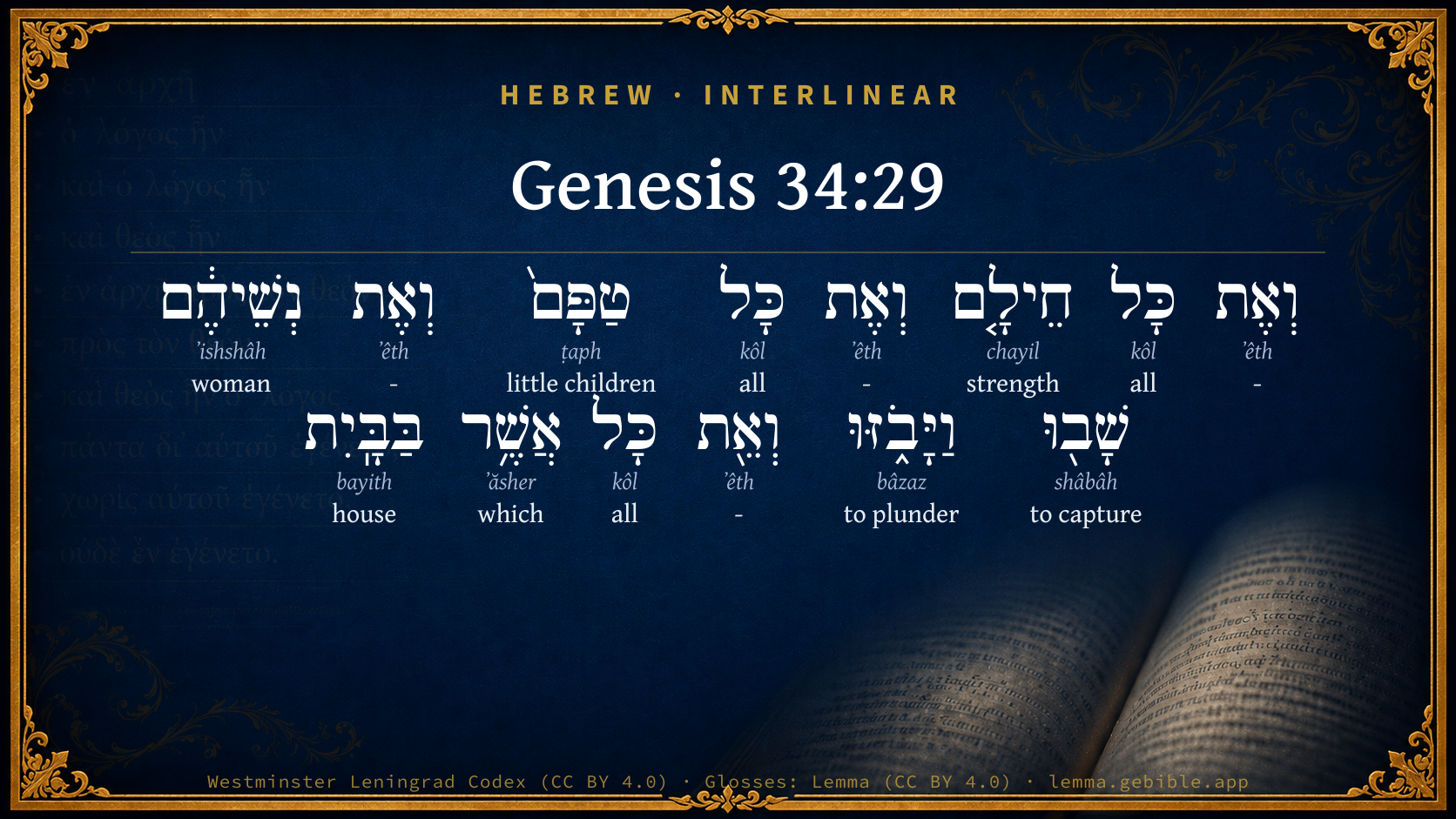
Hebrew (Westminster Leningrad Codex) Genesis 34:29 appears in the Hebrew Old Testament. The text above is from the Westminster Leningrad Codex. Each word links to its Strong’s number, a concise gloss, and parsing drawn from the Open Scriptures Hebrew Bible morphology. Click any word for its full Brown-Driver-Briggs (BDB) entry.
Download image
Cite this verse

Genesis 34:29 (World English Bible). Public Domain. Lemma interlinear Bible study tool, https://lemma.gebible.app/v/genesis/34/29.

Show BibTeX & RIS
BibTeX
RIS
English Translation
and all their wealth. They took captive all their little ones and their wives, and took as plunder everything that was in the house.
World English Bible · Public Domain
Highlights Full analysis ↓
Download a study sheet

One document with this verse’s original text, its word-by-word gloss line, the meaning frame, cross-references with their text, attributed commentary, and full source and license credits — printable, and it pastes into notes with its structure intact.

This verse Autodidact and up

Study sheet (.html) Plain text (.txt)

A passage Seminary Student

Up to 50 verses in one chapter. A passage sheet keeps up to 6 commentary sources and 12 cross-references per verse, in the order this page ranks them, and says so on the sheet whenever that leaves anything out. Ask for a single verse and you get the Autodidact verse sheet above.

Everything on this page stays free to read, with no account — the sheet is a download of what is already on screen, not access to it.

Want to remove ads? Support Godless Engineer
Compare translations 3

The same verse in 3 English versions, stacked beneath the original-language interlinear above. Click any original word for its lexicon entry.

Each is an independent rendering of the whole verse — the interlinear is not word-aligned to these translations.

Highlighted words mark where these versions differ — a whole-verse word diff, not a word-by-word alignment.

  • World English Bible Public Domain
    and all their wealth. They took captive all their little ones and their wives, and took as plunder everything that was in the house.
  • King James Version Public Domain
    And all their wealth, and all their little ones, and their wives took they captive, and spoiled even all that was in the house.
  • unfoldingWord Literal Text CC BY-SA 4.0
    And all their wealth and all their little ones and their women they took captive, and they also plundered everything that in the houses.

unfoldingWord Literal Text — © unfoldingWord, licensed CC BY-SA 4.0. Word-aligned USFM3 via Door43 (git.door43.org/unfoldingWord/en_ult).

Versions to compare (up to 4)

3 of 4 selected

Show all 18 translations

Every available English version of this verse, each an independent rendering of the whole verse.

  • World English Bible Public Domain
    and all their wealth. They took captive all their little ones and their wives, and took as plunder everything that was in the house.
  • Berean Standard Bible Public Domain
    They carried off all their possessions and women and children, and they plundered everything in their houses.
  • Majority Standard Bible Public Domain
    They carried off all their possessions and women and children, and they plundered everything in their houses.
  • King James Version Public Domain
    And all their wealth, and all their little ones, and their wives took they captive, and spoiled even all that was in the house.
  • American Standard Version (1901) Public Domain
    and all their wealth, and all their little ones and their wives, took they captive and made a prey, even all that was in the house.
  • Revised Version (1885) Public Domain
    and all their wealth, and all their little ones and their wives, took they captive and spoiled, even all that was in the house.
  • Geneva Bible (1599) Public Domain
    Also they caryed away captiue and spoyled all their goods, and all their children and their wiues, and all that was in the houses.
  • Douay-Rheims (1899) Public Domain
    and their children and wives they took captive,
  • Young's Literal Translation Public Domain
    and all their wealth, and all their infants, and their wives they have taken captive, and they spoil also all that `is' in the house.
  • Literal Standard Version CC BY-SA 4.0
    and all their wealth, and all their infants, and their wives they have taken captive, and they spoil also all that [is] in the house.
  • Unlocked Literal Bible CC BY-SA 4.0
    all their wealth. All their children and their wives, they captured. They even took everything that was in the houses.
  • unfoldingWord Literal Text CC BY-SA 4.0
    And all their wealth and all their little ones and their women they took captive, and they also plundered everything that in the houses.
  • Darby Bible Public Domain
    and all their goods, and all their little ones, and their wives took they captive, and plundered them, and all that was in the houses.
  • World Messianic Bible Public Domain
    and all their wealth. They took captive all their little ones and their wives, and took as plunder everything that was in the house.
  • Webster's Bible Public Domain
    And all their wealth, and all their little ones, and their wives they took captive, and spoiled even all that was in the house.
  • Free Bible Version CC BY-SA 4.0
    all their possessions. They captured all their women and children, and plundered everything in their homes.
  • Bible in Basic English Public Domain
    And all their wealth and all their little ones and their wives; everything in their houses they took and made them waste.
  • JPS Tanakh (1917) Public Domain
    and all their wealth, and all their little ones and their wives, took they captive and spoiled, even all that was in the house.

Literal Standard Version (2020), Covenant Press — licensed CC BY-SA 4.0. Text via the HelloAO Bible API (eBible.org). Unlocked Literal Bible (unfoldingWord) — licensed CC BY-SA 4.0. Text via the HelloAO Bible API (eBible.org). unfoldingWord Literal Text — © unfoldingWord, licensed CC BY-SA 4.0. Word-aligned USFM3 via Door43 (git.door43.org/unfoldingWord/en_ult). Free Bible Version, Dr. Jonathan Gallagher — licensed CC BY-SA 4.0. Text via the HelloAO Bible API (eBible.org).

Word by word

More ways to search: Search by grammar → Find every occurrence → Compare this word →

Practice this passage: Drill this verse → Learn its vocabulary →

טַפָּם֙
ṭaph
H2945
“little children · their”
Noun, Common, Masculine, Singular, Construct + Suffix, Personal, 3rd Person, Masculine, Plural
Part of Speech
Noun
Type
Common
Gender
Masculine
Number
Singular
State
Construct
Full BDB Definition

Origin: from H2952 (perhaps referring to the tripping gait of children)

TWOT: 821a

children, little children, little ones
  1. וְאֶת ʼêth H853 “and · -” Conjunction + Particle, Direct Object
  2. כָּל kôl H3605 “all of” Noun, Common, Masculine, Singular, Construct
  3. חֵילָ֤ם chayil H2428 “strength · their” Noun, Common, Masculine, Singular, Construct + Suffix, Personal, 3rd Person, Masculine, Plural
  4. וְאֶת ʼêth H853 “and · -” Conjunction + Particle, Direct Object
  5. כָּל kôl H3605 “all of” Noun, Common, Masculine, Singular, Construct
  6. וְאֶת ʼêth H853 “and · -” Conjunction + Particle, Direct Object
  7. נְשֵׁיהֶ֔ם ʼishshâh H802 “women · their” Noun, Common, Feminine, Plural, Construct + Suffix, Personal, 3rd Person, Masculine, Plural
  8. שָׁב֖וּ shâbâh H7617 “to capture” Verb, Qal, Perfect, 3rd Person, Common, Plural
  9. וַיָּבֹ֑זּוּ bâzaz H962 “and · to plunder” Conjunction + Verb, Qal, Sequential Imperfect, 3rd Person, Masculine, Plural
  10. וְאֵ֖ת ʼêth H853 “and · -” Conjunction + Particle, Direct Object
  11. כָּל kôl H3605 “all of” Noun, Common, Masculine, Singular, Construct
  12. אֲשֶׁ֥ר ʼăsher H834 “which” Particle, Relative
  13. בַּבָּֽיִת bayith H1004 “in/at the · house” Preposition, Determined + Noun, Common, Masculine, Singular, Absolute

About this verse

These counts appear in no published source. They are computed here, from the morphology-tagged text and Lemma’s own curated glosses. What Lemma adds →

14
words
9
distinct lemmas
Pentateuch
section

First appearance in Scripture

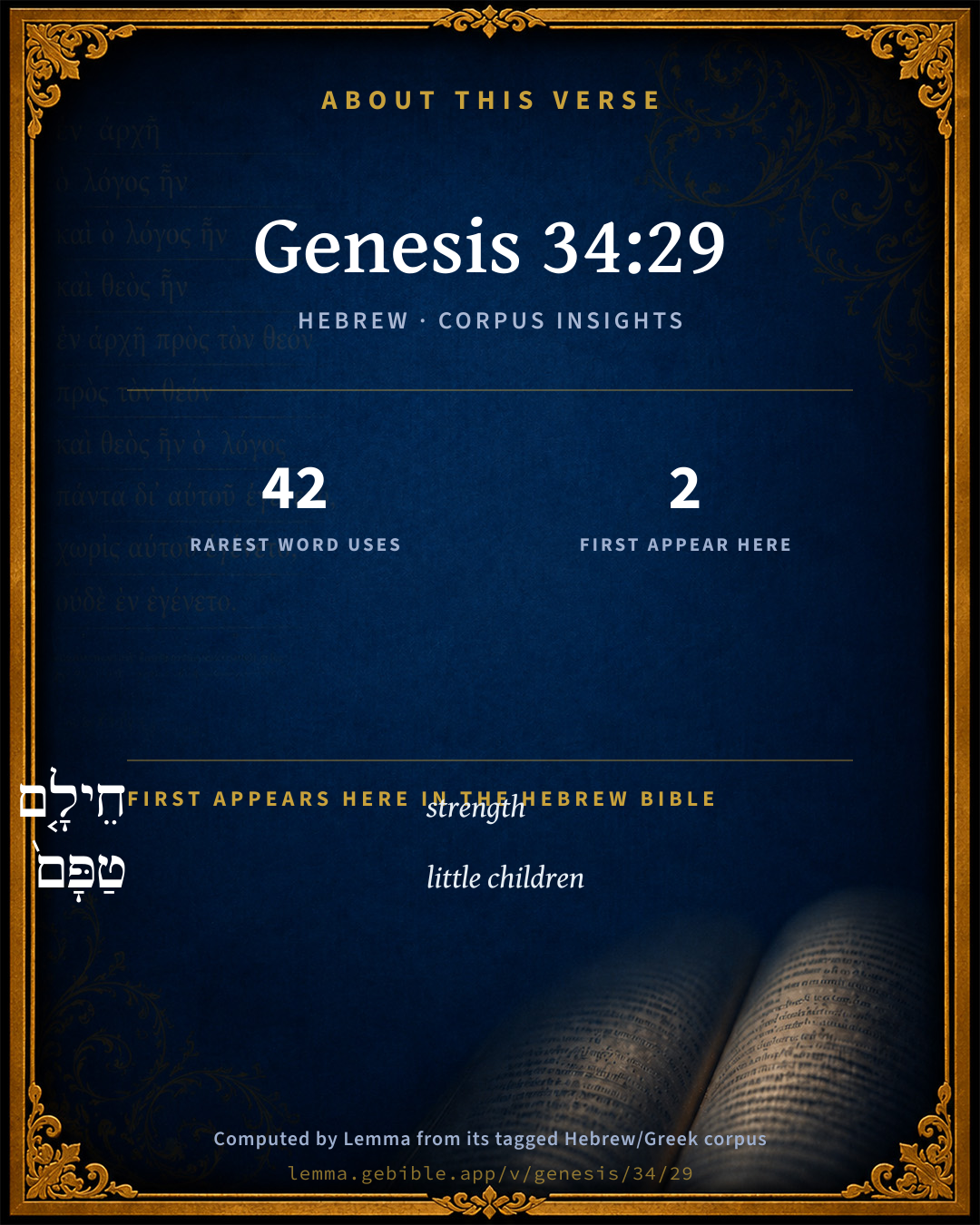
These words make their first canonical appearance in the Hebrew Bible here:

  • חֵילָ֤ם strength H2428
  • טַפָּם֙ little children H2945

Shared distinctive vocabulary

טַפָּם֙ little children H2945 occurs in 42 verses of the Hebrew Bible. Also found in:

Grammatical profile

  • 2 verbs
  • 7 nouns
  • 5 particles

Verb forms

  • שָׁב֖וּ Qal · Perfect
  • וַיָּבֹ֑זּוּ Qal · Sequential Imperfect

Repetition

A word recurs within this verse — often emphatic in Hebrew:

Hebrew & Septuagint length

In English translation the verse runs 24 words from the Hebrew and 34 from the Septuagint (LXX English) — the Septuagint runs noticeably longer here. See the side-by-side →

A rough comparison of the two English renderings, which tokenize alike — not a word-level alignment.

Word counts can differ between the Hebrew and the Greek without any difference in meaning — e.g. the Hebrew direct-object marker אֵת has no separate Greek word, and Greek often adds the article ὁ.

Hebrew and Greek witnesses Masoretic Hebrew ↔ Greek Septuagint

The same verse in the two great witnesses to the Old Testament, shown verse-for-verse.

Here the Septuagint runs noticeably longer than the Hebrew — LXX2012 (modern English Septuagint) 34 words vs World English Bible 24. A rough length comparison of the two English translations, not a word-level alignment — read both below.

These are two independent witnesses, not word-aligned to each other, and the Septuagint is shown in lemma (dictionary) form.

Hebrew Genesis 34:29 Masoretic · Westminster Leningrad Codex

וְאֶת כָּל חֵילָ֤ם וְאֶת כָּל טַפָּם֙ וְאֶת נְשֵׁיהֶ֔ם שָׁב֖וּ וַיָּבֹ֑זּוּ וְאֵ֖ת כָּל אֲשֶׁ֥ר בַּבָּֽיִת

and all their wealth. They took captive all their little ones and their wives, and took as plunder everything that was in the house.

World English Bible · Public Domain

Greek LXX Genesis 34:29 Septuagint · lemma form

καί πᾶς ὁ σῶμα αὐτός καί πᾶς ὁ ἀποσκευή αὐτός καί ὁ γυνή αὐτός αἰχμαλωτεύω καί διαἁρπάζω ὅσος τε εἰμί ἐν ὁ πόλις καί ὅσος εἰμί ἐν ὁ οἰκία

And they took captive all the persons of them, and all their store, and their wives, and plundered both whatever things there were in the city, and whatever things there were in the houses.

LXX2012 (modern English Septuagint) · Public Domain

On this verse, Ellicott's Commentary for English Readers discusses the Septuagint’s reading. Read the note in Commentary ↓

Hebrew: Westminster Leningrad Codex (CC BY 4.0). Greek: Septuagint (public domain); English from LXX2012 (modern English Septuagint) (Public Domain). How the Septuagint differs from the Hebrew →

Targum (Aramaic paraphrase)

2

The Targum is the ancient Jewish Aramaic paraphrase of the Hebrew Scriptures — an interpretive translation, not the Hebrew text itself. Onkelos (literal) and Pseudo-Jonathan (expansive) render the Torah, and Jonathan the Prophets. Coverage is partial: where no permissively-licensed English translation exists for a verse, only the Aramaic is shown. This is verse-level text, not a word-by-word alignment to the Hebrew.

  1. Targum Onkelos Torah (Genesis–Deuteronomy)
    וְיָת כָּל נִכְסֵיהוֹן וְיָת כָּל טַפְלְהוֹן וְיָת נְשֵׁיהוֹן שְׁבוֹ וּבְזוֹ וְיָת כָּל דִּי בְבֵיתָא

    (no public-domain English translation for this verse)

    Targum Onkelos — Aramaic: “Onkelos Genesis” (public domain); “Onkelos Exodus” (public domain); “Onkelos Leviticus” (public domain); “Onkelos Numbers” (public domain); “Onkelos Deuteronomy” (public domain). English: “Sefaria Community Translation” (CC0 1.0 (public-domain dedication)); “J.W. Etheridge. The Targums of Onkelos and Jonathan Ben Uzziel on the Pentateuch. London: Longmans, Green, 1862” (public domain). Text via Sefaria.

  2. Targum Pseudo-Jonathan Torah (Genesis–Deuteronomy)
    וְיַת כָּל נִכְסֵיהוֹן וְיַת כָּל טַפְלֵיהוֹן וְיַת נְשֵׁיהוֹם שְׁבוּ וּבָזוּ וְיַת כָּל דִבְבֵיתָא

    and all their wealth and all their little ones they took and spoiled, and all that was in the houses.

    Targum Pseudo-Jonathan — Aramaic: “Targum Jonathan on Genesis” (public domain); “Targum Jonathan on Exodus” (public domain); “Targum Jonathan on Leviticus” (public domain); “Targum Jonathan on Numbers” (public domain); “Targum Jonathan on Deuteronomy” (public domain). English: “The Targum of Jonathan ben Uzziel, trans. J. W. Etheridge, London, 1862” (public domain). Text via Sefaria.

Commentary

Notes on Genesis 34:29 from classic Christian and Jewish commentators (each source and its license shown beneath its notes). The classic Christian expositions comment on the surrounding passage and are grouped to its opening verse, so a note may address several verses; the Jewish commentaries on the Tanakh (Rashi and others) are per-verse, so they appear only where the commentator wrote on this verse.

Lemma curates 59 commentaries, every one of them public domain or Creative Commons licensed, each selected and text-cleaned for this edition rather than reprinted as found. About our sources →

Trapp's Complete Commentary

John Trapp

Gen 34:29 And all their wealth, and all their little ones, and their wives took they captive, and spoiled even all that [was] in the house.

Ver. 29. And all their wealth,] Or, Power: for in a man’s wealth is his power; yea, it is his "tower of strength," {Pro 18:11} and so much he is valued at, as he is able to disburse. {See Trapp on "Gen 31:1"}

And spoiled even all that was in the house.] So dealt Minerius at Merindol; Charles V, at Magdeburg; the bloody Papists, at the Parisian massacre. But when the Lord came to "make inquisition for blood, he remembered them." {Psa 9:12} He drew articles of inquiry against them, as strict, and as critical, as ever the Spanish Inquisition; and dealt with them accordingly. Cambyses lighting off his horse, after he had been showing great cruelty to them of Athens, his sword flew out of the scabbard, and slew him. {a} If these brethren in iniquity sped better, they may thank a good God, whose terror fell upon the adjacent cities. For they did enough to undo, not themselves only, but their father, and his whole family. It was good counsel to such, that Tertullian gives to bloody Scapula; Si nobis non parcis, tibi parce: si non tibi, Carthagini: See thou undo not thyself and thy city by thy cruelty to Christians.

{a} Justin.

John Trapp, A Commentary or Exposition upon All the Books of the Old and New Testament (1647–1656) — public domain. Text from a community e-Sword module.

Joseph Benson's Commentary

Gen 34:29. Their little ones and their wives took they captive — No mention is made of these captives afterward: nor is it easy to conjecture what became of them. Perhaps the most probable supposition is, that Jacob restored both them and the property taken by his sons to their surviving relatives and countrymen.

Joseph Benson's Commentary on the Old and New Testaments (1811–1818) — public domain. Text from a community e-Sword module.

Ellicott's Commentary for English Readers

(29) Their little ones.—Heb., their taf. (See Note on Gen_17:13.) How erroneous is the translation “little-ones” may be seen from Num_31:17-18, which in the Heb. is, “Now, therefore, kill every male in the taf . . . and all the taf of women that are unmarried.” It would be monstrous to suppose that boys were to be put to death, and men escape, nor would little girls be likely to be married. In 2Ch_31:18 the taf is distinguished both from the sons and daughters; and so also in Gen_20:13, where we read “their tafs and their children. The LXX. have altered the order here, but otherwise translate correctly their persons, that is, their property in men-servants and maid servants, as opposed to their cattle and their wealth in goods. In Gen_1:8 the LXX. translate clan, and in Gen_34:21 household. The slaves thus seized would form the most valuable part probably of the spoil.

A Bible Commentary for English Readers, edited by Charles John Ellicott (1878–1897) — public domain. Text from a community e-Sword module.

John Gill's Exposition

And Jacob said to Simeon and Levi,.... who were the principals concerned in this affair:

ye have troubled me; because of the sin they had committed, because of the dishonour brought upon religion, and because of the danger he and his family were hereby exposed unto; it greatly disquieted him, made him very uneasy, he was at his wit's end almost, knew not what to do, what course to take to wipe off the scandal, and to defend himself and family; since it served, he says:

to make me to stink among the inhabitants of the land; to make him odious and abominable, to be hated and abhorred by all the people round about, and to be looked upon and treated as a deceitful, treacherous, and perfidious man, that had no regard to his word, to covenants and agreements made by him; as a cruel and bloodthirsty man that spared none, made no difference between the innocent and the guilty; and as a robber and plunderer, that stopped at nothing, committing the greatest outrages to get possession of the substance of others:

amongst the Canaanites and the Perizzites: who were the principal inhabitants of the land, the most numerous, and the most rustic and barbarous, and perhaps nearest, and from whom Jacob had most to fear:

and I being few in number; or men of number (p); he and his sons and servants, in all, making but a small number in comparison of the nations about him:

they shall gather themselves together against me, and slay me; and I shall be destroyed, I and my house; not that Jacob was afraid that this would be really the case, for he knew and believed the promises of God to him, of the multiplication of his seed, and of their inheriting the land of Canaan, and of the Messiah springing from him; but this he said to aggravate the sin and folly of his sons, in exposing him and themselves to so much danger, which not only on the face of things appeared probable, but even certain and inevitable, without the interposition of divine power and Providence.

(p) "viri numeri", Montanus, Schmidt.

John Gill's Exposition of the Whole Bible (1746–1763) — public domain (CC PDM 1.0). Text via the HelloAO Bible API.

Haydock's Catholic Bible Commentary

Captive. No doubt Jacob would force them to restore such ill-gotten goods. (Calmet) --- They had acted without authority, and even contrary to the known disposition of their father. They rashly exposed him to destruction, which would inevitably have taken place, if God had not protected him, chap. xxxv. 5. (Haydock)

George Leo Haydock (1774–1849), Haydock's Catholic Family Bible and Commentary, 1859 edition — public domain. Excludes Psalms (Douay-Rheims chapter numbering differs from Protestant) and Deuterocanonical books (Catholic canon only).

Matthew Poole's English Annotations

Either in the prince’s house, or in their several houses; or within doors, as the word signifies.

Matthew Poole's English Annotations on the Holy Bible (1683–1685) — public domain. Text from a community e-Sword/MySword module.

Rashi

Rabbi Shlomo Yitzchaki (Rashi)

חילם means THEIR WEALTH. Examples are: (Deuteronomy 8:17) “hath gotten me this (חיל) wealth”; (Numbers 19:18) “and Israel acquireth (חיל) wealth”; (Psalms 49:11) “and they leave (חילם) their wealth to others”.

שבו has the meaning of taking captive (i.e. it is the Kal. perfect, 3rd pl. of the root שבה and means “they took captive”), and therefore it is accented on the last syllable (whereas שָׁבוּ, accented on the first syllable, is the same form of the verb שוב and means “they returned”).

Rashi on the Tanakh — English translations: “The Judaica Press complete Tanach with Rashi, translated by A. J. Rosenberg” (CC BY 4.0); “Pentateuch with Rashi's commentary by M. Rosenbaum and A.M. Silbermann, 1929-1934” (public domain); “The Metsudah Tanach series, Lakewood, N.J” (CC BY 4.0); and “The Book of Joshua, Metsudah Publications, 1997” (CC BY 4.0). Text via Sefaria.

Radak

Rabbi David Kimhi (Radak)

ואת כל חילם, silver, gold, and precious stones.

ואת כל אשר בבית, chattels. The word בבית is a general term, a place where most chattels are kept.

Radak on the Tanakh — English translations: “Sefaria Community Translation” (CC0 1.0 (public-domain dedication)); “Eliyahu Munk, HaChut Hameshulash” (CC BY 4.0); “Rabbi Mike Feuer, Jerusalem Anthology” (CC BY 4.0); and “R. David Kimhi on the first book of Psalms, Translated by R.G. Finch, London, 1919” (public domain). Text via Sefaria.

Lesson kit

Teaching starters — assembled from the data on this page, not authored interpretation. Every prompt links to the verse data it draws on. Edit before teaching.

Genesis, in the Pentateuch, opens this verse with 14 words (9 distinct Hebrew lemmas). Its most distinctive word is ṭaph (“little children”). The Greek Septuagint runs longer here. A historical commentator’s framing appears above. Read the whole chapter for the surrounding context.

Discussion questions

  1. The word ṭaph carries the sense “little children.” How does it shape the verse?
  2. 2 words here appear for the first time in Scripture. What is being introduced at this debut?
  3. Genesis 43:8 shares the word «little children» with this verse. How do the two illuminate each other?
  4. “all” occurs 3× in this one verse. What is the effect of the repetition?
  5. Compared with the Hebrew, the Septuagint runs longer here. What questions does that raise?
  6. These translations render this verse differently; the difference is in the English rendering, not the original. What questions does that raise?
  7. The verb «שָׁב֖וּ» is Qal Perfect. How does its form color the action?
  8. Reading how Trapp's Complete Commentary and Joseph Benson's Commentary read this verse, where do the two commentators agree and where do they part?

Things to notice

  • 2 words make their first canonical appearance in Scripture here.
  • These translations choose different wording for 10 words in this verse.
  • “all” occurs 3× in this single verse.
  • 9 distinct Hebrew lemmas span 14 words in this verse.

Reading settings

Reading text

Shown beneath each verse's original-language words.

Old Testament
Old Testament edition

Read the OT as the Masoretic Hebrew (MT) or the Greek Septuagint (LXX).

English shown for the Greek Septuagint (in the Hebrew ↔ Greek comparison).

Comparing translations? Open the Compare panel on any verse page to stack up to four side by side.