
Jeremiah 39:1

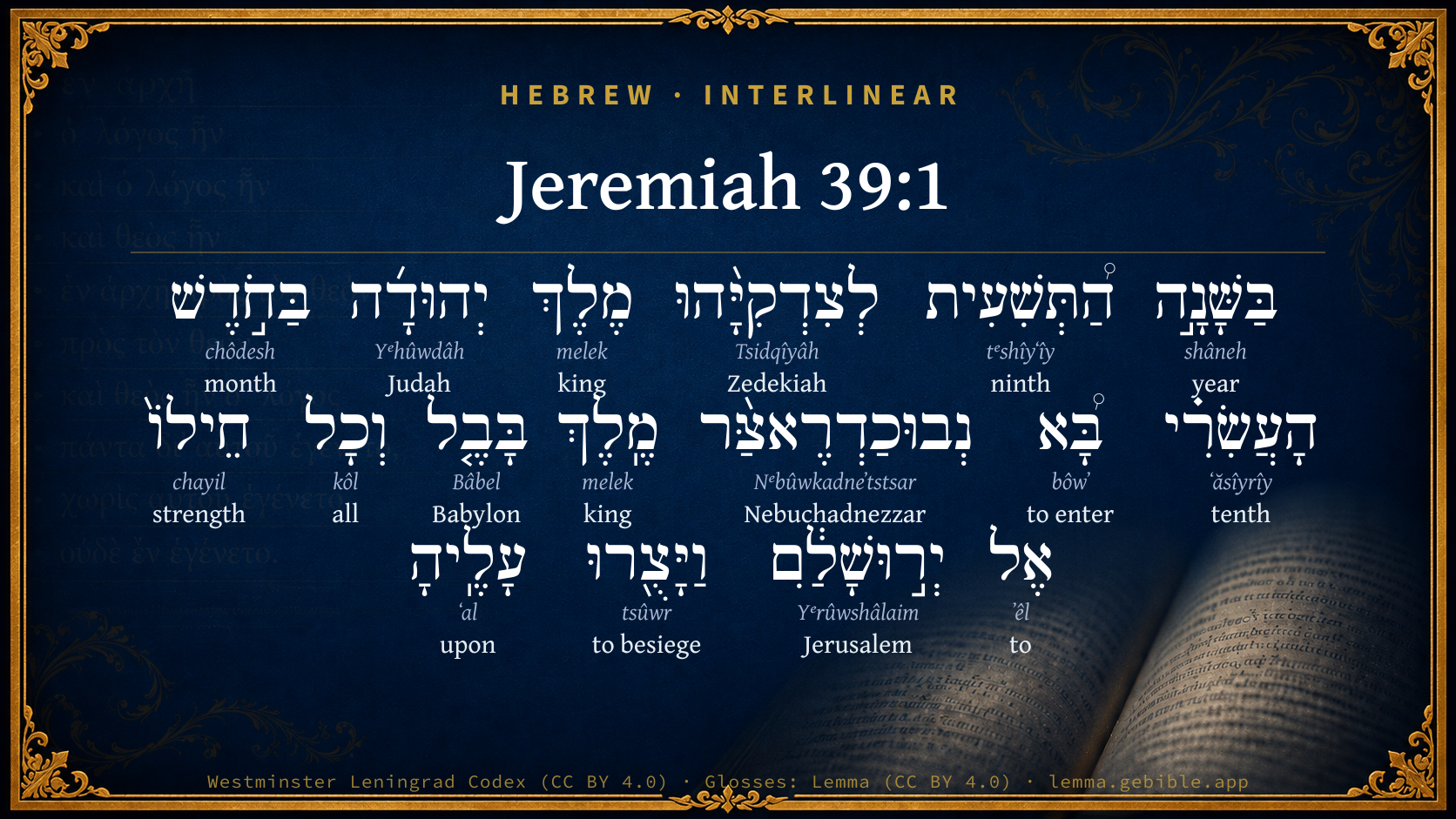
Hebrew (Westminster Leningrad Codex) Jeremiah 39:1 appears in the Hebrew Old Testament. The text above is from the Westminster Leningrad Codex. Each word links to its Strong’s number, a concise gloss, and parsing drawn from the Open Scriptures Hebrew Bible morphology. Click any word for its full Brown-Driver-Briggs (BDB) entry.
Download image
Cite this verse

Jeremiah 39:1 (World English Bible). Public Domain. Lemma interlinear Bible study tool, https://lemma.gebible.app/v/jeremiah/39/1.

Show BibTeX & RIS
BibTeX
RIS
English Translation
It happened when Jerusalem was taken, (in the ninth year of Zedekiah king of Judah, in the tenth month, came Nebuchadrezzar king of Babylon and all his army against Jerusalem, and besieged it;
World English Bible · Public Domain
Download a study sheet

One document with this verse’s original text, its word-by-word gloss line, the meaning frame, cross-references with their text, attributed commentary, and full source and license credits — printable, and it pastes into notes with its structure intact.

This verse Autodidact and up

Study sheet (.html) Plain text (.txt)

A passage Seminary Student

Up to 50 verses in one chapter. A passage sheet keeps up to 6 commentary sources and 12 cross-references per verse, in the order this page ranks them, and says so on the sheet whenever that leaves anything out. Ask for a single verse and you get the Autodidact verse sheet above.

Everything on this page stays free to read, with no account — the sheet is a download of what is already on screen, not access to it.

Want to remove ads? Support Godless Engineer
Compare translations 3

The same verse in 3 English versions, stacked beneath the original-language interlinear above. Click any original word for its lexicon entry.

Each is an independent rendering of the whole verse — the interlinear is not word-aligned to these translations.

Highlighted words mark where these versions differ — a whole-verse word diff, not a word-by-word alignment.

  • World English Bible Public Domain
    It happened when Jerusalem was taken, (in the ninth year of Zedekiah king of Judah, in the tenth month, came Nebuchadrezzar king of Babylon and all his army against Jerusalem, and besieged it;
  • King James Version Public Domain
    In the ninth year of Zedekiah king of Judah, in the tenth month, came Nebuchadrezzar king of Babylon and all his army against Jerusalem, and they besieged it.
  • unfoldingWord Literal Text CC BY-SA 4.0
    In the ninth year and tenth month of Zedekiah king of Judah, Nebuchadnezzar king of Babylon came with all his army against Jerusalem and besieged it.

unfoldingWord Literal Text — © unfoldingWord, licensed CC BY-SA 4.0. Word-aligned USFM3 via Door43 (git.door43.org/unfoldingWord/en_ult).

Versions to compare (up to 4)

3 of 4 selected

Show all 18 translations

Every available English version of this verse, each an independent rendering of the whole verse.

  • World English Bible Public Domain
    It happened when Jerusalem was taken, (in the ninth year of Zedekiah king of Judah, in the tenth month, came Nebuchadrezzar king of Babylon and all his army against Jerusalem, and besieged it;
  • Berean Standard Bible Public Domain
    In the ninth year of Zedekiah king of Judah, in the tenth month, Nebuchadnezzar king of Babylon marched against Jerusalem with his entire army and laid siege to the city.
  • Majority Standard Bible Public Domain
    In the ninth year of Zedekiah king of Judah, in the tenth month, Nebuchadnezzar king of Babylon marched against Jerusalem with his entire army and laid siege to the city.
  • King James Version Public Domain
    In the ninth year of Zedekiah king of Judah, in the tenth month, came Nebuchadrezzar king of Babylon and all his army against Jerusalem, and they besieged it.
  • American Standard Version (1901) Public Domain
    And it came to pass when Jerusalem was taken, (in the ninth year of Zedekiah king of Judah, in the tenth month, came Nebuchadrezzar king of Babylon and all his army against Jerusalem, and besieged it;
  • Revised Version (1885) Public Domain
    (IN the ninth year of Zedekiah king of Judah, in the tenth month, came Nebuchadrezzar king of Babylon and all his army against Jerusalem, and besieged it;
  • Geneva Bible (1599) Public Domain
    In the ninth yeere of Zedekiah King of Iudah in the tenth moneth, came Nebuchad-nezzar King of Babel and all his hoste against Ierusalem, and they besieged it.
  • Douay-Rheims (1899) Public Domain
    In the ninth year of Sedecias king of Juda, in the tenth month, came Nabuchodonosor king of Babylon, and all his army to Jerusalem, and they besieged it.
  • Young's Literal Translation Public Domain
    In the ninth year of Zedekiah king of Judah, in the tenth month, come hath Nebuchadrezzar king of Babylon and all his force unto Jerusalem, and they lay siege against it;
  • Literal Standard Version CC BY-SA 4.0
    In the ninth year of Zedekiah king of Judah, in the tenth month, Nebuchadnezzar king of Babylon and all his force have come to Jerusalem, and they lay siege against it;
  • Unlocked Literal Bible CC BY-SA 4.0
    In the ninth year and tenth month of Zedekiah king of Judah, Nebuchadnezzar king of Babylon came with all his army against Jerusalem and besieged it.
  • unfoldingWord Literal Text CC BY-SA 4.0
    In the ninth year and tenth month of Zedekiah king of Judah, Nebuchadnezzar king of Babylon came with all his army against Jerusalem and besieged it.
  • Darby Bible Public Domain
    And it came to pass when Jerusalem was taken, in the ninth year of Zedekiah king of Judah, in the tenth month, came Nebuchadrezzar king of Babylon and all his army against Jerusalem, and they besieged it.
  • World Messianic Bible Public Domain
    In the ninth year of Zedekiah king of Judah, in the tenth month, Nebuchadnezzar king of Babylon and all his army came against Jerusalem, and besieged it.
  • Webster's Bible Public Domain
    In the ninth year of Zedekiah king of Judah, in the tenth month, came Nebuchadrezzar king of Babylon and all his army against Jerusalem, and they besieged it.
  • Free Bible Version CC BY-SA 4.0
    In the tenth month of the ninth year of the reign of Zedekiah king of Judah, Nebuchadnezzar king of Babylon and his whole army arrived at Jerusalem and besieged it.
  • Bible in Basic English Public Domain
    And it came about, that when Jerusalem was taken, (in the ninth year of Zedekiah, king of Judah, in the tenth month, Nebuchadrezzar, king of Babylon, with all his army, came against Jerusalem, shutting it in on every side;
  • JPS Tanakh (1917) Public Domain
    in the ninth year of Zedekiah king of Judah, in the tenth month, came Nebuchadrezzar king of Babylon and all his army against Jerusalem, and besieged it;

Literal Standard Version (2020), Covenant Press — licensed CC BY-SA 4.0. Text via the HelloAO Bible API (eBible.org). Unlocked Literal Bible (unfoldingWord) — licensed CC BY-SA 4.0. Text via the HelloAO Bible API (eBible.org). unfoldingWord Literal Text — © unfoldingWord, licensed CC BY-SA 4.0. Word-aligned USFM3 via Door43 (git.door43.org/unfoldingWord/en_ult). Free Bible Version, Dr. Jonathan Gallagher — licensed CC BY-SA 4.0. Text via the HelloAO Bible API (eBible.org).

Word by word

More ways to search: Search by grammar → Find every occurrence → Compare this word →

Practice this passage: Drill this verse → Learn its vocabulary →

הַ֠תְּשִׁעִית
tᵉshîyʻîy
H8671
“the · ninth”
Particle, Definite Article + Adjective, Ordinal number, Feminine, Singular, Absolute
Part of Speech
Particle + Adjective
Type
Ordinal number
Gender
Feminine
Number
Singular
State
Absolute
Full BDB Definition

Origin: ordinal from H8672

TWOT: 2551

ninth (as ordinal number)
  1. בַּשָּׁנָ֣ה shâneh H8141 “in/at the · year” Preposition, Determined + Noun, Common, Feminine, Singular, Absolute
  2. לְצִדְקִיָּ֨הוּ Tsidqîyâh H6667 “to/for · Zedekiah” Preposition + Noun, Proper
  3. מֶלֶךְ melek H4428 “king of” Noun, Common, Masculine, Singular, Construct
  4. יְהוּדָ֜ה Yᵉhûwdâh H3063 “Judah” Noun, Proper
  5. בַּחֹ֣דֶשׁ chôdesh H2320 “in/at the · month” Preposition, Determined + Noun, Common, Masculine, Singular, Absolute
  6. הָעֲשִׂרִ֗י ʻăsîyrîy H6224 “the · tenth” Particle, Definite Article + Adjective, Ordinal number, Masculine, Singular, Absolute
  7. בָּ֠א bôwʼ H935 “to enter” Verb, Qal, Perfect, 3rd Person, Masculine, Singular
  8. נְבוּכַדְרֶאצַּ֨ר Nᵉbûwkadneʼtstsar H5019 “Nebuchadnezzar” Noun, Proper
  9. מֶֽלֶךְ melek H4428 “king of” Noun, Common, Masculine, Singular, Construct
  10. בָּבֶ֤ל Bâbel H894 “Babylon” Noun, Proper
  11. וְכָל kôl H3605 “and · all of” Conjunction + Noun, Common, Masculine, Singular, Construct
  12. חֵילוֹ֙ chayil H2428 “strength · his” Noun, Common, Masculine, Singular, Construct + Suffix, Personal, 3rd Person, Masculine, Singular
  13. אֶל ʼêl H413 “to” Preposition
  14. יְר֣וּשָׁלִַ֔ם Yᵉrûwshâlaim H3389 “Jerusalem” Noun, Proper
  15. וַיָּצֻ֖רוּ tsûwr H6696 “and · to besiege” Conjunction + Verb, Qal, Sequential Imperfect, 3rd Person, Masculine, Plural
  16. עָלֶֽיהָ ʻal H5921 “upon · her” Preposition + Suffix, Personal, 3rd Person, Feminine, Singular

About this verse

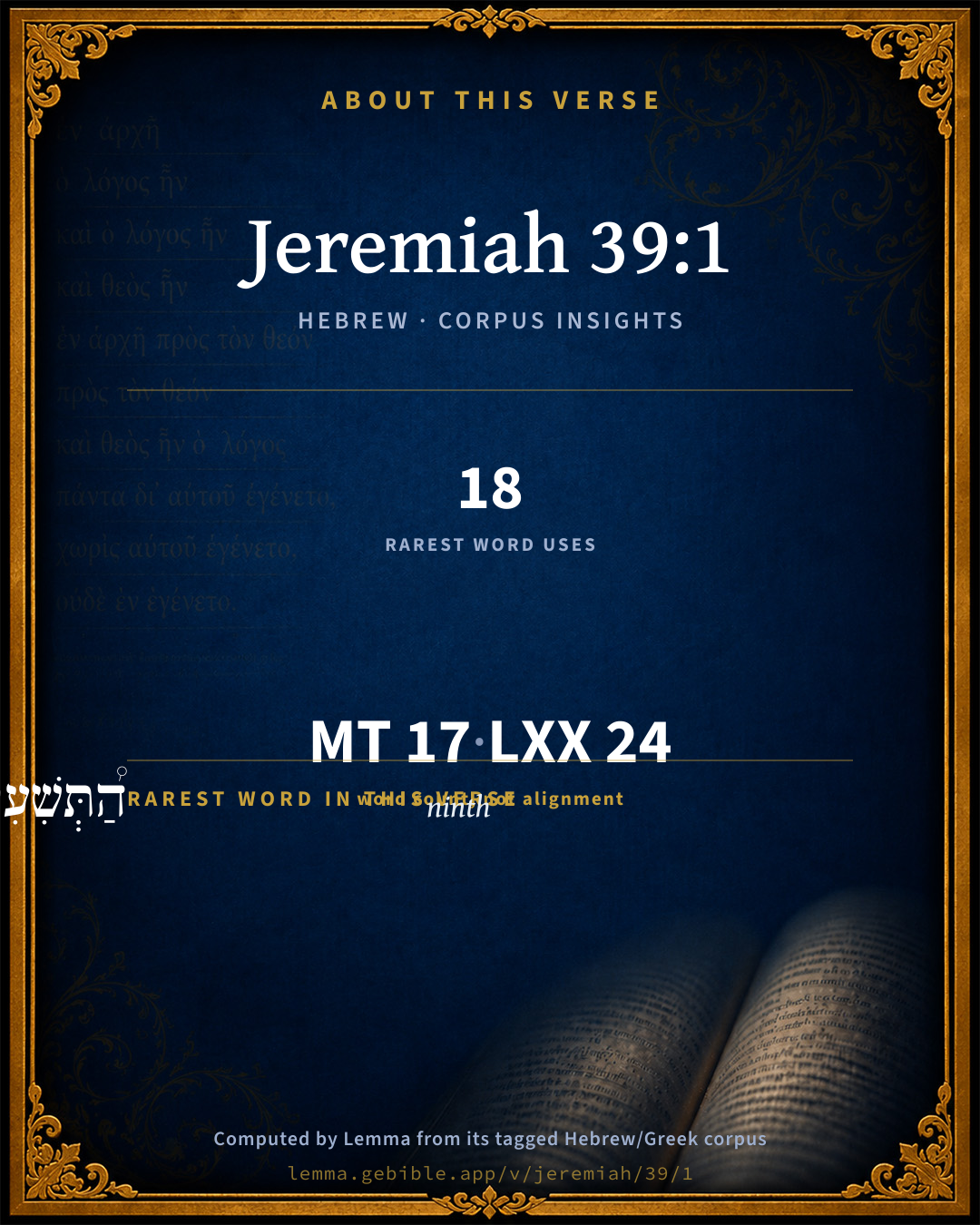
These counts appear in no published source. They are computed here, from the morphology-tagged text and Lemma’s own curated glosses. What Lemma adds →

17
words
16
distinct lemmas
Prophets
section

Notable vocabulary

The rarest word here is הַ֠תְּשִׁעִית ninth H8671 — appearing just 18 times in the whole Hebrew Bible.

Shared distinctive vocabulary

הַ֠תְּשִׁעִית ninth H8671 occurs in 17 verses of the Hebrew Bible. Also found in:

Grammatical profile

  • 2 verbs
  • 11 nouns
  • 2 adjectives
  • 2 prepositions

Verb forms

  • בָּ֠א Qal · Perfect
  • וַיָּצֻ֖רוּ Qal · Sequential Imperfect

Repetition

A word recurs within this verse — often emphatic in Hebrew:

  • מֶלֶךְ king H4428 ×2

Hebrew & Septuagint length

In the original languages it is 17 Hebrew tokens and 24 Greek tokens — but the two are counted differently (Hebrew bundles its prefixes and suffixes into one token; the Greek is in lemma form), so that isn’t a like-for-like length.

Cross-references

4

Topical passages linked to Jeremiah 39:1 in the Treasury of Scripture Knowledge — connected by theme and wording, ordered by reader-vote popularity; previews shown in the World English Bible.

  • Jeremiah 52:4–7 It happened in the ninth year of his reign, in the tenth month, in the tenth day of the month, that Nebuchadrezzar king of Babylon came, he and all his army, against Jerusalem, and encamped against it; and they built forts against it round about.
  • Ezekiel 24:1–2 Again, in the ninth year, in the tenth month, in the tenth [day] of the month, the word of Yahweh came to me, saying,
  • 2 Kings 25:1–12 It happened in the ninth year of his reign, in the tenth month, in the tenth day of the month, that Nebuchadnezzar king of Babylon came, he and all his army, against Jerusalem, and encamped against it; and they built forts against it round about.
  • Zechariah 8:19 Thus says Yahweh of Hosts: "The fasts of the fourth fifth, seventh, and tenth months shall be for the house of Judah joy and gladness, and cheerful feasts. Therefore love truth and peace."

Cross-references courtesy of OpenBible.info (CC BY 4.0).

Hebrew and Greek witnesses Masoretic Hebrew ↔ Greek Septuagint

The same verse in the two great witnesses to the Old Testament, shown verse-for-verse.

These are two independent witnesses, not word-aligned to each other, and the Septuagint is shown in lemma (dictionary) form.

Hebrew Jeremiah 39:1 Masoretic · Westminster Leningrad Codex

בַּשָּׁנָ֣ה הַ֠תְּשִׁעִית לְצִדְקִיָּ֨הוּ מֶלֶךְ יְהוּדָ֜ה בַּחֹ֣דֶשׁ הָעֲשִׂרִ֗י בָּ֠א נְבוּכַדְרֶאצַּ֨ר מֶֽלֶךְ בָּבֶ֤ל וְכָל חֵילוֹ֙ אֶל יְר֣וּשָׁלִַ֔ם וַיָּצֻ֖רוּ עָלֶֽיהָ

It happened when Jerusalem was taken, (in the ninth year of Zedekiah king of Judah, in the tenth month, came Nebuchadrezzar king of Babylon and all his army against Jerusalem, and besieged it;

World English Bible · Public Domain

Greek LXX Structure differs

In the Septuagint, Jeremiah is about an eighth shorter than the Hebrew and arranges its material differently — the Oracles Against the Nations (Hebrew chapters 46–51) appear in the middle of the Greek book, after 25:13. Because the chapter and verse boundaries do not line up, a verse-for-verse comparison with the Hebrew is not shown.

A verse-for-verse comparison isn’t shown here because the chapters and verses don’t line up. Switch to the LXX edition with the MT / LXX toggle above to read the Greek directly.

On this verse, The Preacher's Complete Homiletical Commentary discusses the Septuagint’s reading. Read the note in Commentary ↓

Hebrew: Westminster Leningrad Codex (CC BY 4.0). Greek: Septuagint (public domain); English from a public-domain English Septuagint. How the Septuagint differs from the Hebrew →

Targum (Aramaic paraphrase)

1

The Targum is the ancient Jewish Aramaic paraphrase of the Hebrew Scriptures — an interpretive translation, not the Hebrew text itself. Onkelos (literal) and Pseudo-Jonathan (expansive) render the Torah, and Jonathan the Prophets. Coverage is partial: where no permissively-licensed English translation exists for a verse, only the Aramaic is shown. This is verse-level text, not a word-by-word alignment to the Hebrew.

  1. Targum Jonathan Prophets (Joshua–Malachi)
    בְּשַׁתָּא תְּשִׁיעֵיתָא לְצִדְקִיָה מְלַךְ שִׁבְטָא דְבֵית יְהוּדָה בְּיַרְחָא עֲשִׂירָאָה אֲתָא נְבוּכַדְרֶאצַר מַלְכָּא דְבָבֶל וְכָל מַשִׁרְיָתֵיהּ לִירוּשְׁלֵם וְצָרוּ עֲלָהּ:

    (no public-domain English translation for this verse)

    Targum Jonathan — Aramaic: “Mikraot Gedolot” (public domain). English: “Sefaria Community Translation” (CC0 1.0 (public-domain dedication)); “London "Chaldee Paraphrase," 1871” (public domain). Text via Sefaria.

Commentary

Notes on Jeremiah 39:1 from classic Christian and Jewish commentators (each source and its license shown beneath its notes). The classic Christian expositions comment on the surrounding passage and are grouped to its opening verse, so a note may address several verses; the Jewish commentaries on the Tanakh (Rashi and others) are per-verse, so they appear only where the commentator wrote on this verse.

Lemma curates 59 commentaries, every one of them public domain or Creative Commons licensed, each selected and text-cleaned for this edition rather than reprinted as found. About our sources →

Matthew Henry's Commentary

We were told, in the close of the foregoing chapter, that Jeremiah abode patiently in the court of the prison, until the day that Jerusalem was taken. He gave the princes no further disturbance by his prophesying, nor they him by their persecutions; for he had no more to say than what he had said, and, the siege being carried on briskly, God found them other work to do. See here what it came to.

I. The city is at length taken by storm; for how could it hold out when God himself fought against it? Nebuchadnezzar's army sat down before it in the ninth year of Zedekiah, in the tenth month (Jer 39:1), in the depth of winter. Nebuchadnezzar himself soon after retired to take his pleasure, and left his generals to carry on the siege: they intermitted it awhile, but soon renewed it with redoubled force and vigour. At length, in the eleventh year, in the fourth month, about midsummer, they entered the city, the soldiers being so weakened by famine, and all their provisions being now spent, that they were not able to make any resistance, Jer 39:2. Jerusalem was so strong a place that nobody would have believed the enemy could ever enter its gates, Lam 4:12. But sin had provoked God to withdraw his protection, and then, like Samson when his hair was cut, it was weak as other cities.

II. The princes of the king of Babylon take possession of the middle gate, Jer 39:3. Some think that this was the same with that which is called the second gate (Zep 1:10), which is supposed to be in the middle wall that divided between one part of the city and the other. Here they cautiously made a half, and durst not go forward into so large a city, among men that perhaps would sell their lives as dearly as they could, until they had given directions for the searching of all places, that they might not be surprised by any ambush. They sat in the middle gate, thence to take a view of the city and give orders. The princes are here named, rough and uncouth names they are, to intimate what a sad change sin had made; there, where Eliakim and Hilkiah, who bore the name of the God of Israel, used to sit, now sit Nergal-sharezer, and Samgar-nebo, etc., who bore the names of the heathen gods. Rab-saris and Rab-mag are supposed to be not the names of distinct persons, but the titles of those whose names go before. Sarsechim was Rab-saris, that is, captain of the guard; and Nergal-sharezer, to distinguish him from the other of the same name that is put first, is called Ram-mag - camp-master, either muster-master or quarter-master: these and the other great generals sat in the gate. And now was fulfilled what Jeremiah prophesied long since (Jer 1:15), that the families of the kingdoms of the north should set every one his throne at the entering of the gates of Jerusalem. Justly do the princes of the heathen set up themselves there, where the gods of the heathen had been so often set up.

III. Zedekiah, having in disguise perhaps seen the princes of the king of Babylon take possession of one of the gates of the city, thought it high time to shift for his own safety, and, loaded with guilt and fear, he went out of the city, under no other protection but that of the night (Jer 39:4), which soon failed him, for he was discovered, pursued, and overtaken. Though he made the best of his way, he could make nothing of it, could not get forward, but in the plains of Jericho fell into the hands of the pursuers, Jer 39:5. Thence he was brought prisoner to Riblah, where the king of Babylon passed sentence upon him as a rebel, not sentence of death, but, one many almost say, a worse thing. For, 1. He slew his sons before his eyes, and they must all be little, some of them infants, for Zedekiah himself was now but thirty-two years of age. The death of these sweet babes must needs be so many deaths to himself, especially when he considered that his own obstinacy was the cause of it, for he was particularly told of this thing: They shall bring forth thy wives and children to the Chaldeans, Jer 38:23. 2. He slew all the nobles of Judah (Jer 39:6), probably not those princes of Jerusalem who had advised him to this desperate course (it would be a satisfaction to him to see them cut off), but the great men of the country, who were innocent of the matter. 3. He ordered Zedekiah to have his eyes put out (Jer 39:7), so condemning him to darkness for life who had shut his eyes against the clear light of God's word, and was of those princes who will not understand, but walk on in darkness, Psa 82:5. 4. He bound him with two brazen chains or fetters (so the margin reads it), to carry him away to Babylon, there to spend the rest of his days in misery. All this sad story we had before, Kg2 25:4, etc.

IV. Some time afterwards the city was burnt, temple and palace and all, and the wall of it broken down, Jer 39:8. "O Jerusalem, Jerusalem! this comes of killing the prophets, and stoning those that were sent to thee. O Zedekiah, Zedekiah! this thou mightest have prevented if thou wouldst but have taken God's counsel, and yielded in time."

V. The people that were left were all carried away captives to Babylon, Jer 39:9. Now they must bid a final farewell to the land of their nativity, that pleasant land, and to all their possessions and enjoyments in it, must be driven some hundreds of miles, like beasts, before the conquerors, that were now their cruel masters, must lie at their mercy in a strange land, and be servants to those who would be sure to rule them with rigour. The word tyrant is originally a Chaldee word, and is often used for lords by the Chaldee paraphrast, as if the Chaldeans, when they were lords, tyrannized more than any other: we have reason to think that the poor Jews had reason to say so. Some few were left behind, but they were the poor of the people, that had nothing to lose, and therefore never made any resistance. And they not only had their liberty, and were left to tarry at home, but the captain of the guard gave them vineyards and fields at the same time, such as they were never masters of before, Jer 39:10. Observe here, 1. The wonderful changes of Providence. Some are abased, others advanced, Sa1 2:5. The hungry are filled with good things, and the rich sent empty away. The ruin of some proves the rise of others. Let us therefore in our abundance rejoice as though we rejoiced not, and in our distresses weep as though we wept not. 2. The just retributions or Providence. The rich had been proud oppressors, and now they were justly punished for their injustice; the poor had been patient sufferers, and now they were graciously rewarded for their patience and amends made them for all their losses; for verily there is a God that judges in the earth, even in this world, much more in the other.

Matthew Henry's Commentary on the Whole Bible (1708–1710) — public domain (CC PDM 1.0). Text via the HelloAO Bible API.

Trapp's Complete Commentary

John Trapp

Jer 39:1 In the ninth year of Zedekiah king of Judah, in the tenth month, came Nebuchadrezzar king of Babylon and all his army against Jerusalem, and they besieged it.

Ver. 1. In the ninth year of Zedekiah.] See on 2Ki 25:1.

Came Nebuchadnezzar.] He came to the siege in person, but soon after retired himself to Riblah, i.e., to Antioch in Syria, there to take his pleasure, and therehence to send supplies to his forces as need required.

John Trapp, A Commentary or Exposition upon All the Books of the Old and New Testament (1647–1656) — public domain. Text from a community e-Sword module.

Albert Barnes' Notes on the Bible

“The Capture of Jerusalem” - The majority of the particulars given in Jer 39:1-14 occur again (marginal reference); and are by some regarded as an interpolation. The external evidence (that of the versions) is, however, in favor of their authenticity. Jer 39:14 is to be reconciled with Jer 40:1-4 by remembering that Gedaliah had left Jerusalem and gone to Mizpah Jer 40:6, a city in the immediate neighborhood; and as he was not at home to protect the prophet, nothing is more probable than that Jeremiah in company with the main body of captives was brought to Ramah in chains.

Albert Barnes' Notes on the Bible (1834–1885) — public domain. Text from a community e-Sword/MySword module.

The Biblical Illustrator

Joseph S. Exell

Jer_39:1-10

In the ninth year of Zedekiah king of Judah, in the tenth month, came Nebuchadrezzar king of Babylon.

The downfall of Judah

The siege and sacking of Jerusalem under Nebuchadrezzar is the most tragic story in history. The second destruction of the city under Titus, the Roman general, was analogous, but did not equal the first in horror of detail. The siege was more prolonged under the king of Babylon, the resistance by the Jews more desperate, and the determination with which the people held out more stubborn, preferring starvation to surrender. During those eighteen months the city presented an awful spectacle; delicately reared princesses were seen clawing over dung-heaps and street refuse to find a morsel of food; the once snow-clad Nazarites walked the streets in filthy garments; the fairest and best-looking of the people were reduced to the merest skeletons; desperation of hunger forced fond mothers to boil and eat their own children. The horrors depicted even in outline by the sacred writers almost beggar the imagination. The king of Judah was the vassal of the king of Babylon, but being deceived by false prophets he rebelled against his foreign sovereign, and sought, through an alliance with the king of Egypt, to throw off the Chaldean yoke. Hearing of this attempt at rebellion, the Chaldeans had sent a strong detachment of their army to reduce Zedekiah to obedience, when an Egyptian army making its appearance forced them to raise the siege. Subsequently the Egyptian army was defeated, and then, with his entire army, Nebuchadrezzar came up and besieged Jerusalem for eighteen months, and took it. Jeremiah had persistently warned the king that it was folly to contend with Babylon, for the Lord had determined upon their captivity. So the king and the princes not only rebelled against the king of Babylon, but set themselves in defiance against God Himself.

I. Jerusalem taken and sacked. The prophet does not dwell on the details of the siege, as it was no part of his plan to detail the military processes by which the holy city was at last put into the hands of the Chaldeans. His purpose was simply to record the fact, and thus mark the fulfilment of Gods word. After eighteen months, in which the city had been completely invested, a breach in the walls was effected, and the Babylonian army was in full possession. The princes of the Chaldean king entered the city and took up their headquarters in the middle gate. This was probably the gate through an inner wall within the city which surrounded the citadel. At any rate, the presence of these Babylonian princes in that place showed that the city was entirely in their hands. For further details, compare 2Ki_25:1-30. with our present text, and Jer_52:1-34. These three accounts are substantially the same. For details of the horrors and sufferings of the inhabitants of Jerusalem during the siege, compare Lamentations (especially chap. 4.), in which the heartbroken prophet pours forth his sorrow over the downfall of the city, and especially over the woes which had come upon his people. See also Eze_4:5; Eze_4:12; Eze_21:1-32., where minute prophecies of the downfall of the city are recorded. After the subjugation of the city, and the flight, capture, judgment, and imprisonment of the king, under the command of Nebuzar-adan, the captain of the guard, the Babylonian soldiers burned the city, including the Temple, kings palace, and all the houses of the princes and chief men; the walls were razed; the whole city was turned into a waste and ruinous heap (verse 8; 52:13, 14). Jeremiah laments the destruction of the glorious city of God in these sad and pathetic words: How doth the city sit solitary, that was full of people; how is she become a widow, she that was great among the nations . . . She weepeth sore in the night, and her tears are on her cheeks; among all her lovers she hath none to comfort her; all her friends have dealt treacherously with her; they are become her enemies . . . And from the daughter of Zion all her beauty is departed . . . How is the gold become dim; how is the most fine gold changed; the stones of the sanctuary are poured out in the top of every street. The precious sons of Zion, comparable to fine gold, how are they esteemed as earthen pitchers, the work of the hands of the potter (Lam_1:1-2; Lam_1:6; Lam_4:1-2). The great lesson to be deeply pondered from this awful judgment upon Jerusalem is the certain retribution of God upon persistent sin. No honest and thoughtful man can read these prophetic and historic records without being profoundly impressed with the longsuffering mercy of God toward sinners, and the certainty of retribution following upon unrepented and persistent sin. Gods judgment may be slow in coming, but it is as sure as it is slow. How long He had borne with Judah and Jerusalem before He began to pour out His fury upon them! Long God postpones His judgment, when once it sets in, it goes on to the end, though the mills of God grind slowly, yet they grind exceeding small. What a culmination of calamities at the last! There is no stopping or turning them back. All the skill, the courage, and the endurance which Jerusalem brought to bear in order to avert this awful judgment, availed nothing. When the time for judgment comes it is too late for prayer and entreaty. When will men learn this lesson? We have not to do with the judgment upon Judah and Jerusalem, but with that which is coming upon all men who, like this apostate people, despise Gods Word, and believe not His prophets. No amount of theory or argument will prevent the doom of the persistent sinner. Men may say that death ends all; but the resurrection of Jesus proves that it does not; men may say that God is too merciful to punish sinners according to the declaration of the Scriptures; but is He? Let the story of the flood; the overwhelming fate of Pharaoh; the destruction of Sodom and Gomorrah; the terrible calamities that came upon Israel and Judah, be our answer. After Gods mercy has been ruthlessly trampled under foot, then His righteous retribution comes, and proceeds to the bitter end.

II. The flight and capture of the king. When the king saw the city in the possession of the enemy, he hastily gathered his army and family, and by night fled from the city by a secret way through his garden, and between two walls which concealed his movements (verse 4, 52:7; 2Ki_25:4). His flight, however, was of no avail; for though he nearly effected his escape, having reached the borders of the Jordan, his absence was discovered, and the Chaldeans pursued after him; and, while his army was scattered abroad, probably on a foraging expedition, the king and his family and the princes that were with him were captured. Too late the king sought safety in flight. It was not to be. God had decreed his capture, and no precaution could prevent it. Had he heeded the warning of Jeremiah, who brought him the word of God, and surrendered to the king of Babylon, his own life would have been spared, his childrens lives would have been spared, his princes lives would have been spared, and the glorious City of God would have been spared (Jer_28:17-17). The king was a weak man, and hesitated to do the word of God because he was afraid of being taunted with cowardice by his nobles and the people. How many men are cowards before their fellow-men, and yet bravo before God! They fear the reproach of weak, feeble, and sinful men, but fear not the Word of God. Surely the sorry flight of the wretched king from his ruined city, a fugitive from God and the king of Babylon, was infinitely more humiliating than an honourable surrender to Nebuchadrezzar. How many will seek salvation wildly when it is too late! Let it be remembered again that, when once the master of the house is risen up, and hath shut the door, then flight or petition is of none avail. When once Jesus ceases to be the Advocate of sinners, and becomes their Judge, then repentance is too late, and no man may flee the judgment. What unutterable miseries are added to the main consequences of our sins, when we think of what might have been, had we not been too late!

1. Prophecy and its fulfilment. In connection with the flight, arrest, condemnation, and punishment of the king, we have a most remarkable series of prophetic fulfilments. Ezekiel, under the command of God, had before this final calamity, by means of pantomime, as well as by clear and unmistakable words, depicted every detail of the kings flight, capture, and punishment. Read Eze_12:1-13. Thus have we seen the king laden with his valuables, fleeing at night, digging through a wall to escape the Chaldeans; we have seen God spreading His net, catching and delivering him over, to be first blinded, then loaded with chains, carried to Babylon and thrust into prison; there we have seen him die. How impossible to have understood Ezekiels prophecy until it was fulfilled; how then does it appear to have been the very letter of subsequent fact!

2. Arrested, condemned, and punished. The details are briefly but graphically told. When the soldiers arrested the flying king, they brought him to the king of Babylon, who

(1) gave judgment upon him. Zedekiah was, according to the law of nations, a traitor to the king of Babylon, who had set him upon the throne of Judah as his vassal, and against whom Zedekiah had rebelled. So while the Chaldean king was carrying out Gods decree against Zedekiah for his persistent sin and equity, he was also executing his own law upon him as a rebel. Gods providence ever fits in with the ordinary workings of human history.

(2) The first part of the judgment was that the sons of the king should be butchered before his eyes. What a horrible thing this was! Alas for that poor king! He had brought this upon them. What may be the agonies of a sinful father who, through precept and example, has encouraged his own sons to infidelity, and the final loss of their souls! Then followed the slaughter of the nobles before his face; this too was in part his doing; for, though the king s action in holding out against the king of Babylon, contrary to the counsel and entreaty of Jeremiah, was due to his fear of the nobles, yet as king it was his duty to have asserted his authority and saved them and the city in spite of their mockeries of Gods word.

(3) Finally the king of Babylon ordered Zedekiahs eyes to be put out, then loaded him with chains, sent him to Babylon, and there cast him into prison, until death released him into the other world. Let us hope that a gate of repentance was opened for him before he passed thither. But what an awful punishment for a king and a father! The last impression on his brain from this world was the awful sight of his butchered sons and nobles. Who can tell the horrors of his lonely confinement, shut up with these memories for ever haunting his dark soul? Men choose the ways of sin in this life, counting them to be good things, but they forget that in the hereafter the evil things which they contemptuously denied will be their portion, soured with memorys poisoned sting.

III. The blessed poor. Only one ray of light penetrated the dark cloud of doom that hung over and burst on Jerusalem. The city burned with fire, the Temple destroyed, her fair stones scattered, the king and his family, the princes and nobles, and all the citys inhabitants carried away, slain, or held in a wretched captivity, which brought them nought but sighs and tears; what exception was there in all this misery? Just this; and it is not unsuggestive. The wretchedly and miserably poor were left behind; and more; for the captain of the guard, acting for the king of Babylon, gave them fields and vineyards. In the general judgment that overwhelmed Jerusalem, the sparing of these poor people and the gift to them of fields and vineyards suggest to us the blessings that are in reserve for those on earth who, though poor in this world, are rich in faith, and heirs of the kingdom which He has promised to them that love Him (Jam_2:5). It also suggests the beatitude of Jesus: Blessed are the poor in spirit, for theirs is the kingdom of heaven. Blessed are the meek, for they shall inherit the earth (Mat_5:3; Mat_5:5). God will not forget such. Here is seen Gods reversal. The rich and great of Jerusalem, who had grown so by grinding oppression of the poor, are carried away captive, slain with the sword and cast into prison, while those whom they oppressed are now inheriting their lands and vineyards (Isa_57:15; Isa_66:2). Till the captivity the poor were only a portion of the people, but now they were the whole. This event, therefore, would seem to indicate that the poor, meek, and contrite in spirit are the whole sum of those who shall constitute the people of God in the day of judgment. (G. F. Pentecost, D. D.)

He put out Zedekiahs eyes.

Non-acceptance of chastisement

We sometimes act as though we thought that dispensations of light and joy were made to draw us to God; those of darkness and sorrow the reverse; but that is our mistake; our thought must be God in all. And here God makes the announcement of the chastisement in a manner worthy of Himself--in the midst of judgment He remembers mercy. He commissions Jeremiah to promise circumstances of alleviation and gracious dealing; even though the trouble remain. The trouble and its alleviations were to exist side by side. But now, what are the speakings of this moreover to us?

1. It says to us, Reject not bounded chastisement or trial, for you know not how wide God may remove those bounds, when it comes upon you as something rejected by you, but inflicted, whether you will or no, by Him.

2. It says, Be sure that God will carry His own way. Look upon all resistance of His will as madness, as full of mischief for yourself.

3. If we reject what God thus ordains, we may rest assured that we are laying up for ourselves a long period of sad thought, peopled with sad memories.

4. Though the chastisement or the trial God announces be heavy, still let us be assured that it is the lightest possible under the circumstances.

5. Let us believe that God has terrible reserves of chastening dealings. We think that each trial, as it comes, is the worst that can be; sometimes a man in folly and desperation feels as though God could do no more to him; but the reserves of the Lord in this way, as in blessing, are illimitable--take care, lest a worse thing come upon thee.

6. We may, and must leave it to God to take care of us, when leading us into either discipline or chastisement.

7. Instead of fretting and troubling ourselves unduly, and setting our minds upon finding out fresh and fresh elements in our trial, let us count up some of the moreovers of what might have come upon us; some of the moreovers of the mercies which are bestowed.

8. Let us be careful to keep ourselves well within the line of Gods action with us, and not to subject ourselves to mans. It is not Gods purpose to make a full end of us; He means to deal wisely and admeasuredly with us; He means us to taste that He is gracious; to have reason to believe that He is so. (P. B. Power, M. A.)

The Biblical Illustrator, edited by Joseph S. Exell (c. 1880s–1900s) — public domain. Text from a community e-Sword module.

Joseph Benson's Commentary

Jer 39:1-3. In the ninth year of Zedekiah, &c. — See notes on 2Ki 25:1-4. And all the princes of the king of Babylon came in, and sat in the middle gate — Or, the gate of the centre, as Blaney translates it, observing, “The city of Jerusalem stood upon two hills, Zion to the south, and Acra to the north, with a deep valley between them. The gate of the centre, as the term seems plainly to import, was a gate of communication in the middle of the valley between the two parts of the city, sometimes called the higher and the lower city. The Chaldeans entered the city on the north side by a breach in the walls, and immediately rushing forward, and posting themselves in this gate, in the very heart of the city, they became thereby masters at will of the whole. Zedekiah, with his troops, perceiving this, fled out of the opposite gate on the south side.” Even Nergal- sharezer, Samgar-nebo, &c. — It was customary among the Chaldeans to give the names of their idols, as an additional title or mark of honour, to persons of distinction: see note on Isa 39:1. Nergal was the name of an idol worshipped by the Cuthites, 2Ki 17:30. Nebo was a Babylonish deity, Isa 46:1.

Joseph Benson's Commentary on the Old and New Testaments (1811–1818) — public domain. Text from a community e-Sword module.

Whedon's Commentary on the Bible

Daniel D. Whedon

CAPTURE OF JERUSALEM, Jer_39:1-3.

1, 2. Ninth year… eleventh year — Comparing the two dates we learn that the siege lasted one and a half years. See 2Ki_25:1-4.

Daniel D. Whedon (gen. ed.), Commentary on the Old and New Testaments (1874–1909) — public domain. Text from a community e-Sword module.

The Preacher's Complete Homiletical Commentary

Joseph S. Exell (gen. ed.)

CRITICAL AND EXEGETICAL NOTES.—1. Chronology of the Chapter.—Cf. notes in loc. chap. 34. The siege lasted just one year and six months, not reckoning the interval during which the Chaldeans broke up to give battle to the army of Pharaoh.

2. Contemporary Scriptures.—Eze_12:8-20; Eze_17:11-21; 2Ki_25:1-12; 2Ch_36:11-21; Jer_52:4-11.

3. National Affairs.—Vide below on “The thread of Events.”

4. Personal Allusions.—Jer_39:3; Jer_39:13. A critical examination of Hitzig and others, into these compound names, tends to reduce them to three (instead of, as in Jer_39:3, six), thus: (1). Nergal-Sharezer, the Samgar, or cup-bearer; (2). Nebo-Sarsechim, the Rab-saris, or chief of the eunuchs, or chamberlain; (3). A second Nergal-Sharezer, the Rab-mag, or chief of the magi. The LXX read Ναβουσαχαρ, as a name linking together the terminal “Nebo” and “Sarsechim;” while other Greek manuscripts read Ναβουσαρσεχιμ. This Nebo-Sarsechim is called in Jer_39:13 “Nebushasban the Rab-saris.” The second “Nergal Sharezer,” the Rab-mag, or chief of the magicians, is known in history as Neriglissar, son-in-law of Nebuchadnezzar (supposed by Dr. Payne Smith to have been his vicegerent during Nebuchadnezzar’s seven years’ madness: see Daniel). This Neriglissar seized the crown two years after Nebuchadnezzar’s death, murdering Evil-merodach, the late king’s son. This man’s identification with the “Rab-mag” named here arises from Neriglissar being called “Rabu-emga” in the Assyrian cuneiform inscriptions.

Jer_39:9. “Nebuzar-adan the captain of the guard, i.e. the Rab-tabbachim, or chief of the executioners, called in the Assyrian inscriptions, “Nabu-zir-iddina,” i.e. “Nebo has given offspring.”

Jer_39:14. “Gedaliah the son of Ahikam.” Jeremiah’s steadfast and courageous friend, as his father “Ahikam” had been before him (chap. Jer_26:24, vide note in loc). He was “a man of a generous, genial nature, such as might have rallied the better spirits of his countrymen round him, and taken the place of the fallen dynasty” (Stanley).

5. Geographical Allusions.—Jer_39:4. “By the way of the king’s garden, by the gate betwixt the two walls.” Jerusalem then consisted of an upper and lower city; the upper including Mount Zion, with a strong fortress; the latter, to the north, was considerably lower, and more easily accessible to the Chaldeans. The “gate” from the upper city to the “king’s garden” was appropriated exclusively to royalty, and “stairs” led down from Mount Zion and the palace to the king’s garden below (Neh_3:15). There was a double wall south of Zion, towards the plain of Jericho (Jer_39:5). He broke an opening through the wall in order to escape (see Eze_12:12).

Jer_39:5. “Riblah.” An ancient city on the northern boundary of Palestine, in the land of Hamath, about six miles distant from Jerusalem, forty miles south of Hamath, on the great road between Palestine and Babylon.

Literary Criticism.—Jer_39:7. “He put out Zedekiah’s eyes,” עִוִּרִ. Excavated, dug out.

Jer_39:14. “That he should carry him home,” where, is uncertain, for הַבַּיִת is indefinite. The words are lit. “to take him out into the house.” Not Gedaliah’s, or it would have read “his house.” Either the Temple, therefore, or the king’s house; and most naturally the latter—the royal palace.

GENERAL SURVEY OF CHAPTER 39

THE SIEGE OF JERUSALEM BY NEBUCHADNEZZAR

I. The thread of events as indicated in this chapter. For preliminary events see notes on chap. 34.

1. Nebuchadnezzar’s army effected an entrance into the city of Jerusalem. It was at midnight (Jer_39:4). The date is carefully given in Jer_39:2. The date answers to our July. This was after an eighteen months’ siege, B.C. 587. At this time the city was reduced to misery and starvation (Eze_5:12).

2. Nebuchadnezzar, who himself opened the siege in person (Jer_39:1), had retired to Riblah, and was there at its close (Jer_39:3; Jer_39:6; cf. Jer_38:17).

3. It was into the lower city, on the north side, that the Chaldeans forced an entry (Jer_39:3), “the middle gate” being situate between the lower and the upper city.

4. Zedekiah, with his wives and children and royal guards, having their heads muffled (Eze_12:6; Eze_12:12), fled on the entrance of the Chaldeans, by the gate south of Jerusalem (Jer_39:4), breaking an opening in the wall to get out (Eze_12:12).

5. Pursued by the Chaldeans and captured in the plains of Jericho, his troops were “scattered from him” (chap. Jer_52:8); and Zedekiah and his family were manacled, and thus marched to Riblah to confront the wrathful king of Babylon (Jer_39:5).

6. Doomed for the violation of his oath of allegiance to Babylon (Eze_17:13-19; Ezekiel 2. Chron. Jer_36:13), Zedekiah was first made to behold the slaughter of his courtiers and family, and then his own eyes were put out, and he carried away in chains to Babylon (Jer_39:6-7). Thus were reconciled the two passages, Jer_32:4, and Eze_12:13.

7. A month elapsed, during which the Chaldean princes had probably gone to Riblah to consult Nebuchadnezzar as to the fate of the city and inhabitants (chap. Jer_52:10; 2Ki_25:8), and then Nebuzar-adan came with royal orders to utterly destroy the city (Jer_39:8). Fire consumes the city (chap. Jer_52:13); foul ravages were committed upon the inhabitants (Lam_5:11-12); desecration was heaped upon the dead (chap. Jer_7:32; Jer_8:3).

8. Among the hosts of captives carried off to Ramah (Jer_39:9) was Jeremiah (chap. Jer_40:1). See below: IV. Kindness to the Lord’s Prophet.

II. Incidents of the siege. It began in January, B.C. 587, and continued till July, B.C. 586.

1. The store of bread became gradually exhausted (chap. Jer_52:6), and the horrors of starvation set in (Eze_5:10; Eze_5:16; Lam_2:20; Lam_4:4-5; Lam_5:9-10).

2. In their profanity and despair, the priests increased their flagrant idolatries within the very Temple of Jehovah (2Ch_36:14; see Eze_8:7-9.)

3. The midnight surprise (Jer_39:4), was a moment for fearful slaughter. The sleeping city awoke in terror, and soon the streets flowed with the blood of the slain (2Ch_36:17; Lam_1:15). Princes were hung up by their hands on the Temple walls (Lam_5:12).

4. The treasures of the Temple were carried away as spoil (2Ki_25:13-17; Jer_52:17-22).

5. Pilgrims from surrounding nations came to wonder and bewail over the ruins of the city (chap. Jer_41:5-6), while savage heathen tribes exulted over Jerusalem’s overthrow (Psa_79:1; Eze_25:6; Eze_25:8; Eze_25:15; Eze_26:2).

III. Vengeance for a violated oath (Jer_39:5-7).

1. Faithless himself, he was abandoned by faithless friends—

(1.) Deserters from the city carried tidings to the Chaldean army of Zedekiah’s escape (Josephus, Antiq. Jer_10:8, § 2).

(2.) His “friends and captains” who fled with him abandoned him at the appearance of the Chaldean soldiers (Ibid).

4. The wrath of the conquering king was justly severe. Brought before Nebuchadnezzar, he was first charged by him as a “covenant-breaker,” and “reproached for his ingratitude,” that he had “used the power he gave him against him who gave it;” but, said Nebuchadnezzar, “God is great, who hateth this conduct of thine, and hath brought thee under us” (Ibid).

Then followed the horrors recorded in Jer_39:6-7. And in Babylon Zedekiah was imprisoned till he died.

3. The execration of God, through His prophets, fell upon him for his violated oath; from Jeremiah in Jerusalem (chap. Jer_37:9-10), and from the prophet Ezekiel among those already carried captive to Babylon (Eze_17:16-20).

See homily on chap. Jer_38:17-18 : “SINNERS THE CAUSE OF THEIR OWN SUFFERINGS.”

IV. Kindness shown to the Lord’s prophet (Jer_39:11-14).

1. His faithful witness against Zedekiah’s falsity and his nation’s perfidy had become known to Nebuchadnezzar, probably through the Jews carried captive to Babylon with Jeconiah, and now again through deserters (chap. Jer_38:19, and Jer_39:9). Hence the king’s clemency.

2. Nebuchadnezzar’s chieftain, therefore, was charged specially to care for the prophet amid the judgments to be dealt on the nation.

3. A month after Zedekiah’s flight (see “Thread of Events,” 7, above), Nebuchadnezzar found him in the prison where “he abode” (chap. Jer_38:28); who released him, and with the first mass of captives he was hurried on to Ramah (chap. Jer_40:1).

4. At this point he was released (chap. Jer_40:4), and allowed to choose either a place of high favour in the royal court at Babylon, or any spot in Palestine which he might elect to dwell.

5. Nebuchadnezzar, in accordance with Jeremiah’s desire, placed the prophet in Gedaliah’s charge (chap. Jer_39:14, Jer_40:5); gave him “a reward;” and the prophet made his home in Mizpah (chap. Jer_40:6).

Patriotic to the last, this grand servant of God “had no mind to follow” Nebuzar-adan to Babylon, “nor to dwell anywhere else, but would gladly live in the ruins of his own country,” pleading that Nebuzar-adan would “set at liberty his disciple Baruch, one of a very eminent family, and exceedingly skilful in the language of his country” (Josephus, Antiq. Jer_10:9, § 1).

On the release of Jeremiah, Wordsworth comments: “The siege and capture of Jerusalem by the Chaldeans were the cause of the liberation of Jeremiah. So it is often in the history of the Church. The shocks of dynasties and overthrow of thrones have often been overruled by God into occasions for the liberation and free circulation of His Word. How much has the diffusion of the Holy Scriptures been facilitated by God amid storms and revolution, as in Italy and Spain! How much may the Church of God be extended and purified by His power and love amid the coming conflicts and sufferings of the latter days!”

Note.—For descriptions of the events of the siege and capture of Jerusalem, see Stanley’s “Jewish Church,” 2. sect. 40.; and Josephus, “Antiquities of the Jews,” book 10. chap. 8.

Topic: A LONELY HERO OF FAITH. “Go and speak to Ebed-melech the Ethiopian … I will deliver thee … because thou hast put thy trust in Me, saith the Lord” (Jer_39:15-18).

Comp. homily on chap. Jer_38:7-13, also outline following this, “The Believing Ethiopian.”

The hour had come for the noble act of this Ethiopian to receive its due reward: God would befriend him amid prevailing calamity and destruction.

I. Alone in his heroism, he is singled out by God for special recompense (Jer_39:17-18).

1. Generous deeds arrest God’s attention. His hazardous interest in the persecuted prophet was chronicled before Heaven. Nothing noble is overlooked by God (Act_10:4).

2. Kindnesses shown to God’s servants are especially valued by God. Those who “receive a prophet in the name of a prophet shall receive a prophet’s reward” (Mat_10:41); for they thus further the prophet’s work, as “fellow-helpers to the truth” (3Jn_1:6-8).

3. His single-handed defence of the prophet made his valour the more worthy of reward. It enhanced his service that it was done without the sympathy and support of others, and in the teeth of their malice. See Paul’s words respecting Onesiphorus (2Ti_1:16-18).

II. Human conduct is most approved by God when inspired by faith. “Thou hast put thy trust in Me.”

This religious element in his conduct does not make itself seen in his meritorious service to Jeremiah. All that we should gather as we watch his actions is, that his humane heart moved him to seek the prophet’s release; although it is clear that he regarded the cruelty of the princes as “evil” in itself, and especially “evil” when done against “the prophet” (chap. Jer_38:9).

1. Amid prevailing unbelief, this Ethiopian revered the Lord. What a rebuke on these Jews—God’s favoured people! Remember the words of Jesus, “I have not found so great faith, no, not in Israel!”

2. His humanity to the prophet was prompted by devout feeling. He had the Lord before him in rendering this noble service to His prophet. And this explains his dauntless courage and earnest solicitude. “Ye did it unto Me” (Mat_25:36; Mat_25:40).

3. Trust in God sustained him amid the perils he had to confront. Well he knew that he could not act as the prophet’s friend without incurring hatred and danger; but “he trusted in the Lord that He would deliver him” (Psa_22:8). Trust in God was at the root of his defiance of the mighty men who were foes of God and His servant.

Note, therefore, Ebed-melech believed in and trusted the Lord.

(a.) He held the word of the Lord which Jeremiah proclaimed against the city to be true (Jer_39:16).

(b.) He placed no hope on the means of succour or escape in which the king and his courtiers trusted.

(c.) He withstood the cruelty of Jeremiah’s enemies as resistance of the Lord’s purposes.

(d.) He placed his only hope on the power and graciousness of God Himself.

III. In the hour of His servant’s alarm, God manifests His timely favour (Jer_39:17). For here observe—

1. How this noble and daring man was now disturbed by alarm. “Men of whom thou art afraid!” Courageous though he had been when Jeremiah was perishing, he yet realised impending danger, and trembled in fear. Whether these “men” of whom he was afraid were the princes of Zedekiah’s court, or the Chaldeans who were besieging the city, is uncertain; most naturally the latter, for the mention of “the sword” connects his dread with the army.

2. How tenderly God comforts the souls of His faithful children (Jer_39:17-18). Quiets his fear with express and appropriate assurances.

3. How envious is their lot whom the Lord lovingly befriends! In that hour of Zion’s overthrow what avails it to Zedekiah that he was a king, or to the princes that they were the mighty ones of that doomed kingdom? And what harms it now that Ebed-melech was only a servant in the king’s household, and hated by those in power? The Lord was on his side; and while king and nobles suffered miserably for their ungodliness (Jer_39:6-7), this Ethiopian was divinely shielded from mischief (see Heb_13:6; Psa_146:5).

Observe—(i.) Faith may often be found in those we should least expect to be believers. “There are last that be first,” &c.

(ii.) Faith never is allowed to pass unrewarded by God, who prizes a soul’s trust beyond all else. “Because he trusted in Me.”

THE BELIEVING ETHIOPIAN

Connect chap. Jer_38:7-13 with chap. Jer_39:15-18.

Help for God’s servants arises from directions little expected. Though not one of Jeremiah’s fellow-countrymen befriended him, a Cushite eunuch became his friend.

I. Godliness in an unlikely person. “Ethiopian.”

1. A prophet’s ministry may win success where not expected.

2. Though hearers we naturally supposed would regard our messages turn aside, there are hearts opened to our word.

3. Buried seed will, in its right time, spring up and reward the faithful worker for God.

II. Faith stirring the soul to heroism.

1. Convinced that God’s servant suffered wrongfully, he could not longer conceal his attachment.

2. Reckless of perils, he attempted the prophet’s deliverance.

3. A lowly servant acting in defiance of mighty courtiers, and even rebuking the cowardly king!

III. Religious life flowing out in kindness.

1. How natural for a convert to love his teacher.

2. Piety beautifully expressed—in services of kindness.

3. Affection makes the soul solicitous and courageous; he could not rest: pleaded with the king; hastened to rescue. What a motive in life is godly affection!

IV. Noble service signally rewarded.

1. A message of comfort sent to calm his fears.

2. In the general ruin this godly man was saved. None escapes God’s care who trust in Him.

3. No service for God is allowed to pass unrequited. “A cup of cold water given … shall in no wise lose its reward.”

V. God’s pleasure in His servants’ welfare.

1. Ebed-melech’s generous help to Jeremiah, by which God’s prophet was saved from death, won for the Ethiopian special Divine favour. For God was concerned that His prophet should not suffer; and He providentially provided deliverance through this alien eunuch. For He “careth for” His own.

2. Hence, also, God was concerned for the Ethiopian’s comfort and safety. He was a child of God; and amid menacing perils which filled him with fears, God sent assurance of his preservation.

3. God loves His saints, and will assuredly work out their full redemption.

Note.—Cramer remarks: “This pious courtier had interceded for the prophet with the king; but the prophet had in turn interceded for him with God the Lord. Ebed-melech had drawn him out of the pit, but Jeremiah draws him by his prayer from the jaws of all Chaldean war-vortices. Preachers do their patrons more good than they get from them.”

Jer_39:18. Theme: TRUST.

I. This trust in a Power Divine, and in a Hand unseen, is regarded as fanaticism by scoffers and sceptics.

But against this David says, “It is better to trust in the Lord than to put confidence in man.” It is trust in the Infinite, the Immutable, the Immortal.

II. Trust in the Lord calms and assures the soul in times of alarm and distress. So that the believer says, “I will trust and not be afraid.”

III. Trust in God both pleases Him and wins special manifestations of His favour. “The Lord shall deliver him because he trusteth in Me.” God is honoured by our trust, and He honours them that honour Him.

IV. Trust in God for our welfare and success does not supersede the necessity of effort, nor the wisdom of prayer. “Trust in the Lord at all times; pour out your hearts before Him.” God expects men to ask for grace.

Men of faith and prayer have Omnipotence on their side, and can confidently say, “No weapon formed against us shall prosper.”—“Walks with Jeremiah,” Rev. D. Pledge.

The Preacher's Complete Homiletical Commentary (gen. ed. Joseph S. Exell; Funk & Wagnalls, c. 1892) — public domain (pre-1929). A full-Bible homiletical/sermon-outline anthology covering 65 of 66 books (2 John is absent from the source module). Text from a community e-Sword module.

Keil & Delitzsch

C. F. Keil & F. Delitzsch

In Jer 39:1-14 the events which took place at the taking of Jerusalem are summarily related, for the purpose of showing how the announcements of Jeremiah the prophet have been fulfilled.

(Note: The greater portion of the section Jer 39:1-14 is set down by Movers, Hitzig, Ewald, and Graf as the interpolation of a later glosser, compiled either out of Jer 52:4-16, or from 2 Kings 25. Jer 39:3, Jer 39:11, Jer 39:12, and Jer 39:14 are supposed by Hitzig to be all that are genuine, on the ground that these are the only portions containing independent statements, not derived from any other source. They treat simply of the person of the prophet, and state how, at the command of Nebuchadnezzar, Nebuzaradan, the captain of the body-guard, brought Jeremiah out of the court of the prison and delivered him over to the care of Gedaliah. If we gather together the verses that are left as genuine, we find, of course, that the subject treated of in them is what occurred when Jeremiah was liberated from his confinement in the court of the prison. But neither is the difference between Jer 39:14 and Jer 40:1. thereby settled, nor the difficulty removed, that Nebuzaradan, the captain of the body-guard, was not present with the army when Jerusalem was taken; according to Jer 52:12, it was not till a month after that event that he was sent to Jerusalem from Riblah by the king, who was staying there. Jer 39:11 and Jer 39:12, too, retain the appearance of being interpolations. Ewald and Graf, accordingly, consider these two verses also as later insertions. But even this view does not settle the differences and difficulties that have been raised, but only increases them; for it would represent Jeremiah as being set at liberty, not by Nebuzaradan, as is related Jer 40:1., but by the Chaldean generals named in Jer 39:3. - When, however, we inquire into the grounds taken as the foundation of this hypothesis, the fact that the lxx have omitted Jer 39:4, Jer 39:10, and Jer 39:13 can prove nothing, since Jer 39:1 and Jer 39:2 are found in the lxx, although these also are supposed to be spurious. The only argument adduced for the attempted excision, viz., that Jer 39:1, Jer 39:2, Jer 39:4-10 break the connection, proves absolutely nothing in itself, but merely receives importance on the supposition that the present section could only treat of the liberation of Jeremiah, and must contain nothing that is mentioned elsewhere regarding the taking of Jerusalem. But this supposition is quite unwarranted. That Jer 39:1 and Jer 39:2 are inserted parenthetically cannot afford any ground of suspicion as regards their genuineness; and that, in Jer 39:4-10, mention is briefly made of Zedekiah's being seized and condemned, of the destruction of Jerusalem, and the carrying away of the people, except the very meanest, - this also cannot throw suspicion on the genuineness of these verses; fore these statements obviously aim at showing how the word of the Lord, which Jeremiah had proclaimed repeatedly, and once more a short time before the storming of the city, had been fulfilled. Finally, it follows from this that these statements agree with those given in Jer 52 and in 2 Kings regarding the capture and destruction of Jerusalem; but it does not follow that they have been derived from the latter as their source. The language in the disputed verses is peculiarly that of Jeremiah. The expression כּל־חרי יהוּדה is found in Jer 27:20; while in Jer 52:10, instead of it, we find כּל־שׂרי, and in 2 Kings the whole sentence is wanting. So, also, דּבּר משׁפּטים, Jer 39:5 and Jer 52:9, is an expression peculiar to Jeremiah (see on Jer 1:16); in Kg2 25:6 it is changed to דּבּר משׁפּט. Thus we must set down as groundless and erroneous the allegation made by Hitzig and Graf, that these verses of our chapter have been derived from 2 Kings; for the form of the name Nebuchadnezzar (with n) in Jer 39:5 instead of Nebuchadrezzar, which agrees with 2 Kings, and which has been brought to bear on this question, can prove nothing, just because not only in Jer 39:11 but also in Jer 39:1 (which also is said to be taken from 2 Kings) we find Nebuchadrezzar.)

Jer 39:1-3

"And it came to pass, when Jerusalem had been taken (in the ninth year of Zedekiah the king of Judah, in the tenth month, Nebuchadrezzar and all his army had come against Jerusalem and besieged it; in the eleventh year of Zedekiah, in the fourth month, on the ninth of the month, was the city broken into), then came all the princes of the king of Babylon and sat down at the middle gate, - Nergal-sharezer, Samgar-nebo, Sarsechim, chief chamberlain, Nergal-sharezer, chief magician, and all the rest of the princes of the king of Babylon." These three verses, to which the last clause of Jer 38:28 belongs, form one period, broken up by a pretty long piece inserted in it, on the beginning and duration of the siege of Jerusalem; so that, after the introductory clause והיה כּאשׁר( = ויהי as in Jer 37:11), Jer 38:28, the conclusion does not come till the word ויּבאוּ, Jer 39:3. In the parenthesis, the length of the siege, as stated, substantially agrees with Jer 52:4-7 and Kg2 25:1-4, only that in these passages the time when the siege began is further determined by the mention of the day of the month, לחדשׁ be בּעשׂור, which words are omitted here. The siege, then, lasted eighteen months, all but one day. After the besiegers had penetrated into the city through the breaches made in the wall, the princes, i.e., the chief generals, took up their position at "the gate of the midst." ישׁבוּ, "they sat down," i.e., took up a position, fixed their quarters. "The gate of the midst," which is mentioned only in this passage, is supposed, and perhaps rightly, to have been a gate in the wall which divided the city of Zion from the lower city; from this point, the two portions of the city, the upper and the lower city, could most easily be commanded.

With regard to the names of the Babylonian princes, it is remarkable (1) that the name Nergal-sharezer occurs twice, the first time without any designation, the second time with the official title of chief magician; (2) that the name Samgar-nebo has the name of God (Nebo or Nebu) in the second half, whereas in all other compounds of this kind that are known to us, Nebu forms the first portion of the name, as in Nebuchadnezzar, Nebuzaradan, Nebushasban (Jer 39:13), Naboned, Nabonassar, Nabopolassar, etc.; (3) from this name, too, is omitted the title of office, while we find one with the following name. Moreover (4) in Jer 39:13, where the Babylonian grandees are again spoken of, instead of the four names, only three are given, but every one of them with a title of office; and only the third of these, Nergal-sharezer, the chief magician, is identical with the one who is named last in Jer 39:3; while Nebushasban is mentioned instead of the Sarsechim of Jer 39:3 as רב־סריס, chief of the eunuchs (high chamberlain); and in place of Nergal-sharezer, Samgar-nebo, we find Nebuzaradan as the commander of the body-guards (רב טבּחים). On these four grounds, Hitzig infers that Jer 39:3, in the passage before us, has been corrupted, and that it contained originally only the names of three persons, with their official titles. Moreover, he supposes that סמגּר is formed from the Persian jâm and the derivation-syllable kr, Pers. war, and means "he who has or holds the cup," the cup-bearer; thus corresponding to רב שׁקה ot gnidnop, Rab-shakeh, "chief cup-bearer," Kg2 18:17; Isa 36:2. He also considers שׂרסכים a Hebraizing form of רב סריס; סכה or שׂכה, "to cut," by transposition from חצה, Arab. chtṣy, from which comes chatṣiyun, "a eunuch," = סכי, plur. סכים; hence שׂרסכים = רב סריס, of which the former has been a marginal gloss, afterwards received into the text. This complicated combination, however, by which Hitzig certainly makes out two official titles, though he retains no more than the divine name Nebu as that of Rabsaris, is founded upon two very hazardous conjectures. Nor do these conjectures gain much support from the renewal of the attempt, made about fifty years since by the late P. von Bohlen, to explain from the Neo-Persian the names of persons and titles occurring in the Assyrian and Old-Babylonian languages, an attempt which has long since been looked upon as scientifically unwarranted. Strange as it may seem that the two persons first named are not further specified by the addition of an official title, yet the supposition that the persons named in Isa 36:3 are identical with those mentioned in Isa 36:13 is erroneous, since it stands in contradiction with Jer 52:12, which even Hitzig recognises as historically reliable. According to Jer 52:12, Nebuzaradan, who is the first mentioned in Jer 39:13, was not present at the taking of Jerusalem, and did not reach the city till four weeks afterwards; he was ordered by Nebuchadnezzar to superintend arrangements for the destruction of Jerusalem, and also to make arrangements for the transportation of the captives to Babylon, and for the administration of the country now being laid waste. But in Jer 39:3 are named the generals who, when the city had bee taken by storm, took up their position within it. - Nor do the other difficulties, mentioned above, compel us to make such harsh conjectures. If Nergal-sharezer be the name of a person, compounded of two words, the divine name, Nergal (Kg2 17:30), and Sharezer, probably dominator tuebitur (see Delitzsch on Isa 37:38), then Samgar-Nebu-Sarsechim may possibly be a proper name compounded of three words. So long as we are unable with certainty to explain the words סמגּר and שׂרסכים out of the Assyrian, we can form no decisive judgment regarding them. But not even does the hypothesis of Hitzig account for the occurrence twice over of the name Nergal-sharezer. The Nergal-sharezer mentioned in the first passage was, no doubt, the commander-in-chief of the besieging army; but it could hardly be maintained, with anything like convincing power, that this officer could not bear the same name as that of the chief magician. And if it be conceded that there are really errors in the strange words סמגּר־נבוּ and שׂרסכים, we are as yet without the necessary means of correcting them, and obtaining the proper text.

Jer 39:4-7

In Jer 39:4-7 are narrated the flight of Zedekiah, his capture, and his condemnation, like what we find in Jer 52:7-11 and Kg2 25:4-7. "When Zedekiah the king of Judah and all the men of war saw them (the Chaldean generals who had taken up their position at the mid-gate), they fled by night out of the city, by the way of the king's garden, by a gate between the walls, and he went out by the way to the Arabah. Jer 39:5. But the army of the Chaldeans pursued after them, and overtook Zedekiah in the steppes of Jericho, and captured him, and brought him to Nebuchadnezzar the king of Babylon, to Riblah, in the land of Hamath; and he pronounced judgment on him." Hitzig and Graf consider that the connection of these events, made by כּאשׁר ראם, is awkward, and say that the king would not have waited till the Chaldean generals took up their position at the mid-gate, nor could he see these in the night-time; that, moreover, he would hardly have waited till the city was taken before he fled. These objections are utterly worthless. If the city of Zion, in which the royal palace stood, was separated from the lower city by a wall, then the king might still be quite at ease, with his men of war, in the upper city or city of Zion, so long as the enemy, who were pushing into the lower city from the north, remained at the separating wall, near the middle gate in it; and only when he saw that the city of Zion, too, could no longer be held, did he need to betake himself to flight with the men of war around him. In actual fact, then, he might have been able to see the Chaldean generals with his own eyes, although we need not press ראם so much as to extract this meaning from it. Even at this juncture, flight was still possible through the south gate, at the king's garden, between the two walls. Thenius, on Kg2 25:4, takes חמתים to mean a double wall, which at the southern end of Ophel closed up the ravine between Ophel and Zion. But a double wall must also have had two gates, and Thenius, indeed, has exhibited them in his plan of Jerusalem; but the text speaks of but one gate (שׁער). "The two walls" are rather the walls which ran along the eastern border of Zion and the western border of Ophel. The gate between these was situated in the wall which ran across the Tyropoean valley, and united the wall of Zion and that of Ophel; it was called the horse-gate (Neh 3:28), and occupied the position of the modern "dung-gate" (Bab-el Moghribeh); see on Neh 3:27-28. It was not the "gate of the fountain," as Thenius (Bcher der Kn. S. 456), Ngelsbach, and others imagine, founding on the supposed existence of the double wall at the south end of Ophel. Outside this gate, where the valley of the Tyropoeon joined with the valley of the Kidron, lay the king's garden, in the vicinity of the pool of Siloam; see on Neh 3:15. The words 'ויּצא וגו introduce further details as to the king's flight. In spite of the preceding plurals ויּברחוּ , the sing. יצא is quite suitable here, since the narrator wishes to give further details with regard to the flight of the king alone, without bringing into consideration the warriors who fled along with him. Nor does the following אחריהם militate against this view; for the Chaldean warriors pursued the king and his followers, not to capture these followers, but the king. Escaped from the city, the king took the direction of the ערבה, the plain of the Jordan, in order to escape over Jordan to Gilead. But the pursuing enemy overtook him in the steppes of Jericho (see Comm. on Joshua on Jos 4:13), and thus before he had crossed the Jordan; they led him, bound, to Riblah, before the king of Babylon. "Riblah in the land of Hamath" is still called Ribleh, a wretched village about 20 miles S.S.W. from Hums (Emesa) on the river el Ahsy (Orontes), in a large fertile plain in the northern portion of the Beka, on the great caravan-track which passes from Palestine through Damascus, Emesa, and Hamath to Thapsacus and Carchemish on the Euphrates; see Robinson's Bibl. Res. iii. 545, and on Comm. on Kings at Kg2 23:33. - On דּבּר משׁפּטים, to speak judgment, pronounce sentence of punishment, see on Jer 1:16. Nebuchadnezzar caused the sons of Zedekiah and all the princes of Judah (חרים, nobles, lords, as in 27:30) to be slain before the eyes of the Jewish king; then he put out his eyes and bound him with brazen fetters, to carry him away to Babylon (לביא for להביא), where, according to Jer 52:11, he remained in confinement till his death.

Jer 39:8-10

Jer 39:8-10 contain a brief notice regarding the fate of the city of Jerusalem and its inhabitants, joined on to the passage preceding, in order to prepare the way for a short account of the treatment which Jeremiah experienced at the same time. From the more detailed notice regarding the fate of the city, given in Jer 52:12., Kg2 25:8., we see that the destruction of the city and the carrying away of the people took place one month after their fall, and that the king of Babylon had appointed Nebuzaradan, the commander of his body-guards, to go to Jerusalem for the purpose of carrying out these matters. In these verses of ours, also, Nebuzaradan is mentioned as the one who carried out the judgment that had been pronounced (Jer 39:10.); but the fact of his being sent from Riblah and the date of the execution of his commission are here omitted, so that it appears as if it had all occurred immediately after the capture of the city, and as if Nebuzaradan had been always on the spot. For the writer of this chapter did not need to give a historically exact account of the separate events; it was merely necessary briefly to mention the chief points, in order to place in proper light the treatment experienced by the prophet. The Chaldeans burned the king's house (the palace) and בּית־העם. This latter expression, taken in connection with "the king's house," signifies the rest of the city apart from the king's palace; hence בּית is used in a collective sense. the temple is not mentioned, as being of no consequence for the immediate purpose of this short notice.

Jer 39:9-10

"And the rest of the people that had remained in the city, and the deserters who had deserted to him, and the rest of the people that remained, Nebuzaradan, the chief of the body-guards, led captive to Babylon. Jer 39:10. But of the poorest of the people, who had nothing, Nebuzaradan left some in the country, and he gave them vineyards and arable fields at the same time." עליו after נפלוּ refers, ad sensum, to the king of Babylon; his name, certainly, is not given in the immediate context, but it is readily suggested by it. In Jer 52:15 we find אל־מלך בּבל instead of עליו; yet we might also refer this last-named word to the following subject, Nebuzaradan, as the representative of the king. רב־טבּחים, properly, chief of the slayers, i.e., of the executioners, is the chief of the king's body-guard, who occupied the first place among the royal attendants; see on Gen 37:36. By the addition of the words בּיום ההוּא, on that day, i.e., then, the more general account regarding Jerusalem and its inhabitants is concluded, for the purpose of attaching to it the notice regarding the fate of the prophet Jeremiah, Jer 39:11-14.

Jer 39:11-14

Nebuchadnezzar gave orders regarding Jeremiah, through Nebuzaradan, the chief of the body-guards: "Take him, and set thine eyes upon him, and do him no harm; but, just as he telleth thee, so do with him." In obedience to this command, "Nebuzaradan, the chief of the body-guards, sent-and Nebushasban the head chamberlain, and Nergal-sharezer the chief magician, and all (the other) chief men of the king of Babylon-they sent and took Jeremiah out of the court of the prison, and delivered him over to Gedaliah the son of Ahikam, the son of Shaphan, to take him out to the house. Thus he dwelt among the people." - On the names of the Chaldean grandees, see on Jer 39:3. Instead of the chief chamberlain (רב־סריס) Sarsechim, there is here named, as occupying this office, Nebushasban, who, it seems, along with Nebuzaradan, was not sent from Riblah till after the taking of Jerusalem, when Sarsechim was relieved.

We cannot come to any certain conclusion regarding the relation in which the two persons or names stand to one another, since Nebushasban is only mentioned in Jer 39:13, just as Sarsechim is mentioned only in Jer 39:3. Gedaliah the son of Ahikam, the man who had already on a former occasion given protection to Jeremiah (Jer 26:24), was, according to Jer 40:5, placed by the king of Babylon over the cities of Judah, i.e., was nominated the Chaldean governor over Judah and the Jews who were left in the land. To him, as such, Jeremiah is here (Jer 39:14) delivered, that he may take him into the house. בּית is neither the temple (Hitzig) nor the palace, the king's house (Graf), but the house in which Gedaliah resided as the governor; and we find here הבּית, not בּביתו, since the house was neither the property nor the permanent dwelling-place of Gedaliah. - According to this account, Jeremiah seems to have remained in the court of the prison till Nebuchadnezzar came, to have been liberated by Nebuzaradan only at the command of the king, and to have been sent to Gedaliah the governor. But this is contradicted by the account in Jer 40:1., according to which, Nebuzaradan liberated the prophet in Ramah, where he had been kept, confined by manacles, among the captives of Judah that were to be carried to Babylon: Nebuzaradan sent for him, and gave him his liberty. This contradiction has arisen simply from the intense brevity with which, in this verse, the fate of Jeremiah at the capture and destruction of Jerusalem is recorded; it is easy to settle the difference in this way: - When the city was taken, those inhabitants, especially males, who had not carried arms, were seized by the Chaldeans and carried out of the city to Ramah, where they were held prisoners till the decision of the king regarding their fate should be made known. Jeremiah shared this lot with his fellow-countrymen. When, after this, Nebuzaradan came to Jerusalem to execute the king's commands regarding the city and its inhabitants, at the special order of his monarch, he sent for Jeremiah the prophet, taking him out from among the crowd of prisoners who had been already carried away to Ramah, loosed him from his fetters, and gave him permission to choose his place of residence. This liberation of Jeremiah from his confinement might, in a summary account, be called a sending for him out of the court of the prison, even though the prophet, at the exact moment of his liberation, was no longer in the court of the prison of the palace at Jerusalem, but had been already carried away to Ramah as a captive.

Keil & Delitzsch — Biblical Commentary on the Old Testament (1861–1891) — public domain (CC PDM 1.0). Text via the HelloAO Bible API. (Old Testament only.)

MacLaren's Expositions of Holy Scripture

Alexander MacLaren

Jeremiah

THE LAST AGONY

Jer 39:1 - Jer 39:10.

Two characteristics of this account of the fall of Jerusalem are striking,-its minute particularity, giving step by step the details of the tragedy, and its entire suppression of emotion. The passionless record tells the tale without a tear or a sob. For these we must go to the Book of Lamentations. This is the history of God’s judgment, and here emotion would be misplaced. But there is a world of repressed feeling in the long-drawn narrative, as well as in the fact that three versions of the story are given here {Jer 52:1 - Jer 52:34, 2Ki 25:1 - 2Ki 25:30}. Sorrow curbed by submission, and steadily gazing on God’s judicial act, is the temper of the narrative. It should be the temper of all sufferers. ‘I was dumb, I opened not my mouth; because thou didst it.’ But we may note the three stages in the final agony which this section distinguishes.

I. There is the entrance of the enemy. Jerusalem fell not by assault, but by famine. The siege lasted eighteen months, and ended when ‘all the bread in the city was spent.’ The pitiful pictures in Lamentations fill in the details of misery, telling how high-born women picked garbage from dung-heaps, and mothers made a ghastly meal of their infants, while the nobles were wasted to skeletons, and the little children piteously cried for bread. At length a breach was made in the northern wall {as Josephus tells us, ‘at midnight’}, and through it, on the ninth day of the fourth month {corresponding to July}, swarmed the conquerors, unresisted. The commanders of the Babylonians planted themselves at ‘the middle gate,’ probably a gate in the wall between the upper and lower city, so securing for them the control of both.

How many of these fierce soldiers are named in Jer 39:3? At first sight there seem to be six, but that number must be reduced by at least two, for Rab-saris and Rab-mag are official titles, and designate the offices {chief eunuch and chief magician} of the two persons whose names they respectively follow. Possibly Samgar-Nebo is also to be deducted, for it has been suggested that, as that name stands, it is anomalous, and it has been proposed to render its first element, Samgar, as meaning cup-bearer, and being the official title attached to the name preceding it; while its second part, Nebo, is regarded as the first element in a new name obtained by reading shashban instead of Sarsechim, and attaching that reading to Nebo. This change would bring Jer 39:3 into accord with Jer 39:13, for in both places we should then have Nebo-shashban designated as chief of the eunuchs. However the number of the commanders is settled, and whatever their names, the point which the historian emphasises is their presence there. Had it come to this, that men whose very names were invocations of false gods {‘Nergal protect the king,’ ‘Nebo delivers me’ if we read ‘Nebo-shashban,’ or ‘Be gracious, Nebo,’ if Samgar-nebo} should sit close by the temple, and have their talons fixed in the Holy City?

These intruders were all unconscious of the meaning of their victory, and the tragedy of their presence there. They thought that they were Nebuchadnezzar’s servants, and had captured for him, at last, an obstinate little city, which had given more trouble than it was worth. Its conquest was but a drop in the bucket of his victories. How little they knew that they were serving that Jehovah whom they thought that Nebo had conquered in their persons! How little they knew that they were the instruments of the most solemn act of judgment in the world’s history till then!

The causes which led to the fall of Jerusalem could be reasonably set forth as purely political without a single reference to Israel’s sins or God’s judgment; but none the less was its capture the divine punishment of its departure from Him, and none the less were Nergal-sharezer and his fellows God’s tools, the axes with which He hewed down the barren tree. So does He work still, in national and individual history. You may, in a fashion, account for both without bringing Him in at all; but your philosophy of either will be partial, unless you recognise that ‘the history of the world is the judgment of the world.’ It was the same hand which set these harsh conquerors at the middle gate of Jerusalem that sent the German armies to encamp in the Place de la Concorde in Paris; and in neither case does the recognition of God in the crash of a falling throne absolve the victors from the responsibility of their deeds.

II. We have the flight and fate of Zedekiah and his evil advisers {Jer 39:4 - Jer 39:7}. His weakness of character shows itself to the end. Why was there no resistance? It would have better beseemed him to have died on his palace threshold than to have skulked away in the dark between the shelter of the ‘two walls.’ But he was a poor weakling, and the curse of God sat heavy on his soul, though he had tried to put it away. Conscience made a coward of him; for he, at all events, knew who had set the strangers by the middle gate. Men who harden heart and conscience against threatened judgments are very apt to collapse, when the threats are fulfilled. The frost breaks up with a rapid thaw.

Ezekiel {Eze 12:12} prophesied the very details of the flight. It was to be ‘in the dark,’ the king himself was to ‘carry’ some of his valuables, they were to ‘dig through’ the earthen ramparts; and all appears to have been literally fulfilled. The flight was taken in the opposite direction from the entrance of the besiegers; two walls, which probably ran down the valley between Zion and the temple mount, afforded cover to the fugitives as far as to the south city wall, and there some postern let them out to the king’s garden. That is a tragic touch. It was no time then to gather flowers. The forlorn and frightened company seems to have scattered when once outside the city; for there is a marked contrast in Jer 39:4 between ‘they fled’ and ‘he went.’ In the description of his flight Zedekiah is still called, as in Jer 39:1 - Jer 39:2, the king; but after his capture he is only ‘Zedekiah.’

Down the rocky valley of the Kedron he hurried, and had a long enough start of his pursuers to get to Jericho. Another hour would have seen him safe across Jordan, but the prospect of escape was only dangled before his eyes to make capture more bitter. Probably he was too much absorbed with his misery and fear to feel any additional humiliation from the mighty memories of the scene of his capture; but how solemnly fitting it was that the place which had seen Israel’s first triumph, when ‘by faith the walls of Jericho fell down,’ should witness the lowest shame of the king who had cast away his kingdom by unbelief! The conquering dead might have gathered in shadowy shapes to reproach the weakling and sluggard who had sinned away the heritage which they had won. The scene of the capture underscores the lesson of the capture itself; namely, the victorious power of faith, and the defeat and shame which, in the long-run, are the fruits of an ‘evil heart of unbelief, departing from the living God.’

That would be a sad march through all the length of the fair land that had slipped from his slack fingers, up to far-off Riblah, in the great valley between the Lebanon and the anti-Lebanon. Observe how, in Jer 39:5 - Jer 39:6, the king of Babylon has his royal title, and Zedekiah has not. The crown has fallen from his head, and there is no more a king in Judah. He who had been king now stands chained before the cruel conqueror. Well might the victor think that Nebo had overcome Jehovah, but better did the vanquished know that Jehovah had kept his word.

Cruelty and expediency dictated the savage massacre and mutilation which followed. The death of Zedekiah’s sons, and of the nobles who had scoffed at Jeremiah’s warnings, and the blinding of Zedekiah, were all measures of precaution as well as of savagery. They diminished the danger of revolt; and a blind, childless prisoner, without counsellors or friends, was harmless. But to make the sight of his slaughtered sons the poor wretch’s last sight, was a refinement of gratuitous delight in torturing. Thus singularly was Ezekiel’s enigma solved and harmonised with its apparent contradictions in Jeremiah’s prophecies: ‘Yet shall he not see it, though he shall die there’ {Eze 12:13}.

Zedekiah is one more instance of the evil which may come from a weak character, and of the evil which may fall on it. He had good impulses, but he could not hold his own against the bad men round him, and so he stumbled on, not without misgivings, which only needed to be attended to with resolute determination, in order to have reversed his conduct and fate. Feeble hands can pull down venerable structures built in happier times. It takes a David and a Solomon to rear a temple, but a Zedekiah can overthrow it.

III. We have the completion of the conquest {Jer 39:8 - Jer 39:10}. The first care of the victors was, of course, to secure themselves, and fires and crowbars were the readiest way to that end. But the wail in the last chapter of Lamentations hints at the usual atrocities of the sack of a city, when brutal lust and as brutal ferocity are let loose. Jer 52:1 - Jer 52:34 shows that the final step in our narrative was separated from the capture of the city by a month, which was, no doubt, a month of nameless agonies, horrors, and shame. Then the last drop was added to the bitter cup, in the deportation of the bulk of the inhabitants, according to the politic custom of these old military monarchies. What rending of ties, what weariness and years of long-drawn-out yearning, that meant, can easily be imagined. The residue left behind to keep the country from relapsing into waste land was too weak to be dangerous, and too cowed to dare anything. One knows not who had the sadder lot, the exiles, or the handful of peasants left to till the fields that had once been their own, and to lament their brethren gone captives to the far-off land.

Surely the fall of Jerusalem, though all the agony is calmed ages ago, still remains as a solemn beacon-warning that the wages of sin is death, both for nations and individuals; that the threatenings of God’s Word are not idle, but will be accomplished to the utmost tittle; and that His patience stretches from generation to generation, and His judgments tarry because He is not willing that any should perish, but that for all the long-suffering there comes a time when even divine love sees that it is needful to say ‘Now!? and the bolt falls. The solemn word addressed to Israel has application as real to all Christian churches and individual souls: ‘You only have I known of all the inhabitants of the earth; therefore I will punish you for your iniquities.’

Alexander MacLaren, Expositions of Holy Scripture (1904–1910) — public domain. Text from a community e-Sword module.

The Annotated Bible

Arno C. Gaebelein

CHAPTER 39

1. The fall of Jerusalem and the fate of Zedekiah (Jer 39:1-9)

2. Nebuchadnezzar’s kindness to Jeremiah (Jer 39:10-14)

3. Ebed-melech’s reward (Jer 39:15-18)

Jer 39:1-9. The Word of God comes true; the prophecy of Jeremiah is vindicated! The mighty army of Nebuchadnezzar returned to the city; for many months the siege goes on under indescribable suffering. How horrible it must have been! Then the city fell and the victors rushed in; the work of slaughter and burning began. According to Jewish tradition it was on the ninth day of the month Ab. On the same date in the year 70 of our era, the city was destroyed again and the temple burned, announced some forty years before by one greater than Jeremiah, the Lord Jesus Christ. Ever since, Jerusalem has been trodden down by the Gentiles and is so still. The prophetic Word tells us of a final great tribulation which will sweep over the land, and the restored, unbelieving nation, and once more armies will gather before the city.

Zedekiah tried to escape with his men of war, but is captured. Cruelly his boys are slaughtered in his sight--the last thing his eyes beheld, for immediately after his eyes were put out. Bound with chains he is led to Babylon. All the houses of Jerusalem go up in flames; the walls are demolished and the remnant of the people are carried away prisoners (Jer 52:4-16). The poorest are permitted to remain and were treated mercifully. God remembers the poor and they are spared. For all we know, these poor people, who had nothing, were the godly, those who wept over the conditions and who cried to God for help. Their prayer, the prayer of the needy, was answered.

Jer 39:10-14. And if the poor were remembered, the prophet was likewise treated with great kindness. The Babylonian king commanded: “Take him, and look well to him, and do him no harm; but do unto him even as he shall say unto thee.” Nebuzar-adan found the great man of God in the prison. The princes had to come and take him from the prison house of humiliation. What an exaltation! He dwelt among the people. He cast his lot with the poor, who had nothing. We doubt not Nebuchadnezzar knew much of the history we have followed, that which transpired in Jerusalem during the siege. Perhaps he even knew the great messages concerning himself. But it was the Lord who made him act as he did. His loving eye was open above His servant, who had served so faithfully.

Jer 39:15-18. And now the deliverer of Jeremiah, the Ethiopian eunuch, receives his reward. This message was previously given before the city fell into the hands of Nebuchadnezzar, when Jeremiah was still in prison. It is put here into this place for a very definite purpose, which once more answers the puerile charges of the critics.

It is when judgment comes that the faithful are rewarded. This is the lesson. While the ungodly fell and were carried away, the poor remained and were spared; Jeremiah is well treated, and Ebed-melech receives his reward. So will it be when the Lord comes.

Arno C. Gaebelein, The Annotated Bible (1913–1922) — public domain. Text from a community e-Sword module.

Tyndale Open Study Notes

Tyndale Open Resources

39:1-10 Just as Jeremiah had predicted (34:1-7), the Lord’s judgment fell on Zedekiah and the kingdom of Judah. For other accounts of this event, see 52:4-16; 2 Kgs 25:1-21; 2 Chr 36:11-21; Ezek 24:1-14.

Tyndale Open Study Notes — © Tyndale Open Resources, licensed CC BY-SA 4.0. Text via the HelloAO Bible API.

Adam Clarke's Commentary

CHAPTER XXXIX

This chapter gives an account of the siege and taking of

Jerusalem; the flight, capture, and punishment of Zedekiah;

the burning of the city; and the carrying away of the people,

(a few of the meanest excepted,) to Babylon, 1-10;

also of the release of Jeremiah, and the special orders of

Nebuchadnezzar concerning him, 11-14.

The remaining verses relate to the subject of the preceding

chapter; and contain promises of personal safety to Ebed-melech

the Ethiopian amidst the public calamities, on account of his

piety, and his humanity to the prophet, 15-18.

NOTES ON CHAP. XXXIX

Verse 1. In the ninth year of Zedekiah - in the tenth month] This month is called Tebeth in Es 2:16. It began with the first new moon of our January, and it was on the tenth day of this month that Nebuchadnezzar invested the city.

Adam Clarke's Commentary on the Bible (1810–1826) — public domain. Text from a community e-Sword/MySword module.

John Calvin's Commentaries

Jeremiah seems here indeed to undertake the office of an historian rather than that of a Prophet; but he seals his previous prophecies, and at the same time shews that he had brought forward nothing rashly or thoughtlessly. There is, then, here a proof of all his former doctrine; he brings before us the reality, and shews that whatever he had predicted was accomplished by God’s hand, and in a manner almost incredible. We now understand what this chapter contains.

he says that King Nebuchadnezzar came, though he soon departed from the siege, for, as we shall presently see, he went to Riblah, which, as some think, was the Antioch of Syria; but of this we shall speak in its proper place. When, therefore, the king came with his army, he soon departed, and his purpose was to live at leisure, and in the enjoyment of pleasures as long as the city was besieged, he was not disposed to undertake the trouble and weariness of a long warfare; but yet, in order to spread more terror, he came himself to the City and gave instructions to his army.

We must notice the time: he came in the ninth year, in the tenth month, that is about the end of the year. Zedekiah, no doubt, entertained a good hope, though reports were flying as to the coming of the Chaldean army; for the king had not so soon prepared for the war as he ought to have done. he thought that his revolt from the king of Babylon would be passed by unpunished. But the Prophet here reminds us that it was a false confidence; for though God spared him for a time and suspended his judgment, he yet at length punished the impiety of his revolt, to which was also added ingratitude, as it has been before stated. Thus much as to the ninth year and the tenth month

John Calvin's Commentaries (1540-1563) — public domain. Text from the Calvin Translation Society English edition (1840s-50s) via the Christian Classics Ethereal Library (ccel.org). Calvin's coverage is partial (roughly two-thirds of the Bible); uncommented books and verses are honest gaps, never fabricated. The 19th-century editor's footnotes and remarks are omitted so the notes are faithfully Calvin's own voice.

Ellicott's Commentary for English Readers

XXXIX.

(1) In the ninth year of Zedekiah . . .—The great crisis came at last, as Jeremiah had long ago predicted. A fuller narrative of the siege and capture is given in Jeremiah 52. The two verses which open the chapter seem to have been inserted here by the editor of the prophecies in their present form, as explaining the fact with which Jeremiah 38 had closed. The siege had lasted eighteen months, beginning in B.C. 590 and ending B.C. 588. It came to an end, as we learn from Jer_52:6, through the pressure of the famine, of which we have seen traces in Jer_37:21.

A Bible Commentary for English Readers, edited by Charles John Ellicott (1878–1897) — public domain. Text from a community e-Sword module.

The Cambridge Bible for Schools and Colleges

gen. ed. J. J. S. Perowne

Jer_39:3. and sat] to carry out the matters arising from the capture.

Nergal-sharezer, etc.] From the Eng. it would appear that there are six princes mentioned by name. In fact however there are but four at the most (and probably only two), viz. (a) Nergal-sharezer, (b) Samgar-nebo, (c) Sarsechim, (d) Nergal-sharezer. But (d) is probably an erroneous repetition of (a). Rab-saris (usually explained chief of the eunuchs or chamberlains but more probably chief of the heads, i.e. principal men) and Rab-mag (probably chief of the soothsayers) are the titles of those whose names they follow. Moreover, the first part of Samgar-nebo is probably a corruption of Sar-mag = Rab-mag, chief of the soothsayers, while the latter portion, inasmuch as it never elsewhere ends a name, is to be transferred to the beginning of the third name. Sarsechim, thus becoming Nebo-sarsechim, is an error for Nebushazban of Jer_39:13. The above modifications of the text thus reduce the list to the more accurate form in which it appears in Jer_39:13, viz. two names and two titles, i.e. Nergal-sharezer the Rab-mag and Nebushazban the Rab-saris. Nergal-sharezer was a son-in-law of Nebuchadnezzar, and after the murder of Evil-Merodach (b.c. 560) seized the throne.

The Cambridge Bible for Schools and Colleges (gen. ed. J. J. S. Perowne; Cambridge University Press, 1878–1918) — public domain. Text from a community e-Sword module.

John Gill's Exposition

In the ninth year of Zedekiah king of Judah, in the tenth month,.... The month Tebet, which answers to part of our December, and part of January; so that it was in the winter season the siege of Jerusalem began:

came Nebuchadrezzar king of Babylon and all his army against Jerusalem,

and they besieged it; provoked by Zedekiah's breaking covenant with him, and rebelling against him, who had set him upon his throne, in the room of his nephew; so that here was a mixture of perfidy and ingratitude, which he was determined to revenge; and being impatient of it, came at such an unseasonable time of the year for a long march and a siege. The king of Babylon came in person at first; but having begun the siege, and given proper orders to his generals for the carrying of it on, and supposing it would be a long one, retired to Riblah in Syria, either for pleasure or for business. The time of beginning the siege exactly agrees with the account in Kg2 25:1; only there it is more particular, expressing the day of the month, which was the tenth of it; and so in Jer 52:4. The reason of inserting the account of the siege and taking of the city, in this place, is both to show the exact accomplishment of Jeremiah's prophecies about it, and to lead on to some facts and predictions that followed it.

John Gill's Exposition of the Whole Bible (1746–1763) — public domain (CC PDM 1.0). Text via the HelloAO Bible API.

Matthew Poole's English Annotations

This exactly agreeth with the historical part of Scripture, 2Ki 25:1, and with the repetition of it, Jer 52:4. This month was called Tebeth, Est 2:16, and answers to part of our December and January. Princes are said to do that which is done by their officers by their order, yet some think Nebuchadnezzar came first in person, though he quickly left his army, and was not there at the taking of the city.

Matthew Poole's English Annotations on the Holy Bible (1683–1685) — public domain. Text from a community e-Sword/MySword module.

Dummelow's Commentary on the Holy Bible

J. R. Dummelow

Jeremiah's History from the Fall of Jerusalem till he goes down to Egypt. See Introduction

The Capture of Jerusalem (11th year of Zedekiah)

The narrative in this c., with some varieties in detail, coincides with that of Jeremiah 52 and with 2 Kings 25.

1-7. The city taken. Zedekiah's fate.

3. From the Eng. it would appear that there are six persons named. But Rab-saris (chief of the eunuchs) and Rab-mag (chief of the sorcerers) are only the titles of those whose names they follow.

4. The way of the plain] so as to escape to the eastern bank of Jordan.

5. Riblah] on the high road between Palestine and Babylon.

7. See on Jer_34:3. Putting out the eyes was a common punishment in the East.

8-10. Fate of the city. If we had only this narrative we should suppose that Nebuzaradan was present in person, but Jer_52:12 shows that he did not arrive till a month after the taking of the city.

11-14. Nebuchadnezzar and the prophet.

12. Look well to him] for Jeremiah had always counselled submission to Babylon: cp. Jer_40:1.

14. Gedaliah] see on Jer_26:24

15-18. Message to Ebed-melech.

J. R. Dummelow, A Commentary on the Holy Bible (Macmillan, 1909) — public domain. Text from a community e-Sword module.

The Pulpit Commentary

This chapter is very confused as it stands. To restore order it is absolutely necessary to suppose that some passages (viz. vers. 1, 2, and vers. 4-13) have been inserted by after thoughts. It is important to notice that the latter of these passages is omitted in the Septuagint. We need not go so far as to excise them altogether, but we must at any rate enclose them in parentheses. The chapter then becomes a narrative of the solemn session held by the Babylonian officers in the "middle gate," and the charge which they gave to Gedaliah to take Jeremiah under his protection. Vers. 1, 2 appear to be taken from 2Ki_25:1-4=; (Jer_52:4-7) vers. 4-10 to be shortened from 2Ki_25:4-12=. (Jer_52:7-16) It is difficult to believe that Jeremiah himself made these insertions, not merely because they interrupt the sense, but because they involve several historical difficulties. According to Jer_38:28, Jeremiah "abode in the court of the watch till the day that Jerusalem was taken;" but the prima facie meaning of our vers. 13, 14 is that Nebuzar-adan sent to liberate Jeremiah, and yet, according to 2Ki_25:8=, (Jer_52:12) this officer did not arrive at Jerusalem till a month after its capture. Another difficulty is that, according to ver. 14, Jeremiah was set free by order of Nebuzar-adan, whereas Jer_40:1-5 states distinctly that Jeremiah had been taken in fetters to Ramah, where he was liberated by Nebuzar-adan himself. Even if there should be some reasonable way of harmonizing these various statements (see especially below on ver. 14), yet is it likely that Jeremiah himself used such inconsistent language? Still, the notice in vers. 11, 12 is in itself not improbable, and the spelling "Nebuchad-rezzar" separates it from the rest of the passage (vers. 4-13); it is possible, therefore, that, in spite of its omission in the Septuagint (which wrongly retains vers. 1, 2), they are the work of Jeremiah.

Vers. 1, 2. See homily on Jer_52:4-10.

HOMILIES BY S. CONWAY Vers. 1-8. The retribution of God.

What an accumulation of woe do the eight verses with which this chapter opens present! Let thought dwell on the several statements made here, and let imagination seek to realize what they must have meant to those upon whom the calamities they speak of came; and it will be seen, in vivid lurid light, that the retribution of God upon sin and sinners has been in the past no mere empty threat, and it will lead to the salutary suggestion, so questioned now, that his like threatened retribution in the future is no empty threat either. How unreasonable, in the face of historic facts such as those told of here, and in the face of actual facts of today in which dread suffering and awful calamity are seen overtaking wicked doers, to doubt that God will do the like again should necessity arise! But yet many do doubt and deny the teachings of God"s Word on this matter. Note, therefore

I THE GROUNDS ON WHICH THIS TRUTH IS QUESTIONED. They are such as these:

1. Death ends all. But who can prove this? Why is it less possible that we should live in another condition than that we should have been born into the one in which we now are? Resurrection is not antecedently more incredible than creation.

2. God too merciful. But is he? Does he not do or suffer to be done fearful things now?

3. Retribution comes in this world. In part it does to some, but to others sin seems one long success.

4. Christ"s death atones for all. Yes, but in what sense? Certainly not in the sense of saving from suffering now. Why, then, if the conditions of salvation be not fulfilled, should the atonement avail hereafter more than now?

II THE PROBABLE MOTIVES OF THIS DENIAL. Not irresistible conviction or any satisfactory knowledge of the falsity of what is denied, but such as these:

1. The desire that the doctrine denied should not be true. How often in questions like these the wish is father to the thought! Our opinions follow the line of our interest.

2. The belief that the doctrine renders impossible men"s love and trust in God. Without question there are and have been settings forth of this doctrine which to all thoughtful minds must have this effect. The conception that God has created of course, knowingly myriads of human souls to sin and suffer forever is one that must darken the face of God to the thoughtful soul. Why, it will almost passionately be asked if it were so much better that they should never have been born, were they born?" It is "he, the Lord, that hath made us, and not we ourselves." But we are not shut up to such conception. God "will have all men to be saved;" still through what fiery disciplines may he not have to compel the perverse and unruly wills of sinful men to pass ere they shall come to themselves and say, "I will arise," etc.?

3. Atheistic, agnostic, or materialistic. They who come under such names alike will dislike such doctrine as this. They will not simply disbelieve, but protest against them.

III THE SUCCESS, SUCH AS IT IS, THAT THESE DENIALS HAVE HAD.

1. They have dulled and sometimes deadened the fear of the Lord in many souls. But:

2. They have never been able to convince any that there is no judgment to come. The dread of it haunts them still, the evidence for it being too strong and clear. Hamlet"s soliloquy, "To be or not to be, that is the question," etc., still expresses men"s fear of death. "For in that sleep of death what dreams may come!

3. It is difficult to see aught of good that has been done nothing but more or less ill. Therefore note

IV THE WARNING THAT COMES TO US FROM THESE DENIALS. Cherish a deep and holy fear of God. Judge each one ourselves, that we be not judged of the Lord. C.

HOMILIES BY D. YOUNG Vers. 1-8. Siege and savagery.

I THE MANNER IN WHICH THE CAPTURE OF JERUSALEM IS RELATED. Just enough is told to certify to us the complete and exact fulfilment of prophecy. There is a long siege, a great destruction, and great humiliation and suffering for the captured king. It is no part of the province of Scripture writers to dwell on war, battle, siege, and pillage for the sake of making striking narratives. But behind this very brevity what room there is for imagination! What suffering, gradually mounting to the climax of famine and thirst, during those eighteen months of siege! The very natural advantages of Jerusalem, enabling the people to resist longer, added to their calamities. Indeed, we may say that when a man employs his natural strength wrongly, his suffering in the end is not unlikely to be proportioned somewhat to his strength. A weaker man would not suffer so much or suffer so long.

II THE SAVAGERY CONNECTED WITH THE CAPTURE. This savagery is a point to be studied as throwing a light on the ancient civilizations. Nobody thought, we may safely say, not even prophets themselves, that there was anything out of the way in all this destruction. Savagery was the accepted consequence of a successful siege. Jehovah used these Chaldean soldiers as instruments, but they had to act according to their individuality. A Roman army would have behaved no better. Indeed, humanity in war is a Christian idea. Paradox as it seems, God was working through the very savagery of this war to destroy all war. Men will fight; they will foment discord and accumulate large armies; but it is the glory of God to bring good out of all the conflicts. When the reign of the Prince of peace is fully come, then we shall see, as we cannot see now, the good that men have worked, unconsciously, by war. We are deceived now because we cannot get away from our thoughts physical destruction and suffering.

III THE FATE OF ZEDEKIAH. Brought on him by his own indecision as much as by the savage hands of Chaldeans. If these verses stood by themselves, we should not know this; but we do know it from the record going before, of Jeremiah"s dealings with him. Y.

The Pulpit Commentary (1880–1919), ed. H.D.M. Spence-Jones & Joseph S. Exell — public domain. Text from a community e-Sword module.

John Wesley's Explanatory Notes

Jerusalem is taken: Zedekiah's sons are slain, his eyes put out, he is sent to Babylon, All the nobles of Judah are slain: the city is burnt, and the chief of the people carried captives, ver. 1- 10. Nebuchadrezzar's charge concerning Jeremiah, ver. 11-14. God's promise to Ebed-melech, ver. 15-18.

Tenth month - This month answers to part of our December and January.

John Wesley, Explanatory Notes Upon the Whole Bible (1754–1765) — public domain. Text via the GEBible commentary corpus.

Scofield Reference Notes

C. I. Scofield

tenth month

i.e. January.

The Scofield Reference Bible (1917 edition), notes by C. I. Scofield — public domain. Text from a community e-Sword module.

Kretzmann's Popular Commentary

Paul E. Kretzmann

Jerusalem Taken

v. 1. In the ninth year of Zedekiah, king of Judah, in the tenth month, the day of the month being the tenth, 52:4; 2Ki 25:1-4, came Nebuchadnezzar, king of Babylon, and all his army against Jerusalem, and they besieged it.

v. 2. And in the eleventh year of Zedekiah, in the fourth month, the ninth day of the month, the city was broken up, the enemies gained an entry into the city by battering down a part of the wall. The siege thus lasted eighteen months, if we except the suspension of it caused by the coming of Pharaoh-hophrah. Nebuchadnezzar was present at the beginning of the siege, but was in Riblah at its close.

v. 3. And all the princes of the king of Babylon came in, the generals entering through the breach in the wall, and sat in the middle gate, they occupied that part of the city by encamping in a gate of Zion, in the wall which separated the upper city from the lower, a position which gave them control of the capital, even Nergal-sharezer, Samgar-nebo, Sarsechim, Rabsaris, Nergal-sharezer, Rabmag, Rabsaris being chief of the chamberlains and the second Nergal-sharezer chief of the magi, with all the residue of the princes of the king of Babylon, an imposing array of mighty men.

v. 4. And it came to pass that, when Zedekiah, the king of Judah, saw them, and all the men of war, that is, when Zedekiah and his soldiers noted the pomp and the warlike appearance of the Chaldean generals at close range, then they fled and went forth out of the city, the upper city, where the royal palace was situated, by night, by the way of the king’s garden, by the gate betwixt the two walls, those on the western edge of Ophel and on the eastern edge of Zion, for the royal gardens were situated southeast of the city, on the slopes of the Kidron Valley; and he went out the way of the plain, the meadows of the Jordan near Jericho. There may have been a gap in the lines of the besieging army at this point, since the upper city was almost impregnable from the east and southeast; so this plan was the only one which promised success.

v. 5. But the Chaldeans’ army pursued after them, the attempt of Zedekiah and his soldiers to escape being noticed very soon and the alarm accordingly given, and overtook Zedekiah in the plains of Jericho, for his intention evidently was to escape into the country of the Moabites beyond the river; and when they had taken him, they brought him up to Nebuchadnezzar, king of Babylon, to Riblah, in the land of Hamath, beyond the northern border of Canaan, where the headquarters of the Chaldean king had been established during his campaign of conquest of the countries along the Mediterranean, where he gave judgment upon him, Zedekiah now receiving evidence of the truth of Jeremiah’s prophecy.

v. 6. Then the king of Babylon slew the sons of Zedekiah in Riblah before his eyes, for they were guilty, with their father, of the revolt against the Babylonian supremacy; also, the king of Babylon slew all the nobles of Judah, who really had been the chief rebels against his authority.

v. 7. Moreover, he put out Zedekiah’s eyes, commanding that he be blinded, probably by passing a heated metal rod before his open eyes, and bound him with chains, doubly fettered hand and foot, to carry him to Babylon, in a most shameful captivity.

v. 8. And the Chaldeans burned the king’s house, the beautiful royal palace, and the houses of the people, with fire, destroying all the finer residences of the city, and brake down the walls of Jerusalem, the fortifications of the city, which, in the past, had rendered it almost impregnable.

v. 9. Then Nebuzar-adan, the captain of the guard, the commander of the royal Chaldean body-guard, one of the chief officers of Nebuchadnezzar, carried away captive into Babylon the remnant of the people that remained in the city, the few who had escaped the ravages of the sword and of famine, and those that fell away, that fell to him, those who had deserted and come over into the camp of the enemy during the siege, with the rest of the people that remained, those of any importance who had not yet been led away into exile.

v. 10. But Nebuzar-adan, the captain of the guard, left of the poor of the people, which had nothing in the land of Judah, no landed possessions, and gave them vineyards and fields at the same time, at that time, namely, when he led the others captive. They received orders to cultivate the vineyards and fields, lest the country revert to its wild state and yield no revenue. Thus the threatening words of the Lord concerning the fate of the disobedient Jews were fulfilled in every detail, as an example of warning to the unbelievers of all times.

Paul E. Kretzmann, Popular Commentary of the Bible (1921–1924) — public domain. Text from a community e-Sword module.

The Expositor's Bible

CHAPTER XIII

GEDALIAH

Jer 39-41, 52

"Then arose Ishmael ben Nethaniah, and the ten men that were with him, and smote with the sword and slew

Gedaliah ben Ahikam ben Shaphan, whom the king of Babylon had made king over the land." Jer_41:2

WE now pass to the concluding period of Jeremiahs ministry. His last interview with Zedekiah was speedily followed by the capture of Jerusalem. With that catastrophe the curtain falls upon another act in the tragedy of the prophets life. Most of the chief dramatis personae make their final exit; only Jeremiah and Baruch remain. King and princes, priests and prophets, pass to death or captivity, and new characters appear to play their part for a while upon the vacant stage.

We would gladly know how Jeremiah fared on that night when the city was stormed, and Zedekiah and his army stole out in a vain attempt to escape beyond Jordan. Our book preserves two brief but inconsistent narratives of his fortunes.

One is contained in Jer_39:11-14. Nebuchadnezzar, we must remember, was not present in person with the besieging army. His headquarters were at Riblah, far away in the north. He had, however, given special instructions concerning Jeremiah to Nebuzaradan, the general commanding the forces before Jerusalem: "Take him, and look well to him, and do him no harm; but do with him even as he shall say unto thee."

Accordingly Nebuzaradan and all the king of Babylons princes sent and took Jeremiah out of the court of the guard, and committed him to Gedaliah ben Ahikam ben Shaphan, to take him to his house. And Jeremiah dwelt among the people.

This account is not only inconsistent with that given in the next chapter, but it also represents Nebuzaradan as present when the city was taken, whereas, later on, {Jer_52:6-12} we are told that he did not come upon the scene till a month later. For these and similar reasons, this version of the story is generally considered the less trustworthy. It apparently grew up at a time when the other characters and interests of the period had been thrown into the shade by the reverent recollection of Jeremiah and his ministry. It seemed natural to suppose that Nebuchadnezzar was equally preoccupied with the fortunes of the great prophet who had consistently preached obedience to his authority. The section records the intense reverence which the Jews of the Captivity felt for Jeremiah. We are more likely, however, to get a true idea of what happened by following the narrative in chapter 40.

According to this account, Jeremiah was not at once singled out for any exceptionally favourable treatment. When Zedekiah and the soldiers had left the city, there can have been no question of further resistance. The history does not mention any massacre by the conquerors, but we may probably accept Lam_2:20-21, as a description of the sack of Jerusalem:-

"Shall the priest and the prophet be slain in the sanctuary of the Lord?

The youth and the old man lie on the ground in the streets;

My virgins and my young men are fallen by the sword:

Thou hast slain them in the day of Thine anger;

Thou hast slaughtered, and not pitied."

Yet the silence of Kings and Jeremiah as to all this, combined with their express statements as to captives, indicates that the Chaldean generals did not order a massacre, but rather sought to take prisoners. The soldiers would not be restrained from a certain slaughter in the heat of their first breaking into the city; but prisoners had a market value, and were provided for by the practice of deportation which Babylon had inherited from Nineveh. Accordingly the soldiers lust for blood was satiated or bridled before they reached Jeremiahs prison. The court of the guard probably formed part of the precincts of the palace, and the Chaldean commanders would at once secure its occupants for Nebuchadnezzar. Jeremiah was taken with other captives and put in chains. If the dates in Jer_52:6; Jer_52:12, be correct, he must have remained a prisoner till the arrival of Nebuzaradan, a month later on. He was then a witness of the burning of the city and the destruction of the fortifications, and was carrried with the other captives to Ramah. Here the Chaldean general found leisure to inquire into the deserts of individual prisoners and to decide how they should be treated. He would be aided in this task by the Jewish refugees from whose ridicule Zedekiah had shrunk, and they would at once inform him of the distinguished sanctity of the prophet and of the conspicuous services he had rendered to the Chaldean cause.

Nebuzaradan at once acted upon their representations. He ordered Jeremiahs chains to be removed, gave him full liberty to go where he pleased, and assured him of the favour and protection of the Chaldean government:-

"If it seem good unto thee to come with me into Babylon, come, and I will look well unto thee; but if it seem ill unto thee to come with me into Babylon, forbear: behold, all the land is before thee; go whithersoever it seemeth to thee good and right."

These words are, however, preceded by two remarkable verses. For the nonce, the prophets mantle seems to have fallen upon the Chaldean soldier. He speaks to his auditor just as Jeremiah himself had been wont to address his erring fellow countrymen:-

"Thy God Jehovah pronounced this evil upon this place: and Jehovah hath brought it, and done according as He spake; because ye have sinned against Jehovah, and have not obeyed His voice, therefore this thing is come unto you."

Possibly Nebuzaradan did not include Jeremiah personally in the "ye" and "you"; and yet a prophets message is often turned upon himself in this fashion. Even in our day outsiders will not be at the trouble to distinguish between one Christian and another, and will often denounce a man for his supposed share in Church abuses he has strenuously combated.

We need not be surprised that a heathen noble can talk like a pious Jew. The Chaldeans were eminently religious, and their worship of Bel and Merodach may often have been as spiritual and sincere as the homage paid by most Jews to Jehovah. The Babylonian creed could recognise that a foreign state might have its own legitimate deity and would suffer for disloyalty to him. Assyrian and Chaldean kings were quite willing to accept the prophetic doctrine that Jehovah had commissioned them to punish this disobedient people. Still Jeremiah must have been a little taken aback when one of the cardinal points of his own teaching was expounded to him by so strange a preacher; but he was too prudent to raise any discussion on the matter, and too chivalrous to wish to establish his own rectitude at the expense of his brethren. Moreover he had to decide between the two alternatives offered him by Nebuzaradan. Should he go to Babylon or remain in Judah?

According to a suggestion of Gratz, accepted by Cheyne, Jer_15:10-21 is a record of the inner struggle through which Jeremiah came to a decision on this matter. The section is not very clear, but it suggests that at one time it seemed Jehovahs will that he should go to Babylon, and that it was only after much hesitation that he was convinced that God required him to remain in Judah. Powerful motives drew him in either direction. At Babylon he would reap the full advantage of Nebuchadnezzars favour, and would enjoy the order and culture of a great capital. He would meet with old friends and disciples, amongst the rest Ezekiel. He would find an important sphere for ministry amongst the large Jewish community in Chaldea, where the flower of the whole nation was now in exile. In Judah he would have to share the fortunes of a feeble and suffering remnant, and would be exposed to all the dangers and disorder consequent on the break up of the national government-brigandage on the part of native guerilla bands and raids by the neighbouring tribes. These guerilla bands were the final effort of Jewish resistance, and would seek to punish as traitors those who accepted the dominion of Babylon.

On the other hand, Jeremiahs surviving enemies, priests, prophets, and princes, had been taken en masse to Babylon. On his arrival he would find himself again plunged into the old controversies. Many, if not the majority, of his countrymen there would regard him as a traitor. The protege of Nebuchadnezzar was sure to be disliked and distrusted by his less fortunate brethren. And Jeremiah was not a born courtier like Josephus. In Judah, moreover, he would be amongst friends of his own way of thinking; the remnant left behind had been placed under the authority of his friend Gedaliah, the son of his former protector Ahikam, the grandson of his ancient ally Shaphan. He would be free from the anathemas of corrupt priests and the contradiction of false prophets. The advocacy of true religion amongst the exiles might safely be left to Ezekiel and his school.

But probably the motives that decided Jeremiahs course of action were, firstly, that devoted attachment to the sacred soil which was a passion with every earnest Jew; and, secondly, the inspired conviction that Palestine was to be the scene of the future development of revealed religion. This conviction was coupled with the hope that the scattered refugees who were rapidly gathering at Mizpah under Gedaliah might lay the foundations of a new community, which should become the instrument of the divine purpose. Jeremiah was no deluded visionary, who would suppose that the destruction of Jerusalem had exhausted Gods judgments, and that the millennium would forthwith begin for the special and exclusive benefit of his surviving companions in Judah. Nevertheless, while there was an organised Jewish community left on native soil, it would be regarded as the heir of the national religious hopes and aspirations, and a prophet, with liberty of choice, would feel it his duty to remain.

Accordingly Jeremiah decided to join Gedaliah. Nebuzaradan gave him food and a present, and let him go.

Gedaliahs headquarters were at Mizpah, a town not certainly identified, but lying somewhere to the northwest of Jerusalem, and playing an important part in the history of Samuel and Saul. Men would remember the ancient record which told how the first Hebrew king had been divinely appointed at Mizpah, and might regard the coincidence as a happy omen that Gedaliah would found a kingdom more prosperous and permanent than that which traced its origin to Saul.

Nebuzaradan had left with the new governor "men, women, and children of them that were not carried away captive to Babylon." These were chiefly of the poorer sort, but not altogether, for among them were "royal princesses" and doubtless others belonging to the ruling classes. Apparently after these arrangements had been made the Chaldean forces were almost entirely withdrawn, and Gedaliah was left to cope with the many difficulties of the situation by his own unaided resources. For a time all went well. It seemed at first as if the scattered bands of Jewish soldiers still in the field would submit to the Chaldean government and acknowledge Gedaliahs authority. Various captains with their bands came to him at Mizpah, amongst them Ishmael ben Nethaniah, Johanan ben Kareah and his brother Jonathan. Gedaliah swore to them that they should be pardoned and protected by the Chaldeans. He confirmed them in their possession of the towns and districts they had occupied after the departure of the enemy. They accepted his assurance, and their alliance with him seemed to guarantee the safety and prosperity of the settlement. Refugees from Moab, the Ammonites, Edom, and all the neighbouring countries flocked to Mizpah, and busied themselves in gathering in the produce of the oliveyards and vineyards which had been left ownerless when the nobles were slain or carried away captive. Many of the poorer Jews revelled in such unwonted plenty, and felt that even national ruin had its compensations.

Tradition has supplemented what the sacred record tells us of this period in Jeremiahs history. We are told that "it is also found in the records that the prophet Jeremiah" commanded the exiles to take with them fire from the altar of the Temple, and further exhorted them to observe the law and to abstain from idolatry; and that "it was also contained in the same writing, that the prophet, being warned of God, commanded the tabernacle and the ark to go with him, as he went forth unto the mountain, where Moses climbed up, and saw the heritage of God. And when Jeremiah came thither, he found a hollow cave, wherein he laid the tabernacle and the ark and the altar of incense, and so stopped the door. And some of those that followed him came to mark the way, but they could not find it: which when Jeremiah perceived he blamed them, saying, As for that place, it shall be unknown until the time that God gather His people again together and receive them to His mercy."

A less improbable tradition is that which narrates that Jeremiah composed the Book of Lamentations shortly after the capture of the city. This is first stated by the Septuagint; it has been adopted by the Vulgate and various Rabbinical authorities, and has received considerable support from Christian scholars. Moreover, as the traveller leaves Jerusalem by the Damascus Gate, he passes great stone quarries, where Jeremiahs Grotto is still pointed out as the place where the prophet composed his elegy.

Without entering into the general question of the authorship of Lamentations, we may venture to doubt whether it can be referred to any period of Jeremiahs life which is dealt with in our book: and even whether it accurately represents his feelings at any such period. During the first month that followed the capture of Jerusalem the Chaldean generals held the city and its inhabitants at the disposal of their king. His decision was uncertain; it was by no means a matter of course that he would destroy the city. Jerusalem had been spared by Pharaoh Necho after the defeat of Josiah, and by Nebuchadnezzar after the revolt of Jehoiakim. Jeremiah and the other Jews must have been in a state of extreme suspense as to their own fate and that of their city, very different from the attitude of Lamentations. This suspense was ended when Nebuzaradan arrived and proceeded to burn the city. Jeremiah witnessed the fulfilment of his own prophecies when Jerusalem was thus overtaken by the ruin he had so often predicted. As he stood there chained amongst the other captives, many of his neighbours must have felt towards him as we should feel towards an anarchist gloating over the spectacle of a successful dynamite explosion; and Jeremiah could not be ignorant of their sentiments. His own emotions would be sufficiently vivid, but they would not be so simple as those of the great elegy. Probably they were too poignant to be capable of articulate expression; and the occasion was not likely to be fertile in acrostics.

Doubtless when the venerable priest and prophet looked from Ramah or Mizpah towards the blackened ruins of the Temple and the Holy City, he was possessed by something of the spirit of Lamentations. But from the moment when he went to Mizpah he would be busily occupied in assisting Gedaliah in his gallant effort to gather the nucleus of a new Israel out of the flotsam and jetsam of the shipwreck of Judah. Busy with this work of practical beneficence, his unconquerable spirit already possessed with visions of a brighter future, Jeremiah could not lose himself in mere regrets for the past.

He was doomed to experience yet another disappointment. Gedaliah had only held his office for about two months, when he was warned by Johanan ben Kareah and the other captains that Ishmael ben Nethaniah had been sent by Baalis, king of the Ammonites, to assassinate him. Gedaliah refused to believe them. Johanan, perhaps surmising that the governors incredulity was assumed, came to him privately and proposed to anticipate Ishmael: "Let me go, I pray thee, and slay Ishmael ben Nethaniah, and no one shall know it: wherefore should he slay thee, that all the Jews which are gathered unto thee should be scattered, and the remnant of Judah perish? But Gedaliah ben Ahikam said unto Johanan ben Kareah, Thou shalt not do this thing: for thou speakest falsely of Ishmael."

Gedaliahs misplaced confidence soon had fatal consequences. In the second month, about October, the Jews in the ordinary course of events would have celebrated the Feast of Tabernacles, to return thanks for their plentiful ingathering of grapes, olives, and summer fruit. Possibly this occasion gave Ishmael a pretext for visiting Mizpah. He came thither with ten nobles who, like himself, were connected with the royal family and probably were among the princes who persecuted Jeremiah. This small and distinguished company could not be suspected of intending to use violence. Ishmael seemed to be reciprocating Gedaliahs confidence by putting himself in the governors power. Gedaliah feasted his guests. Johanan and the other captains were not present; they had done what they could to save him, but they did not wait to share the fate which he was bringing on himself.

"Then arose Ishmael ben Nethaniah and his ten companions and smote Gedaliah ben Ahikamand all the Jewish and Chaldean soldiers that were with him at Mizpah."

Probably the eleven assassins were supported by a larger body of followers, who waited outside the city and made their way in amidst the confusion consequent on the murder; doubtless, too, they had friends amongst Gedaliahs entourage. These accomplices had first lulled any suspicions that he might feel as to Ishmael, and had then helped to betray their master.

Not contented with the slaughter which he had already perpetrated, Ishmael took measures to prevent the news getting abroad, and lay in wait for any other adherents of Gedaliah who might come to visit him. He succeeded in entrapping a company of eighty men from Northern Israel: ten were allowed to purchase their lives by revealing hidden stores of wheat, barley, oil, and honey; the rest were slain and thrown into an ancient pit, "which King Asa had made for fear of Baasha king of Israel."

These men were pilgrims, who came with shaven chins and torn clothes, "and having cut themselves, bringing meal offerings and frankincense to the house of Jehovah." The pilgrims were doubtless on their way to celebrate the Feast of Tabernacles: with the destruction of Jerusalem and the Temple, all the joy of their festival would be changed to mourning and its songs to wailing. Possibly they were going to lament on the site of the ruined temple. But Mizpah itself had an ancient sanctuary. Hosea speaks of the priests, princes, and people of Israel as having been "a snare on Mizpah." Jeremiah may have sanctioned the use of this local temple, thinking that Jehovah would "set His name there" till Jerusalem was restored even as He had dwelt at Shiloh before He chose the City of David. But to whatever shrine these pilgrims were journeying, their errand should have made them sacrosanct to all Jews. Ishmaels hypocrisy, treachery, and cruelty in this matter go far to justify Jeremiahs bitterest invectives against the princes of Judah.

But after this bloody deed it was high time for Ishmael to be gone and betake himself back to his heathen patron, Baalis the Ammonite. These massacres could not long be kept a secret. And yet Ishmael seems to have made a final effort to suppress the evidence of his crimes. In his retreat he carried with him all the people left in Mizpah, "soldiers, women, children, and eunuchs," including the royal princesses, and apparently Jeremiah and Baruch. No doubt be hoped to make money out of his prisoners by selling them as slaves or holding them to ransom. He had not ventured to slay Jeremiah: the prophet had not been present at the banquet and had thus escaped the first fierce slaughter, and Ishmael shrank from killing in cold blood the man whose predictions, of ruin had been so exactly and awfully fulfilled by the recent destruction of Jerusalem.

When Johanan ben Kareah and the other captains heard how entirely Ishmael had justified their warning, they assembled their forces and started in pursuit. Ishmaels band seems to have been comparatively small, and was moreover encumbered by the disproportionate number of captives with which they had burdened themselves. They were overtaken "by the great waters that are in Gibeon," only a very short distance from Mizpah.

However Ishmaels original following of ten may have been reinforced, his band cannot have been very numerous and was manifestly inferior to Johanans forces. In face of an enemy of superior strength, Ishmaels only chance of escape was to leave his prisoners to their own devices-he had not even time for another massacre. The captives at once turned round and made their way to their deliverer. Ishmaels followers seem to have been scattered, taken captive, or slain, but he himself escaped with eight men-possibly eight of the original ten-and found refuge with the Ammonites.

Johanan and his companions with the recovered captives made no attempt to return to Mizpah. The Chaldeans would exact a severe penalty for the murder of their governor Gedaliah, and their own fellow countrymen: their vengeance was not likely to be scrupulously discriminating. The massacre would be regarded as an act of rebellion on the part of the Jewish community in Judah, and the community would be punished accordingly. Johanan and his whole company determined that when the day of retribution came the Chaldeans should find no one to punish. They set out for Egypt, the natural asylum of the enemies of Babylon. On the way they halted in the neighbourhood of Bethlehem at a caravanserai which bore the name of Chimham, {2Sa_19:31-40} the son of Davids generous friend Barzillai. So far the fugitives had acted on their first impulse of dismay; now they paused to take breath, to make a more deliberate survey of their situation, and to mature their plans for the future.

William Robertson Nicoll, ed., The Expositor's Bible (London: Hodder & Stoughton, 1887–1910) — public domain. 65 of 66 books (1 Corinthians is not separately keyed, as that volume carries no machine-parseable verse references); section-level commentary keyed to the opening verse. Introductory and overview sections not keyed to a specific passage are excluded.

unfoldingWord translationNotes

Door43 World Missions Community

came ... against Jerusalem

"came to attack Jerusalem"

In the ninth year and tenth month of Zedekiah king of Judah

This is after Zedekiah had been king of Judah for eight years, in the tenth month of the Hebrew calendar. It is during the last part of December and the first part of January on Western calendars. AT: "In the tenth month of the ninth year that Zedekiah was king of Judah" (See: Hebrew Months)

ninth ... tenth ... eleventh ... fourth

See: Ordinal Numbers

In the eleventh year and fourth month of Zedekiah, on the ninth day of the month

This is after Zedekiah had been king of Judah for more than ten years, in the fourth month of the Hebrew calendar. The eleventh day is near the beginning of July on Western calendars. AT: "On the ninth day of the fourth month of the eleventh year that Zedekiah was king" (See: Hebrew Months)

Nebo-Sarsekim, Samgar Nebo, and Sarsechim

These are the names of men. (See: How to Translate Names)

in the middle gate

"in the middle entrance to the city." It was common for leaders to sit at the gate of the city to discuss important matters.

translationWords

year

Zedekiah

king

kingdom of Judah

Nebuchadnezzar

Babylon

Jerusalem

siege

day

gate

unfoldingWord translationNotes — © Distant Shores Media and the Door43 World Missions Community, licensed CC BY-SA 4.0. Source: git.door43.org/Door43/en_tn.

Lesson kit

Teaching starters — assembled from the data on this page, not authored interpretation. Every prompt links to the verse data it draws on. Edit before teaching.

Jeremiah, in the Prophets, opens this verse with 17 words (16 distinct Hebrew lemmas). Its most distinctive word is tᵉshîyʻîy (“ninth”). A historical commentator’s framing appears above. Read the whole chapter for the surrounding context.

Discussion questions

  1. The word tᵉshîyʻîy carries the sense “ninth.” How does it shape the verse?
  2. Leviticus 25:22 shares the word «ninth» with this verse. How do the two illuminate each other?
  3. “king” occurs 2× in this one verse. What is the effect of the repetition?
  4. These translations render this verse differently. What is at stake in choosing one wording over another?
  5. The verb «בָּ֠א» is Qal Perfect. How does its form color the action?
  6. Reading how Matthew Henry's Commentary and Trapp's Complete Commentary read this verse, where do the two commentators agree and where do they part?

Things to notice

Reading settings

Reading text

Shown beneath each verse's original-language words.

Old Testament
Old Testament edition

Read the OT as the Masoretic Hebrew (MT) or the Greek Septuagint (LXX).

English shown for the Greek Septuagint (in the Hebrew ↔ Greek comparison).

Comparing translations? Open the Compare panel on any verse page to stack up to four side by side.